COMPILED BY : VASANT OAK
DGM EHSS
WHAT”s UP- 9987592242
 Identify three consistent and
systematic approaches to
investigating workplace
accidents.
 Understand how to apply these
approaches to a workplace
accident investigation.
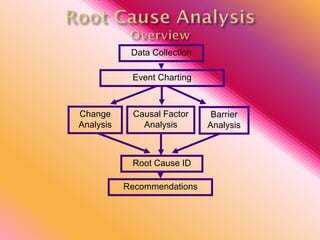
Data Collection
Event Charting
Root Cause ID
Recommendations
Causal Factor
Analysis
Barrier
Analysis
Change
Analysis
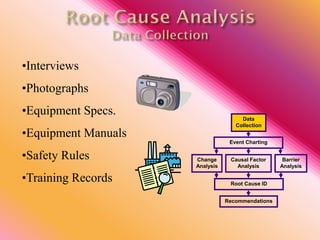
•Interviews
•Photographs
•Equipment Specs.
•Equipment Manuals
•Safety Rules
•Training Records
Data
Collection
Event Charting
Root Cause ID
Recommendations
Causal Factor
Analysis
Barrier
Analysis
Change
Analysis
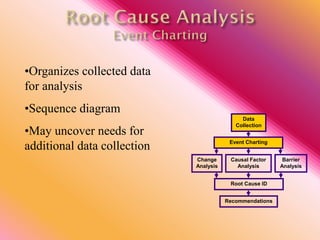
•Organizes collected data
for analysis
•Sequence diagram
•May uncover needs for
additional data collection
Data
Collection
Event Charting
Root Cause ID
Recommendations
Causal Factor
Analysis
Barrier
Analysis
Change
Analysis
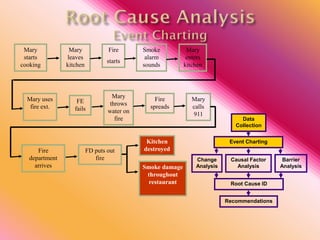
Mary
starts
cooking
Mary
leaves
kitchen
Smoke
alarm
sounds
Mary
enters
kitchen
Mary uses
fire ext.
FE
fails
Mary
throws
water on
fire
Fire
spreads
Fire
starts
Mary
calls
911
Fire
department
arrives
FD puts out
fire
Kitchen
destroyed
Smoke damage
throughout
restaurant
Data
Collection
Event Charting
Root Cause ID
Recommendations
Causal Factor
Analysis
Barrier
Analysis
Change
Analysis
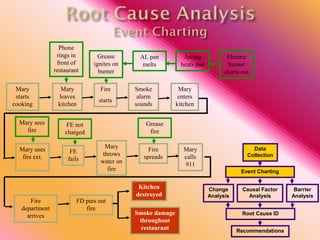
Mary
starts
cooking
Mary
leaves
kitchen
Smoke
alarm
sounds
Mary
enters
kitchen
Mary uses
fire ext.
FE
fails
Mary
throws
water on
fire
Fire
spreads
Fire
starts
Mary
calls
911
Fire
department
arrives
FD puts out
fire
Kitchen
destroyed
Smoke damage
throughout
restaurant
Grease
ignites on
burner
AL pan
melts
Arcing
heats pan
Electric
burner
shorts out
FE not
charged
Mary sees
fire
Grease
fire
Data
Collection
Event Charting
Root Cause ID
Recommendations
Causal Factor
Analysis
Barrier
Analysis
Change
Analysis
Phone
rings in
front of
restaurant
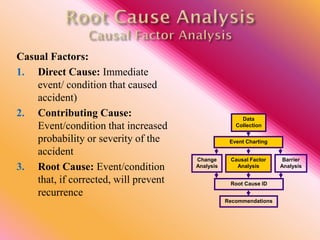
Casual Factors:
1. Direct Cause: Immediate
event/ condition that caused
accident)
2. Contributing Cause:
Event/condition that increased
probability or severity of the
accident
3. Root Cause: Event/condition
that, if corrected, will prevent
recurrence
Data
Collection
Event Charting
Root Cause ID
Recommendations
Causal Factor
Analysis
Barrier
Analysis
Change
Analysis
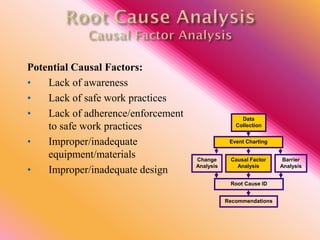
Potential Causal Factors:
• Lack of awareness
• Lack of safe work practices
• Lack of adherence/enforcement
to safe work practices
• Improper/inadequate
equipment/materials
• Improper/inadequate design
Data
Collection
Event Charting
Root Cause ID
Recommendations
Causal Factor
Analysis
Barrier
Analysis
Change
Analysis
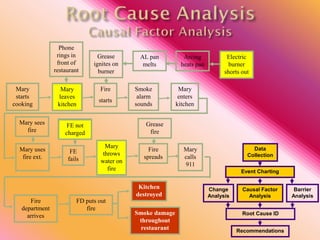
Mary
starts
cooking
Mary
leaves
kitchen
Smoke
alarm
sounds
Mary
enters
kitchen
Mary uses
fire ext.
FE
fails
Mary
throws
water on
fire
Fire
spreads
Fire
starts
Mary
calls
911
Fire
department
arrives
FD puts out
fire
Kitchen
destroyed
Smoke damage
throughout
restaurant
Grease
ignites on
burner
AL pan
melts
Arcing
heats pan
Electric
burner
shorts out
FE not
charged
Mary sees
fire
Grease
fire
Data
Collection
Event Charting
Root Cause ID
Recommendations
Causal Factor
Analysis
Barrier
Analysis
Change
Analysis
Electric
burner
shorts out
Mary
leaves
kitchen
FE not
charged
Mary
throws
water on
fire
Phone
rings in
front of
restaurant
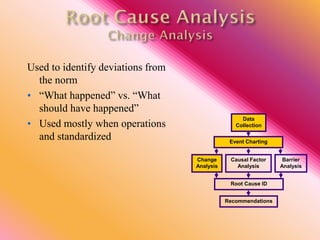
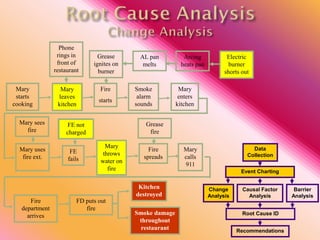
Used to identify deviations from
the norm
• “What happened” vs. “What
should have happened”
• Used mostly when operations
and standardized
Data
Collection
Event Charting
Root Cause ID
Recommendations
Causal Factor
Analysis
Barrier
Analysis
Change
Analysis
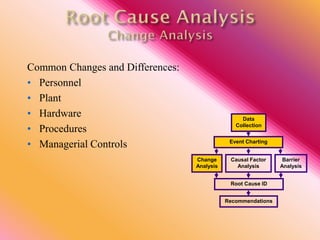
Common Changes and Differences:
• Personnel
• Plant
• Hardware
• Procedures
• Managerial Controls
Data
Collection
Event Charting
Root Cause ID
Recommendations
Causal Factor
Analysis
Barrier
Analysis
Change
Analysis
Mary
starts
cooking
Mary
leaves
kitchen
Smoke
alarm
sounds
Mary
enters
kitchen
Mary uses
fire ext.
FE
fails
Mary
throws
water on
fire
Fire
spreads
Fire
starts
Mary
calls
911
Fire
department
arrives
FD puts out
fire
Kitchen
destroyed
Smoke damage
throughout
restaurant
Grease
ignites on
burner
AL pan
melts
Arcing
heats pan
Electric
burner
shorts out
FE not
charged
Mary sees
fire
Grease
fire
Data
Collection
Event Charting
Root Cause ID
Recommendations
Causal Factor
Analysis
Barrier
Analysis
Change
Analysis
Electric
burner
shorts out
Mary
leaves
kitchen
FE not
charged
Mary
throws
water on
fire
Phone
rings in
front of
restaurant
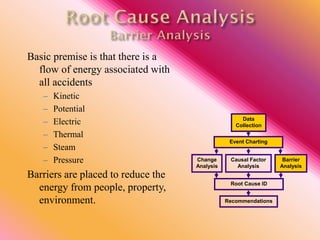
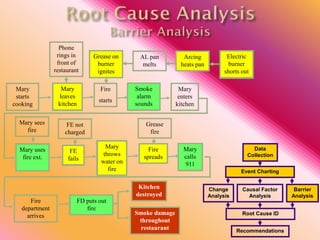
Basic premise is that there is a
flow of energy associated with
all accidents
– Kinetic
– Potential
– Electric
– Thermal
– Steam
– Pressure
Barriers are placed to reduce the
energy from people, property,
environment.
Data
Collection
Event Charting
Root Cause ID
Recommendations
Causal Factor
Analysis
Barrier
Analysis
Change
Analysis
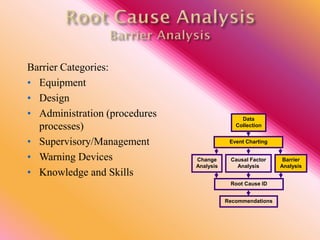
Barrier Categories:
• Equipment
• Design
• Administration (procedures
processes)
• Supervisory/Management
• Warning Devices
• Knowledge and Skills
Data
Collection
Event Charting
Root Cause ID
Recommendations
Causal Factor
Analysis
Barrier
Analysis
Change
Analysis
Mary
starts
cooking
Mary
leaves
kitchen
Smoke
alarm
sounds
Mary
enters
kitchen
Mary uses
fire ext.
FE
fails
Mary
throws
water on
fire
Fire
spreads
Fire
starts
Mary
calls
911
Fire
department
arrives
FD puts out
fire
Kitchen
destroyed
Smoke damage
throughout
restaurant
Grease
ignites on
burner
AL pan
melts
Arcing
heats pan
Electric
burner
shorts out
FE not
charged
Mary sees
fire
Grease
fire
Data
Collection
Event Charting
Root Cause ID
Recommendations
Causal Factor
Analysis
Barrier
Analysis
Change
Analysis
Electric
burner
shorts out
Arcing
heats pan
FE
fails
Mary
throws
water on
fire
Electric
burner
shorts out
Grease on
burner
ignites
Fire
spreads
FD puts out
fire
Mary
leaves
kitchen
Phone
rings in
front of
restaurant
Smoke
alarm
sounds
Mary
calls
911
Mary uses
fire ext.
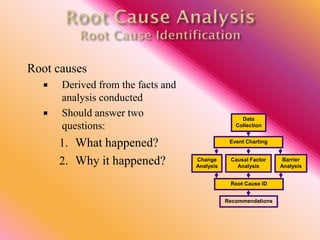
Root causes
 Derived from the facts and
analysis conducted
 Should answer two
questions:
1. What happened?
2. Why it happened?
Data
Collection
Event Charting
Root Cause ID
Recommendations
Causal Factor
Analysis
Barrier
Analysis
Change
Analysis
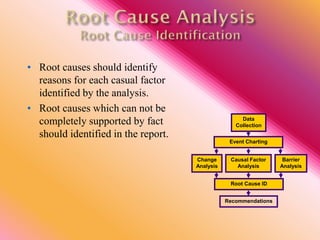
• Root causes should identify
reasons for each casual factor
identified by the analysis.
• Root causes which can not be
completely supported by fact
should identified in the report.
Data
Collection
Event Charting
Root Cause ID
Recommendations
Causal Factor
Analysis
Barrier
Analysis
Change
Analysis
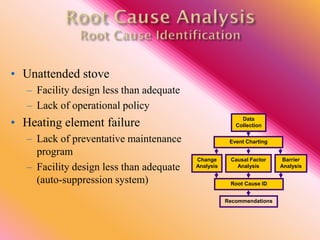
• Unattended stove
– Facility design less than adequate
– Lack of operational policy
• Heating element failure
– Lack of preventative maintenance
program
– Facility design less than adequate
(auto-suppression system)
Data
Collection
Event Charting
Root Cause ID
Recommendations
Causal Factor
Analysis
Barrier
Analysis
Change
Analysis
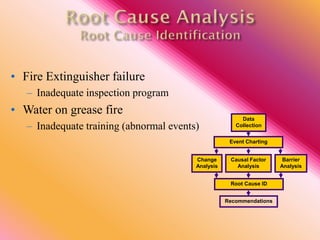
• Fire Extinguisher failure
– Inadequate inspection program
• Water on grease fire
– Inadequate training (abnormal events)
Data
Collection
Event Charting
Root Cause ID
Recommendations
Causal Factor
Analysis
Barrier
Analysis
Change
Analysis
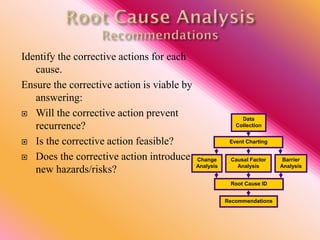
Identify the corrective actions for each
cause.
Ensure the corrective action is viable by
answering:
 Will the corrective action prevent
recurrence?
 Is the corrective action feasible?
 Does the corrective action introduce
new hazards/risks?
Data
Collection
Event Charting
Root Cause ID
Recommendations
Causal Factor
Analysis
Barrier
Analysis
Change
Analysis
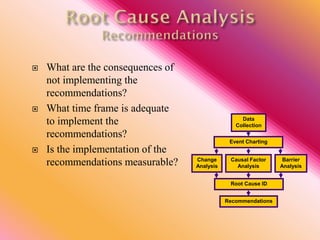
 What are the consequences of
not implementing the
recommendations?
 What time frame is adequate
to implement the
recommendations?
 Is the implementation of the
recommendations measurable?
Data
Collection
Event Charting
Root Cause ID
Recommendations
Causal Factor
Analysis
Barrier
Analysis
Change
Analysis
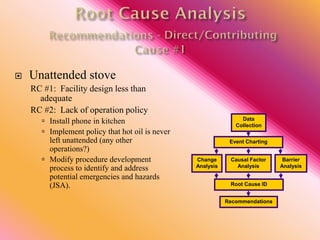
 Unattended stove
RC #1: Facility design less than
adequate
RC #2: Lack of operation policy
 Install phone in kitchen
 Implement policy that hot oil is never
left unattended (any other
operations?)
 Modify procedure development
process to identify and address
potential emergencies and hazards
(JSA).
Data
Collection
Event Charting
Root Cause ID
Recommendations
Causal Factor
Analysis
Barrier
Analysis
Change
Analysis
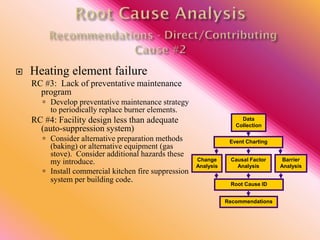
 Heating element failure
RC #3: Lack of preventative maintenance
program
 Develop preventative maintenance strategy
to periodically replace burner elements.
RC #4: Facility design less than adequate
(auto-suppression system)
 Consider alternative preparation methods
(baking) or alternative equipment (gas
stove). Consider additional hazards these
my introduce.
 Install commercial kitchen fire suppression
system per building code.
Data
Collection
Event Charting
Root Cause ID
Recommendations
Causal Factor
Analysis
Barrier
Analysis
Change
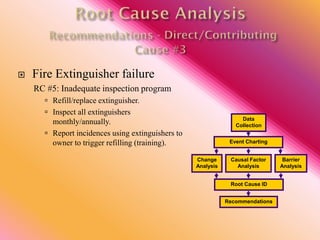
Analysis
 Fire Extinguisher failure
RC #5: Inadequate inspection program
 Refill/replace extinguisher.
 Inspect all extinguishers
monthly/annually.
 Report incidences using extinguishers to
owner to trigger refilling (training).
Data
Collection
Event Charting
Root Cause ID
Recommendations
Causal Factor
Analysis
Barrier
Analysis
Change
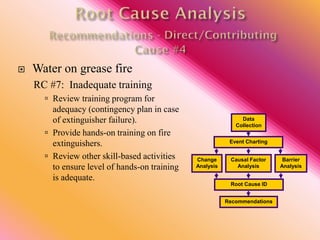
Analysis
 Water on grease fire
RC #7: Inadequate training
 Review training program for
adequacy (contingency plan in case
of extinguisher failure).
 Provide hands-on training on fire
extinguishers.
 Review other skill-based activities
to ensure level of hands-on training
is adequate.
Data
Collection
Event Charting
Root Cause ID
Recommendations
Causal Factor
Analysis
Barrier
Analysis
Change
Analysis
 Identify three consistent and
systematic approaches to
investigating workplace
accidents.
 Understand how to apply these
approaches to a workplace
accident investigation.
COMPILED BY : VASANT OAK
DGM EHSS
WHAT”s UP- 9987592242

RCA

  • 1.
    COMPILED BY :VASANT OAK DGM EHSS WHAT”s UP- 9987592242
  • 2.
     Identify threeconsistent and systematic approaches to investigating workplace accidents.  Understand how to apply these approaches to a workplace accident investigation.
  • 3.
    Data Collection Event Charting RootCause ID Recommendations Causal Factor Analysis Barrier Analysis Change Analysis
  • 4.
    •Interviews •Photographs •Equipment Specs. •Equipment Manuals •SafetyRules •Training Records Data Collection Event Charting Root Cause ID Recommendations Causal Factor Analysis Barrier Analysis Change Analysis
  • 5.
    •Organizes collected data foranalysis •Sequence diagram •May uncover needs for additional data collection Data Collection Event Charting Root Cause ID Recommendations Causal Factor Analysis Barrier Analysis Change Analysis
  • 6.
    Mary starts cooking Mary leaves kitchen Smoke alarm sounds Mary enters kitchen Mary uses fire ext. FE fails Mary throws wateron fire Fire spreads Fire starts Mary calls 911 Fire department arrives FD puts out fire Kitchen destroyed Smoke damage throughout restaurant Data Collection Event Charting Root Cause ID Recommendations Causal Factor Analysis Barrier Analysis Change Analysis
  • 7.
    Mary starts cooking Mary leaves kitchen Smoke alarm sounds Mary enters kitchen Mary uses fire ext. FE fails Mary throws wateron fire Fire spreads Fire starts Mary calls 911 Fire department arrives FD puts out fire Kitchen destroyed Smoke damage throughout restaurant Grease ignites on burner AL pan melts Arcing heats pan Electric burner shorts out FE not charged Mary sees fire Grease fire Data Collection Event Charting Root Cause ID Recommendations Causal Factor Analysis Barrier Analysis Change Analysis Phone rings in front of restaurant
  • 8.
    Casual Factors: 1. DirectCause: Immediate event/ condition that caused accident) 2. Contributing Cause: Event/condition that increased probability or severity of the accident 3. Root Cause: Event/condition that, if corrected, will prevent recurrence Data Collection Event Charting Root Cause ID Recommendations Causal Factor Analysis Barrier Analysis Change Analysis
  • 9.
    Potential Causal Factors: •Lack of awareness • Lack of safe work practices • Lack of adherence/enforcement to safe work practices • Improper/inadequate equipment/materials • Improper/inadequate design Data Collection Event Charting Root Cause ID Recommendations Causal Factor Analysis Barrier Analysis Change Analysis
  • 10.
    Mary starts cooking Mary leaves kitchen Smoke alarm sounds Mary enters kitchen Mary uses fire ext. FE fails Mary throws wateron fire Fire spreads Fire starts Mary calls 911 Fire department arrives FD puts out fire Kitchen destroyed Smoke damage throughout restaurant Grease ignites on burner AL pan melts Arcing heats pan Electric burner shorts out FE not charged Mary sees fire Grease fire Data Collection Event Charting Root Cause ID Recommendations Causal Factor Analysis Barrier Analysis Change Analysis Electric burner shorts out Mary leaves kitchen FE not charged Mary throws water on fire Phone rings in front of restaurant
  • 11.
    Used to identifydeviations from the norm • “What happened” vs. “What should have happened” • Used mostly when operations and standardized Data Collection Event Charting Root Cause ID Recommendations Causal Factor Analysis Barrier Analysis Change Analysis
  • 12.
    Common Changes andDifferences: • Personnel • Plant • Hardware • Procedures • Managerial Controls Data Collection Event Charting Root Cause ID Recommendations Causal Factor Analysis Barrier Analysis Change Analysis
  • 13.
    Mary starts cooking Mary leaves kitchen Smoke alarm sounds Mary enters kitchen Mary uses fire ext. FE fails Mary throws wateron fire Fire spreads Fire starts Mary calls 911 Fire department arrives FD puts out fire Kitchen destroyed Smoke damage throughout restaurant Grease ignites on burner AL pan melts Arcing heats pan Electric burner shorts out FE not charged Mary sees fire Grease fire Data Collection Event Charting Root Cause ID Recommendations Causal Factor Analysis Barrier Analysis Change Analysis Electric burner shorts out Mary leaves kitchen FE not charged Mary throws water on fire Phone rings in front of restaurant
  • 14.
    Basic premise isthat there is a flow of energy associated with all accidents – Kinetic – Potential – Electric – Thermal – Steam – Pressure Barriers are placed to reduce the energy from people, property, environment. Data Collection Event Charting Root Cause ID Recommendations Causal Factor Analysis Barrier Analysis Change Analysis
  • 15.
    Barrier Categories: • Equipment •Design • Administration (procedures processes) • Supervisory/Management • Warning Devices • Knowledge and Skills Data Collection Event Charting Root Cause ID Recommendations Causal Factor Analysis Barrier Analysis Change Analysis
  • 16.
    Mary starts cooking Mary leaves kitchen Smoke alarm sounds Mary enters kitchen Mary uses fire ext. FE fails Mary throws wateron fire Fire spreads Fire starts Mary calls 911 Fire department arrives FD puts out fire Kitchen destroyed Smoke damage throughout restaurant Grease ignites on burner AL pan melts Arcing heats pan Electric burner shorts out FE not charged Mary sees fire Grease fire Data Collection Event Charting Root Cause ID Recommendations Causal Factor Analysis Barrier Analysis Change Analysis Electric burner shorts out Arcing heats pan FE fails Mary throws water on fire Electric burner shorts out Grease on burner ignites Fire spreads FD puts out fire Mary leaves kitchen Phone rings in front of restaurant Smoke alarm sounds Mary calls 911 Mary uses fire ext.
  • 17.
    Root causes  Derivedfrom the facts and analysis conducted  Should answer two questions: 1. What happened? 2. Why it happened? Data Collection Event Charting Root Cause ID Recommendations Causal Factor Analysis Barrier Analysis Change Analysis
  • 18.
    • Root causesshould identify reasons for each casual factor identified by the analysis. • Root causes which can not be completely supported by fact should identified in the report. Data Collection Event Charting Root Cause ID Recommendations Causal Factor Analysis Barrier Analysis Change Analysis
  • 19.
    • Unattended stove –Facility design less than adequate – Lack of operational policy • Heating element failure – Lack of preventative maintenance program – Facility design less than adequate (auto-suppression system) Data Collection Event Charting Root Cause ID Recommendations Causal Factor Analysis Barrier Analysis Change Analysis
  • 20.
    • Fire Extinguisherfailure – Inadequate inspection program • Water on grease fire – Inadequate training (abnormal events) Data Collection Event Charting Root Cause ID Recommendations Causal Factor Analysis Barrier Analysis Change Analysis
  • 21.
    Identify the correctiveactions for each cause. Ensure the corrective action is viable by answering:  Will the corrective action prevent recurrence?  Is the corrective action feasible?  Does the corrective action introduce new hazards/risks? Data Collection Event Charting Root Cause ID Recommendations Causal Factor Analysis Barrier Analysis Change Analysis
  • 22.
     What arethe consequences of not implementing the recommendations?  What time frame is adequate to implement the recommendations?  Is the implementation of the recommendations measurable? Data Collection Event Charting Root Cause ID Recommendations Causal Factor Analysis Barrier Analysis Change Analysis
  • 23.
     Unattended stove RC#1: Facility design less than adequate RC #2: Lack of operation policy  Install phone in kitchen  Implement policy that hot oil is never left unattended (any other operations?)  Modify procedure development process to identify and address potential emergencies and hazards (JSA). Data Collection Event Charting Root Cause ID Recommendations Causal Factor Analysis Barrier Analysis Change Analysis
  • 24.
     Heating elementfailure RC #3: Lack of preventative maintenance program  Develop preventative maintenance strategy to periodically replace burner elements. RC #4: Facility design less than adequate (auto-suppression system)  Consider alternative preparation methods (baking) or alternative equipment (gas stove). Consider additional hazards these my introduce.  Install commercial kitchen fire suppression system per building code. Data Collection Event Charting Root Cause ID Recommendations Causal Factor Analysis Barrier Analysis Change Analysis
  • 25.
     Fire Extinguisherfailure RC #5: Inadequate inspection program  Refill/replace extinguisher.  Inspect all extinguishers monthly/annually.  Report incidences using extinguishers to owner to trigger refilling (training). Data Collection Event Charting Root Cause ID Recommendations Causal Factor Analysis Barrier Analysis Change Analysis
  • 26.
     Water ongrease fire RC #7: Inadequate training  Review training program for adequacy (contingency plan in case of extinguisher failure).  Provide hands-on training on fire extinguishers.  Review other skill-based activities to ensure level of hands-on training is adequate. Data Collection Event Charting Root Cause ID Recommendations Causal Factor Analysis Barrier Analysis Change Analysis
  • 27.
     Identify threeconsistent and systematic approaches to investigating workplace accidents.  Understand how to apply these approaches to a workplace accident investigation.
  • 28.
    COMPILED BY :VASANT OAK DGM EHSS WHAT”s UP- 9987592242