Occupational Safety and Health
(KAS3501)
Semester 6 2014/ 2015
Group 8
Presentation Date: 1 April 2015
1) SITI FAZLIN BINTI MAT RIFIN UK29516
2) SITI SYAFIQAH BINTI NORHAN UK29517
3) NURAKMAL HIDAYAH BINTI MD YUSOF UK29518
4) MUHAMMAD HELMI BIN SAPERI UK29519
5) LEE WAI YIN UK29538
Title : Hazard Analysis
(HAZAN)
What is hazard?
Hazard is the potential for harm.
A hazard is often associated with a
condition or activity that can cause
undesired consequences such as
injury or illness if left uncontrolled.
Basically, a hazard can cause harm
or adverse health effects to
individuals or to organizations as
property or equipment losses.
Types of hazard
1) Chemical hazards
Chemicals can affect skin by contact.
Chemicals can also enter our body
either through the inhalation or
digestive system if air is contaminated
with chemicals, vapor, mist or dust.
The accumulation of chemicals in or on
our body will cause acute (immediate)
effect or chronic (long-term) effect.
2) Physical hazards
Physical hazard will cause injury
risks on our body.
This category includes the hazards
from working in confined spaces,
being hit by flying objects, caught in
explosions, hurt by collapsing
machinery, falling from heights and
tripping on obstacles.
3) Biological hazards
(biohazards)
Biohazards refer to biological substances
that pose a harm to the health of living
organisms.
Sources of biological hazards may include
insects, bacteria, fungi, plants, worms,
animals and viruses.
These sources can cause a variety of
health effects ranging from skin irritation
and allergies to infections, cancer and so
on.
4) Ergonomic hazards
Ergonomic hazards refer to workplace
conditions that pose the risk of injury to
the musculoskeletal system of the worker.
These injuries can be caused by
performing repetitive and forceful
movements and awkward postures that
arise from improper work methods and
improperly designed workstations, tools,
and equipment.
5) Noise hazards
Excessive noise can disrupt
concentration, interfere with
communication and result in loss of
hearing.
High impact noises are particularly
damaging.
Noise can also mask out signals and
affecting communication with others.
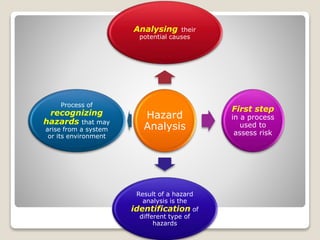
What is Hazard Analysis?
Hazard
Analysis
Analysing their
potential causes
First step
in a process
used to
assess risk
Result of a hazard
analysis is the
identification of
different type of
hazards
Process of
recognizing
hazards that may
arise from a system
or its environment
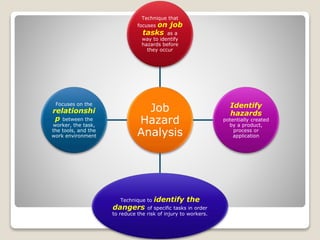
Job
Hazard
Analysis
Technique that
focuses on job
tasks as a
way to identify
hazards before
they occur
Identify
hazards
potentially created
by a product,
process or
application
Technique to identify the
dangers of specific tasks in order
to reduce the risk of injury to workers.
Focuses on the
relationshi
p between the
worker, the task,
the tools, and the
work environment
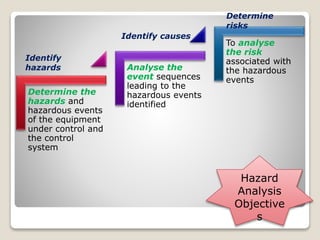
Determine the
hazards and
hazardous events
of the equipment
under control and
the control
system
Analyse the
event sequences
leading to the
hazardous events
identified
To analyse
the risk
associated with
the hazardous
events
Identify
hazards
Identify causes
Determine
risks
Hazard
Analysis
Objective
s
Why Hazard Analysis
important?
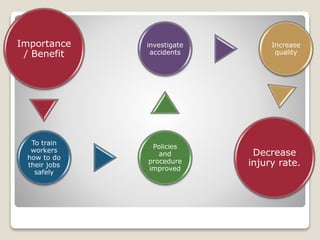
Importance
/ Benefit
To train
workers
how to do
their jobs
safely
Policies
and
procedure
improved
investigate
accidents
Increase
quality
Decrease
injury rate.
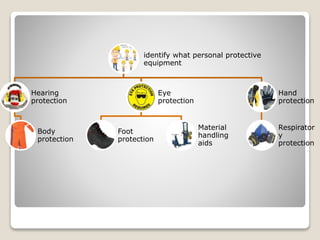
identify what personal protective
equipment
Hearing
protection
Body
protection
Eye
protection
Foot
protection
Material
handling
aids
Hand
protection
Respirator
y
protection
Hazard Analysis
Procedure
Examine the job and determine the
components
Identify tasks likely to present
hazards
Identify and assess hazards
Determine and devise controls
measures
Develop safe work procedures if
hazards cannot be eliminated
How to identify and
analyze hazard?
Identifying The Hazards
 Identify the hazards of each step.
For each hazard, ask:
What can go wrong?
What are the consequences?
How could it arise?
What are other contributing
factors?
How likely is it that the hazard will
occur?
HAZARD ANALYSIS
METHODS
Hazard may be realized or unrealized
Realized hazard – has happened in the
past and can therefore be identified
from experience.
Unrealized hazard – is a potential for a
hazardous situation that has not
happened yet but can be recognized by
analyzing the characteristic of an
environment or failure modes of
equipment item.
Hazard analysis methods
include :
Process Hazard Analysis
Event Tree Analysis
Failure Modes And Effect
Analysis
Fault Tree Analysis
Cause-consequence Diagram
Hazard And Operability Studies
1) PROCESS HAZARD ANALYSIS
A systematic method designed to identify
and analyze hazards associated with the
processing or handling of highly
hazardous material
PHA analyzes
-The potential causes and consequences
of fires, explosions and releases of toxic
chemicals
- the equipment, instrumentation, human
actions and other factors which might
affect the process.
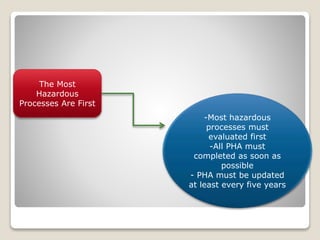
The Most
Hazardous
Processes Are First
-Most hazardous
processes must
evaluated first
-All PHA must
completed as soon as
possible
- PHA must be updated
at least every five years
2) Event Tree Analysis (ETA)
ETA defines the consequential
events which flow from the
primary ‘initiating’ event.
Event trees are used to
investigate the consequences of
loss-making events in order to
find ways of mitigating rather
than preventing losses.
3) Failure modes and effect
analysis (FMEA)
To identify which failures in a system can
lead to undesirable situation.
Particularly suited to electrical and
mechanical processes.
Result are strongly dependent on
analyst’s understanding of the failure
modes
Effects of failure modes can be quantified
4) Fault tree analysis (FTA)
To evaluate the economic justification
for carrying out improvement to a
system
FTA works back from the undesired or
“top event” to the contributing
causes(backward reasoning logic
techniques)
To identify the causes of top event
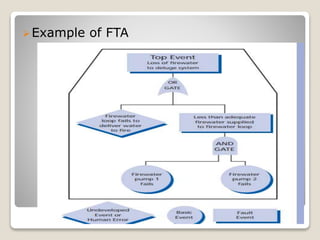
Example of FTA
5) Cause-Consequence
analysis (CCA)
Is proving to be a very useful tool to
depict and maintain an up-to date, real-
time working risk management system
enthralled in daily operations (e.g.
operational).
These diagrams combine the inductive
and deductive reasoning of logical
diagrams (e.g. ETA, FTA) to identify the
basic causes and consequences of
potential accidents.
Example of CCA
6) Hazard and Operability Study
(HAZOP)
A structured and systematic method that
identifies equipment that is being used in
a way that it was not designed to be, and
which might create hazards and
operational problems.
HAZOPs are usually conducted by multi-
skilled team that studies piping and
instrument diagrams.
Each pipeline and vessel is evaluated for
certain limitations and deviations in flow,
temperature, pressure, etc.
How to control
hazard?
Controlling the Hazards
The order of precedence and
effectiveness of hazard
control is the following:
1. Engineering controls.
2. Administrative controls.
3. Personal protective
equipment.
1) Engineering Controls
Engineering controls include the
following:
Elimination/minimization of the
hazard
Substitution of equipment or process
to decrease hazard
Isolation of the hazard with
interlocks, machine guards, blast
shields, or other means; and
Removal or redirection of the hazard
such as with local and exhaust
ventilation.
2) Administrative Controls
Administrative controls include the
following:
Written operating procedures, work
permits, and safe work practices;
Exposure time limitations (used most
commonly to control heat stress and
ergonomic hazards);
Monitoring the use of highly
hazardous materials;
Alarms, signs, and warnings;
Buddy system; and training
3) Personal Protective
Equipment (PPE)
 Personal Protective Equipment is acceptable
as a control method in the following
circumstances:
When engineering controls are not
feasible or do not totally eliminate the
hazard;
While engineering controls are being
developed;
When safe work practices do not provide
sufficient additional protection; and
During emergencies when engineering
controls may not be feasible.
Case Study of Hazard
Analysis
Fire at Formosa Plastic Corporation:
Evaluating Process Hazard
INTRODUCTION
This case study describes a fire and
series of explosions in an olefins
production unit located in Point
Comfort, Texas due to hydrocarbon
release.
16 employees were injured and 1
seriously injured.
The fire burned for 5 days.
 At 3:05 PM on October 6, 2005, a trailer being
towed by a forklift snagged and pulled a small
drain valve of a liquid propylene system.
 Vaporized propylene forming a large flammable
vapor liquid.
 Operators began to shut the plant down and
attempt to isolate the leak. But, the attempt was
a failed.
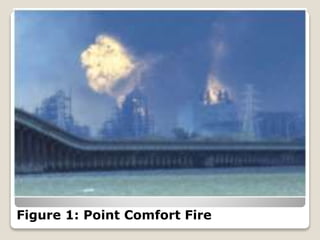
 At 3:07 PM, the vapor ignited and create an
explosion. As a result, two operators were
burned and fire reached more than 500 ft in air
as shown in figure 1.
 The fires burned for five days and about 7
million gallons of water were used to cool vessel.
INCIDENT DESCRIPTION
Figure 1: Point Comfort Fire
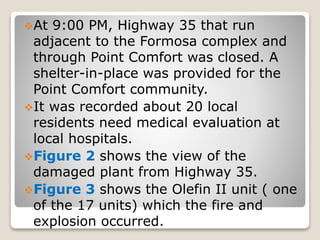
At 9:00 PM, Highway 35 that run
adjacent to the Formosa complex and
through Point Comfort was closed. A
shelter-in-place was provided for the
Point Comfort community.
It was recorded about 20 local
residents need medical evaluation at
local hospitals.
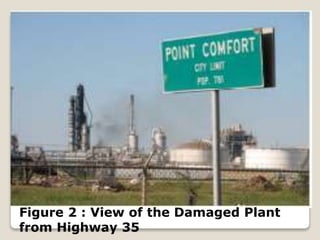
Figure 2 shows the view of the
damaged plant from Highway 35.
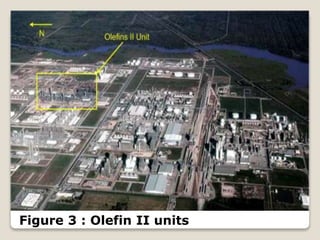
Figure 3 shows the Olefin II unit ( one
of the 17 units) which the fire and
explosion occurred.
Figure 2 : View of the Damaged Plant
from Highway 35
Figure 3 : Olefin II units
INCIDENT SEQUENCE
A worker driving a forklift towing a trailer
under a pipe rack moving backward
between two column to turn around.
When the worker drove forward, the
trailer caught on a valve and stick out a
strainer in propylene piping system.
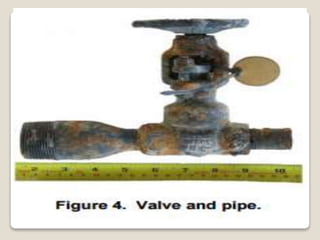
The trailer pulled the valve and associated
pipe (Figure 4) out of the strainer and
leaving 1.9 inch diameter opening.
Pressurized liquid propylene rapidly
escaped through the opening and partially
vaporized creating both of propylene
liquid and rapidly expanding vapor cloud.
The forklift driver and other contractors saw
the release and evacuated.
An operator heard and saw the release and
notified the control room.
The operators closed control valves and
began to shut down the unit as well as pump
from motor control center to slow the leak as
he saw the vapor cloud.
The vapor cloud ignited and operators left the
unit and declared a site-wide emergency.
A large pool fire burned under the pipe rack.
The Formosa ERT arrived and took command
of the incident response.
The fire was extinguished about 5 days.
CAUSES OF INCIDENT
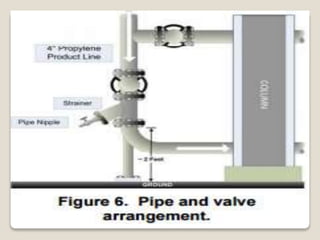
Figure 6 shows the propylene piping
involved in this incident stick out into an
open space and no impact protection.
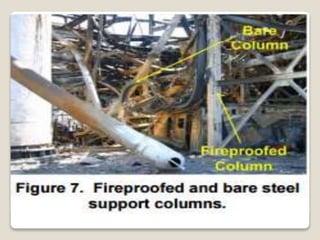
Figure 7 shows passive fire protection was
installed on only three of four support
column rows and the columns that
supported the pressure relief valves and
emergency vent piping had no
fireproofing.
PROCESS HAZARD ANALYSIS
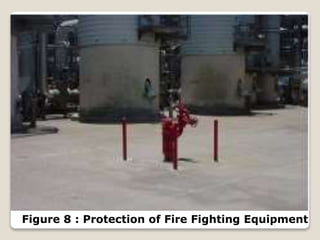
Figure 8 shows the protection of fire
fighting equipment.
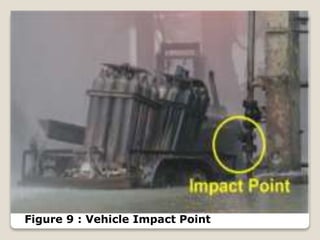
Figure 9 shows the lack of protection
where the impact and release occurred.
Remote equipment isolation is done by
the operators by isolating minor leaks
with local valves.
Figure 8 : Protection of Fire Fighting Equipment
Figure 9 : Vehicle Impact Point
LESSONS LEARNED
When performing a hazard analysis, facility
sitting analysis or pre-startup safety review,
vehicle impact and remote isolation
catastrophic releases should be investigated.
The use of flame resistant clothing may limit
the severity of injury to employees who work
in plants with large inventories of flammable
gases and liquids.
Evaluate the applicability and use of current
safety standards when designing and
constructing a chemical process plant.
References
Fire at Formosa Plastics Corporation:. Case
study, Washington: CSB publications, 2006.
Hazard Analysis Methodologies.
https://www.osha.gov/SLTC/etools/safetyh
ealth/mod4_tools_methodologies.html
(accessed March 27, 2015).
Job Hazard Analysis. 2002.
https://www.osha.gov/Publications/osha30
71.html (accessed March 26, 2015).
Types of Hazards.
http://students.fortresslearning.com.au/del
301/types-of-hazards/ (accessed March 23,
2015).

Hazard analysis(ppt)

  • 1.
    Occupational Safety andHealth (KAS3501) Semester 6 2014/ 2015 Group 8 Presentation Date: 1 April 2015 1) SITI FAZLIN BINTI MAT RIFIN UK29516 2) SITI SYAFIQAH BINTI NORHAN UK29517 3) NURAKMAL HIDAYAH BINTI MD YUSOF UK29518 4) MUHAMMAD HELMI BIN SAPERI UK29519 5) LEE WAI YIN UK29538
  • 2.
    Title : HazardAnalysis (HAZAN)
  • 3.
  • 4.
    Hazard is thepotential for harm. A hazard is often associated with a condition or activity that can cause undesired consequences such as injury or illness if left uncontrolled. Basically, a hazard can cause harm or adverse health effects to individuals or to organizations as property or equipment losses.
  • 5.
  • 6.
    1) Chemical hazards Chemicalscan affect skin by contact. Chemicals can also enter our body either through the inhalation or digestive system if air is contaminated with chemicals, vapor, mist or dust. The accumulation of chemicals in or on our body will cause acute (immediate) effect or chronic (long-term) effect.
  • 7.
    2) Physical hazards Physicalhazard will cause injury risks on our body. This category includes the hazards from working in confined spaces, being hit by flying objects, caught in explosions, hurt by collapsing machinery, falling from heights and tripping on obstacles.
  • 8.
    3) Biological hazards (biohazards) Biohazardsrefer to biological substances that pose a harm to the health of living organisms. Sources of biological hazards may include insects, bacteria, fungi, plants, worms, animals and viruses. These sources can cause a variety of health effects ranging from skin irritation and allergies to infections, cancer and so on.
  • 9.
    4) Ergonomic hazards Ergonomichazards refer to workplace conditions that pose the risk of injury to the musculoskeletal system of the worker. These injuries can be caused by performing repetitive and forceful movements and awkward postures that arise from improper work methods and improperly designed workstations, tools, and equipment.
  • 10.
    5) Noise hazards Excessivenoise can disrupt concentration, interfere with communication and result in loss of hearing. High impact noises are particularly damaging. Noise can also mask out signals and affecting communication with others.
  • 11.
    What is HazardAnalysis?
  • 12.
    Hazard Analysis Analysing their potential causes Firststep in a process used to assess risk Result of a hazard analysis is the identification of different type of hazards Process of recognizing hazards that may arise from a system or its environment
  • 13.
    Job Hazard Analysis Technique that focuses onjob tasks as a way to identify hazards before they occur Identify hazards potentially created by a product, process or application Technique to identify the dangers of specific tasks in order to reduce the risk of injury to workers. Focuses on the relationshi p between the worker, the task, the tools, and the work environment
  • 15.
    Determine the hazards and hazardousevents of the equipment under control and the control system Analyse the event sequences leading to the hazardous events identified To analyse the risk associated with the hazardous events Identify hazards Identify causes Determine risks Hazard Analysis Objective s
  • 16.
  • 17.
    Importance / Benefit To train workers howto do their jobs safely Policies and procedure improved investigate accidents Increase quality Decrease injury rate.
  • 18.
    identify what personalprotective equipment Hearing protection Body protection Eye protection Foot protection Material handling aids Hand protection Respirator y protection
  • 19.
  • 20.
    Examine the joband determine the components Identify tasks likely to present hazards Identify and assess hazards Determine and devise controls measures Develop safe work procedures if hazards cannot be eliminated
  • 21.
    How to identifyand analyze hazard?
  • 22.
    Identifying The Hazards Identify the hazards of each step. For each hazard, ask: What can go wrong? What are the consequences? How could it arise? What are other contributing factors? How likely is it that the hazard will occur?
  • 23.
  • 24.
    Hazard may berealized or unrealized Realized hazard – has happened in the past and can therefore be identified from experience. Unrealized hazard – is a potential for a hazardous situation that has not happened yet but can be recognized by analyzing the characteristic of an environment or failure modes of equipment item.
  • 25.
    Hazard analysis methods include: Process Hazard Analysis Event Tree Analysis Failure Modes And Effect Analysis Fault Tree Analysis Cause-consequence Diagram Hazard And Operability Studies
  • 26.
    1) PROCESS HAZARDANALYSIS A systematic method designed to identify and analyze hazards associated with the processing or handling of highly hazardous material PHA analyzes -The potential causes and consequences of fires, explosions and releases of toxic chemicals - the equipment, instrumentation, human actions and other factors which might affect the process.
  • 27.
    The Most Hazardous Processes AreFirst -Most hazardous processes must evaluated first -All PHA must completed as soon as possible - PHA must be updated at least every five years
  • 28.
    2) Event TreeAnalysis (ETA) ETA defines the consequential events which flow from the primary ‘initiating’ event. Event trees are used to investigate the consequences of loss-making events in order to find ways of mitigating rather than preventing losses.
  • 29.
    3) Failure modesand effect analysis (FMEA) To identify which failures in a system can lead to undesirable situation. Particularly suited to electrical and mechanical processes. Result are strongly dependent on analyst’s understanding of the failure modes Effects of failure modes can be quantified
  • 30.
    4) Fault treeanalysis (FTA) To evaluate the economic justification for carrying out improvement to a system FTA works back from the undesired or “top event” to the contributing causes(backward reasoning logic techniques) To identify the causes of top event
  • 31.
  • 32.
    5) Cause-Consequence analysis (CCA) Isproving to be a very useful tool to depict and maintain an up-to date, real- time working risk management system enthralled in daily operations (e.g. operational). These diagrams combine the inductive and deductive reasoning of logical diagrams (e.g. ETA, FTA) to identify the basic causes and consequences of potential accidents.
  • 33.
  • 34.
    6) Hazard andOperability Study (HAZOP) A structured and systematic method that identifies equipment that is being used in a way that it was not designed to be, and which might create hazards and operational problems. HAZOPs are usually conducted by multi- skilled team that studies piping and instrument diagrams. Each pipeline and vessel is evaluated for certain limitations and deviations in flow, temperature, pressure, etc.
  • 35.
  • 36.
    Controlling the Hazards Theorder of precedence and effectiveness of hazard control is the following: 1. Engineering controls. 2. Administrative controls. 3. Personal protective equipment.
  • 37.
    1) Engineering Controls Engineeringcontrols include the following: Elimination/minimization of the hazard Substitution of equipment or process to decrease hazard Isolation of the hazard with interlocks, machine guards, blast shields, or other means; and Removal or redirection of the hazard such as with local and exhaust ventilation.
  • 38.
    2) Administrative Controls Administrativecontrols include the following: Written operating procedures, work permits, and safe work practices; Exposure time limitations (used most commonly to control heat stress and ergonomic hazards); Monitoring the use of highly hazardous materials; Alarms, signs, and warnings; Buddy system; and training
  • 39.
    3) Personal Protective Equipment(PPE)  Personal Protective Equipment is acceptable as a control method in the following circumstances: When engineering controls are not feasible or do not totally eliminate the hazard; While engineering controls are being developed; When safe work practices do not provide sufficient additional protection; and During emergencies when engineering controls may not be feasible.
  • 40.
    Case Study ofHazard Analysis Fire at Formosa Plastic Corporation: Evaluating Process Hazard
  • 41.
    INTRODUCTION This case studydescribes a fire and series of explosions in an olefins production unit located in Point Comfort, Texas due to hydrocarbon release. 16 employees were injured and 1 seriously injured. The fire burned for 5 days.
  • 42.
     At 3:05PM on October 6, 2005, a trailer being towed by a forklift snagged and pulled a small drain valve of a liquid propylene system.  Vaporized propylene forming a large flammable vapor liquid.  Operators began to shut the plant down and attempt to isolate the leak. But, the attempt was a failed.  At 3:07 PM, the vapor ignited and create an explosion. As a result, two operators were burned and fire reached more than 500 ft in air as shown in figure 1.  The fires burned for five days and about 7 million gallons of water were used to cool vessel. INCIDENT DESCRIPTION
  • 43.
    Figure 1: PointComfort Fire
  • 44.
    At 9:00 PM,Highway 35 that run adjacent to the Formosa complex and through Point Comfort was closed. A shelter-in-place was provided for the Point Comfort community. It was recorded about 20 local residents need medical evaluation at local hospitals. Figure 2 shows the view of the damaged plant from Highway 35. Figure 3 shows the Olefin II unit ( one of the 17 units) which the fire and explosion occurred.
  • 45.
    Figure 2 :View of the Damaged Plant from Highway 35
  • 46.
    Figure 3 :Olefin II units
  • 47.
    INCIDENT SEQUENCE A workerdriving a forklift towing a trailer under a pipe rack moving backward between two column to turn around. When the worker drove forward, the trailer caught on a valve and stick out a strainer in propylene piping system. The trailer pulled the valve and associated pipe (Figure 4) out of the strainer and leaving 1.9 inch diameter opening. Pressurized liquid propylene rapidly escaped through the opening and partially vaporized creating both of propylene liquid and rapidly expanding vapor cloud.
  • 48.
    The forklift driverand other contractors saw the release and evacuated. An operator heard and saw the release and notified the control room. The operators closed control valves and began to shut down the unit as well as pump from motor control center to slow the leak as he saw the vapor cloud. The vapor cloud ignited and operators left the unit and declared a site-wide emergency. A large pool fire burned under the pipe rack. The Formosa ERT arrived and took command of the incident response. The fire was extinguished about 5 days.
  • 50.
    CAUSES OF INCIDENT Figure6 shows the propylene piping involved in this incident stick out into an open space and no impact protection. Figure 7 shows passive fire protection was installed on only three of four support column rows and the columns that supported the pressure relief valves and emergency vent piping had no fireproofing.
  • 53.
    PROCESS HAZARD ANALYSIS Figure8 shows the protection of fire fighting equipment. Figure 9 shows the lack of protection where the impact and release occurred. Remote equipment isolation is done by the operators by isolating minor leaks with local valves.
  • 54.
    Figure 8 :Protection of Fire Fighting Equipment
  • 55.
    Figure 9 :Vehicle Impact Point
  • 56.
    LESSONS LEARNED When performinga hazard analysis, facility sitting analysis or pre-startup safety review, vehicle impact and remote isolation catastrophic releases should be investigated. The use of flame resistant clothing may limit the severity of injury to employees who work in plants with large inventories of flammable gases and liquids. Evaluate the applicability and use of current safety standards when designing and constructing a chemical process plant.
  • 57.
    References Fire at FormosaPlastics Corporation:. Case study, Washington: CSB publications, 2006. Hazard Analysis Methodologies. https://www.osha.gov/SLTC/etools/safetyh ealth/mod4_tools_methodologies.html (accessed March 27, 2015). Job Hazard Analysis. 2002. https://www.osha.gov/Publications/osha30 71.html (accessed March 26, 2015). Types of Hazards. http://students.fortresslearning.com.au/del 301/types-of-hazards/ (accessed March 23, 2015).

Editor's Notes

  • #43 Snag : a rough projection
  • #48 The pipe rack support piping, as well as instrument and power cables to and from columns, vessels, pumps and valves in the unit.