INDUSTRIAL HYGIENE AND  OCCUPATIONAL HEALTH
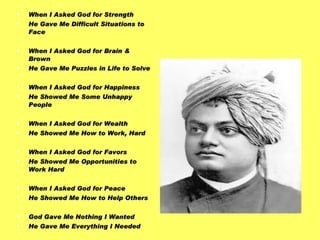
When I Asked God for Strength  He Gave Me Difficult Situations to Face When I Asked God for Brain & Brown  He Gave Me Puzzles in Life to Solve When I Asked God for Happiness  He Showed Me Some Unhappy People When I Asked God for Wealth  He Showed Me How to Work, Hard When I Asked God for Favors He Showed Me Opportunities to Work Hard When I Asked God for Peace  He Showed Me How to Help Others God Gave Me Nothing I Wanted He Gave Me Everything I Needed - Swami Vivekananda
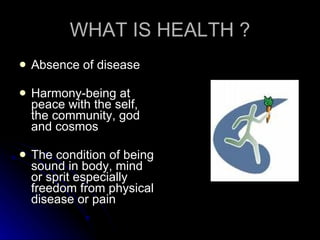
WHAT IS HEALTH ? Absence of disease Harmony-being at peace with the self, the community, god and cosmos The condition of being sound in body, mind or sprit especially freedom from physical disease or pain
WORLD HEALTH ORGANIZATION Health is a state of complete PHYSICAL MENTAL    and  SOCIAL WELLBEING and not merely an absence of  disease or infirmity
AMPLIFIED ABILITY TO LEAD A  SOCIALLY AND  ECONOMICALLY  PRODUCTIVE LIFE
NEW PHILOSOPHY OF HEALTH Health is a fundamental human right Health is the essence of productive life and not the result of ever increasing expenditure on medical care Health is Inter sectoral Health is an  integral part of development Health is central to the concept of quality of life Health involves INDIVIDUAL, state, and International responsibility Health and its maintenance is a major social investment Health is world wide social goal
DETERMINANTS OF HEALTH Heredity Environment Internal  External Life style Socio-Economic Conditions
Heredity -Mental retardation -Heart Problems Environment -Internal Tissue, Organ, Organ system -External   Housing ,water supply    Psycho social Stress, WORK ENVIRONMENT  and    Family Structure
LIFE STYLE Lack of sanitation Poor Nutrition Personal Hygiene Elementary Human Habits Culture and cultural patterns
GOODLIFE STYLE Adequate nutrition Enough sleep Sufficient physical activity
SOCIO ECONOMIC CONDITIONS Economic status Education Occupation Political system
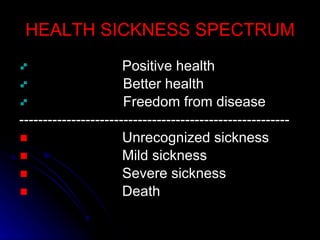
HEALTH SICKNESS SPECTRUM   Positive health   Better health   Freedom from disease ---------------------------------------------------------   Unrecognized sickness   Mild sickness   Severe sickness   Death
MENTAL HEALTH A Mentally Healthy Person feels right     towards others The balanced development of the  individual’s personality and emotional  attitudes which enables him to live  harmoniously with his fellow men,  community and social institution
PARAMETERS His way of living Working Leisure Way he earns and spends his money Way he sees happiness, stability and security
 
ACCIDENT Every disabling  “ACCIDENT ” should be looked on NOT  as an unaccountable misfortune brought by FATE  BUT As a failure By human being In foresight In action In supervision In administration In example The only part to effective accident prevention is   Knowledge Action based on that knowledge Action practiced so often Becomes a HABBIT Our Aim:  Safe Working Our vision:  Zero Incidents
 
INDUSTRIAL HYGIENE AND OCCUPATIONAL HEALTH Industrial Hygiene and Health---Definition Classification of factors Affecting Health in work Environments People Contributing to Industrial Hygiene /Health What is T. L. V. ? Role of Industrial Hygiene in a Factory and it ‘s Benefits   Industrial Hygiene and the Factories Act 1948
OCCUPATIONAL / INDUSTRIAL HYGIENE Is defined as that science and art devoted to the recognition, evaluation and control of those environmental factors or stresses arising in or from the work place which may  Cause: Sickness Impaired Health and Wellbeing Significant Discomfort In-efficiency among workers or  among citizens of community
CLASSSIFICATION OF ENVIRONMENTAL FACTORS AFFECTING HEALTH AT WORK PLACE 1] Physical Agents 2] Chemical Agents 3] Biological Agents 4] Psycho Social Factors
Physical Agents     Electromagnetic Radiation     Ionized Radiation   Thermal Environment [air temperature, humidity,  air movement ,radiant temperature ]   Noise and vibration    Atmospheric Pressure   Repeated motion and pressure   Posture   Illumination
CHEMICAL AGENTS   Dust  :  Mechanically Generated Fumes:  Chemically Generated Mist  :  Tiny Liquid Particles Smoke:  Product of Combustion,    Organic in nature
Their Effects Depend On Chemical Nature Particle size Concentration Duration of Exposure Mode of Entry
EFFECTS OF CHEMICALS CAN BE CLASSIFIED   AS IRRITANTS : Chlorine, Ammonia ,HCHO FIBROGENIC :Coal ,Silica, Asbestos, Iron dust TOXIC   :H2S,Manganese,Lead,Mercury,Cadmium ALLERGIC :Cutting oils, isocyanides DERMATITIC :Coolants, Solvents, Thinners ,Alkalies CARCINOGENIC  :Benzedine, Dye intermediates,    Certain  antioxidants, PVC
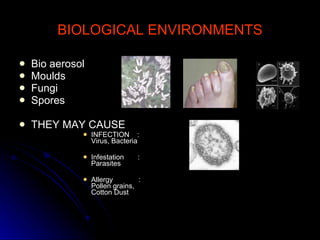
BIOLOGICAL ENVIRONMENTS Bio aerosol Moulds Fungi Spores THEY MAY CAUSE INFECTION  : Virus, Bacteria Infestation  :  Parasites Allergy  :  Pollen grains, Cotton Dust
PSYCHO SOCIAL FACTORS Company Policy and administration Supervision Relationship with Superiors Relationship with subordinates Work conditions Salary Status Security
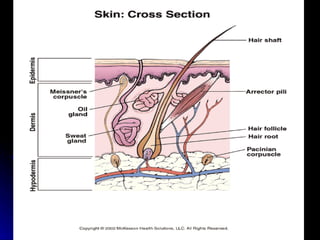
EDUCATION 0F WORKERS on Personal Hygiene Eating and Drinking habits Skin hygiene Oral hygiene Working cloths Discouragement of offensive habits Positive health instructions House keeping and maintenance


CONTROL CAN BE ACHIEVED BY Enclosure of process Making the process wet Finding a harmless or less harmless substitute Isolating hazardous operations Changing the process Providing PPE Training employees Proper maintenance of plant and equipment Good house keeping Applying preventive standards Periodic inspections, tests and examinations Natural/ exhaust ventilation Use of barrier creams Good sanitary facilities
USES OF INDUSTRIAL HYGIENE SURVEYS To determine the workers exposure to toxic agents To check the effectiveness of technical services eg Ventilatory systems in a plating shop To determine if complaints are justified To check adherence to hygiene standards and norms To have base line data
To compare the standard of working environment To assess fire/explosion level of flammable /explosive substances To have safe  and healthy work environment To find the effectiveness of a new machine process or systems To protect the workers health and well being
PEOPLE CONTRIBUTING TO INDUSTRIAL HYGIENE/HEALTH/OHC Occupational Physician Industrial Hygienist Safety Officer Occupational Health Nurse
T. L .V T L V  is the time weighted average concentration to which a normal person may be exposed day  after day for 7to 8 hours over a period of 40/48 hours a week without adverse effects Units of TL V : mg per cubic meter--mg/m3 Parts per million parts --ppm 1ppm =1inch in 16miles 1ppm =1 minute in 2 years 1ppm =0.0001% 1% =10.000ppm
NOW YOU CAN IDENTIFY WHAT IS THE: The Agency    The Environment The Potential Sub Cause The Potential Effect The Possible preventive    Action
WHAT ARE THE BENEFITS? You know the population index of workers Exposed A relative toxicity index comparing a mild toxic substance An incidence index Fire and explosion hazard
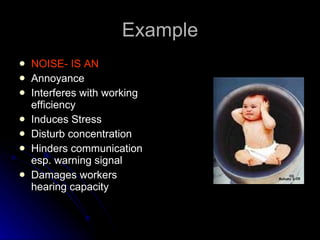
Example NOISE- IS AN Annoyance Interferes with working efficiency Induces Stress Disturb concentration Hinders communication  esp. warning signal Damages workers hearing capacity
COMPARISON OF NOISE LEVELS SPL  Typical environment  Subjective Description 160  Turbo jet engine with  3200 kg thrust  140  30 meters from  Intolerable noise military aircraft at take off 130  Pneumatic chipping and riveting- operators table 120  Boiler shop, shipping engine room SPL  dB[A]
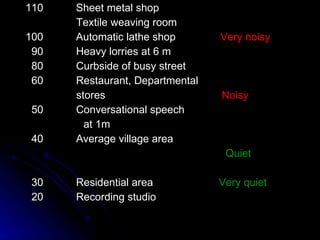
110  Sheet metal shop Textile weaving room 100  Automatic lathe shop  Very noisy 90  Heavy lorries at 6 m 80  Curbside of busy street 60  Restaurant, Departmental stores  Noisy 50  Conversational speech   at 1m 40  Average village area  Quiet 30  Residential area  Very quiet 20  Recording studio
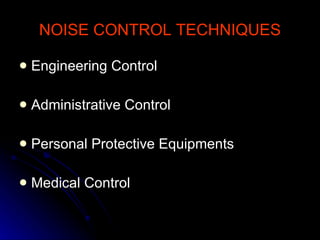
NOISE CONTROL TECHNIQUES Engineering Control Administrative Control Personal Protective Equipments Medical Control
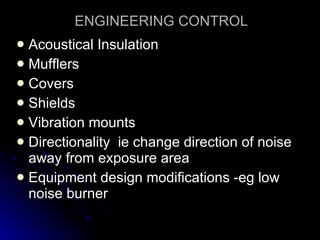
ENGINEERING CONTROL Acoustical Insulation Mufflers Covers Shields Vibration mounts Directionality  ie change direction of noise away from exposure area Equipment design modifications -eg low noise burner
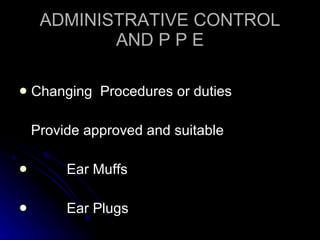
ADMINISTRATIVE CONTROL AND P P E Changing  Procedures or duties Provide approved and suitable Ear Muffs Ear Plugs
MEDICAL CONTROL INCLUDES Pre Employment Medical examination Periodic medical Examination Implementing Hearing Conservation Programme
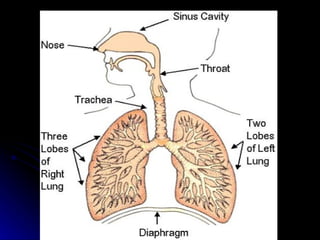
CAUSES OF RESPIRATORY HAZARDS DUE TO GASES AND VAPOURS Inadequate process control Operation and maintenance malpractices Inadequate maintenance Incomplete understanding of the Process Incorrect selection and/ or maintenance of respiratory protective equipments
COMPONENTS OF A RESPIRATORY PROTECTIVE SYSTEM Protection Comfort Vision Speech Compatibility Robustness
YOU MUST KNOW Administrative Information Synonyms and Identifiers Special reference Manufacturing/use information Chemical safety and handling Chemical and Physical properties Environmental Standards and Regulations Environment Fate and Exposure Metabolism and pharmacokinetics Animal Toxicity Human Health Effects Emergency Medical Treatment
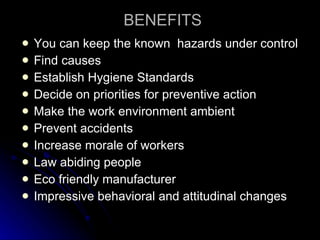
BENEFITS You can keep the known  hazards under control Find causes Establish Hygiene Standards Decide on priorities for preventive action Make the work environment ambient Prevent accidents Increase morale of workers Law abiding people Eco friendly manufacturer Impressive behavioral and attitudinal changes
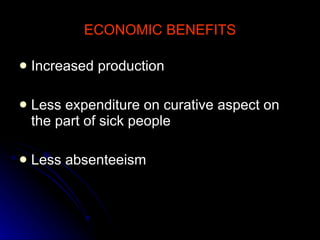
ECONOMIC BENEFITS Increased production Less expenditure on curative aspect on the part of sick people Less absenteeism
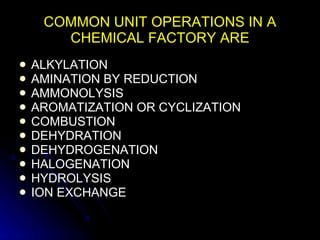
COMMON UNIT OPERATIONS IN A CHEMICAL FACTORY ARE ALKYLATION AMINATION BY REDUCTION AMMONOLYSIS AROMATIZATION OR CYCLIZATION COMBUSTION DEHYDRATION DEHYDROGENATION HALOGENATION HYDROLYSIS ION EXCHANGE
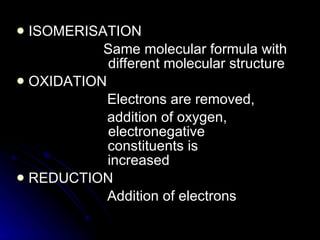
ISOMERISATION Same molecular formula with      different molecular structure OXIDATION Electrons are removed, addition of oxygen,        electronegative    constituents is      increased REDUCTION Addition of electrons
CLASSIFICATION OF HAZARDS ASSOCIATED WITH UNIT OPERATIONS TOXICITY HAZARDS ENVIRONMENTAL HAZARDS FIRE AND EXPLOTION HAZARDS MECHANICAL HAZARDS REACTION HAZARDS
TOXICITY HAZARD Inhalation  - Vapor ,mist  or dust Absorption  - Skin or eyes Oral  -Ingestion Carcinogenic Mutagenic
ENVIRONMENTAL HAZARDS Air releases Ground spills Handling and disposal of waste Odor problem
FIRE AND EXPLOTION HAZARDS Leaks of flammable materials Explosive  mixtures Auto ignition Electrical/static discharge Toxicity of products
MECHANICAL HAZARDS Over pressurization System leak Rotating/moving equipments Thermal burns Noise generation Equipment/utility failure
REACTION HAZARDS Failure to control exothermic reactions Side reactions Feed ratio or rate variation
FACTORS INVOLVING EXPOSURE EVALUATION Continuous or batch or intermittent . Open or closed . Elevated  pressure/temperature . Ambient pressure/temperature . Controlled or uncontrolled . Automated or manual
STRESS WARNING SIGNALS PHYSICAL SYMPTOMS BEHAVIOURAL SYMPTOMS EMOTIONAL SYMPTOMS COGNITIVE SYMPTOMS Source- The Hindu
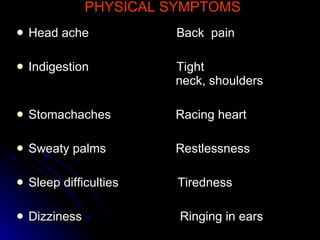
PHYSICAL SYMPTOMS Head ache Back  pain Indigestion Tight    neck, shoulders Stomachaches   Racing heart Sweaty palms   Restlessness Sleep difficulties  Tiredness Dizziness  Ringing in ears
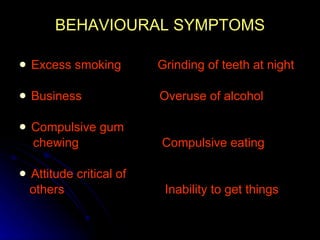
BEHAVIOURAL SYMPTOMS Excess smoking   Grinding of teeth at night Business   Overuse of alcohol Compulsive gum  chewing  Compulsive eating Attitude critical of  others  Inability to get things
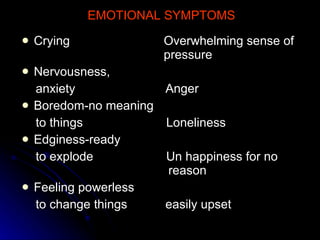
EMOTIONAL SYMPTOMS Crying   Overwhelming sense of    pressure Nervousness, anxiety  Anger Boredom-no meaning to things  Loneliness Edginess-ready to explode  Un happiness for no    reason Feeling powerless to change things  easily upset
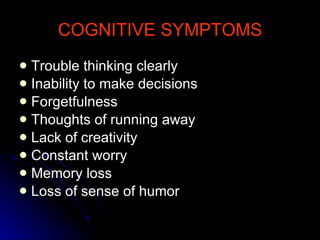
COGNITIVE SYMPTOMS Trouble thinking clearly Inability to make decisions Forgetfulness  Thoughts of running away Lack of creativity Constant worry Memory loss Loss of sense of humor
1 SPEAK TO PEOPLE : There is nothing as nice as a cheerful greeting 2  SMILE: It takes 72 muscles to frown and  only 4 muscles to smile 3   CALL PEOPLE BY NAME  : Every is pleased when you  remember their name 4 BE FRIENDLY AND HELPFUL : and others will respond in like manner
5  SPEAK AND ACT As if everything you do were a genuine pleasure 6  BE GENUINELY Interested in people 7  BE GENEROUS with praise and cautious with criticism 8  BE CONSIDERATE with the feelings of others-it will be     appreciated 9  BE THOUGHTFUL of the opinions of others, there are 3 sides to   any  controversy-yours, the other persons   and the right one 10  BE WILLING to give, what counts most in life is what we   do for others
REMEMBER Important changes take place Only when the people Themselves Become actively responsible For their own and Their community's health
WISHING YOU A SAFE, HEALTHY AND HAPPY LIFE Thank you C. MUTHU

Indudtrial hygiene

  • 1.
    INDUSTRIAL HYGIENE AND OCCUPATIONAL HEALTH
  • 2.
    When I AskedGod for Strength He Gave Me Difficult Situations to Face When I Asked God for Brain & Brown He Gave Me Puzzles in Life to Solve When I Asked God for Happiness He Showed Me Some Unhappy People When I Asked God for Wealth He Showed Me How to Work, Hard When I Asked God for Favors He Showed Me Opportunities to Work Hard When I Asked God for Peace He Showed Me How to Help Others God Gave Me Nothing I Wanted He Gave Me Everything I Needed - Swami Vivekananda
  • 3.
    WHAT IS HEALTH? Absence of disease Harmony-being at peace with the self, the community, god and cosmos The condition of being sound in body, mind or sprit especially freedom from physical disease or pain
  • 4.
    WORLD HEALTH ORGANIZATIONHealth is a state of complete PHYSICAL MENTAL and SOCIAL WELLBEING and not merely an absence of disease or infirmity
  • 5.
    AMPLIFIED ABILITY TOLEAD A SOCIALLY AND ECONOMICALLY PRODUCTIVE LIFE
  • 6.
    NEW PHILOSOPHY OFHEALTH Health is a fundamental human right Health is the essence of productive life and not the result of ever increasing expenditure on medical care Health is Inter sectoral Health is an integral part of development Health is central to the concept of quality of life Health involves INDIVIDUAL, state, and International responsibility Health and its maintenance is a major social investment Health is world wide social goal
  • 7.
    DETERMINANTS OF HEALTHHeredity Environment Internal External Life style Socio-Economic Conditions
  • 8.
    Heredity -Mental retardation-Heart Problems Environment -Internal Tissue, Organ, Organ system -External Housing ,water supply Psycho social Stress, WORK ENVIRONMENT and Family Structure
  • 9.
    LIFE STYLE Lackof sanitation Poor Nutrition Personal Hygiene Elementary Human Habits Culture and cultural patterns
  • 10.
    GOODLIFE STYLE Adequatenutrition Enough sleep Sufficient physical activity
  • 11.
    SOCIO ECONOMIC CONDITIONSEconomic status Education Occupation Political system
  • 12.
    HEALTH SICKNESS SPECTRUM Positive health Better health Freedom from disease --------------------------------------------------------- Unrecognized sickness Mild sickness Severe sickness Death
  • 13.
    MENTAL HEALTH AMentally Healthy Person feels right towards others The balanced development of the individual’s personality and emotional attitudes which enables him to live harmoniously with his fellow men, community and social institution
  • 14.
    PARAMETERS His wayof living Working Leisure Way he earns and spends his money Way he sees happiness, stability and security
  • 15.
  • 16.
    ACCIDENT Every disabling “ACCIDENT ” should be looked on NOT as an unaccountable misfortune brought by FATE BUT As a failure By human being In foresight In action In supervision In administration In example The only part to effective accident prevention is Knowledge Action based on that knowledge Action practiced so often Becomes a HABBIT Our Aim: Safe Working Our vision: Zero Incidents
  • 17.
  • 18.
    INDUSTRIAL HYGIENE ANDOCCUPATIONAL HEALTH Industrial Hygiene and Health---Definition Classification of factors Affecting Health in work Environments People Contributing to Industrial Hygiene /Health What is T. L. V. ? Role of Industrial Hygiene in a Factory and it ‘s Benefits Industrial Hygiene and the Factories Act 1948
  • 19.
    OCCUPATIONAL / INDUSTRIALHYGIENE Is defined as that science and art devoted to the recognition, evaluation and control of those environmental factors or stresses arising in or from the work place which may Cause: Sickness Impaired Health and Wellbeing Significant Discomfort In-efficiency among workers or among citizens of community
  • 20.
    CLASSSIFICATION OF ENVIRONMENTALFACTORS AFFECTING HEALTH AT WORK PLACE 1] Physical Agents 2] Chemical Agents 3] Biological Agents 4] Psycho Social Factors
  • 21.
    Physical Agents Electromagnetic Radiation Ionized Radiation Thermal Environment [air temperature, humidity, air movement ,radiant temperature ] Noise and vibration Atmospheric Pressure Repeated motion and pressure Posture Illumination
  • 22.
    CHEMICAL AGENTS Dust : Mechanically Generated Fumes: Chemically Generated Mist : Tiny Liquid Particles Smoke: Product of Combustion, Organic in nature
  • 23.
    Their Effects DependOn Chemical Nature Particle size Concentration Duration of Exposure Mode of Entry
  • 24.
    EFFECTS OF CHEMICALSCAN BE CLASSIFIED AS IRRITANTS : Chlorine, Ammonia ,HCHO FIBROGENIC :Coal ,Silica, Asbestos, Iron dust TOXIC :H2S,Manganese,Lead,Mercury,Cadmium ALLERGIC :Cutting oils, isocyanides DERMATITIC :Coolants, Solvents, Thinners ,Alkalies CARCINOGENIC :Benzedine, Dye intermediates, Certain antioxidants, PVC
  • 25.
    BIOLOGICAL ENVIRONMENTS Bioaerosol Moulds Fungi Spores THEY MAY CAUSE INFECTION : Virus, Bacteria Infestation : Parasites Allergy : Pollen grains, Cotton Dust
  • 26.
    PSYCHO SOCIAL FACTORSCompany Policy and administration Supervision Relationship with Superiors Relationship with subordinates Work conditions Salary Status Security
  • 27.
    EDUCATION 0F WORKERSon Personal Hygiene Eating and Drinking habits Skin hygiene Oral hygiene Working cloths Discouragement of offensive habits Positive health instructions House keeping and maintenance
  • 28.
  • 29.
  • 30.
  • 31.
    CONTROL CAN BEACHIEVED BY Enclosure of process Making the process wet Finding a harmless or less harmless substitute Isolating hazardous operations Changing the process Providing PPE Training employees Proper maintenance of plant and equipment Good house keeping Applying preventive standards Periodic inspections, tests and examinations Natural/ exhaust ventilation Use of barrier creams Good sanitary facilities
  • 32.
    USES OF INDUSTRIALHYGIENE SURVEYS To determine the workers exposure to toxic agents To check the effectiveness of technical services eg Ventilatory systems in a plating shop To determine if complaints are justified To check adherence to hygiene standards and norms To have base line data
  • 33.
    To compare thestandard of working environment To assess fire/explosion level of flammable /explosive substances To have safe and healthy work environment To find the effectiveness of a new machine process or systems To protect the workers health and well being
  • 34.
    PEOPLE CONTRIBUTING TOINDUSTRIAL HYGIENE/HEALTH/OHC Occupational Physician Industrial Hygienist Safety Officer Occupational Health Nurse
  • 35.
    T. L .VT L V is the time weighted average concentration to which a normal person may be exposed day after day for 7to 8 hours over a period of 40/48 hours a week without adverse effects Units of TL V : mg per cubic meter--mg/m3 Parts per million parts --ppm 1ppm =1inch in 16miles 1ppm =1 minute in 2 years 1ppm =0.0001% 1% =10.000ppm
  • 36.
    NOW YOU CANIDENTIFY WHAT IS THE: The Agency The Environment The Potential Sub Cause The Potential Effect The Possible preventive Action
  • 37.
    WHAT ARE THEBENEFITS? You know the population index of workers Exposed A relative toxicity index comparing a mild toxic substance An incidence index Fire and explosion hazard
  • 38.
    Example NOISE- ISAN Annoyance Interferes with working efficiency Induces Stress Disturb concentration Hinders communication esp. warning signal Damages workers hearing capacity
  • 39.
    COMPARISON OF NOISELEVELS SPL Typical environment Subjective Description 160 Turbo jet engine with 3200 kg thrust 140 30 meters from Intolerable noise military aircraft at take off 130 Pneumatic chipping and riveting- operators table 120 Boiler shop, shipping engine room SPL dB[A]
  • 40.
    110 Sheetmetal shop Textile weaving room 100 Automatic lathe shop Very noisy 90 Heavy lorries at 6 m 80 Curbside of busy street 60 Restaurant, Departmental stores Noisy 50 Conversational speech at 1m 40 Average village area Quiet 30 Residential area Very quiet 20 Recording studio
  • 41.
    NOISE CONTROL TECHNIQUESEngineering Control Administrative Control Personal Protective Equipments Medical Control
  • 42.
    ENGINEERING CONTROL AcousticalInsulation Mufflers Covers Shields Vibration mounts Directionality ie change direction of noise away from exposure area Equipment design modifications -eg low noise burner
  • 43.
    ADMINISTRATIVE CONTROL ANDP P E Changing Procedures or duties Provide approved and suitable Ear Muffs Ear Plugs
  • 44.
    MEDICAL CONTROL INCLUDESPre Employment Medical examination Periodic medical Examination Implementing Hearing Conservation Programme
  • 45.
    CAUSES OF RESPIRATORYHAZARDS DUE TO GASES AND VAPOURS Inadequate process control Operation and maintenance malpractices Inadequate maintenance Incomplete understanding of the Process Incorrect selection and/ or maintenance of respiratory protective equipments
  • 46.
    COMPONENTS OF ARESPIRATORY PROTECTIVE SYSTEM Protection Comfort Vision Speech Compatibility Robustness
  • 47.
    YOU MUST KNOWAdministrative Information Synonyms and Identifiers Special reference Manufacturing/use information Chemical safety and handling Chemical and Physical properties Environmental Standards and Regulations Environment Fate and Exposure Metabolism and pharmacokinetics Animal Toxicity Human Health Effects Emergency Medical Treatment
  • 48.
    BENEFITS You cankeep the known hazards under control Find causes Establish Hygiene Standards Decide on priorities for preventive action Make the work environment ambient Prevent accidents Increase morale of workers Law abiding people Eco friendly manufacturer Impressive behavioral and attitudinal changes
  • 49.
    ECONOMIC BENEFITS Increasedproduction Less expenditure on curative aspect on the part of sick people Less absenteeism
  • 50.
    COMMON UNIT OPERATIONSIN A CHEMICAL FACTORY ARE ALKYLATION AMINATION BY REDUCTION AMMONOLYSIS AROMATIZATION OR CYCLIZATION COMBUSTION DEHYDRATION DEHYDROGENATION HALOGENATION HYDROLYSIS ION EXCHANGE
  • 51.
    ISOMERISATION Same molecularformula with different molecular structure OXIDATION Electrons are removed, addition of oxygen, electronegative constituents is increased REDUCTION Addition of electrons
  • 52.
    CLASSIFICATION OF HAZARDSASSOCIATED WITH UNIT OPERATIONS TOXICITY HAZARDS ENVIRONMENTAL HAZARDS FIRE AND EXPLOTION HAZARDS MECHANICAL HAZARDS REACTION HAZARDS
  • 53.
    TOXICITY HAZARD Inhalation - Vapor ,mist or dust Absorption - Skin or eyes Oral -Ingestion Carcinogenic Mutagenic
  • 54.
    ENVIRONMENTAL HAZARDS Airreleases Ground spills Handling and disposal of waste Odor problem
  • 55.
    FIRE AND EXPLOTIONHAZARDS Leaks of flammable materials Explosive mixtures Auto ignition Electrical/static discharge Toxicity of products
  • 56.
    MECHANICAL HAZARDS Overpressurization System leak Rotating/moving equipments Thermal burns Noise generation Equipment/utility failure
  • 57.
    REACTION HAZARDS Failureto control exothermic reactions Side reactions Feed ratio or rate variation
  • 58.
    FACTORS INVOLVING EXPOSUREEVALUATION Continuous or batch or intermittent . Open or closed . Elevated pressure/temperature . Ambient pressure/temperature . Controlled or uncontrolled . Automated or manual
  • 59.
    STRESS WARNING SIGNALSPHYSICAL SYMPTOMS BEHAVIOURAL SYMPTOMS EMOTIONAL SYMPTOMS COGNITIVE SYMPTOMS Source- The Hindu
  • 60.
    PHYSICAL SYMPTOMS Headache Back pain Indigestion Tight neck, shoulders Stomachaches Racing heart Sweaty palms Restlessness Sleep difficulties Tiredness Dizziness Ringing in ears
  • 61.
    BEHAVIOURAL SYMPTOMS Excesssmoking Grinding of teeth at night Business Overuse of alcohol Compulsive gum chewing Compulsive eating Attitude critical of others Inability to get things
  • 62.
    EMOTIONAL SYMPTOMS Crying Overwhelming sense of pressure Nervousness, anxiety Anger Boredom-no meaning to things Loneliness Edginess-ready to explode Un happiness for no reason Feeling powerless to change things easily upset
  • 63.
    COGNITIVE SYMPTOMS Troublethinking clearly Inability to make decisions Forgetfulness Thoughts of running away Lack of creativity Constant worry Memory loss Loss of sense of humor
  • 64.
    1 SPEAK TOPEOPLE : There is nothing as nice as a cheerful greeting 2 SMILE: It takes 72 muscles to frown and only 4 muscles to smile 3 CALL PEOPLE BY NAME : Every is pleased when you remember their name 4 BE FRIENDLY AND HELPFUL : and others will respond in like manner
  • 65.
    5 SPEAKAND ACT As if everything you do were a genuine pleasure 6 BE GENUINELY Interested in people 7 BE GENEROUS with praise and cautious with criticism 8 BE CONSIDERATE with the feelings of others-it will be appreciated 9 BE THOUGHTFUL of the opinions of others, there are 3 sides to any controversy-yours, the other persons and the right one 10 BE WILLING to give, what counts most in life is what we do for others
  • 66.
    REMEMBER Important changestake place Only when the people Themselves Become actively responsible For their own and Their community's health
  • 67.
    WISHING YOU ASAFE, HEALTHY AND HAPPY LIFE Thank you C. MUTHU

Editor's Notes

  • #20 definition,classification of factors affecting ,people contributing to ihl, tlv,role of industrial hygiene,ih and fa
  • #24 Simple asphyxiants, ch4 co2, chemical asphyxiants co Hcn ,Specific target organ-Pb c6h6,Nervous system-TCE.Liver-VCM Ccl4