YOUR GUIDE TO WORKPLACE 
Everyone is responsible for workplace safety. Know your rights and responsibilities!
OHSA: Occupational Health and Safety Act 
• 
Covers most workers in Ontario 
• 
Everyone in the workplace is responsible for preventing injury/illness 
IRS: Internal Responsibility System 
• 
Workers, supervisors, employers, and worker representatives all have legal duty to keep their workplace safe and healthy 
• 
Workplaces with 6-19 workers must have a Health & Safety Representative 
• 
Workplaces with 20+ workers must have a Joint Health & Safety Committee (JHSC) 
Ontario Ministry of Labour (enforces OHSA) 
•Penalties to pay when health and safety laws are broken 
•Under OHSA, a person can be fined up to: 
•$ 25,000 for every charge laid 
•And/or serve 12 months in jail 
•Corporations can be fined up to $500,000 per violation (if convicted)
• 
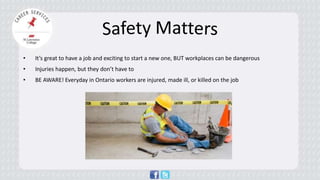
It’s great to have a job and exciting to start a new one, BUT workplaces can be dangerous 
• 
Injuries happen, but they don’t have to 
• 
BE AWARE! Everyday in Ontario workers are injured, made ill, or killed on the job
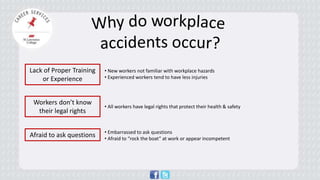
Lack of Proper Training or Experience 
• 
New workers not familiar with workplace hazards 
• Experienced workers tend to have less injuries 
Workers don’t know their legal rights 
• 
All workers have legal rights that protect their health & safety 
Afraid to ask questions 
• Embarrassed to ask questions 
• Afraid to “rock the boat” at work or appear incompetent
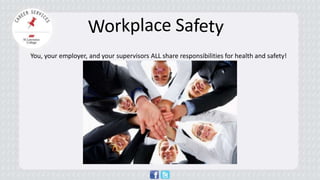
You, your employer, and your supervisors ALL share responsibilities for health and safety!
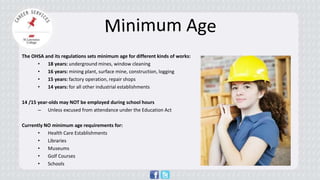
The OHSA and its regulations sets minimum age for different kinds of works: 
• 
18 years: underground mines, window cleaning 
• 
16 years: mining plant, surface mine, construction, logging 
• 
15 years: factory operation, repair shops 
• 
14 years: for all other industrial establishments 
14 /15 year-olds may NOT be employed during school hours 
– 
Unless excused from attendance under the Education Act 
Currently NO minimum age requirements for: 
•Health Care Establishments 
•Libraries 
•Museums 
•Golf Courses 
•Schools
Employer 
•Establish a health and safety policy and program 
•Provide required training 
•Provide information, instructions, and supervision for safe job performance 
•Provide necessary safety equipment 
•Provide information on hazards in the workplace 
•Display important information where everyone can see it 
Supervisor 
•Make sure you follow the law and company's safety rules 
•Tell you about any job hazards or dangers 
•Make sure you use safety equipment properly 
•Should look after the workers
• 
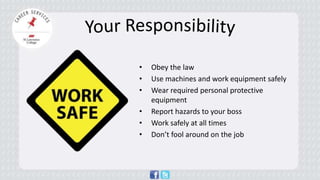
Obey the law 
• 
Use machines and work equipment safely 
• 
Wear required personal protective equipment 
• 
Report hazards to your boss 
• 
Work safely at all times 
• 
Don’t fool around on the job
You have the right to… 
• 
Know about dangers in your workplace 
• 
Training before you start the job 
• 
On-the-job training 
• 
Work Supervision 
• 
Hazard information to perform your job safely 
The right to participate… 
• 
Become a Health & Safety Representative 
• 
Become a member of the Joint Health & Safety Committee (JHSC) 
• 
Help with health & Safety Inspections 
• 
Take Part in Training 
• 
Identify hazards and possible solutions 
The right to refuse unsafe work… 
• 
No job is worth getting hurt 
• 
Discuss it with your boss, before refusing work you think is dangerous 
• 
Employer cannot punish or fire you for refusing work you think is unsafe
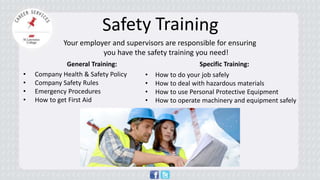
Your employer and supervisors are responsible for ensuring you have the safety training you need! 
General Training: 
• 
Company Health & Safety Policy 
• 
Company Safety Rules 
• 
Emergency Procedures 
• 
How to get First Aid 
Specific Training: 
• 
How to do your job safely 
• 
How to deal with hazardous materials 
• 
How to use Personal Protective Equipment 
• 
How to operate machinery and equipment safely
• 
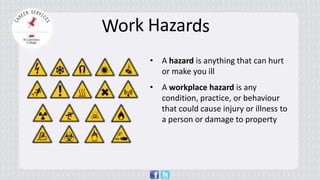
A hazard is anything that can hurt or make you ill 
• 
A workplace hazard is any condition, practice, or behaviour that could cause injury or illness to a person or damage to property
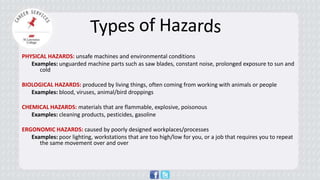
PHYSICAL HAZARDS: unsafe machines and environmental conditions 
Examples: unguarded machine parts such as saw blades, constant noise, prolonged exposure to sun and cold 
BIOLOGICAL HAZARDS: produced by living things, often coming from working with animals or people 
Examples: blood, viruses, animal/bird droppings 
CHEMICAL HAZARDS: materials that are flammable, explosive, poisonous 
Examples: cleaning products, pesticides, gasoline 
ERGONOMIC HAZARDS: caused by poorly designed workplaces/processes 
Examples: poor lighting, workstations that are too high/low for you, or a job that requires you to repeat the same movement over and over
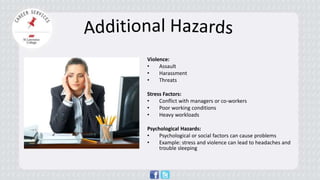
Violence: 
• 
Assault 
• 
Harassment 
• 
Threats 
Stress Factors: 
• 
Conflict with managers or co-workers 
• 
Poor working conditions 
• 
Heavy workloads 
Psychological Hazards: 
• 
Psychological or social factors can cause problems 
• 
Example: stress and violence can lead to headaches and trouble sleeping
• 
You have a legal responsibility to report hazards, protect yourself, and protect your co-workers 
• 
Pay attention to health and safety information, and recognize situations that might be dangerous 
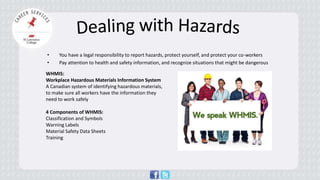
WHMIS: 
Workplace Hazardous Materials Information System 
A Canadian system of identifying hazardous materials, to make sure all workers have the information they need to work safely 
4 Components of WHMIS: 
Classification and Symbols 
Warning Labels 
Material Safety Data Sheets 
Training
Prevent injury “at the source” of the hazard: 
• 
Redesign work processes/isolate dangerous processes 
• 
Install guards/enclosures around moving parts 
• 
Replace hazardous substances with less hazardous ones 
Control hazards “along the path” before reaching the worker: 
• 
Use local ventilation systems to remove fumes 
• 
Put up welding screens to protect co-workers from welding flash 
Use hazard controls “at the worker”: 
•Create rules/procedures for how people work around hazards 
•Limit how long workers are around dangerous materials 
•Provide personal protective equipment (PPE)
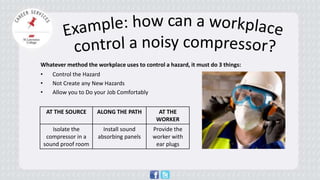
Whatever method the workplace uses to control a hazard, it must do 3 things: 
•Control the Hazard 
•Not Create any New Hazards 
•Allow you to Do your Job Comfortably 
AT THE SOURCE 
ALONG THE PATH 
AT THE WORKER 
Isolate the compressor in a sound proof room 
Install sound absorbing panels 
Provide the worker with ear plugs
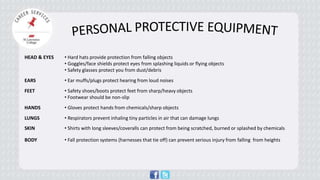
HEAD & EYES 
• 
Hard hats provide protection from falling objects 
• 
Goggles/face shields protect eyes from splashing liquids or flying objects 
• 
Safety glasses protect you from dust/debris 
EARS 
• 
Ear muffs/plugs protect hearing from loud noises 
FEET 
• 
Safety shoes/boots protect feet from sharp/heavy objects 
• 
Footwear should be non-slip 
HANDS 
• 
Gloves protect hands from chemicals/sharp objects 
LUNGS 
• 
Respirators prevent inhaling tiny particles in air that can damage lungs 
SKIN 
• 
Shirts with long sleeves/coveralls can protect from being scratched, burned or splashed by chemicals 
BODY 
• 
Fall protection systems (harnesses that tie off) can prevent serious injury from falling from heights
• 
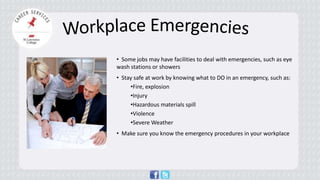
Some jobs may have facilities to deal with emergencies, such as eye wash stations or showers 
• 
Stay safe at work by knowing what to DO in an emergency, such as: 
• 
Fire, explosion 
• 
Injury 
• 
Hazardous materials spill 
• 
Violence 
• 
Severe Weather 
• Make sure you know the emergency procedures in your workplace
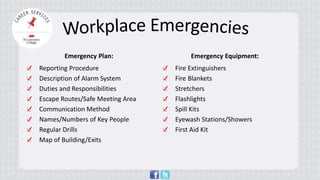
Emergency Equipment: 
Fire Extinguishers 
Fire Blankets 
Stretchers 
Flashlights 
Spill Kits 
Eyewash Stations/Showers 
First Aid Kit 
Emergency Plan: 
Reporting Procedure 
Description of Alarm System 
Duties and Responsibilities 
Escape Routes/Safe Meeting Area 
Communication Method 
Names/Numbers of Key People 
Regular Drills 
Map of Building/Exits
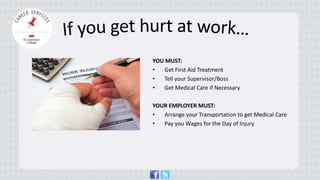
YOU MUST: 
• 
Get First Aid Treatment 
• 
Tell your Supervisor/Boss 
• 
Get Medical Care if Necessary 
YOUR EMPLOYER MUST: 
•Arrange your Transportation to get Medical Care 
•Pay you Wages for the Day of Injury
Workplace Safety and Insurance Board of Ontario 
Health and Safety, Ontario Ministry of Labour 
Know Your Rights, WorkRights.ca
FOR MORE INFORMATION: VISIT THE CAREER CENTRE: Room 11180 - 100 Portsmouth Avenue, Kingston, ON VISIT OUR WEBSITE: www.stlawrencecollege.ca/careerservices EMAIL: careerservices@sl.on.ca PHONE: 613-544-5400 Ext. 1844 613-345-0660 Ext. 1844 613-933-3259 Ext. 1844

Your Guide to Workplace Safety!

  • 1.
    YOUR GUIDE TOWORKPLACE Everyone is responsible for workplace safety. Know your rights and responsibilities!
  • 2.
    OHSA: Occupational Healthand Safety Act • Covers most workers in Ontario • Everyone in the workplace is responsible for preventing injury/illness IRS: Internal Responsibility System • Workers, supervisors, employers, and worker representatives all have legal duty to keep their workplace safe and healthy • Workplaces with 6-19 workers must have a Health & Safety Representative • Workplaces with 20+ workers must have a Joint Health & Safety Committee (JHSC) Ontario Ministry of Labour (enforces OHSA) •Penalties to pay when health and safety laws are broken •Under OHSA, a person can be fined up to: •$ 25,000 for every charge laid •And/or serve 12 months in jail •Corporations can be fined up to $500,000 per violation (if convicted)
  • 3.
    • It’s greatto have a job and exciting to start a new one, BUT workplaces can be dangerous • Injuries happen, but they don’t have to • BE AWARE! Everyday in Ontario workers are injured, made ill, or killed on the job
  • 4.
    Lack of ProperTraining or Experience • New workers not familiar with workplace hazards • Experienced workers tend to have less injuries Workers don’t know their legal rights • All workers have legal rights that protect their health & safety Afraid to ask questions • Embarrassed to ask questions • Afraid to “rock the boat” at work or appear incompetent
  • 5.
    You, your employer,and your supervisors ALL share responsibilities for health and safety!
  • 6.
    The OHSA andits regulations sets minimum age for different kinds of works: • 18 years: underground mines, window cleaning • 16 years: mining plant, surface mine, construction, logging • 15 years: factory operation, repair shops • 14 years: for all other industrial establishments 14 /15 year-olds may NOT be employed during school hours – Unless excused from attendance under the Education Act Currently NO minimum age requirements for: •Health Care Establishments •Libraries •Museums •Golf Courses •Schools
  • 7.
    Employer •Establish ahealth and safety policy and program •Provide required training •Provide information, instructions, and supervision for safe job performance •Provide necessary safety equipment •Provide information on hazards in the workplace •Display important information where everyone can see it Supervisor •Make sure you follow the law and company's safety rules •Tell you about any job hazards or dangers •Make sure you use safety equipment properly •Should look after the workers
  • 8.
    • Obey thelaw • Use machines and work equipment safely • Wear required personal protective equipment • Report hazards to your boss • Work safely at all times • Don’t fool around on the job
  • 9.
    You have theright to… • Know about dangers in your workplace • Training before you start the job • On-the-job training • Work Supervision • Hazard information to perform your job safely The right to participate… • Become a Health & Safety Representative • Become a member of the Joint Health & Safety Committee (JHSC) • Help with health & Safety Inspections • Take Part in Training • Identify hazards and possible solutions The right to refuse unsafe work… • No job is worth getting hurt • Discuss it with your boss, before refusing work you think is dangerous • Employer cannot punish or fire you for refusing work you think is unsafe
  • 10.
    Your employer andsupervisors are responsible for ensuring you have the safety training you need! General Training: • Company Health & Safety Policy • Company Safety Rules • Emergency Procedures • How to get First Aid Specific Training: • How to do your job safely • How to deal with hazardous materials • How to use Personal Protective Equipment • How to operate machinery and equipment safely
  • 11.
    • A hazardis anything that can hurt or make you ill • A workplace hazard is any condition, practice, or behaviour that could cause injury or illness to a person or damage to property
  • 12.
    PHYSICAL HAZARDS: unsafemachines and environmental conditions Examples: unguarded machine parts such as saw blades, constant noise, prolonged exposure to sun and cold BIOLOGICAL HAZARDS: produced by living things, often coming from working with animals or people Examples: blood, viruses, animal/bird droppings CHEMICAL HAZARDS: materials that are flammable, explosive, poisonous Examples: cleaning products, pesticides, gasoline ERGONOMIC HAZARDS: caused by poorly designed workplaces/processes Examples: poor lighting, workstations that are too high/low for you, or a job that requires you to repeat the same movement over and over
  • 13.
    Violence: • Assault • Harassment • Threats Stress Factors: • Conflict with managers or co-workers • Poor working conditions • Heavy workloads Psychological Hazards: • Psychological or social factors can cause problems • Example: stress and violence can lead to headaches and trouble sleeping
  • 14.
    • You havea legal responsibility to report hazards, protect yourself, and protect your co-workers • Pay attention to health and safety information, and recognize situations that might be dangerous WHMIS: Workplace Hazardous Materials Information System A Canadian system of identifying hazardous materials, to make sure all workers have the information they need to work safely 4 Components of WHMIS: Classification and Symbols Warning Labels Material Safety Data Sheets Training
  • 15.
    Prevent injury “atthe source” of the hazard: • Redesign work processes/isolate dangerous processes • Install guards/enclosures around moving parts • Replace hazardous substances with less hazardous ones Control hazards “along the path” before reaching the worker: • Use local ventilation systems to remove fumes • Put up welding screens to protect co-workers from welding flash Use hazard controls “at the worker”: •Create rules/procedures for how people work around hazards •Limit how long workers are around dangerous materials •Provide personal protective equipment (PPE)
  • 16.
    Whatever method theworkplace uses to control a hazard, it must do 3 things: •Control the Hazard •Not Create any New Hazards •Allow you to Do your Job Comfortably AT THE SOURCE ALONG THE PATH AT THE WORKER Isolate the compressor in a sound proof room Install sound absorbing panels Provide the worker with ear plugs
  • 17.
    HEAD & EYES • Hard hats provide protection from falling objects • Goggles/face shields protect eyes from splashing liquids or flying objects • Safety glasses protect you from dust/debris EARS • Ear muffs/plugs protect hearing from loud noises FEET • Safety shoes/boots protect feet from sharp/heavy objects • Footwear should be non-slip HANDS • Gloves protect hands from chemicals/sharp objects LUNGS • Respirators prevent inhaling tiny particles in air that can damage lungs SKIN • Shirts with long sleeves/coveralls can protect from being scratched, burned or splashed by chemicals BODY • Fall protection systems (harnesses that tie off) can prevent serious injury from falling from heights
  • 18.
    • Some jobsmay have facilities to deal with emergencies, such as eye wash stations or showers • Stay safe at work by knowing what to DO in an emergency, such as: • Fire, explosion • Injury • Hazardous materials spill • Violence • Severe Weather • Make sure you know the emergency procedures in your workplace
  • 19.
    Emergency Equipment: FireExtinguishers Fire Blankets Stretchers Flashlights Spill Kits Eyewash Stations/Showers First Aid Kit Emergency Plan: Reporting Procedure Description of Alarm System Duties and Responsibilities Escape Routes/Safe Meeting Area Communication Method Names/Numbers of Key People Regular Drills Map of Building/Exits
  • 20.
    YOU MUST: • Get First Aid Treatment • Tell your Supervisor/Boss • Get Medical Care if Necessary YOUR EMPLOYER MUST: •Arrange your Transportation to get Medical Care •Pay you Wages for the Day of Injury
  • 21.
    Workplace Safety andInsurance Board of Ontario Health and Safety, Ontario Ministry of Labour Know Your Rights, WorkRights.ca
  • 22.
    FOR MORE INFORMATION:VISIT THE CAREER CENTRE: Room 11180 - 100 Portsmouth Avenue, Kingston, ON VISIT OUR WEBSITE: www.stlawrencecollege.ca/careerservices EMAIL: careerservices@sl.on.ca PHONE: 613-544-5400 Ext. 1844 613-345-0660 Ext. 1844 613-933-3259 Ext. 1844