Open-­‐‑Source  Based  Prototype  for  QoS  
Monitoring  and  QoE  Estimation  in  
Telecommunication  Environments  	
Sebastian Schumann
Slovak University of Technology
Bratislava, Slovakia
Cardiff, UK – 15. September 2011
Introduction	
•  Implementation for Quality of Service (QoS) and
Experience (QoE) monitoring
•  Works in Real-time Transport Protocol (RTP) based
telecommunication environments
•  Analysis
o  QoS parameters are evaluated
o  QoE is determined with the E-Model
•  Output
o  R-Factor, one-way delay, packet-loss probability
o  Graphical representation
Environment	
	
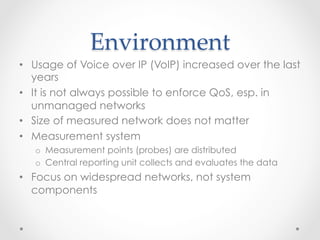
•  Usage of Voice over IP (VoIP) increased over the last
years
•  It is not always possible to enforce QoS, esp. in
unmanaged networks
•  Size of measured network does not matter
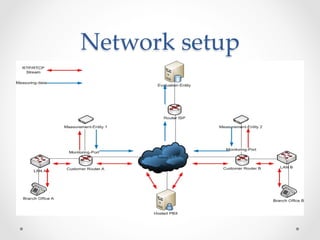
•  Measurement system
o  Measurement points (probes) are distributed
o  Central reporting unit collects and evaluates the data
•  Focus on widespread networks, not system
components
Motivation	
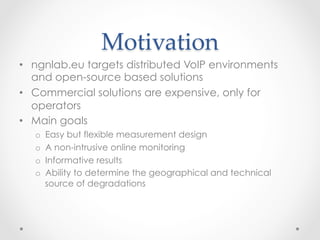
•  ngnlab.eu targets distributed VoIP environments
and open-source based solutions
•  Commercial solutions are expensive, only for
operators
•  Main goals
o  Easy but flexible measurement design
o  A non-intrusive online monitoring
o  Informative results
o  Ability to determine the geographical and technical
source of degradations
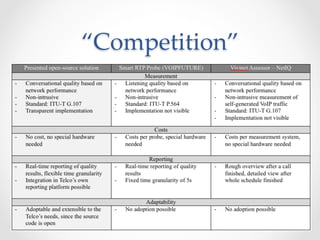
“Competition”
Theory	
•  E-model used to determine QoE (calculated acc.
several network parameters)
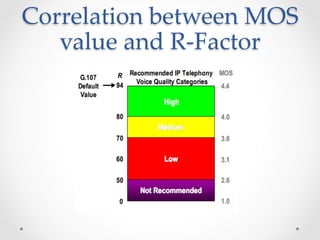
•  Objective (i.e., calculated) value can be mapped
to the subjective Mean Opinion Score (MOS)
•  Impacts on speech quality are
o  One-way delay
o  Packet-loss probability
o  Packet-loss distribution
o  Speech codec
•  Measurement and evaluation of values allow
calculation of QoS/QoE during the call
Correlation  between  MOS  
value  and  R-­‐‑Factor
Measured  Impairments  I	
•  One-way delay
•  Measured by halving
the Round-Trip-Time
(RTT) value of the voice
packets (estimation)
•  Both directions possible
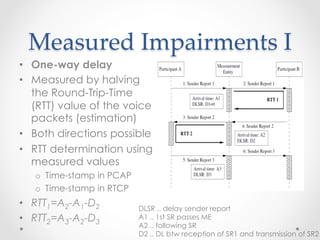
•  RTT determination using
measured values
o  Time-stamp in PCAP
o  Time-stamp in RTCP
•  RTT1=A2-A1-D2
•  RTT2=A3-A2-D3
DLSR .. delay sender report
A1 .. 1st SR passes ME
A2 .. following SR
D2 .. DL btw reception of SR1 and transmission of SR2
Measured  Impairments  II	
•  Packet loss probability
•  Determined by recording the sequence number of
each RTP packet that passes the ME
•  The loss probability is updated after every 100 RTP
packets
o  The time distance is a good balance between the applied
load on the ME, the network load, and the actuality of the
measurement results on the EE
Measured  Impairments  III	
•  Packet loss distribution calculated acc. the patent
of McGowan
o  Overall packet loss probability (Ppl)
o  Average length of all loss sequences
•  Speech codec is determined by parsing the Session
Description Protocol (SDP) during the session
establishment procedure
•  Knowledge is important in relation to the used
compression method and its robustness against
packet loss (packet loss robustness factor)
Network  setup
Application	
•  Measurement probes
o  PCAP library captures packet for analysis
o  Perl script extracts required information from each packet
o  HTTP is used to exchange measured parameters
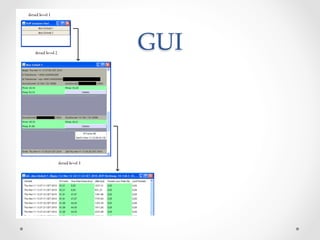
•  Central reporting unit
o  Java application
o  Real-time monitoring with three detail levels (monitoring
unit, call, details)
o  Adjustable color indication when pre-set thresholds are
reached
GUI
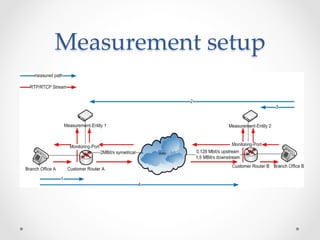
Measurement  setup
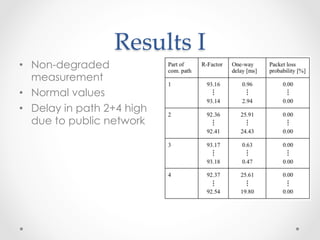
Results  I	
•  Non-degraded
measurement
•  Normal values
•  Delay in path 2+4 high
due to public network
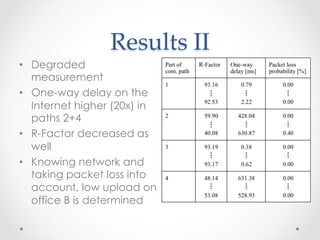
Results  II	
•  Degraded
measurement
•  One-way delay on the
Internet higher (20x) in
paths 2+4
•  R-Factor decreased as
well
•  Knowing network and
taking packet loss into
account, low upload on
office B is determined
Summary	
•  QoS and QoE can be measured using the designed
prototype
•  Implementation is scalable to smaller or larger Telco
networks (probes can be distributed accordingly)
•  Implementation can compete with professional
equipment to a certain extent
•  Extensions open but easily possible
o  Alarms
o  Visual network status display in real-time
o  Follow-up calls for neg. quality calls
o  Recording of call samples possible as well
Thank  you!	
Sebastian Schumann
seb.schumann@gmail.com
@s_schumann

Open-Source Based Prototype for Quality of Service (QoS) Monitoring and Quality of Experience (QoE) Estimation in Telecommunication Environments

  • 1.
    Open-­‐‑Source  Based  Prototype for  QoS   Monitoring  and  QoE  Estimation  in   Telecommunication  Environments   Sebastian Schumann Slovak University of Technology Bratislava, Slovakia Cardiff, UK – 15. September 2011
  • 2.
    Introduction •  Implementation forQuality of Service (QoS) and Experience (QoE) monitoring •  Works in Real-time Transport Protocol (RTP) based telecommunication environments •  Analysis o  QoS parameters are evaluated o  QoE is determined with the E-Model •  Output o  R-Factor, one-way delay, packet-loss probability o  Graphical representation
  • 3.
    Environment •  Usage ofVoice over IP (VoIP) increased over the last years •  It is not always possible to enforce QoS, esp. in unmanaged networks •  Size of measured network does not matter •  Measurement system o  Measurement points (probes) are distributed o  Central reporting unit collects and evaluates the data •  Focus on widespread networks, not system components
  • 4.
    Motivation •  ngnlab.eu targetsdistributed VoIP environments and open-source based solutions •  Commercial solutions are expensive, only for operators •  Main goals o  Easy but flexible measurement design o  A non-intrusive online monitoring o  Informative results o  Ability to determine the geographical and technical source of degradations
  • 5.
  • 6.
    Theory •  E-model usedto determine QoE (calculated acc. several network parameters) •  Objective (i.e., calculated) value can be mapped to the subjective Mean Opinion Score (MOS) •  Impacts on speech quality are o  One-way delay o  Packet-loss probability o  Packet-loss distribution o  Speech codec •  Measurement and evaluation of values allow calculation of QoS/QoE during the call
  • 7.
    Correlation  between  MOS  value  and  R-­‐‑Factor
  • 8.
    Measured  Impairments  I • One-way delay •  Measured by halving the Round-Trip-Time (RTT) value of the voice packets (estimation) •  Both directions possible •  RTT determination using measured values o  Time-stamp in PCAP o  Time-stamp in RTCP •  RTT1=A2-A1-D2 •  RTT2=A3-A2-D3 DLSR .. delay sender report A1 .. 1st SR passes ME A2 .. following SR D2 .. DL btw reception of SR1 and transmission of SR2
  • 9.
    Measured  Impairments  II • Packet loss probability •  Determined by recording the sequence number of each RTP packet that passes the ME •  The loss probability is updated after every 100 RTP packets o  The time distance is a good balance between the applied load on the ME, the network load, and the actuality of the measurement results on the EE
  • 10.
    Measured  Impairments  III • Packet loss distribution calculated acc. the patent of McGowan o  Overall packet loss probability (Ppl) o  Average length of all loss sequences •  Speech codec is determined by parsing the Session Description Protocol (SDP) during the session establishment procedure •  Knowledge is important in relation to the used compression method and its robustness against packet loss (packet loss robustness factor)
  • 11.
  • 12.
    Application •  Measurement probes o PCAP library captures packet for analysis o  Perl script extracts required information from each packet o  HTTP is used to exchange measured parameters •  Central reporting unit o  Java application o  Real-time monitoring with three detail levels (monitoring unit, call, details) o  Adjustable color indication when pre-set thresholds are reached
  • 13.
  • 14.
  • 15.
    Results  I •  Non-degraded measurement • Normal values •  Delay in path 2+4 high due to public network
  • 16.
    Results  II •  Degraded measurement • One-way delay on the Internet higher (20x) in paths 2+4 •  R-Factor decreased as well •  Knowing network and taking packet loss into account, low upload on office B is determined
  • 17.
    Summary •  QoS andQoE can be measured using the designed prototype •  Implementation is scalable to smaller or larger Telco networks (probes can be distributed accordingly) •  Implementation can compete with professional equipment to a certain extent •  Extensions open but easily possible o  Alarms o  Visual network status display in real-time o  Follow-up calls for neg. quality calls o  Recording of call samples possible as well
  • 18.