Logarithmic, Exponential, and 
Other Transcendental Functions 
Copyright © Cengage Learning. All rights reserved.
Exponential Functions: 
Differentiation and Integration 
Copyright © Cengage Learning. All rights reserved.
3 
Objectives 
 Develop properties of the natural exponential function. 
 Differentiate natural exponential functions. 
 Integrate natural exponential functions.
4 
The Natural Exponential Function
5 
The Natural Exponential Function 
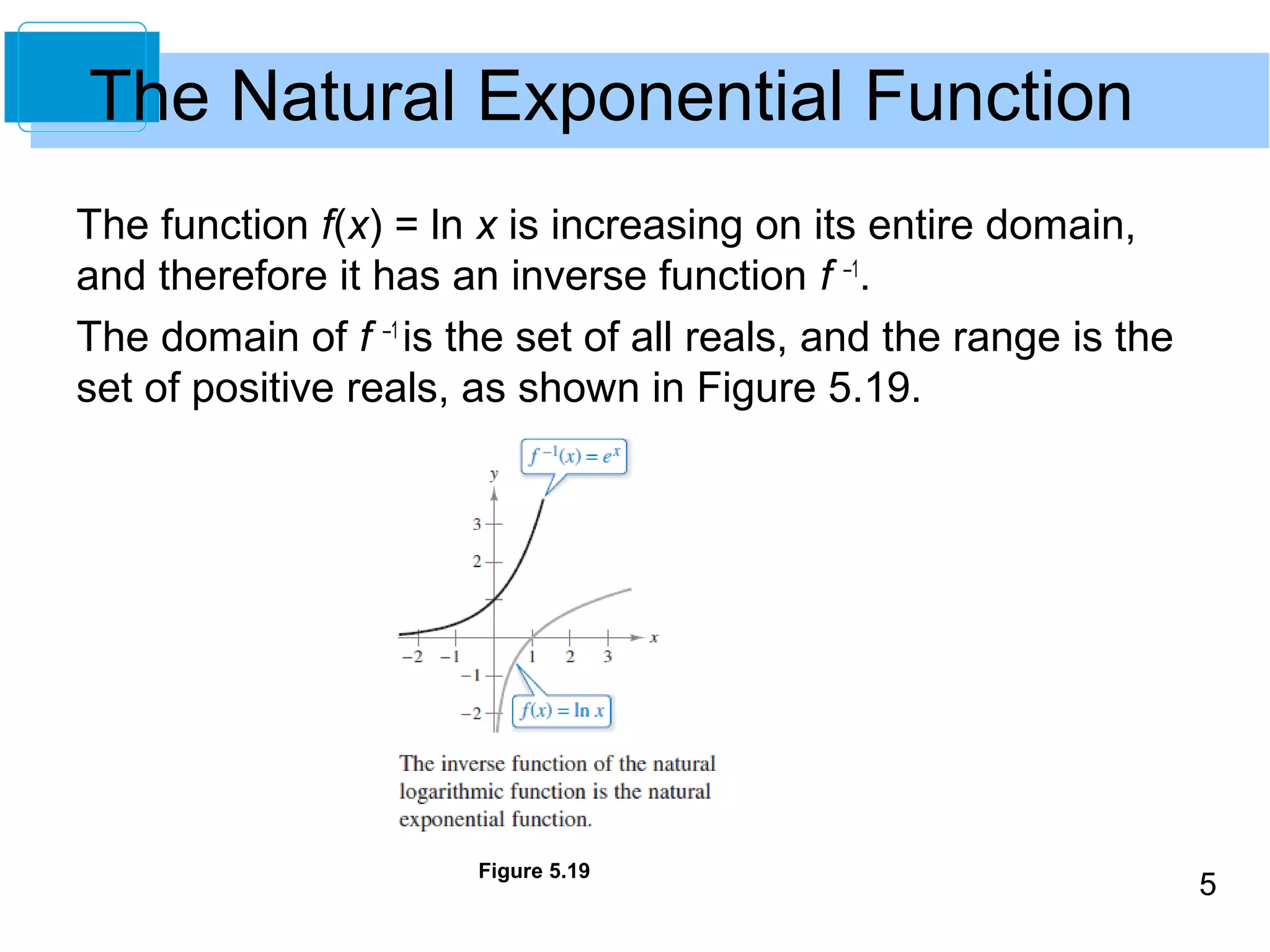
The function f(x) = ln x is increasing on its entire domain, 
and therefore it has an inverse function f –1. 
The domain of f –1 is the set of all reals, and the range is the 
set of positive reals, as shown in Figure 5.19. 
Figure 5.19
6 
The Natural Exponential Function 
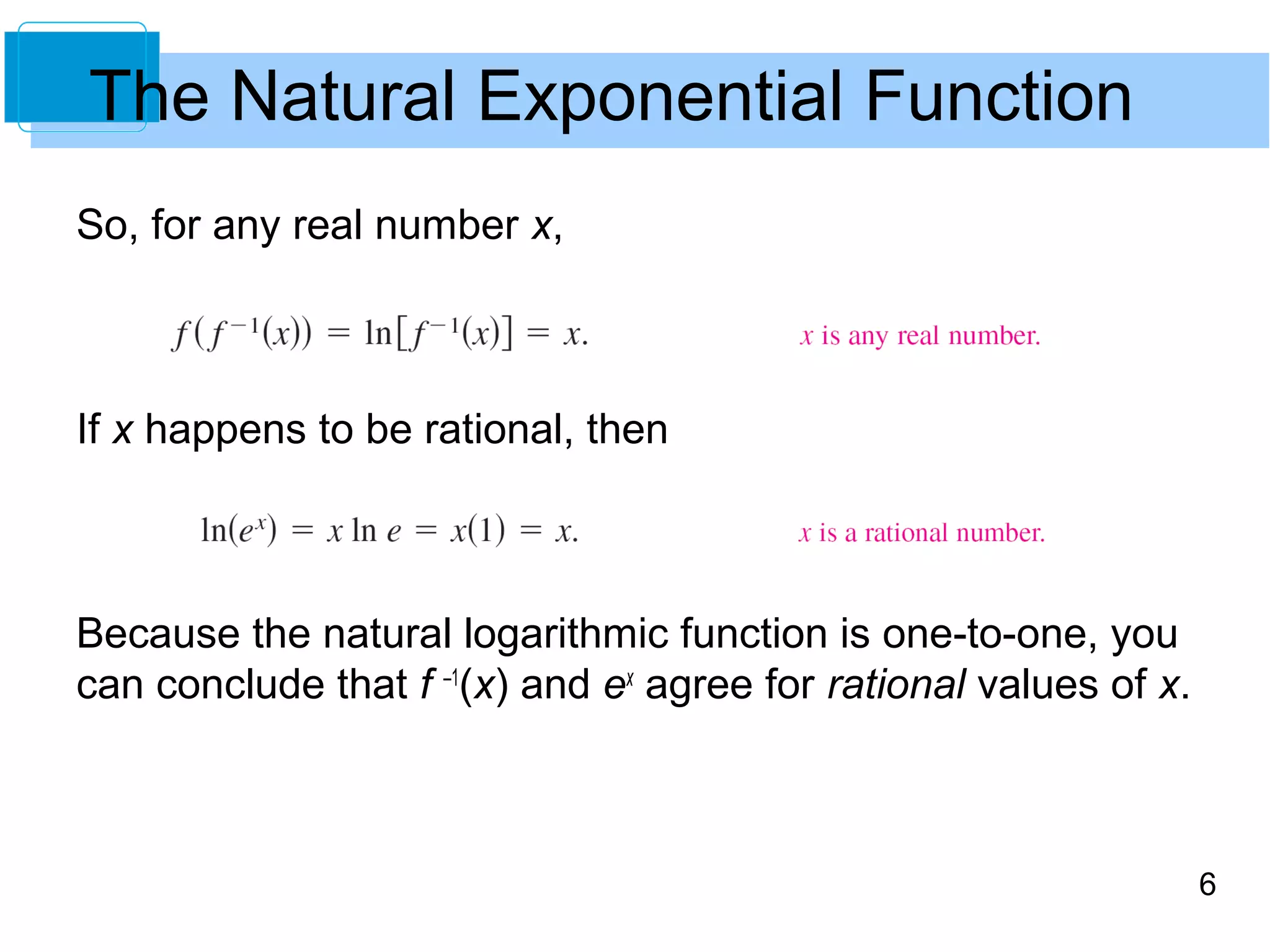
So, for any real number x, 
If x happens to be rational, then 
Because the natural logarithmic function is one-to-one, you 
can conclude that f –1(x) and ex agree for rational values of x.
7 
The Natural Exponential Function 
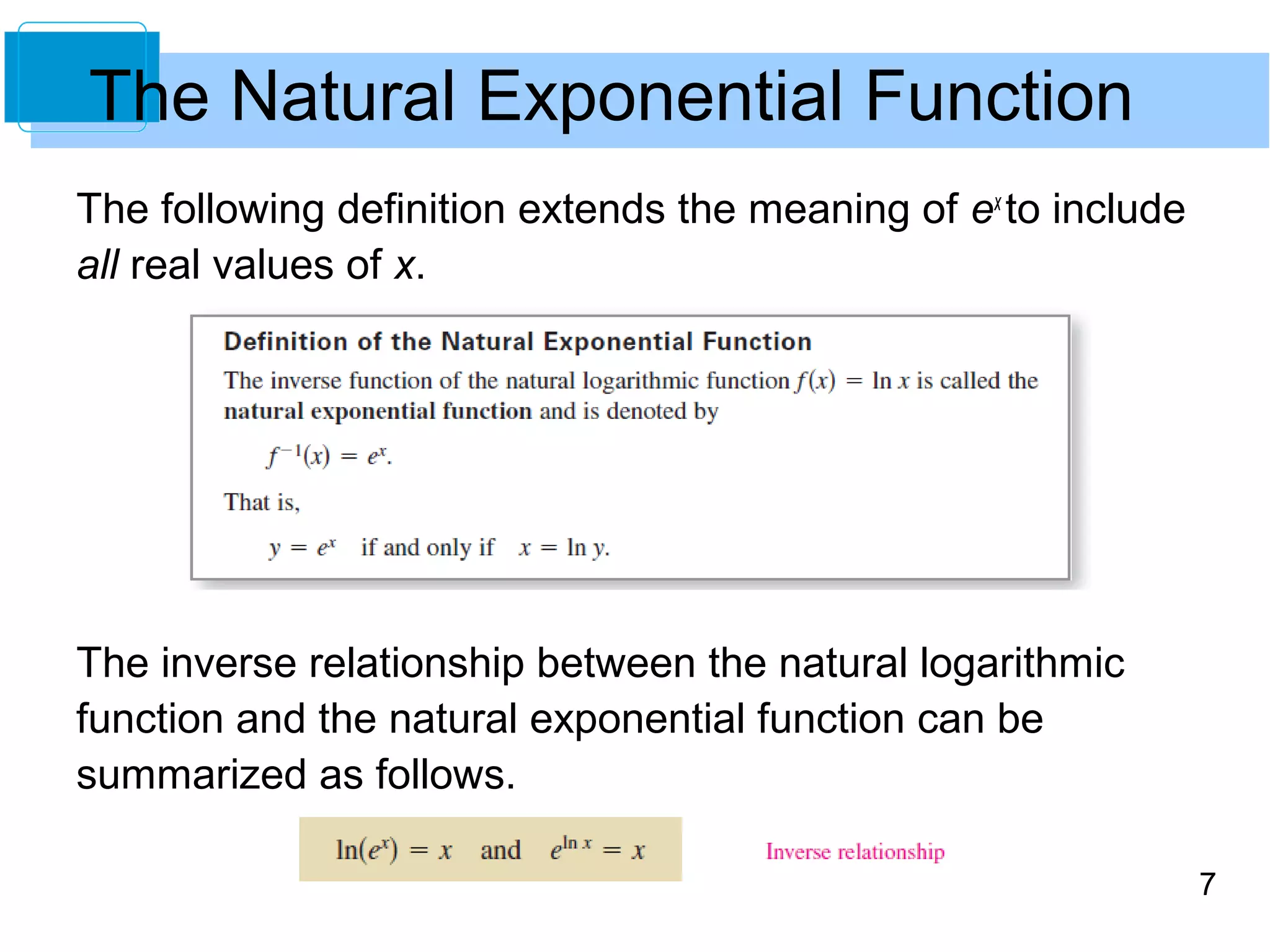
The following definition extends the meaning of ex to include 
all real values of x. 
The inverse relationship between the natural logarithmic 
function and the natural exponential function can be 
summarized as follows.
8 
Example 1 – Solving Exponential Equations 
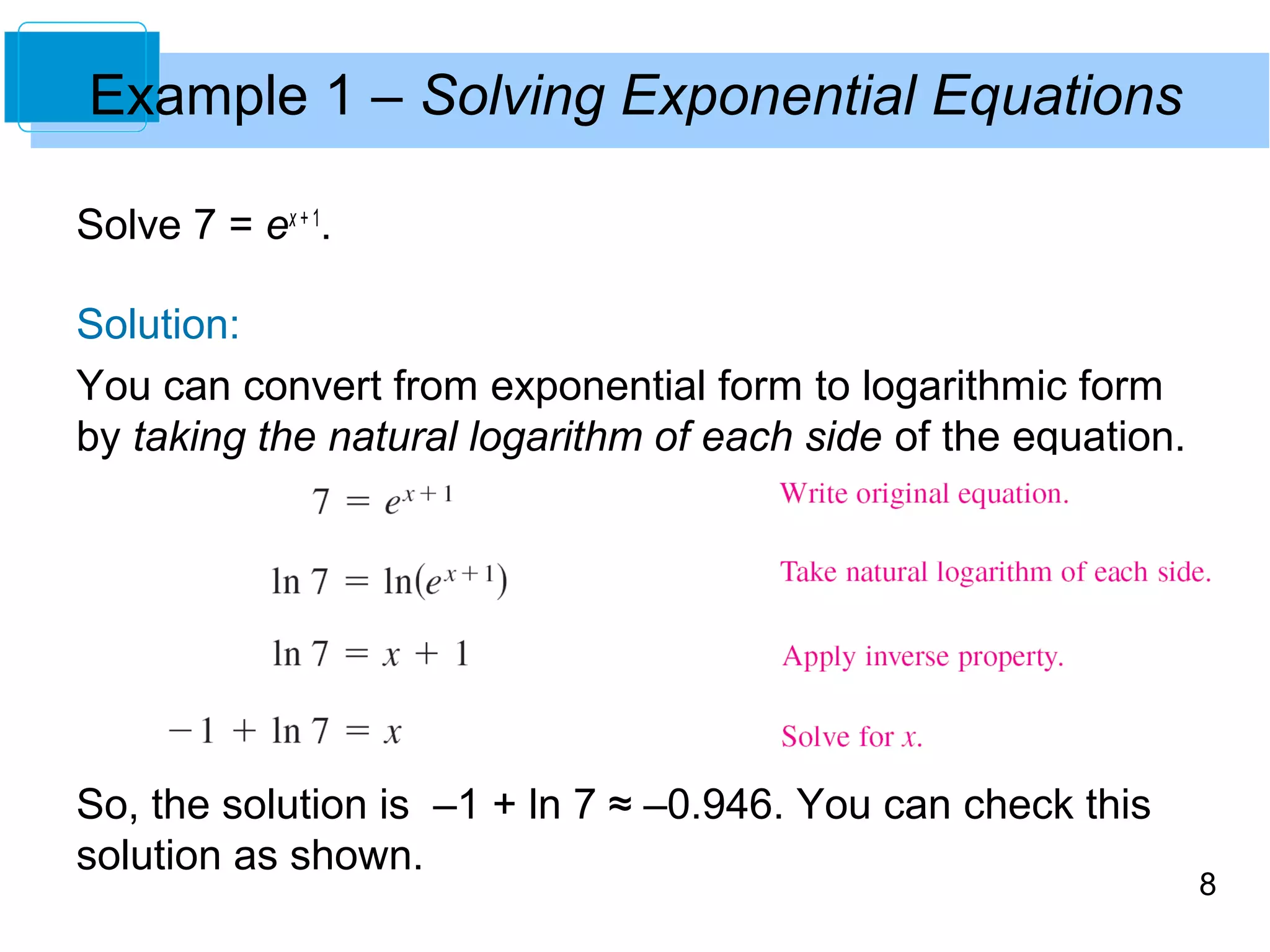
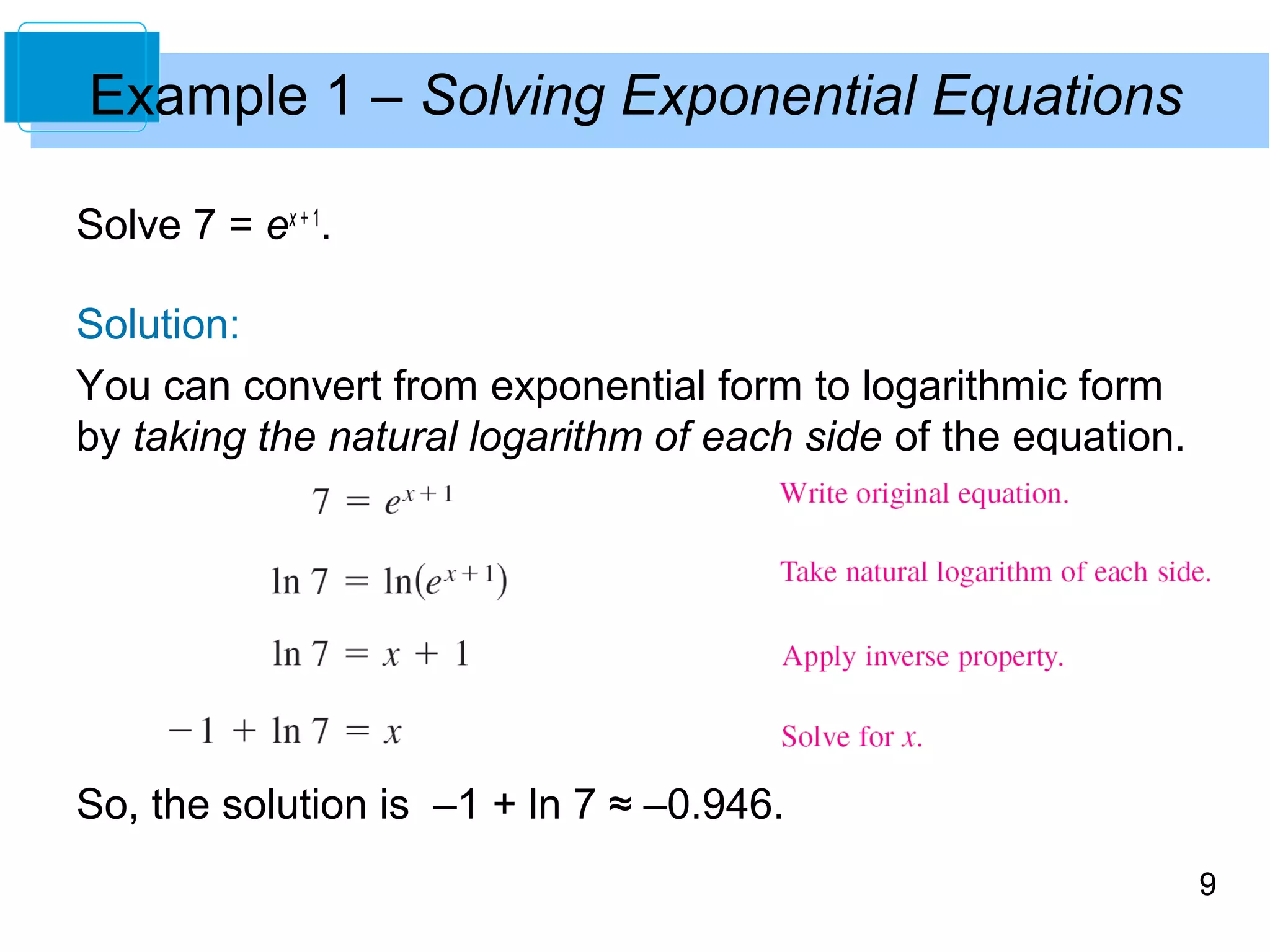
Solve 7 = ex + 1. 
Solution: 
You can convert from exponential form to logarithmic form 
by taking the natural logarithm of each side of the equation. 
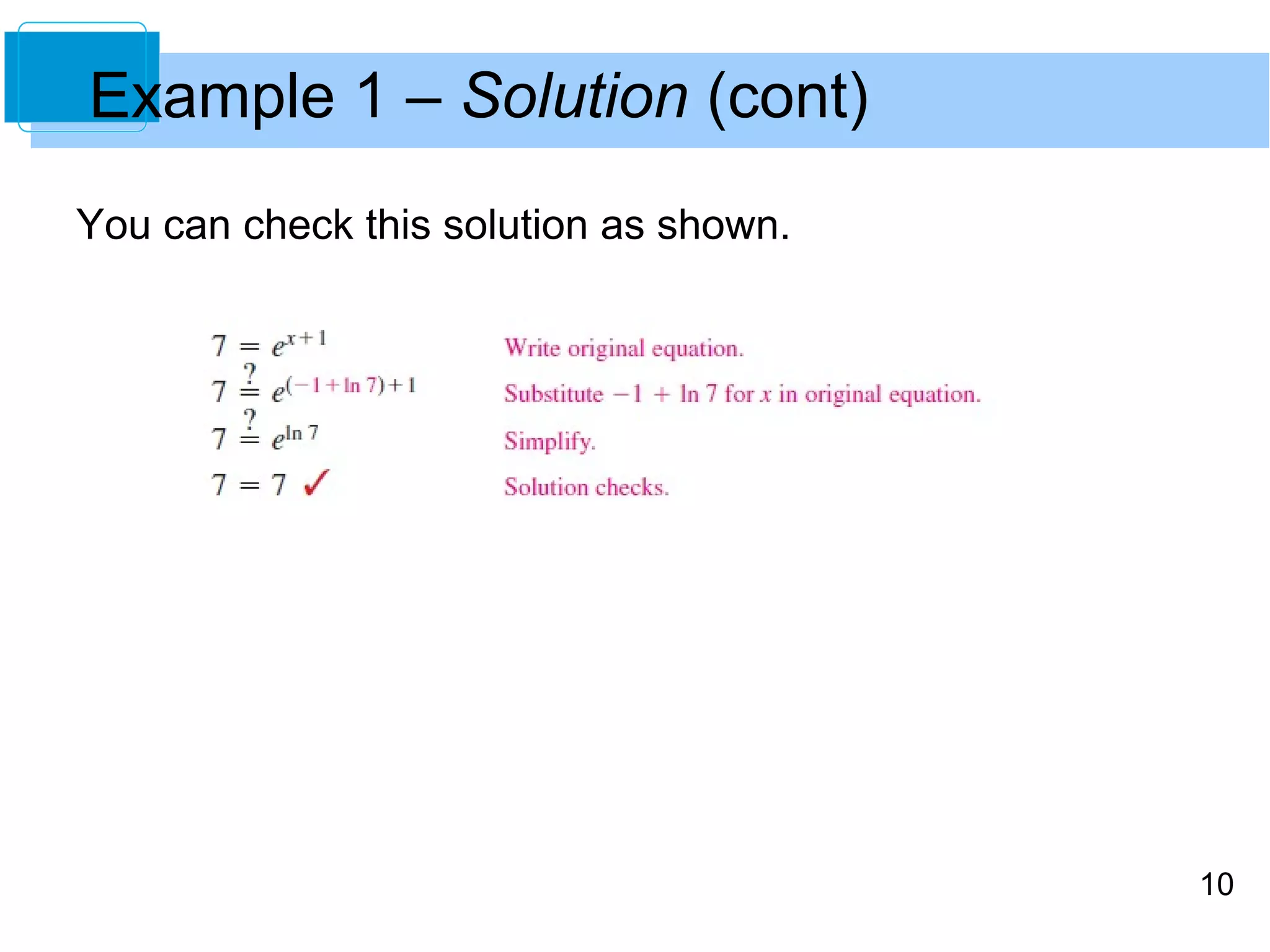
So, the solution is –1 + ln 7 ≈ –0.946. You can check this 
solution as shown.
9 
Example 1 – Solving Exponential Equations 
Solve 7 = ex + 1. 
Solution: 
You can convert from exponential form to logarithmic form 
by taking the natural logarithm of each side of the equation. 
So, the solution is –1 + ln 7 ≈ –0.946.
10 
Example 1 – Solution (cont) 
You can check this solution as shown.
11 
The Natural Exponential Function 
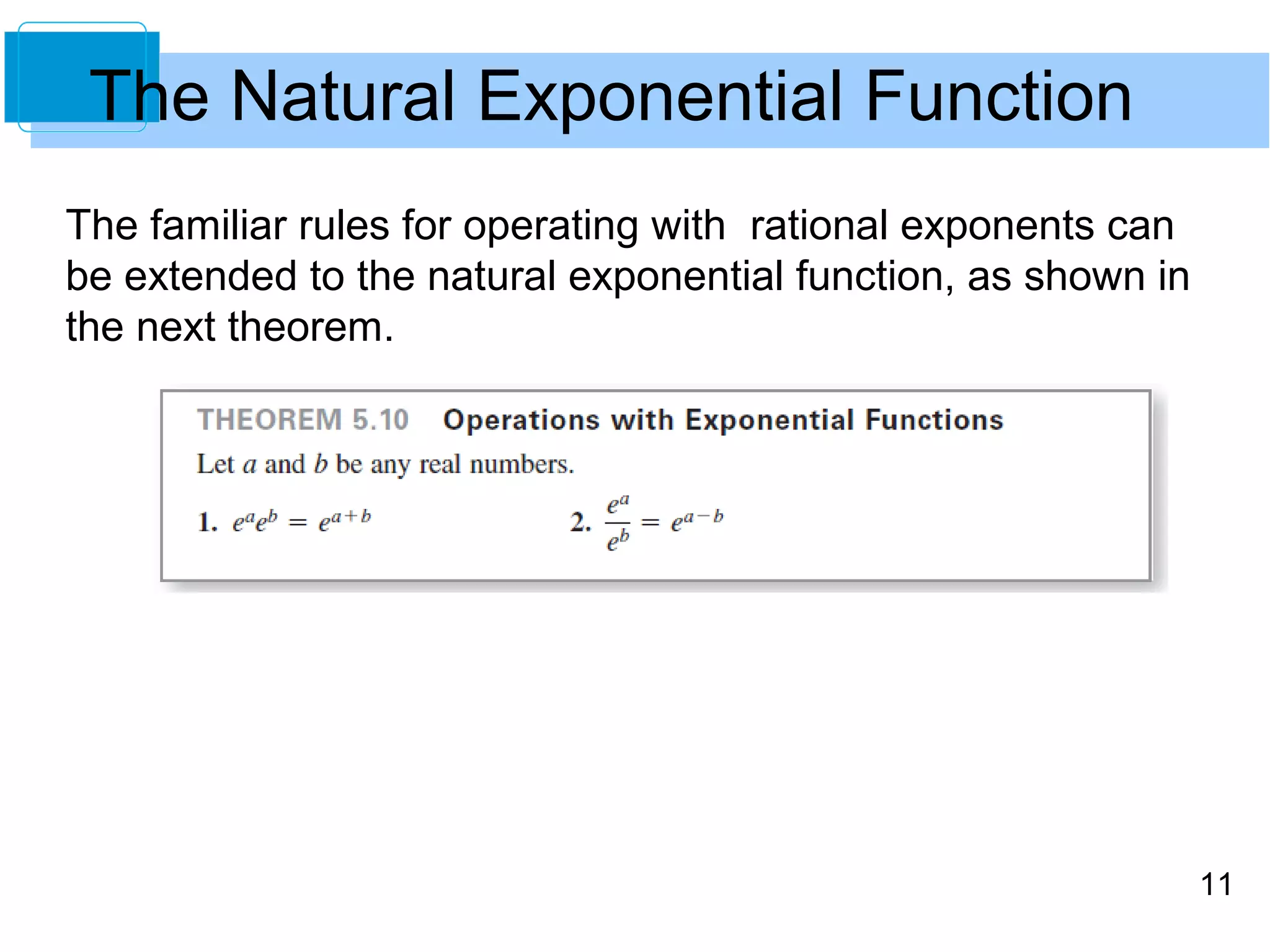
The familiar rules for operating with rational exponents can 
be extended to the natural exponential function, as shown in 
the next theorem.
12 
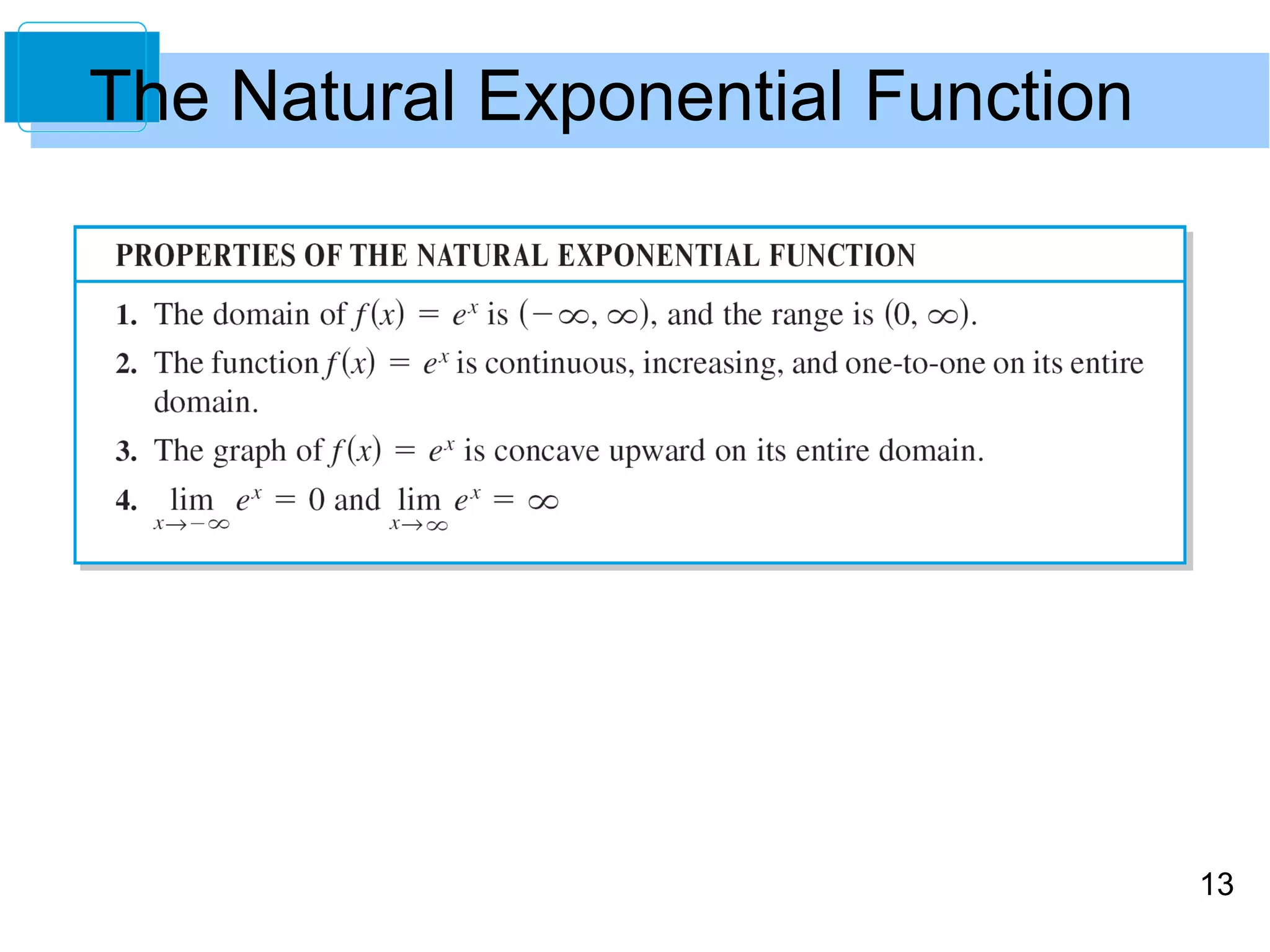
The Natural Exponential Function 
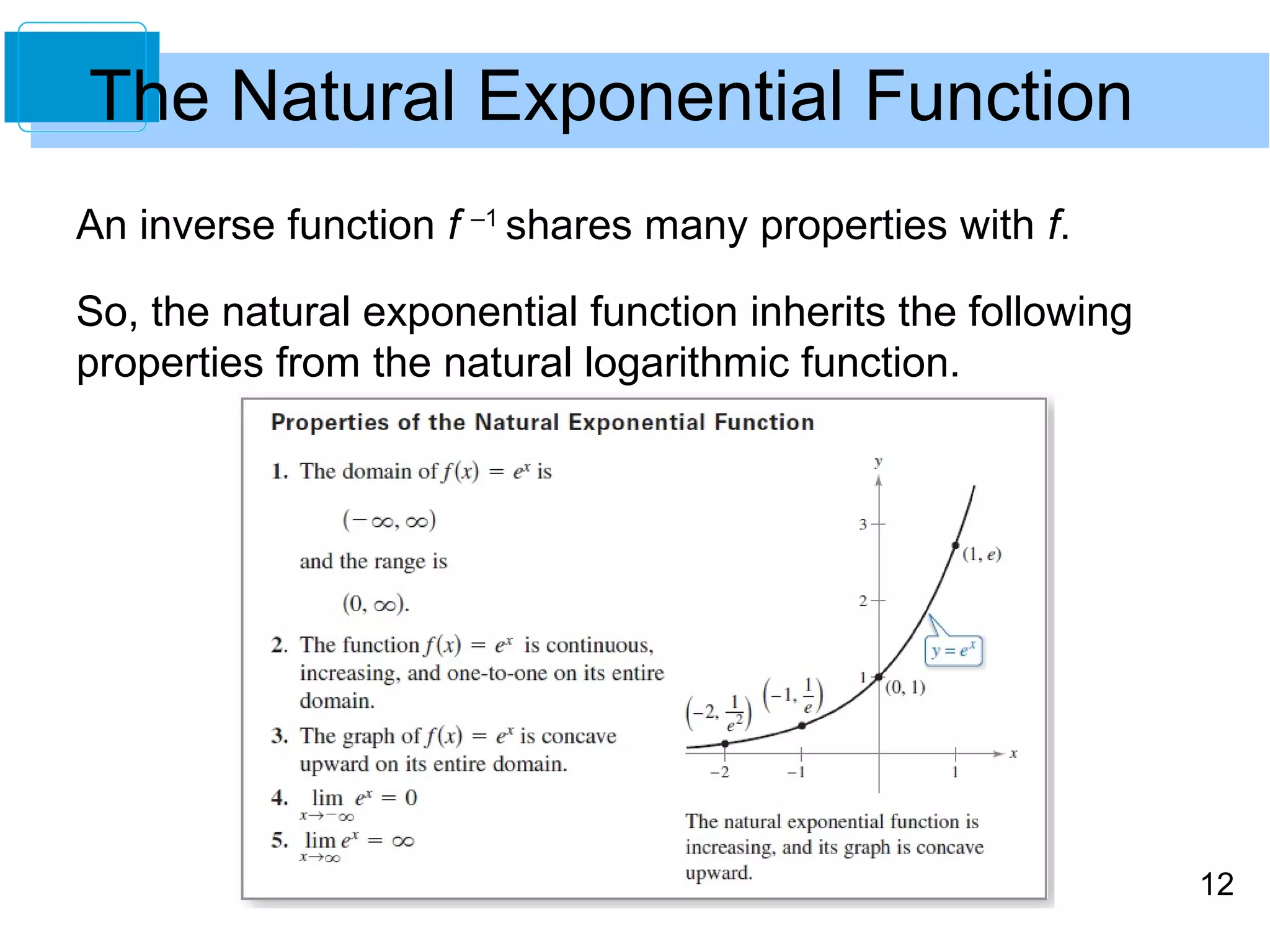
An inverse function f –1 shares many properties with f. 
So, the natural exponential function inherits the following 
properties from the natural logarithmic function.
13 
The Natural Exponential Function
14 
Derivatives of Exponential 
Functions
15 
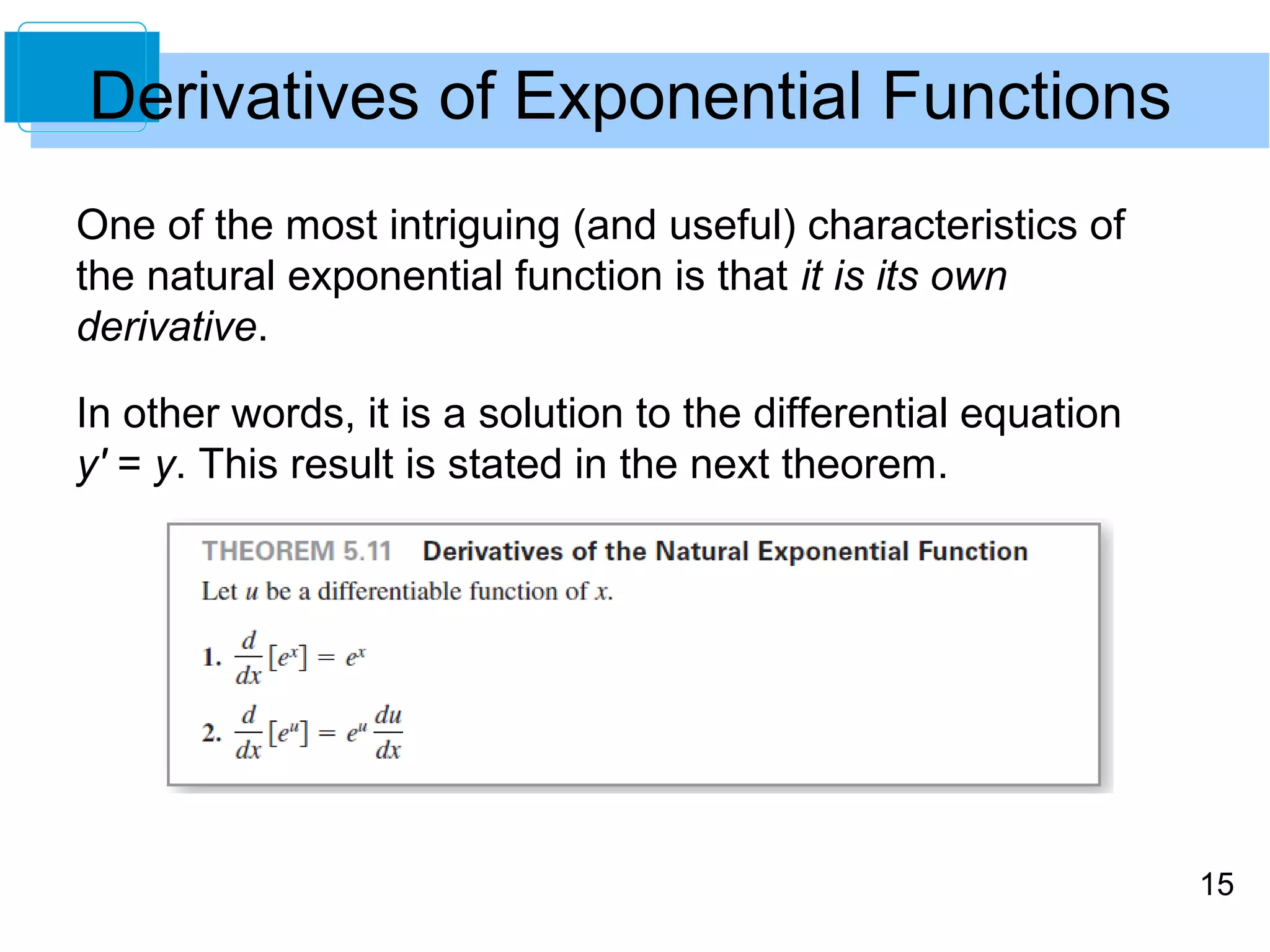
Derivatives of Exponential Functions 
One of the most intriguing (and useful) characteristics of 
the natural exponential function is that it is its own 
derivative. 
In other words, it is a solution to the differential equation 
y' = y. This result is stated in the next theorem.
16 
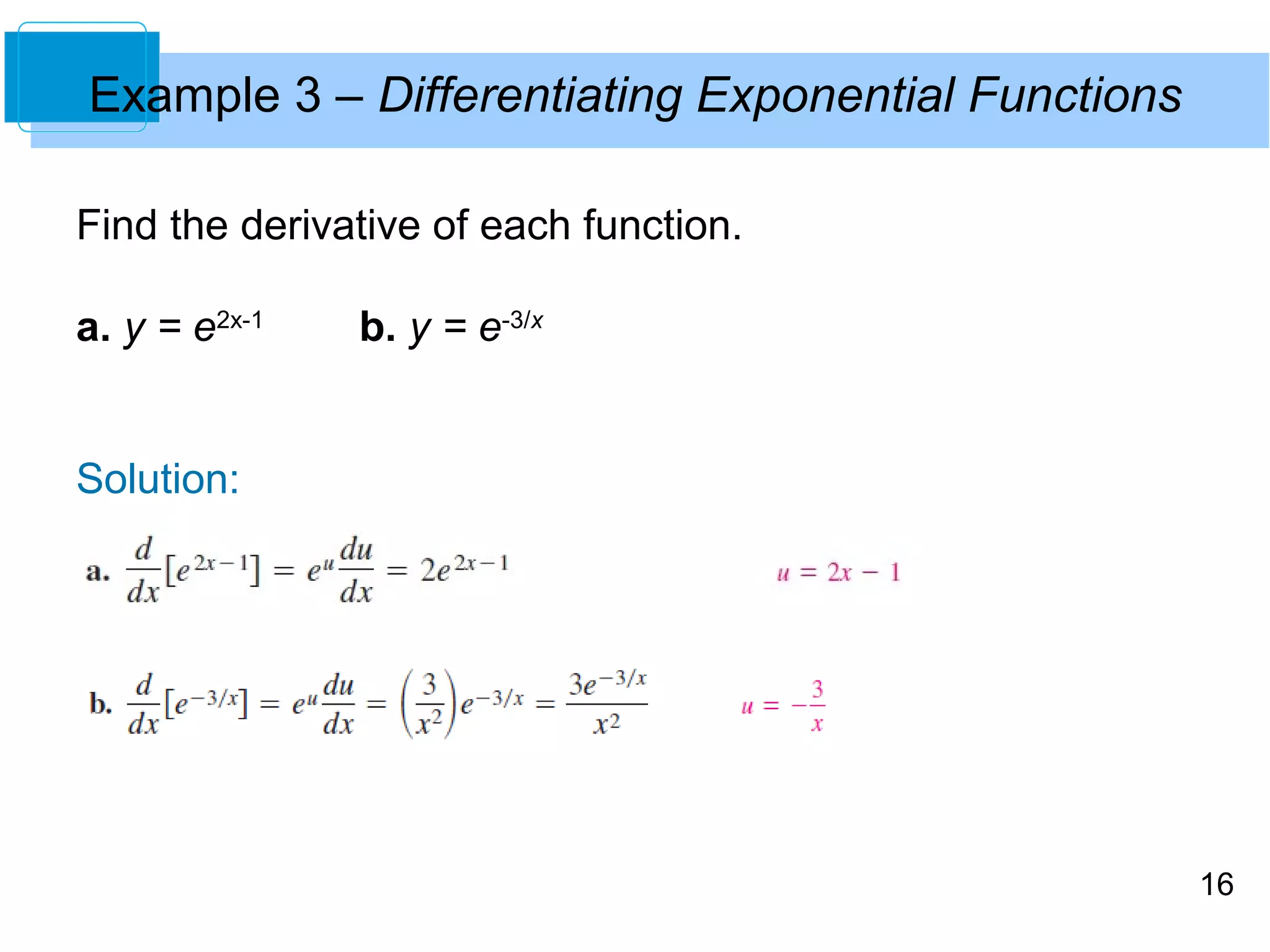
Example 3 – Differentiating Exponential Functions 
Find the derivative of each function. 
a. y = e2x-1 b. y = e-3/x 
Solution:
17 
Integrals of Exponential Functions
18 
Integrals of Exponential Functions 
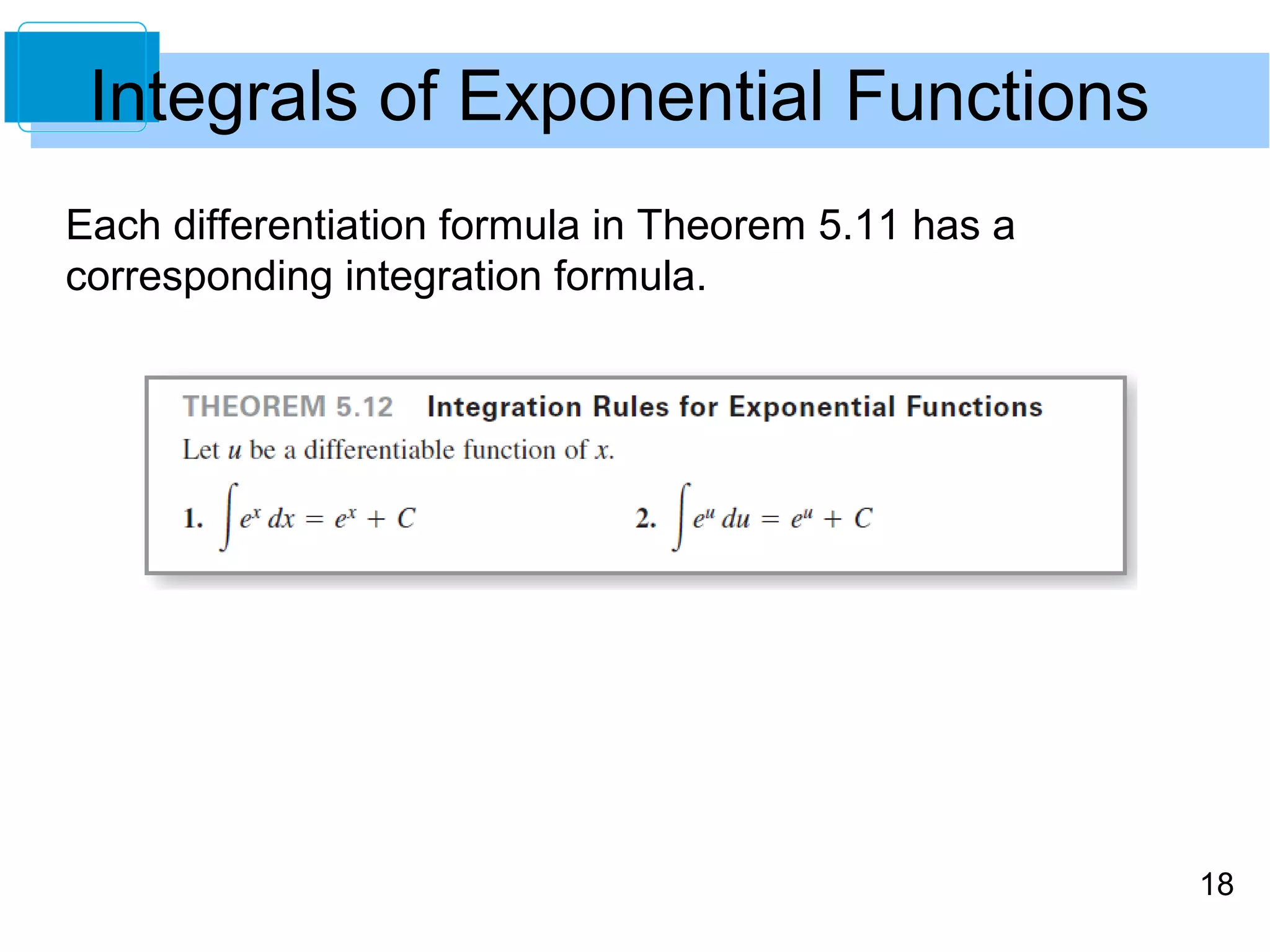
Each differentiation formula in Theorem 5.11 has a 
corresponding integration formula.
19 
Example 7 – Integrating Exponential Functions 
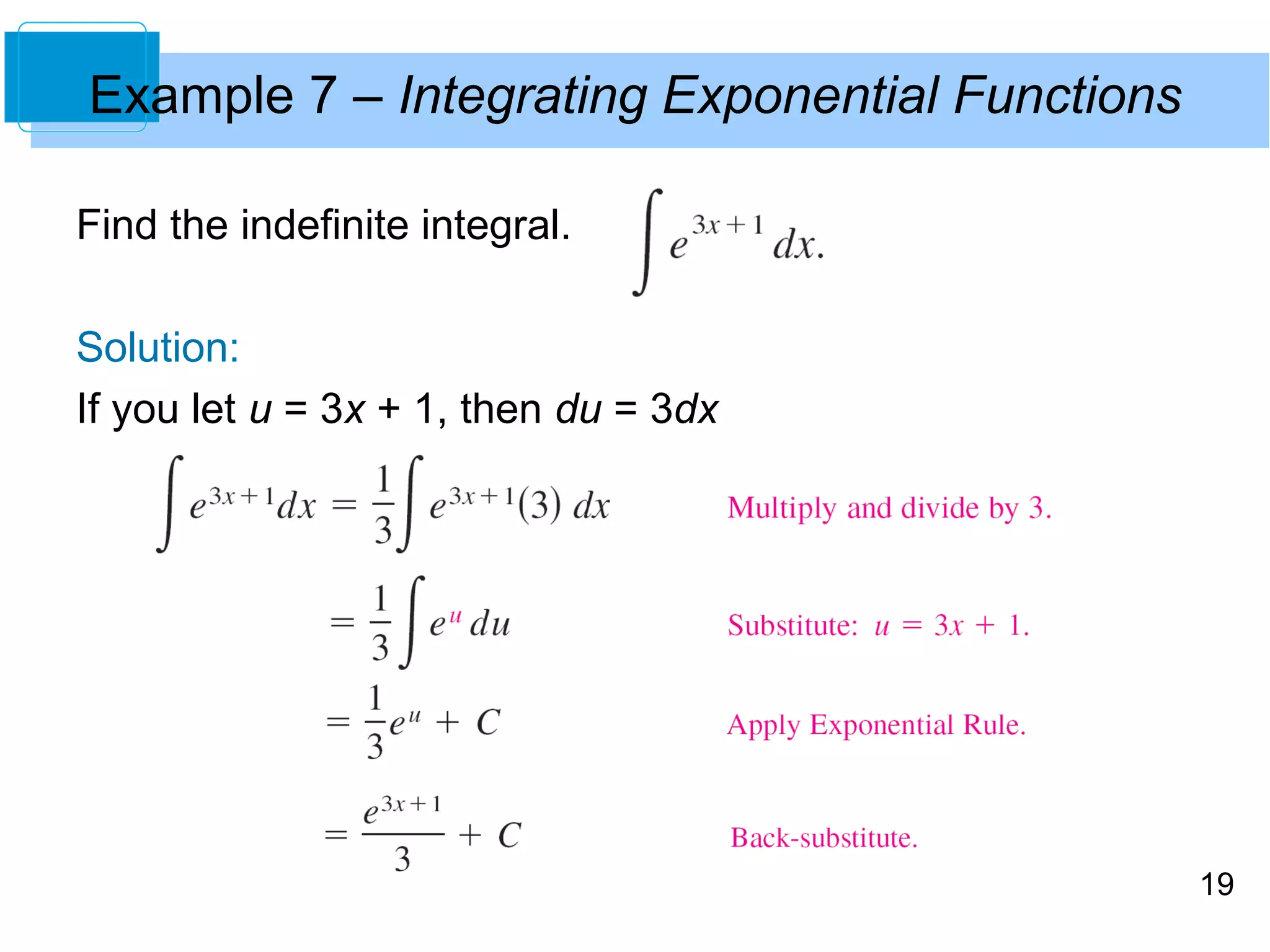
Find the indefinite integral. 
Solution: 
If you let u = 3x + 1, then du = 3dx

Lar calc10 ch05_sec4

  • 1.
    Logarithmic, Exponential, and Other Transcendental Functions Copyright © Cengage Learning. All rights reserved.
  • 2.
    Exponential Functions: Differentiationand Integration Copyright © Cengage Learning. All rights reserved.
  • 3.
    3 Objectives Develop properties of the natural exponential function.  Differentiate natural exponential functions.  Integrate natural exponential functions.
  • 4.
    4 The NaturalExponential Function
  • 5.
    5 The NaturalExponential Function The function f(x) = ln x is increasing on its entire domain, and therefore it has an inverse function f –1. The domain of f –1 is the set of all reals, and the range is the set of positive reals, as shown in Figure 5.19. Figure 5.19
  • 6.
    6 The NaturalExponential Function So, for any real number x, If x happens to be rational, then Because the natural logarithmic function is one-to-one, you can conclude that f –1(x) and ex agree for rational values of x.
  • 7.
    7 The NaturalExponential Function The following definition extends the meaning of ex to include all real values of x. The inverse relationship between the natural logarithmic function and the natural exponential function can be summarized as follows.
  • 8.
    8 Example 1– Solving Exponential Equations Solve 7 = ex + 1. Solution: You can convert from exponential form to logarithmic form by taking the natural logarithm of each side of the equation. So, the solution is –1 + ln 7 ≈ –0.946. You can check this solution as shown.
  • 9.
    9 Example 1– Solving Exponential Equations Solve 7 = ex + 1. Solution: You can convert from exponential form to logarithmic form by taking the natural logarithm of each side of the equation. So, the solution is –1 + ln 7 ≈ –0.946.
  • 10.
    10 Example 1– Solution (cont) You can check this solution as shown.
  • 11.
    11 The NaturalExponential Function The familiar rules for operating with rational exponents can be extended to the natural exponential function, as shown in the next theorem.
  • 12.
    12 The NaturalExponential Function An inverse function f –1 shares many properties with f. So, the natural exponential function inherits the following properties from the natural logarithmic function.
  • 13.
    13 The NaturalExponential Function
  • 14.
    14 Derivatives ofExponential Functions
  • 15.
    15 Derivatives ofExponential Functions One of the most intriguing (and useful) characteristics of the natural exponential function is that it is its own derivative. In other words, it is a solution to the differential equation y' = y. This result is stated in the next theorem.
  • 16.
    16 Example 3– Differentiating Exponential Functions Find the derivative of each function. a. y = e2x-1 b. y = e-3/x Solution:
  • 17.
    17 Integrals ofExponential Functions
  • 18.
    18 Integrals ofExponential Functions Each differentiation formula in Theorem 5.11 has a corresponding integration formula.
  • 19.
    19 Example 7– Integrating Exponential Functions Find the indefinite integral. Solution: If you let u = 3x + 1, then du = 3dx