International Journal of Power Electronics and Drive System (IJPEDS)
Vol. 8, No. 1, March 2017, pp. 434~443
ISSN: 2088-8694, DOI: 10.11591/ijpeds.v8i1.pp434-443  434
Journal homepage: http://iaesjournal.com/online/index.php/IJPEDS
Implementation in Arduino of MPPT Using Variable Step Size
P&O Algorithm in PV Installations
Mustapha Elyaqouti1
, Safa Hakim2
, Sadik Farhat3
, Lahoussine Bouhouch4
, Ahmed Ihlal5
1,3,4
ERTAIER, ESTA Ibn Zohr University, BP 33/S, 80000 Agadir, Morocco
2
LMTI, FS Ibn Zohr University, BP 8106, 80000 Agadir, Morocco
5
LMER, FS Ibn Zohr University, BP 8106, 80000 Agadir, Morocco
Article Info ABSTRACT
Article history:
Received Oct 31, 2016
Revised Jan 06, 2017
Accepted Jan 16, 2017
In order to maximize the electric energy production of a photovoltaic
generator (PVG), the maximum power point tracking (MPPT) methods are
usually used in photovoltaic systems. The principle of these techniques is to
operate the PVG to the maximum power point (MPP), which depends on the
environmental factors, such as solar irradiance and ambient temperature,
ensuring the optimal power transfer between PVG and load. In this paper, we
present the implementation of two digital MPPT commands using the
Arduino Mega type. The two proposed MPPT controls are based on the
algorithm of perturb and observe (P&O), the first one with fixed perturbation
step and the second one with two perturbations step varying with some
conditions. The experimental results show that the P&O algorithm with
variable step perturbation gives good results compared to the P&O algorithm
with fixed perturbation step in terms of the time response and the oscillations
around the MPP.
Keyword:
Boost converter
MPPT
P&O algorithm
P&O Algorithm with Variable
Step
Photovoltaic energy
Copyright © 2017 Institute of Advanced Engineering and Science.
All rights reserved.
Corresponding Author:
Mustapha Elyaqouti,
ERTAIER,
ESTA Ibn Zohr University,
BP 33/S, 80000 Agadir, Morocco.
Email: elyaqouti@gmail.com
1. INTRODUCTION
The use of renewable energy sources has become increasingly popular around the world, due to their
functioning friendly to the environment [1]. Solar energy is the most promising one. It is a clean and
important source for producing electricity [2],[3]. It has a huge energy potential compared to other
sources [4]. Indeed, with an average irradiation of 5630 Wh/m2
/day, Morocco may cover their energy needs
and export a part of it [5].
However, the output characteristics of PV module depend strongly on the solar radiation attaining
the active surface of PV module and cell temperature of PV module. Furthermore, these parameters have a
variable character depending on the latitude, the orientation of the solar field, the season and the hour of day.
In other terms, the characteristics of the PV panels depend on the parameters continually changing during the
day [6].
These characteristics, specifically those of PVG power P(V), admit a point corresponding to the
maximum power, that is the optimum operating point, named MPP (maximum power point). A converter that
ensures the conversion of electricity exploitable by the user must find and track the MPP continuously on the
curve P (V). In this context, a large number of technical research of the maximum power point tracking
(MPPT: Maximum Power Point Tracker) are well established in the literature.
Indeed, several methods exist, such as: "Perturb and Observe" (P&O) [7]-[10], the "Incremental
conductance" (InC) [11]-[13] which are variants of the "Hill Climbing" [14], Fractional open circuit voltage
IJPEDS ISSN: 2088-8694 
Implementation in Arduino of MPPT Using Variable Step Size P&O Algorithm .... (Mustapha Elyaqouti)
435
(FCO) or Fractional short circuit current algorithm (FCC) [15],[16], the techniques of artificial intelligence,
such as the control by fuzzy logic [17]-[19], by genetic algorithm [20] or by neural networks [21]-[23] etc.
Among these techniques, the "P&O" Classic is the most popular and easiest way to implement [24].
In this paper, we focus on the implementation of the command "P&O" classic with fixed
perturbation step as well as variable step. This command is implemented on the Arduino board. Our paper is
organized as follows: After this introduction, we will describe in the second part the test bench and
measurement, then in the third part we will present the modeling of the Boost converter as well as their
MPPT techniques. The last part will be devoted to the exhibition and analysis of experimental results
followed by a conclusion.
2. TEST BENCH AND MEASUREMENT
2.1. Test bench
The present conversion chain constituting our test bench comprises a photovoltaic generator (PVG),
supplying a DC load through a boost converter. This latter is controlled by an MPPT control type "P&O" in
order to have the power supplied by the PVG corresponds to the maximum power generated. The block
diagram of this system is illustrated in Figure 1.
Figure 1. Synoptic scheme of the realized PV conversion chain
The principle measuring adopted in this test bench, is to take the current Ipv supplied by the PVG as
well as the voltage Vpv between its terminals. These variables Ipv and Vpv are delivered by the current and
voltage sensors connected to the inputs of the analog digital converter integrated in the Arduino board type
Mega 2560. This latter is programmed to be used as an acquisition card transmitting in real time, the
numerical values acquired (Ipv, Vpv) to a computer through an RS232 / USB serial converter. Figure 2 below
shows the realized prototype to validate the developed MPPT algorithms.
Figure 2. Realized test Bench
Load
Driver
Boost
Converter
Arduino
Mega 2560
 ISSN: 2088-8694
IJPEDS Vol. 8, No. 1, March 2017 : 434 – 443
436
In terms of treatment unit, we have developed under the Matlab-Simulink environment a program
that ensures the capture of the data (Ipv, Vpv) that will serve as inputs for the MPPT algorithms that we have
developed. These algorithms determine the appropriate duty cycle pv for the Arduino board in order to
produce a PWM signal (Pulse Width Modulation) this latter attack a driver amplifying the current control of
the MOSFET transistor of Boost converter.
Concerning the capture, archiving and treatment of Ipv and Vpv sizes, the Figure 3 shows the block
diagram for the program that we have developed under Matlab-Simulink. This allows us to visualize in real
time the characteristics Ipv = f(t), Vpv = f(t), Ipv = f(Vpv) and the evolution of the power Ppv = f(Vpv) of PV
module.
Figure 3. Acquisition program through the Arduino board and data processing under Matlab-Simulink
2.2. PV Module
The PVG used in our investigations is BP Solar MSX-64. Their electrical specifications provided by
the manufacturer are given in Table 1 [25], under the standard test conditions STC (Standard Test
Conditions: G = 1000 W/m2
, AM 1.5, T = 25°C). The results of characterization of this PVG using many
models have been the subject of the publication [26].
Table 1. Electrical characteristics of the PV panel MSX-64 in STC[25]
Parameters Value
Maximum power Pmax 64 W
Voltage at maximum power Vmpp 17.5 V
Current at maximum power Impp 3.66 A
Short-circuit current Isc 4 A
Open-circuit voltage Voc 21.3 V
2.3. Bench measurement of meteorological conditions
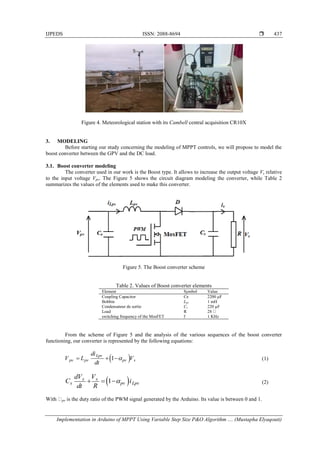
In order to have the meteorological conditions of solar irradiance G and temperature T, under which
the quantities (Ipv, Vpv) are recorded, the Fig.4 illustrates the test bench installed in our laboratory of EST
Agadir. Indeed, the solar irradiance G and the temperature T are measured by means of various sensors
managed by Cambell acquisition unit of CR10X kind. The data G and T are collected every 10 seconds,
depending on the configuration of the data acquisition unit [27].
IJPEDS ISSN: 2088-8694 
Implementation in Arduino of MPPT Using Variable Step Size P&O Algorithm .... (Mustapha Elyaqouti)
437
Figure 4. Meteorological station with its Cambell central acquisition CR10X
3. MODELING
Before starting our study concerning the modeling of MPPT controls, we will propose to model the
boost converter between the GPV and the DC load.
3.1. Boost converter modeling
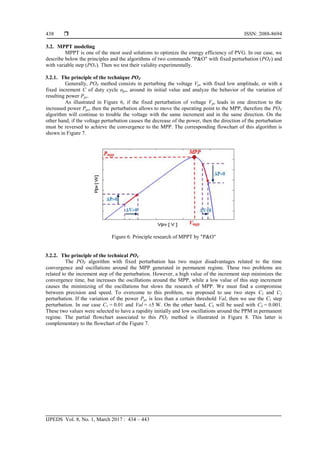
The converter used in our work is the Boost type. It allows to increase the output voltage Vs relative
to the input voltage Vpv. The Figure 5 shows the circuit diagram modeling the converter, while Table 2
summarizes the values of the elements used to make this converter.
Figure 5. The Boost converter scheme
Table 2. Values of Boost converter elements
Element Symbol Value
Coupling Capacitor Ce 2200 µF
Bobbin Lpv 1 mH
Condensateur de sortie Cs 220 µF
Load R 28
switching frequency of the MosFET f 1 KHz
From the scheme of Figure 5 and the analysis of the various sequences of the boost converter
functioning, our converter is represented by the following equations:
 
1
Lpv
pv pv pv s
di
V L V
dt

   (1)
 
1
s s
s pv Lpv
dV V
C i
dt R

   (2)
With pv is the duty ratio of the PWM signal generated by the Arduino. Its value is between 0 and 1.
 ISSN: 2088-8694
IJPEDS Vol. 8, No. 1, March 2017 : 434 – 443
438
3.2. MPPT modeling
MPPT is one of the most used solutions to optimize the energy efficiency of PVG. In our case, we
describe below the principles and the algorithms of two commands "P&O" with fixed perturbation (POF) and
with variable step (POV). Then we test their validity experimentally.
3.2.1. The principle of the technique POF
Generally, POF method consists in perturbing the voltage Vpv with fixed low amplitude, or with a
fixed increment C of duty cycle αpv, around its initial value and analyze the behavior of the variation of
resulting power Ppv.
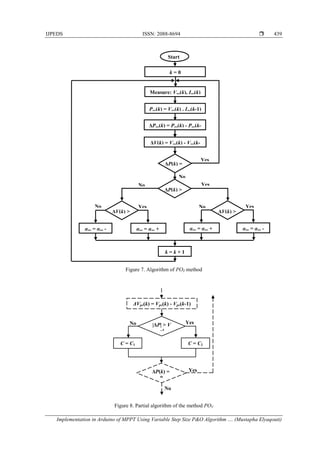
As illustrated in Figure 6, if the fixed perturbation of voltage Vpv leads in one direction to the
increased power Ppv, then the perturbation allows to move the operating point to the MPP, therefore the POF
algorithm will continue to trouble the voltage with the same increment and in the same direction. On the
other hand, if the voltage perturbation causes the decrease of the power, then the direction of the perturbation
must be reversed to achieve the convergence to the MPP. The corresponding flowchart of this algorithm is
shown in Figure 7.
Figure 6. Principle research of MPPT by "P&O"
3.2.2. The principle of the technical POV
The POF algorithm with fixed perturbation has two major disadvantages related to the time
convergence and oscillations around the MPP generated in permanent regime. These two problems are
related to the increment step of the perturbation. However, a high value of the increment step minimizes the
convergence time, but increases the oscillations around the MPP, while a low value of this step increment
causes the minimizing of the oscillations but slows the research of MPP. We must find a compromise
between precision and speed. To overcome to this problem, we proposed to use two steps C1 and C2
perturbation. If the variation of the power Ppv is less than a certain threshold Val, then we use the C1 step
perturbation. In our case C1 = 0.01 and Val = ±5 W. On the other hand, C2 will be used with C2 = 0.001.
These two values were selected to have a rapidity initially and low oscillations around the PPM in permanent
regime. The partial flowchart associated to this POV method is illustrated in Figure 8. This latter is
complementary to the flowchart of the Figure 7.
IJPEDS ISSN: 2088-8694 
Implementation in Arduino of MPPT Using Variable Step Size P&O Algorithm .... (Mustapha Elyaqouti)
439
Figure 7. Algorithm of POF method
Figure 8. Partial algorithm of the method POV
Measure: Vpv(k), Ipv(k)
Ppv(k) = Vpv(k) . Ipv(k-1)
ΔPpv(k) = Ppv(k) - Ppv(k-
1)
ΔV(k) = Vpv(k) - Vpv(k-
1)
ΔP(k) =
0
ΔP(k) >
0
ΔV(k) >
0
ΔV(k) >
0
αpv = αpv -
C
αpv = αpv +
C
αpv = αpv -
C
αpv = αpv +
C
k = k + 1
Yes
Yes
Yes
Yes
No
No
No
No
k = 0
Start
No
ΔVpv(k) = Vpv(k) - Vpv(k-1)
|ΔP| > V
al
ΔP(k) =
0
C = C1 C = C2
Yes
No
Yes
 ISSN: 2088-8694
IJPEDS Vol. 8, No. 1, March 2017 : 434 – 443
440
4. EXPERIMENTAL RESULTS
In order to test the performance of the MPPT algorithms cited in Part 3.2, we are going to plot the
output Ipv = f(Vpv) and Ppv = f(Vpv) of our PVG for different values of solar irradiance G and temperature T.
For this, we vary the duty cycle pv of 5% to 95% with a fixed increment. The obtained measurements allow
us to determine the maximum power Pmax generated by our PVG. And then Pmax will be compared to the
maximum power Pmpp extracted by either algorithms POF and POV. We note that G and T values measured by
the weather station in Figure 4, are considered constant throughout the characterization duration.
The obtained measurements allow us to represent in Figure 9 the characteristics Ipv = f(Vpv) and
Ppv = f(Vpv) for G = 982 W/m2
corresponding to an irradiance received on the active surface of the PV
module.
Figure 9. Experimental characteristicsIpv = f(Vpv) et Ppv = f(Vpv) of PVGMSX64type forG = 982 W/m2
et
T = 25.1°C
Figure 10 to 12 summarizes the experimental responses of power Ppv, of voltage Vpv and of current
Ipv under POF and POV methods. For the first method POF, we have presented two responses, one with a
fixed perturbation step C = 0.01 during the measurement, and another with C = 0.001 which does not vary
during the test. While for the second method POV, we have presented in the same figures the experimental
responses Ppv, Vpv and Ipv with a step depending on the proposed algorithm and can be C1 = 0.01 or
C2 = 0.001, during the time of characterization.
Figure 10. Experimental response of the power Ppv
0 5 10 15 20
0
1
2
3
4
5
Vpv [ V ]
Ipv
[
A
]
0 5 10 15 20
0
10
20
30
40
50
Ppv
[
W
]
0 2 4 6 8 10 12 14
0
10
20
30
40
50
Time [ S ]
Ppv
[
W
]
POF with C=0.01
POF with C=0.001
POV
10
IJPEDS ISSN: 2088-8694 
Implementation in Arduino of MPPT Using Variable Step Size P&O Algorithm .... (Mustapha Elyaqouti)
441
Figure 11. Experimental response of voltage Vpv
Figure 12. Experimental response of current Ipv
After analyzing these figures, we notice that for the algorithm POF with a fixed step C = 0.01 along
the measurement, the operating point reaches the MPP in 1.65 s against 3.72 s for a perturbation step
C = 0.001 also invariable during the test. As a result, the response is logically faster for the big step C = 0.01.
However, the oscillations around the MPP are less important for the small step C = 0.001. This allows us to
confirm that with a big step, the algorithm is faster but less accurate. Whereas, with a small step, the
algorithm is slower but fairly accurate. Regarding the algorithm of the POV technique with C1 = 0.01 and
C2 = 0.001, the operating point reached the MPP in 2.47 s with small oscillations around the MPP which is
identical to the method POF with low step. Therefore, this algorithm shows a good compromise between
speed and accuracy.
5. CONCLUSION
In this paper, we have presented the implementation of the command "P&O" with a fixed
perturbation step (POF) and the command "P&O" with a double perturbation step (POV) using the arduino
Mega board. The experimental result shows that the command POV gives good results compared to the
control POF in terms of time response and oscillations around the MPP.
REFERENCES
[1] M. A. El-Hakeem, “Solar Irradiance estimation of photovoltaic module besed on Thevenin equivalent circuit,”
International Journal of Renewable Energy Research, vol/issue: 5(4), pp. 971-977, 2015.
[2] M. E. Basoglu and B. Çakir, “Comparisons of MPPT performances of insolated and non-isolated DC-DC
converters by using a new approach,” Renewable and Sustainable Energy Reviews, vol. 60, pp. 1100-1113, 2016.
0 2 4 6 8 10 12 14
0
5
10
15
Time [ S ]
Vpv
[
V
]
POF with C=0.01
POF with C=0.001
POV
0 2 4 6 8 10 12 14
0
1
2
3
4
Time [ S ]
Ipv
[
A
]
POF with C=0.01
POF with C=0.001
POV
8
12
14
16
Time [ S ]
Vpv
[
V
]
8
3.2
3.4
3.6
3.8
Time [ S ]
Ipv
[
A
]
 ISSN: 2088-8694
IJPEDS Vol. 8, No. 1, March 2017 : 434 – 443
442
[3] N. Kumar, et al., “Prediction of solar energy based on intelligent ANN modelling,” International Journal of
Renewable Energy Research, vol/issue: 6(1), pp. 183-188, 2016.
[4] R. K. Tarai and P. Kale, “Development of rasterized mapusing PVGIS for assessment of solar PV energy potential
of Odisha,” International Journal of Renewable Energy Research, vol/issue: 6(1), pp. 61-72, 2016.
[5] A. A. Merrouni, et al., “Integration of PV in the Moroccan building: Simulation of a small roof system installed in
Eastern Morocco,” International Journal of Renewable Energy Research, vol/issue: 6(1), pp. 183-188, 2016.
[6] K. K. Kumar, et al., “Implementation of MPPT algorithm for solar photovoltaic cell by comparing short-circuit
method and incremental conductance method,” Procedia Technology, vol. 12, pp. 705-715, 2014.
[7] J. Ahmed and Z. Salam, “An improved perturb and observe (P&O) maximum power point traking (MPPT)
algorithm for higher efficiency,” Applied Energy, vol. 150, pp. 97-108, 2015.
[8] S. Farhat, et al., “P&O and Incremental conductance MPPT implementation,” International Review of Electrical
Engineering (IREE), vol/issue: 10(1), pp. 116-122, 2015.
[9] A. K. Abdelsalam, et al., “High-Performance adaptive Perturb and Observe MPPT technique for photovoltaic-
Based Microgrids,” IEEE Transactions on Power Electronics, vol/issue: 26(4), pp. 1010-1021, 2011.
[10] N. S. D'Souza, et al., “Comparative study of variable size perturbation and observation maximum power point
trackers for PV systems,” Electric Power Systems Research, vol/issue: 80(3), pp. 296-305, 2010.
[11] P. S. Kumar, et al., “Analyse and enhancement of PV efficiency with Incremental Conductance MPPT technique
under non-linear loading conditions,” Renewable Energy, vol. 81, pp. 543-550, 2015.
[12] K. Ishaque, et al., “The performance of perturb and observe and incremental conductance maximum power point
tracking method under dynamic weather conditions,” Applied Energy, vol. 119, pp. 228-236, 2014.
[13] M. B. Kalashani and M. Farsadi, “New Structure for Photovoltaic Systems with Maximum Power Point Tracking
Ability,” International Journal of Power Electronics and Drive System, vol/issue: 4(4), pp. 489-498, 2014.
[14] K. Hirech, et al., “Photovoltaic system equipped with a reliable and efficient regulator/MPPT and energy flow
controller,” International Review of Electrical Engineering (IREE), vol/issue: 10(1), pp. 131-144, 2015.
[15] M. A. Enany, et al., “Modeling and evaluation of main maximum power point tracking algorithms for photovoltaics
systems,” Renewable and Sustainable Energy Reviews, vol. 58, pp. 1578-1586, 2016.
[16] S. Selvan, et al., “A Review on Photovoltaic MPPT Algorithms,” International Journal of Electrical and Computer
Engineering (IJECE), vol/issue: 6(2), pp. 567-582, 2016.
[17] B. Bendib, et al., “A Survey of the most used MPPT methods: Conventional and advanced algorithms applied for
photovoltaic systems,” Renewable and Sustainable Energy Reviews, vol. 45, pp. 637-648, 2015.
[18] Y. T. Chen, et al., “A fuzzy-logic based auto-scaling variable step-size MPPT method for PV systems,” Solar
Energy, vol. 126, pp. 53-63, 2016.
[19] C. Sharma and A. Jain, “Performance Comparison of PID and Fuzzy Controllers in Distributed MPPT,”
International Journal of Power Electronics and Drive System (IJPEDS), vol/issue: 6(3), pp. 625-635, 2015.
[20] S. Daraban, et al., “A novel MPPT (Maximun Power Point Tracking) algorithm based on a modified genetic
algorithm specialized on tracking the global maximum power point in photovoltaic systems affected by partial
shading,” Energy, vol. 74, pp. 374-388, 2014.
[21] P. Kofinus, et al., “An Intelligent MPPT controller based on direct neural control for partially shaded PV system,”
Energy and Building, vol. 90, pp. 51-64, 2015.
[22] A. A. Kulaksiz and R. Akkaya, “A genetic algorithm optimized ANN-based MPPT algorithm for a stand-alone PV
system with induction motor drive,” Solar Energy, vol/issue: 86(9), pp. 2366-2375, 2012.
[23] M. Yaichi, et al., “A Neural Network MPPT Technique Controller for Photovoltaic Pumping System,”
International Journal of Power Electronics and Drive System (IJPEDS), vol/issue: 4(2), pp. 241-255, 2014.
[24] H. Rezk and E. S. Hasaneen, “A new Matlab/Simulink model of triple-junction solar cell and MPPT based on
artificial neural networks for photovoltaic energy systems,” Ain Shams Engineering Journal, vol. 6, pp. 873-881,
2015.
[25] Web site: https://www.smud.org/en/about-smud/environment/renewable-energy/documents/solar-regatta-
photovoltaic-specs.pdf
[26] M. Elyaqouti, et al., “Etude comparative de modèles de caractérisation et extraction des paramètres d’un générateur
photovoltaïque,” 9ème Congrès Francophone de Génie des Procédés, Agadir, 28-30 Avril 2014.
[27] S. Farhat, et al., “MPPT Efficiency test by neural networks and P&O algorithm,” International Review of Electrical
Engineering (IREE), vol/issue: 8(5), pp. 1548-1554, 2013.
BIOGRAPHIES OF AUTHORS
Mustapha Elyaqouti was born in Agadir, Morocco, in 1984. He received the technical
University degree (DUT) in Electrical Engineering from the High School of Technologies of
Agadir (EST Agadir), in 2006. He received his BSc degree in physics and a post graduate degree
in Materials Engineering and energetic environment from Ibn Zohr University, in 2010 and
2012. His research, in the context of national doctoral thesis, focuses on the thematic of
Renewable Energies. The doctoral investigation took place in the Research Team in advanced
Technologies and Engineering of Renewable Energies (ERTAIER) Agadir Morocco
IJPEDS ISSN: 2088-8694 
Implementation in Arduino of MPPT Using Variable Step Size P&O Algorithm .... (Mustapha Elyaqouti)
443
Safa HAKIM Born in Ouarzazate-Morocco in 1988. She received the BSM (2006), Engineer
state degree (2012) from the national school of Arts and Trades (ENSAM Meknes Morocco), she
is currently a student of Ph.D in Faculty of Science, University IbnZohr Agadir-Morocco. His
research, in the context of national doctoral thesis, focuses on the thematic of renewable
Energies. The doctoral investigations took place in the Research Team in Advanced
Technologies and Engineering of Renewable Energies (ERTAIER) Agadir, Morocco
Sadik Farhat Associate Professor (2001) in Electrical Engineering with a Bachelor (1996) in
Electronics in Higher Normal School of Technology (ENSET), Rabat, Morocco and a post
graduate degree in (2007), of Energy and Environment in the National School of Applied
Sciences (ENSA) of Agadir, Morocco. His research, in the context of national doctoral thesis,
focuses on the thematic of renewable Energies. The doctoral investigations took place in the
Research Team in Advanced Technologies and Engineering of Renewable Energies (ERTAIER)
LahoussineBouhouchProfessor of higher education at the ESTA (High School of Technologies
of Agadir), IbnZohr University, Agadir, Morocco. PhD Electrical Engineering at the Nancy I
University, France in 1988 and state doctorate in Electrical in 2007. Responsible of the research
team ERTAIR (Research Team in Advanced Technologies and Engineering of Renewable
Energies). His research focuses on topics related to renewable energy, instrumentation and
electromagnetic compatibility (EMC)
Ahmed Ihlal, was born and brought up in Morocco. He studied Physics and Chemistry and
holds, in 1984, his BSc degree (LicenceEs-Sciences Physique) in Solid State Physics from the
University Mohamed V, Rabat - Morocco. He then joined Paris VII University – France, where
he got, in 1985, a MSc. degree (DEA: Diplome des Etudes Approfondies) in Solar Energy. He
pursued his research on the studies and got, in 1988, a PhD degree from the University of Caen
BasseNormandie - France. Dr. A. Ihlal started his teaching career on I988 as Assistant Professor
in the faculty of Science at University Ibn Zohr. Then he holds a "Doctorat d'Etat" thesis in
1995. He is currently Full Professor in Faculty of Sciences, University Ibn Zohr, Agadir -
Morocco. He is head of the group working on developing cost effective processes for the
fabrication of CIGS and CZTS absorber layers, buffer layers and TCOs. He is working on PV
and CSP systems as well. He has published 60 scientific papers, and acted as a referee for
numerous international journals. He has contributed to the organization of numerous national
and international conferences and was a member of scientific committees for several
international conferences. He is supervising PhD, MSc as well as BSc students in the field of PV
and CSP. He is an expert of the CNRST in the field of renewable energies.

Implementation in Arduino of MPPT Using Variable Step Size P&O Algorithm in PV Installations

  • 1.
    International Journal ofPower Electronics and Drive System (IJPEDS) Vol. 8, No. 1, March 2017, pp. 434~443 ISSN: 2088-8694, DOI: 10.11591/ijpeds.v8i1.pp434-443  434 Journal homepage: http://iaesjournal.com/online/index.php/IJPEDS Implementation in Arduino of MPPT Using Variable Step Size P&O Algorithm in PV Installations Mustapha Elyaqouti1 , Safa Hakim2 , Sadik Farhat3 , Lahoussine Bouhouch4 , Ahmed Ihlal5 1,3,4 ERTAIER, ESTA Ibn Zohr University, BP 33/S, 80000 Agadir, Morocco 2 LMTI, FS Ibn Zohr University, BP 8106, 80000 Agadir, Morocco 5 LMER, FS Ibn Zohr University, BP 8106, 80000 Agadir, Morocco Article Info ABSTRACT Article history: Received Oct 31, 2016 Revised Jan 06, 2017 Accepted Jan 16, 2017 In order to maximize the electric energy production of a photovoltaic generator (PVG), the maximum power point tracking (MPPT) methods are usually used in photovoltaic systems. The principle of these techniques is to operate the PVG to the maximum power point (MPP), which depends on the environmental factors, such as solar irradiance and ambient temperature, ensuring the optimal power transfer between PVG and load. In this paper, we present the implementation of two digital MPPT commands using the Arduino Mega type. The two proposed MPPT controls are based on the algorithm of perturb and observe (P&O), the first one with fixed perturbation step and the second one with two perturbations step varying with some conditions. The experimental results show that the P&O algorithm with variable step perturbation gives good results compared to the P&O algorithm with fixed perturbation step in terms of the time response and the oscillations around the MPP. Keyword: Boost converter MPPT P&O algorithm P&O Algorithm with Variable Step Photovoltaic energy Copyright © 2017 Institute of Advanced Engineering and Science. All rights reserved. Corresponding Author: Mustapha Elyaqouti, ERTAIER, ESTA Ibn Zohr University, BP 33/S, 80000 Agadir, Morocco. Email: elyaqouti@gmail.com 1. INTRODUCTION The use of renewable energy sources has become increasingly popular around the world, due to their functioning friendly to the environment [1]. Solar energy is the most promising one. It is a clean and important source for producing electricity [2],[3]. It has a huge energy potential compared to other sources [4]. Indeed, with an average irradiation of 5630 Wh/m2 /day, Morocco may cover their energy needs and export a part of it [5]. However, the output characteristics of PV module depend strongly on the solar radiation attaining the active surface of PV module and cell temperature of PV module. Furthermore, these parameters have a variable character depending on the latitude, the orientation of the solar field, the season and the hour of day. In other terms, the characteristics of the PV panels depend on the parameters continually changing during the day [6]. These characteristics, specifically those of PVG power P(V), admit a point corresponding to the maximum power, that is the optimum operating point, named MPP (maximum power point). A converter that ensures the conversion of electricity exploitable by the user must find and track the MPP continuously on the curve P (V). In this context, a large number of technical research of the maximum power point tracking (MPPT: Maximum Power Point Tracker) are well established in the literature. Indeed, several methods exist, such as: "Perturb and Observe" (P&O) [7]-[10], the "Incremental conductance" (InC) [11]-[13] which are variants of the "Hill Climbing" [14], Fractional open circuit voltage
  • 2.
    IJPEDS ISSN: 2088-8694 Implementation in Arduino of MPPT Using Variable Step Size P&O Algorithm .... (Mustapha Elyaqouti) 435 (FCO) or Fractional short circuit current algorithm (FCC) [15],[16], the techniques of artificial intelligence, such as the control by fuzzy logic [17]-[19], by genetic algorithm [20] or by neural networks [21]-[23] etc. Among these techniques, the "P&O" Classic is the most popular and easiest way to implement [24]. In this paper, we focus on the implementation of the command "P&O" classic with fixed perturbation step as well as variable step. This command is implemented on the Arduino board. Our paper is organized as follows: After this introduction, we will describe in the second part the test bench and measurement, then in the third part we will present the modeling of the Boost converter as well as their MPPT techniques. The last part will be devoted to the exhibition and analysis of experimental results followed by a conclusion. 2. TEST BENCH AND MEASUREMENT 2.1. Test bench The present conversion chain constituting our test bench comprises a photovoltaic generator (PVG), supplying a DC load through a boost converter. This latter is controlled by an MPPT control type "P&O" in order to have the power supplied by the PVG corresponds to the maximum power generated. The block diagram of this system is illustrated in Figure 1. Figure 1. Synoptic scheme of the realized PV conversion chain The principle measuring adopted in this test bench, is to take the current Ipv supplied by the PVG as well as the voltage Vpv between its terminals. These variables Ipv and Vpv are delivered by the current and voltage sensors connected to the inputs of the analog digital converter integrated in the Arduino board type Mega 2560. This latter is programmed to be used as an acquisition card transmitting in real time, the numerical values acquired (Ipv, Vpv) to a computer through an RS232 / USB serial converter. Figure 2 below shows the realized prototype to validate the developed MPPT algorithms. Figure 2. Realized test Bench Load Driver Boost Converter Arduino Mega 2560
  • 3.
     ISSN: 2088-8694 IJPEDSVol. 8, No. 1, March 2017 : 434 – 443 436 In terms of treatment unit, we have developed under the Matlab-Simulink environment a program that ensures the capture of the data (Ipv, Vpv) that will serve as inputs for the MPPT algorithms that we have developed. These algorithms determine the appropriate duty cycle pv for the Arduino board in order to produce a PWM signal (Pulse Width Modulation) this latter attack a driver amplifying the current control of the MOSFET transistor of Boost converter. Concerning the capture, archiving and treatment of Ipv and Vpv sizes, the Figure 3 shows the block diagram for the program that we have developed under Matlab-Simulink. This allows us to visualize in real time the characteristics Ipv = f(t), Vpv = f(t), Ipv = f(Vpv) and the evolution of the power Ppv = f(Vpv) of PV module. Figure 3. Acquisition program through the Arduino board and data processing under Matlab-Simulink 2.2. PV Module The PVG used in our investigations is BP Solar MSX-64. Their electrical specifications provided by the manufacturer are given in Table 1 [25], under the standard test conditions STC (Standard Test Conditions: G = 1000 W/m2 , AM 1.5, T = 25°C). The results of characterization of this PVG using many models have been the subject of the publication [26]. Table 1. Electrical characteristics of the PV panel MSX-64 in STC[25] Parameters Value Maximum power Pmax 64 W Voltage at maximum power Vmpp 17.5 V Current at maximum power Impp 3.66 A Short-circuit current Isc 4 A Open-circuit voltage Voc 21.3 V 2.3. Bench measurement of meteorological conditions In order to have the meteorological conditions of solar irradiance G and temperature T, under which the quantities (Ipv, Vpv) are recorded, the Fig.4 illustrates the test bench installed in our laboratory of EST Agadir. Indeed, the solar irradiance G and the temperature T are measured by means of various sensors managed by Cambell acquisition unit of CR10X kind. The data G and T are collected every 10 seconds, depending on the configuration of the data acquisition unit [27].
  • 4.
    IJPEDS ISSN: 2088-8694 Implementation in Arduino of MPPT Using Variable Step Size P&O Algorithm .... (Mustapha Elyaqouti) 437 Figure 4. Meteorological station with its Cambell central acquisition CR10X 3. MODELING Before starting our study concerning the modeling of MPPT controls, we will propose to model the boost converter between the GPV and the DC load. 3.1. Boost converter modeling The converter used in our work is the Boost type. It allows to increase the output voltage Vs relative to the input voltage Vpv. The Figure 5 shows the circuit diagram modeling the converter, while Table 2 summarizes the values of the elements used to make this converter. Figure 5. The Boost converter scheme Table 2. Values of Boost converter elements Element Symbol Value Coupling Capacitor Ce 2200 µF Bobbin Lpv 1 mH Condensateur de sortie Cs 220 µF Load R 28 switching frequency of the MosFET f 1 KHz From the scheme of Figure 5 and the analysis of the various sequences of the boost converter functioning, our converter is represented by the following equations:   1 Lpv pv pv pv s di V L V dt     (1)   1 s s s pv Lpv dV V C i dt R     (2) With pv is the duty ratio of the PWM signal generated by the Arduino. Its value is between 0 and 1.
  • 5.
     ISSN: 2088-8694 IJPEDSVol. 8, No. 1, March 2017 : 434 – 443 438 3.2. MPPT modeling MPPT is one of the most used solutions to optimize the energy efficiency of PVG. In our case, we describe below the principles and the algorithms of two commands "P&O" with fixed perturbation (POF) and with variable step (POV). Then we test their validity experimentally. 3.2.1. The principle of the technique POF Generally, POF method consists in perturbing the voltage Vpv with fixed low amplitude, or with a fixed increment C of duty cycle αpv, around its initial value and analyze the behavior of the variation of resulting power Ppv. As illustrated in Figure 6, if the fixed perturbation of voltage Vpv leads in one direction to the increased power Ppv, then the perturbation allows to move the operating point to the MPP, therefore the POF algorithm will continue to trouble the voltage with the same increment and in the same direction. On the other hand, if the voltage perturbation causes the decrease of the power, then the direction of the perturbation must be reversed to achieve the convergence to the MPP. The corresponding flowchart of this algorithm is shown in Figure 7. Figure 6. Principle research of MPPT by "P&O" 3.2.2. The principle of the technical POV The POF algorithm with fixed perturbation has two major disadvantages related to the time convergence and oscillations around the MPP generated in permanent regime. These two problems are related to the increment step of the perturbation. However, a high value of the increment step minimizes the convergence time, but increases the oscillations around the MPP, while a low value of this step increment causes the minimizing of the oscillations but slows the research of MPP. We must find a compromise between precision and speed. To overcome to this problem, we proposed to use two steps C1 and C2 perturbation. If the variation of the power Ppv is less than a certain threshold Val, then we use the C1 step perturbation. In our case C1 = 0.01 and Val = ±5 W. On the other hand, C2 will be used with C2 = 0.001. These two values were selected to have a rapidity initially and low oscillations around the PPM in permanent regime. The partial flowchart associated to this POV method is illustrated in Figure 8. This latter is complementary to the flowchart of the Figure 7.
  • 6.
    IJPEDS ISSN: 2088-8694 Implementation in Arduino of MPPT Using Variable Step Size P&O Algorithm .... (Mustapha Elyaqouti) 439 Figure 7. Algorithm of POF method Figure 8. Partial algorithm of the method POV Measure: Vpv(k), Ipv(k) Ppv(k) = Vpv(k) . Ipv(k-1) ΔPpv(k) = Ppv(k) - Ppv(k- 1) ΔV(k) = Vpv(k) - Vpv(k- 1) ΔP(k) = 0 ΔP(k) > 0 ΔV(k) > 0 ΔV(k) > 0 αpv = αpv - C αpv = αpv + C αpv = αpv - C αpv = αpv + C k = k + 1 Yes Yes Yes Yes No No No No k = 0 Start No ΔVpv(k) = Vpv(k) - Vpv(k-1) |ΔP| > V al ΔP(k) = 0 C = C1 C = C2 Yes No Yes
  • 7.
     ISSN: 2088-8694 IJPEDSVol. 8, No. 1, March 2017 : 434 – 443 440 4. EXPERIMENTAL RESULTS In order to test the performance of the MPPT algorithms cited in Part 3.2, we are going to plot the output Ipv = f(Vpv) and Ppv = f(Vpv) of our PVG for different values of solar irradiance G and temperature T. For this, we vary the duty cycle pv of 5% to 95% with a fixed increment. The obtained measurements allow us to determine the maximum power Pmax generated by our PVG. And then Pmax will be compared to the maximum power Pmpp extracted by either algorithms POF and POV. We note that G and T values measured by the weather station in Figure 4, are considered constant throughout the characterization duration. The obtained measurements allow us to represent in Figure 9 the characteristics Ipv = f(Vpv) and Ppv = f(Vpv) for G = 982 W/m2 corresponding to an irradiance received on the active surface of the PV module. Figure 9. Experimental characteristicsIpv = f(Vpv) et Ppv = f(Vpv) of PVGMSX64type forG = 982 W/m2 et T = 25.1°C Figure 10 to 12 summarizes the experimental responses of power Ppv, of voltage Vpv and of current Ipv under POF and POV methods. For the first method POF, we have presented two responses, one with a fixed perturbation step C = 0.01 during the measurement, and another with C = 0.001 which does not vary during the test. While for the second method POV, we have presented in the same figures the experimental responses Ppv, Vpv and Ipv with a step depending on the proposed algorithm and can be C1 = 0.01 or C2 = 0.001, during the time of characterization. Figure 10. Experimental response of the power Ppv 0 5 10 15 20 0 1 2 3 4 5 Vpv [ V ] Ipv [ A ] 0 5 10 15 20 0 10 20 30 40 50 Ppv [ W ] 0 2 4 6 8 10 12 14 0 10 20 30 40 50 Time [ S ] Ppv [ W ] POF with C=0.01 POF with C=0.001 POV 10
  • 8.
    IJPEDS ISSN: 2088-8694 Implementation in Arduino of MPPT Using Variable Step Size P&O Algorithm .... (Mustapha Elyaqouti) 441 Figure 11. Experimental response of voltage Vpv Figure 12. Experimental response of current Ipv After analyzing these figures, we notice that for the algorithm POF with a fixed step C = 0.01 along the measurement, the operating point reaches the MPP in 1.65 s against 3.72 s for a perturbation step C = 0.001 also invariable during the test. As a result, the response is logically faster for the big step C = 0.01. However, the oscillations around the MPP are less important for the small step C = 0.001. This allows us to confirm that with a big step, the algorithm is faster but less accurate. Whereas, with a small step, the algorithm is slower but fairly accurate. Regarding the algorithm of the POV technique with C1 = 0.01 and C2 = 0.001, the operating point reached the MPP in 2.47 s with small oscillations around the MPP which is identical to the method POF with low step. Therefore, this algorithm shows a good compromise between speed and accuracy. 5. CONCLUSION In this paper, we have presented the implementation of the command "P&O" with a fixed perturbation step (POF) and the command "P&O" with a double perturbation step (POV) using the arduino Mega board. The experimental result shows that the command POV gives good results compared to the control POF in terms of time response and oscillations around the MPP. REFERENCES [1] M. A. El-Hakeem, “Solar Irradiance estimation of photovoltaic module besed on Thevenin equivalent circuit,” International Journal of Renewable Energy Research, vol/issue: 5(4), pp. 971-977, 2015. [2] M. E. Basoglu and B. Çakir, “Comparisons of MPPT performances of insolated and non-isolated DC-DC converters by using a new approach,” Renewable and Sustainable Energy Reviews, vol. 60, pp. 1100-1113, 2016. 0 2 4 6 8 10 12 14 0 5 10 15 Time [ S ] Vpv [ V ] POF with C=0.01 POF with C=0.001 POV 0 2 4 6 8 10 12 14 0 1 2 3 4 Time [ S ] Ipv [ A ] POF with C=0.01 POF with C=0.001 POV 8 12 14 16 Time [ S ] Vpv [ V ] 8 3.2 3.4 3.6 3.8 Time [ S ] Ipv [ A ]
  • 9.
     ISSN: 2088-8694 IJPEDSVol. 8, No. 1, March 2017 : 434 – 443 442 [3] N. Kumar, et al., “Prediction of solar energy based on intelligent ANN modelling,” International Journal of Renewable Energy Research, vol/issue: 6(1), pp. 183-188, 2016. [4] R. K. Tarai and P. Kale, “Development of rasterized mapusing PVGIS for assessment of solar PV energy potential of Odisha,” International Journal of Renewable Energy Research, vol/issue: 6(1), pp. 61-72, 2016. [5] A. A. Merrouni, et al., “Integration of PV in the Moroccan building: Simulation of a small roof system installed in Eastern Morocco,” International Journal of Renewable Energy Research, vol/issue: 6(1), pp. 183-188, 2016. [6] K. K. Kumar, et al., “Implementation of MPPT algorithm for solar photovoltaic cell by comparing short-circuit method and incremental conductance method,” Procedia Technology, vol. 12, pp. 705-715, 2014. [7] J. Ahmed and Z. Salam, “An improved perturb and observe (P&O) maximum power point traking (MPPT) algorithm for higher efficiency,” Applied Energy, vol. 150, pp. 97-108, 2015. [8] S. Farhat, et al., “P&O and Incremental conductance MPPT implementation,” International Review of Electrical Engineering (IREE), vol/issue: 10(1), pp. 116-122, 2015. [9] A. K. Abdelsalam, et al., “High-Performance adaptive Perturb and Observe MPPT technique for photovoltaic- Based Microgrids,” IEEE Transactions on Power Electronics, vol/issue: 26(4), pp. 1010-1021, 2011. [10] N. S. D'Souza, et al., “Comparative study of variable size perturbation and observation maximum power point trackers for PV systems,” Electric Power Systems Research, vol/issue: 80(3), pp. 296-305, 2010. [11] P. S. Kumar, et al., “Analyse and enhancement of PV efficiency with Incremental Conductance MPPT technique under non-linear loading conditions,” Renewable Energy, vol. 81, pp. 543-550, 2015. [12] K. Ishaque, et al., “The performance of perturb and observe and incremental conductance maximum power point tracking method under dynamic weather conditions,” Applied Energy, vol. 119, pp. 228-236, 2014. [13] M. B. Kalashani and M. Farsadi, “New Structure for Photovoltaic Systems with Maximum Power Point Tracking Ability,” International Journal of Power Electronics and Drive System, vol/issue: 4(4), pp. 489-498, 2014. [14] K. Hirech, et al., “Photovoltaic system equipped with a reliable and efficient regulator/MPPT and energy flow controller,” International Review of Electrical Engineering (IREE), vol/issue: 10(1), pp. 131-144, 2015. [15] M. A. Enany, et al., “Modeling and evaluation of main maximum power point tracking algorithms for photovoltaics systems,” Renewable and Sustainable Energy Reviews, vol. 58, pp. 1578-1586, 2016. [16] S. Selvan, et al., “A Review on Photovoltaic MPPT Algorithms,” International Journal of Electrical and Computer Engineering (IJECE), vol/issue: 6(2), pp. 567-582, 2016. [17] B. Bendib, et al., “A Survey of the most used MPPT methods: Conventional and advanced algorithms applied for photovoltaic systems,” Renewable and Sustainable Energy Reviews, vol. 45, pp. 637-648, 2015. [18] Y. T. Chen, et al., “A fuzzy-logic based auto-scaling variable step-size MPPT method for PV systems,” Solar Energy, vol. 126, pp. 53-63, 2016. [19] C. Sharma and A. Jain, “Performance Comparison of PID and Fuzzy Controllers in Distributed MPPT,” International Journal of Power Electronics and Drive System (IJPEDS), vol/issue: 6(3), pp. 625-635, 2015. [20] S. Daraban, et al., “A novel MPPT (Maximun Power Point Tracking) algorithm based on a modified genetic algorithm specialized on tracking the global maximum power point in photovoltaic systems affected by partial shading,” Energy, vol. 74, pp. 374-388, 2014. [21] P. Kofinus, et al., “An Intelligent MPPT controller based on direct neural control for partially shaded PV system,” Energy and Building, vol. 90, pp. 51-64, 2015. [22] A. A. Kulaksiz and R. Akkaya, “A genetic algorithm optimized ANN-based MPPT algorithm for a stand-alone PV system with induction motor drive,” Solar Energy, vol/issue: 86(9), pp. 2366-2375, 2012. [23] M. Yaichi, et al., “A Neural Network MPPT Technique Controller for Photovoltaic Pumping System,” International Journal of Power Electronics and Drive System (IJPEDS), vol/issue: 4(2), pp. 241-255, 2014. [24] H. Rezk and E. S. Hasaneen, “A new Matlab/Simulink model of triple-junction solar cell and MPPT based on artificial neural networks for photovoltaic energy systems,” Ain Shams Engineering Journal, vol. 6, pp. 873-881, 2015. [25] Web site: https://www.smud.org/en/about-smud/environment/renewable-energy/documents/solar-regatta- photovoltaic-specs.pdf [26] M. Elyaqouti, et al., “Etude comparative de modèles de caractérisation et extraction des paramètres d’un générateur photovoltaïque,” 9ème Congrès Francophone de Génie des Procédés, Agadir, 28-30 Avril 2014. [27] S. Farhat, et al., “MPPT Efficiency test by neural networks and P&O algorithm,” International Review of Electrical Engineering (IREE), vol/issue: 8(5), pp. 1548-1554, 2013. BIOGRAPHIES OF AUTHORS Mustapha Elyaqouti was born in Agadir, Morocco, in 1984. He received the technical University degree (DUT) in Electrical Engineering from the High School of Technologies of Agadir (EST Agadir), in 2006. He received his BSc degree in physics and a post graduate degree in Materials Engineering and energetic environment from Ibn Zohr University, in 2010 and 2012. His research, in the context of national doctoral thesis, focuses on the thematic of Renewable Energies. The doctoral investigation took place in the Research Team in advanced Technologies and Engineering of Renewable Energies (ERTAIER) Agadir Morocco
  • 10.
    IJPEDS ISSN: 2088-8694 Implementation in Arduino of MPPT Using Variable Step Size P&O Algorithm .... (Mustapha Elyaqouti) 443 Safa HAKIM Born in Ouarzazate-Morocco in 1988. She received the BSM (2006), Engineer state degree (2012) from the national school of Arts and Trades (ENSAM Meknes Morocco), she is currently a student of Ph.D in Faculty of Science, University IbnZohr Agadir-Morocco. His research, in the context of national doctoral thesis, focuses on the thematic of renewable Energies. The doctoral investigations took place in the Research Team in Advanced Technologies and Engineering of Renewable Energies (ERTAIER) Agadir, Morocco Sadik Farhat Associate Professor (2001) in Electrical Engineering with a Bachelor (1996) in Electronics in Higher Normal School of Technology (ENSET), Rabat, Morocco and a post graduate degree in (2007), of Energy and Environment in the National School of Applied Sciences (ENSA) of Agadir, Morocco. His research, in the context of national doctoral thesis, focuses on the thematic of renewable Energies. The doctoral investigations took place in the Research Team in Advanced Technologies and Engineering of Renewable Energies (ERTAIER) LahoussineBouhouchProfessor of higher education at the ESTA (High School of Technologies of Agadir), IbnZohr University, Agadir, Morocco. PhD Electrical Engineering at the Nancy I University, France in 1988 and state doctorate in Electrical in 2007. Responsible of the research team ERTAIR (Research Team in Advanced Technologies and Engineering of Renewable Energies). His research focuses on topics related to renewable energy, instrumentation and electromagnetic compatibility (EMC) Ahmed Ihlal, was born and brought up in Morocco. He studied Physics and Chemistry and holds, in 1984, his BSc degree (LicenceEs-Sciences Physique) in Solid State Physics from the University Mohamed V, Rabat - Morocco. He then joined Paris VII University – France, where he got, in 1985, a MSc. degree (DEA: Diplome des Etudes Approfondies) in Solar Energy. He pursued his research on the studies and got, in 1988, a PhD degree from the University of Caen BasseNormandie - France. Dr. A. Ihlal started his teaching career on I988 as Assistant Professor in the faculty of Science at University Ibn Zohr. Then he holds a "Doctorat d'Etat" thesis in 1995. He is currently Full Professor in Faculty of Sciences, University Ibn Zohr, Agadir - Morocco. He is head of the group working on developing cost effective processes for the fabrication of CIGS and CZTS absorber layers, buffer layers and TCOs. He is working on PV and CSP systems as well. He has published 60 scientific papers, and acted as a referee for numerous international journals. He has contributed to the organization of numerous national and international conferences and was a member of scientific committees for several international conferences. He is supervising PhD, MSc as well as BSc students in the field of PV and CSP. He is an expert of the CNRST in the field of renewable energies.