Control and Design of PV-Battery Charger
with Maximum Power PointTracker
(MPPT)
Graduation Project- submitted to:
Ι
Department of Electrical Engineering
Faculty of Engineering and InformationTechnology
An–Najah National University
In partial fulfillment of the requirements for Bachelor degree in Electrical
Engineering
Supervised by: Dr. Moien Omar
Outlines
 Introduction
 Problem statement
 Objectives
 Project Work
 MPPT VS PWM
 MPPT algorithm
 (P-V) and (I-V) curves
 Charging time of battery with & without MPPT
 Results & Conclusion
 Second phase work
Introduction
• Solar energy is one of the most important renewable energy sources that have been gaining
increased attention in recent years. Solar energy is plentiful, it has the greatest availability
compared to other energy sources, it is clean and free of emissions.
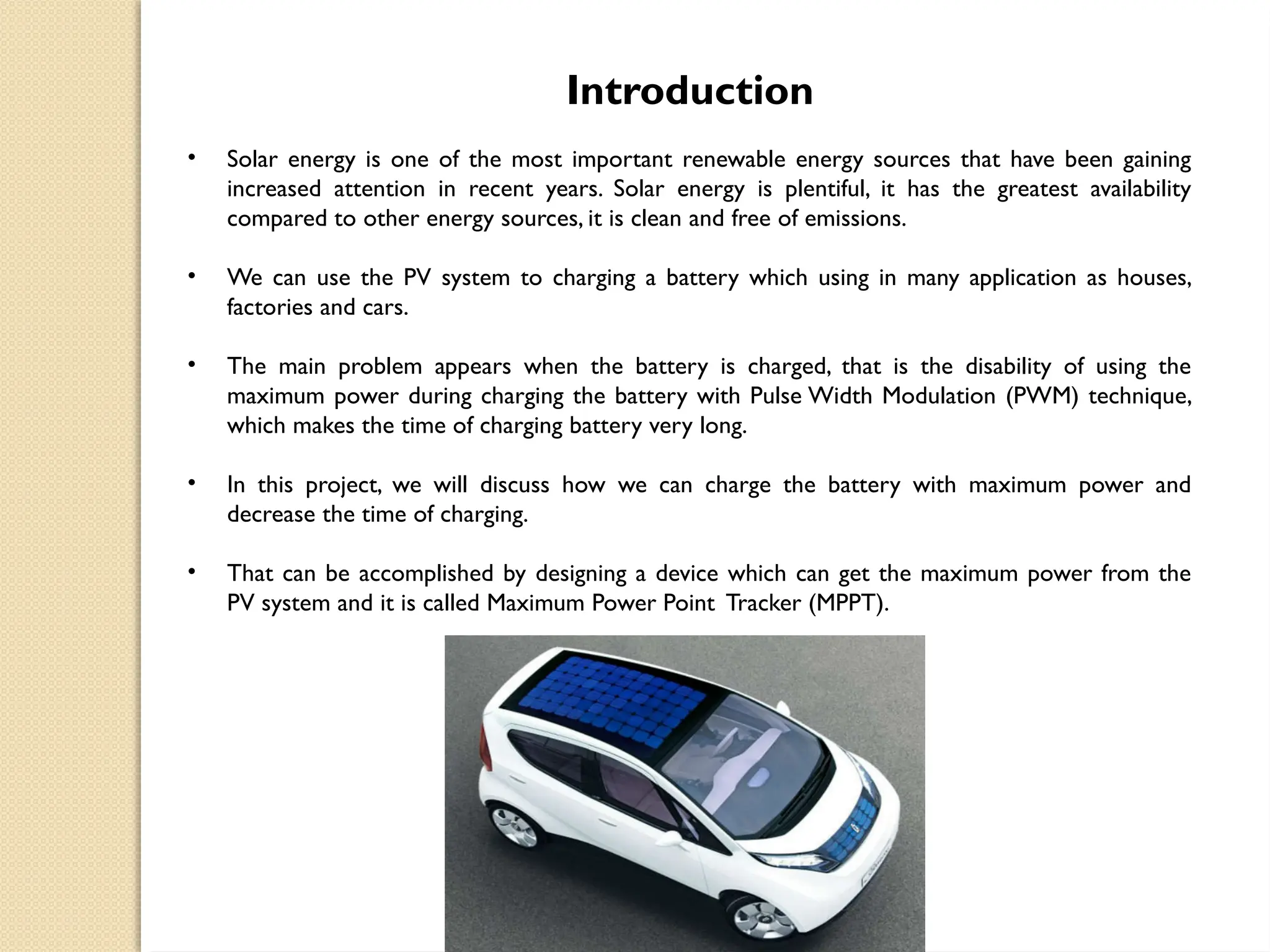
• We can use the PV system to charging a battery which using in many application as houses,
factories and cars.
• The main problem appears when the battery is charged, that is the disability of using the
maximum power during charging the battery with Pulse Width Modulation (PWM) technique,
which makes the time of charging battery very long.
• In this project, we will discuss how we can charge the battery with maximum power and
decrease the time of charging.
• That can be accomplished by designing a device which can get the maximum power from the
PV system and it is called Maximum Power Point Tracker (MPPT).
•
Recently,
research
and
development
of
low
cost
solar
panels,
thin-film
devices,
concentrator
systems,
and
many
innovative
concepts
have
increased.
•
Nowadays,
the
costs
of
small
solar-power
modular
units
and
solar-power
plants
are
economically
feasible
for
large-scale
production
and
use
of
solar
energy.
Problem
Statement
•
The
energy
generated
from
the
PV
module
is
mainly
dependent
on
the
temperature
and
solar
radiation.
•
MPPT
is
used
to
extract
the
maximum
power
from
the
PV
panel
in
order
to
maximize
the
overall
efficiency
of
the
system,
thereby
reducing
the
overall
system
cost.
Objectives
•
In
this
work,
a
battery
charger
form
photovoltaic
(PV)
solar
cell
with
maximum
power
point
tracking
is
proposed.
•
In
the
first
phase
of
the
project,
a
mathematical
model
is
presented
and
simulated
in
order
to
understand
system
operation
and
functions.
Project
Work
• MPPT and PWM charge controllers used to charge the
batteries from a solar array.
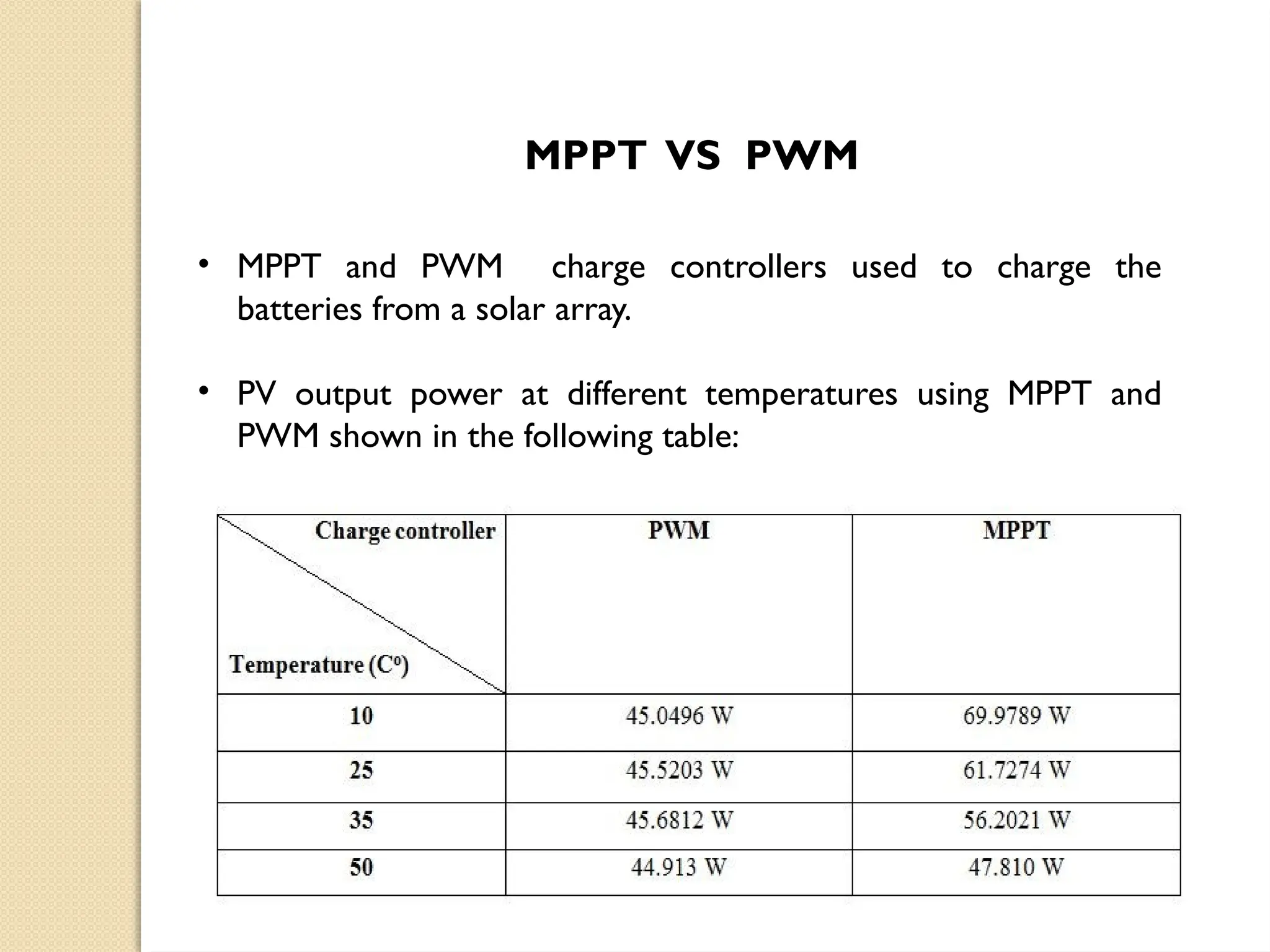
• PV output power at different temperatures using MPPT and
PWM shown in the following table:
MPPT VS PWM
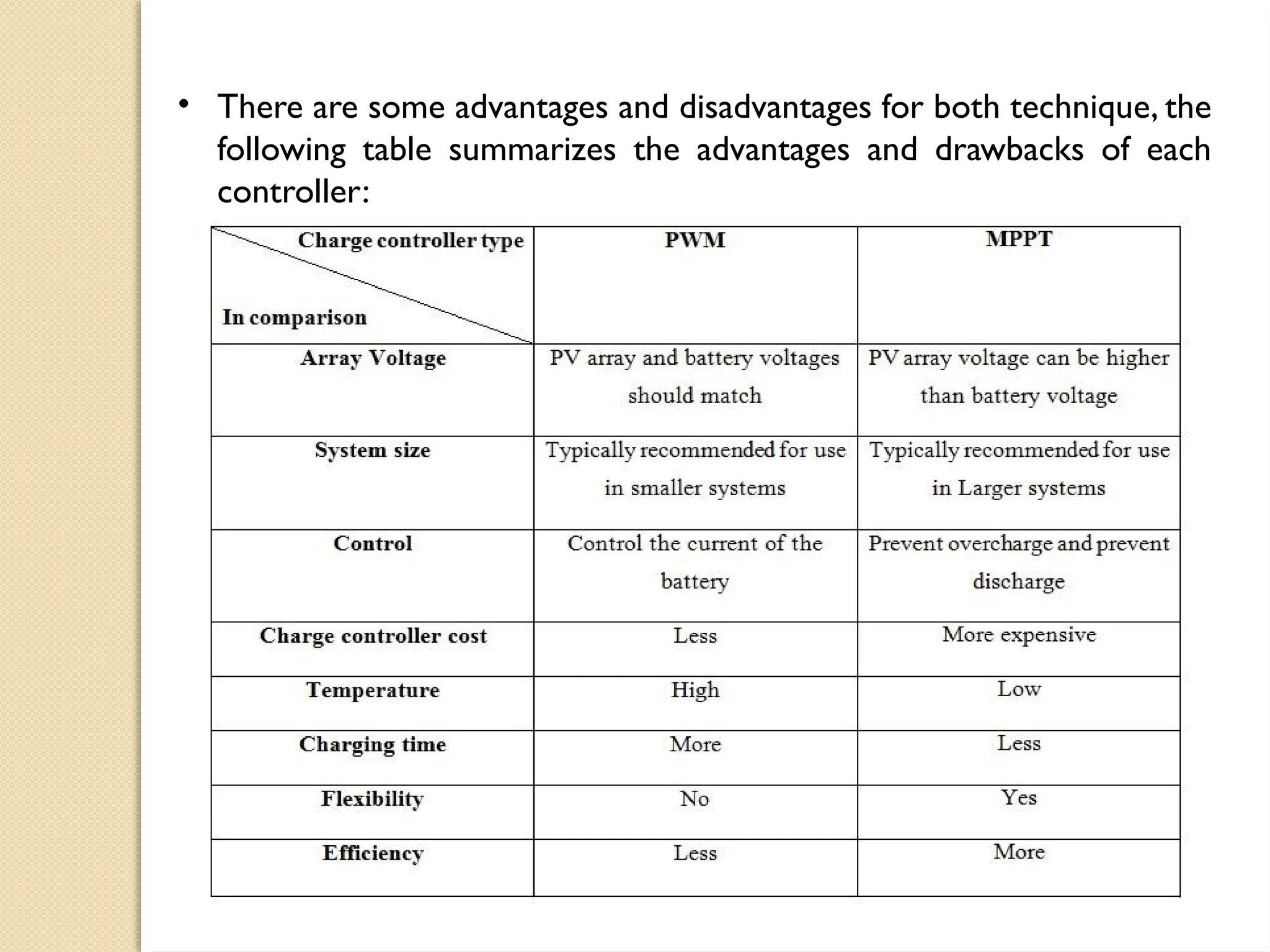
• There are some advantages and disadvantages for both technique, the
following table summarizes the advantages and drawbacks of each
controller:
MPPT algorithm
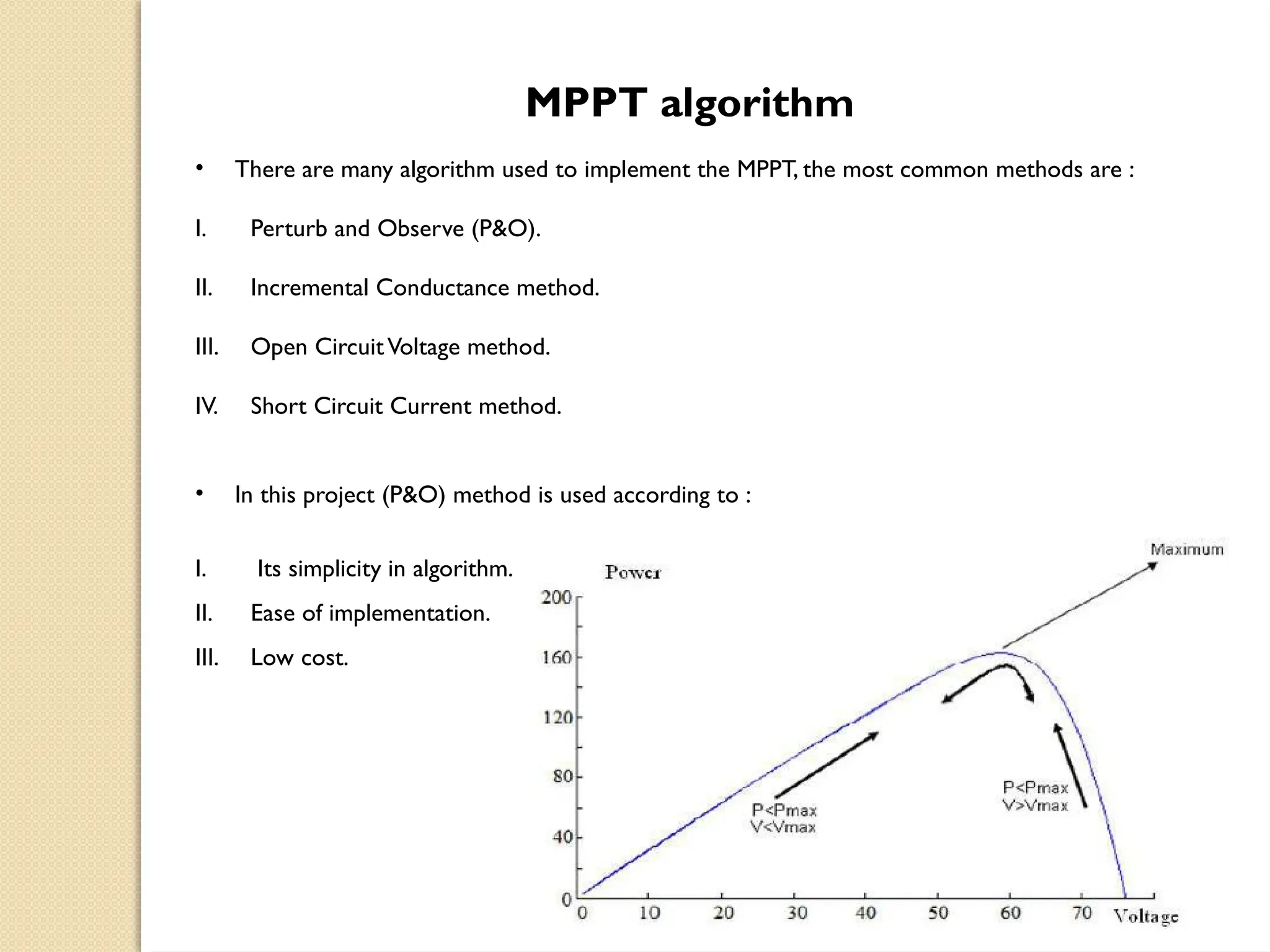
• There are many algorithm used to implement the MPPT, the most common methods are :
I. Perturb and Observe (P&O).
II. Incremental Conductance method.
III. Open CircuitVoltage method.
IV. Short Circuit Current method.
• In this project (P&O) method is used according to :
I. Its simplicity in algorithm.
II. Ease of implementation.
III. Low cost.
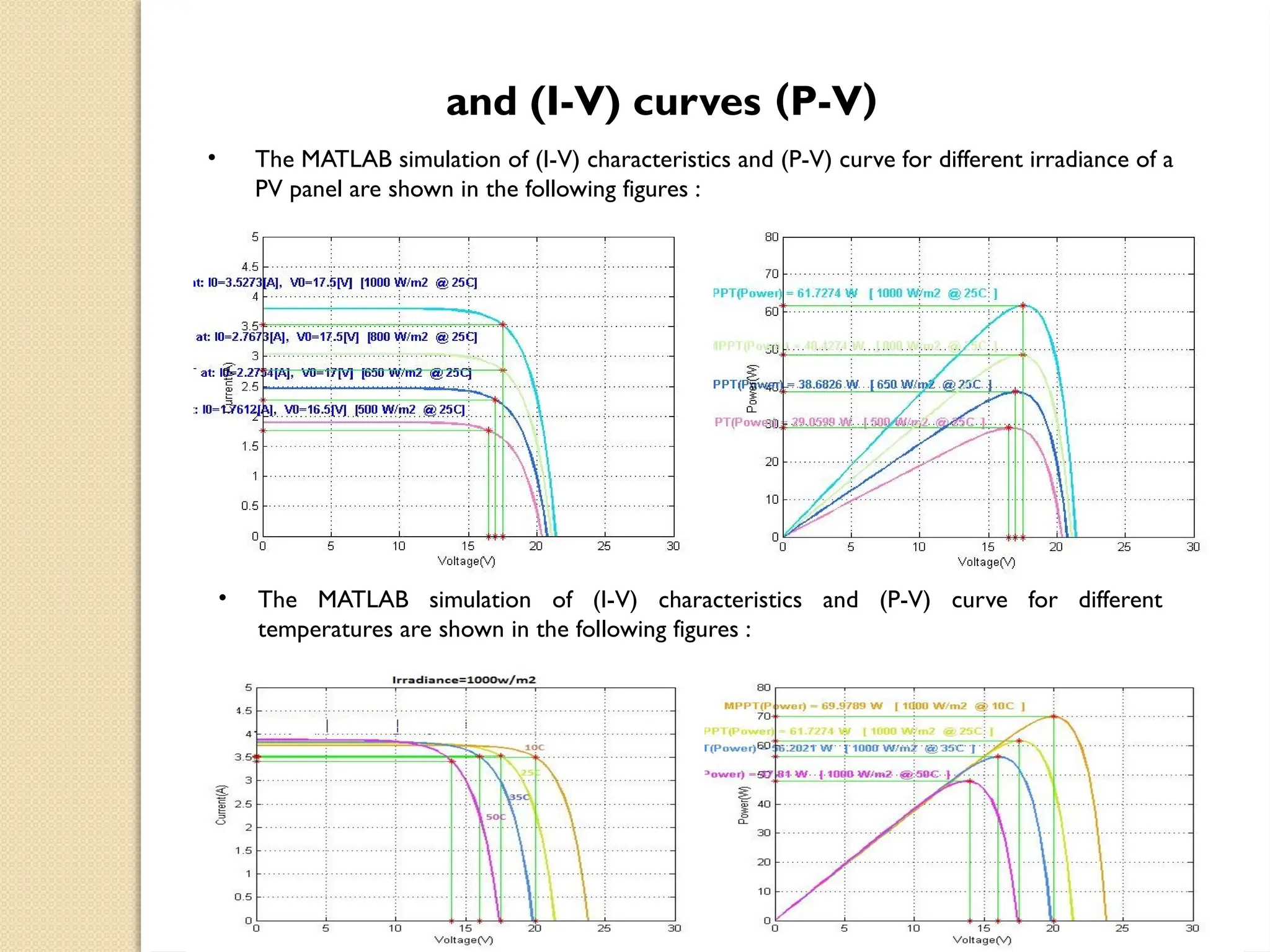
• The MATLAB simulation of (I-V) characteristics and (P-V) curve for different irradiance of a
PV panel are shown in the following figures :
(
P-V
)
and (I-V) curves
• The MATLAB simulation of (I-V) characteristics and (P-V) curve for different
temperatures are shown in the following figures :
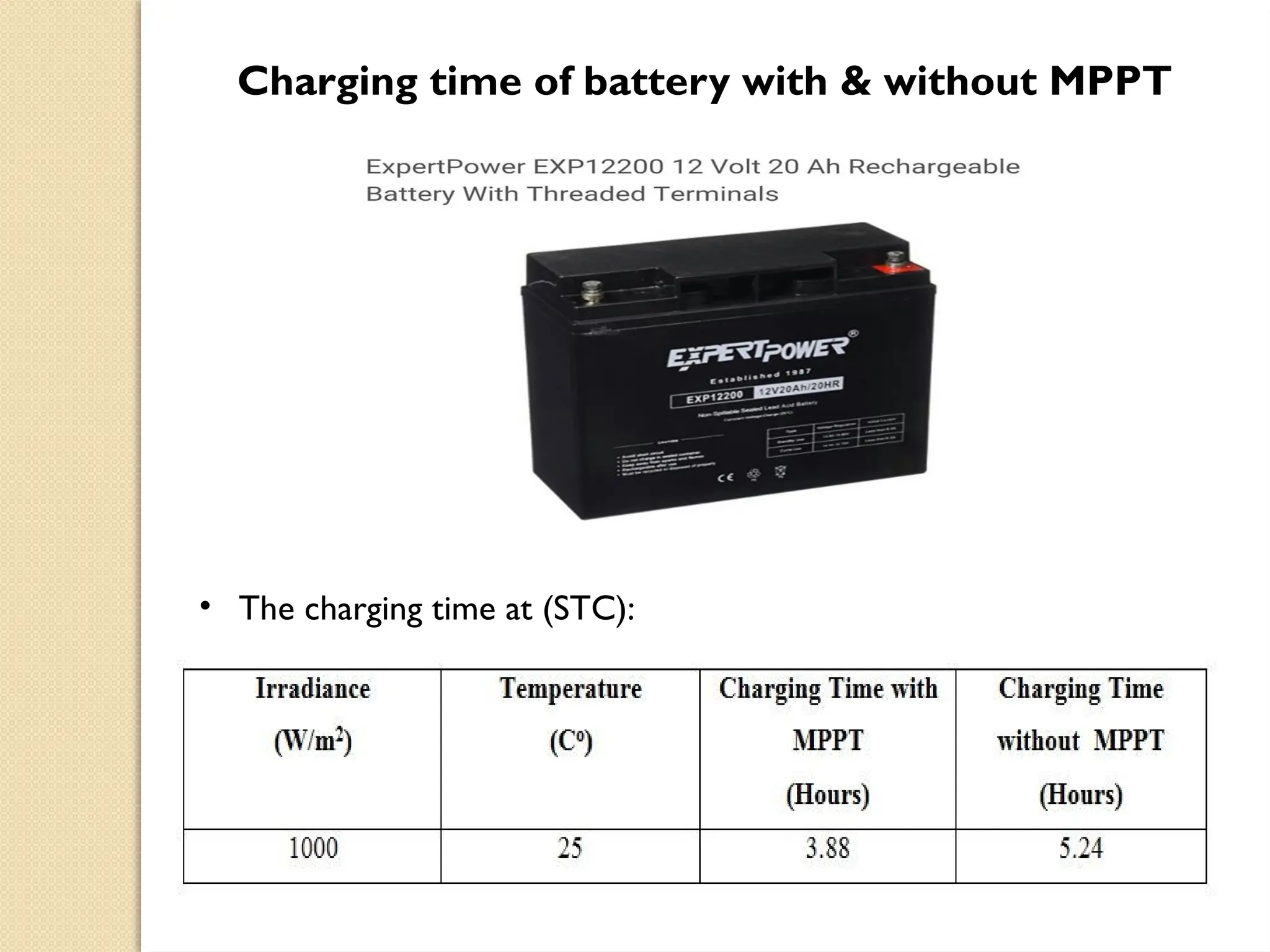
Charging time of battery with & without MPPT
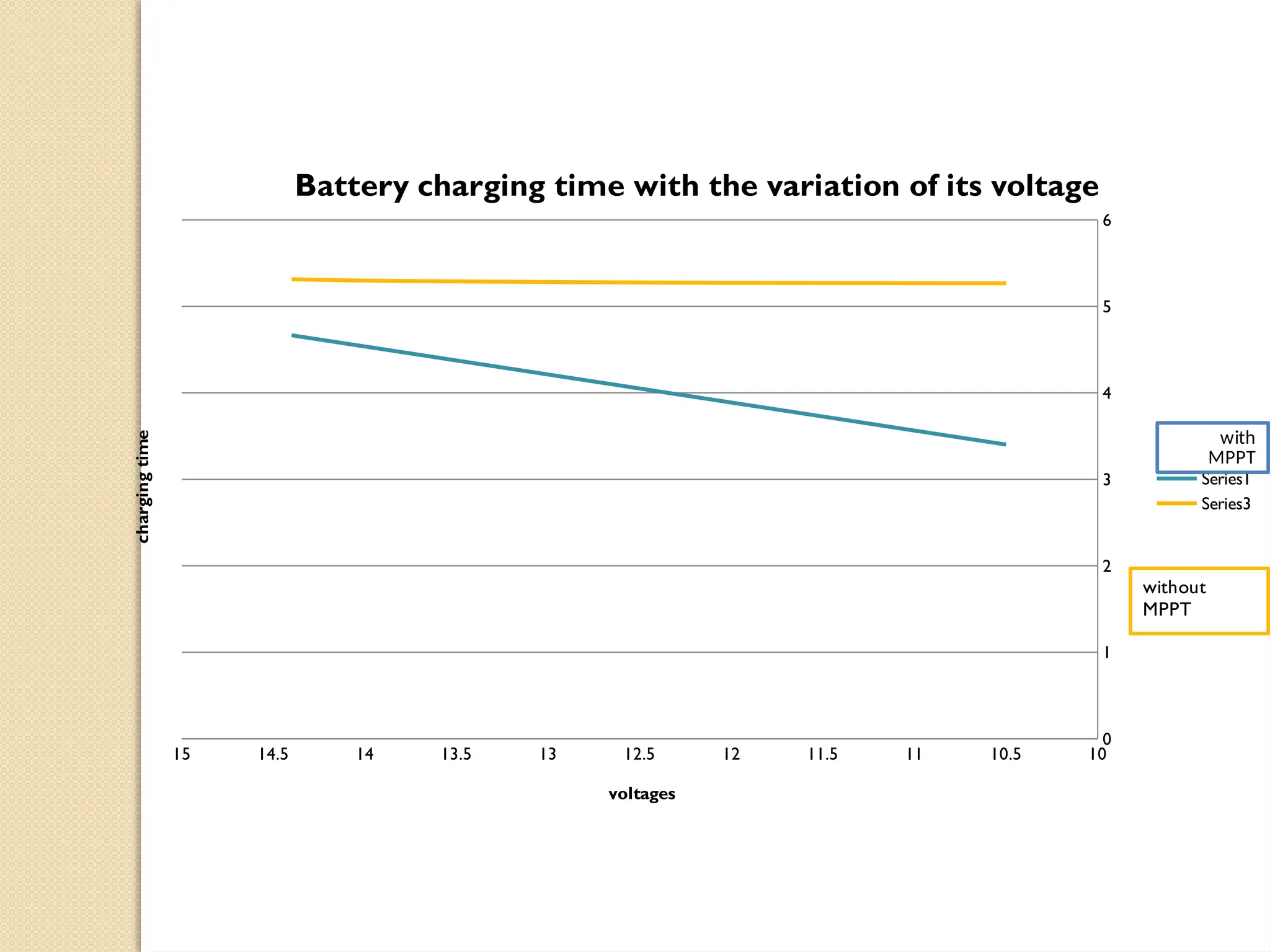
• The charging time at (STC):
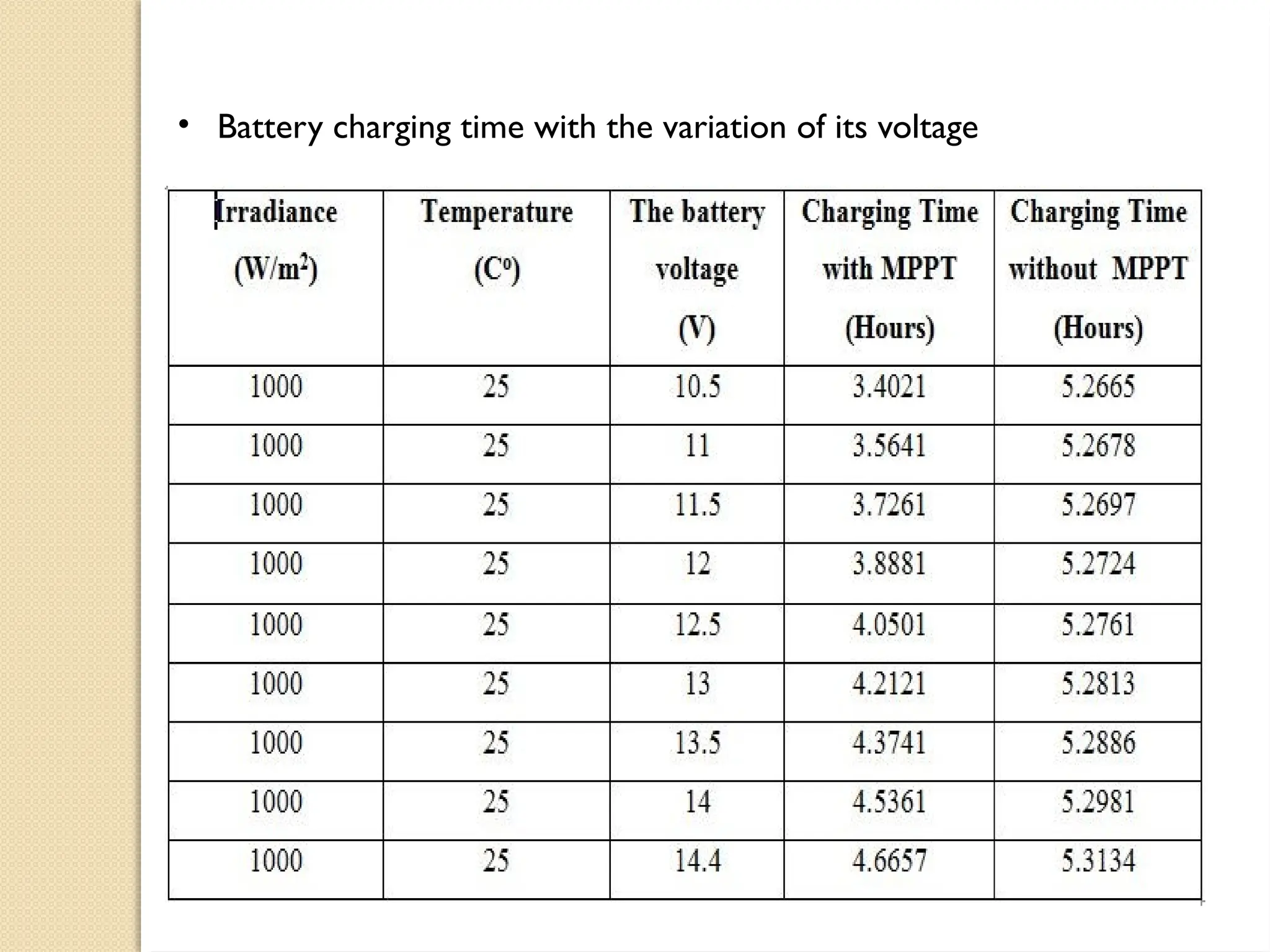
• Battery charging time with the variation of its voltage
10
10.5
11
11.5
12
12.5
13
13.5
14
14.5
15
0
1
2
3
4
5
6
Battery charging time with the variation of its voltage
Series1
Series3
voltages
charging
time
without
MPPT
with
MPPT
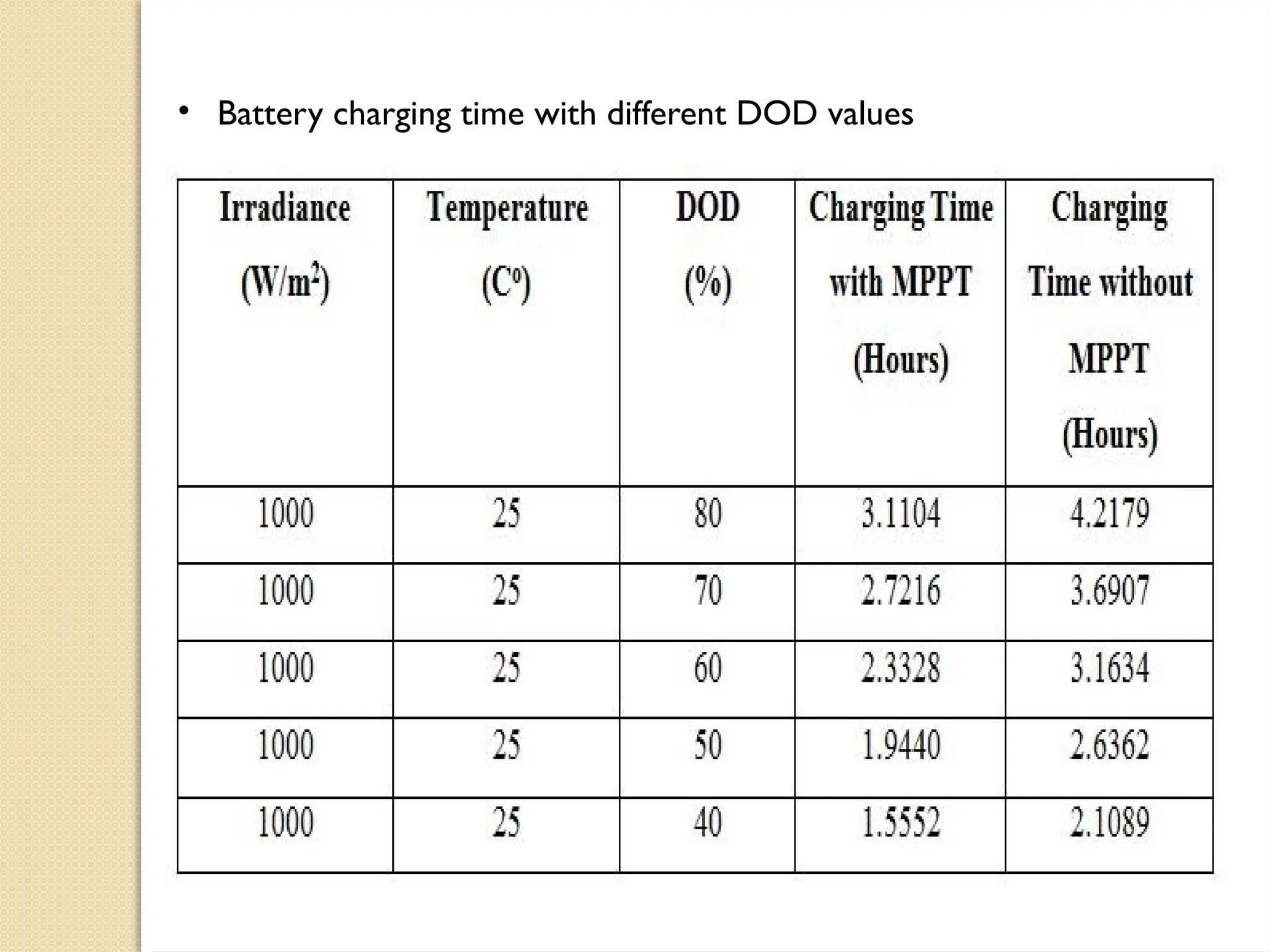
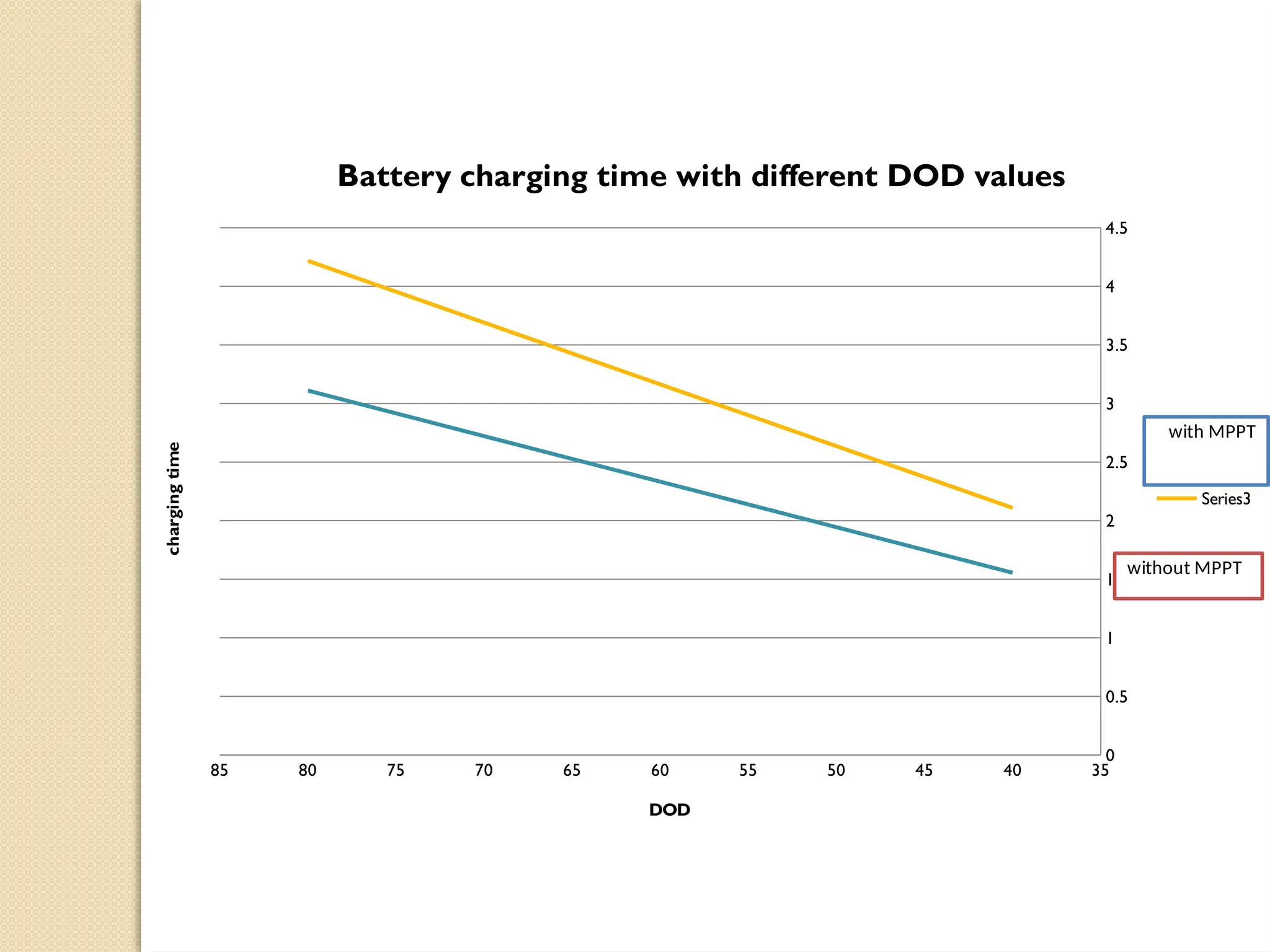
• Battery charging time with different DOD values
35
40
45
50
55
60
65
70
75
80
85
0
0.5
1
1.5
2
2.5
3
3.5
4
4.5
Battery charging time with different DOD values
Series1
Series3
DOD
charging
time
with MPPT
without MPPT
Results & Conclusion
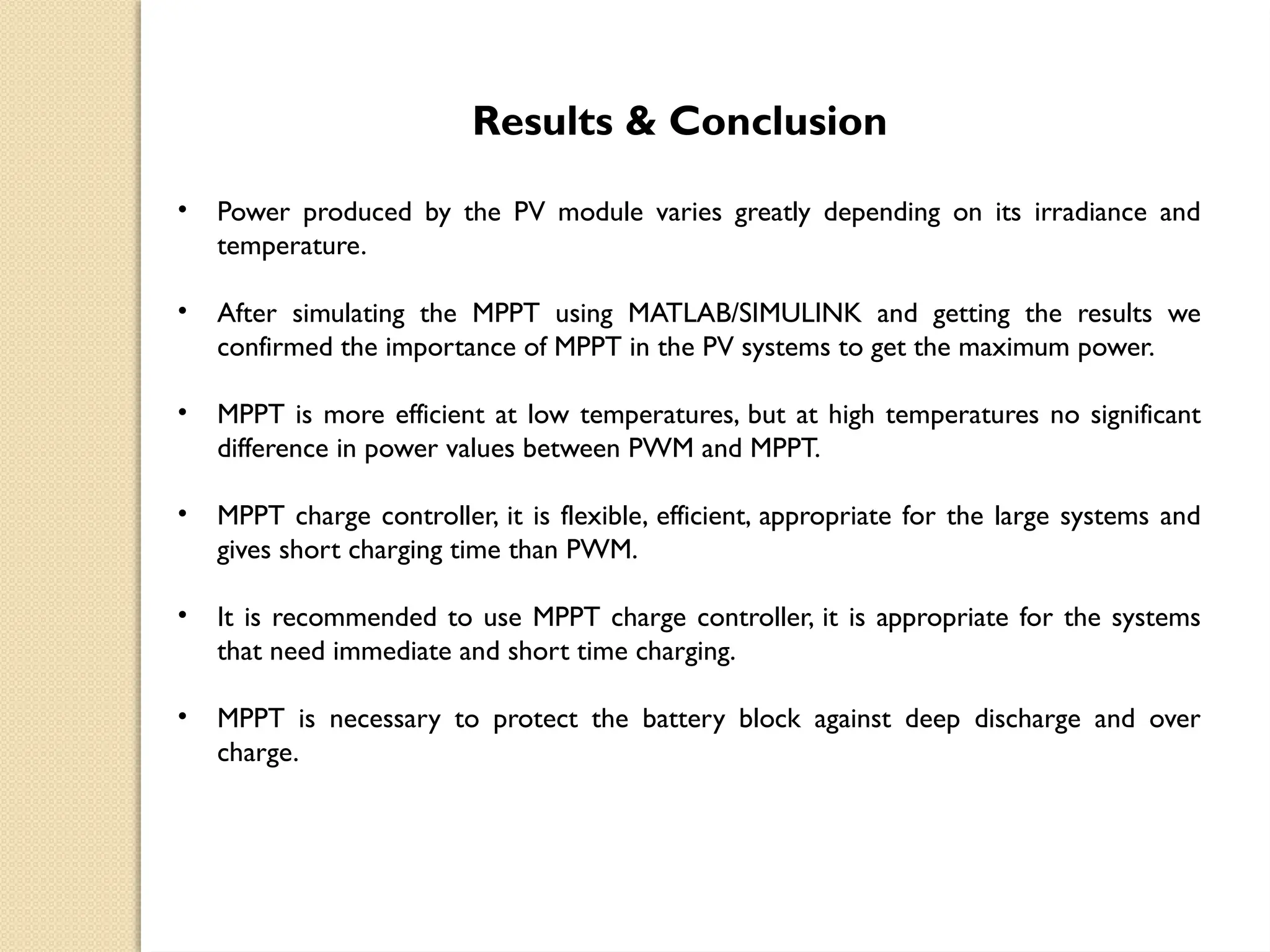
• Power produced by the PV module varies greatly depending on its irradiance and
temperature.
• After simulating the MPPT using MATLAB/SIMULINK and getting the results we
confirmed the importance of MPPT in the PV systems to get the maximum power.
• MPPT is more efficient at low temperatures, but at high temperatures no significant
difference in power values between PWM and MPPT.
• MPPT charge controller, it is flexible, efficient, appropriate for the large systems and
gives short charging time than PWM.
• It is recommended to use MPPT charge controller, it is appropriate for the systems
that need immediate and short time charging.
• MPPT is necessary to protect the battery block against deep discharge and over
charge.
Second phase work
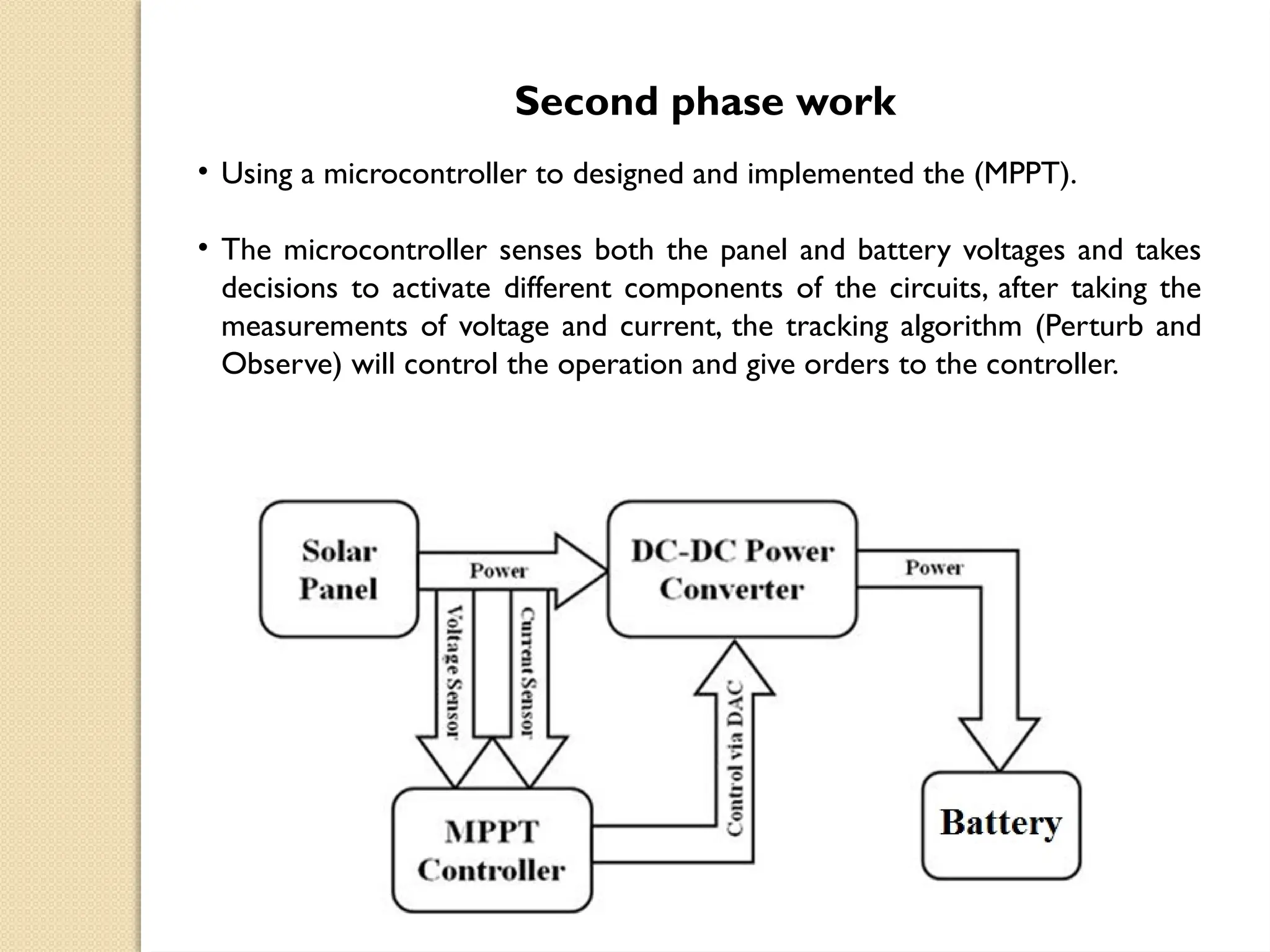
• Using a microcontroller to designed and implemented the (MPPT).
• The microcontroller senses both the panel and battery voltages and takes
decisions to activate different components of the circuits, after taking the
measurements of voltage and current, the tracking algorithm (Perturb and
Observe) will control the operation and give orders to the controller.
• We will build an MPPT using arduino controller with all required components.The complete
MPPT design and implementation will be done in next semester due to shortness of time.
• To make good and complete design and implementation for the MPPT charge controller we
need to be familiar with the following :
I. MPPT algorithm (Perturb and Observe).
II. PV module.
III. Lead acid battery appropriate to the power generated from the PV module.
IV. LED indication for the state of charge.
V. Voltage, current and power sensors.
VI. Arduino microcontroller.
VII. Buck-Boost Converter.
VIII. LCD display.
• It is expected to face a several problems throughout the design and implementation of the
circuit that we will like to avoid and come over them in the future.
• The most expected problem (challenge) which a shorter design and test period, with such a
serious time constraint.
• We think it is beneficial to spend more time testing rather than taking the time to make sure
that each part was the ideal one for the circuit. Either way, more time or better time
management will be a key issue that should definitely be worked out for future reference.
Control and Design of PV-Battery Charger with Maximum Power Point Tracker (MPPT)

Control and Design of PV-Battery Charger with Maximum Power Point Tracker (MPPT)