CONTENTS
 Introduction
 Working principal of DC motor
 Construction of PMDC motor
 Rotor or armature of PMDC motor
 Working
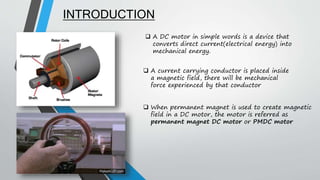
 A current carrying conductor is placed inside
a magnetic field, there will be mechanical
force experienced by that conductor
 When permanent magnet is used to create magnetic
field in a DC motor, the motor is referred as
permanent magnet DC motor or PMDC motor
INTRODUCTION
 A DC motor in simple words is a device that
converts direct current(electrical energy) into
mechanical energy.
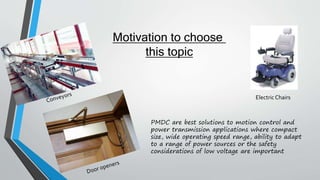
PMDC are best solutions to motion control and
power transmission applications where compact
size, wide operating speed range, ability to adapt
to a range of power sources or the safety
considerations of low voltage are important
Motivation to choose
this topic
ElectricChairs
 Magnets are mounted in periphery of this cylinder.
 The stator also serves as low reluctance return path
for magnetic field.
 Sometimes field coil is used in PMDC motor because if
permanent magnet lose their strength, these lost
strengths can be compensated by field excitation
through these field coils
STATOR
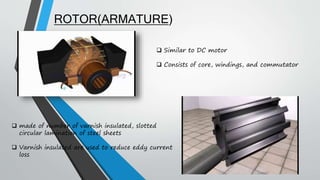
 made of number of varnish insulated, slotted
circular lamination of steel sheets
 Varnish insulated are used to reduce eddy current
loss
ROTOR(ARMATURE)
 Similar to DC motor
 Consists of core, windings, and commutator
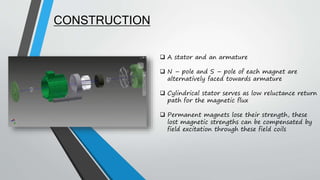
 A stator and an armature
 N – pole and S – pole of each magnet are
alternatively faced towards armature
 Cylindrical stator serves as low reluctance return
path for the magnetic flux
 Permanent magnets lose their strength, these
lost magnetic strengths can be compensated by
field excitation through these field coils
CONSTRUCTION
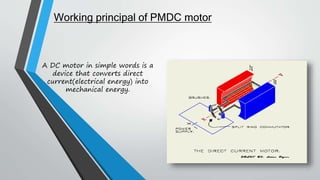
Working principal of PMDC motor
A DC motor in simple words is a
device that converts direct
current(electrical energy) into
mechanical energy.
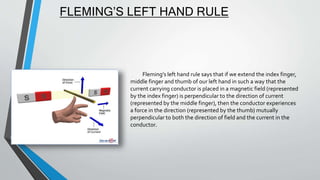
FLEMING’S LEFT HAND RULE
Fleming’s left hand rule says that if we extend the index finger,
middle finger and thumb of our left hand in such a way that the
current carrying conductor is placed in a magnetic field (represented
by the index finger) is perpendicular to the direction of current
(represented by the middle finger), then the conductor experiences
a force in the direction (represented by the thumb) mutually
perpendicular to both the direction of field and the current in the
conductor.
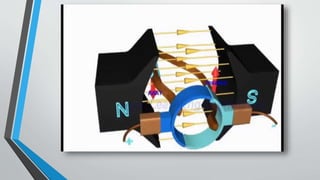
 The working principal of PMDC motor is same as the
working principal of DC motor
 Direction of this force is governed by Fleming’s left
hand rule
each conductor of the armature experiences the
mechanical force F=BIL
 When a carrying conductor comes inside a magnetic
field, a mechanical force will be experienced by the
conductor
 Each conductor of the armature experiences a force
and the compilation of those forces produces a
torque, which tends to rotate the armature.
WORKING
 For smaller ratings, use of permanent magnets reduces
manufacturing cost.
 No need of field excitation winding, hence construction is
simpler.
 No need of electrical supply for field excitation, hence
PMDC motor is relatively more efficient.
 Relatively smaller in size
 Cheap in cost
 The permanent magnets supply the surrounding field
flux, eliminating the need for external field current. This
design yields a smaller, lighter, and energy efficient
motor.
Advantages
 Since the stator in PMDC motor consists of permanent
magnets, it is not possible to add extra ampere-turns to
reduce armature reaction. Thus armature reaction is more in
PMDC motors.
 Stator side field control, for controlling speed of the motor, is
not possible in permanent magnet dc motors.
Disadvantages
APPLICATIONS
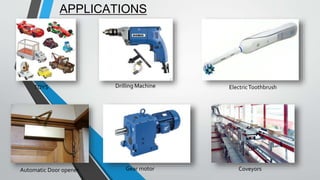
TOYS Drilling Machine ElectricToothbrush
Automatic Door opener Gear motor Coveyors
REFERENCE
 http://www.electrical4u.com
 http://www.completepowerelectronics.com/
 www.learnengineering.org
THANK YOU

PMDC motor

  • 2.
    CONTENTS  Introduction  Workingprincipal of DC motor  Construction of PMDC motor  Rotor or armature of PMDC motor  Working
  • 3.
     A currentcarrying conductor is placed inside a magnetic field, there will be mechanical force experienced by that conductor  When permanent magnet is used to create magnetic field in a DC motor, the motor is referred as permanent magnet DC motor or PMDC motor INTRODUCTION  A DC motor in simple words is a device that converts direct current(electrical energy) into mechanical energy.
  • 4.
    PMDC are bestsolutions to motion control and power transmission applications where compact size, wide operating speed range, ability to adapt to a range of power sources or the safety considerations of low voltage are important Motivation to choose this topic ElectricChairs
  • 5.
     Magnets aremounted in periphery of this cylinder.  The stator also serves as low reluctance return path for magnetic field.  Sometimes field coil is used in PMDC motor because if permanent magnet lose their strength, these lost strengths can be compensated by field excitation through these field coils STATOR
  • 6.
     made ofnumber of varnish insulated, slotted circular lamination of steel sheets  Varnish insulated are used to reduce eddy current loss ROTOR(ARMATURE)  Similar to DC motor  Consists of core, windings, and commutator
  • 7.
     A statorand an armature  N – pole and S – pole of each magnet are alternatively faced towards armature  Cylindrical stator serves as low reluctance return path for the magnetic flux  Permanent magnets lose their strength, these lost magnetic strengths can be compensated by field excitation through these field coils CONSTRUCTION
  • 8.
    Working principal ofPMDC motor A DC motor in simple words is a device that converts direct current(electrical energy) into mechanical energy.
  • 9.
    FLEMING’S LEFT HANDRULE Fleming’s left hand rule says that if we extend the index finger, middle finger and thumb of our left hand in such a way that the current carrying conductor is placed in a magnetic field (represented by the index finger) is perpendicular to the direction of current (represented by the middle finger), then the conductor experiences a force in the direction (represented by the thumb) mutually perpendicular to both the direction of field and the current in the conductor.
  • 10.
     The workingprincipal of PMDC motor is same as the working principal of DC motor  Direction of this force is governed by Fleming’s left hand rule each conductor of the armature experiences the mechanical force F=BIL  When a carrying conductor comes inside a magnetic field, a mechanical force will be experienced by the conductor  Each conductor of the armature experiences a force and the compilation of those forces produces a torque, which tends to rotate the armature. WORKING
  • 12.
     For smallerratings, use of permanent magnets reduces manufacturing cost.  No need of field excitation winding, hence construction is simpler.  No need of electrical supply for field excitation, hence PMDC motor is relatively more efficient.  Relatively smaller in size  Cheap in cost  The permanent magnets supply the surrounding field flux, eliminating the need for external field current. This design yields a smaller, lighter, and energy efficient motor. Advantages
  • 13.
     Since thestator in PMDC motor consists of permanent magnets, it is not possible to add extra ampere-turns to reduce armature reaction. Thus armature reaction is more in PMDC motors.  Stator side field control, for controlling speed of the motor, is not possible in permanent magnet dc motors. Disadvantages
  • 14.
    APPLICATIONS TOYS Drilling MachineElectricToothbrush Automatic Door opener Gear motor Coveyors
  • 15.
  • 16.