International Research Journal of Engineering and Technology (IRJET) e-ISSN: 2395-0056
Volume: 06 Issue: 03 | Mar 2019 www.irjet.net p-ISSN: 2395-0072
© 2019, IRJET | Impact Factor value: 7.211 | ISO 9001:2008 Certified Journal | Page 7671
Design and Implementation of Solar Charge
Controller
Kishore.B 1 , Barath.C2
1 Assistant Professor 2 UG Student
1, 2 Department Of EEE, Dr.Mahalingam College Of Engineering And Technology, Pollachi-642003
---------------------------------------------------------------------***---------------------------------------------------------------------
Abstract— Solar-energy utilization is growing in demand
since the past decade due to the increase in energy needs
and depletion of non-renewable sources. But the problem
with solar energy is that it’s not constant; it keeps on
fluctuating depending upon the weather conditions such as,
solar irradiation, temperature, thus a battery is always
connected between the load and the solar panel so as to act
as a secondary source. On bright sunlight the solar cells
would produce morevoltage andthisexcessivevoltagecould
cause damage to the batteries. This necessitates protecting
battery from overcharging. MPPT is one such method for
extracting maximum power from PV module and also to
protect the battery from overcharging. Thisprojectprovides
details of maximum power point tracking solar charge
controller device. The design of this project says about the
calculated value of converter with the help of MATLAB
software.
Keywords-MPPT, Photovoltaic Cells, solar energy,
MATLAB, Arduino
I.Introduction
A.Solar Panel
Solar energy is a promising source of energy for the
near future. PV modules are connected in series and parallel
manner so as to collect andharnessthesolarenergyobtained
and convert it into electrical energy. Generically stating, an
independent PV system consists of PV arrays which convert
sunlight into DC electricity. In addition, it also includes a
charge controller to regulate the battery charging and
discharging. A charge controllerisoneofthemajorfunctional
components in PV systems which maintain the accurate
charging voltage on the batteries. As solar energy is not
evenly distributed, research is being done on various
methods of collection such as thin-film devices, concentric
collectors etc.
A power electronics device, Maximum Power Point
Tracker (MPPT), which increasestheefficiencyofthesystem
effectively, is used here. By using it, the system always
operates at its Maximum Power Point (MPP), thereby
producing its maximum power output. Thus, an MPPT
maximizes efficiency of the array and reduces the overall
cost of the system.
II.MAJOR COMPONENTS
Solar panel is formedbyconnectingmanysolarcells
in series and parallel so as to get the desired output power
under nominal conditions. A solarcell,or photovoltaiccell,is
an electrical device that converts the energy of light directly
into electricity by the photovoltaic effect, which is
a physical and chemical phenomenon. It is a form of
photoelectric cell, defined as a device whose electrical
characteristics, such as current, voltage, or resistance, vary
when exposed to light. Individual solar cell devices can be
combined to form modules,otherwiseknownas solarpanels.
Using thissolar panel,light energyisconvertedintoelectrical
energy which is transmitted to batteries. Due to excessive
voltage, battery may get damaged, to avoid that, a charge
controller is designed.
International Research Journal of Engineering and Technology (IRJET) e-ISSN: 2395-0056
Volume: 06 Issue: 03 | Mar 2019 www.irjet.net p-ISSN: 2395-0072
© 2019, IRJET | Impact Factor value: 7.211 | ISO 9001:2008 Certified Journal | Page 7672
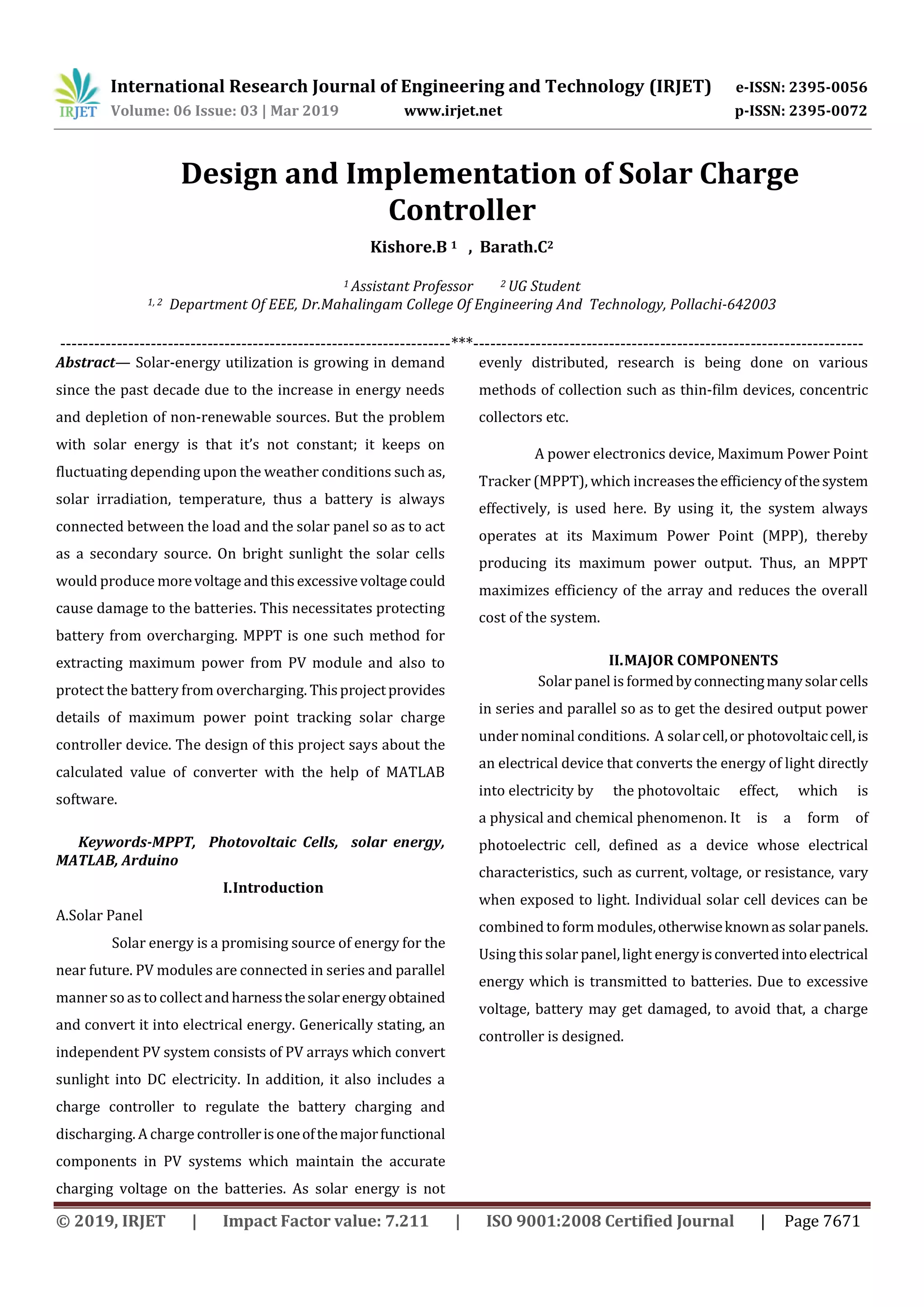
Figure 2.1 Equivalent Cell of Solar Cell
B.DC-DC BUCK-BOOST CONVERTER
A buck-boost converter is a DC - DC converter in
which the output voltage is always lower or higher to the
input voltage with reference to the reference voltage.
MOSFET’s switching is controlled by Arduino in this project.
Figure 2.2 Buck-Boost Converter.
While designing the buck converter we need to find
out the values of capacitor and the inductor used in it. It is a
very crucial part in designing since the efficiency of the
converter depends upon these values. The value of
inductance and capacitance that calculated assuming the
panel is working at full capacity, value of inductance L=33uH
and value of capacitance C=220uF
Calculation of Inductance:
Vo = α Vs / (1 – α)
We know that Output Voltage is 28 V and the input
voltage depends upon the solar panel. Hence assuming
different inputsand calculated dutycyclebasedondutycycle
calculation it resulted as 0.51 and above for Boost mode and
>0.51for Buck Mode.
L = α (Vs) / (Fs) (Δ IL)
For this we took Fs = 10 KHz
L= 0.51 (28) / 10K (4.3)
L= 33 X 10-6 H
By calculation we get L = 33uH
Calculation of Capacitance
C = Io α / Fs Δ Vc
C = 10 X 0.51 / 10K 2.3V
C = 220 X 10-6 F
By Calculating we get C = 220uF
C.Arduino UNO
The Arduino UNO is an open-source microcontroller
board based on the Microchip ATmega328P microcontroller
and developed by Arduino.cc. The board is equipped with
sets of digitaland analog input/output (I/O)pinsthatmaybe
interfaced to various expansion boards (shields) and other
circuits. The board has 14 Digital pins, 6 Analog pins, and
programmable with the Arduino IDE (Integrated
Development Environment) via a type B USB cable. It can be
powered by a USB cable or by an external 9 volt battery,
though it accepts voltages between 7 and 20 volts. It is also
similar to the Arduino Nano and Leonardo. The hardware
reference design is distributed under a Creative
Commons Attribution Share-Alike2.5licenseandisavailable
on the Arduino website. Layout and productionfilesforsome
versions of the hardware are alsoavailable."Uno"meansone
International Research Journal of Engineering and Technology (IRJET) e-ISSN: 2395-0056
Volume: 06 Issue: 03 | Mar 2019 www.irjet.net p-ISSN: 2395-0072
© 2019, IRJET | Impact Factor value: 7.211 | ISO 9001:2008 Certified Journal | Page 7673
in Italian and was chosen to mark the release of Arduino
Software (IDE) 1.0. The Unoboardandversion1.0ofArduino
Software (IDE) were the reference versions of Arduino, now
evolved to newer releases. The Uno board is the first in a
series of USB Arduino boards,andthereferencemodelforthe
Arduino platform. The ATmega328 on the Arduino Uno
comes preprogrammed with a boot loader that allows
uploading new code to it without the use of an external
hardware programmer it communicates using the original
STK500 protocol. The Uno also differs from all preceding
boards in that it does not use the FTDI USB-to-serial driver
chip. Instead, it uses the Atmega16U2 (Atmega8U2 up to
version R2) programmed as a USB-to-serial converter.
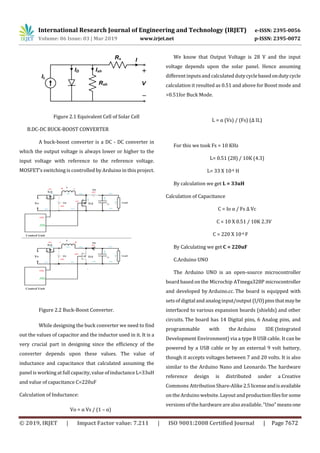
Figure 2.3 Arduino UNO
III.Block Diagram
A.Overall Block Diagram:
Figure 3.1 Block Diagram
In this block diagram theArduinomicrocontrolleris
the heart of this system. The solar panel provides the input
to voltage and current sensor.Themicrocontrollermeasures
the current and voltage anddisplaysontheLCDscreen.Then
depending upon the power level it gives PWM inputtoBuck-
Boost converter which decides whether the solar panel is to
be connected to battery or not for charging. The battery is
connected to the load, the load MOSFET is given input bythe
microcontroller whether to connect the load to the battery
or disconnect it depending upon the battery level which is
sensed by the voltage sensor and its output is provided to
the microcontroller.
B. Perturb and Observe Method
In the method of Perturb and Observe method, the
power is measured by change in the voltage by a diminutive
amount from the array by the controller. If incase,thepower
increases, adjustments are tried to be done in thatparticular
direction until the power cease to increase. This is what we
call the Perturb and Observe method.Thismethodcanresult
into an increase in the oscillations of power output, but still
it is the most commonly used method. Since this method
depends upon the rise in the power curve against voltage
below its maximum power point and the fall which is above
that particular point, this is referred to as the Hill Climbing
Method. This algorithm of Perturb and Observe (P&O)
increases or decreases the output terminal voltage of the
Photo Voltaic Cell periodically and then it simultaneously
compares the power obtained in the current cycle with the
power obtained in the previous cycle. If the power is
comparatively more than the previous value, then it
indicates that it has moved the operating point closer to the
maximum power point (MPP). Thus, further voltage
perturbations if in the same direction, should move the
operating point, even closer to the MPP. If the power
decreases, the operating point moves away from the
Maximum Power Point (MPP), and the direction of the
perturbation has to be changed and reversed to move back
towards the MPP.
International Research Journal of Engineering and Technology (IRJET) e-ISSN: 2395-0056
Volume: 06 Issue: 03 | Mar 2019 www.irjet.net p-ISSN: 2395-0072
© 2019, IRJET | Impact Factor value: 7.211 | ISO 9001:2008 Certified Journal | Page 7674
Figure 3.2 Flow Chart
IV. SIMULATION & RESULTS
Figure 4.1 Overall Simulation.
Figure 4.2 MPPT Simulation
Figure 4.3 Buck-Boost Controller Design
Figure 4.4 Protection Design
B.Hardware Results
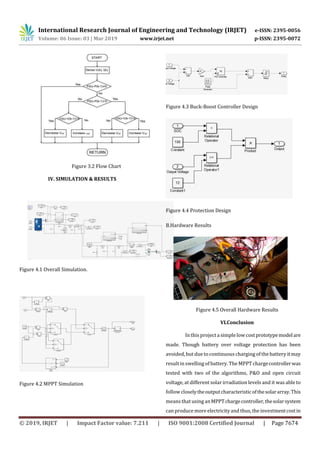
Figure 4.5 Overall Hardware Results
VI.Conclusion
In this project a simple low costprototypemodelare
made. Though battery over voltage protection has been
avoided, but due to continuous charging of the battery itmay
result in swelling of battery.The MPPT chargecontrollerwas
tested with two of the algorithms, P&O and open circuit
voltage, at different solar irradiation levels and it was able to
follow closelytheoutputcharacteristicofthesolararray.This
means that using anMPPTchargecontroller,thesolarsystem
can produce more electricityand thus, the investmentcostin
International Research Journal of Engineering and Technology (IRJET) e-ISSN: 2395-0056
Volume: 06 Issue: 03 | Mar 2019 www.irjet.net p-ISSN: 2395-0072
© 2019, IRJET | Impact Factor value: 7.211 | ISO 9001:2008 Certified Journal | Page 7675
the PV systems being easily amortized. Using this Solar
charge controller the waste age of solar energy can be
avoided by adding more batteries in series connection.
REFERENCES
[1] A.S.M. Jiaul Hoque1*, Sheik Md. Kazi Nazrul
Islam1, 2, Md. Abubakar Siddik1, Sabbir
Ahamed1,”Design and Implementation of a
Microcontroller Based 12V-7A/10A Smart Solar
Battery Charge Controller”.
[2] Marcelo Gradella Villalva, Jonas Rafael Gazoli,
Ernesto Ruppert Filho, "Analysis and simulation of
the P&O MPPT algorithm using a linearized PV
array model,” 10th Brazilian Power Electronics
Conference (COBEP), Brazil, September 27 -
October 1, 2009.
[3] Muhammad H. Rashid, "Power Electronics:
Circuits, Devices Applications" Text Book.
[4] Dr. Anil S. Hiwale, Mugdha V. Patil, Hemangi
Vinchurkar, ”An Efficient MPPT Solar Charge
Controller”, International Journal of Advanced
Research in Electrical, Electronics and
Instrumentation Engineering Vol. 3, Issue 07, July
2004.
[5] Thesis "Maximum Power Point Tracking:
Algorithm and Software Development", Delft
University of Technology FacultyofEEMCSJune27,
2012.
[6] D. Freeman “Introduction to Photovoltaic
Systems Maximum Power Point Tracking”,
Application Report SLVA446–November 2010.
[7] H. N. Zainudin, S. Mekhilef“ComparisonStudyof
Maximum Power Point Tracker Techniques for PV
Systems”, Proceedings of the 14th International
Middle East Power Systems Conference
(MEPCON’10), Cairo University, Egypt, December
19-21, 2010.
[8] Ali Nasr Allah Ali, Mohamed H. Saied, M. Z.
Mostafa, T. M. AbdelMoneim“ASurveyofMaximum
PPT techniques of PV Systems” Energytech
Conference, 2012.
[9] Datasheet Arduino Development Board Kit,
“http://www.arduino.cc/”.

IRJET- Design and Implementation of Solar Charge Controller

  • 1.
    International Research Journalof Engineering and Technology (IRJET) e-ISSN: 2395-0056 Volume: 06 Issue: 03 | Mar 2019 www.irjet.net p-ISSN: 2395-0072 © 2019, IRJET | Impact Factor value: 7.211 | ISO 9001:2008 Certified Journal | Page 7671 Design and Implementation of Solar Charge Controller Kishore.B 1 , Barath.C2 1 Assistant Professor 2 UG Student 1, 2 Department Of EEE, Dr.Mahalingam College Of Engineering And Technology, Pollachi-642003 ---------------------------------------------------------------------***--------------------------------------------------------------------- Abstract— Solar-energy utilization is growing in demand since the past decade due to the increase in energy needs and depletion of non-renewable sources. But the problem with solar energy is that it’s not constant; it keeps on fluctuating depending upon the weather conditions such as, solar irradiation, temperature, thus a battery is always connected between the load and the solar panel so as to act as a secondary source. On bright sunlight the solar cells would produce morevoltage andthisexcessivevoltagecould cause damage to the batteries. This necessitates protecting battery from overcharging. MPPT is one such method for extracting maximum power from PV module and also to protect the battery from overcharging. Thisprojectprovides details of maximum power point tracking solar charge controller device. The design of this project says about the calculated value of converter with the help of MATLAB software. Keywords-MPPT, Photovoltaic Cells, solar energy, MATLAB, Arduino I.Introduction A.Solar Panel Solar energy is a promising source of energy for the near future. PV modules are connected in series and parallel manner so as to collect andharnessthesolarenergyobtained and convert it into electrical energy. Generically stating, an independent PV system consists of PV arrays which convert sunlight into DC electricity. In addition, it also includes a charge controller to regulate the battery charging and discharging. A charge controllerisoneofthemajorfunctional components in PV systems which maintain the accurate charging voltage on the batteries. As solar energy is not evenly distributed, research is being done on various methods of collection such as thin-film devices, concentric collectors etc. A power electronics device, Maximum Power Point Tracker (MPPT), which increasestheefficiencyofthesystem effectively, is used here. By using it, the system always operates at its Maximum Power Point (MPP), thereby producing its maximum power output. Thus, an MPPT maximizes efficiency of the array and reduces the overall cost of the system. II.MAJOR COMPONENTS Solar panel is formedbyconnectingmanysolarcells in series and parallel so as to get the desired output power under nominal conditions. A solarcell,or photovoltaiccell,is an electrical device that converts the energy of light directly into electricity by the photovoltaic effect, which is a physical and chemical phenomenon. It is a form of photoelectric cell, defined as a device whose electrical characteristics, such as current, voltage, or resistance, vary when exposed to light. Individual solar cell devices can be combined to form modules,otherwiseknownas solarpanels. Using thissolar panel,light energyisconvertedintoelectrical energy which is transmitted to batteries. Due to excessive voltage, battery may get damaged, to avoid that, a charge controller is designed.
  • 2.
    International Research Journalof Engineering and Technology (IRJET) e-ISSN: 2395-0056 Volume: 06 Issue: 03 | Mar 2019 www.irjet.net p-ISSN: 2395-0072 © 2019, IRJET | Impact Factor value: 7.211 | ISO 9001:2008 Certified Journal | Page 7672 Figure 2.1 Equivalent Cell of Solar Cell B.DC-DC BUCK-BOOST CONVERTER A buck-boost converter is a DC - DC converter in which the output voltage is always lower or higher to the input voltage with reference to the reference voltage. MOSFET’s switching is controlled by Arduino in this project. Figure 2.2 Buck-Boost Converter. While designing the buck converter we need to find out the values of capacitor and the inductor used in it. It is a very crucial part in designing since the efficiency of the converter depends upon these values. The value of inductance and capacitance that calculated assuming the panel is working at full capacity, value of inductance L=33uH and value of capacitance C=220uF Calculation of Inductance: Vo = α Vs / (1 – α) We know that Output Voltage is 28 V and the input voltage depends upon the solar panel. Hence assuming different inputsand calculated dutycyclebasedondutycycle calculation it resulted as 0.51 and above for Boost mode and >0.51for Buck Mode. L = α (Vs) / (Fs) (Δ IL) For this we took Fs = 10 KHz L= 0.51 (28) / 10K (4.3) L= 33 X 10-6 H By calculation we get L = 33uH Calculation of Capacitance C = Io α / Fs Δ Vc C = 10 X 0.51 / 10K 2.3V C = 220 X 10-6 F By Calculating we get C = 220uF C.Arduino UNO The Arduino UNO is an open-source microcontroller board based on the Microchip ATmega328P microcontroller and developed by Arduino.cc. The board is equipped with sets of digitaland analog input/output (I/O)pinsthatmaybe interfaced to various expansion boards (shields) and other circuits. The board has 14 Digital pins, 6 Analog pins, and programmable with the Arduino IDE (Integrated Development Environment) via a type B USB cable. It can be powered by a USB cable or by an external 9 volt battery, though it accepts voltages between 7 and 20 volts. It is also similar to the Arduino Nano and Leonardo. The hardware reference design is distributed under a Creative Commons Attribution Share-Alike2.5licenseandisavailable on the Arduino website. Layout and productionfilesforsome versions of the hardware are alsoavailable."Uno"meansone
  • 3.
    International Research Journalof Engineering and Technology (IRJET) e-ISSN: 2395-0056 Volume: 06 Issue: 03 | Mar 2019 www.irjet.net p-ISSN: 2395-0072 © 2019, IRJET | Impact Factor value: 7.211 | ISO 9001:2008 Certified Journal | Page 7673 in Italian and was chosen to mark the release of Arduino Software (IDE) 1.0. The Unoboardandversion1.0ofArduino Software (IDE) were the reference versions of Arduino, now evolved to newer releases. The Uno board is the first in a series of USB Arduino boards,andthereferencemodelforthe Arduino platform. The ATmega328 on the Arduino Uno comes preprogrammed with a boot loader that allows uploading new code to it without the use of an external hardware programmer it communicates using the original STK500 protocol. The Uno also differs from all preceding boards in that it does not use the FTDI USB-to-serial driver chip. Instead, it uses the Atmega16U2 (Atmega8U2 up to version R2) programmed as a USB-to-serial converter. Figure 2.3 Arduino UNO III.Block Diagram A.Overall Block Diagram: Figure 3.1 Block Diagram In this block diagram theArduinomicrocontrolleris the heart of this system. The solar panel provides the input to voltage and current sensor.Themicrocontrollermeasures the current and voltage anddisplaysontheLCDscreen.Then depending upon the power level it gives PWM inputtoBuck- Boost converter which decides whether the solar panel is to be connected to battery or not for charging. The battery is connected to the load, the load MOSFET is given input bythe microcontroller whether to connect the load to the battery or disconnect it depending upon the battery level which is sensed by the voltage sensor and its output is provided to the microcontroller. B. Perturb and Observe Method In the method of Perturb and Observe method, the power is measured by change in the voltage by a diminutive amount from the array by the controller. If incase,thepower increases, adjustments are tried to be done in thatparticular direction until the power cease to increase. This is what we call the Perturb and Observe method.Thismethodcanresult into an increase in the oscillations of power output, but still it is the most commonly used method. Since this method depends upon the rise in the power curve against voltage below its maximum power point and the fall which is above that particular point, this is referred to as the Hill Climbing Method. This algorithm of Perturb and Observe (P&O) increases or decreases the output terminal voltage of the Photo Voltaic Cell periodically and then it simultaneously compares the power obtained in the current cycle with the power obtained in the previous cycle. If the power is comparatively more than the previous value, then it indicates that it has moved the operating point closer to the maximum power point (MPP). Thus, further voltage perturbations if in the same direction, should move the operating point, even closer to the MPP. If the power decreases, the operating point moves away from the Maximum Power Point (MPP), and the direction of the perturbation has to be changed and reversed to move back towards the MPP.
  • 4.
    International Research Journalof Engineering and Technology (IRJET) e-ISSN: 2395-0056 Volume: 06 Issue: 03 | Mar 2019 www.irjet.net p-ISSN: 2395-0072 © 2019, IRJET | Impact Factor value: 7.211 | ISO 9001:2008 Certified Journal | Page 7674 Figure 3.2 Flow Chart IV. SIMULATION & RESULTS Figure 4.1 Overall Simulation. Figure 4.2 MPPT Simulation Figure 4.3 Buck-Boost Controller Design Figure 4.4 Protection Design B.Hardware Results Figure 4.5 Overall Hardware Results VI.Conclusion In this project a simple low costprototypemodelare made. Though battery over voltage protection has been avoided, but due to continuous charging of the battery itmay result in swelling of battery.The MPPT chargecontrollerwas tested with two of the algorithms, P&O and open circuit voltage, at different solar irradiation levels and it was able to follow closelytheoutputcharacteristicofthesolararray.This means that using anMPPTchargecontroller,thesolarsystem can produce more electricityand thus, the investmentcostin
  • 5.
    International Research Journalof Engineering and Technology (IRJET) e-ISSN: 2395-0056 Volume: 06 Issue: 03 | Mar 2019 www.irjet.net p-ISSN: 2395-0072 © 2019, IRJET | Impact Factor value: 7.211 | ISO 9001:2008 Certified Journal | Page 7675 the PV systems being easily amortized. Using this Solar charge controller the waste age of solar energy can be avoided by adding more batteries in series connection. REFERENCES [1] A.S.M. Jiaul Hoque1*, Sheik Md. Kazi Nazrul Islam1, 2, Md. Abubakar Siddik1, Sabbir Ahamed1,”Design and Implementation of a Microcontroller Based 12V-7A/10A Smart Solar Battery Charge Controller”. [2] Marcelo Gradella Villalva, Jonas Rafael Gazoli, Ernesto Ruppert Filho, "Analysis and simulation of the P&O MPPT algorithm using a linearized PV array model,” 10th Brazilian Power Electronics Conference (COBEP), Brazil, September 27 - October 1, 2009. [3] Muhammad H. Rashid, "Power Electronics: Circuits, Devices Applications" Text Book. [4] Dr. Anil S. Hiwale, Mugdha V. Patil, Hemangi Vinchurkar, ”An Efficient MPPT Solar Charge Controller”, International Journal of Advanced Research in Electrical, Electronics and Instrumentation Engineering Vol. 3, Issue 07, July 2004. [5] Thesis "Maximum Power Point Tracking: Algorithm and Software Development", Delft University of Technology FacultyofEEMCSJune27, 2012. [6] D. Freeman “Introduction to Photovoltaic Systems Maximum Power Point Tracking”, Application Report SLVA446–November 2010. [7] H. N. Zainudin, S. Mekhilef“ComparisonStudyof Maximum Power Point Tracker Techniques for PV Systems”, Proceedings of the 14th International Middle East Power Systems Conference (MEPCON’10), Cairo University, Egypt, December 19-21, 2010. [8] Ali Nasr Allah Ali, Mohamed H. Saied, M. Z. Mostafa, T. M. AbdelMoneim“ASurveyofMaximum PPT techniques of PV Systems” Energytech Conference, 2012. [9] Datasheet Arduino Development Board Kit, “http://www.arduino.cc/”.