The Age of Imperialism (1800–1914)
Motivations for the New Imperialism
The Industrial Revolution transformed the West.
Advances in science and technology, industry,
transportation, and communication provided
Western nations with many advantages. Armed
with new economic and political power, Western
nations set out to dominate the world, building
extensive overseas empires in the late 1800s.
Motivations for the New Imperialism
1. Industrialization (Economy) - Need for
Resources Drives Further Expansion
2. Nationalism - Political and Military Causes
3. Humanitarianism – Europeans thought it was
their duty to civilize and uplift African people
Humanitarian and Religious Motives
4. Social Darwinism – Survival of the fittest
applied to human behavior
Nationalism
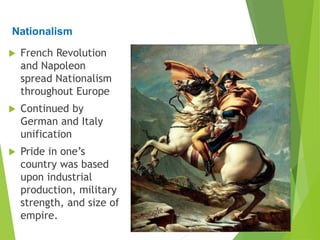
 French Revolution
and Napoleon
spread Nationalism
throughout Europe
 Continued by
German and Italy
unification
 Pride in one’s
country was based
upon industrial
production, military
strength, and size of
empire.
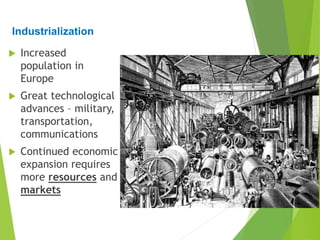
Industrialization
 Increased
population in
Europe
 Great technological
advances – military,
transportation,
communications
 Continued economic
expansion requires
more resources and
markets
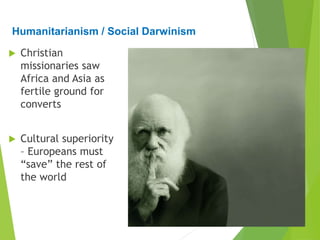
Humanitarianism / Social Darwinism
 Christian
missionaries saw
Africa and Asia as
fertile ground for
converts
 Cultural superiority
– Europeans must
“save” the rest of
the world
Western Imperialism Spreads Rapidly
From about 1870 to 1914, imperialist nations
gained control over much of the world. Leading the
way were soldiers, merchants, settlers,
missionaries, and explorers. In Europe, imperial
expansion found favor with all classes, from
bankers and manufacturers to workers. Western
imperialism expanded rapidly for a number of
reasons.
Western Imperialism Spreads Rapidly
Vulnerable Non-Western States
- Ottoman Empire was weakening
- Tribal wars in West Africa
- Slave trade
- Lack of centralized government
Western Advantages
- Strong economies, well-organized governments,
powerful armies and navies.
- Improved medicine
- Bigger guns
- Europeans also played rivals against one another
Scramble for Africa
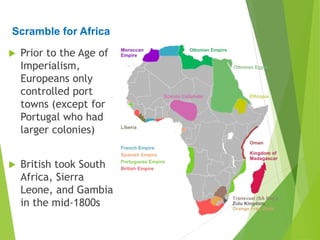
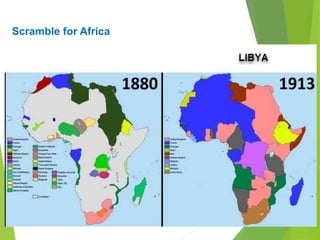
 Prior to the Age of
Imperialism,
Europeans only
controlled port
towns (except for
Portugal who had
larger colonies)
 British took South
Africa, Sierra
Leone, and Gambia
in the mid-1800s
Scramble for Africa
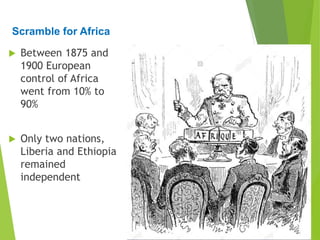
 Between 1875 and
1900 European
control of Africa
went from 10% to
90%
 Only two nations,
Liberia and Ethiopia
remained
independent
Scramble for Africa
Berlin Conference
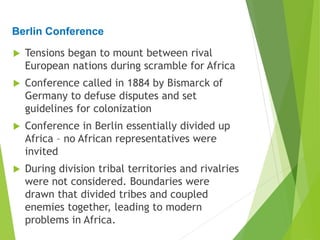
 Tensions began to mount between rival
European nations during scramble for Africa
 Conference called in 1884 by Bismarck of
Germany to defuse disputes and set
guidelines for colonization
 Conference in Berlin essentially divided up
Africa – no African representatives were
invited
 During division tribal territories and rivalries
were not considered. Boundaries were
drawn that divided tribes and coupled
enemies together, leading to modern
problems in Africa.
Types of Imperial Rule
The leading imperial powers developed
several kinds of colonial rule. Each of the
different types reflected different goals for
their colonies.
Types of Imperial Rule
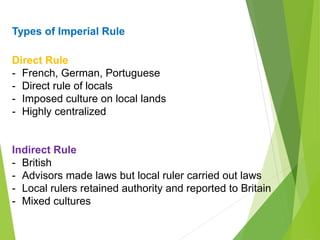
Direct Rule
- French, German, Portuguese
- Direct rule of locals
- Imposed culture on local lands
- Highly centralized
Indirect Rule
- British
- Advisors made laws but local ruler carried out laws
- Local rulers retained authority and reported to Britain
- Mixed cultures
Types of Imperial Rule
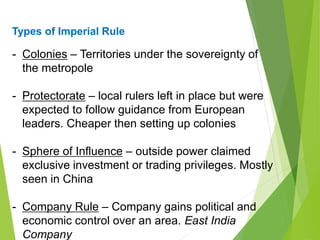
- Colonies – Territories under the sovereignty of
the metropole
- Protectorate – local rulers left in place but were
expected to follow guidance from European
leaders. Cheaper then setting up colonies
- Sphere of Influence – outside power claimed
exclusive investment or trading privileges. Mostly
seen in China
- Company Rule – Company gains political and
economic control over an area. East India
Company

Imperialism.pptx

  • 1.
    The Age ofImperialism (1800–1914)
  • 2.
    Motivations for theNew Imperialism The Industrial Revolution transformed the West. Advances in science and technology, industry, transportation, and communication provided Western nations with many advantages. Armed with new economic and political power, Western nations set out to dominate the world, building extensive overseas empires in the late 1800s.
  • 3.
    Motivations for theNew Imperialism 1. Industrialization (Economy) - Need for Resources Drives Further Expansion 2. Nationalism - Political and Military Causes 3. Humanitarianism – Europeans thought it was their duty to civilize and uplift African people Humanitarian and Religious Motives 4. Social Darwinism – Survival of the fittest applied to human behavior
  • 4.
    Nationalism  French Revolution andNapoleon spread Nationalism throughout Europe  Continued by German and Italy unification  Pride in one’s country was based upon industrial production, military strength, and size of empire.
  • 5.
    Industrialization  Increased population in Europe Great technological advances – military, transportation, communications  Continued economic expansion requires more resources and markets
  • 6.
    Humanitarianism / SocialDarwinism  Christian missionaries saw Africa and Asia as fertile ground for converts  Cultural superiority – Europeans must “save” the rest of the world
  • 7.
    Western Imperialism SpreadsRapidly From about 1870 to 1914, imperialist nations gained control over much of the world. Leading the way were soldiers, merchants, settlers, missionaries, and explorers. In Europe, imperial expansion found favor with all classes, from bankers and manufacturers to workers. Western imperialism expanded rapidly for a number of reasons.
  • 8.
    Western Imperialism SpreadsRapidly Vulnerable Non-Western States - Ottoman Empire was weakening - Tribal wars in West Africa - Slave trade - Lack of centralized government Western Advantages - Strong economies, well-organized governments, powerful armies and navies. - Improved medicine - Bigger guns - Europeans also played rivals against one another
  • 9.
    Scramble for Africa Prior to the Age of Imperialism, Europeans only controlled port towns (except for Portugal who had larger colonies)  British took South Africa, Sierra Leone, and Gambia in the mid-1800s
  • 10.
    Scramble for Africa Between 1875 and 1900 European control of Africa went from 10% to 90%  Only two nations, Liberia and Ethiopia remained independent
  • 11.
  • 12.
    Berlin Conference  Tensionsbegan to mount between rival European nations during scramble for Africa  Conference called in 1884 by Bismarck of Germany to defuse disputes and set guidelines for colonization  Conference in Berlin essentially divided up Africa – no African representatives were invited  During division tribal territories and rivalries were not considered. Boundaries were drawn that divided tribes and coupled enemies together, leading to modern problems in Africa.
  • 13.
    Types of ImperialRule The leading imperial powers developed several kinds of colonial rule. Each of the different types reflected different goals for their colonies.
  • 14.
    Types of ImperialRule Direct Rule - French, German, Portuguese - Direct rule of locals - Imposed culture on local lands - Highly centralized Indirect Rule - British - Advisors made laws but local ruler carried out laws - Local rulers retained authority and reported to Britain - Mixed cultures
  • 15.
    Types of ImperialRule - Colonies – Territories under the sovereignty of the metropole - Protectorate – local rulers left in place but were expected to follow guidance from European leaders. Cheaper then setting up colonies - Sphere of Influence – outside power claimed exclusive investment or trading privileges. Mostly seen in China - Company Rule – Company gains political and economic control over an area. East India Company