Scott
Leberknight
Cloudera's
History
lesson...
Google Map/Reduce
paper (2004)
Cutting & Cafarella
create Hadoop (2005)
Google Dremel paper (2010)
Facebook creates Hive (2007)*
Cloudera announces Impala
(October 2012)
HortonWorks' Stinger
(February 2013)
Apache Drill proposal
(August 2012)
* Hive => "SQL on Hadoop"
Write SQL queries
Translate into Map/Reduce job(s)
Convenient & easy
High-latency (batch processing)
What is Impala?
In-memory, distributed SQL
query engine (no Map/Reduce)
Native code (C++)
Distributed
(on HDFS data nodes)
Why Impala?
Interactive data analysis
Low-latency response
(roughly, 4-100x Hive)
Deploy on existing Hadoop clusters
Why Impala? (cont'd)
Data stored in HDFS avoids...
...duplicate storage
...data transformation
...moving data
Why Impala? (cont'd)
SPEED!
Overview
impalad daemon runs on HDFS nodes
Queries run on "relevant" nodes
Supports common HDFS file formats
statestored, uses Hive metastore
(for database metadata)
Overview (cont'd)
Does not use Map/Reduce
Not fault tolerant !
(query fails if any query on any node fails)
Submit queries via Hue/Beeswax
Thrift API, CLI, ODBC, JDBC (future)
SQL Support
SELECT
Projection
UNION
INSERT OVERWRITE
INSERT INTO
ORDER BY
(w/ LIMIT)
Aggregation
Subqueries
(uncorrelated)
JOIN (equi-join only,
subject to memory
limitations)
(subset of Hive QL)
HBase Queries
Maps HBase tables via Hive
metastore mapping
Row key predicates => start/stop row
Non-row key predicates => SingleColumnValueFilter
HBase scan translations:
(Very) Unscientific Benchmarks
9 queries, run in Impala Demo VM
Macbook Pro Retina, mid 2012
16GB RAM,
4GB for VM (VMWare 5),
Intel i7 2.6GHz quad-core processor
Hardware
No other load on system during queries
Pseudo-cluster + Impala daemons
Benchmarks (cont'd)
(from simple projection queries to
multiple joins, aggregation, multiple
predicates, and order by)
Impala vs. Hive performance
"TPC-DS" sample dataset
(http://www.tpc.org/tpcds/)
Query "A"
select
c.c_first_name,
c.c_last_name
from customer c
limit 50;
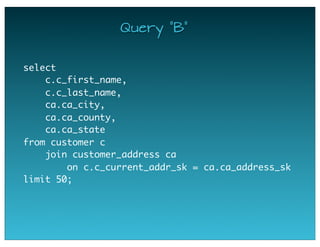
Query "B"
select
   c.c_first_name,
   c.c_last_name,
   ca.ca_city,
   ca.ca_county,
   ca.ca_state
from customer c
   join customer_address ca
on c.c_current_addr_sk = ca.ca_address_sk
limit 50;
Query "C"
select
   c.c_first_name,
   c.c_last_name,
   ca.ca_city,
   ca.ca_county,
   ca.ca_state
from customer c
   join customer_address ca
on c.c_current_addr_sk = ca.ca_address_sk
where lower(c.c_last_name) like 'smi%'
limit 50;
Query "D"
select distinct cd_credit_rating
from customer_demographics;
Query "E"
select
   cd_credit_rating,
   count(*)
from customer_demographics
group by cd_credit_rating;
Query "F"
select
   c.c_first_name,
   c.c_last_name,
   ca.ca_city,
   ca.ca_county,
   ca.ca_state,
   cd.cd_marital_status,
   cd.cd_education_status
from customer c
   join customer_address ca
       on c.c_current_addr_sk = ca.ca_address_sk
   join customer_demographics cd
       on c.c_current_cdemo_sk = cd.cd_demo_sk
where
   lower(c.c_last_name) like 'smi%' and
   cd.cd_credit_rating in ('Unknown', 'High Risk')
limit 50;
Query "G"
select
   count(c.c_customer_sk)
from customer c
   join customer_address ca
       on c.c_current_addr_sk = ca.ca_address_sk
   join customer_demographics cd
       on c.c_current_cdemo_sk = cd.cd_demo_sk
where
   ca.ca_zip in ('20191', '20194') and
   cd.cd_credit_rating in ('Unknown', 'High Risk');
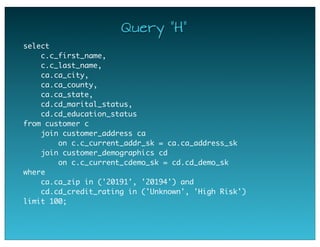
Query "H"
select
   c.c_first_name,
   c.c_last_name,
   ca.ca_city,
   ca.ca_county,
   ca.ca_state,
   cd.cd_marital_status,
   cd.cd_education_status
from customer c
   join customer_address ca
       on c.c_current_addr_sk = ca.ca_address_sk
   join customer_demographics cd
       on c.c_current_cdemo_sk = cd.cd_demo_sk
where
   ca.ca_zip in ('20191', '20194') and
   cd.cd_credit_rating in ('Unknown', 'High Risk')
limit 100;
select  
  i_item_id,
  s_state,
  avg(ss_quantity) agg1,
  avg(ss_list_price) agg2,
  avg(ss_coupon_amt) agg3,
  avg(ss_sales_price) agg4
from store_sales
join date_dim
   on (store_sales.ss_sold_date_sk = date_dim.d_date_sk)
join item
   on (store_sales.ss_item_sk = item.i_item_sk)
join customer_demographics
   on (store_sales.ss_cdemo_sk = customer_demographics.cd_demo_sk)
join store
   on (store_sales.ss_store_sk = store.s_store_sk)
where
  cd_gender = 'M' and
  cd_marital_status = 'S' and
  cd_education_status = 'College' and
  d_year = 2002 and
  s_state in ('TN','SD', 'SD', 'SD', 'SD', 'SD')
group by
  i_item_id,
  s_state
order by
  i_item_id,
  s_state
limit 100;
Query "TPC-DS"
Query Hive (sec) # M/R jobs Impala (sec) x Hive perf.
A 12.4 1 0.21 59
B 30.9 1 0.37 84
C 29.6 1 0.33 91
D 22.8 1 0.60 38
E 22.5 1 0.52 44
F 66.4 2 1.56 43
G 83.0 3 1.33 62
H 66.1 2 1.50 44
TPC-DS 248.3 6 3.05 82
(remember, unscientific...)
A
rchitecture
Two daemons
impalad
statestored
impalad on each HDFS data node
statestored - metadata
Thrift APIs
impalad
Query execution
Query coordination
Query planning
impalad
Query Coordinator
Query Planner
Query Executor
HDFS DataNode
HBase RegionServer
Queries performed in-memory
Intermediate data never hits disk!
Data streamed to clients
C++
runtime code generation
intrinsics for optimization
Execution engine:
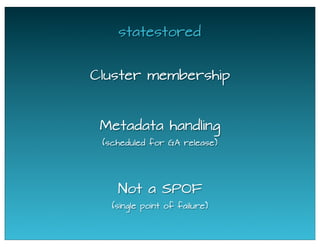
statestored
Cluster membership
Metadata handling
(scheduled for GA release)
Not a SPOF
(single point of failure)
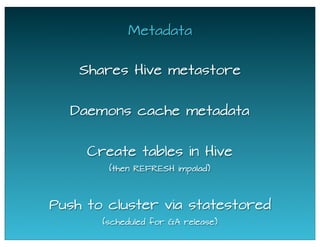
Metadata
Shares Hive metastore
Daemons cache metadata
Push to cluster via statestored
(scheduled for GA release)
Create tables in Hive
(then REFRESH impalad)
Next up - how queries work...
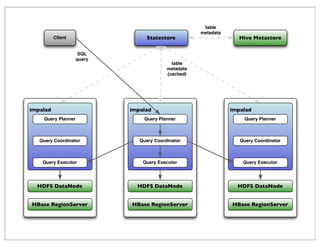
impalad
Query Coordinator
Query Planner
Query Executor
HDFS DataNode
HBase RegionServer
Client Statestore Hive Metastore
table
metadata
table
metadata
(cached)
SQL
query
impalad
Query Coordinator
Query Planner
Query Executor
HDFS DataNode
HBase RegionServer
impalad
Query Coordinator
Query Planner
Query Executor
HDFS DataNode
HBase RegionServer
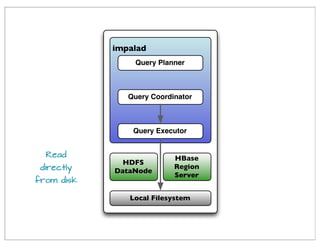
Read directly from disk
Short-circuit reads
Bypass HDFS DataNode
(avoids overhead of HDFS API)
impalad
Query Coordinator
Query Planner
Query Executor
HBase
Region
Server
HDFS
DataNode
Local Filesystem
Read
directly
from disk
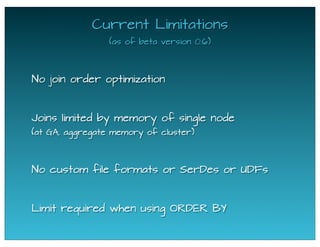
Current Limitations
(as of beta version 0.6)
No join order optimization
No custom file formats or SerDes or UDFs
Limit required when using ORDER BY
Joins limited by memory of single node
(at GA, aggregate memory of cluster)
Current Limitations
(as of beta version 0.6)
No advanced data structures
(arrays, maps, json, etc.)
No DDL (do in Hive)
Limited file formats (text, sequence
w/ snappy/gzip compression)
Future - GA & beyond...
Structure types (structs,
arrays, maps, json, etc.)
DDL support
Additional file formats &
compression support
Columnar format
(Parquet?)
"Performance"
Metadata
(via statestore)
JDBC
Join optimization
(e.g. cost-based)
UDFs
Comparing...
Dremel is a scalable, interactive ad-hoc
query system for analysis of read-only
nested data. By combining multi-level
execution trees and columnar data layout, it
is capable of running aggregation queries
over trillion-row tables in seconds. The
system scales to thousands of CPUs and
petabytes of data, and has thousands of
users at Google.
Comparing Impala to Dremel
- http://research.google.com/pubs/pub36632.html
Comparing Impala to Dremel
Impala = Dremel features circa 2010 + join
support, assuming columnar data format
(but, Google doesn't stand still...)
Dremel is production, mature
Basis for Google's BigQuery
Comparing Impala to Hive
Hive uses Map/Reduce -> high latency
Impala is in-memory, low-
latency query engine
Sacrifices fault tolerance for
performance
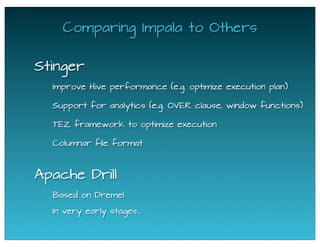
Comparing Impala to Others
Stinger
Apache Drill
Improve Hive performance (e.g. optimize execution plan)
Based on Dremel
In very early stages...
Support for analytics (e.g. OVER clause, window functions)
TEZ framework to optimize execution
Columnar file format
Review
In-memory, distributed
SQL query engine
Integrates into
existing HDFS
Not Map/Reduce
Focus is on
performance
(native code)
References
Google Dremel - http://research.google.com/pubs/pub36632.html
Apache Drill - http://incubator.apache.org/drill/
TPC-DS dataset - http://www.tpc.org/tpcds/
Stinger Initiative - http://hortonworks.com/blog/100x-faster-hive/
Cloudera Impala resources
http://university.cloudera.com/onlineresources/introductionimpala.html
Cloudera Impala: Real-Time Queries in Apache Hadoop, For Real
http://blog.cloudera.com/blog/2012/10/cloudera-impala-real-time-
queries-in-apache-hadoop-for-real/
Photo Attributions
Impala - http://www.flickr.com/photos/gerardstolk/5897570970/
Measuring tape - http://www.morguefile.com/archive/display/24850
Bridge frame - http://www.morguefile.com/archive/display/9699
Balance - http://www.morguefile.com/archive/display/93433
* All others are iStockPhoto (paid)
My Info
scott dot leberknight at nearinfinity dot com
twitter.com/sleberknight www.sleberknight.com/blog
www.nearinfinity.com/blogs/scott_leberknight/all/
scott dot leberknight at gmail dot com

Cloudera Impala