Cloudera Impala:
    A Modern SQL Engine for Apache Hadoop
    Ricky Saltzer
    Tools Developer / Impala Contributor


                                           ricky@cloudera.com
                                                 @monstrado

1
Impala Overview: Goals
•   General-purpose SQL query engine:
     •   should work both for analytical and transactional workloads
     •   will support queries that take from milliseconds to hours
•   Runs directly within Hadoop:
     •   reads widely used Hadoop file formats
     •   talks to widely used Hadoop storage managers
     •   runs on same nodes that run Hadoop processes
•   High performance:
     •   C++ instead of Java
     •   runtime code generation
     •   completely new execution engine that doesn't build on MapReduce
User View of Impala: Overview
•   Runs as a distributed service in cluster: one Impala daemon on each
    node with data
•   User submits query via ODBC/Beeswax Thrift API to any of the
    daemons
•   Query is distributed to all nodes with relevant data
•   If any node fails, the query fails
•   Impala uses Hive's metadata interface, connects to Hive's metastore
•   Supported file formats:
      •   text files (GA: with compression, including lzo)
      •   sequence files with snappy/gzip compression
      •   GA: Avro data files
      •   GA: Trevni (columnar format; more on that later)
User View of Impala: SQL
•   SQL support:
      •   patterned after Hive's version of SQL
      •   limited to Select, Project, Join, Union, Subqueries, Aggregation and
          Insert
      •   only equi-joins; no non-equi joins, no cross products
      •   Order By only with Limit
      •   GA: DDL support (CREATE, ALTER)
•   Functional limitations:
      •   no custom UDFs, file formats, SerDes
      •   no beyond SQL (buckets, samples, transforms, arrays, structs, maps,
          xpath, json)
      •   only hash joins; joined table has to fit in memory:
            • beta: of single node
            • GA: aggregate memory of all (executing) nodes
User View of Impala: Apache HBase
•   HBase functionality:
     •   uses Hive's mapping of HBase table into metastore table
     •   predicates on rowkey columns are mapped into start/stop
         row
     •   predicates on other columns are mapped into
         SingleColumnValueFilters
•   HBase functional limitations:
     •   no nested-loop joins
     •   all data stored as text
Impala Architecture
• Two binaries: impalad and statestored
• Impala daemon (impalad)
     •   handles client requests and all internal requests related to
         query execution
     •   exports Thrift services for these two roles
•   State store daemon (statestored)
     •   provides name service and metadata distribution
     •   also exports a Thrift service
Impala Architecture
•   Query execution phases
     •   request arrives via odbc/beeswax Thrift API
     •   planner turns request into collections of plan fragments
     •   coordinator initiates execution on remote impalad's
     •   during execution
           • intermediate results are streamed between executors
           • query results are streamed back to client
           • subject to limitations imposed to blocking operators
             (top-n, aggregation)
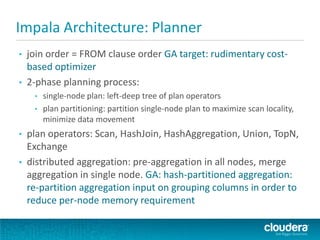
Impala Architecture: Planner
• join order = FROM clause order GA target: rudimentary cost-
  based optimizer
• 2-phase planning process:
     •   single-node plan: left-deep tree of plan operators
     •   plan partitioning: partition single-node plan to maximize scan locality,
         minimize data movement
•   plan operators: Scan, HashJoin, HashAggregation, Union, TopN,
    Exchange
•   distributed aggregation: pre-aggregation in all nodes, merge
    aggregation in single node. GA: hash-partitioned aggregation:
    re-partition aggregation input on grouping columns in order to
    reduce per-node memory requirement
Impala Architecture: Planner
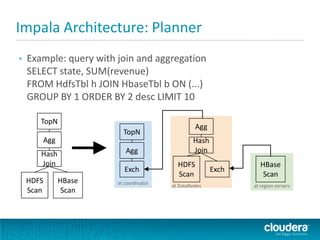
•   Example: query with join and aggregation
    SELECT state, SUM(revenue)
    FROM HdfsTbl h JOIN HbaseTbl b ON (...)
    GROUP BY 1 ORDER BY 2 desc LIMIT 10

       TopN
                                                  Agg
                          TopN
       Agg                                       Hash
       Hash                Agg                   Join
       Join                                HDFS                   HBase
                           Exch                         Exch
                                           Scan                    Scan
    HDFS      HBase     at coordinator   at DataNodes          at region servers
    Scan       Scan
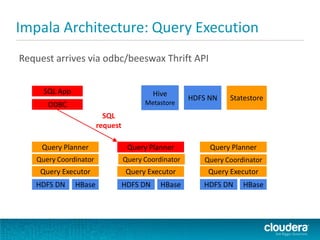
Impala Architecture: Query Execution
Request arrives via odbc/beeswax Thrift API


     SQL App                               Hive
                                                     HDFS NN   Statestore
      ODBC                             Metastore
                         SQL
                       request

     Query Planner                Query Planner           Query Planner
   Query Coordinator             Query Coordinator      Query Coordinator
    Query Executor               Query Executor          Query Executor
   HDFS DN     HBase             HDFS DN     HBase      HDFS DN    HBase
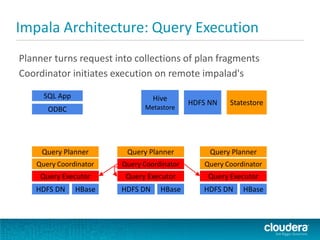
Impala Architecture: Query Execution
Planner turns request into collections of plan fragments
Coordinator initiates execution on remote impalad's

      SQL App                     Hive
                                            HDFS NN   Statestore
       ODBC                   Metastore


     Query Planner       Query Planner           Query Planner
    Query Coordinator   Query Coordinator      Query Coordinator
     Query Executor      Query Executor         Query Executor
    HDFS DN     HBase   HDFS DN     HBase      HDFS DN    HBase
Impala Architecture: Query Execution
Intermediate results are streamed between impalad's Query
results are streamed back to client

     SQL App                          Hive
                                                HDFS NN   Statestore
      ODBC                        Metastore

                   query
                  results

    Query Planner            Query Planner           Query Planner
   Query Coordinator        Query Coordinator      Query Coordinator
    Query Executor           Query Executor         Query Executor
   HDFS DN     HBase        HDFS DN     HBase      HDFS DN    HBase
Impala Architecture
•   Metadata handling:
     • utilizes Hive's metastore
     • caches metadata: no synchronous metastore API calls
       during query execution
     • beta: impalad's read metadata from metastore at startup
     • GA: metadata distribution through statestore
     • post-GA: HCatalog
Impala Architecture
•   Execution engine
     •   written in C++
     •   runtime code generation for "big loops"
          •   example: insert batch of rows into hash table
          •   code generation with llvm
          •   inlines all expressions; no function calls inside loop
     •   all data is copied into canonical in-memory tuple format; all
         fixed-width data is located at fixed offsets
     •   uses intrinsics/special cpu instructions for text parsing,
         crc32 computation, etc.
Impala's Statestore
•   Central system state repository
      •   name service (membership)
      •   GA: metadata
      •   GA: other scheduling-relevant or diagnostic state
•   Soft-state
      •   all impalad's register at startup
      •   impalad's re-register after losing connection
      •   Impala service continues to function in absence of statestored (but:
          with increasingly stale state)
      •   State pushed to impalad's periodically
      •   Repeated failed heartbeat means impalad evicted from cluster view
•   Thrift API for service / subscription registration
Statestore: Why not ZooKeeper?
•   ZK is not a good pub-sub system
     •   Watch API is awkward and requires a lot of client logic
     •   multiple round-trips required to get data for changes to
         node's children
     •   push model is more natural for our use case
•   Don't need all the guarantees ZK provides:
     • serializability
     • persistence
     • prefer to avoid complexity where possible

•   ZK is bad at the things we care about and good at the
    things we don't
Comparing Impala to Google Dremel
•   What is Dremel?
     •   columnar storage for data with nested structures
     •   distributed scalable aggregation on top of that
•   Columnar storage in Hadoop: joint project between Cloudera
    and Twitter
     •   new columnar format, derived from Doug Cutting's Trevni
     •   stores data in appropriate native/binary types
     •   can also store nested structures similar to Dremel's ColumnIO
•   Distributed aggregation: Impala
•   Impala plus columnar format: a superset of the published
    version of Dremel (which didn't support joins)
Comparing Impala to Hive
•   Hive: MapReduce as an execution engine
     •   High latency, low throughput queries
     •   Fault-tolerance model based on MapReduce's on-disk
         checkpointing; materializes all intermediate results
     •   Java runtime allows for easy late-binding of functionality:
         file formats and UDFs.
     •   Extensive layering imposes high runtime overhead
•   Impala:
     •   direct, process-to-process data exchange
     •   no fault tolerance
     •   an execution engine designed for low runtime overhead
Comparing Impala to Hive
•   Impala's performance advantage over Hive: no hard
    numbers, but
     •   Impala can get full disk throughput (~100MB/sec/disk);
         I/O-bound workloads often faster by 3-4x
     •   queries that require multiple map-reduce phases in Hive
         see a higher speedup
     •   queries that run against in-memory data see a higher
         speedup (observed up to 100x)
Impala Roadmap: GA – Q2 2013
•   New data formats:
     • lzo-compressed text
     • Avro
     • columnar

•   Better metadata handling:
     •   automatic metadata distribution through statestore
• Connectivity: jdbc
• Improved query execution: partitioned joins
• Further performance improvements
Impala Roadmap: GA – Q2 2013
•   Guidelines for production deployment:
     •   load balancing across impalad's
     •   resource isolation within MR cluster
•   Additional packages: RHEL 5.7, Ubuntu, Debian
Impala Roadmap: 2013
•   Improved HBase support:
     •   composite keys, Avro data in columns,
         index nested-loop joins,
         INSERT/UPDATE/DELETE
•   Additional SQL:
     • UDFs
     • SQL authorization and DDL
     • ORDER BY without LIMIT
     • window functions
     • support for structured data types
Impala Roadmap: 2013
•   Runtime optimizations:
     • straggler handling
     • join order optimization
     • improved cache management
     • data collocation for improved join performance

•   Resource management:
     • cluster-wide quotas
     • Teradata-style policies ("user x can never have more than 5
       concurrent queries running", etc.)
     • goal: run exploratory and production workloads in same
       cluster, against same data, w/o impacting production jobs
Questions
     •   My email:              Download Impala (beta)
          ricky@cloudera.com     cloudera.com/downloads

                                Learn more about Cloudera
                                 Enterprise RTQ, Powered
                                        by Impala
                                   cloudera.com/impala


     Thank you for attending!

24

Impala presentation

  • 1.
    Cloudera Impala: A Modern SQL Engine for Apache Hadoop Ricky Saltzer Tools Developer / Impala Contributor ricky@cloudera.com @monstrado 1
  • 2.
    Impala Overview: Goals • General-purpose SQL query engine: • should work both for analytical and transactional workloads • will support queries that take from milliseconds to hours • Runs directly within Hadoop: • reads widely used Hadoop file formats • talks to widely used Hadoop storage managers • runs on same nodes that run Hadoop processes • High performance: • C++ instead of Java • runtime code generation • completely new execution engine that doesn't build on MapReduce
  • 3.
    User View ofImpala: Overview • Runs as a distributed service in cluster: one Impala daemon on each node with data • User submits query via ODBC/Beeswax Thrift API to any of the daemons • Query is distributed to all nodes with relevant data • If any node fails, the query fails • Impala uses Hive's metadata interface, connects to Hive's metastore • Supported file formats: • text files (GA: with compression, including lzo) • sequence files with snappy/gzip compression • GA: Avro data files • GA: Trevni (columnar format; more on that later)
  • 4.
    User View ofImpala: SQL • SQL support: • patterned after Hive's version of SQL • limited to Select, Project, Join, Union, Subqueries, Aggregation and Insert • only equi-joins; no non-equi joins, no cross products • Order By only with Limit • GA: DDL support (CREATE, ALTER) • Functional limitations: • no custom UDFs, file formats, SerDes • no beyond SQL (buckets, samples, transforms, arrays, structs, maps, xpath, json) • only hash joins; joined table has to fit in memory: • beta: of single node • GA: aggregate memory of all (executing) nodes
  • 5.
    User View ofImpala: Apache HBase • HBase functionality: • uses Hive's mapping of HBase table into metastore table • predicates on rowkey columns are mapped into start/stop row • predicates on other columns are mapped into SingleColumnValueFilters • HBase functional limitations: • no nested-loop joins • all data stored as text
  • 6.
    Impala Architecture • Twobinaries: impalad and statestored • Impala daemon (impalad) • handles client requests and all internal requests related to query execution • exports Thrift services for these two roles • State store daemon (statestored) • provides name service and metadata distribution • also exports a Thrift service
  • 7.
    Impala Architecture • Query execution phases • request arrives via odbc/beeswax Thrift API • planner turns request into collections of plan fragments • coordinator initiates execution on remote impalad's • during execution • intermediate results are streamed between executors • query results are streamed back to client • subject to limitations imposed to blocking operators (top-n, aggregation)
  • 8.
    Impala Architecture: Planner •join order = FROM clause order GA target: rudimentary cost- based optimizer • 2-phase planning process: • single-node plan: left-deep tree of plan operators • plan partitioning: partition single-node plan to maximize scan locality, minimize data movement • plan operators: Scan, HashJoin, HashAggregation, Union, TopN, Exchange • distributed aggregation: pre-aggregation in all nodes, merge aggregation in single node. GA: hash-partitioned aggregation: re-partition aggregation input on grouping columns in order to reduce per-node memory requirement
  • 9.
    Impala Architecture: Planner • Example: query with join and aggregation SELECT state, SUM(revenue) FROM HdfsTbl h JOIN HbaseTbl b ON (...) GROUP BY 1 ORDER BY 2 desc LIMIT 10 TopN Agg TopN Agg Hash Hash Agg Join Join HDFS HBase Exch Exch Scan Scan HDFS HBase at coordinator at DataNodes at region servers Scan Scan
  • 10.
    Impala Architecture: QueryExecution Request arrives via odbc/beeswax Thrift API SQL App Hive HDFS NN Statestore ODBC Metastore SQL request Query Planner Query Planner Query Planner Query Coordinator Query Coordinator Query Coordinator Query Executor Query Executor Query Executor HDFS DN HBase HDFS DN HBase HDFS DN HBase
  • 11.
    Impala Architecture: QueryExecution Planner turns request into collections of plan fragments Coordinator initiates execution on remote impalad's SQL App Hive HDFS NN Statestore ODBC Metastore Query Planner Query Planner Query Planner Query Coordinator Query Coordinator Query Coordinator Query Executor Query Executor Query Executor HDFS DN HBase HDFS DN HBase HDFS DN HBase
  • 12.
    Impala Architecture: QueryExecution Intermediate results are streamed between impalad's Query results are streamed back to client SQL App Hive HDFS NN Statestore ODBC Metastore query results Query Planner Query Planner Query Planner Query Coordinator Query Coordinator Query Coordinator Query Executor Query Executor Query Executor HDFS DN HBase HDFS DN HBase HDFS DN HBase
  • 13.
    Impala Architecture • Metadata handling: • utilizes Hive's metastore • caches metadata: no synchronous metastore API calls during query execution • beta: impalad's read metadata from metastore at startup • GA: metadata distribution through statestore • post-GA: HCatalog
  • 14.
    Impala Architecture • Execution engine • written in C++ • runtime code generation for "big loops" • example: insert batch of rows into hash table • code generation with llvm • inlines all expressions; no function calls inside loop • all data is copied into canonical in-memory tuple format; all fixed-width data is located at fixed offsets • uses intrinsics/special cpu instructions for text parsing, crc32 computation, etc.
  • 15.
    Impala's Statestore • Central system state repository • name service (membership) • GA: metadata • GA: other scheduling-relevant or diagnostic state • Soft-state • all impalad's register at startup • impalad's re-register after losing connection • Impala service continues to function in absence of statestored (but: with increasingly stale state) • State pushed to impalad's periodically • Repeated failed heartbeat means impalad evicted from cluster view • Thrift API for service / subscription registration
  • 16.
    Statestore: Why notZooKeeper? • ZK is not a good pub-sub system • Watch API is awkward and requires a lot of client logic • multiple round-trips required to get data for changes to node's children • push model is more natural for our use case • Don't need all the guarantees ZK provides: • serializability • persistence • prefer to avoid complexity where possible • ZK is bad at the things we care about and good at the things we don't
  • 17.
    Comparing Impala toGoogle Dremel • What is Dremel? • columnar storage for data with nested structures • distributed scalable aggregation on top of that • Columnar storage in Hadoop: joint project between Cloudera and Twitter • new columnar format, derived from Doug Cutting's Trevni • stores data in appropriate native/binary types • can also store nested structures similar to Dremel's ColumnIO • Distributed aggregation: Impala • Impala plus columnar format: a superset of the published version of Dremel (which didn't support joins)
  • 18.
    Comparing Impala toHive • Hive: MapReduce as an execution engine • High latency, low throughput queries • Fault-tolerance model based on MapReduce's on-disk checkpointing; materializes all intermediate results • Java runtime allows for easy late-binding of functionality: file formats and UDFs. • Extensive layering imposes high runtime overhead • Impala: • direct, process-to-process data exchange • no fault tolerance • an execution engine designed for low runtime overhead
  • 19.
    Comparing Impala toHive • Impala's performance advantage over Hive: no hard numbers, but • Impala can get full disk throughput (~100MB/sec/disk); I/O-bound workloads often faster by 3-4x • queries that require multiple map-reduce phases in Hive see a higher speedup • queries that run against in-memory data see a higher speedup (observed up to 100x)
  • 20.
    Impala Roadmap: GA– Q2 2013 • New data formats: • lzo-compressed text • Avro • columnar • Better metadata handling: • automatic metadata distribution through statestore • Connectivity: jdbc • Improved query execution: partitioned joins • Further performance improvements
  • 21.
    Impala Roadmap: GA– Q2 2013 • Guidelines for production deployment: • load balancing across impalad's • resource isolation within MR cluster • Additional packages: RHEL 5.7, Ubuntu, Debian
  • 22.
    Impala Roadmap: 2013 • Improved HBase support: • composite keys, Avro data in columns, index nested-loop joins, INSERT/UPDATE/DELETE • Additional SQL: • UDFs • SQL authorization and DDL • ORDER BY without LIMIT • window functions • support for structured data types
  • 23.
    Impala Roadmap: 2013 • Runtime optimizations: • straggler handling • join order optimization • improved cache management • data collocation for improved join performance • Resource management: • cluster-wide quotas • Teradata-style policies ("user x can never have more than 5 concurrent queries running", etc.) • goal: run exploratory and production workloads in same cluster, against same data, w/o impacting production jobs
  • 24.
    Questions • My email: Download Impala (beta) ricky@cloudera.com cloudera.com/downloads Learn more about Cloudera Enterprise RTQ, Powered by Impala cloudera.com/impala Thank you for attending! 24