
Copyright © 2013 Cloudera Inc. All rights reserved.
Headline Goes Here
Speaker Name or Subhead Goes Here
Hadoop Beyond Batch: 

Real-time Workloads, SQL-on-
Hadoop, and the Virtual EDW
Marcel Kornacker | marcel@cloudera.com 
April 2014
Copyright © 2013 Cloudera Inc. All rights reserved.
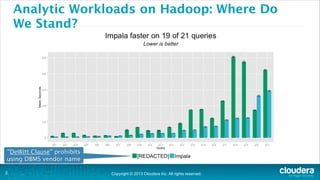
Analytic Workloads on Hadoop: Where Do
We Stand?
!2
“DeWitt Clause” prohibits
using DBMS vendor name
Copyright © 2013 Cloudera Inc. All rights reserved.
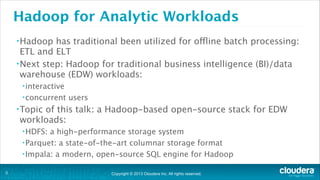
Hadoop for Analytic Workloads
•Hadoop has traditional been utilized for offline batch processing:
ETL and ELT
•Next step: Hadoop for traditional business intelligence (BI)/data
warehouse (EDW) workloads:
•interactive
•concurrent users
•Topic of this talk: a Hadoop-based open-source stack for EDW
workloads:
•HDFS: a high-performance storage system
•Parquet: a state-of-the-art columnar storage format
•Impala: a modern, open-source SQL engine for Hadoop
!3
Copyright © 2013 Cloudera Inc. All rights reserved.
Hadoop for Analytic Workloads
•Thesis of this talk:
•techniques and functionality of established commercial
solutions are either already available or are rapidly being
implemented in Hadoop stack
•Hadoop stack is effective solution for certain EDW workloads
•Hadoop-based EDW solution maintains Hadoop’s strengths:
flexibility, ease of scaling, cost effectiveness
!4
Copyright © 2013 Cloudera Inc. All rights reserved.
HDFS: A Storage System for Analytic
Workloads
•Available in Hdfs today:
•high-efficiency data scans at or near hardware speed, both
from disk and memory
•On the immediate roadmap:
•co-partitioned tables for even faster distributed joins
•temp-FS: write temp table data straight to memory,
bypassing disk

!5
Copyright © 2013 Cloudera Inc. All rights reserved.
HDFS: The Details
•High efficiency data transfers
•short-circuit reads: bypass DataNode protocol when reading
from local disk

-> read at 100+MB/s per disk
•HDFS caching: access explicitly cached data w/o copy or
checksumming

-> access memory-resident data at memory bus speed

-> enable in-memory processing
!6
Copyright © 2013 Cloudera Inc. All rights reserved.
HDFS: The Details
•Coming attractions:
•affinity groups: collocate blocks from different files

-> create co-partitioned tables for improved join
performance
•temp-fs: write temp table data straight to memory,
bypassing disk

-> ideal for iterative interactive data analysis
!7
Copyright © 2013 Cloudera Inc. All rights reserved.
Parquet: Columnar Storage for Hadoop
•What it is:
•state-of-the-art, open-source columnar file format that’s
available for (most) Hadoop processing frameworks:

Impala, Hive, Pig, MapReduce, Cascading, …
•offers both high compression and high scan efficiency
•co-developed by Twitter and Cloudera; hosted on github and
soon to be an Apache incubator project
•with contributors from Criteo, Stripe, Berkeley AMPlab,
LinkedIn
•used in production at Twitter and Criteo
!8
Copyright © 2013 Cloudera Inc. All rights reserved.
Parquet: The Details
•columnar storage: column-major instead of the traditional
row-major layout; used by all high-end analytic DBMSs
•optimized storage of nested data structures: patterned
after Dremel’s ColumnIO format
•extensible set of column encodings:
•run-length and dictionary encodings in current version (1.2)
•delta and optimized string encodings in 2.0
•embedded statistics: version 2.0 stores inlined column
statistics for further optimization of scan efficiency
!9
Copyright © 2013 Cloudera Inc. All rights reserved.
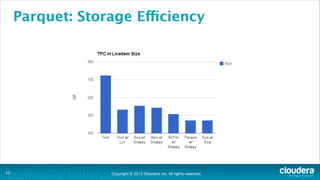
Parquet: Storage Efficiency
!10
Copyright © 2013 Cloudera Inc. All rights reserved.
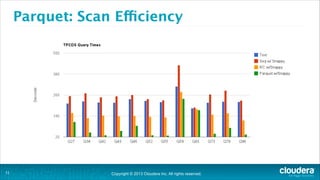
Parquet: Scan Efficiency
!11
Copyright © 2013 Cloudera Inc. All rights reserved.
Impala: A Modern, Open-Source SQL Engine
•implementation of an MPP SQL query engine for the Hadoop
environment
•highest-performance SQL engine for the Hadoop ecosystem;

already outperforms some of its commercial competitors
•effective for EDW-style workloads
•maintains Hadoop flexibility by utilizing standard Hadoop
components (HDFS, Hbase, Metastore, Yarn)
•plays well with traditional BI tools:

exposes/interacts with industry-standard interfaces (odbc/
jdbc, Kerberos and LDAP, ANSI SQL)
!12
Copyright © 2013 Cloudera Inc. All rights reserved.
Impala: A Modern, Open-Source SQL Engine
•history:
•developed by Cloudera and fully open-source; hosted on
github
•released as beta in 10/2012
•1.0 version available in 05/2013
•current version is 1.2.3, available for CDH4 and CDH5 beta
!13
Copyright © 2013 Cloudera Inc. All rights reserved.
Impala from The User’s Perspective
•create tables as virtual views over data stored in HDFS
or Hbase;

schema metadata is stored in Metastore (shared with
Hive, Pig, etc.; basis of HCatalog)
•connect via odbc/jdbc; authenticate via Kerberos or
LDAP
•run standard SQL:
•current version: ANSI SQL-92 (limited to SELECT and bulk
insert) minus correlated subqueries, has UDFs and UDAs
!14
Copyright © 2013 Cloudera Inc. All rights reserved.
Impala from The User’s Perspective
•2014 roadmap:
•1.3: admission control 
•1.4: Decimal(<precision>, <scale>)
•2.0 or earlier: analytic window functions, Order By without
Limit, support for nested types (structs, arrays, maps),
UDTFs, disk-based joins and aggregation
!15
Copyright © 2013 Cloudera Inc. All rights reserved.
Impala Architecture
•distributed service:
•daemon process (impalad) runs on every node with data
•easily deployed with Cloudera Manager
•each node can handle user requests; load balancer
configuration for multi-user environments recommended
•query execution phases:
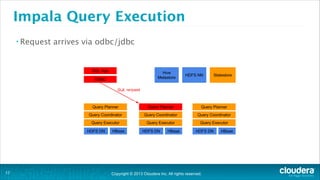
•client request arrives via odbc/jdbc
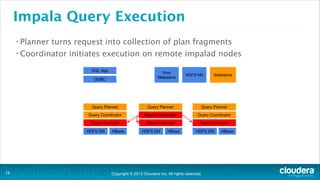
•planner turns request into collection of plan fragments
•coordinator initiates execution on remote impala’s
!16
Copyright © 2013 Cloudera Inc. All rights reserved.
• Request arrives via odbc/jdbc
Impala Query Execution
!17
Copyright © 2013 Cloudera Inc. All rights reserved.
• Planner turns request into collection of plan fragments
• Coordinator initiates execution on remote impalad nodes
Impala Query Execution
!18
Copyright © 2013 Cloudera Inc. All rights reserved.
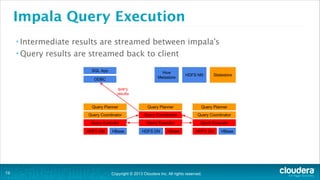
• Intermediate results are streamed between impala’s
• Query results are streamed back to client
Impala Query Execution
!19
Copyright © 2013 Cloudera Inc. All rights reserved.
Impala Architecture: Query Planning
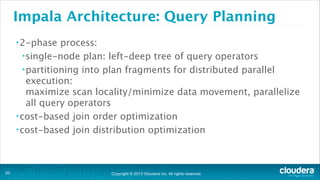
•2-phase process:
•single-node plan: left-deep tree of query operators
•partitioning into plan fragments for distributed parallel
execution:

maximize scan locality/minimize data movement, parallelize
all query operators
•cost-based join order optimization
•cost-based join distribution optimization
!20
Copyright © 2013 Cloudera Inc. All rights reserved.
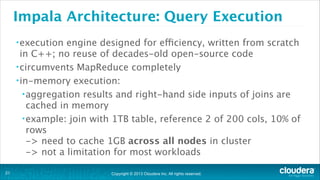
Impala Architecture: Query Execution
•execution engine designed for efficiency, written from scratch
in C++; no reuse of decades-old open-source code
•circumvents MapReduce completely
•in-memory execution:
•aggregation results and right-hand side inputs of joins are
cached in memory
•example: join with 1TB table, reference 2 of 200 cols, 10% of
rows 

-> need to cache 1GB across all nodes in cluster

-> not a limitation for most workloads
!21
Copyright © 2013 Cloudera Inc. All rights reserved.
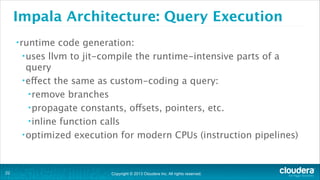
Impala Architecture: Query Execution
•runtime code generation:
•uses llvm to jit-compile the runtime-intensive parts of a
query
•effect the same as custom-coding a query:
•remove branches
•propagate constants, offsets, pointers, etc.
•inline function calls
•optimized execution for modern CPUs (instruction pipelines)
!22
Copyright © 2013 Cloudera Inc. All rights reserved.
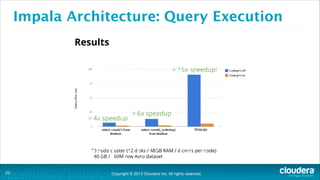
Impala Architecture: Query Execution
!23
Copyright © 2013 Cloudera Inc. All rights reserved.
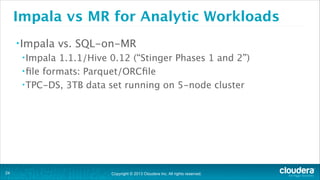
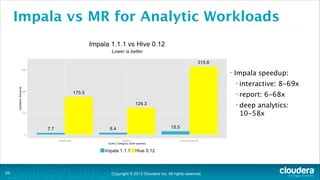
Impala vs MR for Analytic Workloads
•Impala vs. SQL-on-MR
•Impala 1.1.1/Hive 0.12 (“Stinger Phases 1 and 2”)
•file formats: Parquet/ORCfile
•TPC-DS, 3TB data set running on 5-node cluster
!24
Copyright © 2013 Cloudera Inc. All rights reserved.
Impala vs MR for Analytic Workloads
• Impala speedup:
• interactive: 8-69x
• report: 6-68x
• deep analytics:
10-58x
!25
Copyright © 2013 Cloudera Inc. All rights reserved.
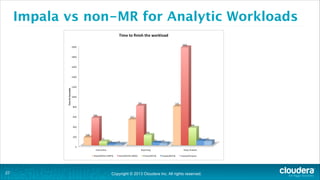
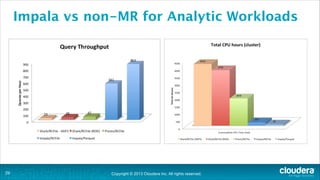
Impala vs non-MR for Analytic Workloads
•Impala 1.2.3/Presto 0.6/Shark
•file formats: RCfile (+ Parquet)
•TPC-DS, 15TB data set running on 21-node cluster
!26
Copyright © 2013 Cloudera Inc. All rights reserved.
Impala vs non-MR for Analytic Workloads
!27
Copyright © 2013 Cloudera Inc. All rights reserved.
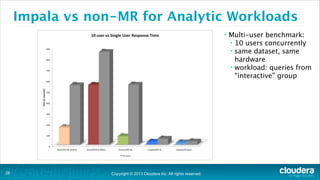
Impala vs non-MR for Analytic Workloads
!28
• Multi-user benchmark:
• 10 users concurrently
• same dataset, same
hardware
• workload: queries from
“interactive” group
Copyright © 2013 Cloudera Inc. All rights reserved.
Impala vs non-MR for Analytic Workloads
!29
Copyright © 2013 Cloudera Inc. All rights reserved.
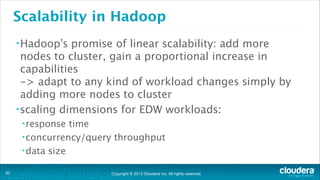
Scalability in Hadoop
•Hadoop’s promise of linear scalability: add more
nodes to cluster, gain a proportional increase in
capabilities

-> adapt to any kind of workload changes simply by
adding more nodes to cluster
•scaling dimensions for EDW workloads:
•response time
•concurrency/query throughput
•data size
!30
Copyright © 2013 Cloudera Inc. All rights reserved.
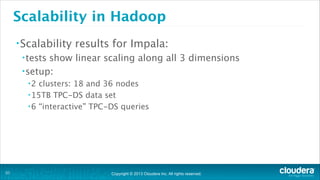
Scalability in Hadoop
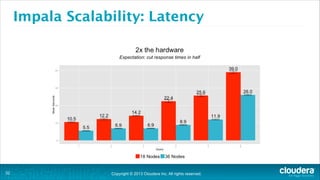
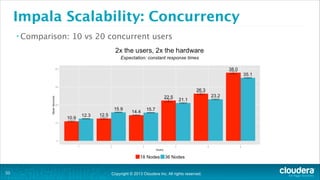
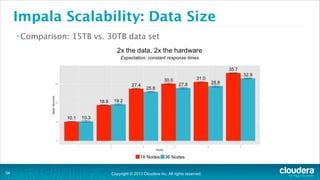
•Scalability results for Impala:
•tests show linear scaling along all 3 dimensions
•setup:
•2 clusters: 18 and 36 nodes
•15TB TPC-DS data set
•6 “interactive” TPC-DS queries
!31
Copyright © 2013 Cloudera Inc. All rights reserved.
Impala Scalability: Latency
!32
Copyright © 2013 Cloudera Inc. All rights reserved.
• Comparison: 10 vs 20 concurrent users
Impala Scalability: Concurrency
!33
Copyright © 2013 Cloudera Inc. All rights reserved.
Impala Scalability: Data Size
• Comparison: 15TB vs. 30TB data set
!34
Copyright © 2013 Cloudera Inc. All rights reserved.
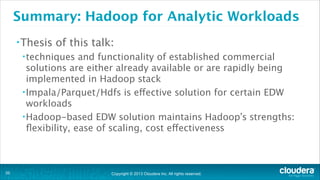
Summary: Hadoop for Analytic Workloads
•Thesis of this talk:
•techniques and functionality of established commercial
solutions are either already available or are rapidly being
implemented in Hadoop stack
•Impala/Parquet/Hdfs is effective solution for certain EDW
workloads
•Hadoop-based EDW solution maintains Hadoop’s strengths:
flexibility, ease of scaling, cost effectiveness
!35
The End
!36
Copyright © 2013 Cloudera Inc. All rights reserved.
Summary: Hadoop for Analytic Workloads
•what the future holds:
•further performance gains
•more complete SQL capabilities
•improved resource mgmt and ability to handle multiple
concurrent workloads in a single cluster
!37

Building a Hadoop Data Warehouse with Impala

  • 1.
    Copyright © 2013Cloudera Inc. All rights reserved. Headline Goes Here Speaker Name or Subhead Goes Here Hadoop Beyond Batch: 
 Real-time Workloads, SQL-on- Hadoop, and the Virtual EDW Marcel Kornacker | marcel@cloudera.com April 2014
  • 2.
    Copyright © 2013Cloudera Inc. All rights reserved. Analytic Workloads on Hadoop: Where Do We Stand? !2 “DeWitt Clause” prohibits using DBMS vendor name
  • 3.
    Copyright © 2013Cloudera Inc. All rights reserved. Hadoop for Analytic Workloads •Hadoop has traditional been utilized for offline batch processing: ETL and ELT •Next step: Hadoop for traditional business intelligence (BI)/data warehouse (EDW) workloads: •interactive •concurrent users •Topic of this talk: a Hadoop-based open-source stack for EDW workloads: •HDFS: a high-performance storage system •Parquet: a state-of-the-art columnar storage format •Impala: a modern, open-source SQL engine for Hadoop !3
  • 4.
    Copyright © 2013Cloudera Inc. All rights reserved. Hadoop for Analytic Workloads •Thesis of this talk: •techniques and functionality of established commercial solutions are either already available or are rapidly being implemented in Hadoop stack •Hadoop stack is effective solution for certain EDW workloads •Hadoop-based EDW solution maintains Hadoop’s strengths: flexibility, ease of scaling, cost effectiveness !4
  • 5.
    Copyright © 2013Cloudera Inc. All rights reserved. HDFS: A Storage System for Analytic Workloads •Available in Hdfs today: •high-efficiency data scans at or near hardware speed, both from disk and memory •On the immediate roadmap: •co-partitioned tables for even faster distributed joins •temp-FS: write temp table data straight to memory, bypassing disk
 !5
  • 6.
    Copyright © 2013Cloudera Inc. All rights reserved. HDFS: The Details •High efficiency data transfers •short-circuit reads: bypass DataNode protocol when reading from local disk
 -> read at 100+MB/s per disk •HDFS caching: access explicitly cached data w/o copy or checksumming
 -> access memory-resident data at memory bus speed
 -> enable in-memory processing !6
  • 7.
    Copyright © 2013Cloudera Inc. All rights reserved. HDFS: The Details •Coming attractions: •affinity groups: collocate blocks from different files
 -> create co-partitioned tables for improved join performance •temp-fs: write temp table data straight to memory, bypassing disk
 -> ideal for iterative interactive data analysis !7
  • 8.
    Copyright © 2013Cloudera Inc. All rights reserved. Parquet: Columnar Storage for Hadoop •What it is: •state-of-the-art, open-source columnar file format that’s available for (most) Hadoop processing frameworks:
 Impala, Hive, Pig, MapReduce, Cascading, … •offers both high compression and high scan efficiency •co-developed by Twitter and Cloudera; hosted on github and soon to be an Apache incubator project •with contributors from Criteo, Stripe, Berkeley AMPlab, LinkedIn •used in production at Twitter and Criteo !8
  • 9.
    Copyright © 2013Cloudera Inc. All rights reserved. Parquet: The Details •columnar storage: column-major instead of the traditional row-major layout; used by all high-end analytic DBMSs •optimized storage of nested data structures: patterned after Dremel’s ColumnIO format •extensible set of column encodings: •run-length and dictionary encodings in current version (1.2) •delta and optimized string encodings in 2.0 •embedded statistics: version 2.0 stores inlined column statistics for further optimization of scan efficiency !9
  • 10.
    Copyright © 2013Cloudera Inc. All rights reserved. Parquet: Storage Efficiency !10
  • 11.
    Copyright © 2013Cloudera Inc. All rights reserved. Parquet: Scan Efficiency !11
  • 12.
    Copyright © 2013Cloudera Inc. All rights reserved. Impala: A Modern, Open-Source SQL Engine •implementation of an MPP SQL query engine for the Hadoop environment •highest-performance SQL engine for the Hadoop ecosystem;
 already outperforms some of its commercial competitors •effective for EDW-style workloads •maintains Hadoop flexibility by utilizing standard Hadoop components (HDFS, Hbase, Metastore, Yarn) •plays well with traditional BI tools:
 exposes/interacts with industry-standard interfaces (odbc/ jdbc, Kerberos and LDAP, ANSI SQL) !12
  • 13.
    Copyright © 2013Cloudera Inc. All rights reserved. Impala: A Modern, Open-Source SQL Engine •history: •developed by Cloudera and fully open-source; hosted on github •released as beta in 10/2012 •1.0 version available in 05/2013 •current version is 1.2.3, available for CDH4 and CDH5 beta !13
  • 14.
    Copyright © 2013Cloudera Inc. All rights reserved. Impala from The User’s Perspective •create tables as virtual views over data stored in HDFS or Hbase;
 schema metadata is stored in Metastore (shared with Hive, Pig, etc.; basis of HCatalog) •connect via odbc/jdbc; authenticate via Kerberos or LDAP •run standard SQL: •current version: ANSI SQL-92 (limited to SELECT and bulk insert) minus correlated subqueries, has UDFs and UDAs !14
  • 15.
    Copyright © 2013Cloudera Inc. All rights reserved. Impala from The User’s Perspective •2014 roadmap: •1.3: admission control •1.4: Decimal(<precision>, <scale>) •2.0 or earlier: analytic window functions, Order By without Limit, support for nested types (structs, arrays, maps), UDTFs, disk-based joins and aggregation !15
  • 16.
    Copyright © 2013Cloudera Inc. All rights reserved. Impala Architecture •distributed service: •daemon process (impalad) runs on every node with data •easily deployed with Cloudera Manager •each node can handle user requests; load balancer configuration for multi-user environments recommended •query execution phases: •client request arrives via odbc/jdbc •planner turns request into collection of plan fragments •coordinator initiates execution on remote impala’s !16
  • 17.
    Copyright © 2013Cloudera Inc. All rights reserved. • Request arrives via odbc/jdbc Impala Query Execution !17
  • 18.
    Copyright © 2013Cloudera Inc. All rights reserved. • Planner turns request into collection of plan fragments • Coordinator initiates execution on remote impalad nodes Impala Query Execution !18
  • 19.
    Copyright © 2013Cloudera Inc. All rights reserved. • Intermediate results are streamed between impala’s • Query results are streamed back to client Impala Query Execution !19
  • 20.
    Copyright © 2013Cloudera Inc. All rights reserved. Impala Architecture: Query Planning •2-phase process: •single-node plan: left-deep tree of query operators •partitioning into plan fragments for distributed parallel execution:
 maximize scan locality/minimize data movement, parallelize all query operators •cost-based join order optimization •cost-based join distribution optimization !20
  • 21.
    Copyright © 2013Cloudera Inc. All rights reserved. Impala Architecture: Query Execution •execution engine designed for efficiency, written from scratch in C++; no reuse of decades-old open-source code •circumvents MapReduce completely •in-memory execution: •aggregation results and right-hand side inputs of joins are cached in memory •example: join with 1TB table, reference 2 of 200 cols, 10% of rows 
 -> need to cache 1GB across all nodes in cluster
 -> not a limitation for most workloads !21
  • 22.
    Copyright © 2013Cloudera Inc. All rights reserved. Impala Architecture: Query Execution •runtime code generation: •uses llvm to jit-compile the runtime-intensive parts of a query •effect the same as custom-coding a query: •remove branches •propagate constants, offsets, pointers, etc. •inline function calls •optimized execution for modern CPUs (instruction pipelines) !22
  • 23.
    Copyright © 2013Cloudera Inc. All rights reserved. Impala Architecture: Query Execution !23
  • 24.
    Copyright © 2013Cloudera Inc. All rights reserved. Impala vs MR for Analytic Workloads •Impala vs. SQL-on-MR •Impala 1.1.1/Hive 0.12 (“Stinger Phases 1 and 2”) •file formats: Parquet/ORCfile •TPC-DS, 3TB data set running on 5-node cluster !24
  • 25.
    Copyright © 2013Cloudera Inc. All rights reserved. Impala vs MR for Analytic Workloads • Impala speedup: • interactive: 8-69x • report: 6-68x • deep analytics: 10-58x !25
  • 26.
    Copyright © 2013Cloudera Inc. All rights reserved. Impala vs non-MR for Analytic Workloads •Impala 1.2.3/Presto 0.6/Shark •file formats: RCfile (+ Parquet) •TPC-DS, 15TB data set running on 21-node cluster !26
  • 27.
    Copyright © 2013Cloudera Inc. All rights reserved. Impala vs non-MR for Analytic Workloads !27
  • 28.
    Copyright © 2013Cloudera Inc. All rights reserved. Impala vs non-MR for Analytic Workloads !28 • Multi-user benchmark: • 10 users concurrently • same dataset, same hardware • workload: queries from “interactive” group
  • 29.
    Copyright © 2013Cloudera Inc. All rights reserved. Impala vs non-MR for Analytic Workloads !29
  • 30.
    Copyright © 2013Cloudera Inc. All rights reserved. Scalability in Hadoop •Hadoop’s promise of linear scalability: add more nodes to cluster, gain a proportional increase in capabilities
 -> adapt to any kind of workload changes simply by adding more nodes to cluster •scaling dimensions for EDW workloads: •response time •concurrency/query throughput •data size !30
  • 31.
    Copyright © 2013Cloudera Inc. All rights reserved. Scalability in Hadoop •Scalability results for Impala: •tests show linear scaling along all 3 dimensions •setup: •2 clusters: 18 and 36 nodes •15TB TPC-DS data set •6 “interactive” TPC-DS queries !31
  • 32.
    Copyright © 2013Cloudera Inc. All rights reserved. Impala Scalability: Latency !32
  • 33.
    Copyright © 2013Cloudera Inc. All rights reserved. • Comparison: 10 vs 20 concurrent users Impala Scalability: Concurrency !33
  • 34.
    Copyright © 2013Cloudera Inc. All rights reserved. Impala Scalability: Data Size • Comparison: 15TB vs. 30TB data set !34
  • 35.
    Copyright © 2013Cloudera Inc. All rights reserved. Summary: Hadoop for Analytic Workloads •Thesis of this talk: •techniques and functionality of established commercial solutions are either already available or are rapidly being implemented in Hadoop stack •Impala/Parquet/Hdfs is effective solution for certain EDW workloads •Hadoop-based EDW solution maintains Hadoop’s strengths: flexibility, ease of scaling, cost effectiveness !35
  • 36.
  • 37.
    Copyright © 2013Cloudera Inc. All rights reserved. Summary: Hadoop for Analytic Workloads •what the future holds: •further performance gains •more complete SQL capabilities •improved resource mgmt and ability to handle multiple concurrent workloads in a single cluster !37