Sept 2012
Impact of Conserved Germplasm
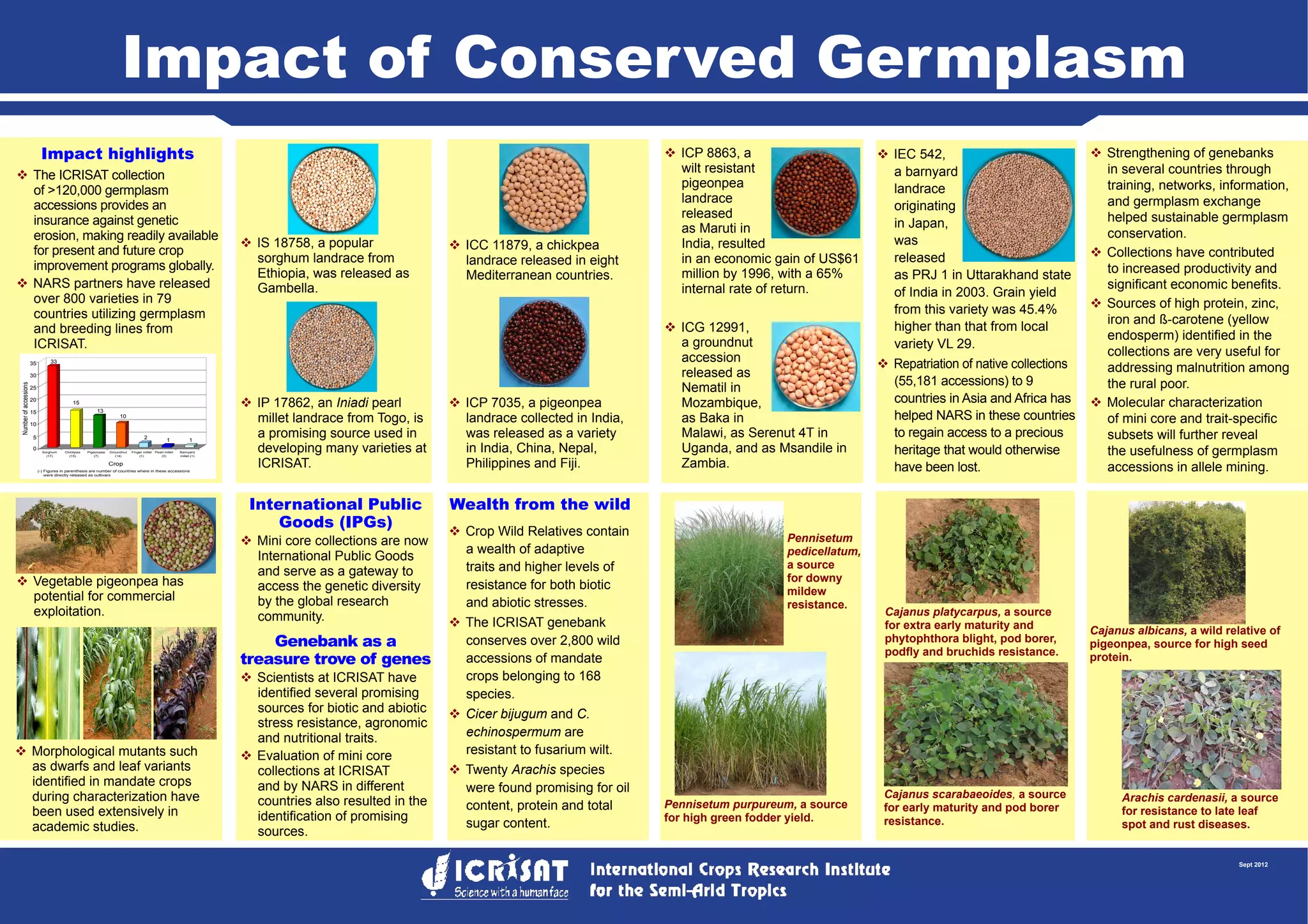
Impact highlights
™™ The ICRISAT collection
of >120,000 germplasm
accessions provides an
insurance against genetic
erosion, making readily available
for present and future crop
improvement programs globally.
™™ NARS partners have released
over 800 varieties in 79
countries utilizing germplasm
and breeding lines from
ICRISAT.
™™ IS 18758, a popular
sorghum landrace from
Ethiopia, was released as
Gambella.
™™ IP 17862, an Iniadi pearl
millet landrace from Togo, is
a promising source used in
developing many varieties at
ICRISAT.
™™ ICC 11879, a chickpea
landrace released in eight
Mediterranean countries.
™™ ICP 7035, a pigeonpea
landrace collected in India,
was released as a variety
in India, China, Nepal,
Philippines and Fiji.
™™ ICP 8863, a
wilt resistant
pigeonpea
landrace
released
as Maruti in
India, resulted
in an economic gain of US$61
million by 1996, with a 65%
internal rate of return.
™™ ICG 12991,
a groundnut
accession
released as
Nematil in
Mozambique,
as Baka in
Malawi, as Serenut 4T in
Uganda, and as Msandile in
Zambia.
™™ IEC 542,
a barnyard
landrace
originating
in Japan,
was
released
as PRJ 1 in Uttarakhand state
of India in 2003. Grain yield
from this variety was 45.4%
higher than that from local
variety VL 29.
™™ Repatriation of native collections
(55,181 accessions) to 9
countries in Asia and Africa has
helped NARS in these countries
to regain access to a precious
heritage that would otherwise
have been lost.
™™ Vegetable pigeonpea has
potential for commercial
exploitation.
™™ Morphological mutants such
as dwarfs and leaf variants
identified in mandate crops
during characterization have
been used extensively in
academic studies.
Wealth from the wild
™™ Crop Wild Relatives contain
a wealth of adaptive
traits and higher levels of
resistance for both biotic
and abiotic stresses.
™™ The ICRISAT genebank
conserves over 2,800 wild
accessions of mandate
crops belonging to 168
species.
™™ Cicer bijugum and C.
echinospermum are
resistant to fusarium wilt.
™™ Twenty Arachis species
were found promising for oil
content, protein and total
sugar content.
Pennisetum
pedicellatum,
a source
for downy
mildew
resistance.
Pennisetum purpureum, a source
for high green fodder yield.
Cajanus scarabaeoides, a source
for early maturity and pod borer
resistance.
Cajanus platycarpus, a source
for extra early maturity and
phytophthora blight, pod borer,
podfly and bruchids resistance.
Cajanus albicans, a wild relative of
pigeonpea, source for high seed
protein.
Arachis cardenasii, a source
for resistance to late leaf
spot and rust diseases.
™™ Strengthening of genebanks
in several countries through
training, networks, information,
and germplasm exchange
helped sustainable germplasm
conservation.
™™ Collections have contributed
to increased productivity and
significant economic benefits.
™™ Sources of high protein, zinc,
iron and ß-carotene (yellow
endosperm) identified in the
collections are very useful for
addressing malnutrition among
the rural poor.
™™ Molecular characterization
of mini core and trait-specific
subsets will further reveal
the usefulness of germplasm
accessions in allele mining.
International Public
Goods (IPGs)
™™ Mini core collections are now
International Public Goods
and serve as a gateway to
access the genetic diversity
by the global research
community.
Genebank as a
treasure trove of genes
™™ Scientists at ICRISAT have
identified several promising
sources for biotic and abiotic
stress resistance, agronomic
and nutritional traits.
™™ Evaluation of mini core
collections at ICRISAT
and by NARS in different
countries also resulted in the
identification of promising
sources.
3335
30
25
20
15
10
5
0
15
13
10
2 1 1
Numberofaccessions
Crop
(-) Figures in parenthesis are number of countries where in these accessions
were directly released as cultivars
Sorghum
(17)
Chickpea
(15)
Pigeonpea
(7)
Groundnut
(14)
Finger millet
(1)
Pearl millet
(3)
Barnyard
millet (1)

Impact of germplasm conservation

  • 1.
    Sept 2012 Impact ofConserved Germplasm Impact highlights ™™ The ICRISAT collection of >120,000 germplasm accessions provides an insurance against genetic erosion, making readily available for present and future crop improvement programs globally. ™™ NARS partners have released over 800 varieties in 79 countries utilizing germplasm and breeding lines from ICRISAT. ™™ IS 18758, a popular sorghum landrace from Ethiopia, was released as Gambella. ™™ IP 17862, an Iniadi pearl millet landrace from Togo, is a promising source used in developing many varieties at ICRISAT. ™™ ICC 11879, a chickpea landrace released in eight Mediterranean countries. ™™ ICP 7035, a pigeonpea landrace collected in India, was released as a variety in India, China, Nepal, Philippines and Fiji. ™™ ICP 8863, a wilt resistant pigeonpea landrace released as Maruti in India, resulted in an economic gain of US$61 million by 1996, with a 65% internal rate of return. ™™ ICG 12991, a groundnut accession released as Nematil in Mozambique, as Baka in Malawi, as Serenut 4T in Uganda, and as Msandile in Zambia. ™™ IEC 542, a barnyard landrace originating in Japan, was released as PRJ 1 in Uttarakhand state of India in 2003. Grain yield from this variety was 45.4% higher than that from local variety VL 29. ™™ Repatriation of native collections (55,181 accessions) to 9 countries in Asia and Africa has helped NARS in these countries to regain access to a precious heritage that would otherwise have been lost. ™™ Vegetable pigeonpea has potential for commercial exploitation. ™™ Morphological mutants such as dwarfs and leaf variants identified in mandate crops during characterization have been used extensively in academic studies. Wealth from the wild ™™ Crop Wild Relatives contain a wealth of adaptive traits and higher levels of resistance for both biotic and abiotic stresses. ™™ The ICRISAT genebank conserves over 2,800 wild accessions of mandate crops belonging to 168 species. ™™ Cicer bijugum and C. echinospermum are resistant to fusarium wilt. ™™ Twenty Arachis species were found promising for oil content, protein and total sugar content. Pennisetum pedicellatum, a source for downy mildew resistance. Pennisetum purpureum, a source for high green fodder yield. Cajanus scarabaeoides, a source for early maturity and pod borer resistance. Cajanus platycarpus, a source for extra early maturity and phytophthora blight, pod borer, podfly and bruchids resistance. Cajanus albicans, a wild relative of pigeonpea, source for high seed protein. Arachis cardenasii, a source for resistance to late leaf spot and rust diseases. ™™ Strengthening of genebanks in several countries through training, networks, information, and germplasm exchange helped sustainable germplasm conservation. ™™ Collections have contributed to increased productivity and significant economic benefits. ™™ Sources of high protein, zinc, iron and ß-carotene (yellow endosperm) identified in the collections are very useful for addressing malnutrition among the rural poor. ™™ Molecular characterization of mini core and trait-specific subsets will further reveal the usefulness of germplasm accessions in allele mining. International Public Goods (IPGs) ™™ Mini core collections are now International Public Goods and serve as a gateway to access the genetic diversity by the global research community. Genebank as a treasure trove of genes ™™ Scientists at ICRISAT have identified several promising sources for biotic and abiotic stress resistance, agronomic and nutritional traits. ™™ Evaluation of mini core collections at ICRISAT and by NARS in different countries also resulted in the identification of promising sources. 3335 30 25 20 15 10 5 0 15 13 10 2 1 1 Numberofaccessions Crop (-) Figures in parenthesis are number of countries where in these accessions were directly released as cultivars Sorghum (17) Chickpea (15) Pigeonpea (7) Groundnut (14) Finger millet (1) Pearl millet (3) Barnyard millet (1)