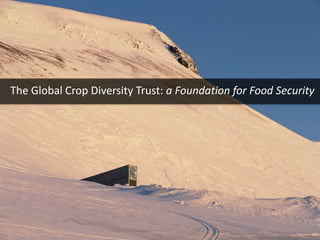
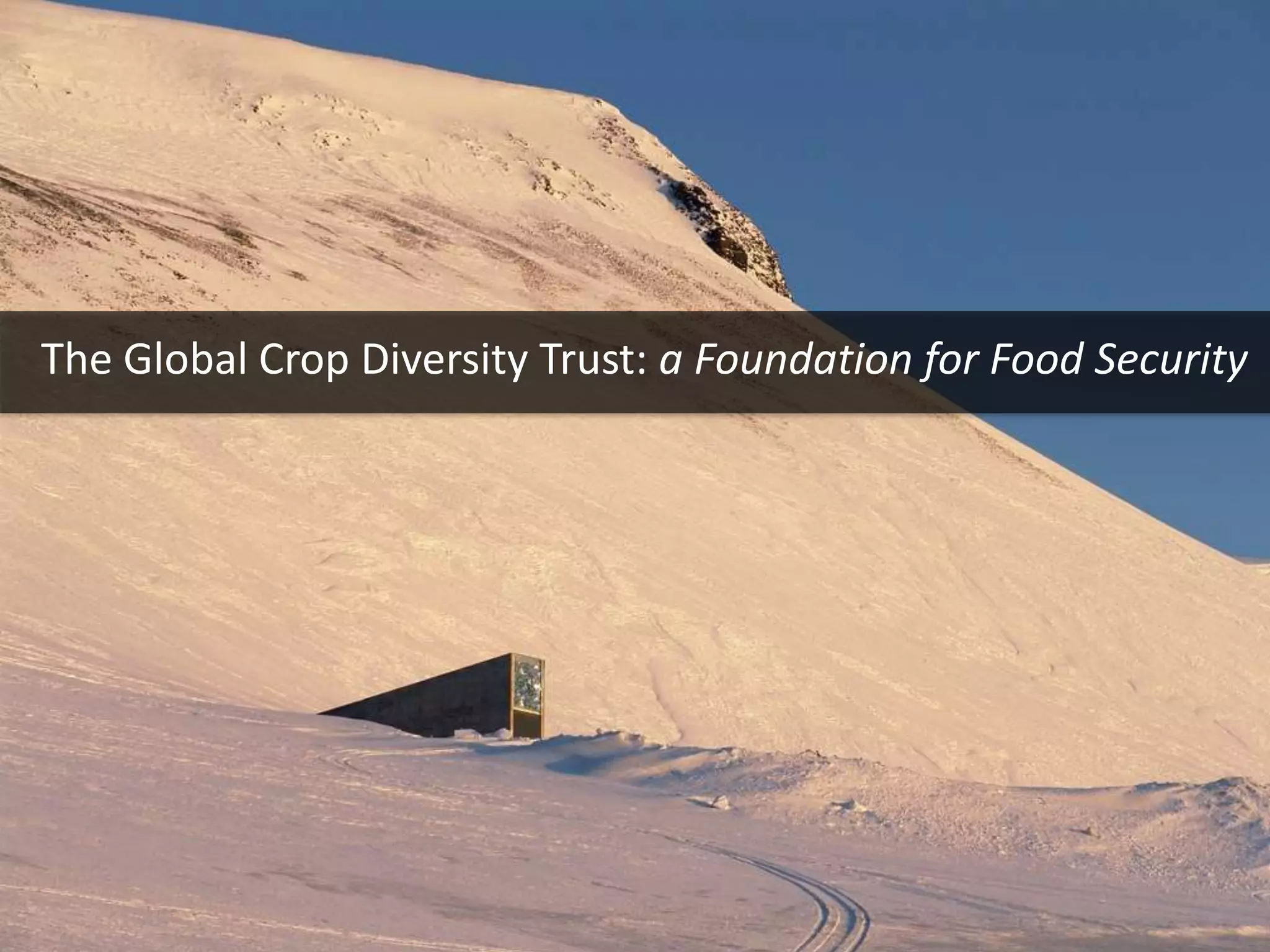
The Global Crop Diversity Trust: a Foundation for Food Security
What is the Trust ?
 Independent international organization established by FAO
and CGIAR Centres
• Established in October 2004
• Secretariat in Bonn from January 2013
 Endowment to secure long-term funding for global system
• Complementary short-term project funding to overcome
key constraints
 Policy framework of International Treaty on PGRFA
• Element of the funding strategy of the Treaty
• Priority for crops under Annex 1, collections in Article 15
 Governed by Executive Board
• Treaty GB, Donors Council, FAO, CGIAR
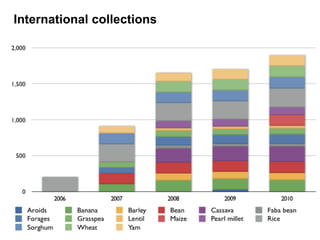
International collections
Goal
“to advance an efficient and sustainable
global system of ex situ conservation by
promoting the rescue, understanding, use
and long-term conservation of valuable
plant genetic resources”
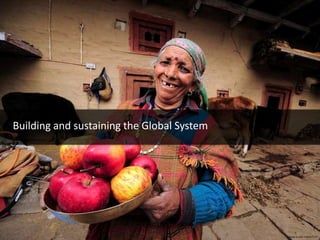
Building and sustaining the Global System
Image by:Neil Palmer/CIAT
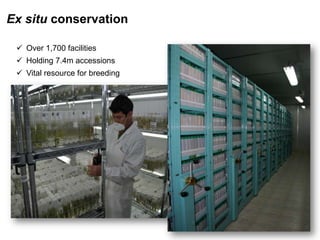
Ex situ conservation
 Over 1,700 facilities
 Holding 7.4m accessions
 Vital resource for breeding
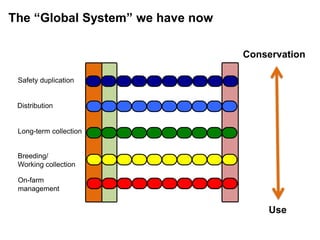
Safety duplication
Long-term collection
On-farm
management
Breeding/
Working collection
The “Global System” we have now
Conservation
Use
Distribution
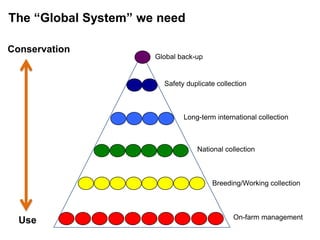
Global back-up
Safety duplicate collection
Long-term international collection
National collection
Breeding/Working collection
On-farm management
The “Global System” we need
Conservation
Use
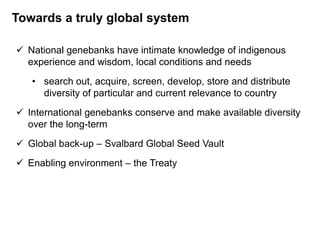
 National genebanks have intimate knowledge of indigenous
experience and wisdom, local conditions and needs
• search out, acquire, screen, develop, store and distribute
diversity of particular and current relevance to country
 International genebanks conserve and make available diversity
over the long-term
 Global back-up – Svalbard Global Seed Vault
 Enabling environment – the Treaty
Towards a truly global system
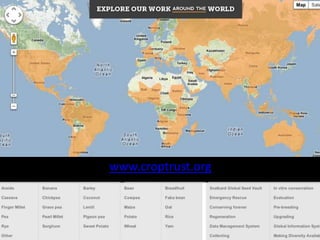
www.croptrust.org
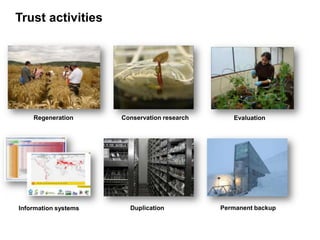
Trust activities
Regeneration Conservation research Evaluation
Permanent backupDuplicationInformation systems
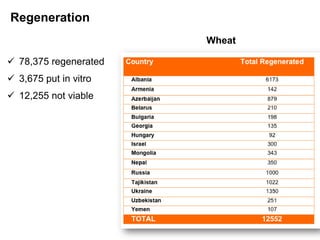
Wheat
 78,375 regenerated
 3,675 put in vitro
 12,255 not viable
Regeneration
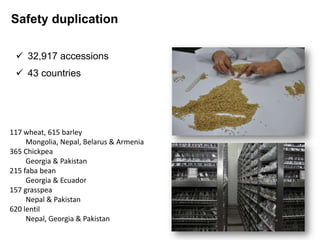
Safety duplication
 32,917 accessions
 43 countries
117 wheat, 615 barley
Mongolia, Nepal, Belarus & Armenia
365 Chickpea
Georgia & Pakistan
215 faba bean
Georgia & Ecuador
157 grasspea
Nepal & Pakistan
620 lentil
Nepal, Georgia & Pakistan
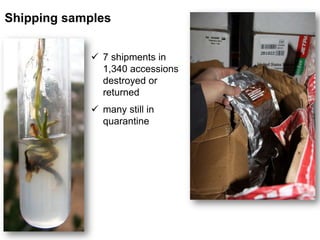
Shipping samples
 7 shipments in
1,340 accessions
destroyed or
returned
 many still in
quarantine
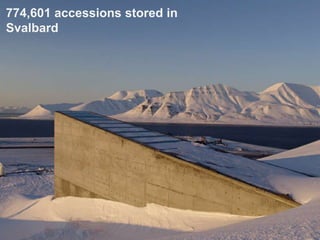
774,601 accessions stored in
Svalbard
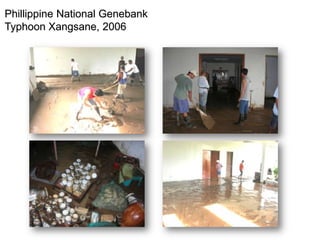
Phillippine National Genebank
Typhoon Xangsane, 2006
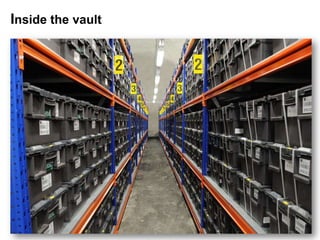
Inside the vault
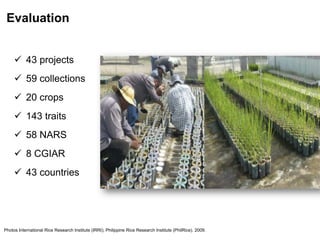
Photos International Rice Research Institute (IRRI); Philippine Rice Research Institute (PhilRice). 2009.
 43 projects
 59 collections
 20 crops
 143 traits
 58 NARS
 8 CGIAR
 43 countries
Evaluation
Promoting use: Information systems
Image by:Neil Palmer/CIAT
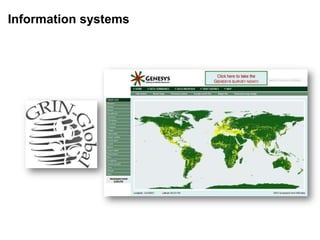
Information systems
• Online portal to accession-level information on the world’s
genebank holdings
• Initially developed as investment from GCDT, Bioversity, and
ITPGRFA-Secretariat
• Initially encompasses CGIAR/held International
Collections, Eurisco and USDA
• Searchable on passport, characterization, evaluation and
ecogeographic descriptors
• Plans for further development and improvement
• Expandable to include all genebanks!
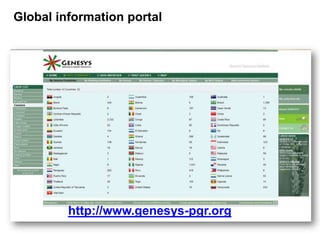
http://www.genesys-pgr.org
Global information portal
• An information management system for genebanks
• The new incarnation of USDA’s Genetic Resources Information
System (GRIN)
• “Open source” software for continued development and
maintenance by the user community
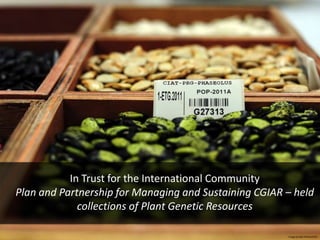
In Trust for the International Community
Plan and Partnership for Managing and Sustaining CGIAR – held
collections of Plant Genetic Resources
Image by:Neil Palmer/CIAT
Objective
To conserve the diversity of PGR in CGIAR-held
collections, to make it available to breeders
and researchers in a manner that meets high
international scientific standards, is cost
efficient, is secure, reliable and sustainable
over the long-term and is supportive of and
consistent with ITPGRFA
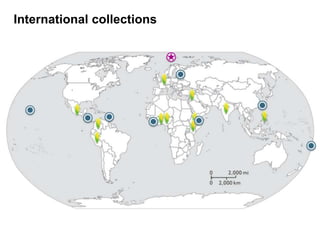
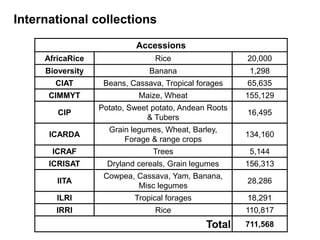
International collections
Accessions
AfricaRice Rice 20,000
Bioversity Banana 1,298
CIAT Beans, Cassava, Tropical forages 65,635
CIMMYT Maize, Wheat 155,129
CIP
Potato, Sweet potato, Andean Roots
& Tubers
16,495
ICARDA
Grain legumes, Wheat, Barley,
Forage & range crops
134,160
ICRAF Trees 5,144
ICRISAT Dryland cereals, Grain legumes 156,313
IITA
Cowpea, Cassava, Yam, Banana,
Misc legumes
28,286
ILRI Tropical forages 18,291
IRRI Rice 110,817
Total 711,568
International collections
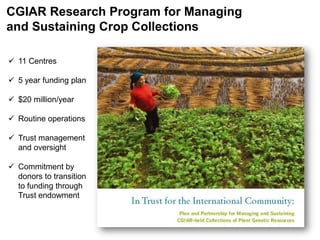
CGIAR Research Program for Managing
and Sustaining Crop Collections
 11 Centres
 5 year funding plan
 $20 million/year
 Routine operations
 Trust management
and oversight
 Commitment by
donors to transition
to funding through
Trust endowment
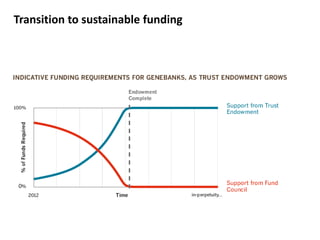
Transition to sustainable funding
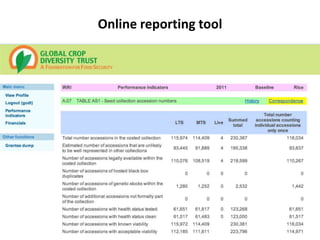
Online reporting tool
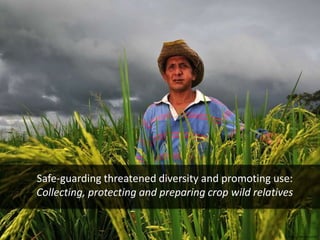
Safe-guarding threatened diversity and promoting use:
Collecting, protecting and preparing crop wild relatives
Image by:Neil Palmer/CIAT
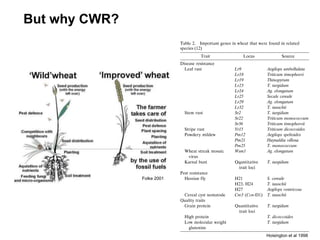
But why CWR?
Hoisington et al 1998
Folke 2001
The Trust’s CWR initiative
• Identify, collect, conserve, document and use key crop wild
relative diversity for climate change adaptation (in developing
countries)
• $50 million over 10 years pledged by Norwegian
government, starting 2011
• 26 target crops
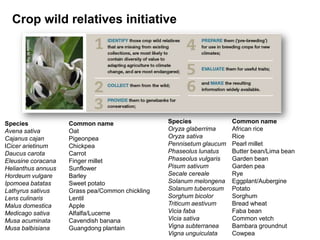
Species Common name
Avena sativa Oat
Cajanus cajan Pigeonpea
lCicer arietinum Chickpea
Daucus carota Carrot
Eleusine coracana Finger millet
Helianthus annuus Sunflower
Hordeum vulgare Barley
Ipomoea batatas Sweet potato
Lathyrus sativus Grass pea/Common chickling
Lens culinaris Lentil
Malus domestica Apple
Medicago sativa Alfalfa/Lucerne
Musa acuminata Cavendish banana
Musa balbisiana Guangdong plantain
Species Common name
Oryza glaberrima African rice
Oryza sativa Rice
Pennisetum glaucum Pearl millet
Phaseolus lunatus Butter bean/Lima bean
Phaseolus vulgaris Garden bean
Pisum sativum Garden pea
Secale cereale Rye
Solanum melongena Eggplant/Aubergine
Solanum tuberosum Potato
Sorghum bicolor Sorghum
Triticum aestivum Bread wheat
Vicia faba Faba bean
Vicia sativa Common vetch
Vigna subterranea Bambara groundnut
Vigna unguiculata Cowpea
Crop wild relatives initiative
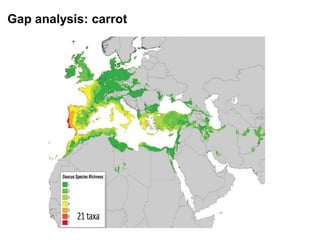
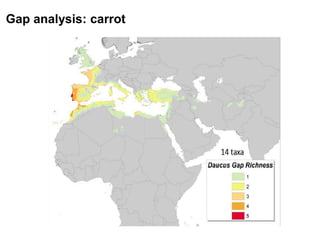
Gap analysis: carrot
www.croptrust.org

Introduction to the Global Crop Diversity Trust

  • 1.
    The Global CropDiversity Trust: a Foundation for Food Security
  • 2.
    What is theTrust ?  Independent international organization established by FAO and CGIAR Centres • Established in October 2004 • Secretariat in Bonn from January 2013  Endowment to secure long-term funding for global system • Complementary short-term project funding to overcome key constraints  Policy framework of International Treaty on PGRFA • Element of the funding strategy of the Treaty • Priority for crops under Annex 1, collections in Article 15  Governed by Executive Board • Treaty GB, Donors Council, FAO, CGIAR
  • 3.
  • 4.
    Goal “to advance anefficient and sustainable global system of ex situ conservation by promoting the rescue, understanding, use and long-term conservation of valuable plant genetic resources”
  • 5.
    Building and sustainingthe Global System Image by:Neil Palmer/CIAT
  • 6.
    Ex situ conservation Over 1,700 facilities  Holding 7.4m accessions  Vital resource for breeding
  • 7.
    Safety duplication Long-term collection On-farm management Breeding/ Workingcollection The “Global System” we have now Conservation Use Distribution
  • 8.
    Global back-up Safety duplicatecollection Long-term international collection National collection Breeding/Working collection On-farm management The “Global System” we need Conservation Use
  • 9.
     National genebankshave intimate knowledge of indigenous experience and wisdom, local conditions and needs • search out, acquire, screen, develop, store and distribute diversity of particular and current relevance to country  International genebanks conserve and make available diversity over the long-term  Global back-up – Svalbard Global Seed Vault  Enabling environment – the Treaty Towards a truly global system
  • 10.
  • 11.
    Trust activities Regeneration Conservationresearch Evaluation Permanent backupDuplicationInformation systems
  • 12.
    Wheat  78,375 regenerated 3,675 put in vitro  12,255 not viable Regeneration
  • 13.
    Safety duplication  32,917accessions  43 countries 117 wheat, 615 barley Mongolia, Nepal, Belarus & Armenia 365 Chickpea Georgia & Pakistan 215 faba bean Georgia & Ecuador 157 grasspea Nepal & Pakistan 620 lentil Nepal, Georgia & Pakistan
  • 14.
    Shipping samples  7shipments in 1,340 accessions destroyed or returned  many still in quarantine
  • 15.
  • 16.
  • 17.
  • 18.
    Photos International RiceResearch Institute (IRRI); Philippine Rice Research Institute (PhilRice). 2009.  43 projects  59 collections  20 crops  143 traits  58 NARS  8 CGIAR  43 countries Evaluation
  • 19.
    Promoting use: Informationsystems Image by:Neil Palmer/CIAT
  • 20.
  • 21.
    • Online portalto accession-level information on the world’s genebank holdings • Initially developed as investment from GCDT, Bioversity, and ITPGRFA-Secretariat • Initially encompasses CGIAR/held International Collections, Eurisco and USDA • Searchable on passport, characterization, evaluation and ecogeographic descriptors • Plans for further development and improvement • Expandable to include all genebanks!
  • 22.
  • 23.
    • An informationmanagement system for genebanks • The new incarnation of USDA’s Genetic Resources Information System (GRIN) • “Open source” software for continued development and maintenance by the user community
  • 24.
    In Trust forthe International Community Plan and Partnership for Managing and Sustaining CGIAR – held collections of Plant Genetic Resources Image by:Neil Palmer/CIAT
  • 25.
    Objective To conserve thediversity of PGR in CGIAR-held collections, to make it available to breeders and researchers in a manner that meets high international scientific standards, is cost efficient, is secure, reliable and sustainable over the long-term and is supportive of and consistent with ITPGRFA
  • 26.
  • 27.
    Accessions AfricaRice Rice 20,000 BioversityBanana 1,298 CIAT Beans, Cassava, Tropical forages 65,635 CIMMYT Maize, Wheat 155,129 CIP Potato, Sweet potato, Andean Roots & Tubers 16,495 ICARDA Grain legumes, Wheat, Barley, Forage & range crops 134,160 ICRAF Trees 5,144 ICRISAT Dryland cereals, Grain legumes 156,313 IITA Cowpea, Cassava, Yam, Banana, Misc legumes 28,286 ILRI Tropical forages 18,291 IRRI Rice 110,817 Total 711,568 International collections
  • 28.
    CGIAR Research Programfor Managing and Sustaining Crop Collections  11 Centres  5 year funding plan  $20 million/year  Routine operations  Trust management and oversight  Commitment by donors to transition to funding through Trust endowment
  • 29.
  • 30.
  • 31.
    Safe-guarding threatened diversityand promoting use: Collecting, protecting and preparing crop wild relatives Image by:Neil Palmer/CIAT
  • 32.
    But why CWR? Hoisingtonet al 1998 Folke 2001
  • 33.
    The Trust’s CWRinitiative • Identify, collect, conserve, document and use key crop wild relative diversity for climate change adaptation (in developing countries) • $50 million over 10 years pledged by Norwegian government, starting 2011 • 26 target crops
  • 34.
    Species Common name Avenasativa Oat Cajanus cajan Pigeonpea lCicer arietinum Chickpea Daucus carota Carrot Eleusine coracana Finger millet Helianthus annuus Sunflower Hordeum vulgare Barley Ipomoea batatas Sweet potato Lathyrus sativus Grass pea/Common chickling Lens culinaris Lentil Malus domestica Apple Medicago sativa Alfalfa/Lucerne Musa acuminata Cavendish banana Musa balbisiana Guangdong plantain Species Common name Oryza glaberrima African rice Oryza sativa Rice Pennisetum glaucum Pearl millet Phaseolus lunatus Butter bean/Lima bean Phaseolus vulgaris Garden bean Pisum sativum Garden pea Secale cereale Rye Solanum melongena Eggplant/Aubergine Solanum tuberosum Potato Sorghum bicolor Sorghum Triticum aestivum Bread wheat Vicia faba Faba bean Vicia sativa Common vetch Vigna subterranea Bambara groundnut Vigna unguiculata Cowpea Crop wild relatives initiative
  • 35.
  • 36.
  • 37.

Editor's Notes

  • #11 The Global Crop Diversity Trust to ensure that crop diversity is properly conserved and easily available.  It is working worldwide, on a wide range of crops and activities .
  • #12 The Trust is also working on a. rescuing threatened collectionsb. researching how to conserve some crops better (particularly difficult-to-conserve crops like cassava, yams and taro)c. evaluating accessions held by genebanks, so that they are better understood and therefore more useful to breedersd. working on information systems to ensure that genebanks are better run, and also that plant breeders can access both information and accessions from genebanks around the worlde. to avoid disasters such as the slide shown earlier from the Philippines, ensuring that collections are duplicated for safety,f. and ensuring that a safety back-up is stored in the safest seed storage on the planet - the Svalbard Global Seed Vault.
  • #13 This includes over 10,000 wheat accessions which were threatened with extinction.
  • #16 The Vault now contains a large percentage of the world's diversity – as safe as it can possibly be!
  • #17 Or very vulnerable
  • #21 An information management system for genebanksThe new incarnation of USDA’s Genetic Resources Information System (GRIN)Support to adoption has been provided by Bioversity International“Open source” software for continued development and maintenance by the user communityXx genebanks now trained
  • #22 GeneSys is a global platform for the the sharing of data provided by international and national genebanks. This platform is envisioned to meet the needs of data providers to publish their individual genebank data globally. It will meet the needs of a diversity of users to search through this diversity to identify key accessions needed for access. It will also enhance global understanding of the utilization potential and the unique nature of the world’s germplasm. It is one of a number of platforms available but has the potential to link many together
  • #24 GeneSys is a global platform for the the sharing of data provided by international and national genebanks. This platform is envisioned to meet the needs of data providers to publish their individual genebank data globally. It will meet the needs of a diversity of users to search through this diversity to identify key accessions needed for access. It will also enhance global understanding of the utilization potential and the unique nature of the world’s germplasm. It is one of a number of platforms available but has the potential to link many together
  • #35 Current 10 year initiative is CWR