Programme Report 2012
    Work Plan 2013
                  Tim Krupnick, CIMMYT
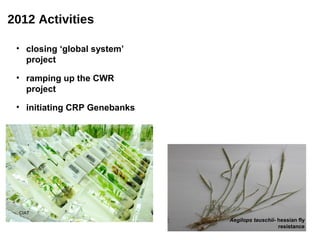
2012 Activities

 • closing ‘global system’
   project

 • ramping up the CWR
   project

 • initiating CRP Genebanks


  CIAT
                              Aegilops tauschii- hessian fly
                                                 resistance
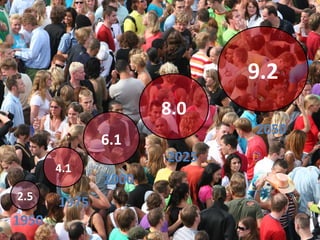
9.2
                     8.0
                            2050
              6.1
                     2025
       4.1
              2000
2.5
       1975
1950
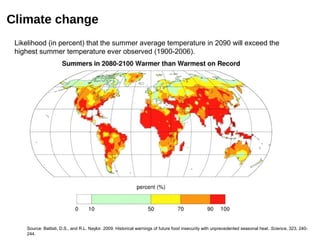
Climate change
 Likelihood (in percent) that the summer average temperature in 2090 will exceed the
 highest summer temperature ever observed (1900-2006).


    Source: Battisti, D.S., and R.L. Naylor. 2009. Historical warnings of future food insecurity with unprecedented seasonal heat. Science, 323, 240-
    244.
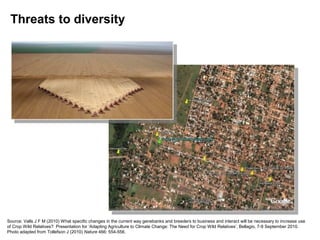
Threats to diversity


Source: Valls J F M (2010) What specific changes in the current way genebanks and breeders to business and interact will be necessary to increase use
of Crop Wild Relatives? Presentation for ‘Adapting Agriculture to Climate Change: The Need for Crop Wild Relatives’, Bellagio, 7-9 September 2010.
Photo adapted from Tollefson J (2010) Nature 466: 554-556.
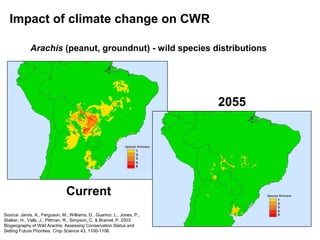
Impact of climate change on CWR

             Arachis (peanut, groundnut) - wild species distributions


                                                                          2055


                                Current
Source: Jarvis, A., Ferguson, M., Williams, D., Guarino, L., Jones, P.,
Stalker, H., Valls, J., Pittman, R., Simpson, C. & Bramel, P. 2003.
Biogeography of Wild Arachis: Assessing Conservation Status and
Setting Future Priorities. Crop Science 43, 1100-1108.
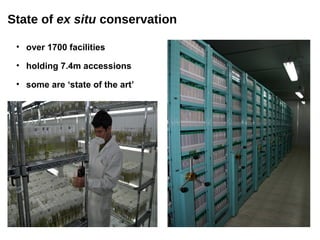
State of ex situ conservation

 • over 1700 facilities

 • holding 7.4m accessions

 • some are ‘state of the art’
State of ex situ conservation

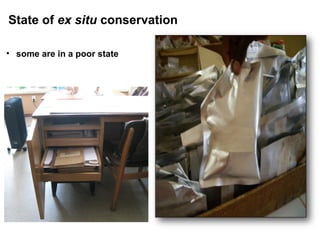
• some are in a poor state
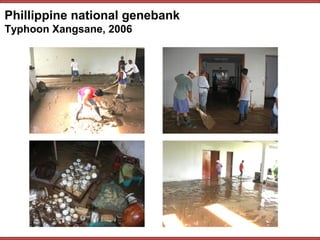
Phillippine national genebank
Typhoon Xangsane, 2006
Phillippine National Genebank
Fire, 28 January 2012
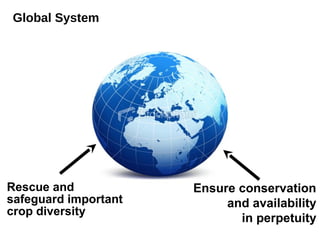
Global System


Rescue and            Ensure conservation
safeguard important        and availability
crop diversity
                             in perpetuity
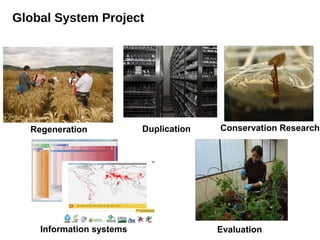
Global System Project


  Regeneration            Duplication   Conservation Research


    Information systems                 Evaluation
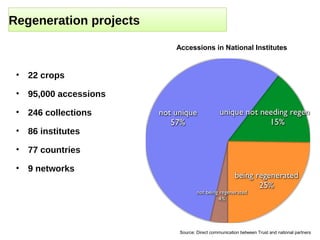
Regeneration projects

                         Accessions in National Institutes


 •   22 crops

 •   95,000 accessions

 •   246 collections

 •   86 institutes

 •   77 countries

 •   9 networks


                          Source: Direct communication between Trust and national partners
Results of the regeneration


• 74,410 regenerated

• 3,675 put in vitro

• 12,255 not viable
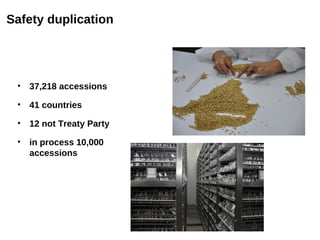
Safety duplication


 • 37,218 accessions

 • 41 countries

 • 12 not Treaty Party

 • in process 10,000
   accessions
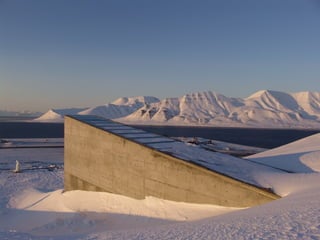
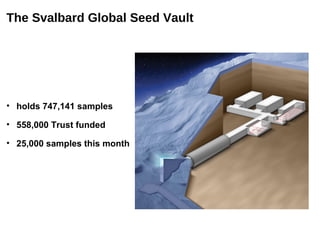
The Svalbard Global Seed Vault


• holds 747,141 samples

• 558,000 Trust funded

• 25,000 samples this month
Status 2012
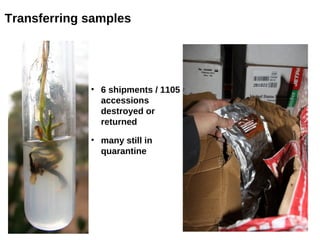
Transferring samples


             • 6 shipments / 1105
               accessions
               destroyed or
               returned

             • many still in
               quarantine
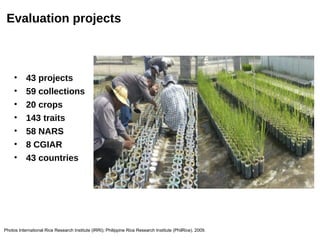
Evaluation projects


     •     43 projects
     •     59 collections
     •     20 crops
     •     143 traits
     •     58 NARS
     •     8 CGIAR
     •     43 countries


Photos International Rice Research Institute (IRRI); Philippine Rice Research Institute (PhilRice). 2009.
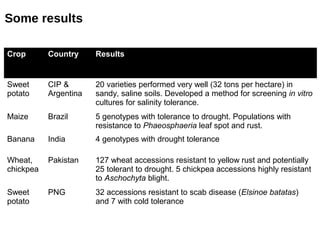
Some results

Crop       Country     Results


Sweet      CIP &       20 varieties performed very well (32 tons per hectare) in
potato     Argentina   sandy, saline soils. Developed a method for screening in vitro
                       cultures for salinity tolerance.
Maize      Brazil      5 genotypes with tolerance to drought. Populations with
                       resistance to Phaeosphaeria leaf spot and rust.
Banana     India       4 genotypes with drought tolerance

Wheat,     Pakistan    127 wheat accessions resistant to yellow rust and potentially
chickpea               25 tolerant to drought. 5 chickpea accessions highly resistant
                       to Aschochyta blight.
Sweet      PNG         32 accessions resistant to scab disease (Elsinoe batatas)
potato                 and 7 with cold tolerance
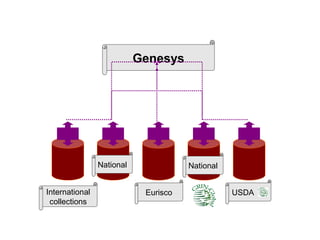
Genesys


                National              National


International               Eurisco              USDA
 collections
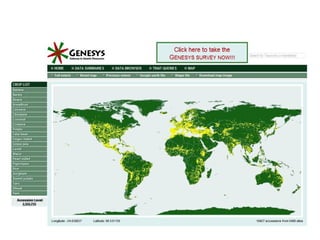
http://www.genesys-pgr.org/
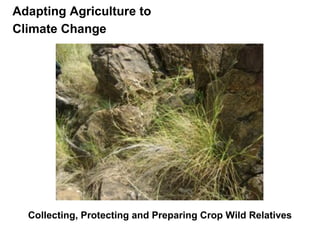
Adapting Agriculture to
Climate Change


  Collecting, Protecting and Preparing Crop Wild Relatives
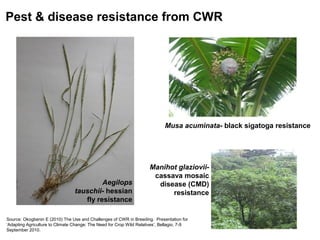
Pest & disease resistance from CWR


                                                                             Musa acuminata- black sigatoga resistance


                                                                      Manihot glaziovii-
                                                                       cassava mosaic
                                          Aegilops                      disease (CMD)
                                 tauschii- hessian                          resistance
                                    fly resistance

Source: Okogbenin E (2010) The Use and Challenges of CWR in Breeding. Presentation for
‘Adapting Agriculture to Climate Change: The Need for Crop Wild Relatives’, Bellagio, 7-9
September 2010.
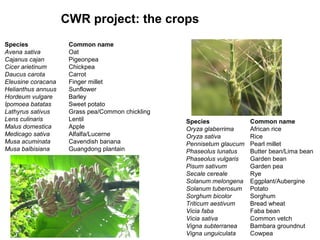
CWR project: the crops
Species              Common name
Avena sativa         Oat
Cajanus cajan        Pigeonpea
Cicer arietinum      Chickpea
Daucus carota        Carrot
Eleusine coracana    Finger millet
Helianthus annuus    Sunflower
Hordeum vulgare      Barley
Ipomoea batatas      Sweet potato
Lathyrus sativus     Grass pea/Common chickling
Lens culinaris       Lentil                       Species              Common name
Malus domestica      Apple                        Oryza glaberrima     African rice
Medicago sativa      Alfalfa/Lucerne              Oryza sativa         Rice
Musa acuminata       Cavendish banana             Pennisetum glaucum   Pearl millet
Musa balbisiana      Guangdong plantain           Phaseolus lunatus    Butter bean/Lima bean
                                                  Phaseolus vulgaris   Garden bean
                                                  Pisum sativum        Garden pea
                                                  Secale cereale       Rye
                                                  Solanum melongena    Eggplant/Aubergine
                                                  Solanum tuberosum    Potato
                                                  Sorghum bicolor      Sorghum
                                                  Triticum aestivum    Bread wheat
                                                  Vicia faba           Faba bean
                                                  Vicia sativa         Common vetch
                                                  Vigna subterranea    Bambara groundnut
                                                  Vigna unguiculata    Cowpea
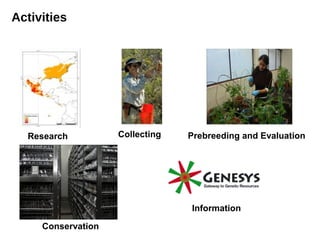
Activities


  Research          Collecting   Prebreeding and Evaluation


                                 Information

     Conservation
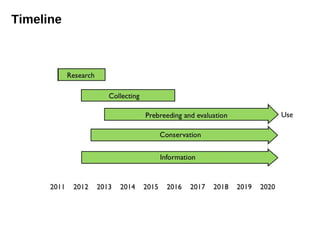
Timeline
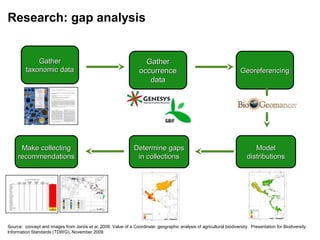
Research: gap analysis


             Gather                                                   Gather
         taxonomic data                                             occurrence                                          Georeferencing
                                                                       data


      Make collecting                                            Determine gaps                                               Model
     recommendations                                              in collections                                           distributions


Source: concept and images from Jarvis et al. 2009. Value of a Coordinate: geographic analysis of agricultural biodiversity. Presentation for Biodiversity
Information Standards (TDWG), November 2009.
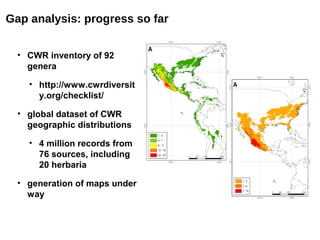
Gap analysis: progress so far


  • CWR inventory of 92
    genera

    • http://www.cwrdiversit
      y.org/checklist/

  • global dataset of CWR
    geographic distributions

    • 4 million records from
      76 sources, including
      20 herbaria

  • generation of maps under
    way
Gap analysis: man vs. machine
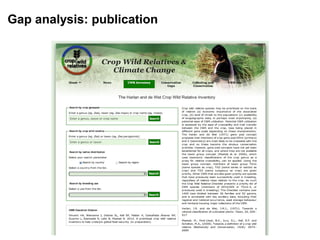
Gap analysis: publication
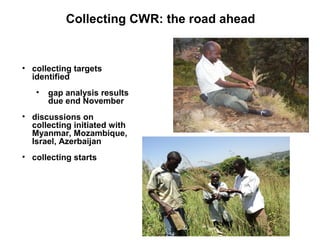
Collecting CWR: the road ahead


• collecting targets
  identified
   •   gap analysis results
       due end November
• discussions on
  collecting initiated with
  Myanmar, Mozambique,
  Israel, Azerbaijan
• collecting starts
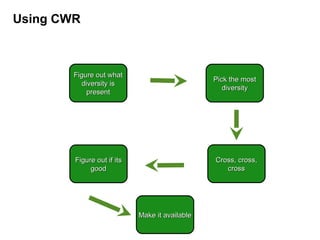
Using CWR


        Figure out what
                                                Pick the most
          diversity is
                                                   diversity
            present


        Figure out if its                       Cross, cross,
             good                                  cross


                            Make it available
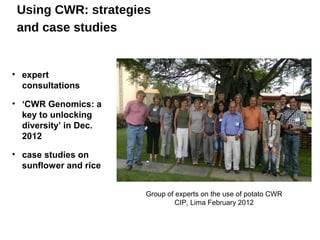
Using CWR: strategies
 and case studies


• expert
  consultations

• ‘CWR Genomics: a
  key to unlocking
  diversity’ in Dec.
  2012

• case studies on
  sunflower and rice


                       Group of experts on the use of potato CWR
                                CIP, Lima February 2012

Programme report-Global System and CWR

  • 1.
    Programme Report 2012 Work Plan 2013 Tim Krupnick, CIMMYT
  • 2.
    2012 Activities •closing ‘global system’ project • ramping up the CWR project • initiating CRP Genebanks CIAT Aegilops tauschii- hessian fly resistance
  • 3.
    9.2 8.0 2050 6.1 2025 4.1 2000 2.5 1975 1950
  • 4.
    Climate change Likelihood(in percent) that the summer average temperature in 2090 will exceed the highest summer temperature ever observed (1900-2006). Source: Battisti, D.S., and R.L. Naylor. 2009. Historical warnings of future food insecurity with unprecedented seasonal heat. Science, 323, 240- 244.
  • 5.
    Threats to diversity Source:Valls J F M (2010) What specific changes in the current way genebanks and breeders to business and interact will be necessary to increase use of Crop Wild Relatives? Presentation for ‘Adapting Agriculture to Climate Change: The Need for Crop Wild Relatives’, Bellagio, 7-9 September 2010. Photo adapted from Tollefson J (2010) Nature 466: 554-556.
  • 6.
    Impact of climatechange on CWR Arachis (peanut, groundnut) - wild species distributions 2055 Current Source: Jarvis, A., Ferguson, M., Williams, D., Guarino, L., Jones, P., Stalker, H., Valls, J., Pittman, R., Simpson, C. & Bramel, P. 2003. Biogeography of Wild Arachis: Assessing Conservation Status and Setting Future Priorities. Crop Science 43, 1100-1108.
  • 7.
    State of exsitu conservation • over 1700 facilities • holding 7.4m accessions • some are ‘state of the art’
  • 8.
    State of exsitu conservation • some are in a poor state
  • 9.
  • 10.
  • 11.
    Global System Rescue and Ensure conservation safeguard important and availability crop diversity in perpetuity
  • 12.
    Global System Project Regeneration Duplication Conservation Research Information systems Evaluation
  • 13.
    Regeneration projects Accessions in National Institutes • 22 crops • 95,000 accessions • 246 collections • 86 institutes • 77 countries • 9 networks Source: Direct communication between Trust and national partners
  • 14.
    Results of theregeneration • 74,410 regenerated • 3,675 put in vitro • 12,255 not viable
  • 15.
    Safety duplication •37,218 accessions • 41 countries • 12 not Treaty Party • in process 10,000 accessions
  • 17.
    The Svalbard GlobalSeed Vault • holds 747,141 samples • 558,000 Trust funded • 25,000 samples this month
  • 18.
  • 19.
    Transferring samples • 6 shipments / 1105 accessions destroyed or returned • many still in quarantine
  • 20.
    Evaluation projects • 43 projects • 59 collections • 20 crops • 143 traits • 58 NARS • 8 CGIAR • 43 countries Photos International Rice Research Institute (IRRI); Philippine Rice Research Institute (PhilRice). 2009.
  • 21.
    Some results Crop Country Results Sweet CIP & 20 varieties performed very well (32 tons per hectare) in potato Argentina sandy, saline soils. Developed a method for screening in vitro cultures for salinity tolerance. Maize Brazil 5 genotypes with tolerance to drought. Populations with resistance to Phaeosphaeria leaf spot and rust. Banana India 4 genotypes with drought tolerance Wheat, Pakistan 127 wheat accessions resistant to yellow rust and potentially chickpea 25 tolerant to drought. 5 chickpea accessions highly resistant to Aschochyta blight. Sweet PNG 32 accessions resistant to scab disease (Elsinoe batatas) potato and 7 with cold tolerance
  • 24.
    Genesys National National International Eurisco USDA collections
  • 25.
  • 26.
    Adapting Agriculture to ClimateChange Collecting, Protecting and Preparing Crop Wild Relatives
  • 27.
    Pest & diseaseresistance from CWR Musa acuminata- black sigatoga resistance Manihot glaziovii- cassava mosaic Aegilops disease (CMD) tauschii- hessian resistance fly resistance Source: Okogbenin E (2010) The Use and Challenges of CWR in Breeding. Presentation for ‘Adapting Agriculture to Climate Change: The Need for Crop Wild Relatives’, Bellagio, 7-9 September 2010.
  • 28.
    CWR project: thecrops Species Common name Avena sativa Oat Cajanus cajan Pigeonpea Cicer arietinum Chickpea Daucus carota Carrot Eleusine coracana Finger millet Helianthus annuus Sunflower Hordeum vulgare Barley Ipomoea batatas Sweet potato Lathyrus sativus Grass pea/Common chickling Lens culinaris Lentil Species Common name Malus domestica Apple Oryza glaberrima African rice Medicago sativa Alfalfa/Lucerne Oryza sativa Rice Musa acuminata Cavendish banana Pennisetum glaucum Pearl millet Musa balbisiana Guangdong plantain Phaseolus lunatus Butter bean/Lima bean Phaseolus vulgaris Garden bean Pisum sativum Garden pea Secale cereale Rye Solanum melongena Eggplant/Aubergine Solanum tuberosum Potato Sorghum bicolor Sorghum Triticum aestivum Bread wheat Vicia faba Faba bean Vicia sativa Common vetch Vigna subterranea Bambara groundnut Vigna unguiculata Cowpea
  • 29.
    Activities Research Collecting Prebreeding and Evaluation Information Conservation
  • 30.
  • 31.
    Research: gap analysis Gather Gather taxonomic data occurrence Georeferencing data Make collecting Determine gaps Model recommendations in collections distributions Source: concept and images from Jarvis et al. 2009. Value of a Coordinate: geographic analysis of agricultural biodiversity. Presentation for Biodiversity Information Standards (TDWG), November 2009.
  • 32.
    Gap analysis: progressso far • CWR inventory of 92 genera • http://www.cwrdiversit y.org/checklist/ • global dataset of CWR geographic distributions • 4 million records from 76 sources, including 20 herbaria • generation of maps under way
  • 33.
    Gap analysis: manvs. machine
  • 34.
  • 35.
    Collecting CWR: theroad ahead • collecting targets identified • gap analysis results due end November • discussions on collecting initiated with Myanmar, Mozambique, Israel, Azerbaijan • collecting starts
  • 36.
    Using CWR Figure out what Pick the most diversity is diversity present Figure out if its Cross, cross, good cross Make it available
  • 37.
    Using CWR: strategies and case studies • expert consultations • ‘CWR Genomics: a key to unlocking diversity’ in Dec. 2012 • case studies on sunflower and rice Group of experts on the use of potato CWR CIP, Lima February 2012

Editor's Notes

  • #27 Picture reference: Pennisetum procerum from NARO, Uganda collecting project
  • #38 Development of use strategies: Expert consultations completed to date: potato, beans, sunflower, cereals, eggplant, sweetpotato, alfalfa, lentil, banana, apple and cowpea. Strategies for all genepools developed by end 2013. Meeting on ‘CWR Genomics: A key to unlocking diversity’ planned for December 2013: In collaboration with high-level team of scientific advisors co-funding from the US National Science Foundation as well as several Canadian Genome programmes.