Representativeness in genebanks

   Measured in terms of diversity captured within ex situ genebanks


   Is the best guarantee to face future threats


   Is a concern for curators, not for breeders


   The reference must be nature for CWR, agroecosystems for landraces


   To assess it, comparative studies (genebank vs nature/farm) are required
Why is it so difficult to assess it?


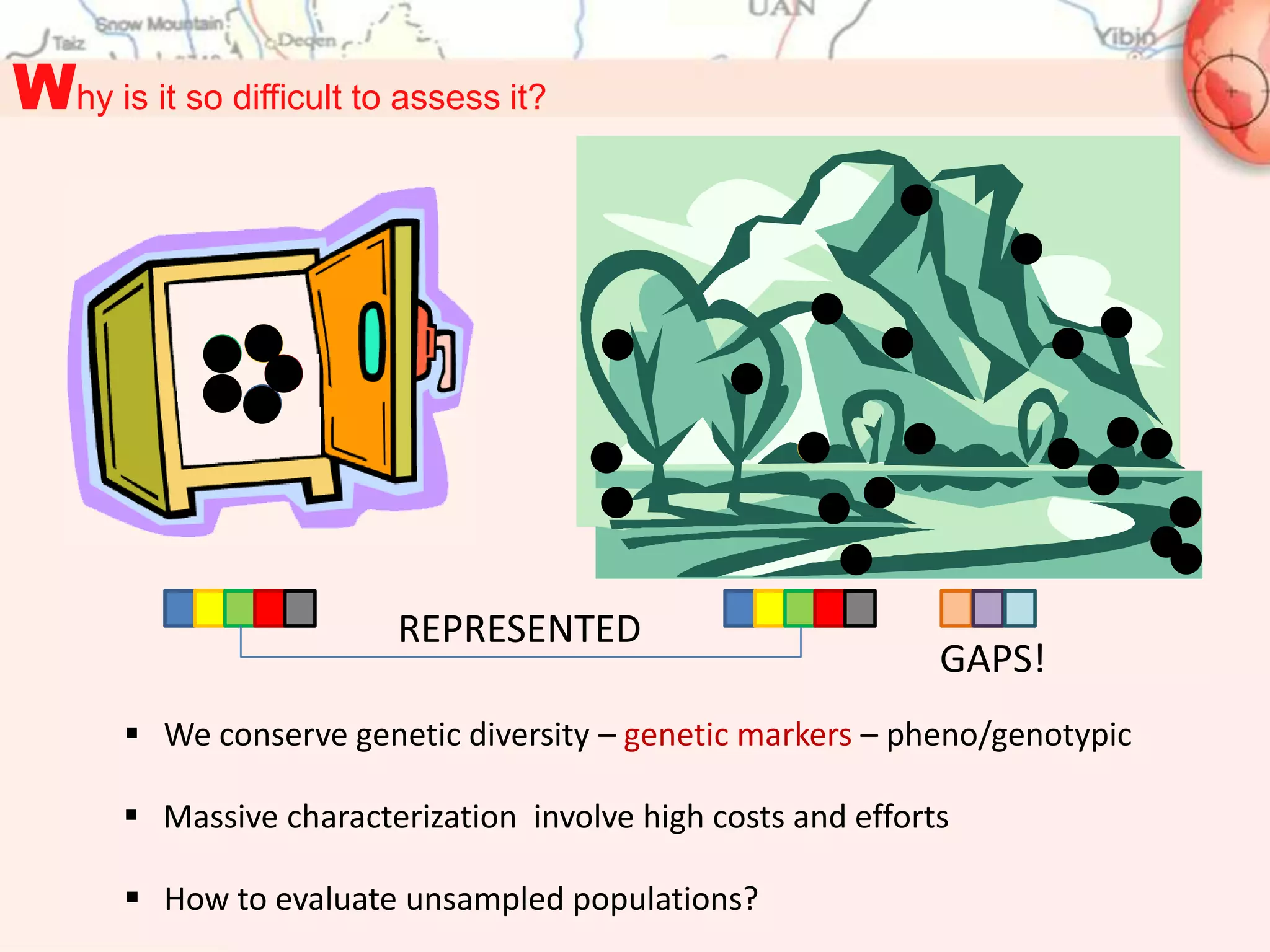
                         REPRESENTED
                                                               GAPS!
        We conserve genetic diversity – genetic markers – pheno/genotypic

        Massive characterization involve high costs and efforts

        How to evaluate unsampled populations?
Ecogeography and genetics
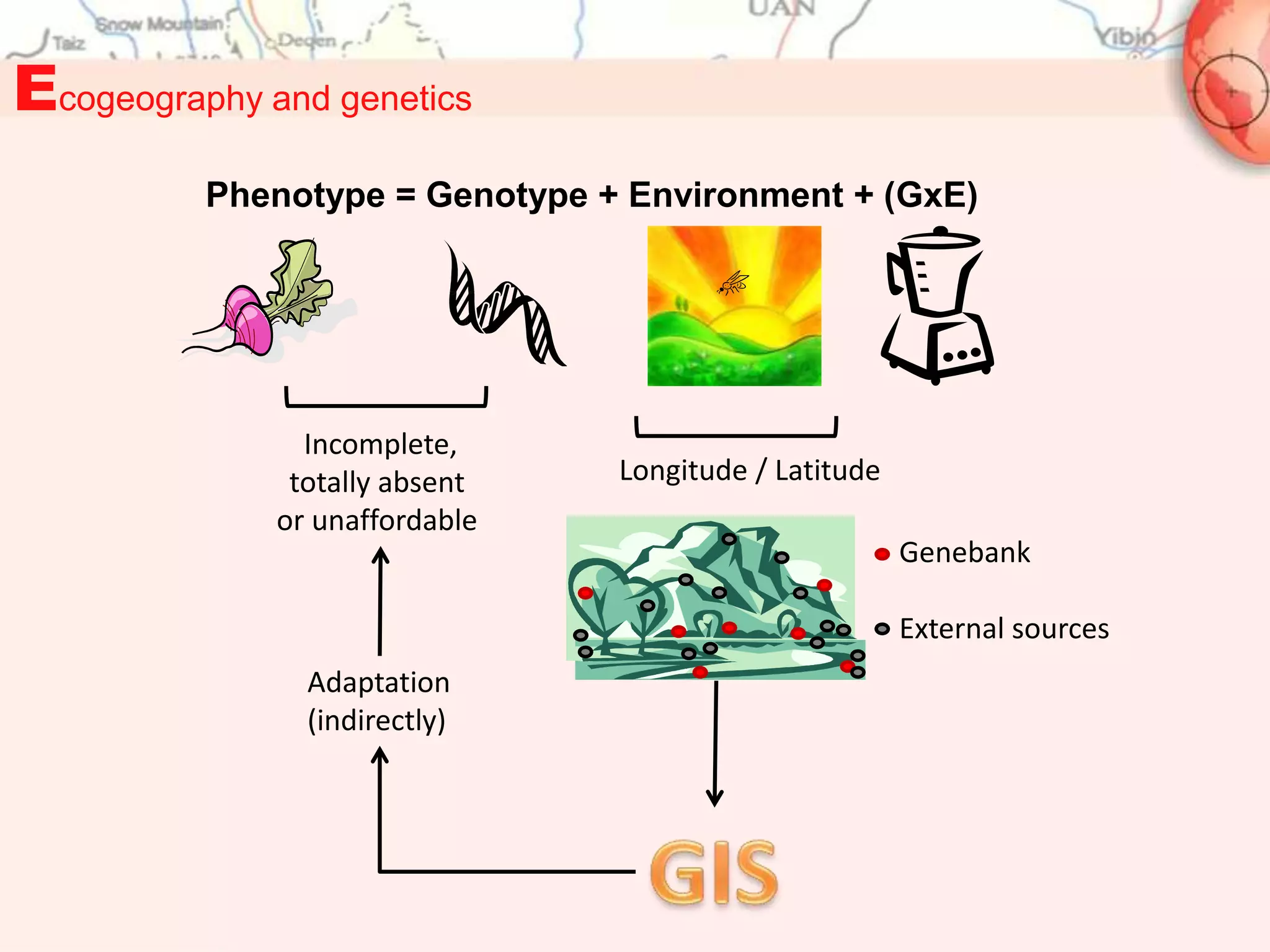
          Phenotype = Genotype + Environment + (GxE)


                Incomplete,
               totally absent   Longitude / Latitude
              or unaffordable
                                                       Genebank

                                                       External sources
                Adaptation
                (indirectly)
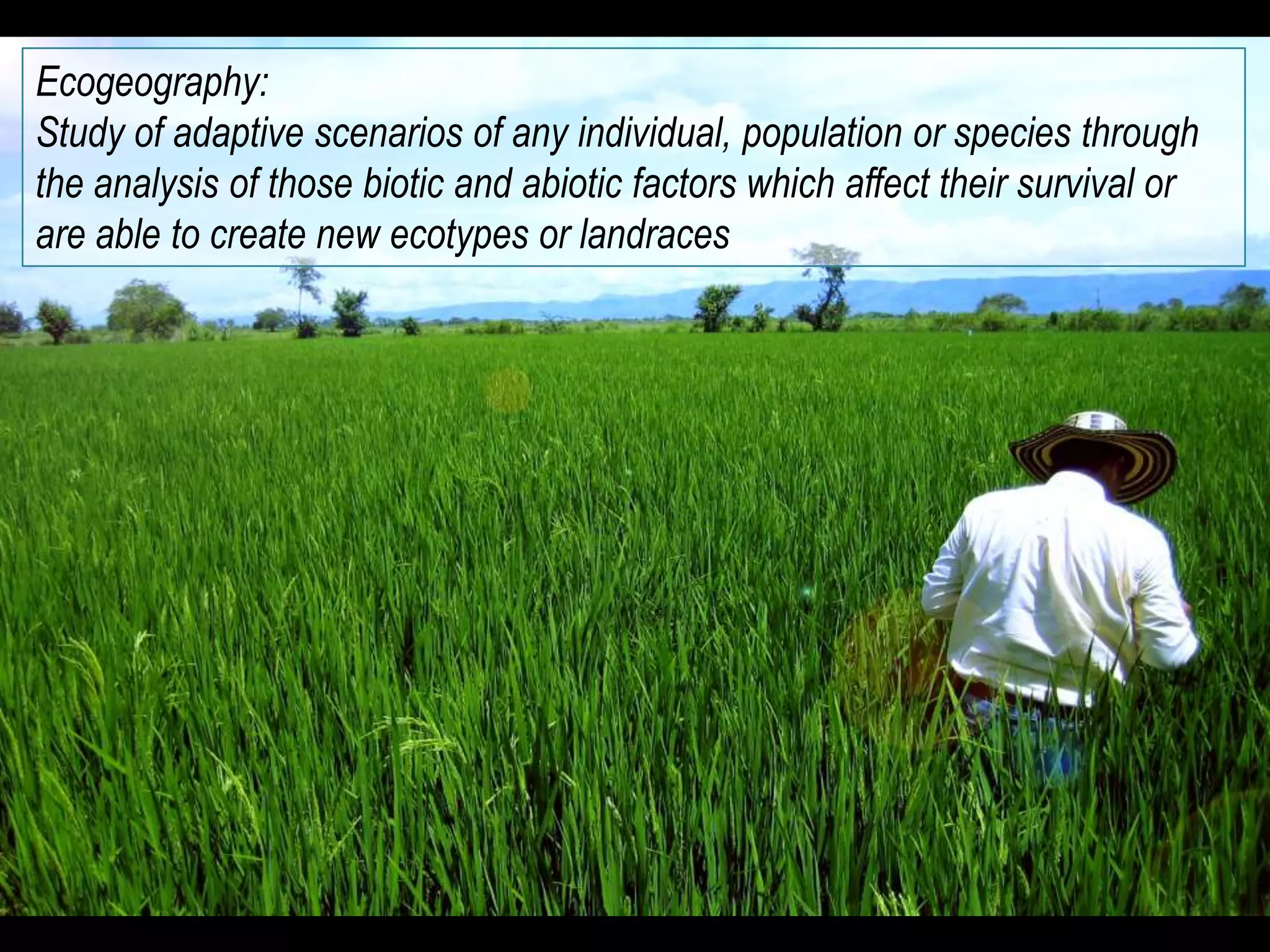
Ecogeography:
Study of adaptive scenarios of any individual, population or species through
the analysis of those biotic and abiotic factors which affect their survival or
are able to create new ecotypes or landraces
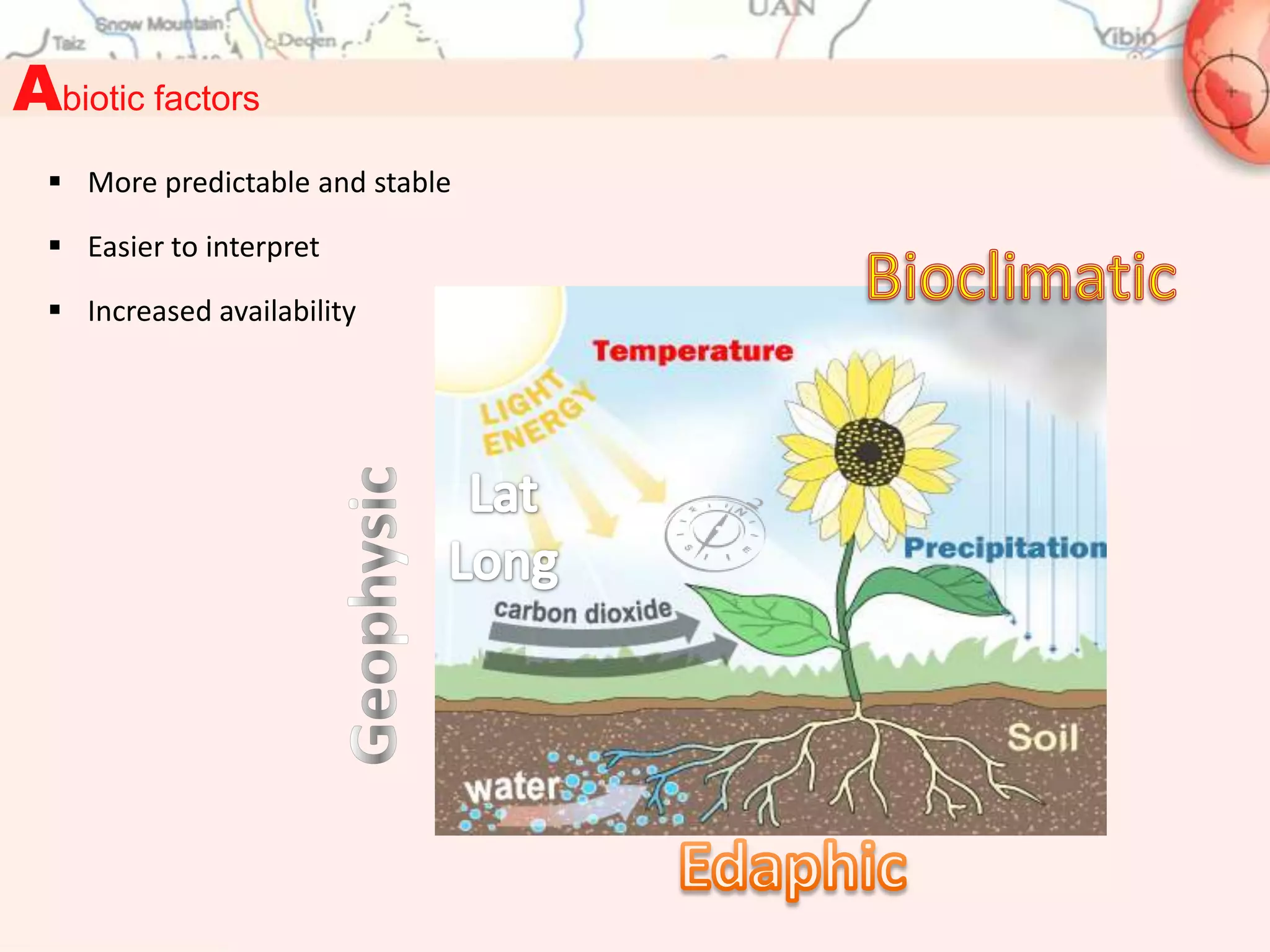
Abiotic factors
   More predictable and stable

   Easier to interpret

   Increased availability
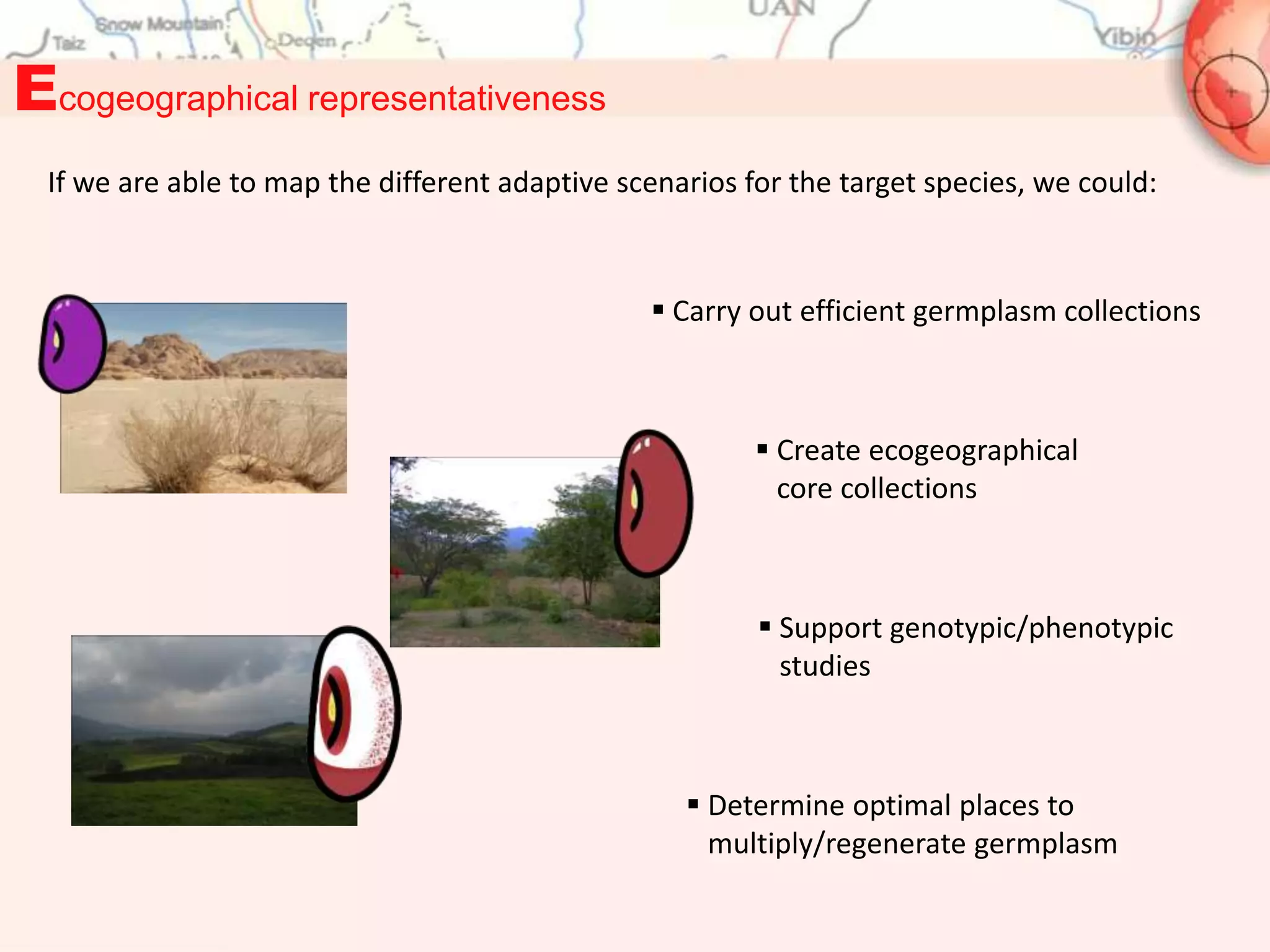
Ecogeographical representativeness
  If we are able to map the different adaptive scenarios for the target species, we could:


                                                  Carry out efficient germplasm collections


                                                           Create ecogeographical
                                                            core collections


                                                           Support genotypic/phenotypic
                                                            studies


                                                     Determine optimal places to
                                                      multiply/regenerate germplasm
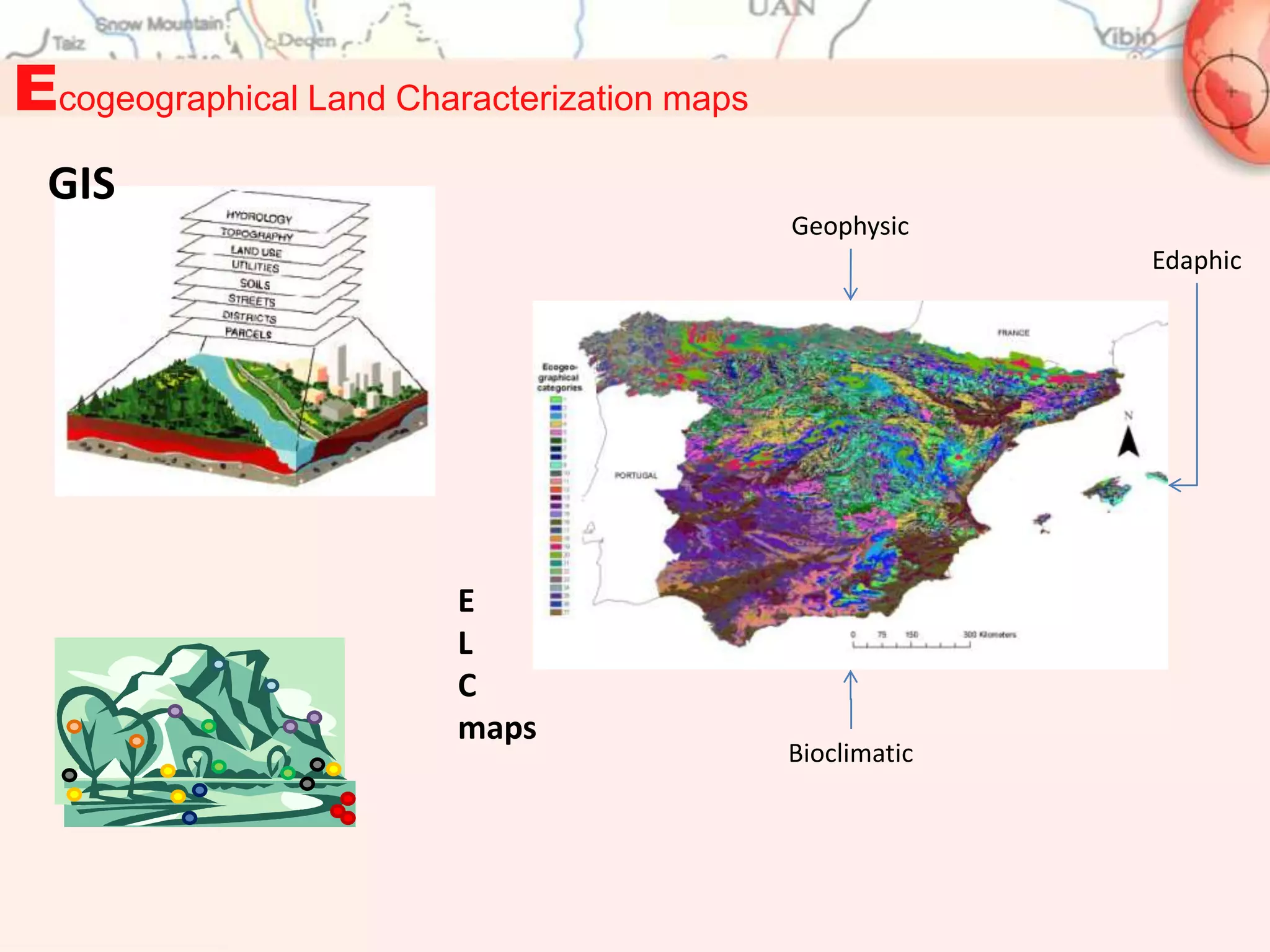
Ecogeographical Land Characterization maps
 GIS
                                             Geophysic
                                                           Edaphic


                         E
                         L
                         C
                         maps
                                             Bioclimatic
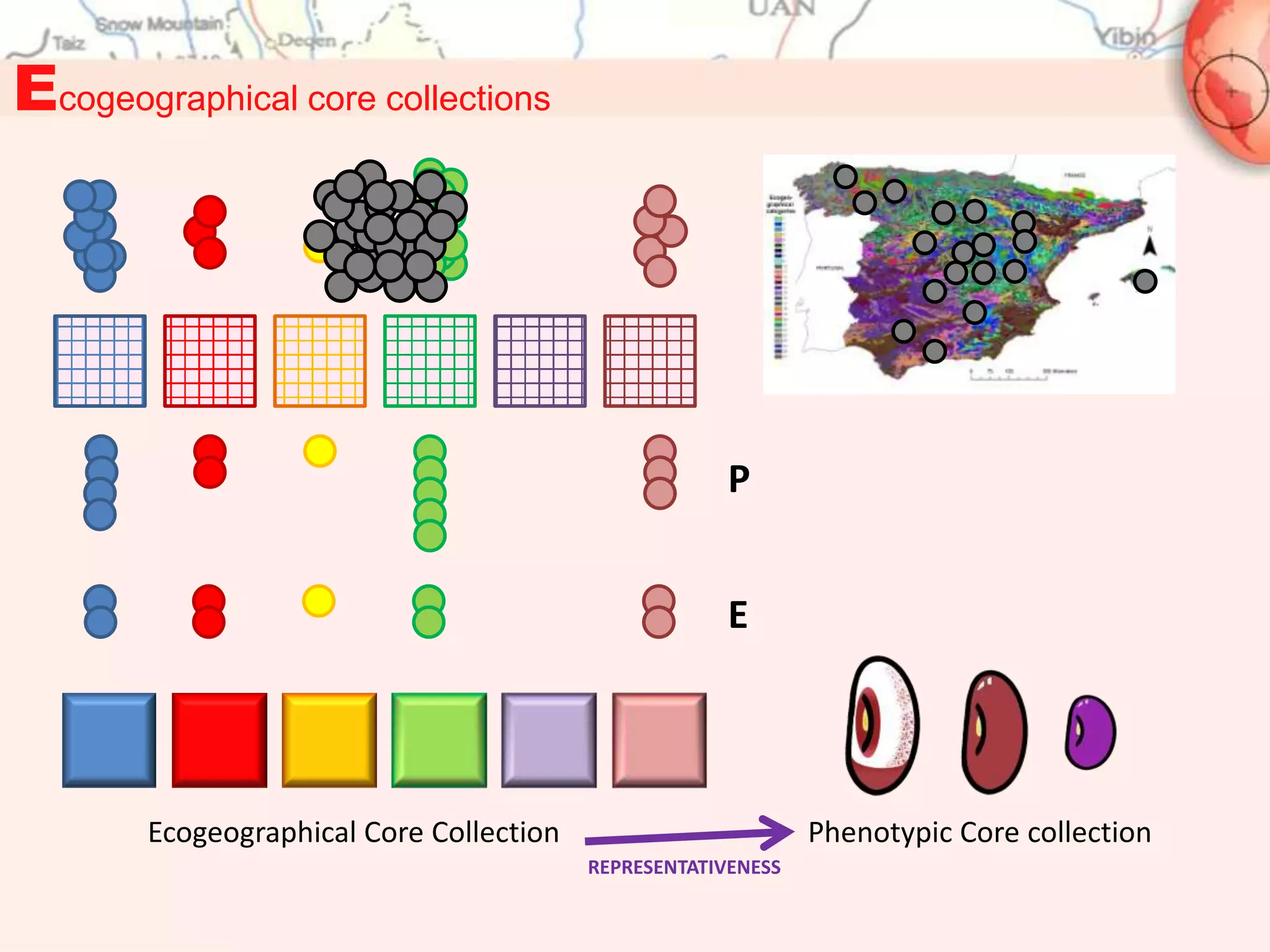
Ecogeographical core collections


                                                       P


                                                       E


        Ecogeographical Core Collection                        Phenotypic Core collection
                                          REPRESENTATIVENESS
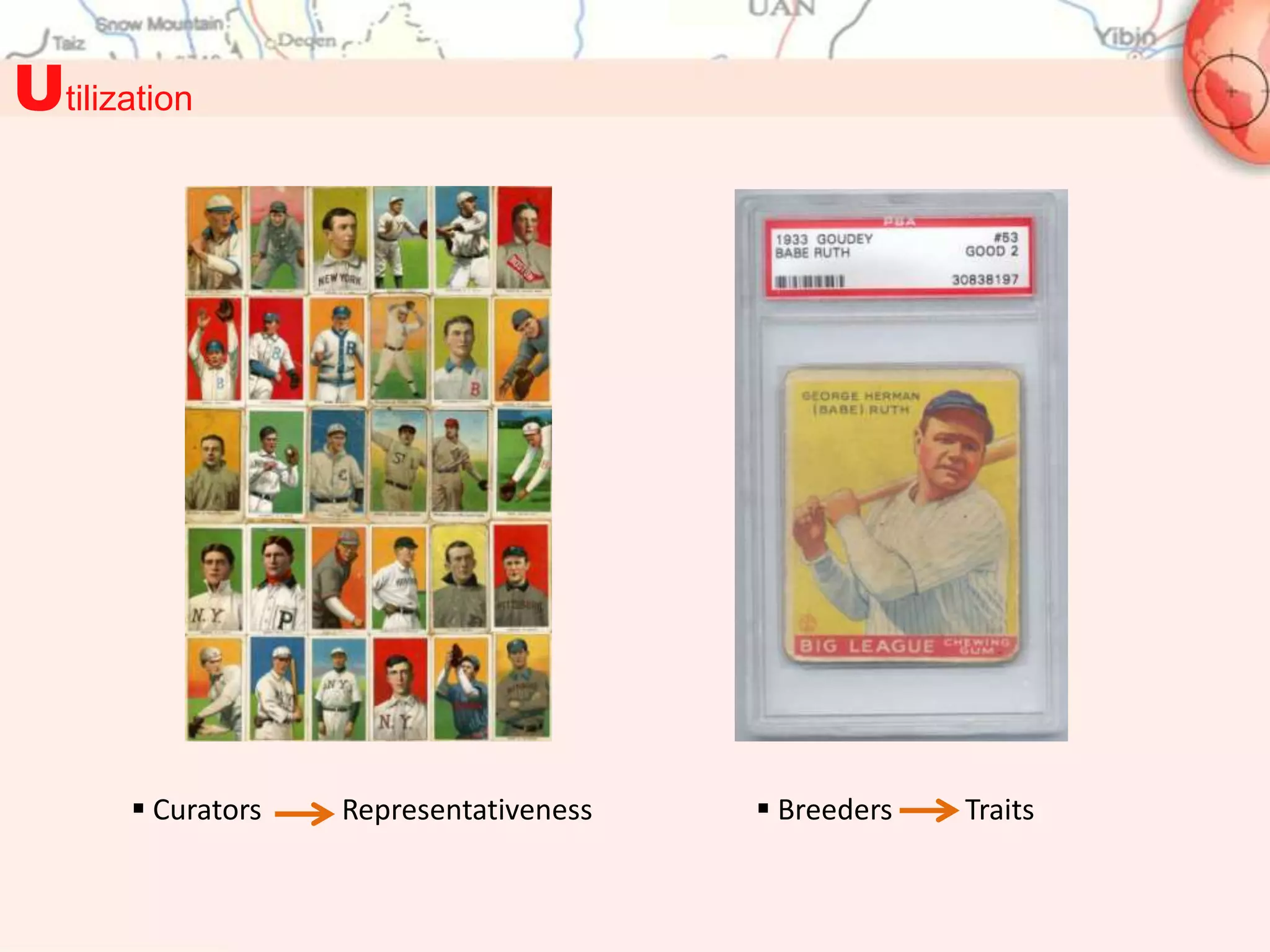
Utilization


        Curators   Representativeness    Breeders   Traits
Utilization paradox
  Few funds for germplasm characterization & evaluation

  Plant breeders need information (characterization and evaluation data) about
   germplasm collections in order to use them

       Curators/PGR centers focus their efforts on conservation and sometimes (when
        funds are available) on germplasm characterization
       Plant breeders may expect up to 100-200 germplasm accessions to evaluate
        for a particular trait as a part of their routine activities

  Frequently what they find are large gene bank
   collections

  They have limited screening capacity

  Scarce evaluation data (at least, available data)

  Low level of utilization
Focused Identification Germplasm Strategy
   FIGS idea: Michael Mackay (1986,1990, 1995)
                  Phenotype = Genotype + Environment + (GxE)

            Resistance/Tolerance = Genotype + Environment + (GxE)

     Identifying plant germplasm with a higher likelihood of having desired genetic
      diversity for a target trait

     Using ecogeographic data for prediction of crop traits a priori, BEFORE the field trials

     With fewer or no characterization efforts, providing a reduced number of germplasm
      accessions to breeders/curators to be evaluated

                     Boosting
     Generating FIGS subsets (≠ core collections)
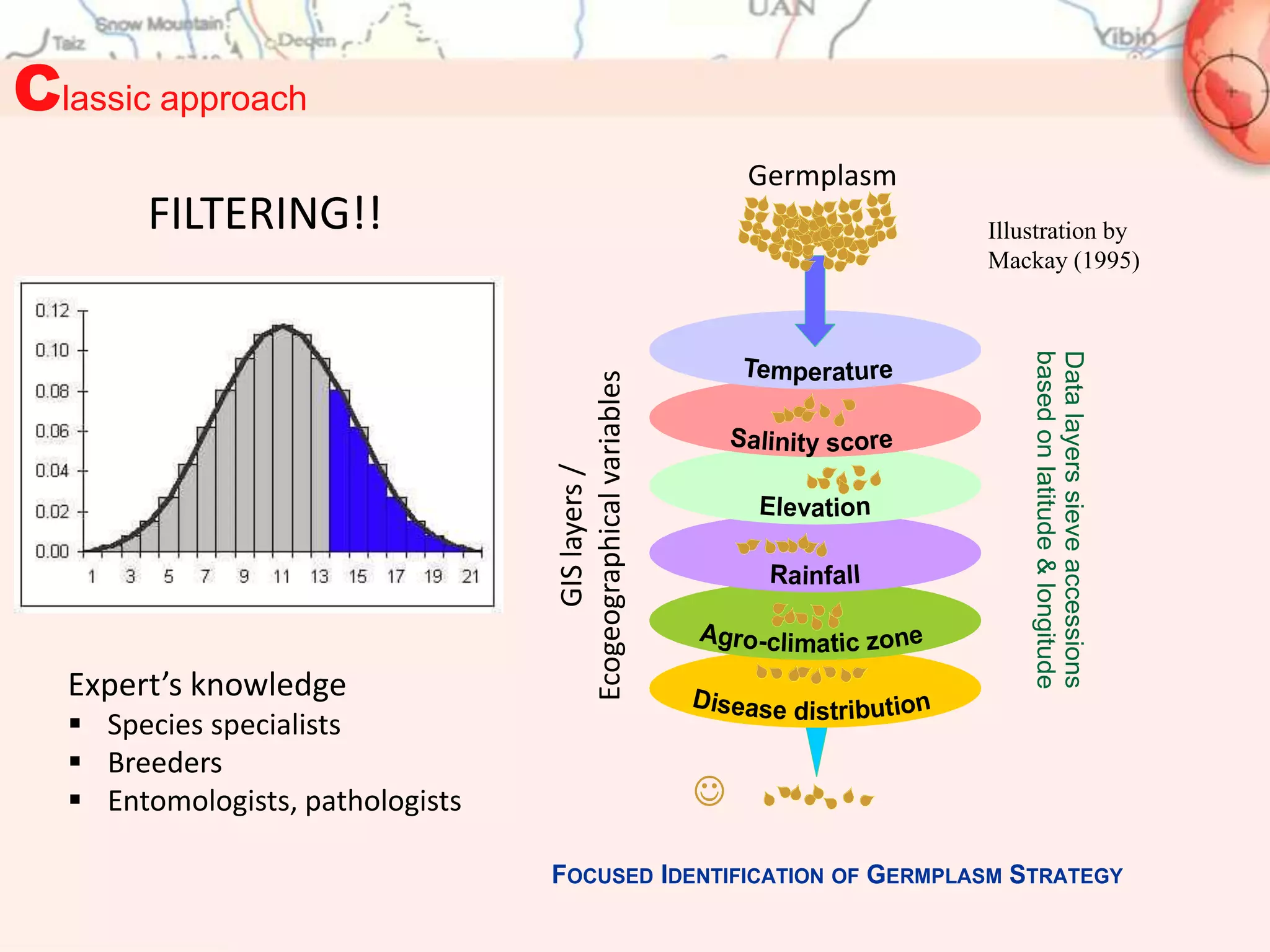
Classic approach
                                                                  Germplasm
       FILTERING!!                                                                     Illustration by
                                                                                       Mackay (1995)


                                                                                           based on latitude & longitude
                                                                                           Data layers sieve accessions
                                                                 Temperature


                                  Ecogeographical variables
                                                                Salinity score


                                        GIS layers /
                                                                  Elevation

                                                                   Rainfall

                                                              Agro-climatic zone

  Expert’s knowledge                                          Disease
                                                                        distribution
   Species specialists
   Breeders
   Entomologists, pathologists

                                  FOCUSED IDENTIFICATION OF GERMPLASM STRATEGY
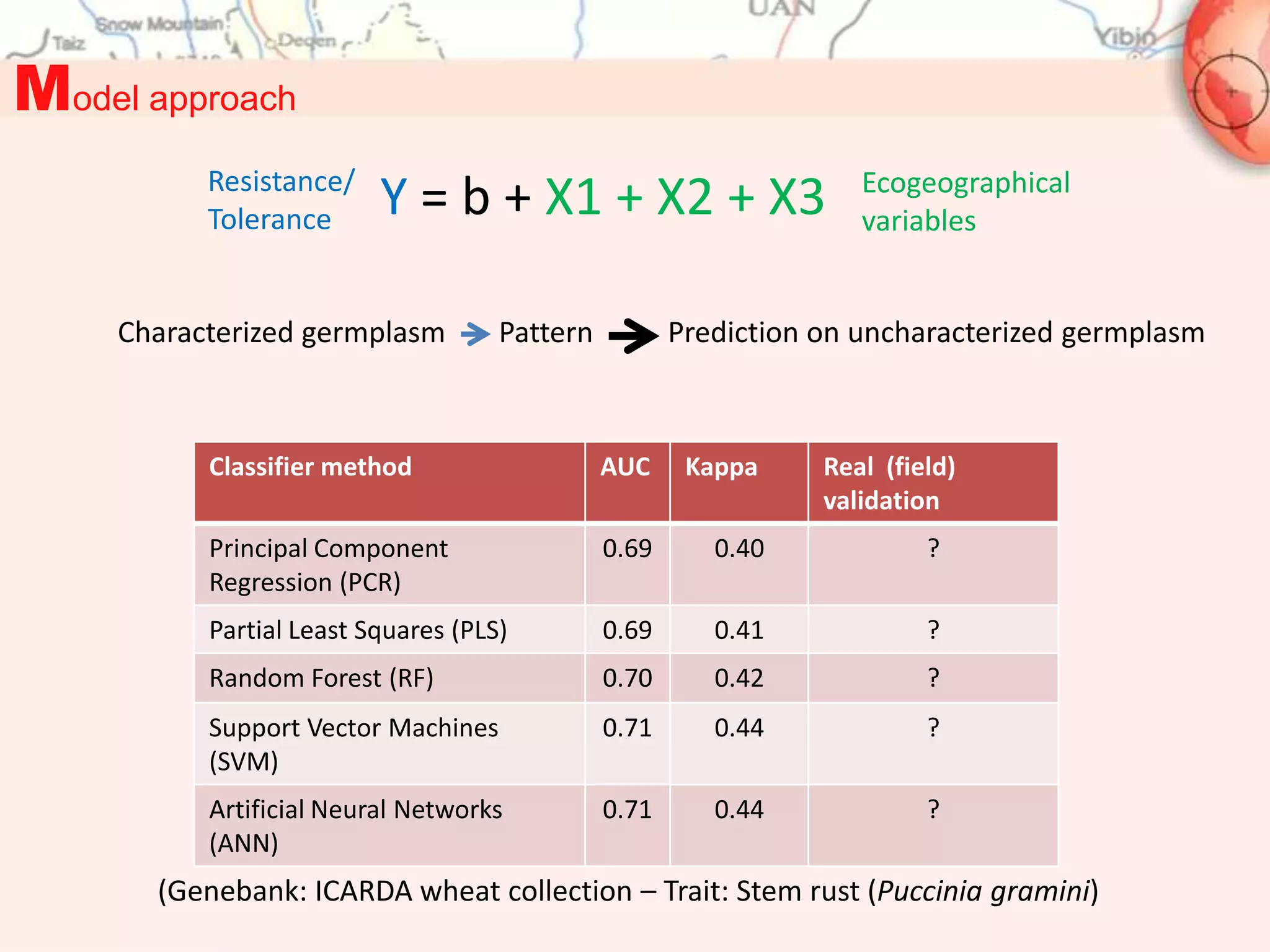
Model approach
           Resistance/                                              Ecogeographical
           Tolerance      Y = b + X1 + X2 + X3                      variables


     Characterized germplasm         Pattern          Prediction on uncharacterized germplasm


           Classifier method                   AUC     Kappa     Real (field)
                                                                 validation
           Principal Component                 0.69      0.40             ?
           Regression (PCR)
           Partial Least Squares (PLS)         0.69      0.41             ?
           Random Forest (RF)                  0.70      0.42             ?
           Support Vector Machines             0.71      0.44             ?
           (SVM)
           Artificial Neural Networks          0.71      0.44             ?
           (ANN)
       (Genebank: ICARDA wheat collection – Trait: Stem rust (Puccinia gramini)
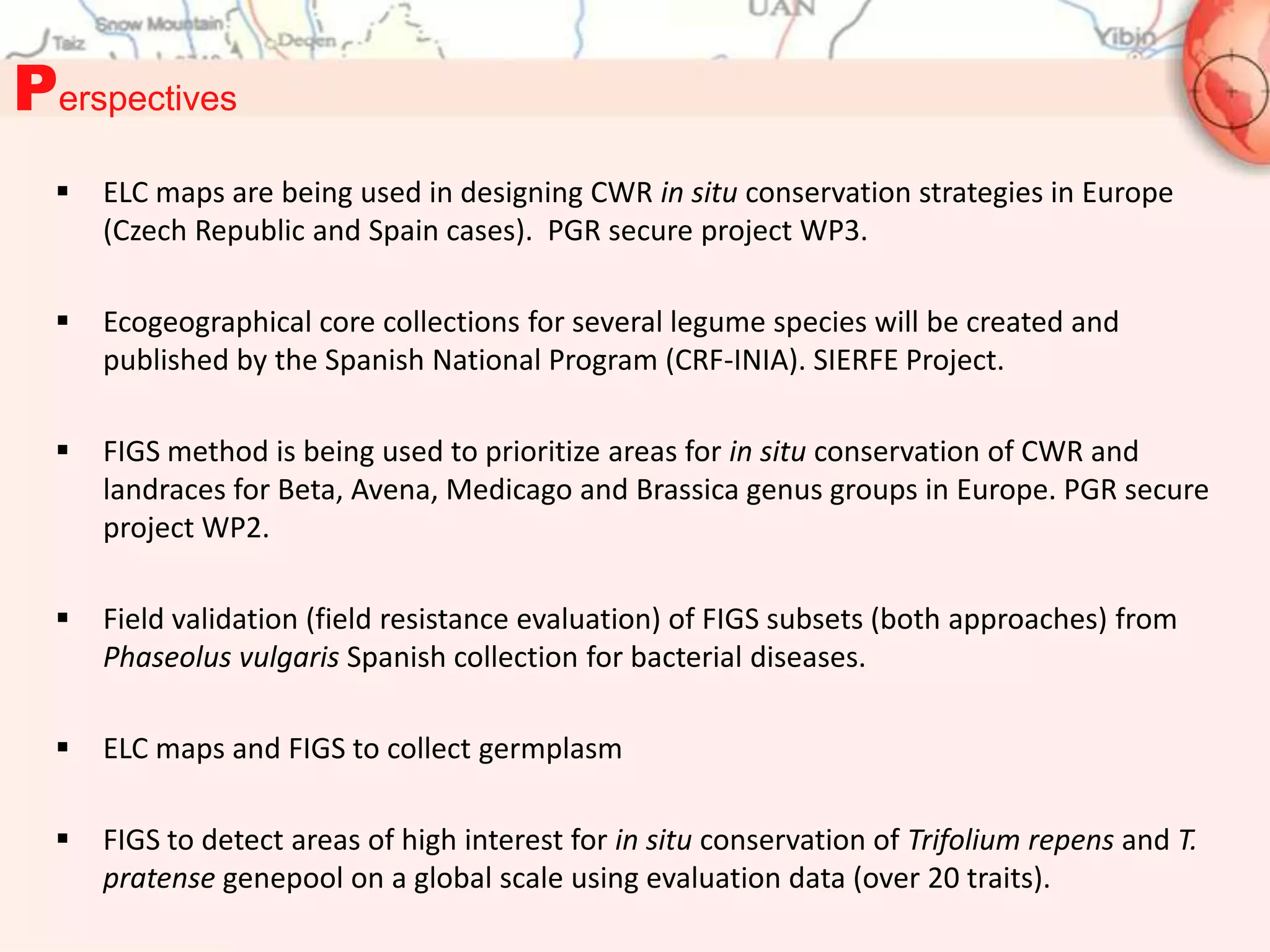
Perspectives
     ELC maps are being used in designing CWR in situ conservation strategies in Europe
      (Czech Republic and Spain cases). PGR secure project WP3.

     Ecogeographical core collections for several legume species will be created and
      published by the Spanish National Program (CRF-INIA). SIERFE Project.

     FIGS method is being used to prioritize areas for in situ conservation of CWR and
      landraces for Beta, Avena, Medicago and Brassica genus groups in Europe. PGR secure
      project WP2.

     Field validation (field resistance evaluation) of FIGS subsets (both approaches) from
      Phaseolus vulgaris Spanish collection for bacterial diseases.

     ELC maps and FIGS to collect germplasm

     FIGS to detect areas of high interest for in situ conservation of Trifolium repens and T.
      pratense genepool on a global scale using evaluation data (over 20 traits).
More information
 ELC maps:

 1.   M. Parra-Quijano, J.M. Iriondo , M.E. Torres. 2012. Ecogeographical land characterization maps as a tool for
      assessing plant adaptation and their implications in agrobiodiversity studies. Genetic Resources and Crop
      Evolution 59(2):205-217
 Ecogeographical Core Collections:

 2. M. Parra-Quijano, J.M. Iriondo , M.E. Torres, L. De la Rosa. 2011. Evaluation and validation of ecogeographical core
    collections using phenotypic data. Crop
     Science 51:694-703
 FIGS “classic” approach (study case):

 3.    El Bouhssini, M., et al.(2011). Sources of resistance in bread wheat to Russian wheat aphid (Diuvaphis noxia) in
      Syria identified using the Focused Identification of Germplasm Strategy (FIGS). Plant Breeding 130: 97-97
 FIGS modelling approach:

 4.   Bari, A., K. Street, , M. Mackay, D.T.F. Endresen, E. De Pauw, and A. Amri (2011). Focused Identification of
      Germplasm Strategy (FIGS) detects wheat stem rust resistance linked to environment variables. Genetic
      Resources and Crop Evolution [online first]. doi:10.1007/s10722-011-9775-5.

Websites
http://www.figstraitmine.org/ (FIGS subsets on wheat)

Review about ecogeographical and GIS tools
http://revistas.inia.es/index.php/sjar/article/view/1859/1673

Ecogeographic core collections and FIGS

  • 2.
    Representativeness in genebanks  Measured in terms of diversity captured within ex situ genebanks  Is the best guarantee to face future threats  Is a concern for curators, not for breeders  The reference must be nature for CWR, agroecosystems for landraces  To assess it, comparative studies (genebank vs nature/farm) are required
  • 3.
    Why is itso difficult to assess it? REPRESENTED GAPS!  We conserve genetic diversity – genetic markers – pheno/genotypic  Massive characterization involve high costs and efforts  How to evaluate unsampled populations?
  • 4.
    Ecogeography and genetics Phenotype = Genotype + Environment + (GxE) Incomplete, totally absent Longitude / Latitude or unaffordable Genebank External sources Adaptation (indirectly)
  • 5.
    Ecogeography: Study of adaptivescenarios of any individual, population or species through the analysis of those biotic and abiotic factors which affect their survival or are able to create new ecotypes or landraces
  • 6.
    Abiotic factors  More predictable and stable  Easier to interpret  Increased availability
  • 7.
    Ecogeographical representativeness If we are able to map the different adaptive scenarios for the target species, we could:  Carry out efficient germplasm collections  Create ecogeographical core collections  Support genotypic/phenotypic studies  Determine optimal places to multiply/regenerate germplasm
  • 8.
    Ecogeographical Land Characterizationmaps GIS Geophysic Edaphic E L C maps Bioclimatic
  • 9.
    Ecogeographical core collections P E Ecogeographical Core Collection Phenotypic Core collection REPRESENTATIVENESS
  • 10.
    Utilization  Curators Representativeness  Breeders Traits
  • 11.
    Utilization paradox Few funds for germplasm characterization & evaluation  Plant breeders need information (characterization and evaluation data) about germplasm collections in order to use them  Curators/PGR centers focus their efforts on conservation and sometimes (when funds are available) on germplasm characterization  Plant breeders may expect up to 100-200 germplasm accessions to evaluate for a particular trait as a part of their routine activities  Frequently what they find are large gene bank collections  They have limited screening capacity  Scarce evaluation data (at least, available data)  Low level of utilization
  • 12.
    Focused Identification GermplasmStrategy  FIGS idea: Michael Mackay (1986,1990, 1995) Phenotype = Genotype + Environment + (GxE) Resistance/Tolerance = Genotype + Environment + (GxE)  Identifying plant germplasm with a higher likelihood of having desired genetic diversity for a target trait  Using ecogeographic data for prediction of crop traits a priori, BEFORE the field trials  With fewer or no characterization efforts, providing a reduced number of germplasm accessions to breeders/curators to be evaluated Boosting  Generating FIGS subsets (≠ core collections)
  • 13.
    Classic approach Germplasm FILTERING!! Illustration by Mackay (1995) based on latitude & longitude Data layers sieve accessions Temperature Ecogeographical variables Salinity score GIS layers / Elevation Rainfall Agro-climatic zone Expert’s knowledge Disease distribution  Species specialists  Breeders  Entomologists, pathologists FOCUSED IDENTIFICATION OF GERMPLASM STRATEGY
  • 14.
    Model approach Resistance/ Ecogeographical Tolerance Y = b + X1 + X2 + X3 variables Characterized germplasm Pattern Prediction on uncharacterized germplasm Classifier method AUC Kappa Real (field) validation Principal Component 0.69 0.40 ? Regression (PCR) Partial Least Squares (PLS) 0.69 0.41 ? Random Forest (RF) 0.70 0.42 ? Support Vector Machines 0.71 0.44 ? (SVM) Artificial Neural Networks 0.71 0.44 ? (ANN) (Genebank: ICARDA wheat collection – Trait: Stem rust (Puccinia gramini)
  • 15.
    Perspectives  ELC maps are being used in designing CWR in situ conservation strategies in Europe (Czech Republic and Spain cases). PGR secure project WP3.  Ecogeographical core collections for several legume species will be created and published by the Spanish National Program (CRF-INIA). SIERFE Project.  FIGS method is being used to prioritize areas for in situ conservation of CWR and landraces for Beta, Avena, Medicago and Brassica genus groups in Europe. PGR secure project WP2.  Field validation (field resistance evaluation) of FIGS subsets (both approaches) from Phaseolus vulgaris Spanish collection for bacterial diseases.  ELC maps and FIGS to collect germplasm  FIGS to detect areas of high interest for in situ conservation of Trifolium repens and T. pratense genepool on a global scale using evaluation data (over 20 traits).
  • 17.
    More information ELCmaps: 1. M. Parra-Quijano, J.M. Iriondo , M.E. Torres. 2012. Ecogeographical land characterization maps as a tool for assessing plant adaptation and their implications in agrobiodiversity studies. Genetic Resources and Crop Evolution 59(2):205-217 Ecogeographical Core Collections: 2. M. Parra-Quijano, J.M. Iriondo , M.E. Torres, L. De la Rosa. 2011. Evaluation and validation of ecogeographical core collections using phenotypic data. Crop Science 51:694-703 FIGS “classic” approach (study case): 3. El Bouhssini, M., et al.(2011). Sources of resistance in bread wheat to Russian wheat aphid (Diuvaphis noxia) in Syria identified using the Focused Identification of Germplasm Strategy (FIGS). Plant Breeding 130: 97-97 FIGS modelling approach: 4. Bari, A., K. Street, , M. Mackay, D.T.F. Endresen, E. De Pauw, and A. Amri (2011). Focused Identification of Germplasm Strategy (FIGS) detects wheat stem rust resistance linked to environment variables. Genetic Resources and Crop Evolution [online first]. doi:10.1007/s10722-011-9775-5. Websites http://www.figstraitmine.org/ (FIGS subsets on wheat) Review about ecogeographical and GIS tools http://revistas.inia.es/index.php/sjar/article/view/1859/1673