CONSERVATION OF MEDICINAL PLANTS
SATYAJIT GHOSH
B. PHARM 4TH
SEMESTER
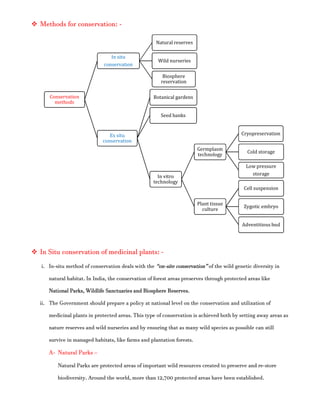
 Methods for conservation: -
 In Situ conservation of medicinal plants: -
i. In-situ method of conservation deals with the “on-site conservation” of the wild genetic diversity in
natural habitat. In India, the conservation of forest areas preserves through protected areas like
National Parks, Wildlife Sanctuaries and Biosphere Reserves.
ii. The Government should prepare a policy at national level on the conservation and utilization of
medicinal plants in protected areas. This type of conservation is achieved both by setting away areas as
nature reserves and wild nurseries and by ensuring that as many wild species as possible can still
survive in managed habitats, like farms and plantation forests.
A- Natural Parks –
Natural Parks are protected areas of important wild resources created to preserve and re-store
biodiversity. Around the world, more than 12,700 protected areas have been established.
Conservation
methods
In situ
conservation
Natural reserves
Wild nurseries
Biosphere
reservation
Ex situ
conservation
Botanical gardens
Seed banks
In vitro
technology
Germplasm
technology
Cryopreservation
Cold storage
Low pressure
storage
Plant tissue
culture
Cell suspension
Zygotic embryo
Adventitious bud
Conserving medicinal plants in their natural habitat requires evaluating the contributions and
ecosystem roles of individual habitats.
Examples: -
Velavadar national park, Gujarat,
Ranthambore national park, Rajasthan,
Corbett national park, Uttarakhand.
B- Wild nurseries –
The populations of medicinal plants are under hefty burden because of overexploitation, habitat
degradation and invasive species, wild nurseries can provide an effective approach for in situ
conservation of medicinal plants that are endemic, threatened, and in-demand.
E.g.
Periyar wildlife sanctuary, Kerala
Bandipur wildlife sanctuary, Karnataka
Dandeli wildlife sanctuary.
C- Biosphere reserves: -
They are areas of terrestrial and coastal ecosystems promoting solutions to reconcile the
conservation of biodiversity with its sustainable use. Out of the 34 biodiversity rich spots in the
world, three lies in India; they are the Western Ghats, Eastern Himalayas and Indo-Burma region.
There are 18 biosphere reserves in India. These aim at securing the ecosystem by stopping
irresponsible interference of humans with the ecosystem and also to conserve the endemic and
endangered species.
 Ex Situ conservation of medicinal plant: -
Ex-situ conservation deals with the “off-site conservation” of the wild genetic resources in outside the
natural habitat. It includes the collection, preservation and maintenance of certain genetic resources from
wild.
Ex-situ method of conservation is a complementary action to conserve the genetic diversity, thereby
reducing pressure on wild environments and enhancing raw material availability.
A- Botanic gardens: -
It is a garden dedicated to the collection, cultivation, preservation, and display of a wide range of
plants labelled with their botanical names. It should set up seed banks for the medicinal plants native
and cultivated in the country.
Botanical Survey of India is actively engaged in the ex-situ conservation through its chain of Botanic
gardens established in different regional circles.
E.g.
Government Botanical Gardens, Tamil Nadu,
Garden of Medicinal Plants, West Bengal
Empress Garden, Maharashtra
B- Seed banks: -
A seed bank stores seeds to preserves genetic diversity. Seed banks proposed a better way of storing
the genetic diversity of many medicinal plant’s ex situ than through botanic gardens.
Seed banks allow quick access to plant samples for the evaluation of their properties. The challenging
tasks of seed banking are how to intro-duce again the plant species back into the wild and how to
actively assist in the restoration of wild populations.
C- Field Gene Banks: -
Field gene banks conserve plants by using tools of biotechnology. These include:
a- In vitro conservation
b- In vitro propagation and re-introduction of plants to their natural habitats.
c- Molecular masker technology
Various In-vitro techniques have been developed to store vegetatively propagated seed producing
species. These can be categorized as –
A- Germplasm techniques: -
i. Germplasm is a live information source for all the genes present in the respective plant, which
can be conserved for long periods and regenerated whenever it is required in the future.
ii. Germplasm conservation of vegetative propagated plants and forest species in life field gene
banks require land and labour for annual or perennial replanting.
iii. It further eliminates the need for long procedures during movement and ex-change of
germplasms.
Methods Involved in the in vitro Conservation of Germplasm: -
1) Cryopreservation: -
i. In this technique the cells or tissues are preserved in a frozen state at very low
temperatures using solid carbon dioxide (at –79°C), with low temperature deep
freezers (at –80°C), using vapor nitrogen (at –150°C) and liquid nitrogen (at –196°C).
ii. This technique includes four stages freezing, thawing, and reculture. This freezing
temperature inactivates the cell and thus can be preserved for a longer time.
iii. Any tissue from a plant can be used for cryopreservation, for example, meristems,
embryos, endosperms, ovules, seeds, cultured plant cells, protoplasts.
iv. To prevent the damage caused to the cells (by freezing or thawing) various compounds
like dimethyl sulfoxide, glycerol, ethylene, propylene, sucrose, mannose, glucose,
praline, acetamide, etc. are added during cryopreservation. These compounds are
called cryoprotectants, which prevents the damage caused to cells by reducing the
freezing point and super cooling point of water.
2) Cold storage: -
i. This is a slow growth conservation method that conserves the germplasm at a low and
nonfreezing temperature (1–9°C). The main advantage of this method over
cryopreservation is that it slows down growth of the plant material at cold storage (1–
9°C) in contrast to complete stoppage during cryopreservation, hence it protects the
plants against cryogenic injuries.
ii. Moreover, this method is simple, cost effective, and yields germplasms with better
survival rates. Many outstanding examples of cold storage have recently been reported,
for example, virus-free strawberry plants could be preserved at 10°C for about 6 years
and several grape plants have been stored for over 15 years by using cold storage at
temperature around 9°C.
3) Low pressure and low oxygen storage: -
i. In this method atmospheric pressure (below 50 mmHg reduces plant tissue growth)
and oxygen concentration surrounded by plant material are reduced, which causes the
reduced availability of O2, reduced production of CO2, and hence photosynthetic
activity is reduced, which inhibits plant tissue growth and dimension.
ii. These conditions may lead to slow and reduced growth of the plant material, which
assists in increasing the shelf-life of many fruits, vegetables, and flowers.
iii. Therefore, conservation of germplasm by conventional methods has several limitations
such as seed dormancy, short-lived seeds, seed-borne diseases, and high inputs of cost
and labor.
Disadvantages-
i. Certain plants may not produce viable seeds.
ii. Certain plant seeds deteriorate rapidly due to seed-borne pathogens.
iii. Certain plant seeds are heterogenous and are not suitable for maintaining true to type
genotypes.
iv. Application of cryopreservation technology can circumvent the above problems
B- Plant tissue culture techniques: -
1) Cell suspensions:
a) Pre-treatment: The cell suspension is inoculated at high density into standard medium
containing 6% mannitol and cultured under standard conditions.
b) The suspension is harvested when the cell will be dividing rapidly and chilled on ice.
c) Cryopreservation: A double strength cryoprotectants solution (1M dimethyl sulfoxide
(DMSO) + 1M glycerol + 2M sucrose) was prepared and one volume of cryoprotectants
solution is added to one volume of cell suspension and the mixture is incubated on ice for
1hr.
d) The mixture is dispensed as 1 ml aliquots and the ampoules are cooled at 1℃ min-1 until
they reach -35℃.
e) Storage: The ampoules are stored in or over liquid nitrogen.
f) Thawing: The ampoules are dropped into sterile water at about 40℃ with a ratio of 4
ampoules to 150 ml water.
g) Regrowth: The cells in suspension are transferred to several layers of 5 cm filter paper on
the surface of a 9 cm agar plate containing a growth medium and are incubated under
standard conditions. The cells and upper layers of filter paper are then transferred to fresh
medium, until after 5 – 6 days, the cells alone are transferred to agar medium.
2) Zygotic embryos:
a) Pre-growth: The embryos are excised aseptically from the seeds then in an open petri dish
are exposed to a sterile airflow in a laminar flow cabinet for 3h.
b) Cryopreservation: The embryos contained in plastic ampoules are immersed in liquid
nitrogen.
c) Thawing: The plastic ampoules are transferred to a water bath at 37 – 38℃ then placed on
moist sterile filter paper in petri dishes for 10 days.
d) Regrowth: After 10 days in the absence of medium the embryos are added to a standard
growth medium to stimulate growth into plants Zygotic embryos.
3) Adventitious buds:
a) Pre-growth: Uniformed nodes (5 mm in length) containing an adventitious bud are
removed from stem sections of plants.
b) Nodes are placed on agar medium containing 0.7 M sucrose and incubated under standard
conditions for two days then transferred to a nylon membrane contained in a dish.
c) Cryopreservation: Nodes are transferred to plastic ampoules then immersed in liquid
nitrogen and stored under liquid nitrogen.
d) Thawing: Nodes are thawed in a water bath at 25℃.
e) Regrowth: Because of their size, nodes can be transferred individually to a standard growth
medium and the adventitious bud is stimulated to develop as a shoot.
Advantages of tissue culture: -
a) The production of exact copies of plants that produce particularly good flowers, fruits, or
have other desirable traits.
b) Quickly produce mature plants.
c) The production of multiples of plants in the absence of seeds or necessary pollinators to
produce seeds.
d) The regeneration of whole plants from plant cells that have been genetically modified.
e) The production of plants in sterile containers that allows them to be moved with greatly
reduced chances of transmitting diseases, pests, and pathogens.
f) The production of plants from seeds that otherwise have very low chances of germinating
and growing, i.e.: orchids and nepenthes.
g) To clean particular plant of viral and other infections and to quickly multiply these plants
as 'cleaned stock' for horticulture and agriculture.
Application of Tissue Culture: -
a) Species which are difficult to regenerate by conventional methods and the only way to save
them from extinction is to propagate them by tissue culture.
b) Species where population has decreased due to over exploitation and thus initial bulking of
the stock can be taken up by tissue culture.
c) Species which show lot of variability in terms of the active principles with medicinal
properties. Tissue culture of selected clones will help in sustainable harvest and fetching
better prices both in the domestic and international market.
d) Trees with medicinal properties or elites can be identified based on their potential of
yielding higher amount of active principle.