


GERMPLASM CONSERVATION
Presented by Mamoona Ghaffar
Mamoona
GERMPLASM
CONSERVATION
By Mamoona Ghaffar
TOPIC: GERMPLASM CONSERVATION
Submitted To: Ma’am Wjeeha Iqbal
Submitted By: Mamoona Ghaffar
Roll No: 35846
Registration #: 2016 GCUF 068036
Degree: Bs Hons Botany (Regular)
Course Title: Plant Tissue Culture
Course Code: Bot-608
CONTENT
Introduction
Important features of germplasm
Germplasm conservation
Methods
1. In-situ conservation
2. Ex-situ conservation
Three Approaches For The In-vitro Conservation Of Germplasm
1. Cryopreservation (freeze-preservation)
2. Cold storage
3. Low-pressure and low-oxygen storage
APPLICATIONS OF GERMPLASM STORAGE
LIMITATIONS OF GERMPLASM STORAGE
Germplasm broadly refers to the
hereditary material (total content of genes)
transmitted to the offspring through germ
cells.
Germplasm conservation is the most
successful method to conserve the genetic
traits of endangered and commercially
valuable species.
GERMPLASM
CONSERVATION
Mamoona
GERMPLASM
Germplasm is the genetic material of germ cells.
The sum total of hereditary material i.e. all the alleles
of various genes, present in a crop species and its wild
relatives is referred to as Germplasm.
This is also known as genetic resources or gene pool
or genetic stock.
Germplasm are living genetic resources such as
seeds or tissues that are maintained for the purpose of
plant breeding, preservation, and other research uses.
IMPORTANT FEATURES
OF GERMPLASM
Genetic pool represents the entire genetic variability or
diversity available in a crop species.
Germplasm consists of land races, modern cultivars,
obsolete cultivars, breeding stocks, wild forms and wild
species of cultivated crops.
Germplasm includes both cultivated and wild species
and relatives of crop plants.
Germplasm is collected from centers of diversity, gene
banks, gene sanctuaries, farmer’s fields, markers and seed
companies.
Germplasm is the basic material for launching a crop
improvement programme.
Germplasm may be indigenous (collected within country)
or exotic (collected from foreign countries)
GERMPLASM CONSERVATION
Conservation refers to protection of genetic diversity of crop
plants from genetic erosion
The very objective of Germplasm Conservation (or storage)
is to preserve the genetic diversity of a particular plant or
genetic stock for its use at any time in future.
It is important to conserve the endangered plants or else
some of the valuable genetic traits present in the primitive
plants may be lost.
Germplasm conservation is the most successful method to
conserve the genetic traits of endangered and commercially
valuable species.
Germplasm is a live information source for all the genes
present in the respective plant, which can be conserved for long
periods and regenerated whenever it is required in the future
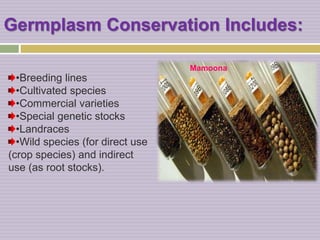
Germplasm Conservation Includes:
•Breeding lines
•Cultivated species
•Commercial varieties
•Special genetic stocks
•Landraces
•Wild species (for direct use
(crop species) and indirect
use (as root stocks).
Mamoona
GERMPLASM
CONSERVATION METHODS
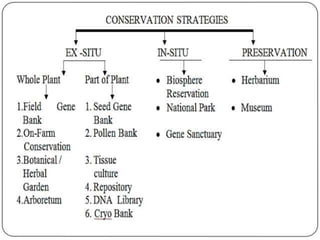
There are two important methods of Germplasm conservation
or preservation:
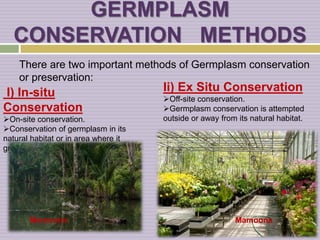
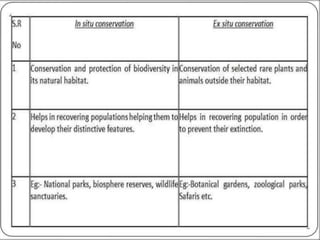
I) In-situ
Conservation
On-site conservation.
Conservation of germplasm in its
natural habitat or in area where it
grows naturally.
Ii) Ex Situ Conservation
Off-site conservation.
Germplasm conservation is attempted
outside or away from its natural habitat.
MamoonaMamoona
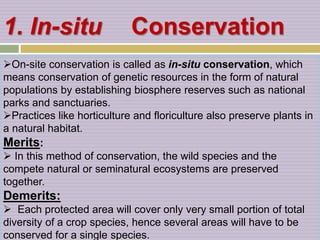
1. In-situ Conservation
On-site conservation is called as in-situ conservation, which
means conservation of genetic resources in the form of natural
populations by establishing biosphere reserves such as national
parks and sanctuaries.
Practices like horticulture and floriculture also preserve plants in
a natural habitat.
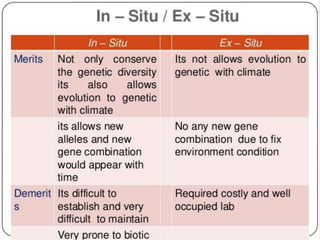
Merits:
 In this method of conservation, the wild species and the
compete natural or seminatural ecosystems are preserved
together.
Demerits:
 Each protected area will cover only very small portion of total
diversity of a crop species, hence several areas will have to be
conserved for a single species.
2. Ex-Situ Conservation
Off-site conservation is called as ex-situ conservation.
Ex-situ conservation is the chief method for the preservation of
Germplasm obtained from cultivated and wild plant materials.
The genetic materials in the form of seeds or from in vitro cultures
(plant cells, tissues or organs) can be preserved as gene banks for long
term storage under suitable conditions.
For successful establishment of gene banks, adequate knowledge of
genetic structure of plant populations, and the techniques involved in
sampling, regeneration, maintenance of gene pools etc. are essential.
It refers to preservation of germplasm in gene banks.
This is the most practical method of germplasm conservation.
This Method Has Following Advantages.
1. It is possible to preserve entire genetic diversity of a crop species at
one place.
2. Handling of germplasm is also easy.
3. This is a cheap method of germplams conservation.
Germplasm Conservation
In The Form Of Seeds:
Usually, seeds are the most common and convenient materials
to conserve plant germplasm. This is because many plants are
propagated through seeds, and seeds occupy relatively small
space. Further, seeds can be easily transported to various
places.
There are however, certain limitations in the conservation
of seeds:
i. Viability of seeds is reduced or lost with passage of time.
ii. Seeds are susceptible to insect or pathogen attack, often
leading to their destruction.
iii. This approach is exclusively confined to seed propagating
plants, and therefore it is of no use for vegetatively propagated
plants e.g. potato, Ipomoea, Dioscorea.
iv. It is difficult to maintain clones through seed conservation.
In-Vitro Methods For
Germplasm Conservation:
In vitro methods employing shoots, meristems and embryos are ideally
suited for the conservation of germplasm of vegetatively propagated
plants. The plants with recalcitrant seeds and genetically engineered
materials can also be preserved by this in vitro approach.
There are several advantages associated with in vitro
germplasm conservation:
i. Large quantities of materials can be preserved in small space.
ii. The germplasm preserved can be maintained in an environment, free
from pathogens.
iii. It can be protected against the nature’s hazards.
iv. From the germplasm stock, large number of plants can be obtained
whenever needed.
v. Obstacles for their transport through national and international borders
are minimal (since the germplasm is maintained under aseptic conditions).
There Are Mainly Three Approaches For The
In-vitro Conservation Of Germplasm:
1. Cryopreservation (freeze-
preservation)
2. Cold storage
3. Low-pressure and low-oxygen
storage
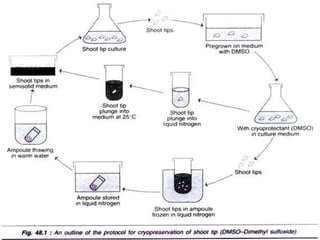
1. Cryopreservation
Cryopreservation broadly means the
storage of germplasm at very low
temperatures:
i. Over solid carbon dioxide (at -79°C)
ii. Low temperature deep freezers (at -
80°C)
iii. In vapour phase nitrogen (at -150°C)
iv. In liquid nitrogen (at -196°C)
Cryopreservation (Greek, krayos-frost) literally means
preservation in the frozen state. The principle involved in
cryopreservation is to bring the plant cell and tissue cultures to
a zero metabolism or non-dividing state by reducing the
temperature in the presence of cryoprotectants.
Mamoona
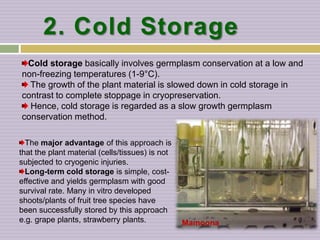
2. Cold Storage
Cold storage basically involves germplasm conservation at a low and
non-freezing temperatures (1-9°C).
The growth of the plant material is slowed down in cold storage in
contrast to complete stoppage in cryopreservation.
Hence, cold storage is regarded as a slow growth germplasm
conservation method.
The major advantage of this approach is
that the plant material (cells/tissues) is not
subjected to cryogenic injuries.
Long-term cold storage is simple, cost-
effective and yields germplasm with good
survival rate. Many in vitro developed
shoots/plants of fruit tree species have
been successfully stored by this approach
e.g. grape plants, strawberry plants. Mamoona
3. Low-Pressure and Low-
Oxygen Storage:
Low-Pressure Storage
(LPS):
In low-pressure storage, the
atmospheric pressure surrounding
the plant material is reduced. This
results in a partial decrease of the
pressure exerted by the gases
around the germplasm. The lowered
partial pressure reduces the in vitro
growth of plants (of organized or
unorganized tissues). Low-pressure
storage systems are useful for short-
term and long-term storage of plant
materials.
Low-Oxygen Storage (LOS):
In the low-oxygen storage, the oxygen
concentration is reduced, but the
atmospheric pressure (260 mm Hg) is
maintained by the addition of inert
gases (particularly nitrogen). The
partial pressure of oxygen below 50
mm Hg reduces plant tissue growth
(organized or unorganized tissue).
This is due to the fact that with
reduced availability of O2, the
production of CO2 is low. As a
consequence, the photosynthetic
activity is reduced, thereby inhibiting
the plant tissue growth and dimension.
APPLICATIONS OF
GERMPLASM STORAGE:
1) Maintenance of stock cultures
2) Cryopreservation is an ideal method for long term conservation of cell
cultures which produce secondary metabolites (e.g. medicines).
3) Disease (pathogen)-free plant materials can be frozen, and propagated
whenever required.
4) Recalcitrant seeds can be maintained for long.
5) Conservation of somaclonal and gametoclonal variations in cultures.
6) Plant materials from endangered species can be conserved.
7) Conservation of pollen for enhancing longevity.
8) Rare germplasms developed through somatic hybridization and other
genetic manipulations can be stored.
9) Cryopreservation is a good method for the selection of cold resistant
mutant cell lines which could develop into frost resistant plants.
10) Establishment of germplasm banks for exchange of information at the
international level.
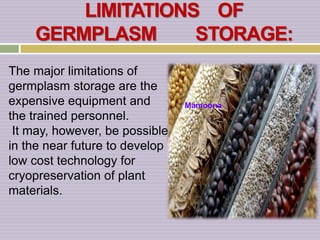
LIMITATIONS OF
GERMPLASM STORAGE:
The major limitations of
germplasm storage are the
expensive equipment and
the trained personnel.
It may, however, be possible
in the near future to develop
low cost technology for
cryopreservation of plant
materials.
Mamoona
REFERENCE
https://www.docsity.com/en/germplasm-perservation-cell-biology-lecture-
slides/87119/
https://www.biologydiscussion.com/biotechnology/germplasm-
conservation/germplasm-conservation-and-cryopreservation-with-
diagram/10757#:~:text=Germplasm%20Conservation%3A,the%20offspring%
20through%20germ%20cells.&text=The%20very%20objective%20of%20ger
mplasm,at%20any%20time%20in%20future.
https://www.sciencedirect.com/topics/agricultural-and-biological-
sciences/germplasm-
conservation#:~:text=Germplasm%20conservation%20is%20the%20most,is
%20required%20in%20the%20future.
https://www.slideshare.net/ruchu44/germplasm-conservation-in-situ-ex-situ-
and-onfarm-and-biodiversity
Germplasm Conservation || Presented by Mamoona Ghaffar

Germplasm Conservation || Presented by Mamoona Ghaffar

  • 1.
    GERMPLASM CONSERVATION Presented byMamoona Ghaffar Mamoona GERMPLASM CONSERVATION By Mamoona Ghaffar
  • 2.
    TOPIC: GERMPLASM CONSERVATION SubmittedTo: Ma’am Wjeeha Iqbal Submitted By: Mamoona Ghaffar Roll No: 35846 Registration #: 2016 GCUF 068036 Degree: Bs Hons Botany (Regular) Course Title: Plant Tissue Culture Course Code: Bot-608
  • 3.
    CONTENT Introduction Important features ofgermplasm Germplasm conservation Methods 1. In-situ conservation 2. Ex-situ conservation Three Approaches For The In-vitro Conservation Of Germplasm 1. Cryopreservation (freeze-preservation) 2. Cold storage 3. Low-pressure and low-oxygen storage APPLICATIONS OF GERMPLASM STORAGE LIMITATIONS OF GERMPLASM STORAGE
  • 4.
    Germplasm broadly refersto the hereditary material (total content of genes) transmitted to the offspring through germ cells. Germplasm conservation is the most successful method to conserve the genetic traits of endangered and commercially valuable species. GERMPLASM CONSERVATION Mamoona
  • 5.
    GERMPLASM Germplasm is thegenetic material of germ cells. The sum total of hereditary material i.e. all the alleles of various genes, present in a crop species and its wild relatives is referred to as Germplasm. This is also known as genetic resources or gene pool or genetic stock. Germplasm are living genetic resources such as seeds or tissues that are maintained for the purpose of plant breeding, preservation, and other research uses.
  • 6.
    IMPORTANT FEATURES OF GERMPLASM Geneticpool represents the entire genetic variability or diversity available in a crop species. Germplasm consists of land races, modern cultivars, obsolete cultivars, breeding stocks, wild forms and wild species of cultivated crops. Germplasm includes both cultivated and wild species and relatives of crop plants. Germplasm is collected from centers of diversity, gene banks, gene sanctuaries, farmer’s fields, markers and seed companies. Germplasm is the basic material for launching a crop improvement programme. Germplasm may be indigenous (collected within country) or exotic (collected from foreign countries)
  • 7.
    GERMPLASM CONSERVATION Conservation refersto protection of genetic diversity of crop plants from genetic erosion The very objective of Germplasm Conservation (or storage) is to preserve the genetic diversity of a particular plant or genetic stock for its use at any time in future. It is important to conserve the endangered plants or else some of the valuable genetic traits present in the primitive plants may be lost. Germplasm conservation is the most successful method to conserve the genetic traits of endangered and commercially valuable species. Germplasm is a live information source for all the genes present in the respective plant, which can be conserved for long periods and regenerated whenever it is required in the future
  • 8.
    Germplasm Conservation Includes: •Breedinglines •Cultivated species •Commercial varieties •Special genetic stocks •Landraces •Wild species (for direct use (crop species) and indirect use (as root stocks). Mamoona
  • 9.
    GERMPLASM CONSERVATION METHODS There aretwo important methods of Germplasm conservation or preservation: I) In-situ Conservation On-site conservation. Conservation of germplasm in its natural habitat or in area where it grows naturally. Ii) Ex Situ Conservation Off-site conservation. Germplasm conservation is attempted outside or away from its natural habitat. MamoonaMamoona
  • 10.
    1. In-situ Conservation On-siteconservation is called as in-situ conservation, which means conservation of genetic resources in the form of natural populations by establishing biosphere reserves such as national parks and sanctuaries. Practices like horticulture and floriculture also preserve plants in a natural habitat. Merits:  In this method of conservation, the wild species and the compete natural or seminatural ecosystems are preserved together. Demerits:  Each protected area will cover only very small portion of total diversity of a crop species, hence several areas will have to be conserved for a single species.
  • 11.
    2. Ex-Situ Conservation Off-siteconservation is called as ex-situ conservation. Ex-situ conservation is the chief method for the preservation of Germplasm obtained from cultivated and wild plant materials. The genetic materials in the form of seeds or from in vitro cultures (plant cells, tissues or organs) can be preserved as gene banks for long term storage under suitable conditions. For successful establishment of gene banks, adequate knowledge of genetic structure of plant populations, and the techniques involved in sampling, regeneration, maintenance of gene pools etc. are essential. It refers to preservation of germplasm in gene banks. This is the most practical method of germplasm conservation. This Method Has Following Advantages. 1. It is possible to preserve entire genetic diversity of a crop species at one place. 2. Handling of germplasm is also easy. 3. This is a cheap method of germplams conservation.
  • 15.
    Germplasm Conservation In TheForm Of Seeds: Usually, seeds are the most common and convenient materials to conserve plant germplasm. This is because many plants are propagated through seeds, and seeds occupy relatively small space. Further, seeds can be easily transported to various places. There are however, certain limitations in the conservation of seeds: i. Viability of seeds is reduced or lost with passage of time. ii. Seeds are susceptible to insect or pathogen attack, often leading to their destruction. iii. This approach is exclusively confined to seed propagating plants, and therefore it is of no use for vegetatively propagated plants e.g. potato, Ipomoea, Dioscorea. iv. It is difficult to maintain clones through seed conservation.
  • 16.
    In-Vitro Methods For GermplasmConservation: In vitro methods employing shoots, meristems and embryos are ideally suited for the conservation of germplasm of vegetatively propagated plants. The plants with recalcitrant seeds and genetically engineered materials can also be preserved by this in vitro approach. There are several advantages associated with in vitro germplasm conservation: i. Large quantities of materials can be preserved in small space. ii. The germplasm preserved can be maintained in an environment, free from pathogens. iii. It can be protected against the nature’s hazards. iv. From the germplasm stock, large number of plants can be obtained whenever needed. v. Obstacles for their transport through national and international borders are minimal (since the germplasm is maintained under aseptic conditions).
  • 17.
    There Are MainlyThree Approaches For The In-vitro Conservation Of Germplasm: 1. Cryopreservation (freeze- preservation) 2. Cold storage 3. Low-pressure and low-oxygen storage
  • 18.
    1. Cryopreservation Cryopreservation broadlymeans the storage of germplasm at very low temperatures: i. Over solid carbon dioxide (at -79°C) ii. Low temperature deep freezers (at - 80°C) iii. In vapour phase nitrogen (at -150°C) iv. In liquid nitrogen (at -196°C) Cryopreservation (Greek, krayos-frost) literally means preservation in the frozen state. The principle involved in cryopreservation is to bring the plant cell and tissue cultures to a zero metabolism or non-dividing state by reducing the temperature in the presence of cryoprotectants. Mamoona
  • 20.
    2. Cold Storage Coldstorage basically involves germplasm conservation at a low and non-freezing temperatures (1-9°C). The growth of the plant material is slowed down in cold storage in contrast to complete stoppage in cryopreservation. Hence, cold storage is regarded as a slow growth germplasm conservation method. The major advantage of this approach is that the plant material (cells/tissues) is not subjected to cryogenic injuries. Long-term cold storage is simple, cost- effective and yields germplasm with good survival rate. Many in vitro developed shoots/plants of fruit tree species have been successfully stored by this approach e.g. grape plants, strawberry plants. Mamoona
  • 21.
    3. Low-Pressure andLow- Oxygen Storage: Low-Pressure Storage (LPS): In low-pressure storage, the atmospheric pressure surrounding the plant material is reduced. This results in a partial decrease of the pressure exerted by the gases around the germplasm. The lowered partial pressure reduces the in vitro growth of plants (of organized or unorganized tissues). Low-pressure storage systems are useful for short- term and long-term storage of plant materials. Low-Oxygen Storage (LOS): In the low-oxygen storage, the oxygen concentration is reduced, but the atmospheric pressure (260 mm Hg) is maintained by the addition of inert gases (particularly nitrogen). The partial pressure of oxygen below 50 mm Hg reduces plant tissue growth (organized or unorganized tissue). This is due to the fact that with reduced availability of O2, the production of CO2 is low. As a consequence, the photosynthetic activity is reduced, thereby inhibiting the plant tissue growth and dimension.
  • 22.
    APPLICATIONS OF GERMPLASM STORAGE: 1)Maintenance of stock cultures 2) Cryopreservation is an ideal method for long term conservation of cell cultures which produce secondary metabolites (e.g. medicines). 3) Disease (pathogen)-free plant materials can be frozen, and propagated whenever required. 4) Recalcitrant seeds can be maintained for long. 5) Conservation of somaclonal and gametoclonal variations in cultures. 6) Plant materials from endangered species can be conserved. 7) Conservation of pollen for enhancing longevity. 8) Rare germplasms developed through somatic hybridization and other genetic manipulations can be stored. 9) Cryopreservation is a good method for the selection of cold resistant mutant cell lines which could develop into frost resistant plants. 10) Establishment of germplasm banks for exchange of information at the international level.
  • 23.
    LIMITATIONS OF GERMPLASM STORAGE: Themajor limitations of germplasm storage are the expensive equipment and the trained personnel. It may, however, be possible in the near future to develop low cost technology for cryopreservation of plant materials. Mamoona
  • 24.