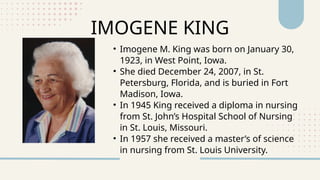
• Imogene M.King was born on January 30,
1923, in West Point, Iowa.
• She died December 24, 2007, in St.
Petersburg, Florida, and is buried in Fort
Madison, Iowa.
• In 1945 King received a diploma in nursing
from St. John’s Hospital School of Nursing
in St. Louis, Missouri.
• In 1957 she received a master’s of science
in nursing from St. Louis University.
IMOGENE KING
3.
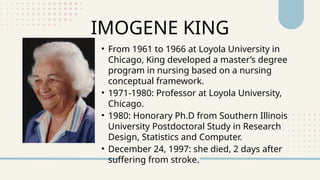
• From 1961to 1966 at Loyola University in
Chicago, King developed a master’s degree
program in nursing based on a nursing
conceptual framework.
• 1971-1980: Professor at Loyola University,
Chicago.
• 1980: Honorary Ph.D from Southern Illinois
University Postdoctoral Study in Research
Design, Statistics and Computer.
• December 24, 1997: she died, 2 days after
suffering from stroke.
IMOGENE KING
4.
• A Middle-rangedTheory based on her Conceptual System
(1960s)
• Focuses on the attainment of certain life goals.
THEORY OF GOAL
ATTAINMENT
• Factors affecting the attainment of goals:
Roles
Stress
Space
Time
5.
NURSE’S
• Goal:
Tohelp patients maintain health.
• Domain:
Includes promoting, maintaining, and restoring
health, and caring for the sick, injured and dying.
• Function:
To interpret information in the nursing process.
6.
• King (1971)spoke of concepts as “abstract ideas that give
meaning to our sense perceptions, permit generalizations,
and tend to be stored in our memory for recall and use at a
later time in new and different situations” .
• King (1984) defined theory as “a set of concepts, that, when
defined, are interrelated and observable in the world of
nursing practice”
• Health
“Health isdefined as dynamic life experiences of a
human being, which implies continuous adjustment to
stressors in the internal and external environment
through optimum use of one’s resources to achieve
maximum potential for daily living” (King, 1981, p. 5).
9.
• Nursing
“Nursing isdefined as a process of action, reaction, and
interaction whereby nurse and client share information
about their perceptions in the nursing situation” (King,
1981, p. 2).
10.
• Self
“The selfis a composite of thoughts and feelings which constitute
a person’s awareness of his [or her] individual existence, his [or
her] conception of who and what he [or she] is. A person’s self is
the sum total of all he [or she] can call his [or hers]. The self
includes, among other things, a system of ideas, attitudes, values,
and commitments. The self is a person’s total subjective
environment. “
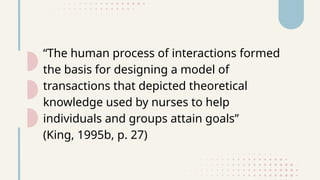
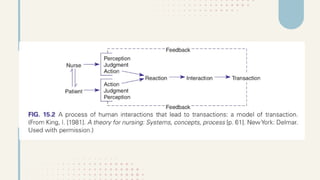
“The human processof interactions formed
the basis for designing a model of
transactions that depicted theoretical
knowledge used by nurses to help
individuals and groups attain goals”
(King, 1995b, p. 27)
15.
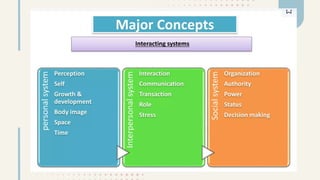
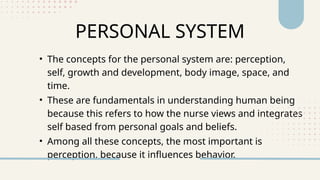
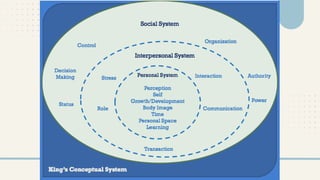
PERSONAL SYSTEM
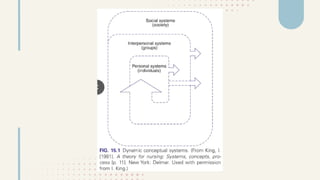
• Theconcepts for the personal system are: perception,
self, growth and development, body image, space, and
time.
• These are fundamentals in understanding human being
because this refers to how the nurse views and integrates
self based from personal goals and beliefs.
• Among all these concepts, the most important is
perception, because it influences behavior.
16.
Personal systems areindividuals, who are regarded as
rational, sentient, social beings. Concepts related to the
personal system are:
• Perception-- a process of organizing, interpreting, and
transforming information from sense data and memory
that gives meaning to one's experience, represents one's
image of reality, and influences one's behavior.
17.
• Self-- acomposite of thoughts and feelings that
constitute a person's awareness of individual existence,
of who and what he or she is
• Growth and development-- cellular, molecular, and
behavioral changes in human beings that are a function
of genetic endowment, meaningful and satisfying
experiences, and an environment conducive to helping
individuals move toward maturity.
• Body image--a person's perceptions of his or her body.
18.
• Time-- theduration between the occurrence of one event
and the occurrence of another event.
• Space--the physical area called territory that exists in all
directions.
• Learning– gaining knowledge
19.
INTERPERSONAL SYSTEM
• Theconcepts associated for the interpersonal system
are: interaction, communication, transaction, role, and
stress.
• King refers to two individuals as dyads, three as triads
and four or more individuals as small group or large
group (King, 1981).
• This shows how the nurse interrelates with a co-worker
or patient, particularly in a nurse-patient relationship.
20.
• Communication betweenthe nurse and the client can be
verbal or nonverbal.
• Collaboration between the Dyads (nurse-patient) is very
important for the attainment of the goal.
21.
• Interactions--the actsof two or more persons in mutual
presence; a sequence of verbal and nonverbal behaviors
that are goal directed.
• Communication-the vehicle by which human relations are
developed and maintained; encompasses intrapersonal,
interpersonal, verbal, and nonverbal communication.
• Transaction--a process of interaction in which human
beings communicate with the environment to achieve
goals that are valued; goal-directed human behaviors.
23.
• Role--a setof behaviors expected of a person occupying a
position in a social system.
• Stress--a dynamic state whereby a human being interacts
with the environment to maintain balance for growth,
development, and performance, involving an exchange of
energy and information between the person and the
environment for regulation and control of stressors.
• Coping- a way of dealing stress
24.
SOCIAL SYSTEM
• Thefinal interacting system is the social system. This
shows how the nurse interacts with co workers,
superiors, subordinates and the client environment in
general. These are groups of people within the
community or society that share a common goals,
values and interests.
25.
• It providesa framework for social interaction and
relationships and establishes rules of behavior and
courses of action (King, 1971). Social systems are
organized boundary systems of social roles, behaviors,
and practices developed to maintain values and the
mechanisms to regulate the practices and roles.
26.
• Authority-- transactionalprocess characterized by
active, reciprocal relations in which members' values,
backgrounds, and perceptions play a role in defining,
validating, and accepting the authority of individuals
within an organization.
• Power-- the process whereby one or more persons
influence other persons in a situation.
• Status-- the position of an individual in a group or a
group in relation to other groups in an organization.
27.
• Organization-- composedof human beings with prescribed
roles and positions who use resources to accomplish
personal and organizational goals.
• Decision making-- a dynamic and systematic process by
which goal-directed choice of perceived alternatives is
made and acted upon by individuals or groups to answer a
question and attain a goal.
• Control- being in charge.
29.
• Among thethree systems, the conceptual framework
of Interpersonal system had the greatest influence on
the development of her theory.
• She stated that "Although personal systems and social
systems influence quality of care, the major elements
in a theory of goal attainment are discovered in the
interpersonal systems in which two people, who are
usually strangers, come together in a health care
organization to help and to be helped to maintain a
state of health that permits functioning in roles"
30.
KING’S INTERACTING SYSTEMSFRAMEWORK AND THEORY OF
GOAL ATTAINMENT AS A FRAMEWORK FOR NURSING PRACTICE
• King points that nursing is a process of interactions that lead
to transactions.
• Transactions lead to goal attainment, and goal attainment is
a measure of effective nursing care.
31.
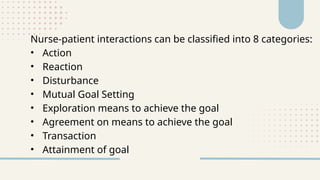
Nurse-patient interactions canbe classified into 8 categories:
• Action
• Reaction
• Disturbance
• Mutual Goal Setting
• Exploration means to achieve the goal
• Agreement on means to achieve the goal
• Transaction
• Attainment of goal
32.
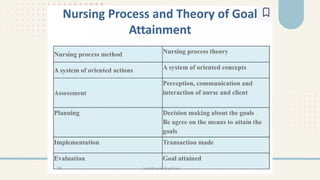
• To implementthe theory of goal attainment in practice, the
goal-oriented nursing record was proposed.
• It consists of a nursing database that assesses the patient’s
abilities to perform ADL, perceptions of health concerns,
and knowledge related to the patient’s learning needs.
• From these data, nursing diagnoses are constructed and
goals are mutually set with patients.
33.
• During theseinteractions, nurses provide information to
assist patients in making informed decisions.
• When goals have been identified, nursing orders have been
written based on the goals, and the progress notes indicate
that the goals have been attained, and effective nursing care
has been documented.
PERSON
• A socialbeing who has 3 fundamental needs.
Health information
Care that seeks to prevent illness
Care when the patient is unable to help him or
herself.
36.
HEALTH
• Involving thepatient’s life experiences.
Internal environment
External environment
37.
• The backgroundfor human interaction.
Internal and external to the individual; nurse.
ENVIRONMENT
38.
• Is aprocess of action, reaction, and interaction
whereby nurse and client share information about
their perceptions in the nursing situation.
NURSING
39.
• King's conceptualframework and theory of goal
attainment "are based on an overall assumption
that the focus of nursing is human beings
interacting with their environment leading to a state
of health for individuals, which is an ability to
function in social roles"
• In thenursing process, each member of the dyad
perceives the other, makes judgments, and takes
actions.
• Together, these activities culminate in reaction.
PROPOSITIONS OF KING'S
THEORY
43.
“Nurses purposely interactwith clients to mutually
establish goals, and to explore and agree on means to
achieve goals. Mutual goal setting is based on nurses’
assessment of clients’ concerns, problems, and
disturbances in health, their perceptions of problems,
and their sharing information to move toward goal
attainment.”
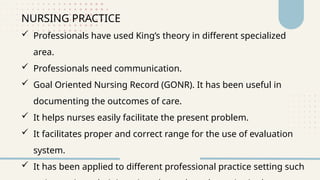
NURSING PRACTICE
Professionalshave used King’s theory in different specialized
area.
Professionals need communication.
Goal Oriented Nursing Record (GONR). It has been useful in
documenting the outcomes of care.
It helps nurses easily facilitate the present problem.
It facilitates proper and correct range for the use of evaluation
system.
It has been applied to different professional practice setting such


![• Self
“The self is a composite of thoughts and feelings which constitute
a person’s awareness of his [or her] individual existence, his [or
her] conception of who and what he [or she] is. A person’s self is
the sum total of all he [or she] can call his [or hers]. The self
includes, among other things, a system of ideas, attitudes, values,
and commitments. The self is a person’s total subjective
environment. “](https://image.slidesharecdn.com/imogene-king-250502071958-1062b180/85/Imogene-King-Presentation_Theory_Theorist-10-320.jpg)




![Imo king [Autosaved].pptx11111111111111theorryytt](https://cdn.slidesharecdn.com/ss_thumbnails/imokingautosaved-250127083514-4d629a1b-thumbnail.jpg?width=640&height=640&fit=bounds)


