Imogene King’s
Theory of Goal Attainment
NSG 6604
Eddrea Cade
Lindsay Fort
Carlie Peacock
Leah Williamson
Background
• 1945, Imogene King received nursing diploma from St. John’s Hospital School of Nursing in St. Louis, Missouri
• 1948, received BSN from St. Louis University
• 1957, received MSN from St. Louis University
• 1961, received doctoral degree from Teachers College, Columbia University
• 1961 through 1966, was Associate Professor at Loyola University in Chicago
• 1966 and 1968, was Assistant Chief of the Research Grants Branch of the Division of Nursing in Washington, DC
• 1968 through 1972, was director of the Ohio State University School of Nursing
• 1971 through 1980, was Professor at Loyola University in Chicago
• 1980 through 1990, was Professor at the University of South Florida’s College of Nursing in Tampa, Florida
• Retired afterwards with the title Professor Emeritus
• Active member District IV Florida Nurses Association, the American Nurses Association, and Sigma Theta Tau
International, also a Fellow in the American Academy of Nursing
• Works included:
– Theory for Nursing: Systems, Concepts, and Process
– The Language of Nursing theory and Metatheory
– Toward a Theory for Nursing: General Concepts of Human Behavior
– Curriculum and Instruction in Nursing: Concepts and Process
• 1960s, Theory of Goal Attainment was first introduced
(Nursing Theory.org, 2013)
Background cont.
• King produced a conceptual system and a middle-range theory for nursing
• 1971, issued the conceptual framework
• 1981, expanded to the Theory of Goal Attainment, a middle-range theory
• Human beings was the focus of nursing and they interact with their environment
• Focused on existing knowledge in nursing and expanded for nursing practice
• Concepts analyzed: Social systems, health, interpersonal relationships, and perceptions for nursing
discipline
• 1971, a conceptual framework was formulated around personal, interpersonal and social systems, and was
extended to include communication, interpersonal relationships, information, energy, social organizations,
role and status
• 1978, believed science should form scientific knowledge based off nursing and research
• Concepts of theory include: perception, communication, interaction, transaction, self, role, growth and
development, stressors/stress, time and space
• Changes made to the conceptual system included: personal system concept; spirituality; and calling this the
conceptual system
• Linked to nursing process (assessment, plan, implement, and evaluate)
• Improve or maintain health, control illness, or lead to a peaceful death
(Khowaja, 2007)
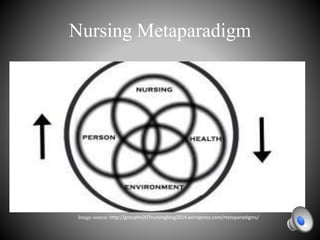
Nursing Metaparadigm
Image source: http://grouphn207nursingblog2014.wordpress.com/metaparadigms/
Nursing Metaparadigm
• Person: Nursing practice must be viewed by patients as
central to the experiences of embodiment and illness while
including family members and other important people to the
patient
• Health: Multifaceted dimension that patient has on well
being and quality of life including functional status, role
performance, psychological wellness, and overall
satisfaction throughout the lifespan
– Nursing plays a distinct role in the support
of the patient to maximize patient health
(Thorne et al., 1998)
Nursing Metaparadigm
• Environment: Includes both internal and external
factors influencing patient
– Nursing meets patient environmental need by having a
multilayered view to tailor to individuals everyday reality,
culture, economic structure, and social interactions
• Nursing: Nurses are to apply principles of
knowledge, skills, collaboration, communication,
and professional judgment
– A key focus to nursing is carrying the role of caring to all
individuals
(Thorne et al., 1998)
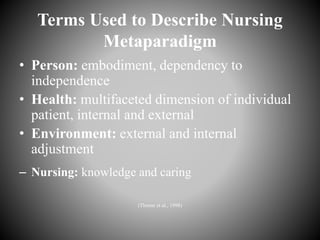
Terms Used to Describe Nursing
Metaparadigm
• Person: embodiment, dependency to
independence
• Health: multifaceted dimension of individual
patient, internal and external
• Environment: external and internal
adjustment
– Nursing: knowledge and caring
(Thorne et al., 1998)
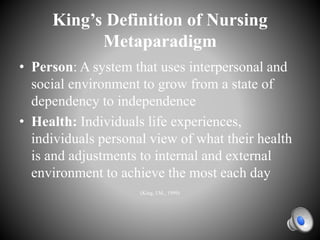
King’s Definition of Nursing
Metaparadigm
• Person: A system that uses interpersonal and
social environment to grow from a state of
dependency to independence
• Health: Individuals life experiences,
individuals personal view of what their health
is and adjustments to internal and external
environment to achieve the most each day
(King, I.M., 1999)
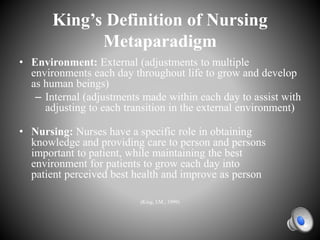
King’s Definition of Nursing
Metaparadigm
• Environment: External (adjustments to multiple
environments each day throughout life to grow and develop
as human beings)
– Internal (adjustments made within each day to assist with
adjusting to each transition in the external environment)
• Nursing: Nurses have a specific role in obtaining
knowledge and providing care to person and persons
important to patient, while maintaining the best
environment for patients to grow each day into
patient perceived best health and improve as person
(King, I.M., 1999)
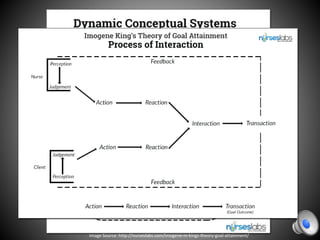
Goal of Attainment Model
Image Source: http://nurseslabs.com/imogene-m-kings-theory-goal-attainment/
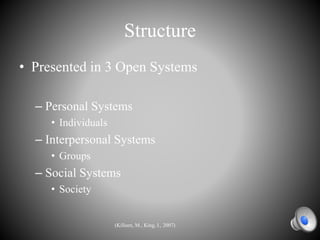
Structure
• Presented in 3 Open Systems
– Personal Systems
• Individuals
– Interpersonal Systems
• Groups
– Social Systems
• Society
(Killeen, M., King, I., 2007)
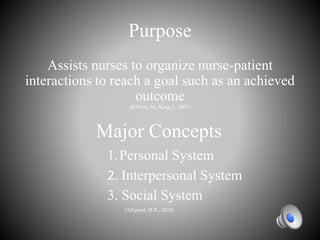
Purpose
Assists nurses to organize nurse-patient
interactions to reach a goal such as an achieved
outcome
(Killeen, M., King, I., 2007)
Major Concepts
1.Personal System
2. Interpersonal System
3. Social System
(Alligood, M.R., 2010)
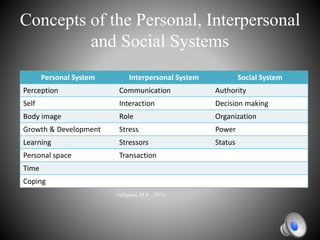
Concepts of the Personal, Interpersonal
and Social Systems
Personal System Interpersonal System Social System
Perception Communication Authority
Self Interaction Decision making
Body image Role Organization
Growth & Development Stress Power
Learning Stressors Status
Personal space Transaction
Time
Coping
(Alligood, M.R., 2010)
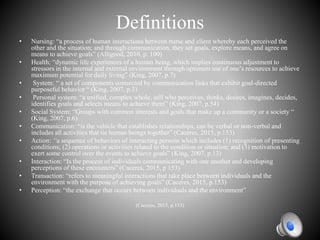
Definitions
• Nursing: “a process of human interactions between nurse and client whereby each perceived the
other and the situation; and through communication, they set goals, explore means, and agree on
means to achieve goals” (Alligood, 2010, p. 100)
• Health: “dynamic life experiences of a human being, which implies continuous adjustment to
stressors in the internal and external environment through optimum use of one’s resources to achieve
maximum potential for daily living” (King, 2007, p.7)
• System: “ a set of components connected by communication links that exhibit goal-directed
purposeful behavior “ (King, 2007, p.3)
• Personal system: “a unified, complex whole, self who perceives, thinks, desires, imagines, decides,
identifies goals and selects means to achieve them” (King, 2007, p.54)
• Social System: “Groups with common interests and goals that make up a community or a society “
(King, 2007, p.6)
• Communication: “is the vehicle that establishes relationships, can be verbal or non-verbal and
includes all activities that tie human beings together” (Caceres, 2015, p.153)
• Action: “a sequence of behaviors of interacting persons which includes (1) recognition of presenting
conditions; (2) operations or activities related to the condition or situation; and (3) motivation to
exert some control over the events to achieve goals” (King, 2007, p.13)
• Interaction: “Is the process of individuals communicating with one another and developing
perceptions of these encounters” (Caceres, 2015, p 153)
• Transaction: “refers to meaningful interactions that take place between individuals and the
environment with the purpose of achieving goals” (Caceres, 2015, p.153)
• Perception: “the exchange that occurs between individuals and the environment”
(Caceres, 2015, p.153)
Propositions & Relationships
• Nurses and patients form relationships through
interactions
• Transactions will occur if nurse-patient interactions are
present and the patient perceives the expectations and
performance the same as the nurse
• Goals will be set and attained mutually if the patient is
given information that is appropriate through
communication from the nurse
• Goals will be achieved if transactions are made
between a nurse and patient and effective care has been
given
• If goals are achieved, satisfaction will occur
(Alligood, M.R., 2010)
Assumptions
• Focus care of human being
• Goal is to cure individuals and groups
• Open systems interacting with the environment
• Communicate to form a goal that is mutual and
acts to attain the set goal
(Killeen, M., King, I., 2007)
Nursing Goal
• Assist nurses to mutually establish goals and
agree on how to achieve those goal with
patients
• Maintain health
(King, 2007)
Nursing Practice
• Major milestones:
– Development and use of conceptual systems and theories during the scientific evolution in the 1970s
– Classification systems beginning in the 1980s
– Nursing informatics applications in the 1990s
• These three milestone linkages are like the linkages between structure, process, and outcomes
• Define the physical and social environments within which human beings function
• Personal, interpersonal, and social systems make up the conceptual structure
• The ten concepts are important in today’s global issues of cultural diversity and transcultural nursing
• Transaction Process Model helps ordered function so human groups can interact as systems in societies and
nations
• Describes the nurse-patient interactions leading to transactions and achievement of goals
• Theory of Goal Attainment and Transaction Process were established as part of the scientific movement in
nursing
• A general systems theory
• The delivery of healthcare services have need for both individual and interdisciplinary team approach
• Open communication and respect for one’s contribution to the total plan of care is necessary to achieve goal
attainment and outcomes
• Transaction Process aid in mutual goal setting with patients
• Concepts in the Transaction Process provide theoretical knowledge
• Nursing process is an international method to use in the structure of theory
(Killeen & King, 2007)
Nursing Practice cont.
• Represent human beings as personal systems (individuals)
• Interpersonal systems presented by dyads (two individuals), triads (three individuals, such as nurse-patient-
physician), and small groups (such as nurse, physician, pharmacist, and therapists)
• Social systems are large groups such as healthcare systems, educational systems, and government systems
• Three interacting systems show the interrelationship of human beings as they function in a variety of
systems
• Knowledge of the 15 concepts are used by human beings in all three systems
• Perception, self, body image, growth and development, time, personal space, and coping are related to
individuals
• Role, communication, interaction, stress, and transaction represent interpersonal systems
• Organization, status, power, authority, and decision making represent social systems
• Age is critical in all three systems
• Three systems represent social and physical environments to help achieve the set goals
• Relevant in most cultures, differences may exist relative to perception and communication
• Ten concepts selected the conceptual system used to develop a theory of Goal Attainment which a
transaction process was derived
• Goal Attainment represents outcome and provides evidence-based practice
• Transaction process is mutual goal setting
• Describes the nature of the nurse-client encounters and provide a theoretical basis for the nursing process
• Concepts can be used by individuals and healthcare professionals in any healthcare system
• Transaction process is useful in multidisciplinary and interdisciplinary involvement
(King, 2006)
Nursing Research
• Ultimate use to improve patient/client care
• Other theories builds other disciplines; borrowed theories can develop into nursing theories
• Requires nursing scientists to re-evaluate the present state of theory, research, and practice in the discipline
• Nursing scholars and educators visualized a scientific discipline complete with theory-driven research and
practice
• National League for Nursing’s accreditation for nursing education provided a stimulus for nursing
researchers to increase their efforts to develop appropriate theories to guide nursing research and practice
• Each single nursing theory or conceptual model represents an individual system
• Integration of nursing theory or conceptual model into scientific research represents the group system
• The interaction on the level of the nursing community and nursing discipline as a whole represents the
societal system
• The mutual goal for the three systems is to build scientific knowledge that can be used to improve patient
care and nursing practice
• An organizing framework help to build nursing’s scientific knowledge
• For over 50 years, nursing scientists have developed the Scientific Discipline of Nursing through the use of
theory to guide research to improve practice, thereby improving patient outcomes
(Bond et al., 2011)
Nursing Research cont.
• 70% reported adverse events could be from lack of communication and collaboration
• Supports the phenomenon of interdisciplinary collaboration
• Nurse-physician collaboration and communication can improve both patient outcomes and provider
satisfaction
• Gender, age, culture, and level of education of the nurse or physician may directly impact the perceived
level of collaboration
• Not only used by nurses with their patients, but can be used by any individual in any interactions with other
professionals
• Used to guide nursing practice and research for approximately 30 years
• Has depth and scope beyond bedside nursing
• Used by nurses, administrators, and other healthcare providers, also used with nursing administration and to
guide nursing curricula
• Tested in research and used in every patient population from infants to the elderly
• Wicks family health model and the Advanced directive decision making model was derived from King’s
theory to guide nursing practice
• Developed research instruments and facilitated other middle-range theories such as the Theory of Group
Power
• Promote interdisciplinary collaboration with the intended outcome of improved patient and nursing
outcomes
• Application may help to move forward in improving outcomes and reducing adverse events
(Fewster-Thuente & Velsor-Friedrich, 2008)
How clear is this theory ?
 Addresses the nurse-patient interactions
 States its main components
 Provides & maintains the same definitions for
all key concepts
 Ease of understanding
 Concepts clearly defined & models provided
(Alligood, 2014)
How simple is this theory ?
 10 major concepts
- Making it a complex theory
 Clear concepts are easily understood
 Derived from identified characteristics
 Easily used within the nursing field &
influences positive patient outcomes
 Provides a systemic means of viewing &
clarifying the nursing profession
(Alligood, 2014)
How general is this theory ?
 King believed critics were assuming that a
theory would address every patient & situation
which is impossible
 Criticized for having limited application in
nursing areas
 King used the theory in board terms in nurse-
patient relationships
 Documented examples of the Theory of Goal
Attainment
(Alligood, 2014)
How accessible is this theory ?
 Widely accepted in nursing
 Used with research studies & in nursing schools
 Several studies used this theory to measure patient
outcomes
 Useful in practice
- individualized plan of care with patient actively
being involved in the decision making process
(Alligood, 2014)
How important is this theory
?
 Has been proven that the nurse-patient interaction is
a vital component
 King’s theory explores this relationship
 Explains how nurses can interact with patients to
achieve goals
 Emphasizes all aspects of the nursing process
- Assessment, planning, implementation, &
evaluation
(Alligood, 2014)
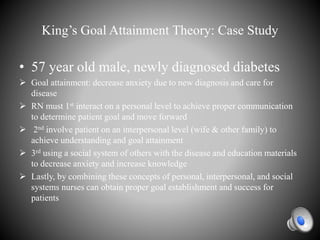
King’s Goal Attainment Theory: Case Study
• 57 year old male, newly diagnosed diabetes
 Goal attainment: decrease anxiety due to new diagnosis and care for
disease
 RN must 1st interact on a personal level to achieve proper communication
to determine patient goal and move forward
 2nd involve patient on an interpersonal level (wife & other family) to
achieve understanding and goal attainment
 3rd using a social system of others with the disease and education materials
to decrease anxiety and increase knowledge
 Lastly, by combining these concepts of personal, interpersonal, and social
systems nurses can obtain proper goal establishment and success for
patients
Refrences
• Alligood, M. R. (2010). Family healthcare with King’s theory of goal attainment. Nursing Science Quarterly, 23(2), 99-104.
http://dx.doi.org/10.1177/0894318410362553
• Alligood, M. (2014). Imogene M. King: Conceptual system and middle-range theory of goal attainment. Nursing Theorists
and Their Work (8th ed., pp. 258-268). St. Louis, Missouri: Elsesvier Mosby.
• Bond, A. E., Esha, N. F., Bani-Khaled, M., Hamad, A. O., Habashreh, S., Kataua, H.,&… Maabreh, R. (2011).Who uses
nursing theory? A univariate descriptive analysis of five years’ research articles. Scandinavian Journal of Caring Sciences,
25(2), 404-409. doi:10.1111/j.1471-6712.2010.00835.x
• Caceres, B. A. (2015). King’s theory of goal attainment: Exploring functional status. Nursing Science Quarterly, 28(2),
151-155. http://dx.doi.org/10.1177/0894318415571601
• Christina, S. L., Maureen, F. A., & Imogene, K. M. (2007). King’s structure, process, and outcome in the 21st century. In S.
L. Christina, & F. A. Maureen (Eds.), Middle range theory development using King’s conceptual system. [eBook
Academic Collection]. Retrieved from http://eds.a.ebscohost.com.ezproxy.una.edu/eds/detail?sid=ccbb3cc3-
dde4-4322-9ab3-b8c5f9d7fabe@sessionmgr4001&vid=1#db=e000xna&AN=194785
References
• Fewster-Thuente, L. & Velsor-Friedrich, B. (2008). Interdisciplinary collaboration for healthcare professionals. Nursing
Administration Quarterly, 32(1), 40-48. doi:10.1097/01.NAQ.0000305946.31193.61
• Imogene King- Nursing theorist (2013). Nursing Theory. Retrieved from
http://nursing-theory.org/nursing-theorists/Imogene-King.php
• Khowaja, K. (2007). Utilization of King’s interacting systems framework and theory of goal attainment with new
multidisciplinary model: Clinical pathway. Australian Journal of Advanced Nursing, 24(2), 44-50. Retrieved from
http://search.proquest.com/docview/236088445?accountid=38769
• Killeen, M. B., & King, I. M. (2007). Viewpoint: Use of King’s conceptual system, nursing informatics, and nursing
classification systems for global communication. International Journal of Nursing Terminologies and
Classifications, 18(2), 51-57. Retrieved from
http://web.a.ebscohost.com.libproxy.troy.edu/ehost/pdfviewer/pdfviewer? sid=830f949b-fd53-4de7-a2c8-
6be49f3eb410%40sessionmgr4002&vid=3&hid=4106
• King, I. M. (1999). A theory of goal attainment: Philosophical and ethical implications. Nursing Science Quarterly, 12(4),
292-296. doi:10.1177/08943189922107205
References
• King, I. (2006). A systems approach in nursing administration: Structure’ process’ and outcome. Nursing Administration
Quarterly, 30(2), 100-104.
• Thorne, S., Canam, C., Dahinten, S., Hall, W., Henderson, A., & Kirkham, S. R. (1998). Nursing's metaparadigm concepts:
Disimpacting the debates. J Adv Nurs Journal of Advanced Nursing, 27(6), 1257-1268. doi:10.1046/j. 1365-
2648.1998.00623.x

Imogene King Goal Attainment Theory Group Project

  • 1.
    Imogene King’s Theory ofGoal Attainment NSG 6604 Eddrea Cade Lindsay Fort Carlie Peacock Leah Williamson
  • 2.
    Background • 1945, ImogeneKing received nursing diploma from St. John’s Hospital School of Nursing in St. Louis, Missouri • 1948, received BSN from St. Louis University • 1957, received MSN from St. Louis University • 1961, received doctoral degree from Teachers College, Columbia University • 1961 through 1966, was Associate Professor at Loyola University in Chicago • 1966 and 1968, was Assistant Chief of the Research Grants Branch of the Division of Nursing in Washington, DC • 1968 through 1972, was director of the Ohio State University School of Nursing • 1971 through 1980, was Professor at Loyola University in Chicago • 1980 through 1990, was Professor at the University of South Florida’s College of Nursing in Tampa, Florida • Retired afterwards with the title Professor Emeritus • Active member District IV Florida Nurses Association, the American Nurses Association, and Sigma Theta Tau International, also a Fellow in the American Academy of Nursing • Works included: – Theory for Nursing: Systems, Concepts, and Process – The Language of Nursing theory and Metatheory – Toward a Theory for Nursing: General Concepts of Human Behavior – Curriculum and Instruction in Nursing: Concepts and Process • 1960s, Theory of Goal Attainment was first introduced (Nursing Theory.org, 2013)
  • 3.
    Background cont. • Kingproduced a conceptual system and a middle-range theory for nursing • 1971, issued the conceptual framework • 1981, expanded to the Theory of Goal Attainment, a middle-range theory • Human beings was the focus of nursing and they interact with their environment • Focused on existing knowledge in nursing and expanded for nursing practice • Concepts analyzed: Social systems, health, interpersonal relationships, and perceptions for nursing discipline • 1971, a conceptual framework was formulated around personal, interpersonal and social systems, and was extended to include communication, interpersonal relationships, information, energy, social organizations, role and status • 1978, believed science should form scientific knowledge based off nursing and research • Concepts of theory include: perception, communication, interaction, transaction, self, role, growth and development, stressors/stress, time and space • Changes made to the conceptual system included: personal system concept; spirituality; and calling this the conceptual system • Linked to nursing process (assessment, plan, implement, and evaluate) • Improve or maintain health, control illness, or lead to a peaceful death (Khowaja, 2007)
  • 4.
    Nursing Metaparadigm Image source:http://grouphn207nursingblog2014.wordpress.com/metaparadigms/
  • 5.
    Nursing Metaparadigm • Person:Nursing practice must be viewed by patients as central to the experiences of embodiment and illness while including family members and other important people to the patient • Health: Multifaceted dimension that patient has on well being and quality of life including functional status, role performance, psychological wellness, and overall satisfaction throughout the lifespan – Nursing plays a distinct role in the support of the patient to maximize patient health (Thorne et al., 1998)
  • 6.
    Nursing Metaparadigm • Environment:Includes both internal and external factors influencing patient – Nursing meets patient environmental need by having a multilayered view to tailor to individuals everyday reality, culture, economic structure, and social interactions • Nursing: Nurses are to apply principles of knowledge, skills, collaboration, communication, and professional judgment – A key focus to nursing is carrying the role of caring to all individuals (Thorne et al., 1998)
  • 7.
    Terms Used toDescribe Nursing Metaparadigm • Person: embodiment, dependency to independence • Health: multifaceted dimension of individual patient, internal and external • Environment: external and internal adjustment – Nursing: knowledge and caring (Thorne et al., 1998)
  • 8.
    King’s Definition ofNursing Metaparadigm • Person: A system that uses interpersonal and social environment to grow from a state of dependency to independence • Health: Individuals life experiences, individuals personal view of what their health is and adjustments to internal and external environment to achieve the most each day (King, I.M., 1999)
  • 9.
    King’s Definition ofNursing Metaparadigm • Environment: External (adjustments to multiple environments each day throughout life to grow and develop as human beings) – Internal (adjustments made within each day to assist with adjusting to each transition in the external environment) • Nursing: Nurses have a specific role in obtaining knowledge and providing care to person and persons important to patient, while maintaining the best environment for patients to grow each day into patient perceived best health and improve as person (King, I.M., 1999)
  • 10.
    Goal of AttainmentModel Image Source: http://nurseslabs.com/imogene-m-kings-theory-goal-attainment/
  • 11.
    Structure • Presented in3 Open Systems – Personal Systems • Individuals – Interpersonal Systems • Groups – Social Systems • Society (Killeen, M., King, I., 2007)
  • 12.
    Purpose Assists nurses toorganize nurse-patient interactions to reach a goal such as an achieved outcome (Killeen, M., King, I., 2007) Major Concepts 1.Personal System 2. Interpersonal System 3. Social System (Alligood, M.R., 2010)
  • 13.
    Concepts of thePersonal, Interpersonal and Social Systems Personal System Interpersonal System Social System Perception Communication Authority Self Interaction Decision making Body image Role Organization Growth & Development Stress Power Learning Stressors Status Personal space Transaction Time Coping (Alligood, M.R., 2010)
  • 14.
    Definitions • Nursing: “aprocess of human interactions between nurse and client whereby each perceived the other and the situation; and through communication, they set goals, explore means, and agree on means to achieve goals” (Alligood, 2010, p. 100) • Health: “dynamic life experiences of a human being, which implies continuous adjustment to stressors in the internal and external environment through optimum use of one’s resources to achieve maximum potential for daily living” (King, 2007, p.7) • System: “ a set of components connected by communication links that exhibit goal-directed purposeful behavior “ (King, 2007, p.3) • Personal system: “a unified, complex whole, self who perceives, thinks, desires, imagines, decides, identifies goals and selects means to achieve them” (King, 2007, p.54) • Social System: “Groups with common interests and goals that make up a community or a society “ (King, 2007, p.6) • Communication: “is the vehicle that establishes relationships, can be verbal or non-verbal and includes all activities that tie human beings together” (Caceres, 2015, p.153) • Action: “a sequence of behaviors of interacting persons which includes (1) recognition of presenting conditions; (2) operations or activities related to the condition or situation; and (3) motivation to exert some control over the events to achieve goals” (King, 2007, p.13) • Interaction: “Is the process of individuals communicating with one another and developing perceptions of these encounters” (Caceres, 2015, p 153) • Transaction: “refers to meaningful interactions that take place between individuals and the environment with the purpose of achieving goals” (Caceres, 2015, p.153) • Perception: “the exchange that occurs between individuals and the environment” (Caceres, 2015, p.153)
  • 15.
    Propositions & Relationships •Nurses and patients form relationships through interactions • Transactions will occur if nurse-patient interactions are present and the patient perceives the expectations and performance the same as the nurse • Goals will be set and attained mutually if the patient is given information that is appropriate through communication from the nurse • Goals will be achieved if transactions are made between a nurse and patient and effective care has been given • If goals are achieved, satisfaction will occur (Alligood, M.R., 2010)
  • 16.
    Assumptions • Focus careof human being • Goal is to cure individuals and groups • Open systems interacting with the environment • Communicate to form a goal that is mutual and acts to attain the set goal (Killeen, M., King, I., 2007)
  • 17.
    Nursing Goal • Assistnurses to mutually establish goals and agree on how to achieve those goal with patients • Maintain health (King, 2007)
  • 18.
    Nursing Practice • Majormilestones: – Development and use of conceptual systems and theories during the scientific evolution in the 1970s – Classification systems beginning in the 1980s – Nursing informatics applications in the 1990s • These three milestone linkages are like the linkages between structure, process, and outcomes • Define the physical and social environments within which human beings function • Personal, interpersonal, and social systems make up the conceptual structure • The ten concepts are important in today’s global issues of cultural diversity and transcultural nursing • Transaction Process Model helps ordered function so human groups can interact as systems in societies and nations • Describes the nurse-patient interactions leading to transactions and achievement of goals • Theory of Goal Attainment and Transaction Process were established as part of the scientific movement in nursing • A general systems theory • The delivery of healthcare services have need for both individual and interdisciplinary team approach • Open communication and respect for one’s contribution to the total plan of care is necessary to achieve goal attainment and outcomes • Transaction Process aid in mutual goal setting with patients • Concepts in the Transaction Process provide theoretical knowledge • Nursing process is an international method to use in the structure of theory (Killeen & King, 2007)
  • 19.
    Nursing Practice cont. •Represent human beings as personal systems (individuals) • Interpersonal systems presented by dyads (two individuals), triads (three individuals, such as nurse-patient- physician), and small groups (such as nurse, physician, pharmacist, and therapists) • Social systems are large groups such as healthcare systems, educational systems, and government systems • Three interacting systems show the interrelationship of human beings as they function in a variety of systems • Knowledge of the 15 concepts are used by human beings in all three systems • Perception, self, body image, growth and development, time, personal space, and coping are related to individuals • Role, communication, interaction, stress, and transaction represent interpersonal systems • Organization, status, power, authority, and decision making represent social systems • Age is critical in all three systems • Three systems represent social and physical environments to help achieve the set goals • Relevant in most cultures, differences may exist relative to perception and communication • Ten concepts selected the conceptual system used to develop a theory of Goal Attainment which a transaction process was derived • Goal Attainment represents outcome and provides evidence-based practice • Transaction process is mutual goal setting • Describes the nature of the nurse-client encounters and provide a theoretical basis for the nursing process • Concepts can be used by individuals and healthcare professionals in any healthcare system • Transaction process is useful in multidisciplinary and interdisciplinary involvement (King, 2006)
  • 20.
    Nursing Research • Ultimateuse to improve patient/client care • Other theories builds other disciplines; borrowed theories can develop into nursing theories • Requires nursing scientists to re-evaluate the present state of theory, research, and practice in the discipline • Nursing scholars and educators visualized a scientific discipline complete with theory-driven research and practice • National League for Nursing’s accreditation for nursing education provided a stimulus for nursing researchers to increase their efforts to develop appropriate theories to guide nursing research and practice • Each single nursing theory or conceptual model represents an individual system • Integration of nursing theory or conceptual model into scientific research represents the group system • The interaction on the level of the nursing community and nursing discipline as a whole represents the societal system • The mutual goal for the three systems is to build scientific knowledge that can be used to improve patient care and nursing practice • An organizing framework help to build nursing’s scientific knowledge • For over 50 years, nursing scientists have developed the Scientific Discipline of Nursing through the use of theory to guide research to improve practice, thereby improving patient outcomes (Bond et al., 2011)
  • 21.
    Nursing Research cont. •70% reported adverse events could be from lack of communication and collaboration • Supports the phenomenon of interdisciplinary collaboration • Nurse-physician collaboration and communication can improve both patient outcomes and provider satisfaction • Gender, age, culture, and level of education of the nurse or physician may directly impact the perceived level of collaboration • Not only used by nurses with their patients, but can be used by any individual in any interactions with other professionals • Used to guide nursing practice and research for approximately 30 years • Has depth and scope beyond bedside nursing • Used by nurses, administrators, and other healthcare providers, also used with nursing administration and to guide nursing curricula • Tested in research and used in every patient population from infants to the elderly • Wicks family health model and the Advanced directive decision making model was derived from King’s theory to guide nursing practice • Developed research instruments and facilitated other middle-range theories such as the Theory of Group Power • Promote interdisciplinary collaboration with the intended outcome of improved patient and nursing outcomes • Application may help to move forward in improving outcomes and reducing adverse events (Fewster-Thuente & Velsor-Friedrich, 2008)
  • 22.
    How clear isthis theory ?  Addresses the nurse-patient interactions  States its main components  Provides & maintains the same definitions for all key concepts  Ease of understanding  Concepts clearly defined & models provided (Alligood, 2014)
  • 23.
    How simple isthis theory ?  10 major concepts - Making it a complex theory  Clear concepts are easily understood  Derived from identified characteristics  Easily used within the nursing field & influences positive patient outcomes  Provides a systemic means of viewing & clarifying the nursing profession (Alligood, 2014)
  • 24.
    How general isthis theory ?  King believed critics were assuming that a theory would address every patient & situation which is impossible  Criticized for having limited application in nursing areas  King used the theory in board terms in nurse- patient relationships  Documented examples of the Theory of Goal Attainment (Alligood, 2014)
  • 25.
    How accessible isthis theory ?  Widely accepted in nursing  Used with research studies & in nursing schools  Several studies used this theory to measure patient outcomes  Useful in practice - individualized plan of care with patient actively being involved in the decision making process (Alligood, 2014)
  • 26.
    How important isthis theory ?  Has been proven that the nurse-patient interaction is a vital component  King’s theory explores this relationship  Explains how nurses can interact with patients to achieve goals  Emphasizes all aspects of the nursing process - Assessment, planning, implementation, & evaluation (Alligood, 2014)
  • 27.
    King’s Goal AttainmentTheory: Case Study • 57 year old male, newly diagnosed diabetes  Goal attainment: decrease anxiety due to new diagnosis and care for disease  RN must 1st interact on a personal level to achieve proper communication to determine patient goal and move forward  2nd involve patient on an interpersonal level (wife & other family) to achieve understanding and goal attainment  3rd using a social system of others with the disease and education materials to decrease anxiety and increase knowledge  Lastly, by combining these concepts of personal, interpersonal, and social systems nurses can obtain proper goal establishment and success for patients
  • 28.
    Refrences • Alligood, M.R. (2010). Family healthcare with King’s theory of goal attainment. Nursing Science Quarterly, 23(2), 99-104. http://dx.doi.org/10.1177/0894318410362553 • Alligood, M. (2014). Imogene M. King: Conceptual system and middle-range theory of goal attainment. Nursing Theorists and Their Work (8th ed., pp. 258-268). St. Louis, Missouri: Elsesvier Mosby. • Bond, A. E., Esha, N. F., Bani-Khaled, M., Hamad, A. O., Habashreh, S., Kataua, H.,&… Maabreh, R. (2011).Who uses nursing theory? A univariate descriptive analysis of five years’ research articles. Scandinavian Journal of Caring Sciences, 25(2), 404-409. doi:10.1111/j.1471-6712.2010.00835.x • Caceres, B. A. (2015). King’s theory of goal attainment: Exploring functional status. Nursing Science Quarterly, 28(2), 151-155. http://dx.doi.org/10.1177/0894318415571601 • Christina, S. L., Maureen, F. A., & Imogene, K. M. (2007). King’s structure, process, and outcome in the 21st century. In S. L. Christina, & F. A. Maureen (Eds.), Middle range theory development using King’s conceptual system. [eBook Academic Collection]. Retrieved from http://eds.a.ebscohost.com.ezproxy.una.edu/eds/detail?sid=ccbb3cc3- dde4-4322-9ab3-b8c5f9d7fabe@sessionmgr4001&vid=1#db=e000xna&AN=194785
  • 29.
    References • Fewster-Thuente, L.& Velsor-Friedrich, B. (2008). Interdisciplinary collaboration for healthcare professionals. Nursing Administration Quarterly, 32(1), 40-48. doi:10.1097/01.NAQ.0000305946.31193.61 • Imogene King- Nursing theorist (2013). Nursing Theory. Retrieved from http://nursing-theory.org/nursing-theorists/Imogene-King.php • Khowaja, K. (2007). Utilization of King’s interacting systems framework and theory of goal attainment with new multidisciplinary model: Clinical pathway. Australian Journal of Advanced Nursing, 24(2), 44-50. Retrieved from http://search.proquest.com/docview/236088445?accountid=38769 • Killeen, M. B., & King, I. M. (2007). Viewpoint: Use of King’s conceptual system, nursing informatics, and nursing classification systems for global communication. International Journal of Nursing Terminologies and Classifications, 18(2), 51-57. Retrieved from http://web.a.ebscohost.com.libproxy.troy.edu/ehost/pdfviewer/pdfviewer? sid=830f949b-fd53-4de7-a2c8- 6be49f3eb410%40sessionmgr4002&vid=3&hid=4106 • King, I. M. (1999). A theory of goal attainment: Philosophical and ethical implications. Nursing Science Quarterly, 12(4), 292-296. doi:10.1177/08943189922107205
  • 30.
    References • King, I.(2006). A systems approach in nursing administration: Structure’ process’ and outcome. Nursing Administration Quarterly, 30(2), 100-104. • Thorne, S., Canam, C., Dahinten, S., Hall, W., Henderson, A., & Kirkham, S. R. (1998). Nursing's metaparadigm concepts: Disimpacting the debates. J Adv Nurs Journal of Advanced Nursing, 27(6), 1257-1268. doi:10.1046/j. 1365- 2648.1998.00623.x