Nursing Theory


     What is it?

     Deanna B Hiott MSN,RN
Nursing Domain
A domain is a specific area of expert knowledge.

Thedomain of nursing describes the profession’s
subject, concepts, values, and beliefs.

Nursing’s domain is the profession itself, past, present,
future…
The Nursing Paradigm…
   A paradigm is a model. It describes the domain
   using science, philosophy and theory. Nursing’s
   paradigm involves person, health, environment
   and nursing.

Environment – setting affecting client, family,
   community

Health – dynamic, changing, individual

Nursing Care – treatment of human responses to
   illness

Person – recipient of care, individual, family,
   community
Nursing Theories
Are composed of concepts, definitions and
proposals to explain phenomenon.

A phenomenon is an aspect of life that people
experience


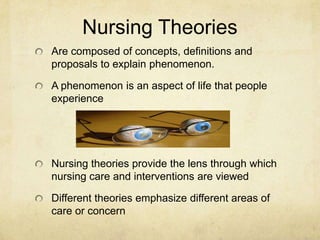
Nursing theories provide the lens through which
nursing care and interventions are viewed

Different theories emphasize different areas of
care or concern
Nursing Theories can be
    described as…
Descriptive: First level, describe phenomena

Prescriptive: Address nursing interventions

Mid-Range: Limited, less abstract, reflect a wide
variety of nursing situations

Grand: Broad, complex, addresses nursing
framework not specific interventions
Common Nursing Theories
 Nightingale (1860) fresh air, light, cleanliness, quiet
 and proper nutrition

 Peplau (1952) Interpersonal Relations Theory,
 mutual goal setting

 Virginia Avenal Henderson (1955) 14 basic human
 needs.

 Martha Rogers Science of Unitary Human Beings
 (1970)

 Betty Neuman (1972) Systems Theory
Common Nursing Theories
   Orem’s Self Care Deficit Theory (1971)

   Leininger’s Culture Care Theory (1991)

   Sister Calista Roy’s Adaptation Theory focuses
   on helping the client adapt to health changes

   Watson’s Theory of Human Caring 1979


(Potter & Perry, 2009)
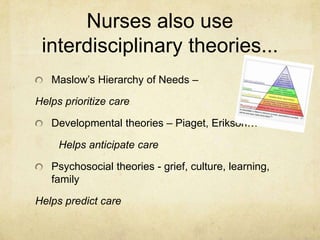
Nurses also use
 interdisciplinary theories...
   Maslow’s Hierarchy of Needs –

Helps prioritize care

   Developmental theories – Piaget, Erikson…

     Helps anticipate care

   Psychosocial theories - grief, culture, learning,
   family

Helps predict care
What’s the point?
Over the years nurses have attempted to define
nursing. From these efforts, numerous theories
have emerged. Many might consider these
theories rather dry material, and in all honesty,
this was probably my first conclusion as well. As I
studied nursing theorists, I felt confused by the
language. I was at a loss to see the purpose.
However, for any students grappling with these
same feelings, I would like to encourage you.
The more you study them, the more you
appreciate these nurses who spent a great deal
of time and effort defining our profession, for
ultimately this is what delineates a science.
Assessing Nursing
        Theories
Theory relevance can be assessed by applying
the theory to a patient care situation

The nursing paradigm of environment, health,
nursing care and person are examined
An example of a theorist’s paradigm.
Definitions of person, nurse, health and
               environment
   According to Myra Estrine Levine (Conservation Theory) :
     "From the moment of birth until the instant of death,
       every individual cherishes and defends his wholeness.
       "(Schaefer, Pond 1991, p. 17)

       Health represents the "unity and integrity of the
        patient." (George,p.185)

       "Nursing is a human interaction" based on the goal of
        promoting wholeness for that individual. (Schaefer,
        Pond, 1991,p. 23)

       A patient's environment is internal and external.
Nursing Interventions based on a
              nursing theory

   Myra Estrine Levine’s Conservation Theory views
    nursing care through the lens of conservation…


     1) The conservation of energy

     2) The conservation of structural integrity

     3) The conservation of personal integrity

     4) The conservation of social integrity


(George, 1990)
Research can test the application of
               Nursing Theory
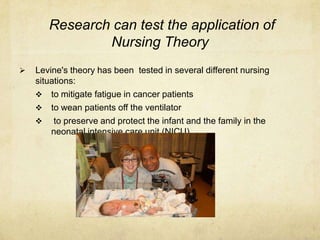
   Levine's theory has been tested in several different nursing
    situations:
     to mitigate fatigue in cancer patients
     to wean patients off the ventilator
     to preserve and protect the infant and the family in the
        neonatal intensive care unit (NICU).
ENVIRONMENTAL
                 INFLUENCES ON PRETERM INFANT

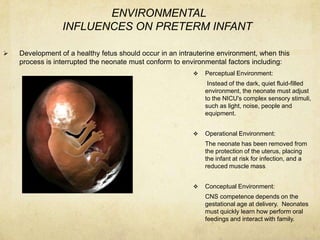
   Development of a healthy fetus should occur in an intrauterine environment, when this
    process is interrupted the neonate must conform to environmental factors including:
                                                             Perceptual Environment:
                                                               Instead of the dark, quiet fluid-filled
                                                              environment, the neonate must adjust
                                                              to the NICU's complex sensory stimuli,
                                                              such as light, noise, people and
                                                              equipment.


                                                             Operational Environment:
                                                              The neonate has been removed from
                                                              the protection of the uterus, placing
                                                              the infant at risk for infection, and a
                                                              reduced muscle mass


                                                             Conceptual Environment:
                                                              CNS competence depends on the
                                                              gestational age at delivery. Neonates
                                                              must quickly learn how perform oral
                                                              feedings and interact with family.
HEALTH (WHOLENESS)
       INFLUENCES ON PRETERM INFANTS

   Physiologic immaturity: Neonates must use energy adapt to
    underdeveloped respiratory, gastrointestinal, and central
    nervous systems.
   Structural immaturity: Neonates must confront increased
    risks of infections, toxic effects of oxygen administration,
    retinal detachment, GI disorders, brain injury,
    musculoskeletal abnormalities.
   Neurologic Immaturity: Sense of identity can be affected.
   Disruption in Family System: Challenges include grieving
    the loss of the healthy infant, disruption of bonding, parenting
    a special needs child, social identity.

(Mefford, 2004)
NURSING INFLUENCES
         PRETERM INFANTS
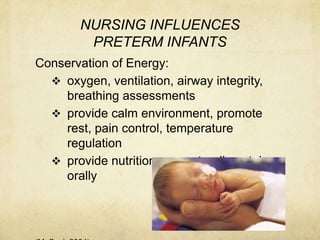
Conservation of Energy:
   oxygen, ventilation, airway integrity,
    breathing assessments
   provide calm environment, promote
    rest, pain control, temperature
    regulation
   provide nutrition: parenterally, g-tube,
    orally
NURSING INFLUENCES
             PRETERM INFANTS
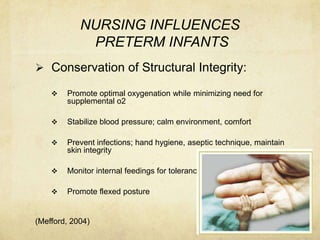
 Conservation of Structural Integrity:

       Promote optimal oxygenation while minimizing need for
        supplemental o2

       Stabilize blood pressure; calm environment, comfort

       Prevent infections; hand hygiene, aseptic technique, maintain
        skin integrity

       Monitor internal feedings for tolerance

       Promote flexed posture


(Mefford, 2004)
NURSING INFLUENCES
                 PRETERM INFANTS
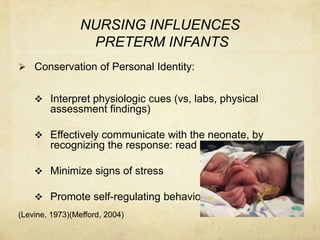
 Conservation of Personal Identity:


     Interpret physiologic cues (vs, labs, physical
        assessment findings)

     Effectively communicate with the neonate, by
        recognizing the response: read the message

     Minimize signs of stress

     Promote self-regulating behavior
(Levine, 1973)(Mefford, 2004)
NURSING INTERVENTIONS
                PRETERM INFANTS
 Conservation of Social Integrity:


    Modifying NICU to welcome families and promote
       parental comfort
      Assist parents through grief of loss of having a
       healthy infant
      Provide support to family to cope with NICU
       experience
      Foster parent-infant attachment
      Facilitate parent performance of infant care
      Ensure infant and family's readiness for discharge
       from the NICU
(Mefford, 2004)
Links to Nursing Theory
http://nursingclass2.wikispaces.com/Nursing+Th
eorists

http://currentnursing.com/nursing_theory/introduc
tion.html

http://nursing-theory.org/
Bibliography
Alligood, Martha; Ann Marriner-Tomey. (1997). Nursing Theory Utilization and Application. St. Louis: Mosby.

Ann Marriner Tomey, Martha Raile Alligood. (1998). Nursing Theorists and Their Work (4th ed.). (L. Wilson, Ed.) St Louis:
Mosby.


Delmore, B. A. (2006). Levine's Framework in Long-Term Ventilated Patients During the Weaning Course. Nursing
Science Quarterly , 19 (3), 247-258.


George, J. B. (Ed.). (1990). Nursing Theories: The Base for Professional Nursing Practice (3rd ed.). Norwalk, Connecticut:
Appleton and Lange.


Kathleen Sitzman, Lisa Wright Eichelberger. (2004). Understanding the Work of Nurse Theorists : A Creative Beginning.
Sudbury, Massachusetts: Jones and Bartlett Publishers, Inc.


Mefford, L. (2004). A Theory of Health Promotion for Preterm Infants Based on Levine's Conservation Model of Nursing.
Nursing Science Quarterly , 17 (3), 260-266.


Melanie McEwen, Evelyn M. Wills. (2007). Theoretical Basis for Nursing (2nd ed.). (H. Kogut, E. Kors, & M. Zuccarini,
Eds.) Philadelpia, PA: Lippincott Williams & Wilkins.

Myra Levine, Jacqueline Fawcett. (1991). Levine's Conservation Model: A Framework for nursing Practice. (K. M.
Schaefer, & J. B. Pond, Eds.) Philadelphia: F.A.Davis Company.


Victoria Mock, Christine St, Ours, Amy Bositis, Miriam Tillery, Anne Belcher, Sharon Krumm and Ruth McCorkle. (2007).
Using a conceptual model in nursing research - mitigating fatigue in cancer patients. Journal of Advanced Nursing , 58 (5),
503-512.

Uscu nursing theory what is it

  • 1.
    Nursing Theory What is it? Deanna B Hiott MSN,RN
  • 2.
    Nursing Domain A domainis a specific area of expert knowledge. Thedomain of nursing describes the profession’s subject, concepts, values, and beliefs. Nursing’s domain is the profession itself, past, present, future…
  • 3.
    The Nursing Paradigm… A paradigm is a model. It describes the domain using science, philosophy and theory. Nursing’s paradigm involves person, health, environment and nursing. Environment – setting affecting client, family, community Health – dynamic, changing, individual Nursing Care – treatment of human responses to illness Person – recipient of care, individual, family, community
  • 4.
    Nursing Theories Are composedof concepts, definitions and proposals to explain phenomenon. A phenomenon is an aspect of life that people experience Nursing theories provide the lens through which nursing care and interventions are viewed Different theories emphasize different areas of care or concern
  • 5.
    Nursing Theories canbe described as… Descriptive: First level, describe phenomena Prescriptive: Address nursing interventions Mid-Range: Limited, less abstract, reflect a wide variety of nursing situations Grand: Broad, complex, addresses nursing framework not specific interventions
  • 6.
    Common Nursing Theories Nightingale (1860) fresh air, light, cleanliness, quiet and proper nutrition Peplau (1952) Interpersonal Relations Theory, mutual goal setting Virginia Avenal Henderson (1955) 14 basic human needs. Martha Rogers Science of Unitary Human Beings (1970) Betty Neuman (1972) Systems Theory
  • 7.
    Common Nursing Theories Orem’s Self Care Deficit Theory (1971) Leininger’s Culture Care Theory (1991) Sister Calista Roy’s Adaptation Theory focuses on helping the client adapt to health changes Watson’s Theory of Human Caring 1979 (Potter & Perry, 2009)
  • 8.
    Nurses also use interdisciplinary theories... Maslow’s Hierarchy of Needs – Helps prioritize care Developmental theories – Piaget, Erikson… Helps anticipate care Psychosocial theories - grief, culture, learning, family Helps predict care
  • 9.
    What’s the point? Overthe years nurses have attempted to define nursing. From these efforts, numerous theories have emerged. Many might consider these theories rather dry material, and in all honesty, this was probably my first conclusion as well. As I studied nursing theorists, I felt confused by the language. I was at a loss to see the purpose. However, for any students grappling with these same feelings, I would like to encourage you. The more you study them, the more you appreciate these nurses who spent a great deal of time and effort defining our profession, for ultimately this is what delineates a science.
  • 10.
    Assessing Nursing Theories Theory relevance can be assessed by applying the theory to a patient care situation The nursing paradigm of environment, health, nursing care and person are examined
  • 11.
    An example ofa theorist’s paradigm. Definitions of person, nurse, health and environment  According to Myra Estrine Levine (Conservation Theory) :  "From the moment of birth until the instant of death, every individual cherishes and defends his wholeness. "(Schaefer, Pond 1991, p. 17)  Health represents the "unity and integrity of the patient." (George,p.185)  "Nursing is a human interaction" based on the goal of promoting wholeness for that individual. (Schaefer, Pond, 1991,p. 23)  A patient's environment is internal and external.
  • 12.
    Nursing Interventions basedon a nursing theory  Myra Estrine Levine’s Conservation Theory views nursing care through the lens of conservation…  1) The conservation of energy  2) The conservation of structural integrity  3) The conservation of personal integrity  4) The conservation of social integrity (George, 1990)
  • 13.
    Research can testthe application of Nursing Theory  Levine's theory has been tested in several different nursing situations:  to mitigate fatigue in cancer patients  to wean patients off the ventilator  to preserve and protect the infant and the family in the neonatal intensive care unit (NICU).
  • 14.
    ENVIRONMENTAL INFLUENCES ON PRETERM INFANT  Development of a healthy fetus should occur in an intrauterine environment, when this process is interrupted the neonate must conform to environmental factors including:  Perceptual Environment: Instead of the dark, quiet fluid-filled environment, the neonate must adjust to the NICU's complex sensory stimuli, such as light, noise, people and equipment.  Operational Environment: The neonate has been removed from the protection of the uterus, placing the infant at risk for infection, and a reduced muscle mass  Conceptual Environment: CNS competence depends on the gestational age at delivery. Neonates must quickly learn how perform oral feedings and interact with family.
  • 15.
    HEALTH (WHOLENESS) INFLUENCES ON PRETERM INFANTS  Physiologic immaturity: Neonates must use energy adapt to underdeveloped respiratory, gastrointestinal, and central nervous systems.  Structural immaturity: Neonates must confront increased risks of infections, toxic effects of oxygen administration, retinal detachment, GI disorders, brain injury, musculoskeletal abnormalities.  Neurologic Immaturity: Sense of identity can be affected.  Disruption in Family System: Challenges include grieving the loss of the healthy infant, disruption of bonding, parenting a special needs child, social identity. (Mefford, 2004)
  • 16.
    NURSING INFLUENCES PRETERM INFANTS Conservation of Energy:  oxygen, ventilation, airway integrity, breathing assessments  provide calm environment, promote rest, pain control, temperature regulation  provide nutrition: parenterally, g-tube, orally
  • 17.
    NURSING INFLUENCES PRETERM INFANTS  Conservation of Structural Integrity:  Promote optimal oxygenation while minimizing need for supplemental o2  Stabilize blood pressure; calm environment, comfort  Prevent infections; hand hygiene, aseptic technique, maintain skin integrity  Monitor internal feedings for tolerance  Promote flexed posture (Mefford, 2004)
  • 18.
    NURSING INFLUENCES PRETERM INFANTS  Conservation of Personal Identity:  Interpret physiologic cues (vs, labs, physical assessment findings)  Effectively communicate with the neonate, by recognizing the response: read the message  Minimize signs of stress  Promote self-regulating behavior (Levine, 1973)(Mefford, 2004)
  • 19.
    NURSING INTERVENTIONS PRETERM INFANTS  Conservation of Social Integrity:  Modifying NICU to welcome families and promote parental comfort  Assist parents through grief of loss of having a healthy infant  Provide support to family to cope with NICU experience  Foster parent-infant attachment  Facilitate parent performance of infant care  Ensure infant and family's readiness for discharge from the NICU (Mefford, 2004)
  • 20.
    Links to NursingTheory http://nursingclass2.wikispaces.com/Nursing+Th eorists http://currentnursing.com/nursing_theory/introduc tion.html http://nursing-theory.org/
  • 21.
    Bibliography Alligood, Martha; AnnMarriner-Tomey. (1997). Nursing Theory Utilization and Application. St. Louis: Mosby. Ann Marriner Tomey, Martha Raile Alligood. (1998). Nursing Theorists and Their Work (4th ed.). (L. Wilson, Ed.) St Louis: Mosby. Delmore, B. A. (2006). Levine's Framework in Long-Term Ventilated Patients During the Weaning Course. Nursing Science Quarterly , 19 (3), 247-258. George, J. B. (Ed.). (1990). Nursing Theories: The Base for Professional Nursing Practice (3rd ed.). Norwalk, Connecticut: Appleton and Lange. Kathleen Sitzman, Lisa Wright Eichelberger. (2004). Understanding the Work of Nurse Theorists : A Creative Beginning. Sudbury, Massachusetts: Jones and Bartlett Publishers, Inc. Mefford, L. (2004). A Theory of Health Promotion for Preterm Infants Based on Levine's Conservation Model of Nursing. Nursing Science Quarterly , 17 (3), 260-266. Melanie McEwen, Evelyn M. Wills. (2007). Theoretical Basis for Nursing (2nd ed.). (H. Kogut, E. Kors, & M. Zuccarini, Eds.) Philadelpia, PA: Lippincott Williams & Wilkins. Myra Levine, Jacqueline Fawcett. (1991). Levine's Conservation Model: A Framework for nursing Practice. (K. M. Schaefer, & J. B. Pond, Eds.) Philadelphia: F.A.Davis Company. Victoria Mock, Christine St, Ours, Amy Bositis, Miriam Tillery, Anne Belcher, Sharon Krumm and Ruth McCorkle. (2007). Using a conceptual model in nursing research - mitigating fatigue in cancer patients. Journal of Advanced Nursing , 58 (5), 503-512.