C.M PATEL COLLEGE OF
NURSING
GANDHINAGAR
SUBJECT:ADVANCE
NURSING PRACTICE
Martha Roger’s theory
Presentedby:
Ankita.M. Patel
First year M.sc Nursing
C.M.P College of Nursing
Introduction of theorist
• Born :May 12, 1914, Dallas, Texas, USA
• Diploma : Knoxville General Hospital School of Nursing(1936)
• Graduation in Public Health Nursing : George Peabody
College, 1937
• MA :Teachers college, Columbia university, New York, 1945
• MPH :Johns Hopkins University, Baltimore, 1952
• Doctorate in nursing :Johns Hopkins University,
Baltimore, 1954
• Position: Professor at Division of Nursing,
New York University and Consultant, Speaker
• Died : March 13 , 1994
Publications of Martha Rogers
• Theoretical basis of nursing (Rogers 1970)
• Nursing science and art :a prospective (Rogers
1988)
• Nursing :science of unitary, irreducible, human
beings (Rogers 1990)
• Vision of space based nursing (Rogers 1990)
Introduction of theory
• The belief of the coexistence of the human
and the environment has greatly influenced
the process of change toward better health.
• In short, a patient can’t be separated from his
or her environment when addressing health
and treatment.
• This view lead and opened Martha E. Rogers‘
theory, known as the “Science of Unitary
Human Beings,” which allowed nursing to be
considered one of the scientific disciplines
• Rogers repeatedly stated that she did not
create a "theory" but rather an abstract
system, a science, from which many theories
may be derived.
cont…
• The science of unitary human beings
comprises of five assumption, four major
concepts and three major principles
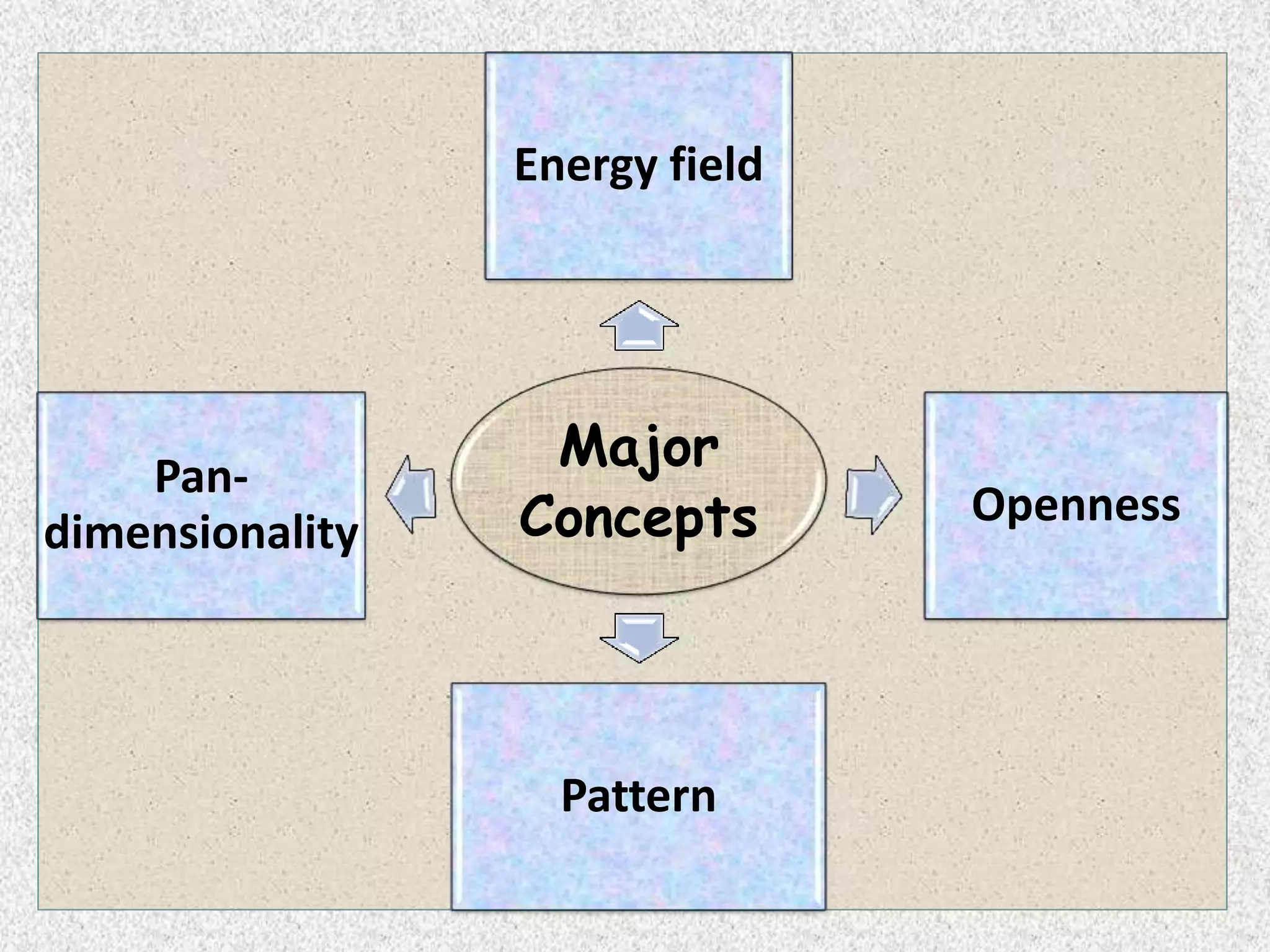
• Major concepts are : Energy field,
openness, pattern, and pan
dimensionality
• Major principles include resonancy ,
helicy and integrity. It is also known as
homeodynamic principles.
Assumptions
• Human being is considered as united
wholewholeness
• A person and his environment are
continuously exchanging energy with
each other
openness
• The life process of human being
evolves irreversibly and unidirectional
i.e from birth to death
Unidirectionality
• Pattern identifies individuals and
reflects their innovative wholeness.
Pattern and
organization
• Humans are the only organisms able
to think, imagine, have language and
emotions
Sentence and
thought
Major
Concepts
Energy field
Openness
Pattern
Pan-
dimensionality
Energy field
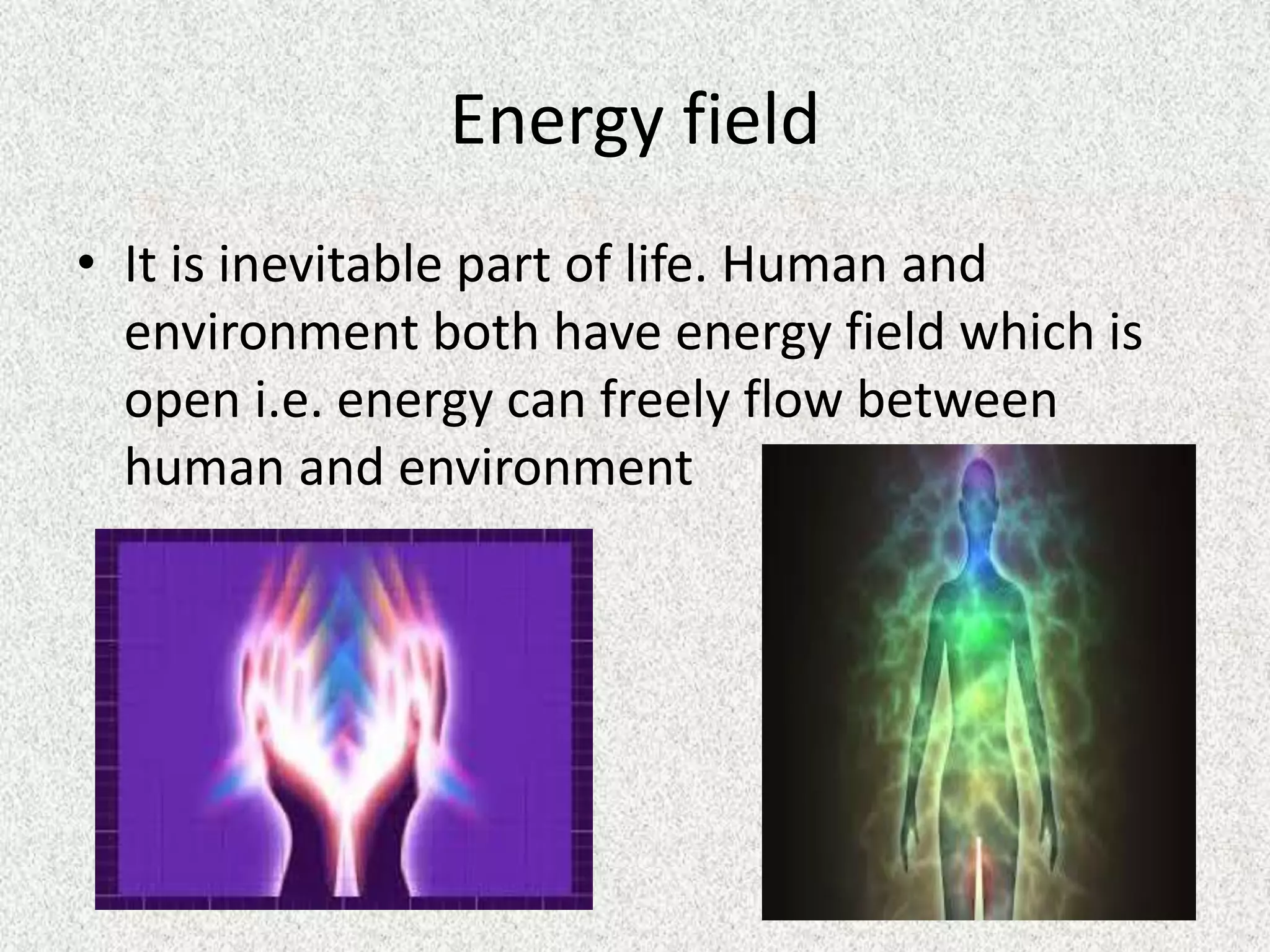
• It is inevitable part of life. Human and
environment both have energy field which is
open i.e. energy can freely flow between
human and environment
Openness
• There is no boundary or barrier that can
inhibit the flow of energy between human and
environment which leads to the continuous
movement or matter of energy.
Pattern
• Pattern is defined as the distinguishing
characteristic of an energy field perceived as a
single waves
• "pattern is an abstraction and it gives identity
to the field"
Pan dimensionality
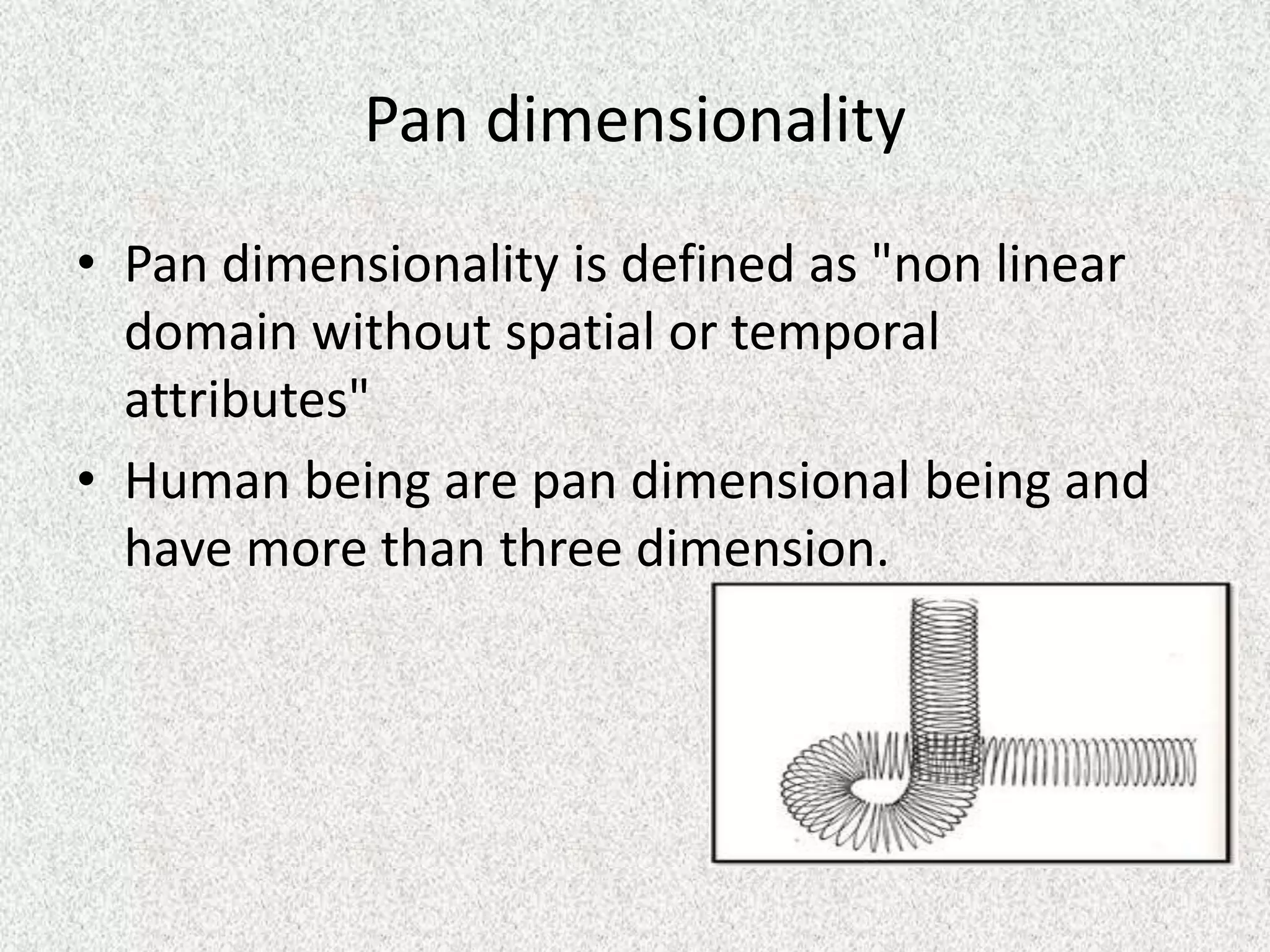
• Pan dimensionality is defined as "non linear
domain without spatial or temporal
attributes"
• Human being are pan dimensional being and
have more than three dimension.
Homeodynamic principles
• Homeodynamics refers to the balance
between the dynamic life process and
environment.
• These principles help to view human as
unitary human being.
• Three principle of homeodynamics
– Resonancy
– Helicy
– integrality
1. Resonancy
• Wave patterns are continuously changing in
environmental and human energy fields.
2. Helicy
• The nature of change is unpredictable,
continuous, and an innovative.
3. Integrality
• Energy fields of humans and environment are
in a continuous mutual process.
Roger’s theory and nursing
metaparadigm
Person
Environment
Health
Nursing
1. Unitary Human Being (person)
• A unitary human being is open systems which
continuously interact with environment. A
person cannot be viewed as parts, it should be
considered as a whole.
2. Environment
• It includes the entire energy field other than a
person.
• These energy fields are irreducible, not limited
by space and time, identified by its pattern
and organization.
3. Health
• Not clearly defined by Rogers. It is determined by
the interaction between energy fields i.e. human
and environments.
• Bad interaction or misplacing of energy leads to
illness.
4. Nursing
• Nursing exists to serve people.
• Nursing is both science and art.
• It is the direct and overriding responsibility to the
society
Application of Roger’s theory in
nursing
Clinical
Practice
Nursing
education
Research
Clinical practice
• Nursing action is always focused on unitary
human being and change the energy field
between human and environment.
• Nursing action include all non-invasive actions
such as guided imaginary, humor, therapeutic
touch, music etc. which are used to increase the
potential of human field.
• The more importance should be on the
management of pain, supportive therapy and
rehabilitation.
• Example in nursing care plan:
• Ritu 22 years old female was admitted in
psychiatric hospital with severe depression
secondary to diagnosis of ovarian malignancy.
She became tearfull while history taking. Ritu was
accompanied by her husband and 1 year old
child. Her husband appear anxious but
supportive. Ritu was diagnosed with ovarian
cancer 2 month ago and underwent surgery for
same. From past three week ritu started sitting
alone, decreased activity of daily living, repeated
crying spells, decreased talk, decreased sleep,
neglecting her child care, and also attempted
suicide.
Nursing education
• Emphasis should be given on the
understanding of the patient and self, energy
field and environment.
• Example :
Training should lay more focus on teaching
non-invasive modalities such as therapeutic
touch, meditation, humor, regular in service
education programme etc.
Research
• Rogerian theory has been used in many research
works and has always found testable and
applicable in research.
• Example:-
A study to assess the effectiveness of music
therapy on stress reduction among
postmenopausal women residing in Hudco
Colony, Coimbatore
• A Study to Assess the Effectiveness of Yoga
Therapy in Reducing Stress among Primary
Care Givers of Psychiatric Patients.
Strengths
• Rogers’ concepts provide a worldview from
which nurses may derive theories and
hypotheses and propose relationships specific
to different situations.
• Rogers’ theory is not directly testable due to
lack of concrete hypotheses, but it is testable
in principle.
Weaknesses
• Overall this theory is considered as very complex
concept and quite difficult to understand.
• Rogers’ model does not define particular hypotheses or
theories for it is an abstract, unified, and highly derived
framework.
• Testing the concepts’ validity is questionable because
its concepts are not directly measurable.
• The theory was believed to be profound, and was too
ambitious because the concepts are extremely
abstract.
• Rogers claimed that nursing exists to serve people;
however, nurses’ roles were not clearly defined.
Summary and Conclusion
• The Science of Unitary Human Beings is highly
generalizable as the concepts and ideas are not
confined with a specific nursing approach unlike the
usual way of other nurse theorists in defining the
major concepts of a theory.
• Rogers gave much emphasis on how a nurse should
view the patient. She developed principles which
emphasizes that a nurse should view the client as a
whole.
• Her statements, in general, made us believe that a
person and his or her environment are integral to each
other. That is, a patient can’t be separated from his or
her environment when addressing health and
treatment.
• Bibliography:
1. Basavanthappa BT : “ NURSING THEORIES” ; 1ST Edition 2007 ; Jaypee
brother publication ; New delhi. Page no : 273-285
2. Navdeep kaur brar, “ ADVANCE NURSING PRACTICE”; 1st edition,
2015; jaypee brother publications, new delhi; p.p-615 - 623.
3. Potter and perry : “ FUNDAMENTAL OF NURSING”; 7TH edition;
Elsevier publication, Nodia. Page no: 66-68.
4. Samta soni, “ TEXTBOOK OF ADVANCED NURSING PRACTICE”; 1st
edition, 2013; Jaypee publications, new delhi.p.p – 277-285
5. Taylor carol : “ FUNDAMENTAL OF NURSING” ; 5TH edition RP 2006 ;
published by wolters kluwer health pvt Ltd , New delhi. Page no:
77- 81.
• Websites :
– https://en.wikipedia.org/wiki/Martha_E._Rogers
– nurseslabs.com/martha-e-rogers-theory-unitary-
human-beings
– www.nursing-theory.org/theories-and.../roger-
theory-of-unitary-human-beings.php
– nursingtheories.weebly.com/martha-rogers.html
– nsq.sagepub.com/content/1/2/50.refs
– https://www.youtube.com/watch?v=jAUyDMIhjyg
– martharogerstheory.blogspot.com/2012/03/mart
ha-e-rogers-science-of-unitary.html
Martha rogers theory

Martha rogers theory

  • 1.
    C.M PATEL COLLEGEOF NURSING GANDHINAGAR SUBJECT:ADVANCE NURSING PRACTICE
  • 2.
    Martha Roger’s theory Presentedby: Ankita.M.Patel First year M.sc Nursing C.M.P College of Nursing
  • 3.
    Introduction of theorist •Born :May 12, 1914, Dallas, Texas, USA • Diploma : Knoxville General Hospital School of Nursing(1936) • Graduation in Public Health Nursing : George Peabody College, 1937 • MA :Teachers college, Columbia university, New York, 1945 • MPH :Johns Hopkins University, Baltimore, 1952 • Doctorate in nursing :Johns Hopkins University, Baltimore, 1954 • Position: Professor at Division of Nursing, New York University and Consultant, Speaker • Died : March 13 , 1994
  • 4.
    Publications of MarthaRogers • Theoretical basis of nursing (Rogers 1970) • Nursing science and art :a prospective (Rogers 1988) • Nursing :science of unitary, irreducible, human beings (Rogers 1990) • Vision of space based nursing (Rogers 1990)
  • 5.
    Introduction of theory •The belief of the coexistence of the human and the environment has greatly influenced the process of change toward better health. • In short, a patient can’t be separated from his or her environment when addressing health and treatment.
  • 6.
    • This viewlead and opened Martha E. Rogers‘ theory, known as the “Science of Unitary Human Beings,” which allowed nursing to be considered one of the scientific disciplines • Rogers repeatedly stated that she did not create a "theory" but rather an abstract system, a science, from which many theories may be derived.
  • 7.
    cont… • The scienceof unitary human beings comprises of five assumption, four major concepts and three major principles • Major concepts are : Energy field, openness, pattern, and pan dimensionality • Major principles include resonancy , helicy and integrity. It is also known as homeodynamic principles.
  • 8.
    Assumptions • Human beingis considered as united wholewholeness • A person and his environment are continuously exchanging energy with each other openness • The life process of human being evolves irreversibly and unidirectional i.e from birth to death Unidirectionality • Pattern identifies individuals and reflects their innovative wholeness. Pattern and organization • Humans are the only organisms able to think, imagine, have language and emotions Sentence and thought
  • 9.
  • 10.
    Energy field • Itis inevitable part of life. Human and environment both have energy field which is open i.e. energy can freely flow between human and environment
  • 11.
    Openness • There isno boundary or barrier that can inhibit the flow of energy between human and environment which leads to the continuous movement or matter of energy.
  • 12.
    Pattern • Pattern isdefined as the distinguishing characteristic of an energy field perceived as a single waves • "pattern is an abstraction and it gives identity to the field"
  • 13.
    Pan dimensionality • Pandimensionality is defined as "non linear domain without spatial or temporal attributes" • Human being are pan dimensional being and have more than three dimension.
  • 14.
    Homeodynamic principles • Homeodynamicsrefers to the balance between the dynamic life process and environment. • These principles help to view human as unitary human being. • Three principle of homeodynamics – Resonancy – Helicy – integrality
  • 15.
    1. Resonancy • Wavepatterns are continuously changing in environmental and human energy fields. 2. Helicy • The nature of change is unpredictable, continuous, and an innovative. 3. Integrality • Energy fields of humans and environment are in a continuous mutual process.
  • 16.
    Roger’s theory andnursing metaparadigm Person Environment Health Nursing
  • 17.
    1. Unitary HumanBeing (person) • A unitary human being is open systems which continuously interact with environment. A person cannot be viewed as parts, it should be considered as a whole. 2. Environment • It includes the entire energy field other than a person. • These energy fields are irreducible, not limited by space and time, identified by its pattern and organization.
  • 18.
    3. Health • Notclearly defined by Rogers. It is determined by the interaction between energy fields i.e. human and environments. • Bad interaction or misplacing of energy leads to illness. 4. Nursing • Nursing exists to serve people. • Nursing is both science and art. • It is the direct and overriding responsibility to the society
  • 19.
    Application of Roger’stheory in nursing Clinical Practice Nursing education Research
  • 20.
    Clinical practice • Nursingaction is always focused on unitary human being and change the energy field between human and environment. • Nursing action include all non-invasive actions such as guided imaginary, humor, therapeutic touch, music etc. which are used to increase the potential of human field. • The more importance should be on the management of pain, supportive therapy and rehabilitation.
  • 21.
    • Example innursing care plan: • Ritu 22 years old female was admitted in psychiatric hospital with severe depression secondary to diagnosis of ovarian malignancy. She became tearfull while history taking. Ritu was accompanied by her husband and 1 year old child. Her husband appear anxious but supportive. Ritu was diagnosed with ovarian cancer 2 month ago and underwent surgery for same. From past three week ritu started sitting alone, decreased activity of daily living, repeated crying spells, decreased talk, decreased sleep, neglecting her child care, and also attempted suicide.
  • 22.
    Nursing education • Emphasisshould be given on the understanding of the patient and self, energy field and environment. • Example : Training should lay more focus on teaching non-invasive modalities such as therapeutic touch, meditation, humor, regular in service education programme etc.
  • 23.
    Research • Rogerian theoryhas been used in many research works and has always found testable and applicable in research. • Example:- A study to assess the effectiveness of music therapy on stress reduction among postmenopausal women residing in Hudco Colony, Coimbatore
  • 24.
    • A Studyto Assess the Effectiveness of Yoga Therapy in Reducing Stress among Primary Care Givers of Psychiatric Patients.
  • 25.
    Strengths • Rogers’ conceptsprovide a worldview from which nurses may derive theories and hypotheses and propose relationships specific to different situations. • Rogers’ theory is not directly testable due to lack of concrete hypotheses, but it is testable in principle.
  • 26.
    Weaknesses • Overall thistheory is considered as very complex concept and quite difficult to understand. • Rogers’ model does not define particular hypotheses or theories for it is an abstract, unified, and highly derived framework. • Testing the concepts’ validity is questionable because its concepts are not directly measurable. • The theory was believed to be profound, and was too ambitious because the concepts are extremely abstract. • Rogers claimed that nursing exists to serve people; however, nurses’ roles were not clearly defined.
  • 27.
    Summary and Conclusion •The Science of Unitary Human Beings is highly generalizable as the concepts and ideas are not confined with a specific nursing approach unlike the usual way of other nurse theorists in defining the major concepts of a theory. • Rogers gave much emphasis on how a nurse should view the patient. She developed principles which emphasizes that a nurse should view the client as a whole. • Her statements, in general, made us believe that a person and his or her environment are integral to each other. That is, a patient can’t be separated from his or her environment when addressing health and treatment.
  • 28.
    • Bibliography: 1. BasavanthappaBT : “ NURSING THEORIES” ; 1ST Edition 2007 ; Jaypee brother publication ; New delhi. Page no : 273-285 2. Navdeep kaur brar, “ ADVANCE NURSING PRACTICE”; 1st edition, 2015; jaypee brother publications, new delhi; p.p-615 - 623. 3. Potter and perry : “ FUNDAMENTAL OF NURSING”; 7TH edition; Elsevier publication, Nodia. Page no: 66-68. 4. Samta soni, “ TEXTBOOK OF ADVANCED NURSING PRACTICE”; 1st edition, 2013; Jaypee publications, new delhi.p.p – 277-285 5. Taylor carol : “ FUNDAMENTAL OF NURSING” ; 5TH edition RP 2006 ; published by wolters kluwer health pvt Ltd , New delhi. Page no: 77- 81.
  • 29.
    • Websites : –https://en.wikipedia.org/wiki/Martha_E._Rogers – nurseslabs.com/martha-e-rogers-theory-unitary- human-beings – www.nursing-theory.org/theories-and.../roger- theory-of-unitary-human-beings.php – nursingtheories.weebly.com/martha-rogers.html – nsq.sagepub.com/content/1/2/50.refs – https://www.youtube.com/watch?v=jAUyDMIhjyg – martharogerstheory.blogspot.com/2012/03/mart ha-e-rogers-science-of-unitary.html