THEORIES,MODELS,AND
APPROACHESAPPLIEDTO
MIDWIFERYPRACTICE
 PRESENTED BY-
Ms. Sweta K. Gaude
M.Sc.(N) 1st year
SDM INS
THEORIES
•KING THEORY
• LYDIA ELOISE HALL: Care, Core and Cure
• MATERNAL ROLE ATTAINMENT THEORY
• CALLISTA ROY; ADAPTATIONTHEORY
• JEAN WATSON: THEORY OF CARING
1.KINGTHEORY
INTRODUCTION:
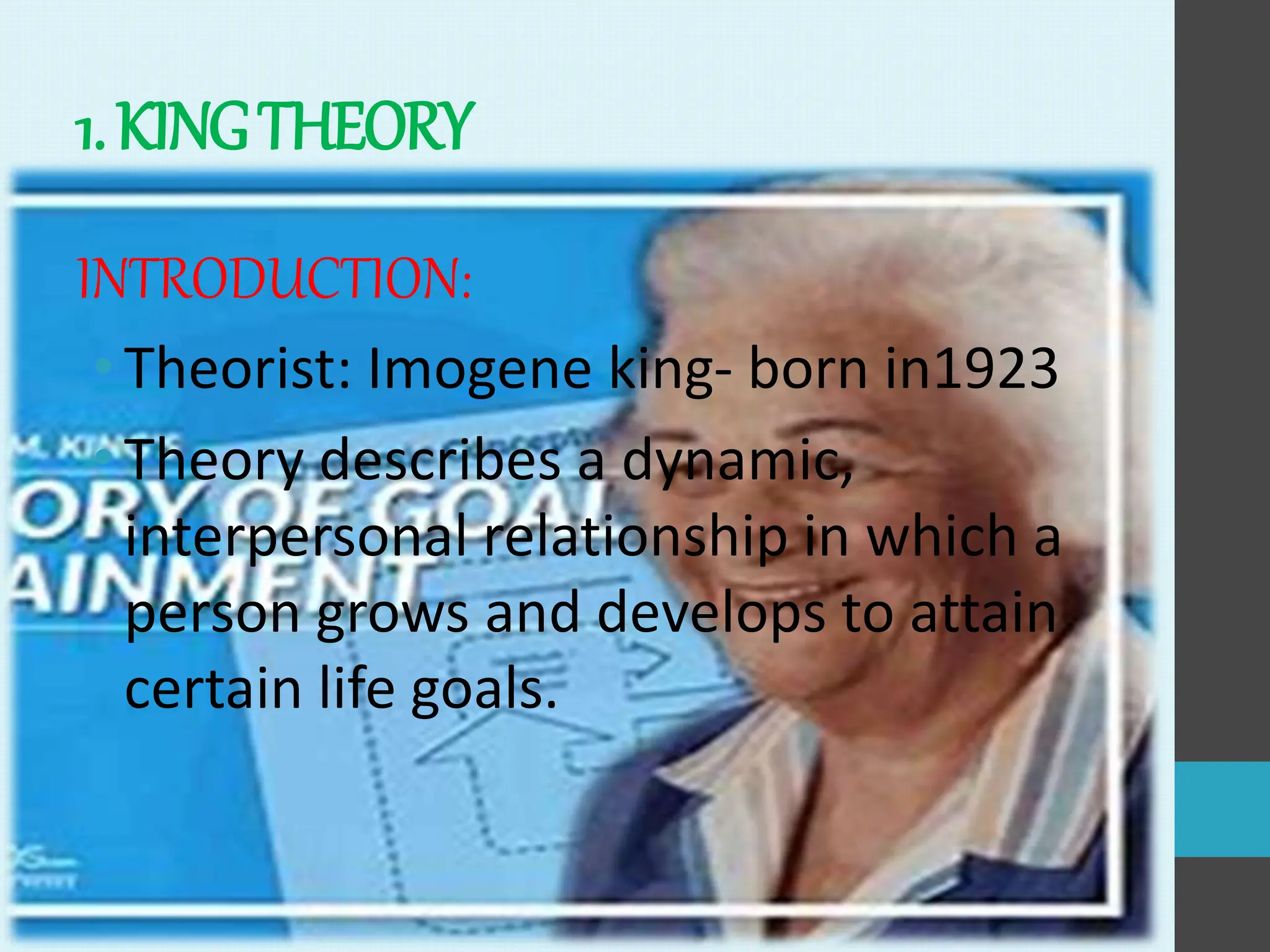
•Theorist: Imogene king- born in1923
•Theory describes a dynamic,
interpersonal relationship in which a
person grows and develops to attain
certain life goals.
BASIC ASSUMPTIONS
• Nursing focus is the human being.
• Nursing goal is the health care of individual & groups
• Human beings: are open systems interacting constantly with their
environment.
• Basic assumption of goal attainment theory is that nurse & client
communicate information, set goal mutually & then act to attain
those goal, is also the basic assumption of nursing process.
• “Each human being perceives the world as a total person in making
transactions with individuals & things in environment”.
• “Transaction represents a life situation in which perceiver & thing
perceived are encountered & in which person enters the situation
as an active participant & each is changed in the process of these
experiences”.
Proposition’s Of King’s Theory
1) If perceptual interaction accuracy is present in nurse-client
interactions, transaction will occur.
2) If nurse & client make transaction, goal will be attained
3) If goal are attained, satisfaction will occur.
4) If transactions are made in nurse-client interactions, growth &
development will be enhanced.
5) If role expectations & role performance as perceived by nurse &
client are congruent, transaction will occur.
6) If role conflict is experienced by nurse or client or both, stress in
nurse-client interaction will occur.
7) If nurse with special knowledge skill communicate appropriate
information to client, mutual goal setting & goal attainment will
occur.
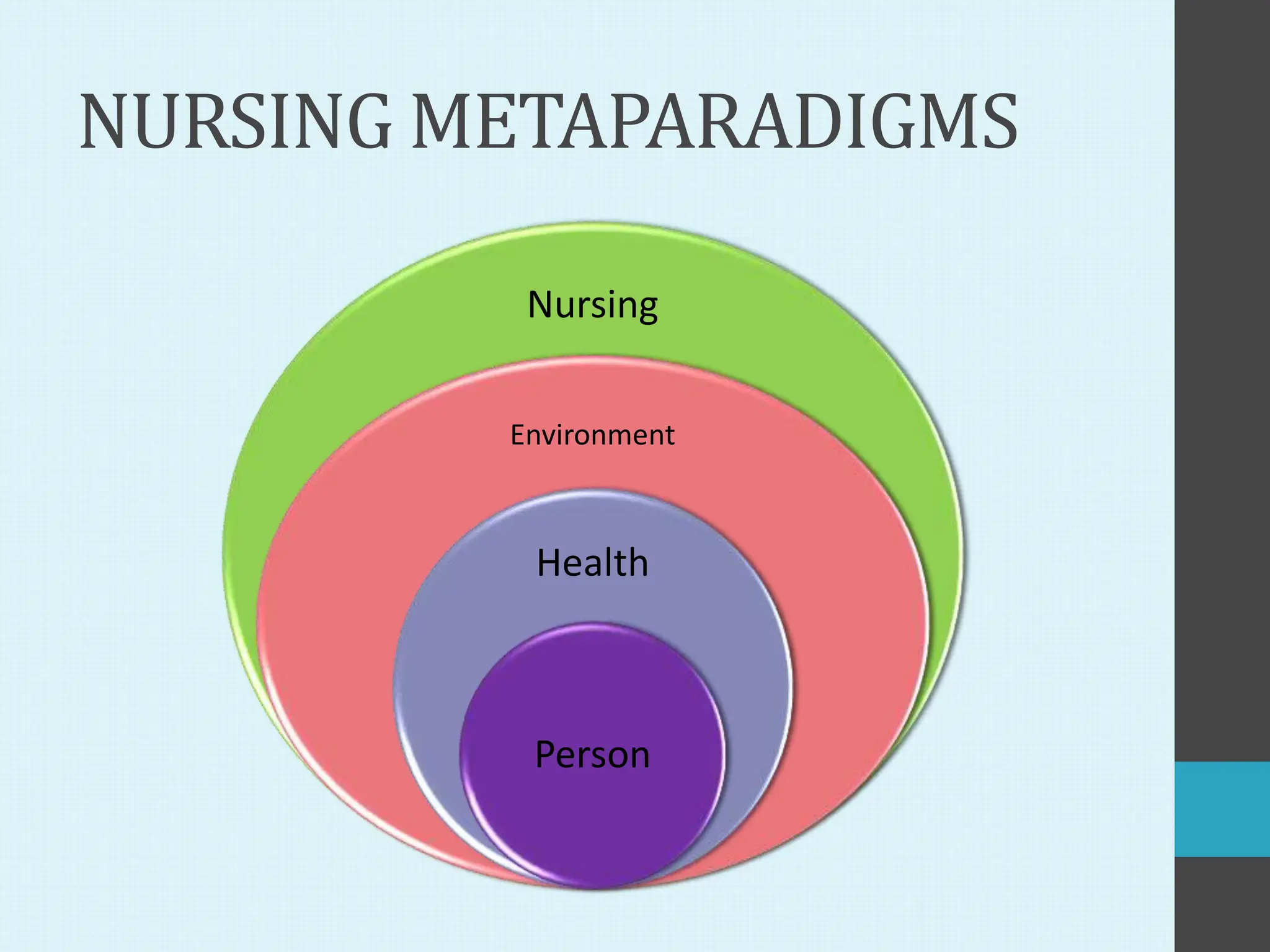
NURSING METAPARADIGMS
Nursing
Environment
Health
Person
1. Human Being/Person
Human being or person refers to social being are rational and sentient.
Person has ability to:
• Perceive
• Think
• Feel
• Choose
• Set goals
• Select means to achieve goals &
• To make decision
Human being has three fundamental needs:
• The need for the health information that is unable at the time when it is
needed & can be used.
• The need for care that seek to prevent illness, &
• The need for care when human beings are unable to help themselves.
2. Health
• Health involves dynamic life experiences of a human being,
which implies continuous adjustment to stressors in the
internal & external environment through optimum use of
one’s resources to achieve maximum potential for daily living.
3. Environment
Environment is the background for
human interactions.
It involves:
Internal environment: transforms
energy to enable person to adjust
to continuous external
environmental changes.
External environment: involves
formal & informal organizations.
Nurse is a part of the patients
environment.
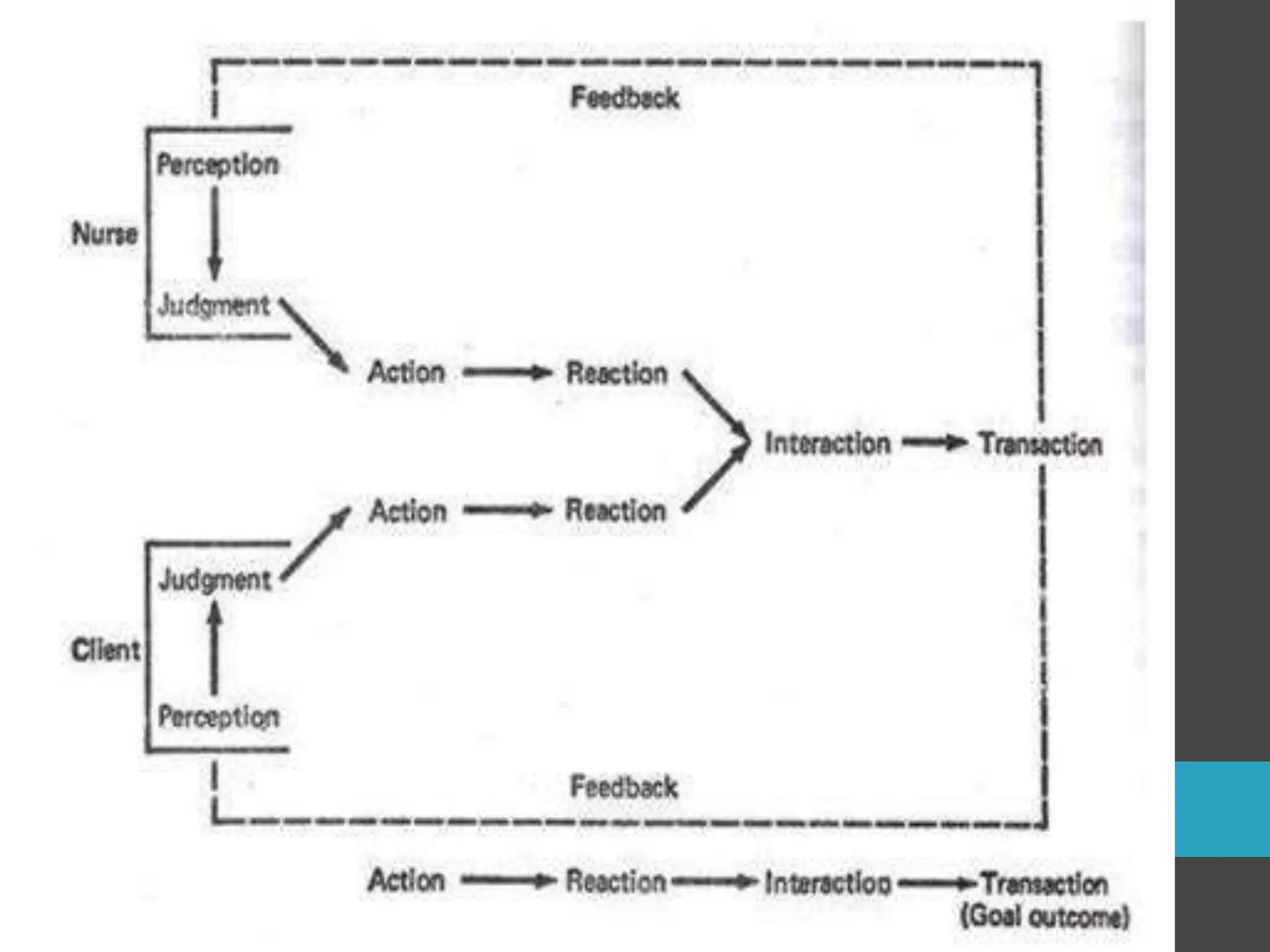
4. Nursing
• Definition:
- “A process of action & interaction by which nurse & client
share information about their perception in nursing situation.” &
“a process of human interactions between nurse & client
whereby each perceives the other & the situation, & through
communication, they set goals, explore means, and agree on
means to achieve goals”.
• Action: Is defined as a sequence of behaviors involving mental and
physical action.
• Reaction: Which is considered as included in the sequence of behaviors
described in action.
• In addition, king discussed:
a) goal
b) Domain &
c) Functions of professional nurse
• Goal of Nurse: “To help individuals to maintain their health so they can
function in their roles”.
• Domain of Nurse: “Includes promoting, maintaining, & restoring health, &
caring for the sick, injured & dying.
• Function of professional nurse: “To interpret information in nursing
process to plan, implement & evaluate nursing care.
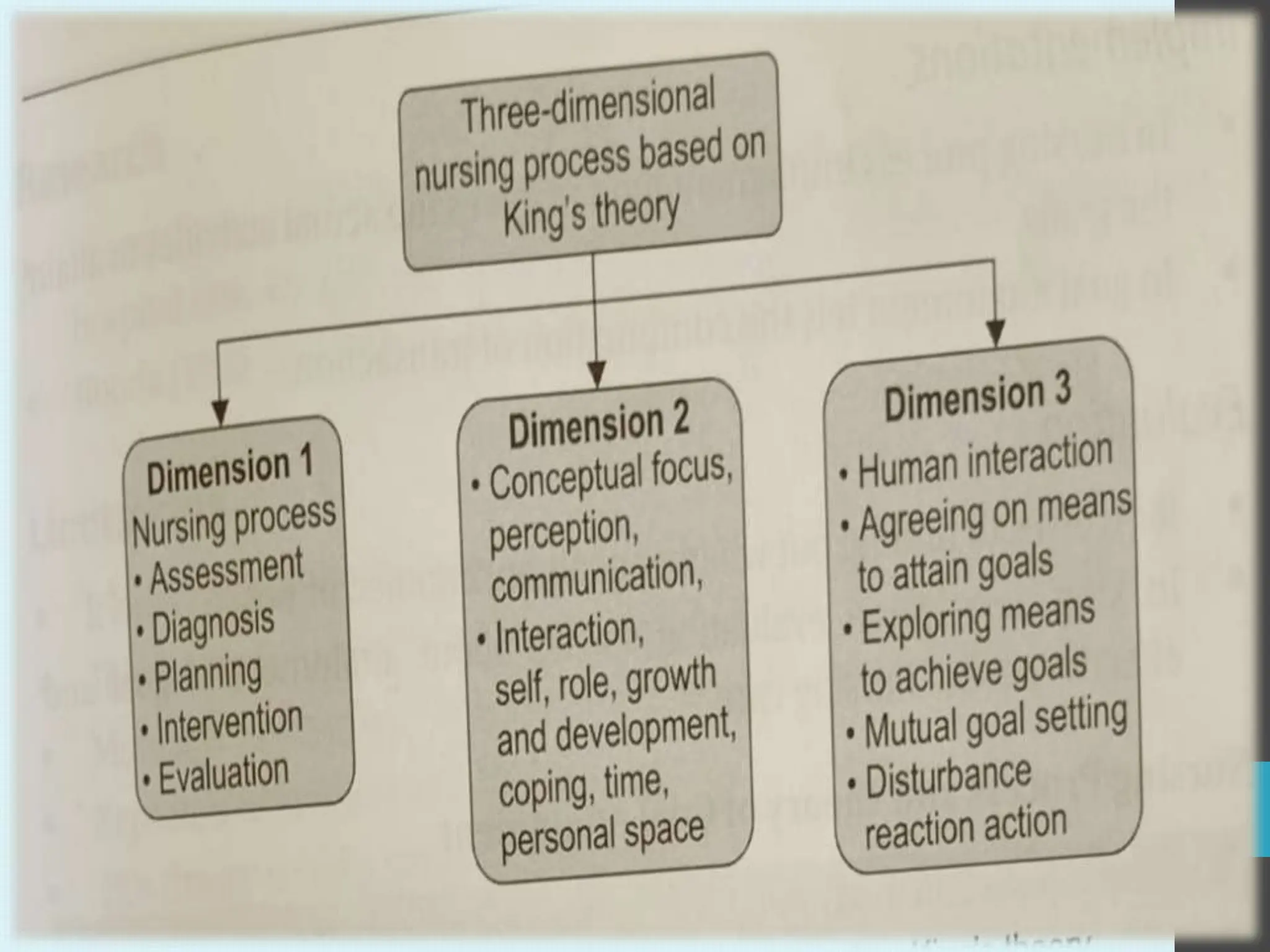
THEORY OF GOAL ATTAINTMENT
AND NURSING PROCESS
ASSESS
MENT
NURSING
DIAGNOSI
S
PLANNI
NG
IMPLEME
NTATION
EVALUATI
ON
ASSESSMENT
• Assessment occur during interaction.
• The nurse brings special knowledge & skills whereas client
brings knowledge of self & perception of problems of concern,
to this interaction.
• During assessment nurse collects data regarding client (his/her
growth & development, perception of self & current health
status, roles etc.)
• Perception is the base for collection & interaction of data.
• Communication is required to verify accuracy of perception,
for interaction & transaction.
NURSING DIAGNOSIS
• The data collected by assessment are used to make nursing
diagnosis in nursing process.
• In process of attaining goal the nurse identifies the problems,
concerns & disturbances about which person seek help.
PLANNING
• After diagnosis, planning for interventions to solve those
problems is done.
• In goal attainment planning is represented by setting goals &
making decisions about & being agreed on the means to
achieve goals.
• This part of transaction & client’s participation is encouraged
in making decision on the means to achieve the goals.
IMPLEMENTATION
• In nursing process implementation involves the actual
activities to achieve the goals.
• In goal attainment it is the continuation of transaction.
EVALUATION
• It involves to finding out whether goals are achieved or not.
• In king description evaluation speaks about attainment of goal
& effectiveness of nursing care.
Nursing Process And Theory Of
Goal Attainment
Nursing Process Method Nursing Process Theory
A system of oriented actions A system of oriented concepts
Assessment Perception, communication and
interaction of nurse & client.
Planning Decision making about the goals. Be
agree on the means to attain the goals.
Implementation Transaction made
Evaluation Goal attained
MATERNALROLEATTAINMENTTHEORY
Introduction
Born in 1929
Mercer began her nursing career in 1950 & she graduated from St.
Margaret’s school of nursing, Montgomery, alabama.
For the next 10 years she worked as a & instructor in pediatric &
obstetrical nursing in addition to the field of contagious diseases
(Meighan, 2010).
Her early nursing experience molded her interests toward pediatric
& obstetrics. Returned to school in 1960 & earned her master’s
degree specializing in maternal-child nursing at the University of
New Mexico in 1964 (Meighan, 2010).
• She continued pursuing her passion for maternity nursing &
completed her Ph.D. at the University of Pittsburgh in 1973.
• Dr. Mercer then moved to California & worked as a nursing
professor at the University of California until she retired in 1987.
• Even in her retirement, she still continues to revise & clarify her
work because she believes that “theory building is a continual
process” (Mercer, 2004).
• Ramona Mercer’s early work in the 1970’s was focused on the
1. Needs of breastfeeding mothers
2. Teenage mothers
3. Postpartum illness
4. Mothers bearing children with defects.
• She had also a deep interest in the development of the
1) Maternal role
2) Self-esteem
3) Self-concept of mothers
• During the span of Mercer’s career, her work expanded further in
the area of maternal-child nursing.
• Ramon Mercer’s early work in the 1970’s was focused on the
1) Needs of breastfeeding mothers
2) Teenage mothers
3) Postpartum illness
4) Mothers bearing children with defects.
 She had also a deep interest in the development of the
1) Maternal role
2) Self-esteem
3) Self-concept of mothers
• During the span of Mercer’s career, her work expanded further in
the area of maternal-child nursing.
MATERNALROLEATTAINMENTTHEORY
Defined as an interaction & developmental process occurring
over time, in which the mother becomes attached to her
infant, acquires competence in the care-taking tasks involved
in the role, & expresses pleasure & gratification in the role.
OR
Maternal role attainment is also as defined a process of
binding in or being attached to the child & maternal role
identity or seeing oneself in the role & having a sense of
comfort about it.
FACTORS THAT DIRECTLY OR
INDIRECTLY INFLUENCE ON THE
MATERNAL ROLE
The Maternal Factors includes:
• Age at first birth
• Birth experience
• Early separation from the infant
• Social stress
• Social support personality traits, self-concept
• Child-rearing attitudes
• Health
She also include the INFANT VARIABLES:
• Temperature
• Appearance
• Responsiveness
• Health status, & ability to give cues.
She also noted the importance of the father’s role, the mother-
father relationship.
She also noted the importance of the father’s role & applied many
of her previous findings in studying the paternal response to
parenthood.
CONCEPTS
1) Maternal identity:
 Maternal identity is defined as having an internalized view of
the self as a mother (Mercer, 1995).
2) PERCEPTION OF BIRTH EXPERIENCE:
• A woman’s perception of her performance during labor &
birth is her perception of the birth experience (Mercer, 1990).
3) SELF-ESTEEM:
• Mercer, May, Ferketich & Dejoseph (1986) describe self-esteem as “
an individual’s perception of how others view one & self-
acceptance of the perception”.
4) SELF-CONCEPT (SELF-REGARD):
• Mercer (1986) outlines self-concept, or self-regard,, as “The overall
perception of self that includes self-satisfaction, self-acceptance,
self-esteem, & congruence or discrepancy between self & ideal
self”.
5) FLEXIBILITY:
• Roles are not rigidly fixed; therefore, who fills the roles is not
important (Mercer, 1990). “Flexibility of children attitudes increases
with increased development.., Older mothers have infants & to
view each situation in respect to the unique nuances”.
6) CHILDREARING ATTITUDES:
• Childrearing attitudes are material attitudes or beliefs about
childrearing.
7) HEALTH STATUS:
• Health status is defined as “The mother’s & father’s perception of
their prior health, current health, health outlook, resistance-
susceptibility to illness, health worry concern, sickness orientation,
& rejection of the sick role”.
8) ANXIETY:
• According to Mercer and colleagues (1986), describe anxiety as “a
trait in which there is specific proneness to perceive stressful
situation-specific state”.
9) DEPRESSION:
• According to Merce & collegues (1986), depression is “having a
group of depression symptoms & in particular the effective
component of the depressed mood”.
10) ROLE STRAIN-ROLE CONFLICT:
• Role strain is the conflict and difficulty felt by the women in fulfilling
the maternal role obligation.
11) GRATIFICATION-SATISFACTION:
• Mercer describes gratification as “the satisfaction, enjoyment,
reward, or pleasure that a women experiences in interacting with
her infant & in fulfilling the usual tasks inherent in mothering”.
12) ATTACHMENT:
• Attachment versus a difficult temperament is related to whether
the infant sends hard-to –read cues, leading to feelings of
incompetence & frustration in the process.
13) INFANT HEALTH STATUS:
• Infant health status is illness causing maternal infant separation,
interfering with the attachment process.
14) INFANT CHARACTERISTICS:
• Characteristics include infant temperament, appearance, & health
status.
15) INFANT CUES:
• Infant cues are infant behaviors that elicit a response from the
mother.
16) FAMILY:
• Mercer & colleagues define family as “a dynamic system which
includes subsystems-in-individuals (mother, father, fetus/infant) &
dyads (mother-father, mother-fetus/infants, & father fetus/infant)
within the overall family system.
17) FATHER OR INTIMATE PARTNER:
• The father or intimate partner contributes to the process of
maternal role attainment in a way that cannot be duplicated by any
other person. The father’s interactions help diffuse tension &
facilitate maternal role attainment.
18) FAMILY FUNCTIONING:
• Family functioning is the individual’s view of the activities &
relationships between the family & its subsystems & broader social
units.
19) STRESS:
• Stress is made up of positively & negatively perceived life events &
environmental variables.
20) MOTHER FATHER RELATIONSHIP:
• The mother-father relationship is the perception of the mate
relationship that includes intended & actual values, goals, &
agreement between the two. The maternal attachment to the
infant develops within the emotional held of the parent’s
relationship.
21) SOCIAL SUPPORT:
• According to Mercer & colleagues, social support is “the amount of
help actually received, satisfaction with that help, & the persons
(network) providing that help”.
• Four area of social support as follows:
 Emotional support: “Feeling loved, cared for, trusted, &
understood”.
Informational support: Helps the individual help herself by
providing information that is useful in dealing with the problem
&/or situation.
Physical support: A direct kind of help.
Appraisal support: A support that tells the role taker how she is
performing in the role; it enables the individual to evaluate herself
in relationship to others “performance in the role”.
ASSUMPTIONS
A relatively, stable core self, acquired through lifelong socialization,
determines how a mother defines & perceive events; her
perceptions of her infant’s & others responses to her mothering ,
with her life situation, are real world to which she responds.
In addition to the mother’s socialization, her developmental level &
characteristics also influence her behavioral responses.
The mother’s role partner, her infant, will reflect the mother’s
competence in the mothering role through growth & development.
The infant considered an active partner in maternal role-taking
process, affecting & being affected by the role enactment.
The father or mother’s intimate partner contributes to role
attainment in a that cannot be duplicated by any other supportive
person.
Maternal identity develops concurrently with maternal attachment
& each depends on one other.
METAPARADIGM
NURSING:
Mercer stated that, “Nurses are the health professionals
having the most sustained & intense interaction with women
in the maternity cycle. She emphasizes that the kind of a
woman receives during pregnancy & over the first year
following birth can have a lifelong term effects for her & her
child.
PERSON:
She refers the person as self or core self, view the self as separate
from the roles that are played. The mother interacts with her infant
& with the father or her significant other; influential & is influential
& is influenced by both of them.
HEALTH:
She defines health status as the mothers & father’s perception of
their prior health, current health, health outlook, resistance,
susceptibility to illness, worry or concern & rejection of sick role.
Health status of newborn is the extent of disease present & infant
health status by parental rating of overall health.
She also stresses the importance of healthcare during childbearing
& childbearing process.
ENVIRONMENT:
She conceptualized the environment from Bronfenbrenner’s
definition of the ecological environment.
Development of a role/person cannot be considered apart from the
environment; there is a mutual accommodation between
developing person & the changing properties of the immediate
settings, & the larger context in which the settings are embedded.
THEORETICAL ASSERTIONS
(PROPOSED MODEL OF
MATERNAL ROLE ATTAINMENT)
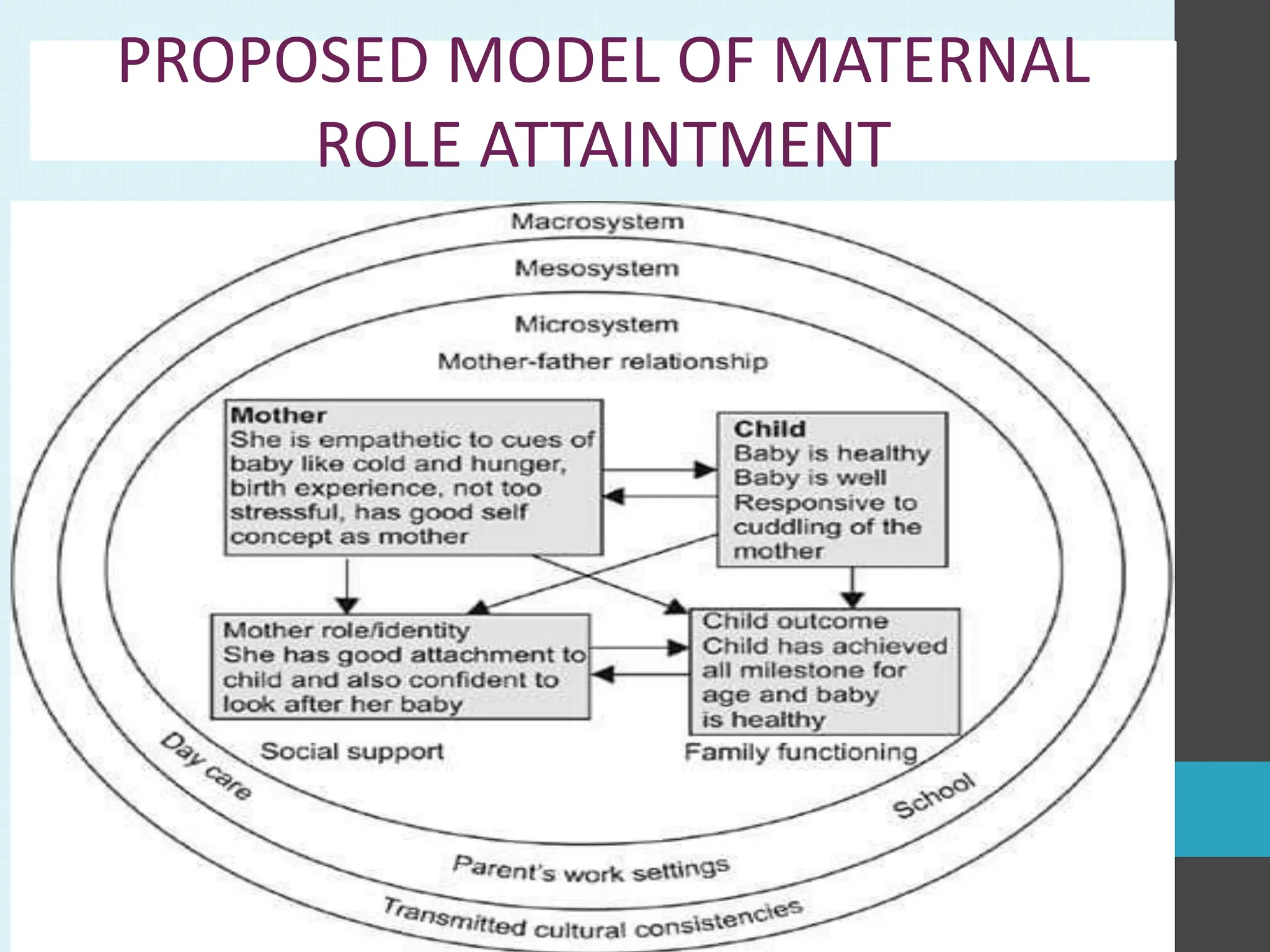
PROPOSED MODEL OF MATERNAL
ROLE ATTAINTMENT
1) The microsystem is the immediate environment where maternal
role attainment occurs.
• This indicates the family & factors such as family functioning,
mother-father relationships, social support & stress.
• The infant is an individual embedded within the family system.
• This system is the most influential on maternal role attainment &
attainment is achieved within the microsystem through the
interactions of father, mother & infant.
2) The Mesosytem encompasses,, influences, & delimits the
microsystem.
• The mother-infant unit is not contained within the mesosystem, but
the mesosytem may determine in part what happens to the
developing maternal role & the child.
• It includes extended family, school, work church & other entities
within the mother’s more immediate community.
The Exosystem, the previously used term, is an extension of the
interrelationships of two or more settings or subsystems that more
directly influences the mother such as interactions between works
setting, daycare, local laws & rules, community & church.
3) The macrosystem refers to the general prototypes existing in a
particular culture or transmitted cultural consistencies which include
the social, political & cultural influences on other two systems.
It is in the macrosystem where the health care environment & the
impact of current health care system on maternal role attainment
originate.
The maternal role attainment is a process that follows four stages
of role acquisition; these stages have been adapted from Thornton
& Nardi’s 1975 research.
These four stages are indicated as microsystem within the evolving
model of maternal role attainment.
a) Anticipatory stage:
Begins ion the pregnancy & includes the initial social &
psychological adjustment to pregnancy.
The mother learns the expectations of the role, fantasizes about the
role, related to the fetus in the uterus, & begins role play.
b) Formal stage:
Begins with the birth of the infant & includes learning & taking of
the role of the mother.
Role behaviors are guided by formal, consensual expectations &
others in the mother’s social system.
c) Informal stage:
Begins as the mother develops unique way of dealing with the role
not conveyed by social system.
The women makes her new role fit within her existing lifestyle
based on past experiences & future goals.
d) Personal stage:
Role identity stage occurs as the woman internalizes her role.
The mother experiences harmony, confidence & competence in the
way she performs the role & the maternal role is achieved.
• These four stages of role acquisition overlap & are altered as the
infant grows as & develops.
• The final stage of maternal role identity may be achieved in many
period of time.
• The stages are influenced by social support, stress, family
functioning, & the relationship between the mother & father or
significant others.
• Traits & behaviors of both the mother & the infant may influence
maternal role identity & child outcome.
• Maternal traits & behaviors included Mercer’s model are empathy,
sensitivity to infant cues, self-esteem & self-concept, parenting
received as a child, maturity & flexibility, attitude, pregnancy &
birth experience, health, depression & role conflict.
• Infant traits having an impact on maternal role identity include
temperament, ability to send cues, appearance, general
characteristics, responsiveness & stress.
• According to Mercer, the maternal role is attained when the mother
feels internal harmony with the role & its expectations & described
three major components of the role:
1. Attachment to the infant
2. Gaining competence in mothering behaviors.
3. Expressing gratification in maternal-infant interactions.
 Outcome for the child includes cognitive, mental development,
attachment, health, & other social competence.
APPLICATION
NURSING EDUCATION:
The concepts of Mercer& her model have used by nursing in
numerous obstetrical textbooks.
The use of Mercer’s theory provides a valuable framework for
students & nurses.
An educational program was established for substance
abusing women in a residential treatment center based on
Mercer’s maternal role attainment theory.
NURSING PRACTICE:
Her theory & model is practice oriented.
Maternal role attainment theory lays the framework for assessing,
planning, implementation, & evaluation of maternal & newborn
care.
NURSING RESEARCH:
Mercer has tested factor that she theorized &/or hypothesized have
an impact on maternal attainment. She has received the literature
extensively & formulated questions & models that guided
researchers.
Mercer’s theory is used in graduate student these & research
projects. Also theoretical framework has been used by many in
correlation studies & doctoral research dissertations.
LIMITATIONS:
 Some interchanging of terms & labels used to identify concepts,
such as adaptation, attainment; social support & support network
are potentially confusing to the learners.
 Concepts are not specific to time & place & are abstract.
LYDIA ELOISE HALL: Care,
Core and Cure
INTRODUCTION:
• Lydia E Hall believed that patient outcomes
are improved by direct care as given by the
professional nurse.
• She stood against the turning over of care
when a patient is stabilized to practical nurses
& argued against the concepts of team
nursing.
• She saw nursing as interacting with the
person, called “the core- person, “the care-
body, “the cure- disease.
Theory Overview
Theory developed in late 1960’s.
Nursing care be delivered on three interlocking levels.
Core=patient
Care=Body
Cure= Disease
Defined nursing as care performed by trained nurses.
Care focused on maintaining optimal health & quality life from
birth to end of life.
Care is ongoing matrix of learning & teaching.
METAPARADIGM OF THE
THEORY
Individual
Health
Nursing
Environment
Individual
Persons who are more than 16years old & in the long-term
illness are the focus of Hall’s work.
Hall emphasizes the importance of an individual as unique,
capable of growth, learning & requiring a total person
approach.
Health
Inferred to be state of self-awareness with conscious selection
of behaviors.
Hall stresses the need to help the person explore the meaning
of his or her behavior to identify & overcome problems
through developing self-identity & maturity.
Nursing:
Identifies & consisting participation in the care, core & cure aspects
of patient care.
Care is the sole function of nurses.
Major purpose of care is to achieve an interpersonal relationship
with the individual.
ENVIRONMENT:
The concept of environment is dealt within relation to the
individual/person.
Hall developed the concept of Loeb Centre because she assumed
that the hospital environment during treatment of acute illness
creates a difficult psychological experience for the ill person.
Loeb Centre focuses on providing an environment that is conducive
to self-development. In such a setting, action of the nurses is for
assisting the individual in achieving a personal goal.
ASSUMPTIONS
• The motivation & energy necessary for healing exist within the
patient, rather than in the health care team.
• The 3 aspects of nursing should be viewed as interrelated but
not viewed as functioning independently.
• The 3 aspects interact, & the circles representing them change
size, depending on the patient’s total course of progress.
3 CIRCLES (3C)
CORE
CARE
CURE
THEORY ASSERTION
THE CARE CIRCLE:
Nurturing component of care & is exclusive to nursing.
Motherly care & comfort of patient.
Provides teaching & learning activities.
Nurses goal is to give care & comfort to the patient.
Nurses provides bodily care for the patient.
Patient may explore & share feelings with the nurse.
When functioning in the care circle, the nurses apply knowledge of
the natural & biological sciences.
The patient views the nurse as potential comforter, one who
provides care & comfort through the lying of hands.
THE CURE CIRCLE:
Cure based on pathological & therapeutic sciences.
Application of medical knowledge by nurses.
Nurse assisting the doctors in performing different
procedures.
Nurse is patient advocate in this circle.
The cure aspect is different from the care circle because many
of nurse’s actions changes from a negative quality of
avoidance of pain rather than a positive quality of comfort.
Nurses role changes to positive quality to negative quality.
THE CORE CIRCLE
• Patient care is based on social sciences.
• Involves therapeutic use of self & is shared with other team
members.
• By developing interpersonal relationship with the patient, the
nurse is able to help the patient verbally express feelings
regarding the disease process & its effects.
• Patient is able to gain self-identity & further develop maturity.
• Patient is able to make conscious decision.
“CORE”
Social sciences & therapeutic
use of self aspect of nursing
‘The Person’
“THE CURE”
Pathological & therapeutic
sciences seeing the patient
& the family through the
medical care-aspects of
nursing
‘The Disease’
“THE CARE”
Natural & biological sciences
intimate bodily care aspects
of nursing
‘The Body’
INTERACTION OF ALL THREE
ASPECTS
 Emphasis placed on the importance of total person.
 Importance placed on all three aspects together.
 All three aspects interact & changes in size.
CALLISTAROY;ADAPTATIONTHEORY
INTRODUCTION:
Sister Callista Roy developed the Adaptation Model, a
prominent grand nursing theory in 1976.
In Roy’s model the human being has a set of interrelated
systems (biological, psychological & social) & strives to
maintain a balance between these systems & the outside
environment, but there is no absolute level of balance.
Human being strives to live within a unique group in which he
or she can cope adequately.
METAPARADIGRAM
PERSON ENVORONMENT
NURSING HEALTH
PERSON:
According to Callista Roy, ‘Human systems have thinking & feeling
capacities, rooted in consciousness & meaning, by which they
adjust effectively to changes in the environment &, in turns, affect
the environment’.
Human beings are holostic that are in constant interaction with
their environment.
Human being use a system of adaptation, both innate & acquired,
to respond to the environmental stimuli they experience.
Human systems may be individuals or groups, like families,
organizations, & the whole global community.
Human beings is the recipient of nursing care.
ENVIRONMENT:
According to her, environment means ‘The conditions,
circumstances & influences surrounding & affecting the
development & behavior of persons or groups, with particular
consideration of the mutuality of person & health resources that
includes focal, contextual & residual stimuli’.
Contextual stimuli are characterized as the rest of the stimuli that
present with the focal stimuli, & contribute to its effect. Residual
stimuli are the additional environmental factors present within the
situation, but its effect is unclear (previous experience with certain
stimuli).
HEALTH:
 Roy describes, ‘Health is not freedom from the inevitability of
death, disease, unhappiness, & stress, but the ability to cope with
them in a competent way’.
 Health is defined ass the state where human beings can continually
adapt to stimuli. Because illness is a part of life, health is the result
of a process where health & illness can coexist.
 Health is the result of process & human beings are striving to attain
their maximum potential.
NURSING
• “The goal of nursing’ is the promotion of adaptation for human
beings & groups in each of the four adaptive modes ( physiological,
self-concept, role function, & interdependence), thus contributing
to health, quality of life, & dying with dignity.
• Nurse acts as facilitators of adaptation.(coping mechanism, asses
client’s behavior for adaptation,).
THEORETICAL ASSERTIONS
• INPUTE: (stimuli & adaptation level)
• CONTROL PROCESS: (coping mechanism, subsystem: regulator
& cognator)
• EFFECTORS: (four adaptive mode)
• OUTPUT: (may be adaptive or ineffective responses).
INPUTE:
Input of the system include the 3 types of stimuli ( focal,
contextual, & residual stimuli) & adaptation level of the
person.
The adaptive sytem has input is from external environment or
from the individual itself.
At particular point in time these 3 stimuli combine & interface
to set the adaptation level of the individual.
This response is unique to each individual & adaptation level
of each individual is regularly changing.
OUTPUT
Output of the system means behavior response of the
individual & that serve as feedback.
It can be both internal & external.
Behavior response may be adaptive response or ineffective
response.
CONTROL PROCESS:
It includes coping mechanism & internal process or subsystem
(regulator & cognator).
Coping mechanism may be innate (inherited) or acquired
(learning).
Regulator coping process is involving neural, chemical, &
endocrine & cognator coping process is involving four
cognitive emotive channel; perceptual & information
processing, learning, judgment & emotion.
THE COGNATOR
• EFFECTORS:
Physiological mode
Self-concept mode
Role function mode
Interdependence mode
Physiological Mode:
- Oxygenation
- Nutrition
- Elimination
- Activity
- Rest
- Protection
Self-concept:
 Which include
- Physical Self (involves body sensation & body image)
- Personal Self: (made up of self-consistency, self-ideal or expectancy
& the oral-ethical-spiritual self).
ROLE FUNCTION:
Primary role
Secondary role
Tertiary role
INTERDEPENDENCE MODE:
Coping mechanism arising from close relationship.
STRENGTH OF RAM
• Use to analyze diverse health care related issues.
• Analyzes the individual from a broad perspective
• Identify the factors affecting the individual & his community.
• Provide opportunity to understand whole human being.
• Includes the spiritual aspect of nursing assessment.
JEAN WATSON:
THEORY OF CARING
INTRODUCTION:
 Caring is the integral part of nursing profession .
 In Jean Watson’s view, the disease might be cured, but
illness would remain because without caring, health is
not attainted.
METAPARADIGM OF THE
THEORY
Human Being: according to Watson, the human being is a
valued person, cared for, respected & respected & viewed in a
holistic way, as body, & spirit.
Health: Dr. Watson believes that there are other factors that
are needed to be added in the WHO definition of health. She
ads the following 3 elements:
 A high level of overall physical, mental & social functioning.
 A general adaptive-maintenance level of daily functioning.
 The absence of illness (or the presence of efforts that leads its
absence).
Nursing:
She states nursing as a human science of persons & health-illness
experience that are mediated by professional, personal, scientific, &
ethical care interactions.
Environment:
According to Watson ‘Caring (and nursing) has existed in every
society.
Every society has had some people who have cared for others.
A caring attitude is not transmitted from generation to generation
by genes.
It is transmitted by the culture of the profession as a unique way of
coping with its environment’.
MAJOR ELEMENTS OF WATSON’S
THEORY OF HUMAN CARING:
CARATIVE
FACTORS
TRANSPERSONAL
CARING
RELATIONSHIP
CARING
OCCASION/CARING
MOVEMENTS
WATSON’S THEORY AND NURSING
PROCESS:
Watson’s nursing process contains the same steps as the
scientific research process.
ASSESSMENT PLAN
EVALUATION INTERVENTION
ASSESSMENT
This phase involves observation, identification & review of the
problem; use of applicable knowledge in literature.
It includes conceptual knowledge for the formulation &
conceptualization of framework to assess the problem.
It also includes the formulation of hypothesis about
relationships & defining variables that will be examined in
solving the problem.
PLAN:
This phase helps to determine how variables would be examined or
measured.
It includes a conceptual approach or design for solving problem &
referred as nursing care plan.
It determines which data should be collected & how on whom.
INTERVENTION:
It is the direct action & implementation of the plan.
In this phase the collection of the data occurs.
EVALUATION:
• In this phase analysis of the data as well as the examination of
the effects of interventions based on the data occurs.
• It includes the interpretation of the results, the degree to
which positive outcome has occurred & whether the result
can be generalized.
• It may also generate additional hypothesis or may even lead to
the generation of a nursing theory.
THEORIES, MODELS, AND APPROACHES APPLIED TO.pptx

THEORIES, MODELS, AND APPROACHES APPLIED TO.pptx

  • 1.
  • 2.
    THEORIES •KING THEORY • LYDIAELOISE HALL: Care, Core and Cure • MATERNAL ROLE ATTAINMENT THEORY • CALLISTA ROY; ADAPTATIONTHEORY • JEAN WATSON: THEORY OF CARING
  • 3.
    1.KINGTHEORY INTRODUCTION: •Theorist: Imogene king-born in1923 •Theory describes a dynamic, interpersonal relationship in which a person grows and develops to attain certain life goals.
  • 4.
    BASIC ASSUMPTIONS • Nursingfocus is the human being. • Nursing goal is the health care of individual & groups • Human beings: are open systems interacting constantly with their environment. • Basic assumption of goal attainment theory is that nurse & client communicate information, set goal mutually & then act to attain those goal, is also the basic assumption of nursing process. • “Each human being perceives the world as a total person in making transactions with individuals & things in environment”. • “Transaction represents a life situation in which perceiver & thing perceived are encountered & in which person enters the situation as an active participant & each is changed in the process of these experiences”.
  • 5.
    Proposition’s Of King’sTheory 1) If perceptual interaction accuracy is present in nurse-client interactions, transaction will occur. 2) If nurse & client make transaction, goal will be attained 3) If goal are attained, satisfaction will occur. 4) If transactions are made in nurse-client interactions, growth & development will be enhanced. 5) If role expectations & role performance as perceived by nurse & client are congruent, transaction will occur. 6) If role conflict is experienced by nurse or client or both, stress in nurse-client interaction will occur. 7) If nurse with special knowledge skill communicate appropriate information to client, mutual goal setting & goal attainment will occur.
  • 6.
  • 7.
    1. Human Being/Person Humanbeing or person refers to social being are rational and sentient. Person has ability to: • Perceive • Think • Feel • Choose • Set goals • Select means to achieve goals & • To make decision Human being has three fundamental needs: • The need for the health information that is unable at the time when it is needed & can be used. • The need for care that seek to prevent illness, & • The need for care when human beings are unable to help themselves.
  • 8.
    2. Health • Healthinvolves dynamic life experiences of a human being, which implies continuous adjustment to stressors in the internal & external environment through optimum use of one’s resources to achieve maximum potential for daily living.
  • 9.
    3. Environment Environment isthe background for human interactions. It involves: Internal environment: transforms energy to enable person to adjust to continuous external environmental changes. External environment: involves formal & informal organizations. Nurse is a part of the patients environment.
  • 10.
    4. Nursing • Definition: -“A process of action & interaction by which nurse & client share information about their perception in nursing situation.” & “a process of human interactions between nurse & client whereby each perceives the other & the situation, & through communication, they set goals, explore means, and agree on means to achieve goals”.
  • 11.
    • Action: Isdefined as a sequence of behaviors involving mental and physical action. • Reaction: Which is considered as included in the sequence of behaviors described in action. • In addition, king discussed: a) goal b) Domain & c) Functions of professional nurse • Goal of Nurse: “To help individuals to maintain their health so they can function in their roles”. • Domain of Nurse: “Includes promoting, maintaining, & restoring health, & caring for the sick, injured & dying. • Function of professional nurse: “To interpret information in nursing process to plan, implement & evaluate nursing care.
  • 12.
    THEORY OF GOALATTAINTMENT AND NURSING PROCESS ASSESS MENT NURSING DIAGNOSI S PLANNI NG IMPLEME NTATION EVALUATI ON
  • 14.
    ASSESSMENT • Assessment occurduring interaction. • The nurse brings special knowledge & skills whereas client brings knowledge of self & perception of problems of concern, to this interaction. • During assessment nurse collects data regarding client (his/her growth & development, perception of self & current health status, roles etc.) • Perception is the base for collection & interaction of data. • Communication is required to verify accuracy of perception, for interaction & transaction.
  • 15.
    NURSING DIAGNOSIS • Thedata collected by assessment are used to make nursing diagnosis in nursing process. • In process of attaining goal the nurse identifies the problems, concerns & disturbances about which person seek help.
  • 16.
    PLANNING • After diagnosis,planning for interventions to solve those problems is done. • In goal attainment planning is represented by setting goals & making decisions about & being agreed on the means to achieve goals. • This part of transaction & client’s participation is encouraged in making decision on the means to achieve the goals.
  • 17.
    IMPLEMENTATION • In nursingprocess implementation involves the actual activities to achieve the goals. • In goal attainment it is the continuation of transaction.
  • 18.
    EVALUATION • It involvesto finding out whether goals are achieved or not. • In king description evaluation speaks about attainment of goal & effectiveness of nursing care.
  • 19.
    Nursing Process AndTheory Of Goal Attainment Nursing Process Method Nursing Process Theory A system of oriented actions A system of oriented concepts Assessment Perception, communication and interaction of nurse & client. Planning Decision making about the goals. Be agree on the means to attain the goals. Implementation Transaction made Evaluation Goal attained
  • 21.
    MATERNALROLEATTAINMENTTHEORY Introduction Born in 1929 Mercerbegan her nursing career in 1950 & she graduated from St. Margaret’s school of nursing, Montgomery, alabama. For the next 10 years she worked as a & instructor in pediatric & obstetrical nursing in addition to the field of contagious diseases (Meighan, 2010). Her early nursing experience molded her interests toward pediatric & obstetrics. Returned to school in 1960 & earned her master’s degree specializing in maternal-child nursing at the University of New Mexico in 1964 (Meighan, 2010).
  • 22.
    • She continuedpursuing her passion for maternity nursing & completed her Ph.D. at the University of Pittsburgh in 1973. • Dr. Mercer then moved to California & worked as a nursing professor at the University of California until she retired in 1987. • Even in her retirement, she still continues to revise & clarify her work because she believes that “theory building is a continual process” (Mercer, 2004).
  • 23.
    • Ramona Mercer’searly work in the 1970’s was focused on the 1. Needs of breastfeeding mothers 2. Teenage mothers 3. Postpartum illness 4. Mothers bearing children with defects. • She had also a deep interest in the development of the 1) Maternal role 2) Self-esteem 3) Self-concept of mothers • During the span of Mercer’s career, her work expanded further in the area of maternal-child nursing.
  • 24.
    • Ramon Mercer’searly work in the 1970’s was focused on the 1) Needs of breastfeeding mothers 2) Teenage mothers 3) Postpartum illness 4) Mothers bearing children with defects.  She had also a deep interest in the development of the 1) Maternal role 2) Self-esteem 3) Self-concept of mothers • During the span of Mercer’s career, her work expanded further in the area of maternal-child nursing.
  • 25.
    MATERNALROLEATTAINMENTTHEORY Defined as aninteraction & developmental process occurring over time, in which the mother becomes attached to her infant, acquires competence in the care-taking tasks involved in the role, & expresses pleasure & gratification in the role. OR Maternal role attainment is also as defined a process of binding in or being attached to the child & maternal role identity or seeing oneself in the role & having a sense of comfort about it.
  • 26.
    FACTORS THAT DIRECTLYOR INDIRECTLY INFLUENCE ON THE MATERNAL ROLE The Maternal Factors includes: • Age at first birth • Birth experience • Early separation from the infant • Social stress • Social support personality traits, self-concept • Child-rearing attitudes • Health
  • 27.
    She also includethe INFANT VARIABLES: • Temperature • Appearance • Responsiveness • Health status, & ability to give cues. She also noted the importance of the father’s role, the mother- father relationship. She also noted the importance of the father’s role & applied many of her previous findings in studying the paternal response to parenthood.
  • 28.
    CONCEPTS 1) Maternal identity: Maternal identity is defined as having an internalized view of the self as a mother (Mercer, 1995). 2) PERCEPTION OF BIRTH EXPERIENCE: • A woman’s perception of her performance during labor & birth is her perception of the birth experience (Mercer, 1990).
  • 29.
    3) SELF-ESTEEM: • Mercer,May, Ferketich & Dejoseph (1986) describe self-esteem as “ an individual’s perception of how others view one & self- acceptance of the perception”. 4) SELF-CONCEPT (SELF-REGARD): • Mercer (1986) outlines self-concept, or self-regard,, as “The overall perception of self that includes self-satisfaction, self-acceptance, self-esteem, & congruence or discrepancy between self & ideal self”.
  • 30.
    5) FLEXIBILITY: • Rolesare not rigidly fixed; therefore, who fills the roles is not important (Mercer, 1990). “Flexibility of children attitudes increases with increased development.., Older mothers have infants & to view each situation in respect to the unique nuances”. 6) CHILDREARING ATTITUDES: • Childrearing attitudes are material attitudes or beliefs about childrearing.
  • 31.
    7) HEALTH STATUS: •Health status is defined as “The mother’s & father’s perception of their prior health, current health, health outlook, resistance- susceptibility to illness, health worry concern, sickness orientation, & rejection of the sick role”. 8) ANXIETY: • According to Mercer and colleagues (1986), describe anxiety as “a trait in which there is specific proneness to perceive stressful situation-specific state”.
  • 32.
    9) DEPRESSION: • Accordingto Merce & collegues (1986), depression is “having a group of depression symptoms & in particular the effective component of the depressed mood”. 10) ROLE STRAIN-ROLE CONFLICT: • Role strain is the conflict and difficulty felt by the women in fulfilling the maternal role obligation.
  • 33.
    11) GRATIFICATION-SATISFACTION: • Mercerdescribes gratification as “the satisfaction, enjoyment, reward, or pleasure that a women experiences in interacting with her infant & in fulfilling the usual tasks inherent in mothering”. 12) ATTACHMENT: • Attachment versus a difficult temperament is related to whether the infant sends hard-to –read cues, leading to feelings of incompetence & frustration in the process.
  • 34.
    13) INFANT HEALTHSTATUS: • Infant health status is illness causing maternal infant separation, interfering with the attachment process. 14) INFANT CHARACTERISTICS: • Characteristics include infant temperament, appearance, & health status. 15) INFANT CUES: • Infant cues are infant behaviors that elicit a response from the mother.
  • 35.
    16) FAMILY: • Mercer& colleagues define family as “a dynamic system which includes subsystems-in-individuals (mother, father, fetus/infant) & dyads (mother-father, mother-fetus/infants, & father fetus/infant) within the overall family system. 17) FATHER OR INTIMATE PARTNER: • The father or intimate partner contributes to the process of maternal role attainment in a way that cannot be duplicated by any other person. The father’s interactions help diffuse tension & facilitate maternal role attainment.
  • 36.
    18) FAMILY FUNCTIONING: •Family functioning is the individual’s view of the activities & relationships between the family & its subsystems & broader social units. 19) STRESS: • Stress is made up of positively & negatively perceived life events & environmental variables. 20) MOTHER FATHER RELATIONSHIP: • The mother-father relationship is the perception of the mate relationship that includes intended & actual values, goals, & agreement between the two. The maternal attachment to the infant develops within the emotional held of the parent’s relationship.
  • 37.
    21) SOCIAL SUPPORT: •According to Mercer & colleagues, social support is “the amount of help actually received, satisfaction with that help, & the persons (network) providing that help”. • Four area of social support as follows:  Emotional support: “Feeling loved, cared for, trusted, & understood”. Informational support: Helps the individual help herself by providing information that is useful in dealing with the problem &/or situation. Physical support: A direct kind of help. Appraisal support: A support that tells the role taker how she is performing in the role; it enables the individual to evaluate herself in relationship to others “performance in the role”.
  • 38.
    ASSUMPTIONS A relatively, stablecore self, acquired through lifelong socialization, determines how a mother defines & perceive events; her perceptions of her infant’s & others responses to her mothering , with her life situation, are real world to which she responds. In addition to the mother’s socialization, her developmental level & characteristics also influence her behavioral responses. The mother’s role partner, her infant, will reflect the mother’s competence in the mothering role through growth & development.
  • 39.
    The infant consideredan active partner in maternal role-taking process, affecting & being affected by the role enactment. The father or mother’s intimate partner contributes to role attainment in a that cannot be duplicated by any other supportive person. Maternal identity develops concurrently with maternal attachment & each depends on one other.
  • 40.
    METAPARADIGM NURSING: Mercer stated that,“Nurses are the health professionals having the most sustained & intense interaction with women in the maternity cycle. She emphasizes that the kind of a woman receives during pregnancy & over the first year following birth can have a lifelong term effects for her & her child.
  • 41.
    PERSON: She refers theperson as self or core self, view the self as separate from the roles that are played. The mother interacts with her infant & with the father or her significant other; influential & is influential & is influenced by both of them. HEALTH: She defines health status as the mothers & father’s perception of their prior health, current health, health outlook, resistance, susceptibility to illness, worry or concern & rejection of sick role. Health status of newborn is the extent of disease present & infant health status by parental rating of overall health. She also stresses the importance of healthcare during childbearing & childbearing process.
  • 42.
    ENVIRONMENT: She conceptualized theenvironment from Bronfenbrenner’s definition of the ecological environment. Development of a role/person cannot be considered apart from the environment; there is a mutual accommodation between developing person & the changing properties of the immediate settings, & the larger context in which the settings are embedded.
  • 43.
    THEORETICAL ASSERTIONS (PROPOSED MODELOF MATERNAL ROLE ATTAINMENT)
  • 44.
    PROPOSED MODEL OFMATERNAL ROLE ATTAINTMENT
  • 47.
    1) The microsystemis the immediate environment where maternal role attainment occurs. • This indicates the family & factors such as family functioning, mother-father relationships, social support & stress. • The infant is an individual embedded within the family system. • This system is the most influential on maternal role attainment & attainment is achieved within the microsystem through the interactions of father, mother & infant.
  • 48.
    2) The Mesosytemencompasses,, influences, & delimits the microsystem. • The mother-infant unit is not contained within the mesosystem, but the mesosytem may determine in part what happens to the developing maternal role & the child. • It includes extended family, school, work church & other entities within the mother’s more immediate community. The Exosystem, the previously used term, is an extension of the interrelationships of two or more settings or subsystems that more directly influences the mother such as interactions between works setting, daycare, local laws & rules, community & church.
  • 49.
    3) The macrosystemrefers to the general prototypes existing in a particular culture or transmitted cultural consistencies which include the social, political & cultural influences on other two systems. It is in the macrosystem where the health care environment & the impact of current health care system on maternal role attainment originate.
  • 50.
    The maternal roleattainment is a process that follows four stages of role acquisition; these stages have been adapted from Thornton & Nardi’s 1975 research. These four stages are indicated as microsystem within the evolving model of maternal role attainment.
  • 51.
    a) Anticipatory stage: Beginsion the pregnancy & includes the initial social & psychological adjustment to pregnancy. The mother learns the expectations of the role, fantasizes about the role, related to the fetus in the uterus, & begins role play. b) Formal stage: Begins with the birth of the infant & includes learning & taking of the role of the mother. Role behaviors are guided by formal, consensual expectations & others in the mother’s social system.
  • 52.
    c) Informal stage: Beginsas the mother develops unique way of dealing with the role not conveyed by social system. The women makes her new role fit within her existing lifestyle based on past experiences & future goals. d) Personal stage: Role identity stage occurs as the woman internalizes her role. The mother experiences harmony, confidence & competence in the way she performs the role & the maternal role is achieved.
  • 53.
    • These fourstages of role acquisition overlap & are altered as the infant grows as & develops. • The final stage of maternal role identity may be achieved in many period of time. • The stages are influenced by social support, stress, family functioning, & the relationship between the mother & father or significant others. • Traits & behaviors of both the mother & the infant may influence maternal role identity & child outcome.
  • 54.
    • Maternal traits& behaviors included Mercer’s model are empathy, sensitivity to infant cues, self-esteem & self-concept, parenting received as a child, maturity & flexibility, attitude, pregnancy & birth experience, health, depression & role conflict. • Infant traits having an impact on maternal role identity include temperament, ability to send cues, appearance, general characteristics, responsiveness & stress.
  • 55.
    • According toMercer, the maternal role is attained when the mother feels internal harmony with the role & its expectations & described three major components of the role: 1. Attachment to the infant 2. Gaining competence in mothering behaviors. 3. Expressing gratification in maternal-infant interactions.  Outcome for the child includes cognitive, mental development, attachment, health, & other social competence.
  • 56.
    APPLICATION NURSING EDUCATION: The conceptsof Mercer& her model have used by nursing in numerous obstetrical textbooks. The use of Mercer’s theory provides a valuable framework for students & nurses. An educational program was established for substance abusing women in a residential treatment center based on Mercer’s maternal role attainment theory.
  • 57.
    NURSING PRACTICE: Her theory& model is practice oriented. Maternal role attainment theory lays the framework for assessing, planning, implementation, & evaluation of maternal & newborn care. NURSING RESEARCH: Mercer has tested factor that she theorized &/or hypothesized have an impact on maternal attainment. She has received the literature extensively & formulated questions & models that guided researchers. Mercer’s theory is used in graduate student these & research projects. Also theoretical framework has been used by many in correlation studies & doctoral research dissertations.
  • 58.
    LIMITATIONS:  Some interchangingof terms & labels used to identify concepts, such as adaptation, attainment; social support & support network are potentially confusing to the learners.  Concepts are not specific to time & place & are abstract.
  • 60.
    LYDIA ELOISE HALL:Care, Core and Cure INTRODUCTION: • Lydia E Hall believed that patient outcomes are improved by direct care as given by the professional nurse. • She stood against the turning over of care when a patient is stabilized to practical nurses & argued against the concepts of team nursing. • She saw nursing as interacting with the person, called “the core- person, “the care- body, “the cure- disease.
  • 61.
    Theory Overview Theory developedin late 1960’s. Nursing care be delivered on three interlocking levels. Core=patient Care=Body Cure= Disease Defined nursing as care performed by trained nurses. Care focused on maintaining optimal health & quality life from birth to end of life. Care is ongoing matrix of learning & teaching.
  • 62.
  • 63.
    Individual Persons who aremore than 16years old & in the long-term illness are the focus of Hall’s work. Hall emphasizes the importance of an individual as unique, capable of growth, learning & requiring a total person approach.
  • 64.
    Health Inferred to bestate of self-awareness with conscious selection of behaviors. Hall stresses the need to help the person explore the meaning of his or her behavior to identify & overcome problems through developing self-identity & maturity.
  • 65.
    Nursing: Identifies & consistingparticipation in the care, core & cure aspects of patient care. Care is the sole function of nurses. Major purpose of care is to achieve an interpersonal relationship with the individual. ENVIRONMENT: The concept of environment is dealt within relation to the individual/person. Hall developed the concept of Loeb Centre because she assumed that the hospital environment during treatment of acute illness creates a difficult psychological experience for the ill person. Loeb Centre focuses on providing an environment that is conducive to self-development. In such a setting, action of the nurses is for assisting the individual in achieving a personal goal.
  • 66.
    ASSUMPTIONS • The motivation& energy necessary for healing exist within the patient, rather than in the health care team. • The 3 aspects of nursing should be viewed as interrelated but not viewed as functioning independently. • The 3 aspects interact, & the circles representing them change size, depending on the patient’s total course of progress.
  • 67.
  • 68.
    THEORY ASSERTION THE CARECIRCLE: Nurturing component of care & is exclusive to nursing. Motherly care & comfort of patient. Provides teaching & learning activities. Nurses goal is to give care & comfort to the patient. Nurses provides bodily care for the patient. Patient may explore & share feelings with the nurse. When functioning in the care circle, the nurses apply knowledge of the natural & biological sciences. The patient views the nurse as potential comforter, one who provides care & comfort through the lying of hands.
  • 69.
    THE CURE CIRCLE: Curebased on pathological & therapeutic sciences. Application of medical knowledge by nurses. Nurse assisting the doctors in performing different procedures. Nurse is patient advocate in this circle. The cure aspect is different from the care circle because many of nurse’s actions changes from a negative quality of avoidance of pain rather than a positive quality of comfort. Nurses role changes to positive quality to negative quality.
  • 70.
    THE CORE CIRCLE •Patient care is based on social sciences. • Involves therapeutic use of self & is shared with other team members. • By developing interpersonal relationship with the patient, the nurse is able to help the patient verbally express feelings regarding the disease process & its effects. • Patient is able to gain self-identity & further develop maturity. • Patient is able to make conscious decision.
  • 71.
    “CORE” Social sciences &therapeutic use of self aspect of nursing ‘The Person’ “THE CURE” Pathological & therapeutic sciences seeing the patient & the family through the medical care-aspects of nursing ‘The Disease’ “THE CARE” Natural & biological sciences intimate bodily care aspects of nursing ‘The Body’
  • 73.
    INTERACTION OF ALLTHREE ASPECTS  Emphasis placed on the importance of total person.  Importance placed on all three aspects together.  All three aspects interact & changes in size.
  • 74.
    CALLISTAROY;ADAPTATIONTHEORY INTRODUCTION: Sister Callista Roydeveloped the Adaptation Model, a prominent grand nursing theory in 1976. In Roy’s model the human being has a set of interrelated systems (biological, psychological & social) & strives to maintain a balance between these systems & the outside environment, but there is no absolute level of balance. Human being strives to live within a unique group in which he or she can cope adequately.
  • 75.
  • 76.
    PERSON: According to CallistaRoy, ‘Human systems have thinking & feeling capacities, rooted in consciousness & meaning, by which they adjust effectively to changes in the environment &, in turns, affect the environment’. Human beings are holostic that are in constant interaction with their environment. Human being use a system of adaptation, both innate & acquired, to respond to the environmental stimuli they experience. Human systems may be individuals or groups, like families, organizations, & the whole global community. Human beings is the recipient of nursing care.
  • 77.
    ENVIRONMENT: According to her,environment means ‘The conditions, circumstances & influences surrounding & affecting the development & behavior of persons or groups, with particular consideration of the mutuality of person & health resources that includes focal, contextual & residual stimuli’. Contextual stimuli are characterized as the rest of the stimuli that present with the focal stimuli, & contribute to its effect. Residual stimuli are the additional environmental factors present within the situation, but its effect is unclear (previous experience with certain stimuli).
  • 78.
    HEALTH:  Roy describes,‘Health is not freedom from the inevitability of death, disease, unhappiness, & stress, but the ability to cope with them in a competent way’.  Health is defined ass the state where human beings can continually adapt to stimuli. Because illness is a part of life, health is the result of a process where health & illness can coexist.  Health is the result of process & human beings are striving to attain their maximum potential.
  • 79.
    NURSING • “The goalof nursing’ is the promotion of adaptation for human beings & groups in each of the four adaptive modes ( physiological, self-concept, role function, & interdependence), thus contributing to health, quality of life, & dying with dignity. • Nurse acts as facilitators of adaptation.(coping mechanism, asses client’s behavior for adaptation,).
  • 80.
    THEORETICAL ASSERTIONS • INPUTE:(stimuli & adaptation level) • CONTROL PROCESS: (coping mechanism, subsystem: regulator & cognator) • EFFECTORS: (four adaptive mode) • OUTPUT: (may be adaptive or ineffective responses).
  • 82.
    INPUTE: Input of thesystem include the 3 types of stimuli ( focal, contextual, & residual stimuli) & adaptation level of the person. The adaptive sytem has input is from external environment or from the individual itself. At particular point in time these 3 stimuli combine & interface to set the adaptation level of the individual. This response is unique to each individual & adaptation level of each individual is regularly changing.
  • 83.
    OUTPUT Output of thesystem means behavior response of the individual & that serve as feedback. It can be both internal & external. Behavior response may be adaptive response or ineffective response.
  • 84.
    CONTROL PROCESS: It includescoping mechanism & internal process or subsystem (regulator & cognator). Coping mechanism may be innate (inherited) or acquired (learning). Regulator coping process is involving neural, chemical, & endocrine & cognator coping process is involving four cognitive emotive channel; perceptual & information processing, learning, judgment & emotion.
  • 85.
    THE COGNATOR • EFFECTORS: Physiologicalmode Self-concept mode Role function mode Interdependence mode
  • 86.
    Physiological Mode: - Oxygenation -Nutrition - Elimination - Activity - Rest - Protection Self-concept:  Which include - Physical Self (involves body sensation & body image) - Personal Self: (made up of self-consistency, self-ideal or expectancy & the oral-ethical-spiritual self).
  • 87.
    ROLE FUNCTION: Primary role Secondaryrole Tertiary role INTERDEPENDENCE MODE: Coping mechanism arising from close relationship.
  • 89.
    STRENGTH OF RAM •Use to analyze diverse health care related issues. • Analyzes the individual from a broad perspective • Identify the factors affecting the individual & his community. • Provide opportunity to understand whole human being. • Includes the spiritual aspect of nursing assessment.
  • 90.
    JEAN WATSON: THEORY OFCARING INTRODUCTION:  Caring is the integral part of nursing profession .  In Jean Watson’s view, the disease might be cured, but illness would remain because without caring, health is not attainted.
  • 91.
    METAPARADIGM OF THE THEORY HumanBeing: according to Watson, the human being is a valued person, cared for, respected & respected & viewed in a holistic way, as body, & spirit. Health: Dr. Watson believes that there are other factors that are needed to be added in the WHO definition of health. She ads the following 3 elements:  A high level of overall physical, mental & social functioning.  A general adaptive-maintenance level of daily functioning.  The absence of illness (or the presence of efforts that leads its absence).
  • 92.
    Nursing: She states nursingas a human science of persons & health-illness experience that are mediated by professional, personal, scientific, & ethical care interactions. Environment: According to Watson ‘Caring (and nursing) has existed in every society. Every society has had some people who have cared for others. A caring attitude is not transmitted from generation to generation by genes. It is transmitted by the culture of the profession as a unique way of coping with its environment’.
  • 94.
    MAJOR ELEMENTS OFWATSON’S THEORY OF HUMAN CARING: CARATIVE FACTORS TRANSPERSONAL CARING RELATIONSHIP CARING OCCASION/CARING MOVEMENTS
  • 95.
    WATSON’S THEORY ANDNURSING PROCESS: Watson’s nursing process contains the same steps as the scientific research process. ASSESSMENT PLAN EVALUATION INTERVENTION
  • 96.
    ASSESSMENT This phase involvesobservation, identification & review of the problem; use of applicable knowledge in literature. It includes conceptual knowledge for the formulation & conceptualization of framework to assess the problem. It also includes the formulation of hypothesis about relationships & defining variables that will be examined in solving the problem.
  • 97.
    PLAN: This phase helpsto determine how variables would be examined or measured. It includes a conceptual approach or design for solving problem & referred as nursing care plan. It determines which data should be collected & how on whom. INTERVENTION: It is the direct action & implementation of the plan. In this phase the collection of the data occurs.
  • 98.
    EVALUATION: • In thisphase analysis of the data as well as the examination of the effects of interventions based on the data occurs. • It includes the interpretation of the results, the degree to which positive outcome has occurred & whether the result can be generalized. • It may also generate additional hypothesis or may even lead to the generation of a nursing theory.