Secondary[Acquired]
Immunodeficiency states
 may arise as complications of :-
  infections ; malnutrition ; aging ; or side effects of
  immunosuppression, irradiation , chemotherapy.

Acquired Immunodeficiency Syndrome (AIDS) :
 caused by retrovirus Human Immunodeficiency Virus
  (HIV).
 characterized by profound immunosuppression that
  leads to opportunistic infections, secondary neoplasms,
  and neurologic manifestations.
 The virus is transmited via:
  1. Unprotected sex with someone who is infected.
  2. Transfusion of contaminated blood
     or blood products ; skin grafts or organ transplants
     taken from someone who is infected.
  3. From a mother who is infected to her baby , this
     can occur during pregnancy, at birth , and through
     breast feeding.
 4. Sharing unsterilized injection equipment that has
    previously been used by someone who is infected
    as in drug addicts.
Properties of HIV:
 HIV is retrovirus ( RNA containing virus ) that can
  convert its genetic material into DNA by means of
  enzyme reverse transcriptase which enables it
  to become integrated into DNA of its host cells.
 Two genetically different but related forms of HIV,
  called HIV-1 and HIV-2.
Structure of HIV:
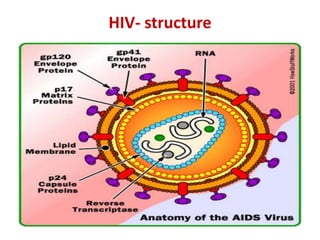
 HIV virion is spherical and contains a cone-shaped core
  surrounded by a lipid envelope derived from the host
  cell membrane .
 The virus core contains:
 (1) major capsid protein ( p24 ).
 (2) nucleocapsid protein ( p7/p9 ).
 (3) two copies of genomic RNA.
 (4) three viral enzymes (protease , reverse transcriptase ,
     and integrase).
 p24 is the most readily detected viral antigen and,
  is the target for antibodies that are used for
  diagnosis of HIV infection.
 The viral core is surrounded by a matrix protein
  called p17, which lies underneath the virion
  envelope.
 Studding the viral envelope are two viral
  glycoproteins ( gp120 and gp41 ) which are critical
  for HIV infection of cells.
HIV- structure
Pathogenesis of HIV Infection and AIDS:
there are two major targets of HIV infection:
immune system and central nervous system.
Immune system:-
 This results from infection and severe loss of
  CD4+ T cells as well as impairment in function
  of surviving CD4+ T cells.
 macrophages and dendritic cells are also targets of
  HIV infection.
 HIV envelope contains two glycoproteins, surface
  ( gp120 ) that is non-covalently attached to
  transmembrane protein ( gp41 ).
 The initial step in infection is binding of gp120.
 This binding leads to a conformational change that
  results in formation of a new recognition site on
  gp120 for coreceptors CCR5 ( on macrophage ) or
  CXCR4 (on CD4+ T cells ).
 The next step involves conformational changes in
  gp41 , these changes result in insertion of a fusion
  peptide at tip of gp41 into cell membrane of target
  cells .
 After fusion, the virus core containing HIV genome
  enters cytoplasm of cell.
 Once internalized, the RNA genome of virus undergoes
  reverse transcription, leading to formation of cDNA
  (proviral DNA) .
 In quiescent T cells, HIV cDNA may remain in cytoplasm.
 In dividing T cells, the cDNA , enters the nucleus and
  is then integrated into host genome.
 After this integration, the provirus may remain locked
  into chromosome for months or years, and hence the
  infection becomes latent.
 Alternatively, proviral DNA may be transcribed, with
  formation of complete viral particles that bud from cell
  membrane.
 Such productive infection, when associated with
  extensive viral budding, leads to cell death.
 Early in course of HIV infection, the immune system
  can replace the dying T cells.
 Later in course of disease, renewal of CD4+ T cells
  cannot keep up with loss of these cells.
 Despite the fact that macrophages allow viral
  replication, they are quite resistant to cytopathic
  effects of HIV, in contrast to CD4+ T cells.
  Thus, macrophages may be reservoirs of infection.
 two types of dendritic cells are also targets of HIV
  infection: mucosal and follicular dendritic cells.
 patients with AIDS also display profound abnormalities
  of B-cell function
Central Nervous System:
 It is a major target of HIV infection.
 Macrophages and microglia (cells in central nervous
  system that belong to monocyte and macrophage
  lineage) are predominant cell types in brain that are
  infected with HIV.
 HIV is carried into brain by infected monocytes.
Natural History of HIV Infection:
Three phases recognized:-
(1) Early , acute retroviral syndrome.
(2) Middle, chronic phase.
(3) Final , full-blown AIDS.
 Early , acute retroviral syndrome ( phase 1):
 high level of virus production, viremia, and
   widespread seeding of lymphoid tissues.
 however, is readily controlled by development
   of antiviral immune response.
 Clinically: nonspecific symptoms, including sore throat,
   myalgia , fever, rash, weight loss, and fatigue,
   resembling a flulike syndrome.
Middle chronic phase ( phase 2 ):
 represents a stage of relative containment of virus,
  associated with period of clinical latency.
 The immune system is largely intact, but there is
  continuous HIV replication, predominantly in lymphoid
  tissues, which may last for several years.
 Patients are either asymptomatic or develop
  persistent generalized lymphadenopathy.
 Final phase ( phase 3 ), full-blown AIDS :
 Its progression to AIDS, characterized by a breakdown
  of host defense, a dramatic increase in plasma virus,
  and clinical disease.
 Typically the patient presents with long-lasting fever
  (>1 month), fatigue, weight loss, and diarrhea.
 After a variable period: serious opportunistic infections,
  secondary neoplasms, or clinical neurologic disease
  (grouped under the AIDS indicator diseases ), and
  the patient is said to have developed AIDS.
Clinical Features of AIDS:
 Opportunistic infections:
 account for the majority of deaths in patients with
   AIDS.
 Approximately 15% to 30% of HIV-infected people
   develop pneumonia caused by opportunistic fungus
   P. carinii .The risk of developing this infection is
   extremely high in individuals with fewer than
   200 CD4+ cells/µL.
 other opportunistic infections are caused by Candida,
   cytomegalovirus, atypical and typical mycobacteria,
   Cryptococcus neoformans, Toxoplasma gondii, and
   herpes simplex virus.
 Neoplasms :
 Kaposi sarcoma (KS) ; non-Hodgkin B-cell lymphoma ;
  cervical cancer in women ; and anal cancer in men.
 It is estimated that 25% to 40% of HIV-infected
  individuals will eventually develop malignancy.
 KS is composed of mesenchymal (spindle) cells that
  form blood vessels; the proliferation of these cells is
  driven by a variety of cytokines and growth factors that
  are derived from tumor cells , and from HIV-infected
  T cells. it is strongly linked to infection of tumor cells
  by KS-associated herpesvirus (KSHV).
 Central nervous system:
 90%of patients demonstrate some form of neurologic
  involvement at autopsy ; and 40% to 60% have
  clinically manifest neurologic dysfunction.
 These include : self-limited meningoencephalitis ;
  aseptic meningitis ; vacuolar myelopathy ;
  peripheral neuropathies ; and most commonly
  a progressive encephalopathy designated clinically
  as (AIDS-dementia complex ).
Morphology:
 Biopsy specimens from enlarged lymph nodes in
  early stages of HIV infection reveal marked follicular
  hyperplasia.
 With disease progression, B-cell proliferation subsides
  and gives rise to severe follicular involution.
  The follicles are depleted of cells.
  The germinal centers may become hyalinized.
  These lymph nodes are atrophic and small and
  may harbor numerous opportunistic pathogens.
 Lymphoid depletion is not confined to lymph nodes;
  in later stages of AIDS, the spleen and thymus also
  appear to be "wastelands."
THANK YOU

Immunopathology 5

  • 1.
  • 2.
     may ariseas complications of :- infections ; malnutrition ; aging ; or side effects of immunosuppression, irradiation , chemotherapy. Acquired Immunodeficiency Syndrome (AIDS) :  caused by retrovirus Human Immunodeficiency Virus (HIV).  characterized by profound immunosuppression that leads to opportunistic infections, secondary neoplasms, and neurologic manifestations.
  • 3.
     The virusis transmited via: 1. Unprotected sex with someone who is infected. 2. Transfusion of contaminated blood or blood products ; skin grafts or organ transplants taken from someone who is infected. 3. From a mother who is infected to her baby , this can occur during pregnancy, at birth , and through breast feeding. 4. Sharing unsterilized injection equipment that has previously been used by someone who is infected as in drug addicts.
  • 4.
    Properties of HIV: HIV is retrovirus ( RNA containing virus ) that can convert its genetic material into DNA by means of enzyme reverse transcriptase which enables it to become integrated into DNA of its host cells.  Two genetically different but related forms of HIV, called HIV-1 and HIV-2. Structure of HIV:  HIV virion is spherical and contains a cone-shaped core surrounded by a lipid envelope derived from the host cell membrane .
  • 5.
     The viruscore contains: (1) major capsid protein ( p24 ). (2) nucleocapsid protein ( p7/p9 ). (3) two copies of genomic RNA. (4) three viral enzymes (protease , reverse transcriptase , and integrase).
  • 6.
     p24 isthe most readily detected viral antigen and, is the target for antibodies that are used for diagnosis of HIV infection.  The viral core is surrounded by a matrix protein called p17, which lies underneath the virion envelope.  Studding the viral envelope are two viral glycoproteins ( gp120 and gp41 ) which are critical for HIV infection of cells.
  • 7.
  • 8.
    Pathogenesis of HIVInfection and AIDS: there are two major targets of HIV infection: immune system and central nervous system. Immune system:-  This results from infection and severe loss of CD4+ T cells as well as impairment in function of surviving CD4+ T cells.  macrophages and dendritic cells are also targets of HIV infection.  HIV envelope contains two glycoproteins, surface ( gp120 ) that is non-covalently attached to transmembrane protein ( gp41 ).
  • 9.
     The initialstep in infection is binding of gp120.  This binding leads to a conformational change that results in formation of a new recognition site on gp120 for coreceptors CCR5 ( on macrophage ) or CXCR4 (on CD4+ T cells ).  The next step involves conformational changes in gp41 , these changes result in insertion of a fusion peptide at tip of gp41 into cell membrane of target cells .  After fusion, the virus core containing HIV genome enters cytoplasm of cell.
  • 10.
     Once internalized,the RNA genome of virus undergoes reverse transcription, leading to formation of cDNA (proviral DNA) .  In quiescent T cells, HIV cDNA may remain in cytoplasm.  In dividing T cells, the cDNA , enters the nucleus and is then integrated into host genome.  After this integration, the provirus may remain locked into chromosome for months or years, and hence the infection becomes latent.  Alternatively, proviral DNA may be transcribed, with formation of complete viral particles that bud from cell membrane.
  • 11.
     Such productiveinfection, when associated with extensive viral budding, leads to cell death.  Early in course of HIV infection, the immune system can replace the dying T cells.  Later in course of disease, renewal of CD4+ T cells cannot keep up with loss of these cells.  Despite the fact that macrophages allow viral replication, they are quite resistant to cytopathic effects of HIV, in contrast to CD4+ T cells. Thus, macrophages may be reservoirs of infection.
  • 12.
     two typesof dendritic cells are also targets of HIV infection: mucosal and follicular dendritic cells.  patients with AIDS also display profound abnormalities of B-cell function Central Nervous System:  It is a major target of HIV infection.  Macrophages and microglia (cells in central nervous system that belong to monocyte and macrophage lineage) are predominant cell types in brain that are infected with HIV.  HIV is carried into brain by infected monocytes.
  • 13.
    Natural History ofHIV Infection: Three phases recognized:- (1) Early , acute retroviral syndrome. (2) Middle, chronic phase. (3) Final , full-blown AIDS.  Early , acute retroviral syndrome ( phase 1):  high level of virus production, viremia, and widespread seeding of lymphoid tissues.  however, is readily controlled by development of antiviral immune response.  Clinically: nonspecific symptoms, including sore throat, myalgia , fever, rash, weight loss, and fatigue, resembling a flulike syndrome.
  • 14.
    Middle chronic phase( phase 2 ):  represents a stage of relative containment of virus, associated with period of clinical latency.  The immune system is largely intact, but there is continuous HIV replication, predominantly in lymphoid tissues, which may last for several years.  Patients are either asymptomatic or develop persistent generalized lymphadenopathy.
  • 15.
     Final phase( phase 3 ), full-blown AIDS :  Its progression to AIDS, characterized by a breakdown of host defense, a dramatic increase in plasma virus, and clinical disease.  Typically the patient presents with long-lasting fever (>1 month), fatigue, weight loss, and diarrhea.  After a variable period: serious opportunistic infections, secondary neoplasms, or clinical neurologic disease (grouped under the AIDS indicator diseases ), and the patient is said to have developed AIDS.
  • 16.
    Clinical Features ofAIDS:  Opportunistic infections:  account for the majority of deaths in patients with AIDS.  Approximately 15% to 30% of HIV-infected people develop pneumonia caused by opportunistic fungus P. carinii .The risk of developing this infection is extremely high in individuals with fewer than 200 CD4+ cells/µL.  other opportunistic infections are caused by Candida, cytomegalovirus, atypical and typical mycobacteria, Cryptococcus neoformans, Toxoplasma gondii, and herpes simplex virus.
  • 17.
     Neoplasms : Kaposi sarcoma (KS) ; non-Hodgkin B-cell lymphoma ; cervical cancer in women ; and anal cancer in men.  It is estimated that 25% to 40% of HIV-infected individuals will eventually develop malignancy.  KS is composed of mesenchymal (spindle) cells that form blood vessels; the proliferation of these cells is driven by a variety of cytokines and growth factors that are derived from tumor cells , and from HIV-infected T cells. it is strongly linked to infection of tumor cells by KS-associated herpesvirus (KSHV).
  • 18.
     Central nervoussystem:  90%of patients demonstrate some form of neurologic involvement at autopsy ; and 40% to 60% have clinically manifest neurologic dysfunction.  These include : self-limited meningoencephalitis ; aseptic meningitis ; vacuolar myelopathy ; peripheral neuropathies ; and most commonly a progressive encephalopathy designated clinically as (AIDS-dementia complex ).
  • 19.
    Morphology:  Biopsy specimensfrom enlarged lymph nodes in early stages of HIV infection reveal marked follicular hyperplasia.  With disease progression, B-cell proliferation subsides and gives rise to severe follicular involution. The follicles are depleted of cells. The germinal centers may become hyalinized. These lymph nodes are atrophic and small and may harbor numerous opportunistic pathogens.  Lymphoid depletion is not confined to lymph nodes; in later stages of AIDS, the spleen and thymus also appear to be "wastelands."
  • 20.