SECONDARY IMMUNE DEFICIENCY
DISEASES
Dr. Imtiaz Ahmad Qureshi
BSc, MBBS, FCPS
Rabigh Medical College-KAU
2020
Objectives
Define secondary Immune deficiency diseases
Causes of Secondary Immune deficiency disorders
Common clinical presentations: recurrent infections, fever, failure to
thrive……
Acquired Immune deficiency syndrome (AIDS), causative agent,
epidemiology, route of transmission and its pathogenesis.
Morphology of lymph node and CNS in AIDS
Name AIDS defining opportunistic infections and neoplasm
Mention tests for the diagnosis of AIDS
IMMUNE DEFICIENCY DISEASES (IDD)
Primary IDD
Rare
Inherited genetic defect affecting immune system development
Incidence; come to attention early in life (from 6 months to 2 years)
Secondary IDD
Common
Acquired immune suppression due to defects in the following components of
immune system; antibodies, phagocytes, complement, cell-mediated
immunity and T - Lymphocytes
Pathogenesis: Secondary IDD
Defects at following levels leads to increased susceptibility to infections with
pyogenic bacteria and certain cancers as for example;
Antibodies - Nephrotic syndrome
Phagocytes - Neutropenia
Complement - Systemic Lupus Erythematosus
Defects in cell-mediated immunity - prone to infections caused by viruses,
fungi, and intracellular bacteria
T – Lymphocytes - Acquired Immunodeficiency Syndrome, lymphomas
Causes of Secondary IDD
Involvement of bone marrow;; by cancers (metastases, leukemia)
Irradiation and chemotherapy; leading to bone marrow suppression
HIV infection; depletion of CD4+ helper T cells
Steroids; for organ transplants
Malnutrition (protein deficiency); impairs cell mediated immunity
Chronic renal failure; toxic metabolites affects B & T cell functions
Splenectomy; in lymphomas, lead to decreased phagocytic activity
HIV Infection and AIDS
Epidemiology
Age: 15 and 49 years of age
Sex: About 50% adults homosexual or bisexual men and 20% heterosexual
men are at high risk for developing AIDS in USA, whereas; in Africa and Asia
largest group at risk are heterosexual mostly women infected by male
partners
Geographical distribution: Two genetically different but related form of HIV
infections associated with AIDS are;
HIV-1 The most common type in USA, Europe and Central Africa
HIV-2 Most common in West Africa and India
Of the estimated 36 million HIV infected peoples worldwide about 70% are
in Africa and 20% in Asia
Mortality: 1to 2 million deaths annually
Pathogenesis & Natural History of HIV Infection
Centers for Disease Control (CDC)USA clinically categorize HIV infection
into three phases on the basis of CD4+ T-cell counts :
Early acute phase CDC-A
(CD4+ T-cell counts more than 500 cells/μL)
Middle chronic phase CDC-B
(CD4+ T-cell counts between 200 and 500 cells/μL)
Final crisis phase CDC-C
(CD4+ T-cell counts less than 200 cells/μL)
For clinical management, CD4+ cell counts are an important adjunct to HIV
viral load measurements.
Early Acute Phase of HIV Infection
conti……
Epithelial dendritic cells capture virus from entry sites and migrate into
lymph nodes, may pass HIV on to CD4+ T cells through direct contact
Within days virus replication in lymph nodes leads to viremia, infecting
helper T cells, macrophages, and dendritic cells in peripheral lymphoid
tissues, called as; acute HIV syndrome
Usually within 3 to 17 weeks of exposure development of virus-specific
CD8+ CTLs and humoral immune responses against viral antigens, partially
control the viral production, decreasing viremia
CD4+ T cells count return to nearly normal, but viral replication continues
within CD4+ T cells and macrophages in the tissues, viral load in this phase
is called the set point
Anti retroviral therapy can reduce this set point, early detection in cases of
needle stick injuries, rape and other risky exercises can benefit from it
Early Acute Phase of HIV Infection
Clinical manifestations
A self-limited illness, in 50% to 70% of adults
After 3 to 6 weeks of HIV infection, individuals develop nonspecific flu like
symptoms (sore throat, myalgia, fever, rash, and aseptic meningitis) and
their body started producing antibody to HIV, called seroconversion illness
Most individuals exposed to HIV sexually, become chronically infected as
antibody is largely ineffective against intracellular virus
In clinical latency period the immune system remains competent, as
majority of peripheral blood T cells do not harbor the virus
Middle; Chronic Phase of HIV Infection
HIV continuous replication and cell destruction in lymph nodes and spleen,
decreases CD4+ T cells in blood, but at same time is replenished by a large
proportion of the CD4+ T cells thus decline of CD4+ T cells in the peripheral
blood is modest
Immune system largely intact, but HIV replication continues and may last for
10 -12 years
After an extended and variable period, the number of CD4+ T cells and host
defenses begin to decrease thus ending up into final crisis phase
Clinically; Asymptomatic or develop persistent generalized
lymphadenopathy (PGL)
Final; Crisis Phase HIV Infection
Over a period of years, breakdown of host defenses, viremia and constant
destruction of CD4+ T cells results in decrease in the number of CD4+ T
cells in the lymphoid tissues and in the circulation
Macrophages parasitized by the virus early are not lysed and they transport
the virus to tissues, particularly the brain
AIDS: an advanced form of HIV infection, patient develops serious
opportunistic infections, secondary neoplasms, and/or neurologic
manifestations or when his CD4+ T cell counts is less than or equal to 200
cells/μL
Clinically; patients present with fever of more than 1 month's duration,
fatigue, weight loss, and diarrhea
How does HIV progress to AIDS?
Reverse transcriptase makes mutations for roughly 1 in every 10,000, the
immune system may no longer recognize such mutations and requires
another fresh immune response
HIV can hide in host DNA, remains dormant for many years (latent phase)
reactivation results in production of HIV RNA, and the infection continues
CD4 count declines, cytotoxic T lymphocytes become less effective as they
receive less support from T helper cells
Infected macrophages, resistant to the cytopathic effects of HIV, therefore
harbor the virus for long periods
Circulating monocytes also transport HIV to various organs, like; brain
HINTS AND TIPS Each infected individual contains many hundreds of
slightly different strains following infection with a single virus
AIDS-Defining Diseases (Opportunistic Infections & Neoplasms)
PROTOZOAL & HELMINTHIC INFECTIONS
Cryptosporidiosis or isosporidiosis (enteritis)
Pneumocystis carinii ( jiroveci) pneumonia
Toxoplasmosis (pneumonia or CNS infection)
FUNGAL INFECTIONS
Candidiasis (esophageal, tracheal or pulmonary)
Cryptococcosis (CNS infection)
Coccidioidomycosis (disseminated)
Histoplasmosis (disseminated)
BACTERIAL INFECTIONS
Atypical / M. tuberculosis, pulmonary or extra-
pulmonary)
VIRAL INFECTIONS
Cytogegalovirus (pulmonary, intestinal, retinitis, or CNS
infections)
Herpes simplex virus (localized or disseminated)
Varicella-zoster virus (localized or disseminated)
JC virus (Progressive multifocal leukoencephalopathy)
Neoplasms
Kaposi sarcoma
Non-Hodgkin lymphomas high-grade diffuse B-cell type
Invasive cancer of uterine cervix
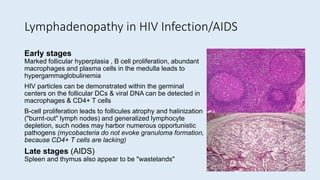
Lymphadenopathy in HIV Infection/AIDS
Early stages
Marked follicular hyperplasia , B cell proliferation, abundant
macrophages and plasma cells in the medulla leads to
hypergammaglobulinemia
HIV particles can be demonstrated within the germinal
centers on the follicular DCs & viral DNA can be detected in
macrophages & CD4+ T cells
B-cell proliferation leads to follicules atrophy and halinization
("burnt-out" lymph nodes) and generalized lymphocyte
depletion, such nodes may harbor numerous opportunistic
pathogens (mycobacteria do not evoke granuloma formation,
because CD4+ T cells are lacking)
Late stages (AIDS)
Spleen and thymus also appear to be "wastelands"
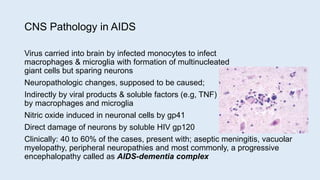
CNS Pathology in AIDS
Virus carried into brain by infected monocytes to infect
macrophages & microglia with formation of multinucleated
giant cells but sparing neurons
Neuropathologic changes, supposed to be caused;
Indirectly by viral products & soluble factors (e.g, TNF) produced
by macrophages and microglia
Nitric oxide induced in neuronal cells by gp41
Direct damage of neurons by soluble HIV gp120
Clinically: 40 to 60% of the cases, present with; aseptic meningitis, vacuolar
myelopathy, peripheral neuropathies and most commonly, a progressive
encephalopathy called as AIDS-dementia complex
Diagnosis and Monitoring of HIV infection
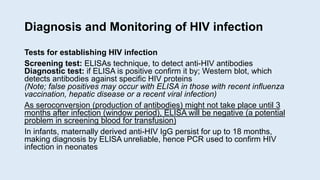
Tests for establishing HIV infection
Screening test: ELISAs technique, to detect anti-HIV antibodies
Diagnostic test: if ELISA is positive confirm it by; Western blot, which
detects antibodies against specific HIV proteins
(Note; false positives may occur with ELISA in those with recent influenza
vaccination, hepatic disease or a recent viral infection)
As seroconversion (production of antibodies) might not take place until 3
months after infection (window period), ELISA will be negative (a potential
problem in screening blood for transfusion)
In infants, maternally derived anti-HIV IgG persist for up to 18 months,
making diagnosis by ELISA unreliable, hence PCR used to confirm HIV
infection in neonates
conti…
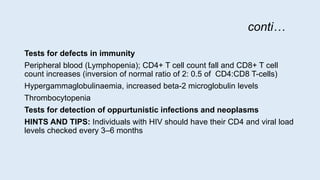
Tests for defects in immunity
Peripheral blood (Lymphopenia); CD4+ T cell count fall and CD8+ T cell
count increases (inversion of normal ratio of 2: 0.5 of CD4:CD8 T-cells)
Hypergammaglobulinaemia, increased beta-2 microglobulin levels
Thrombocytopenia
Tests for detection of oppurtunistic infections and neoplasms
HINTS AND TIPS: Individuals with HIV should have their CD4 and viral load
levels checked every 3–6 months
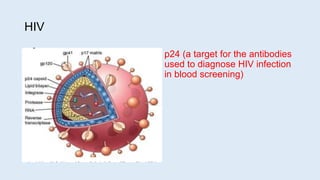
HIV
p24 (a target for the antibodies
used to diagnose HIV infection
in blood screening)
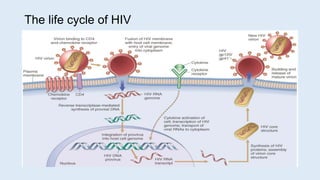
The life cycle of HIV
HIV and AIDS
Internal Assessment
Q 1. In clinically full blown AIDS, CD4+ T-cell counts is;
a. 500 cells/μL
b. 400 cells/μL
c. 300 cells/μL)
d. 200 cells/μL)
Internal Assessment
Q1. Why ELISA technique gives negative result in first 3 months of HIV
infection?
Q2. ELISA technique is based on detection of which substances in HIV
infection.
Q3. Name the diagnostic technique which is used to detect HIV infection in
neonates.
Q4. Enlist two malignancies associated with AIDS.
Learning Outcomes
Enlist causes of secondary immune deficiency diseases.
Understand epidemiology, routes of transmission and pathogenesis of
HIV infection.
Identify morphology of lymph node and CNS in AIDS
Recognise AIDS defining opportunistic infections and neoplasms
Enlist the common clinical features of AIDS
Mention tests for the diagnosis of HIV/AIDS.
References
Robbins Basic Pathology, 10th Edition (2017), By: Kumar, Abbas, Aster
(pages 173-182)
Web Path
Crash course Immunology and Hematology (pages 129-131)

Tutorial secondary idd aids

  • 1.
    SECONDARY IMMUNE DEFICIENCY DISEASES Dr.Imtiaz Ahmad Qureshi BSc, MBBS, FCPS Rabigh Medical College-KAU 2020
  • 2.
    Objectives Define secondary Immunedeficiency diseases Causes of Secondary Immune deficiency disorders Common clinical presentations: recurrent infections, fever, failure to thrive…… Acquired Immune deficiency syndrome (AIDS), causative agent, epidemiology, route of transmission and its pathogenesis. Morphology of lymph node and CNS in AIDS Name AIDS defining opportunistic infections and neoplasm Mention tests for the diagnosis of AIDS
  • 3.
    IMMUNE DEFICIENCY DISEASES(IDD) Primary IDD Rare Inherited genetic defect affecting immune system development Incidence; come to attention early in life (from 6 months to 2 years) Secondary IDD Common Acquired immune suppression due to defects in the following components of immune system; antibodies, phagocytes, complement, cell-mediated immunity and T - Lymphocytes
  • 4.
    Pathogenesis: Secondary IDD Defectsat following levels leads to increased susceptibility to infections with pyogenic bacteria and certain cancers as for example; Antibodies - Nephrotic syndrome Phagocytes - Neutropenia Complement - Systemic Lupus Erythematosus Defects in cell-mediated immunity - prone to infections caused by viruses, fungi, and intracellular bacteria T – Lymphocytes - Acquired Immunodeficiency Syndrome, lymphomas
  • 5.
    Causes of SecondaryIDD Involvement of bone marrow;; by cancers (metastases, leukemia) Irradiation and chemotherapy; leading to bone marrow suppression HIV infection; depletion of CD4+ helper T cells Steroids; for organ transplants Malnutrition (protein deficiency); impairs cell mediated immunity Chronic renal failure; toxic metabolites affects B & T cell functions Splenectomy; in lymphomas, lead to decreased phagocytic activity
  • 6.
    HIV Infection andAIDS Epidemiology Age: 15 and 49 years of age Sex: About 50% adults homosexual or bisexual men and 20% heterosexual men are at high risk for developing AIDS in USA, whereas; in Africa and Asia largest group at risk are heterosexual mostly women infected by male partners Geographical distribution: Two genetically different but related form of HIV infections associated with AIDS are; HIV-1 The most common type in USA, Europe and Central Africa HIV-2 Most common in West Africa and India Of the estimated 36 million HIV infected peoples worldwide about 70% are in Africa and 20% in Asia Mortality: 1to 2 million deaths annually
  • 7.
    Pathogenesis & NaturalHistory of HIV Infection Centers for Disease Control (CDC)USA clinically categorize HIV infection into three phases on the basis of CD4+ T-cell counts : Early acute phase CDC-A (CD4+ T-cell counts more than 500 cells/μL) Middle chronic phase CDC-B (CD4+ T-cell counts between 200 and 500 cells/μL) Final crisis phase CDC-C (CD4+ T-cell counts less than 200 cells/μL) For clinical management, CD4+ cell counts are an important adjunct to HIV viral load measurements.
  • 8.
    Early Acute Phaseof HIV Infection conti…… Epithelial dendritic cells capture virus from entry sites and migrate into lymph nodes, may pass HIV on to CD4+ T cells through direct contact Within days virus replication in lymph nodes leads to viremia, infecting helper T cells, macrophages, and dendritic cells in peripheral lymphoid tissues, called as; acute HIV syndrome Usually within 3 to 17 weeks of exposure development of virus-specific CD8+ CTLs and humoral immune responses against viral antigens, partially control the viral production, decreasing viremia CD4+ T cells count return to nearly normal, but viral replication continues within CD4+ T cells and macrophages in the tissues, viral load in this phase is called the set point Anti retroviral therapy can reduce this set point, early detection in cases of needle stick injuries, rape and other risky exercises can benefit from it
  • 9.
    Early Acute Phaseof HIV Infection Clinical manifestations A self-limited illness, in 50% to 70% of adults After 3 to 6 weeks of HIV infection, individuals develop nonspecific flu like symptoms (sore throat, myalgia, fever, rash, and aseptic meningitis) and their body started producing antibody to HIV, called seroconversion illness Most individuals exposed to HIV sexually, become chronically infected as antibody is largely ineffective against intracellular virus In clinical latency period the immune system remains competent, as majority of peripheral blood T cells do not harbor the virus
  • 10.
    Middle; Chronic Phaseof HIV Infection HIV continuous replication and cell destruction in lymph nodes and spleen, decreases CD4+ T cells in blood, but at same time is replenished by a large proportion of the CD4+ T cells thus decline of CD4+ T cells in the peripheral blood is modest Immune system largely intact, but HIV replication continues and may last for 10 -12 years After an extended and variable period, the number of CD4+ T cells and host defenses begin to decrease thus ending up into final crisis phase Clinically; Asymptomatic or develop persistent generalized lymphadenopathy (PGL)
  • 11.
    Final; Crisis PhaseHIV Infection Over a period of years, breakdown of host defenses, viremia and constant destruction of CD4+ T cells results in decrease in the number of CD4+ T cells in the lymphoid tissues and in the circulation Macrophages parasitized by the virus early are not lysed and they transport the virus to tissues, particularly the brain AIDS: an advanced form of HIV infection, patient develops serious opportunistic infections, secondary neoplasms, and/or neurologic manifestations or when his CD4+ T cell counts is less than or equal to 200 cells/μL Clinically; patients present with fever of more than 1 month's duration, fatigue, weight loss, and diarrhea
  • 12.
    How does HIVprogress to AIDS? Reverse transcriptase makes mutations for roughly 1 in every 10,000, the immune system may no longer recognize such mutations and requires another fresh immune response HIV can hide in host DNA, remains dormant for many years (latent phase) reactivation results in production of HIV RNA, and the infection continues CD4 count declines, cytotoxic T lymphocytes become less effective as they receive less support from T helper cells Infected macrophages, resistant to the cytopathic effects of HIV, therefore harbor the virus for long periods Circulating monocytes also transport HIV to various organs, like; brain HINTS AND TIPS Each infected individual contains many hundreds of slightly different strains following infection with a single virus
  • 13.
    AIDS-Defining Diseases (OpportunisticInfections & Neoplasms) PROTOZOAL & HELMINTHIC INFECTIONS Cryptosporidiosis or isosporidiosis (enteritis) Pneumocystis carinii ( jiroveci) pneumonia Toxoplasmosis (pneumonia or CNS infection) FUNGAL INFECTIONS Candidiasis (esophageal, tracheal or pulmonary) Cryptococcosis (CNS infection) Coccidioidomycosis (disseminated) Histoplasmosis (disseminated) BACTERIAL INFECTIONS Atypical / M. tuberculosis, pulmonary or extra- pulmonary) VIRAL INFECTIONS Cytogegalovirus (pulmonary, intestinal, retinitis, or CNS infections) Herpes simplex virus (localized or disseminated) Varicella-zoster virus (localized or disseminated) JC virus (Progressive multifocal leukoencephalopathy) Neoplasms Kaposi sarcoma Non-Hodgkin lymphomas high-grade diffuse B-cell type Invasive cancer of uterine cervix
  • 14.
    Lymphadenopathy in HIVInfection/AIDS Early stages Marked follicular hyperplasia , B cell proliferation, abundant macrophages and plasma cells in the medulla leads to hypergammaglobulinemia HIV particles can be demonstrated within the germinal centers on the follicular DCs & viral DNA can be detected in macrophages & CD4+ T cells B-cell proliferation leads to follicules atrophy and halinization ("burnt-out" lymph nodes) and generalized lymphocyte depletion, such nodes may harbor numerous opportunistic pathogens (mycobacteria do not evoke granuloma formation, because CD4+ T cells are lacking) Late stages (AIDS) Spleen and thymus also appear to be "wastelands"
  • 15.
    CNS Pathology inAIDS Virus carried into brain by infected monocytes to infect macrophages & microglia with formation of multinucleated giant cells but sparing neurons Neuropathologic changes, supposed to be caused; Indirectly by viral products & soluble factors (e.g, TNF) produced by macrophages and microglia Nitric oxide induced in neuronal cells by gp41 Direct damage of neurons by soluble HIV gp120 Clinically: 40 to 60% of the cases, present with; aseptic meningitis, vacuolar myelopathy, peripheral neuropathies and most commonly, a progressive encephalopathy called as AIDS-dementia complex
  • 16.
    Diagnosis and Monitoringof HIV infection Tests for establishing HIV infection Screening test: ELISAs technique, to detect anti-HIV antibodies Diagnostic test: if ELISA is positive confirm it by; Western blot, which detects antibodies against specific HIV proteins (Note; false positives may occur with ELISA in those with recent influenza vaccination, hepatic disease or a recent viral infection) As seroconversion (production of antibodies) might not take place until 3 months after infection (window period), ELISA will be negative (a potential problem in screening blood for transfusion) In infants, maternally derived anti-HIV IgG persist for up to 18 months, making diagnosis by ELISA unreliable, hence PCR used to confirm HIV infection in neonates
  • 17.
    conti… Tests for defectsin immunity Peripheral blood (Lymphopenia); CD4+ T cell count fall and CD8+ T cell count increases (inversion of normal ratio of 2: 0.5 of CD4:CD8 T-cells) Hypergammaglobulinaemia, increased beta-2 microglobulin levels Thrombocytopenia Tests for detection of oppurtunistic infections and neoplasms HINTS AND TIPS: Individuals with HIV should have their CD4 and viral load levels checked every 3–6 months
  • 18.
    HIV p24 (a targetfor the antibodies used to diagnose HIV infection in blood screening)
  • 19.
  • 20.
  • 21.
    Internal Assessment Q 1.In clinically full blown AIDS, CD4+ T-cell counts is; a. 500 cells/μL b. 400 cells/μL c. 300 cells/μL) d. 200 cells/μL)
  • 22.
    Internal Assessment Q1. WhyELISA technique gives negative result in first 3 months of HIV infection? Q2. ELISA technique is based on detection of which substances in HIV infection. Q3. Name the diagnostic technique which is used to detect HIV infection in neonates. Q4. Enlist two malignancies associated with AIDS.
  • 23.
    Learning Outcomes Enlist causesof secondary immune deficiency diseases. Understand epidemiology, routes of transmission and pathogenesis of HIV infection. Identify morphology of lymph node and CNS in AIDS Recognise AIDS defining opportunistic infections and neoplasms Enlist the common clinical features of AIDS Mention tests for the diagnosis of HIV/AIDS.
  • 24.
    References Robbins Basic Pathology,10th Edition (2017), By: Kumar, Abbas, Aster (pages 173-182) Web Path Crash course Immunology and Hematology (pages 129-131)

Editor's Notes

  • #6 A normal CD4 count is from 500 to 1,500 cells per cubic millimeter of blood. Splenectomy e.g in lymphomas, lead to decreased phagocytic activity
  • #8 Sexual contact: More than 75% of all cases of HIV transmission (Virus present both in semen and within mononuclear inflammatory cells, enters the recipient's body through lacerations or abrasions in mucosa. Rectal mucosa harbor HIV
  • #13 AIDS patient without treatment can live for 3 years, young person diagnosed of HIV infection can live for 30 to 60 years