Secondary immunodeficiency, or acquired
immunodeficiency, is the loss of immune function
and results from exposure to various agents (not
a genetic or developmental problem). By far the
most common secondary immunodeficiency is
Acquired Immunodeficiency Syndrome, or
                  AIDS,
which results from infection with the human
immunodeficiency virus 1 (HIV-1)
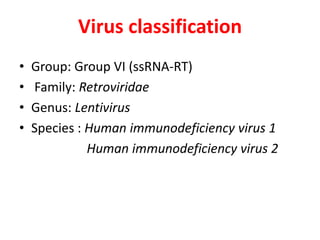
Virus classification
•   Group: Group VI (ssRNA-RT)
•   Family: Retroviridae
•   Genus: Lentivirus
•   Species : Human immunodeficiency virus 1
              Human immunodeficiency virus 2
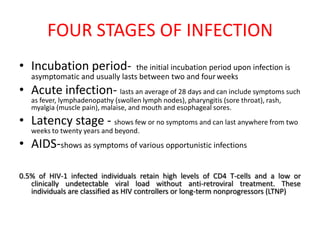
FOUR STAGES OF INFECTION
• Incubation period-             the initial incubation period upon infection is
   asymptomatic and usually lasts between two and four weeks
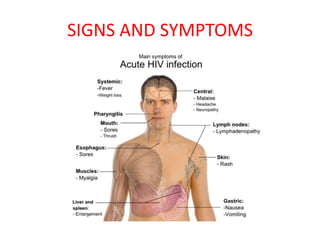
• Acute infection- lasts an average of 28 days and can include symptoms such
   as fever, lymphadenopathy (swollen lymph nodes), pharyngitis (sore throat), rash,
   myalgia (muscle pain), malaise, and mouth and esophageal sores.
• Latency stage - shows few or no symptoms and can last anywhere from two
   weeks to twenty years and beyond.
• AIDS-shows as symptoms of various opportunistic infections

0.5% of HIV-1 infected individuals retain high levels of CD4 T-cells and a low or
   clinically undetectable viral load without anti-retroviral treatment. These
   individuals are classified as HIV controllers or long-term nonprogressors (LTNP)
SIGNS AND SYMPTOMS
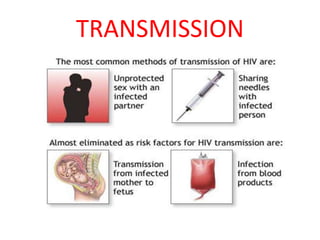
TRANSMISSION
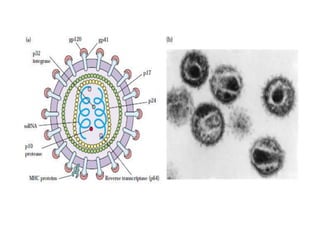
STRUCTURE OF THE VIRUS- HIV1
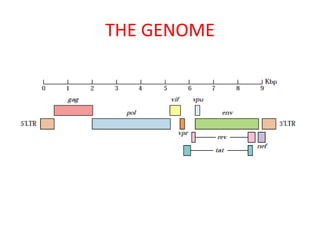
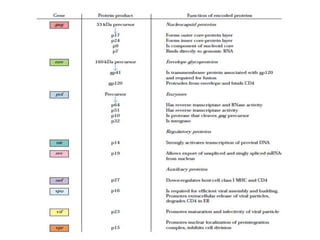
THE GENOME
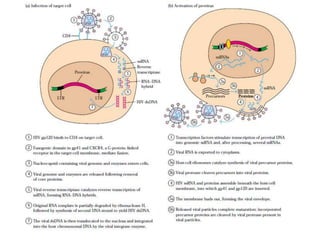
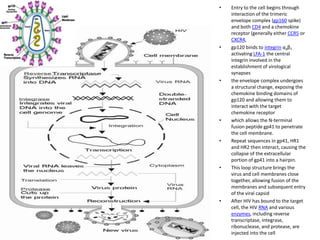
LIFE CYCLE
•   Entry to the cell begins through
    interaction of the trimeric
    envelope complex (gp160 spike)
    and both CD4 and a chemokine
    receptor (generally either CCR5 or
    CXCR4,
•   gp120 binds to integrin α4β7
    activating LFA-1 the central
    integrin involved in the
    establishment of virological
    synapses
•   the envelope complex undergoes
    a structural change, exposing the
    chemokine binding domains of
    gp120 and allowing them to
    interact with the target
    chemokine receptor
•   which allows the N-terminal
    fusion peptide gp41 to penetrate
    the cell membrane.
•   Repeat sequences in gp41, HR1
    and HR2 then interact, causing the
    collapse of the extracellular
    portion of gp41 into a hairpin.
•   This loop structure brings the
    virus and cell membranes close
    together, allowing fusion of the
    membranes and subsequent entry
    of the viral capsid
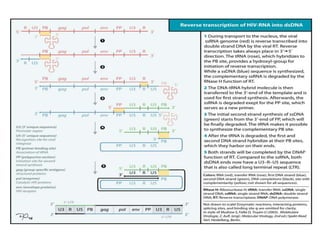
•   After HIV has bound to the target
    cell, the HIV RNA and various
    enzymes, including reverse
    transcriptase, integrase,
    ribonuclease, and protease, are
    injected into the cell
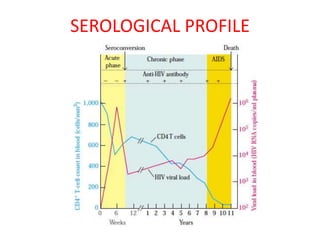
SEROLOGICAL PROFILE
HIV TROPISM
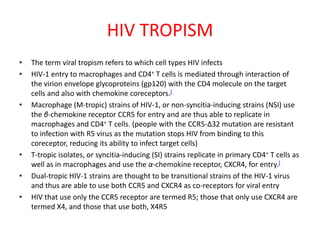
•   The term viral tropism refers to which cell types HIV infects
•   HIV-1 entry to macrophages and CD4+ T cells is mediated through interaction of
    the virion envelope glycoproteins (gp120) with the CD4 molecule on the target
    cells and also with chemokine coreceptors.[
•   Macrophage (M-tropic) strains of HIV-1, or non-syncitia-inducing strains (NSI) use
    the β-chemokine receptor CCR5 for entry and are thus able to replicate in
    macrophages and CD4+ T cells. (people with the CCR5-Δ32 mutation are resistant
    to infection with R5 virus as the mutation stops HIV from binding to this
    coreceptor, reducing its ability to infect target cells)
•   T-tropic isolates, or syncitia-inducing (SI) strains replicate in primary CD4+ T cells as
    well as in macrophages and use the α-chemokine receptor, CXCR4, for entry.[
•   Dual-tropic HIV-1 strains are thought to be transitional strains of the HIV-1 virus
    and thus are able to use both CCR5 and CXCR4 as co-receptors for viral entry
•   HIV that use only the CCR5 receptor are termed R5; those that only use CXCR4 are
    termed X4, and those that use both, X4R5
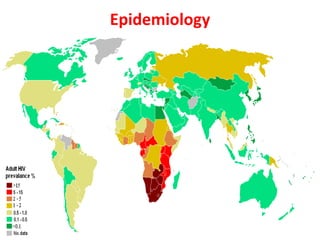
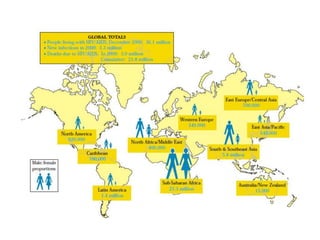
Epidemiology
TREATMENT
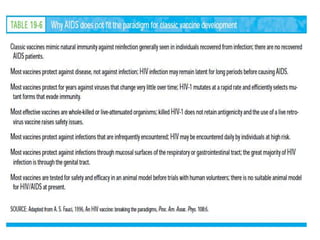
•   There is currently no publicly available vaccine or cure for HIV or AIDS
•   Current treatment for HIV infection consists of highly active antiretroviral therapy,
    or HAART.
•   Current HAART options are combinations (or "cocktails") consisting of at least
    three drugs belonging to at least two types, or "classes," of antiretroviral agents.
    Typically, these classes are two nucleoside analogue reverse transcriptase
    inhibitors (NARTIs or NRTIs) plus either a protease inhibitor or a non-nucleoside
    reverse transcriptase inhibitor (NNRTI)
•   Zidovudine & Lamibudine (NRTI) , Nevirapine & Nefavirenz (NNRTI) ->regime ZLN
•   SLN - Saquinavir (NRTI)
•   Ritonavir Saquanvir Emprinavir (PI)
•   One study suggests the average life expectancy of an HIV infected individual is 32
    years from the time of infection if treatment is started when the CD4 count is
    350/µL.In the absence of HAART, progression from HIV infection to AIDS has been
    observed to occur at a median of between nine to ten years and the median
    survival time after developing AIDS is only 9.2 months
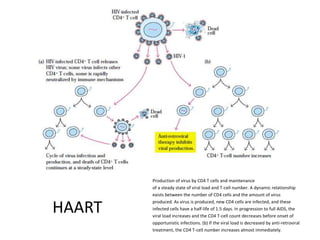
Production of virus by CD4 T cells and maintenance
        of a steady state of viral load and T-cell number. A dynamic relationship
        exists between the number of CD4 cells and the amount of virus


HAART
        produced. As virus is produced, new CD4 cells are infected, and these
        infected cells have a half-life of 1.5 days. In progression to full AIDS, the
        viral load increases and the CD4 T-cell count decreases before onset of
        opportunistic infections. (b) If the viral load is decreased by anti-retroviral
        treatment, the CD4 T-cell number increases almost immediately.
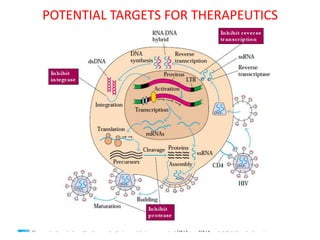
POTENTIAL TARGETS FOR THERAPEUTICS
Aids – A Secondary Immunodeficiency Disorder

Aids – A Secondary Immunodeficiency Disorder

  • 2.
    Secondary immunodeficiency, oracquired immunodeficiency, is the loss of immune function and results from exposure to various agents (not a genetic or developmental problem). By far the most common secondary immunodeficiency is Acquired Immunodeficiency Syndrome, or AIDS, which results from infection with the human immunodeficiency virus 1 (HIV-1)
  • 3.
    Virus classification • Group: Group VI (ssRNA-RT) • Family: Retroviridae • Genus: Lentivirus • Species : Human immunodeficiency virus 1 Human immunodeficiency virus 2
  • 4.
    FOUR STAGES OFINFECTION • Incubation period- the initial incubation period upon infection is asymptomatic and usually lasts between two and four weeks • Acute infection- lasts an average of 28 days and can include symptoms such as fever, lymphadenopathy (swollen lymph nodes), pharyngitis (sore throat), rash, myalgia (muscle pain), malaise, and mouth and esophageal sores. • Latency stage - shows few or no symptoms and can last anywhere from two weeks to twenty years and beyond. • AIDS-shows as symptoms of various opportunistic infections 0.5% of HIV-1 infected individuals retain high levels of CD4 T-cells and a low or clinically undetectable viral load without anti-retroviral treatment. These individuals are classified as HIV controllers or long-term nonprogressors (LTNP)
  • 5.
  • 6.
  • 7.
    STRUCTURE OF THEVIRUS- HIV1
  • 9.
  • 11.
  • 13.
    Entry to the cell begins through interaction of the trimeric envelope complex (gp160 spike) and both CD4 and a chemokine receptor (generally either CCR5 or CXCR4, • gp120 binds to integrin α4β7 activating LFA-1 the central integrin involved in the establishment of virological synapses • the envelope complex undergoes a structural change, exposing the chemokine binding domains of gp120 and allowing them to interact with the target chemokine receptor • which allows the N-terminal fusion peptide gp41 to penetrate the cell membrane. • Repeat sequences in gp41, HR1 and HR2 then interact, causing the collapse of the extracellular portion of gp41 into a hairpin. • This loop structure brings the virus and cell membranes close together, allowing fusion of the membranes and subsequent entry of the viral capsid • After HIV has bound to the target cell, the HIV RNA and various enzymes, including reverse transcriptase, integrase, ribonuclease, and protease, are injected into the cell
  • 15.
  • 16.
    HIV TROPISM • The term viral tropism refers to which cell types HIV infects • HIV-1 entry to macrophages and CD4+ T cells is mediated through interaction of the virion envelope glycoproteins (gp120) with the CD4 molecule on the target cells and also with chemokine coreceptors.[ • Macrophage (M-tropic) strains of HIV-1, or non-syncitia-inducing strains (NSI) use the β-chemokine receptor CCR5 for entry and are thus able to replicate in macrophages and CD4+ T cells. (people with the CCR5-Δ32 mutation are resistant to infection with R5 virus as the mutation stops HIV from binding to this coreceptor, reducing its ability to infect target cells) • T-tropic isolates, or syncitia-inducing (SI) strains replicate in primary CD4+ T cells as well as in macrophages and use the α-chemokine receptor, CXCR4, for entry.[ • Dual-tropic HIV-1 strains are thought to be transitional strains of the HIV-1 virus and thus are able to use both CCR5 and CXCR4 as co-receptors for viral entry • HIV that use only the CCR5 receptor are termed R5; those that only use CXCR4 are termed X4, and those that use both, X4R5
  • 17.
  • 19.
    TREATMENT • There is currently no publicly available vaccine or cure for HIV or AIDS • Current treatment for HIV infection consists of highly active antiretroviral therapy, or HAART. • Current HAART options are combinations (or "cocktails") consisting of at least three drugs belonging to at least two types, or "classes," of antiretroviral agents. Typically, these classes are two nucleoside analogue reverse transcriptase inhibitors (NARTIs or NRTIs) plus either a protease inhibitor or a non-nucleoside reverse transcriptase inhibitor (NNRTI) • Zidovudine & Lamibudine (NRTI) , Nevirapine & Nefavirenz (NNRTI) ->regime ZLN • SLN - Saquinavir (NRTI) • Ritonavir Saquanvir Emprinavir (PI) • One study suggests the average life expectancy of an HIV infected individual is 32 years from the time of infection if treatment is started when the CD4 count is 350/µL.In the absence of HAART, progression from HIV infection to AIDS has been observed to occur at a median of between nine to ten years and the median survival time after developing AIDS is only 9.2 months
  • 20.
    Production of virusby CD4 T cells and maintenance of a steady state of viral load and T-cell number. A dynamic relationship exists between the number of CD4 cells and the amount of virus HAART produced. As virus is produced, new CD4 cells are infected, and these infected cells have a half-life of 1.5 days. In progression to full AIDS, the viral load increases and the CD4 T-cell count decreases before onset of opportunistic infections. (b) If the viral load is decreased by anti-retroviral treatment, the CD4 T-cell number increases almost immediately.
  • 22.