

IMMUNODEFICIENCY DISORDER
By
Bhukya.Nom Kumar
Naik
2nd pharm .D
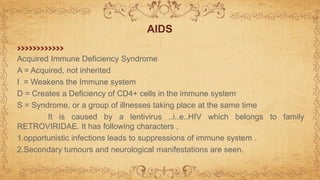
AIDS
Acquired Immune Deficiency Syndrome
A = Acquired, not inherited
I = Weakens the Immune system
D = Creates a Deficiency of CD4+ cells in the immune system
S = Syndrome, or a group of illnesses taking place at the same time
It is caused by a lentivirus ..i..e..HIV which belongs to family
RETROVIRIDAE. It has following characters ,
1.opportunistic infections leads to suppressions of immune system .
2.Secondary tumours and neurological manifestations are seen.
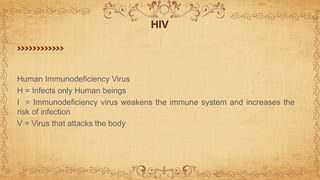
Human Immunodeficiency Virus
H = Infects only Human beings
I = Immunodeficiency virus weakens the immune system and increases the
risk of infection
V = Virus that attacks the body
HIV
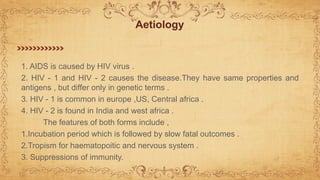
1. AIDS is caused by HIV virus .
2. HIV - 1 and HIV - 2 causes the disease.They have same properties and
antigens , but differ only in genetic terms .
3. HIV - 1 is common in europe ,US, Central africa .
4. HIV - 2 is found in India and west africa .
The features of both forms include ,
1.Incubation period which is followed by slow fatal outcomes .
2.Tropism for haematopoitic and nervous system .
3. Suppressions of immunity.
Aetiology
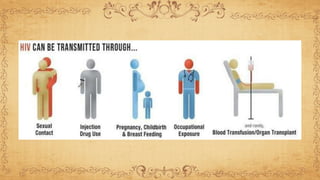
1. Sexual contact most important mode of transmission /Acquisition of HIV
world wide
A. Heterosexual .
B. Homosexual.
C. Non - consensual sexual exposure (Assault )
2. Parenteral .
A. Blood or Blood products .
B. Infected blood or body fluids through contaminated sharps.
C. IDU through needle - sharping or needle stick accidents .
Route of Transmission
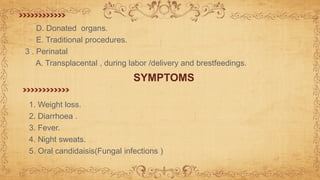
D. Donated organs.
E. Traditional procedures.
3 . Perinatal
A. Transplacental , during labor /delivery and brestfeedings.
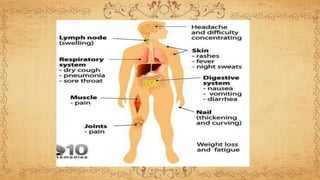
SYMPTOMS
1. Weight loss.
2. Diarrhoea .
3. Fever.
4. Night sweats.
5. Oral candidaisis(Fungal infections )
6. Skin rashes.
7. Flaky skin .
8. Short term memory loss .
9. Sever pain .
10. Numbness in hands and feet .
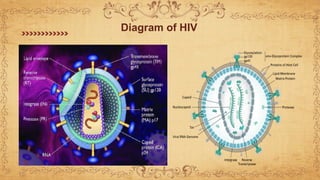
Structure of HIV
1.Retrovirus (HIV) spherical in shape
2.size range between 100 - 140 nm.
3. It contain electron dense core which is surrounded by a lipid membrane.
4. The core is made up of 2 RNA stands , reverse transcriptase emzyme and core
proteins (p24 and p18 )
Diagram of HIV
5. The bilayer of a core is studded with 2 viral glycoproteins (gp120 and gp41)
6. These glycoproteins are important for Hiv infection.
7. HIV - 1 genome contains gens namely gag , pol , env and tat.
1.Gag produce core proteins (p24 and p18)
2.Pol for reverse transcriptase emzymes.
3.Env for envelop or lipid proteins (gp120 and gp41)
4.Tat gene is responsible for carrying out the functions of viral
amplification , budding and replication.
Gag, pol , env and tat are markers for diagnosis in laboratory .
The 2 major systems affected by HIV are : -
1 . Immune system and
2 . Central nervous system (CNS).
1. Immune system pathogenesis : - immune system is made up of T - cells (cell
mediated immunity ) and B - cells (antigen - antibody mediated immunity ).
T - cell (cell mediated immunity ) : -
1.HIV mainly affects the cell mediated immunity .
2. The normal function of T - cell is recognition and binding to
specific T - cell receptors .
PATHOPHYSIOLOGY
3. The T - cell express a variety of molecular protein complexes like CD3
,CD4(80%) , CD8 (30%) ,CD11A , and CD2.
4 . Of all of these complexes CD4 and CD8 T - cells are expressed as
mutually exclusive subsets.
CD4 T - cell functions are : -
1. They are the master regulator of immune system .
2 . Secrete some soluble factors like cytokines which influence the
other T - cells of the immune system .If CD4 T - cells count are less , then it
indicates regulation of immune system is improper
The intensity of the disease is measured by count of CD4 and CD8
cells.
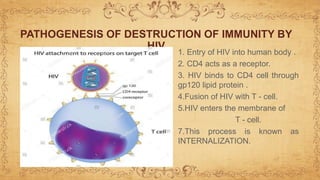
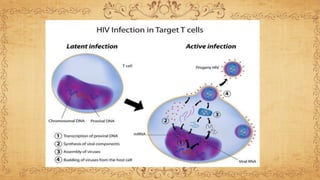
1. Entry of HIV into human body .
2. CD4 acts as a receptor.
3. HIV binds to CD4 cell through
gp120 lipid protein .
4.Fusion of HIV with T - cell.
5.HIV enters the membrane of
T - cell.
7.This process is known as
INTERNALIZATION.
PATHOGENESIS OF DESTRUCTION OF IMMUNITY BY
HIV
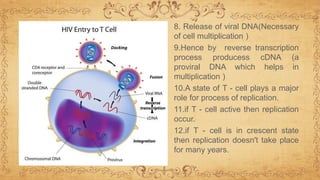
8. Release of viral DNA(Necessary
of cell multiplication )
9.Hence by reverse transcription
process producess cDNA (a
proviral DNA which helps in
multiplication )
10.A state of T - cell plays a major
role for process of replication.
11.if T - cell active then replication
occur.
12.if T - cell is in crescent state
then replication doesn't take place
for many years.
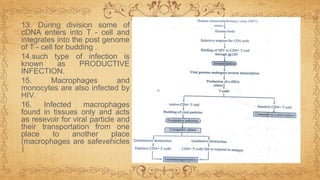
13. During division some of
cDNA enters into T - cell and
integrates into the post genome
of T - cell for budding .
14.such type of infection is
known as PRODUCTIVE
INFECTION.
15. Macrophages and
monocytes are also infected by
HIV.
16. Infected macrophages
found in tissues only and acts
as resevoir for viral particle and
their transportation from one
place to another place
(macrophages are safevehicles
)
B - cell (antigen - antibody mediated immunity)
B - cells are destroyed by glycoprotein (gp120) of HIV . The cell mediated
immunity (by T - cells ) is relatively affected than antigen - antibody mediated
immunity (B - cells).
2 .Central nervous system pathogenesis ; -After the attack of immune
system , monocytes and macrophages are targeted . The HIV infected
macrophages produce Cytokines which are highly toxic to the neuronal cells.
There are 3 phases : - 1 . Early /acute phase.
2 . Middle /chronic phase.
3 . Final /crisis phase or AIDS.
Phases of HIV infection
1. It represents initial response tothe body .
2.Large amount of viruses are produced in the body
3. Fever is the most common symptom.
Other symptoms include:
1.headaches
2.sore throat
3.excessive fatigue
4.chills
5.muscle pain
6.swollen lymph nodes
7.maculopapular truncal rash
1.Early / Acute phase : -
1.HIV virus multiplies at very slow , but is still active .
2.CD4 falls below 200/mm3 , with out treatment people can survive
2 - 3 years and are prone to many infections .
3.People with advanced, chronic HIV can experience episodes of:
a.coughing or breathing difficulties.
b.weight loss
c.diarrhea
d.fatigue
e.high fever
2. Middle / chronic phase : -
1. During this phase the patient is diagnosed , when the immune system is at total
risk .
2.Patient is considered to be AIDS.
3.Symptoms of AIDS include:
a.persistent high fevers of over 100°F (37.8°C)
b.severe chills and night sweats
c.white spots in the mouth
d.genital or anal sores
e.severe fatigue
f.rashes that can be brown, red, purple, or pink in color
g.regular coughing and breathing problems
h.significant weight loss
i.persistent headaches
j.memory problems
k.pneumonia
3. Final / crisis phase or AIDS : -
Thank
you

Immunodeficiency disorder by nom naik

  • 1.
  • 3.
    AIDS Acquired Immune DeficiencySyndrome A = Acquired, not inherited I = Weakens the Immune system D = Creates a Deficiency of CD4+ cells in the immune system S = Syndrome, or a group of illnesses taking place at the same time It is caused by a lentivirus ..i..e..HIV which belongs to family RETROVIRIDAE. It has following characters , 1.opportunistic infections leads to suppressions of immune system . 2.Secondary tumours and neurological manifestations are seen.
  • 4.
    Human Immunodeficiency Virus H= Infects only Human beings I = Immunodeficiency virus weakens the immune system and increases the risk of infection V = Virus that attacks the body HIV
  • 5.
    1. AIDS iscaused by HIV virus . 2. HIV - 1 and HIV - 2 causes the disease.They have same properties and antigens , but differ only in genetic terms . 3. HIV - 1 is common in europe ,US, Central africa . 4. HIV - 2 is found in India and west africa . The features of both forms include , 1.Incubation period which is followed by slow fatal outcomes . 2.Tropism for haematopoitic and nervous system . 3. Suppressions of immunity. Aetiology
  • 6.
    1. Sexual contactmost important mode of transmission /Acquisition of HIV world wide A. Heterosexual . B. Homosexual. C. Non - consensual sexual exposure (Assault ) 2. Parenteral . A. Blood or Blood products . B. Infected blood or body fluids through contaminated sharps. C. IDU through needle - sharping or needle stick accidents . Route of Transmission
  • 8.
    D. Donated organs. E.Traditional procedures. 3 . Perinatal A. Transplacental , during labor /delivery and brestfeedings. SYMPTOMS 1. Weight loss. 2. Diarrhoea . 3. Fever. 4. Night sweats. 5. Oral candidaisis(Fungal infections )
  • 10.
    6. Skin rashes. 7.Flaky skin . 8. Short term memory loss . 9. Sever pain . 10. Numbness in hands and feet . Structure of HIV 1.Retrovirus (HIV) spherical in shape 2.size range between 100 - 140 nm. 3. It contain electron dense core which is surrounded by a lipid membrane. 4. The core is made up of 2 RNA stands , reverse transcriptase emzyme and core proteins (p24 and p18 )
  • 11.
  • 12.
    5. The bilayerof a core is studded with 2 viral glycoproteins (gp120 and gp41) 6. These glycoproteins are important for Hiv infection. 7. HIV - 1 genome contains gens namely gag , pol , env and tat. 1.Gag produce core proteins (p24 and p18) 2.Pol for reverse transcriptase emzymes. 3.Env for envelop or lipid proteins (gp120 and gp41) 4.Tat gene is responsible for carrying out the functions of viral amplification , budding and replication. Gag, pol , env and tat are markers for diagnosis in laboratory .
  • 13.
    The 2 majorsystems affected by HIV are : - 1 . Immune system and 2 . Central nervous system (CNS). 1. Immune system pathogenesis : - immune system is made up of T - cells (cell mediated immunity ) and B - cells (antigen - antibody mediated immunity ). T - cell (cell mediated immunity ) : - 1.HIV mainly affects the cell mediated immunity . 2. The normal function of T - cell is recognition and binding to specific T - cell receptors . PATHOPHYSIOLOGY
  • 14.
    3. The T- cell express a variety of molecular protein complexes like CD3 ,CD4(80%) , CD8 (30%) ,CD11A , and CD2. 4 . Of all of these complexes CD4 and CD8 T - cells are expressed as mutually exclusive subsets. CD4 T - cell functions are : - 1. They are the master regulator of immune system . 2 . Secrete some soluble factors like cytokines which influence the other T - cells of the immune system .If CD4 T - cells count are less , then it indicates regulation of immune system is improper The intensity of the disease is measured by count of CD4 and CD8 cells.
  • 15.
    1. Entry ofHIV into human body . 2. CD4 acts as a receptor. 3. HIV binds to CD4 cell through gp120 lipid protein . 4.Fusion of HIV with T - cell. 5.HIV enters the membrane of T - cell. 7.This process is known as INTERNALIZATION. PATHOGENESIS OF DESTRUCTION OF IMMUNITY BY HIV
  • 16.
    8. Release ofviral DNA(Necessary of cell multiplication ) 9.Hence by reverse transcription process producess cDNA (a proviral DNA which helps in multiplication ) 10.A state of T - cell plays a major role for process of replication. 11.if T - cell active then replication occur. 12.if T - cell is in crescent state then replication doesn't take place for many years.
  • 17.
    13. During divisionsome of cDNA enters into T - cell and integrates into the post genome of T - cell for budding . 14.such type of infection is known as PRODUCTIVE INFECTION. 15. Macrophages and monocytes are also infected by HIV. 16. Infected macrophages found in tissues only and acts as resevoir for viral particle and their transportation from one place to another place (macrophages are safevehicles )
  • 19.
    B - cell(antigen - antibody mediated immunity) B - cells are destroyed by glycoprotein (gp120) of HIV . The cell mediated immunity (by T - cells ) is relatively affected than antigen - antibody mediated immunity (B - cells). 2 .Central nervous system pathogenesis ; -After the attack of immune system , monocytes and macrophages are targeted . The HIV infected macrophages produce Cytokines which are highly toxic to the neuronal cells. There are 3 phases : - 1 . Early /acute phase. 2 . Middle /chronic phase. 3 . Final /crisis phase or AIDS. Phases of HIV infection
  • 20.
    1. It representsinitial response tothe body . 2.Large amount of viruses are produced in the body 3. Fever is the most common symptom. Other symptoms include: 1.headaches 2.sore throat 3.excessive fatigue 4.chills 5.muscle pain 6.swollen lymph nodes 7.maculopapular truncal rash 1.Early / Acute phase : -
  • 21.
    1.HIV virus multipliesat very slow , but is still active . 2.CD4 falls below 200/mm3 , with out treatment people can survive 2 - 3 years and are prone to many infections . 3.People with advanced, chronic HIV can experience episodes of: a.coughing or breathing difficulties. b.weight loss c.diarrhea d.fatigue e.high fever 2. Middle / chronic phase : -
  • 22.
    1. During thisphase the patient is diagnosed , when the immune system is at total risk . 2.Patient is considered to be AIDS. 3.Symptoms of AIDS include: a.persistent high fevers of over 100°F (37.8°C) b.severe chills and night sweats c.white spots in the mouth d.genital or anal sores e.severe fatigue f.rashes that can be brown, red, purple, or pink in color g.regular coughing and breathing problems h.significant weight loss i.persistent headaches j.memory problems k.pneumonia 3. Final / crisis phase or AIDS : -
  • 24.