Masters of pharmacy, Pharmaceutical technology (Pharmaceutics)
Subject- Modern pharmaceutical analytical techniques (Mpt-101T)
Lesion no- 6 IMMUNOLOGICAL ASSAYS By- Drx JAYESH M RAJPUT
Points:-
1) Immunological assays (Immunoassay)
An immunoassay is a biochemical test that measures the presence or concentration of a macromolecule or a
small molecule or a small molecule in a solution through the use of an antibody (usually) or an antigen
(sometimes). The molecule detected by the immunoassay is often referred to as an “analyte” and is in many
cases a protein although it may be other kinds of molecules, of different size and types, as long as the proper
antibodies that have the adequate properties for the assay are developed. Analytes in biological liquids such
as serum or urine are frequently measured using immunoassays for medical and research purposes.
Immunoassays come in many different formats and variations. Immunoassays may be run in multiple steps
with reagents being added and washed away or separated at different points in the assay. Multiple-step
assays are often called separation immunoassays or heterogeneous immunoassays. Some immunoassays
can be carried out simply by mixing the reagents and sample and making a physical measurement. Such
assays are called homogeneous immunoassays, or less frequently non-separation immunoassays.
The use of a calibrator is often employed in immunoassays. Calibrators are solutions that are known to
contain the analyte in questions, and the concentration of that analyte is generally known. Comparison of an
assay’s response to a real sample against the assay’s response produced by the calibrator makes it possible
to interpret the signal in terms of the presence or concentration of analyte in the sample.
Immunoassay relies on the ability of an antibody to recognize and bind a specific macromolecule in what
might be a complex mixture of macromolecules. In immunology the particular macromolecule bound by an
antibody is referred to as an antigen and the area on an antigen to which the antibody binds is called an
epitope, in some cases, an immunoassay may use an antigen to detect for the presence of antibodies, which
recognize that antigen, in a solution. In other words, in some immunoassays, the analyte may be an antibody
rather than an antigen. In addition to the binding of an antibody to its antigen, the other key feature of all
immunoassays is a means to produce a measurable signal in response to the binding. Most though not all,
immunoassays involve chemically linking antibodies or antigens with some kind of detectable label. A large
number of labels exist in modern immunoassays, and they allow for detection through different means
many labels are detectable because they emit radiation, produce a color change in a solution, fluorescence
under light, or can be induced to emit light.
 immunoassay means a method to measure any particular substance in a mixture using its specific-
binding antibody
 one of the merits of immunoassay is that we can measure a substance that is present in a mixture of
various contaminants
 immunoassay have become very popular in view of their high sensitivity, safety, economy and simple
instrument requirements
2) RIA (Radio Immuno assays)
The technique was introduced in 1960 by berson and Yalow as an assay for the concentration of insulin in
plasma, it represented the first time that hormone levels in the blood could be detected by an in vitro assay,
and the sensitivity range is 0.0006-0.006 micro gram antibody/ml. RADIOIMMUNOASSAY (RIA) is a very
sensitive in vitro assay technique in which antibody or antigen is labeled with a radioactive material (I-125)
 it is used to measure concentrations of antigens using specificity of antigen-antibody binding and
quantization using radioactivity
 it is also called as binder-ligand assay where binder is the component to which radioactive material is
labeled and ligand (antigen or antibody) is the component which is to be detected
 it is more specific and sensitive method and can detect antigen upto pictogram quantities
Principle of RIA
It involves three principles:
 an immune reaction i.e. antigen, antibody binding
 a competitive binding or competitive displacement reaction (it gives specificity)
 measurement of radio emission (it gives sensitivity)
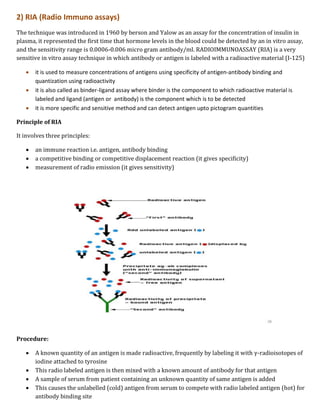
Procedure:
 A known quantity of an antigen is made radioactive, frequently by labeling it with γ-radioisotopes of
iodine attached to tyrosine
 This radio labeled antigen is then mixed with a known amount of antibody for that antigen
 A sample of serum from patient containing an unknown quantity of same antigen is added
 This causes the unlabelled (cold) antigen from serum to compete with radio labeled antigen (hot) for
antibody binding site
 As the concentration of cold antigen is increased, more of it binds to antibody, displacing the radio
labeled variant and reducing the ratio of antibody bound radio labeled antigen to free radio labeled
antigen
 The bound antigens are then separated from the unbound ones, and the radioactivity of the free
antigen remaining in the supernatant is measured using a γ-counter
 The concentration of the test antigen can be calculated from the ratio of the bound and total antigen
labels, using a standard dose response curve
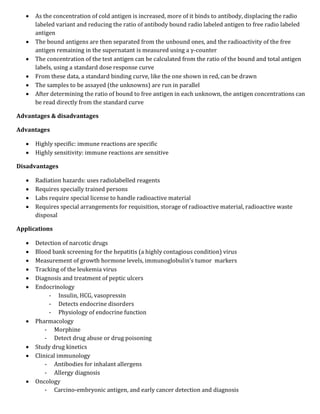
 From these data, a standard binding curve, like the one shown in red, can be drawn
 The samples to be assayed (the unknowns) are run in parallel
 After determining the ratio of bound to free antigen in each unknown, the antigen concentrations can
be read directly from the standard curve
Advantages & disadvantages
Advantages
 Highly specific: immune reactions are specific
 Highly sensitivity: immune reactions are sensitive
Disadvantages
 Radiation hazards: uses radiolabelled reagents
 Requires specially trained persons
 Labs require special license to handle radioactive material
 Requires special arrangements for requisition, storage of radioactive material, radioactive waste
disposal
Applications
 Detection of narcotic drugs
 Blood bank screening for the hepatitis (a highly contagious condition) virus
 Measurement of growth hormone levels, immunoglobulin’s tumor markers
 Tracking of the leukemia virus
 Diagnosis and treatment of peptic ulcers
 Endocrinology
- Insulin, HCG, vasopressin
- Detects endocrine disorders
- Physiology of endocrine function
 Pharmacology
- Morphine
- Detect drug abuse or drug poisoning
 Study drug kinetics
 Clinical immunology
- Antibodies for inhalant allergens
- Allergy diagnosis
 Oncology
- Carcino-embryonic antigen, and early cancer detection and diagnosis
3) ELISA (Enzyme linked Immuno-sorbent assay)
 Elisa is a biochemical technique used mainly in immunology to detect the presence of an antibody or
an antigen in a sample
 In this method the antigen or antibody is conjugated to an enzyme
 It is a plate based assays designed for detecting and quantifying substances such as peptides,
proteins, antibodies, antigens and hormones
 It involves detection of “analyte” in a liquid sample using liquid reagent (wet lab) or dry strips (dry
lab)
 The test can be done in polystyrene tubes (macro-ELISA) or polyvinyl microtitre plates (micro-
ELISA)
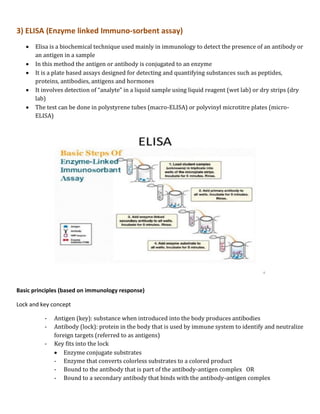
Basic principles (based on immunology response)
Lock and key concept
- Antigen (key): substance when introduced into the body produces antibodies
- Antibody (lock): protein in the body that is used by immune system to identify and neutralize
foreign targets (referred to as antigens)
- Key fits into the lock
 Enzyme conjugate substrates
- Enzyme that converts colorless substrates to a colored product
- Bound to the antibody that is part of the antibody-antigen complex OR
- Bound to a secondary antibody that binds with the antibody-antigen complex
Advantages of ELISA test
 Sensitive: nanogram levels or lower
 Reproducible
 Minimal reagents
 Qualitative and quantitative
Qualitative- Eg: HIV testing
Quantitative assays- Eg: TDM
 Greater scope: wells can be coated with antigens OR antibodies
 No radiation hazards
 Fast-90 samples tested in 2-3 hr
 Sensitivity (up to 10 pg/ml)
 Specificity (sample with high concentration contaminants)
Four common ELISA tests- based on the binding structure between the antibody and antigen
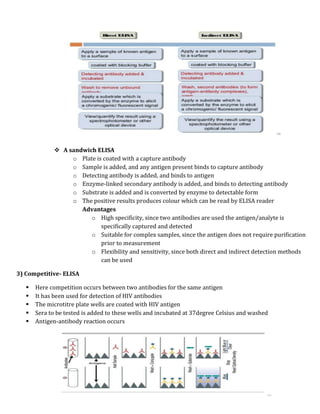
1) Direct- ELISA
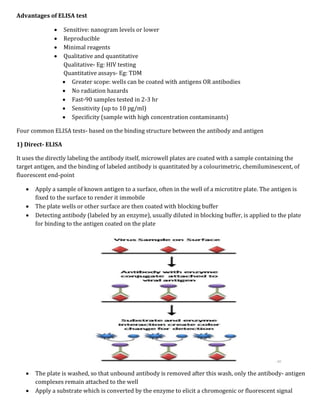
It uses the directly labeling the antibody itself, microwell plates are coated with a sample containing the
target antigen, and the binding of labeled antibody is quantitated by a colourimetric, chemiluminescent, of
fluorescent end-point
 Apply a sample of known antigen to a surface, often in the well of a microtitre plate. The antigen is
fixed to the surface to render it immobile
 The plate wells or other surface are then coated with blocking buffer
 Detecting antibody (labeled by an enzyme), usually diluted in blocking buffer, is applied to the plate
for binding to the antigen coated on the plate
 The plate is washed, so that unbound antibody is removed after this wash, only the antibody- antigen
complexes remain attached to the well
 Apply a substrate which is converted by the enzyme to elicit a chromogenic or fluorescent signal
 View/quantify the result using a spectrophotometer or other optical device
 Positive and negative controls should always be included in the test
 At every step, incubation and washing is done to wash off unbound reagents
Advantages of direct ELISA:
 Quick methodology since only one antibody is used
 Cross-reactivity of secondary antibody is eliminated
Disadvantages of direct ELISA:
 Immuno- reactivity of the primary antibody may be reduced as a result of labeling
 Labeling of energy primary antibody label from one experiment to another
 Little signal amplification
2) Indirect- ELISA
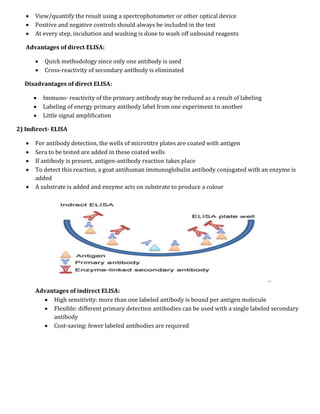
 For antibody detection, the wells of microtitre plates are coated with antigen
 Sera to be tested are added in these coated wells
 If antibody is present, antigen-antibody reaction takes place
 To detect this reaction, a goat antihuman immunoglobulin antibody conjugated with an enzyme is
added
 A substrate is added and enzyme acts on substrate to produce a colour
Advantages of indirect ELISA:
 High sensitivity: more than one labeled antibody is bound per antigen molecule
 Flexible: different primary detection antibodies can be used with a single labeled secondary
antibody
 Cost-saving: fewer labeled antibodies are required
 A sandwich ELISA
o Plate is coated with a capture antibody
o Sample is added, and any antigen present binds to capture antibody
o Detecting antibody is added, and binds to antigen
o Enzyme-linked secondary antibody is added, and binds to detecting antibody
o Substrate is added and is converted by enzyme to detectable form
o The positive results produces colour which can be read by ELISA reader
Advantages
o High specificity, since two antibodies are used the antigen/analyte is
specifically captured and detected
o Suitable for complex samples, since the antigen does not require purification
prior to measurement
o Flexibility and sensitivity, since both direct and indirect detection methods
can be used
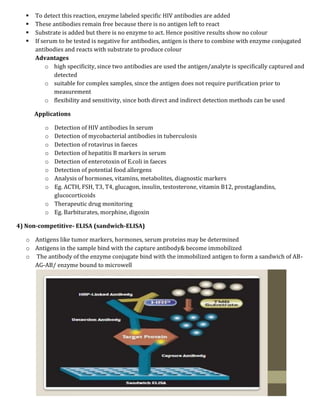
3) Competitive- ELISA
 Here competition occurs between two antibodies for the same antigen
 It has been used for detection of HIV antibodies
 The microtitre plate wells are coated with HIV antigen
 Sera to be tested is added to these wells and incubated at 37degree Celsius and washed
 Antigen-antibody reaction occurs
 To detect this reaction, enzyme labeled specific HIV antibodies are added
 These antibodies remain free because there is no antigen left to react
 Substrate is added but there is no enzyme to act. Hence positive results show no colour
 If serum to be tested is negative for antibodies, antigen is there to combine with enzyme conjugated
antibodies and reacts with substrate to produce colour
Advantages
o high specificity, since two antibodies are used the antigen/analyte is specifically captured and
detected
o suitable for complex samples, since the antigen does not require purification prior to
measurement
o flexibility and sensitivity, since both direct and indirect detection methods can be used
Applications
o Detection of HIV antibodies In serum
o Detection of mycobacterial antibodies in tuberculosis
o Detection of rotavirus in faeces
o Detection of hepatitis B markers in serum
o Detection of enterotoxin of E.coli in faeces
o Detection of potential food allergens
o Analysis of hormones, vitamins, metabolites, diagnostic markers
o Eg. ACTH, FSH, T3, T4, glucagon, insulin, testosterone, vitamin B12, prostaglandins,
glucocorticoids
o Therapeutic drug monitoring
o Eg. Barbiturates, morphine, digoxin
4) Non-competitive- ELISA (sandwich-ELISA)
o Antigens like tumor markers, hormones, serum proteins may be determined
o Antigens in the sample bind with the capture antibody& become immobilized
o The antibody of the enzyme conjugate bind with the immobilized antigen to form a sandwich of AB-
AG-AB/ enzyme bound to microwell
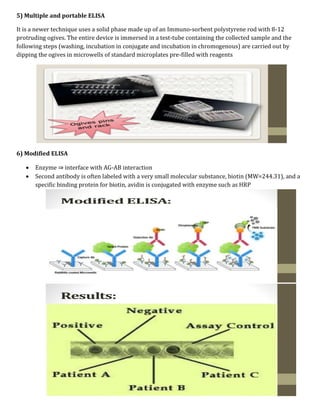
5) Multiple and portable ELISA
It is a newer technique uses a solid phase made up of an Immuno-sorbent polystyrene rod with 8-12
protruding ogives. The entire device is immersed in a test-tube containing the collected sample and the
following steps (washing, incubation in conjugate and incubation in chromogenous) are carried out by
dipping the ogives in microwells of standard microplates pre-filled with reagents
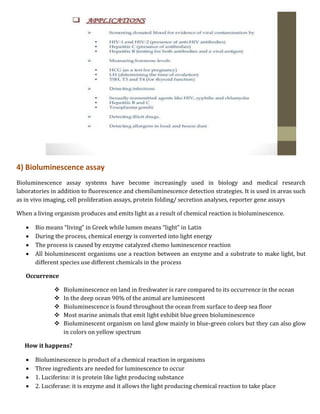
6) Modified ELISA
 Enzyme ⇒ interface with AG-AB interaction
 Second antibody is often labeled with a very small molecular substance, biotin (MW=244.31), and a
specific binding protein for biotin, avidin is conjugated with enzyme such as HRP
4) Bioluminescence assay
Bioluminescence assay systems have become increasingly used in biology and medical research
laboratories in addition to fluorescence and chemiluminescence detection strategies. It is used in areas such
as in vivo imaging, cell proliferation assays, protein folding/ secretion analyses, reporter gene assays
When a living organism produces and emits light as a result of chemical reaction is bioluminescence.
 Bio means “living” in Greek while lumen means “light” in Latin
 During the process, chemical energy is converted into light energy
 The process is caused by enzyme catalyzed chemo luminescence reaction
 All bioluminescent organisms use a reaction between an enzyme and a substrate to make light, but
different species use different chemicals in the process
Occurrence
 Bioluminescence on land in freshwater is rare compared to its occurrence in the ocean
 In the deep ocean 90% of the animal are luminescent
 Bioluminescence is found throughout the ocean from surface to deep sea floor
 Most marine animals that emit light exhibit blue green bioluminescence
 Bioluminescent organism on land glow mainly in blue-green colors but they can also glow
in colors on yellow spectrum
How it happens?
 Bioluminescence is product of a chemical reaction in organisms
 Three ingredients are needed for luminescence to occur
 1. Luciferins: it is protein like light producing substance
 2. Luciferase: it is enzyme and it allows the light producing chemical reaction to take place
 3. Oxygen: it is colorless and odorless gas. Oxygen forms 20% of earth’s atmosphere and it is found in
water
 The Luciferase allows oxygen to combine with luciferin
 And this reaction produces light and oxidized luciferin become inactive oxy-luciferin
 Some reaction do not involve this enzyme Luciferase, so these reaction involve chemical called
photoprotin that combine with oxygen and Luciferase but require another agent. Often an ion of
element calcium, to produce light
Bioluminescence: - is the production and emission of light by a living organism. It is a form of
chemiluminescence. Bioluminescence occurs widely in marine vertebrates and invertebrates, as well as
in some fungi microorganisms including some bioluminescent bacteria and terrestrial invertebrae such
as fireflies. Bioluminescence assays involve the use of the property of bioluminescence for measuring
cell proliferation, apoptosis, drug metabolism, kinase activity, etc
Principle: - Bioluminescence is a form of chemiluminescence where light energy is released by a
chemical reaction. This reaction involves a light emitting pigment, the luciferin and a Luciferase the
enzyme component because of the diversity of luciferin/ Luciferase combinations, there are very few
commonalities in the chemical mechanism. For example, the firefly luciferin / Luciferase reaction
requires magnesium and ATP and produces carbon-dioxide (co2), adenosine monophosphate (AMP) and
pyrophosphate (PP) as waste products. Other cofactors may be required for the reaction, such as
calcium (ca2+) for the photoprotin acquorin or magnesium (MG2+) ions and ATP for the firely
Luciferase. Generically, this reaction could be described as: -
Luciferin + o2 ⇒ oxyluciferin + light energy
Among assay methods, chemiluminescence (CL) detection represents a versatile, ultrasensitive tool with
a wide range of applications in biotechnology. It also gives a sensitive, rapid alternative to radioactivity
as a detection principle in IA for the determination of molecules (eg, proteins, hormones, drugs, nucleic
acids and environmental pollutants). CL is now commonly used for IA in the form of CL label or as a CL
detection reaction for an enzyme or a nanoparticle (NP) label. In recent years, CLIA has become very
popular in clinical chemistry and environmental analysis, due to its high sensitivity, wide dynamic range
and complete automation. With development and application of recombinant AB (rAB) technology,
markers and related techniques, solid-phase materials and improvements in automation, integration
and miniaturization, CLIA has acquired an entirely new appearance.
Luminescence
 “cold light” that can be emitted at lower temperature
 Source kicks an electron of an atom out of its lowest energy “ground” state into a higher energy
“excited” state
 Finally electron returns the energy in the form of light so it can fall back to its “ground” state
Introduction
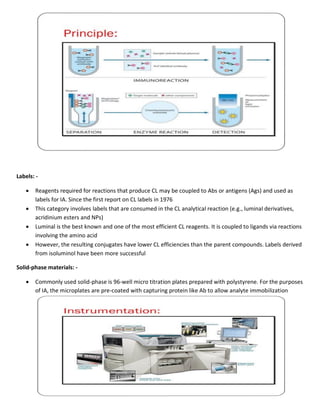
 Chemiluminescence immunoassay (CLIA) using microplate luminometers provides a
sensitive, high throughoutput, and economical way to quantitatively measure antigen in cell
lysates, plasma, urine, saliva, tissue and culture media samples
 Chemiluminescence immunoassay does not require long incubations and the addition of
stopping reagents, as is the case in conventional colorimetric cases such as enzyme linked
Immuno-sorbent assay (ELISA)
 Among various enzyme assays that employ light-emitting reactions, one of the most
successful assays is the enhanced chemiluminescent immunoassay involving a horseradish
peroxidase (HRP) labeled antibody or antigen and a mixture of chemiluminescent substrate,
hydrogen peroxide, and enhancers
 CLIA are designed to detect glow based chemiluminescent reactions
 This provide a broader dynamic assay range, superior low-end sensitivity, and a faster
protocol than the conventional (ELISA)
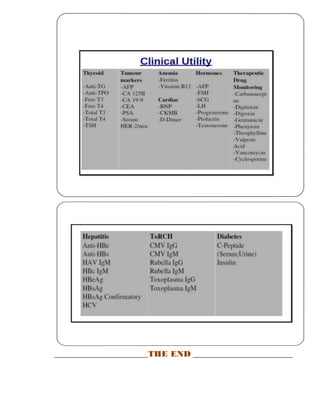
 It covers thyroid function markers, gonadal hormones, tumor markers, diabetic marker,
cardiac marker and other markers
 They can be used to replace conventional colorimetric ELISAs that have been widely used in
many research and diagnostic applications
Chemiluminescence immunoassay (CLIA) provides a sensitive, high throughoutput alternative to
conventional colorimetric methodologies
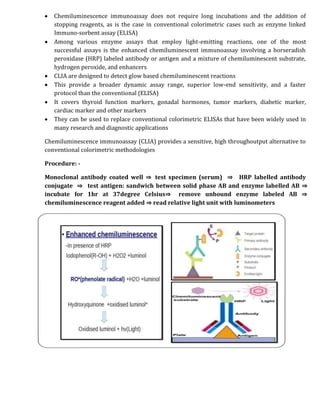
Procedure: -
Monoclonal antibody coated well ⇒ test specimen (serum) ⇒ HRP labelled antibody
conjugate ⇒ test antigen: sandwich between solid phase AB and enzyme labelled AB ⇒
incubate for 1hr at 37degree Celsius⇒ remove unbound enzyme labeled AB ⇒
chemiluminescence reagent added ⇒ read relative light unit with luminometers
Labels: -
 Reagents required for reactions that produce CL may be coupled to Abs or antigens (Ags) and used as
labels for IA. Since the first report on CL labels in 1976
 This category involves labels that are consumed in the CL analytical reaction (e.g., luminal derivatives,
acridinium esters and NPs)
 Luminal is the best known and one of the most efficient CL reagents. It is coupled to ligands via reactions
involving the amino acid
 However, the resulting conjugates have lower CL efficiencies than the parent compounds. Labels derived
from isoluminol have been more successful
Solid-phase materials: -
 Commonly used solid-phase is 96-well micro titration plates prepared with polystyrene. For the purposes
of IA, the microplates are pre-coated with capturing protein like Ab to allow analyte immobilization
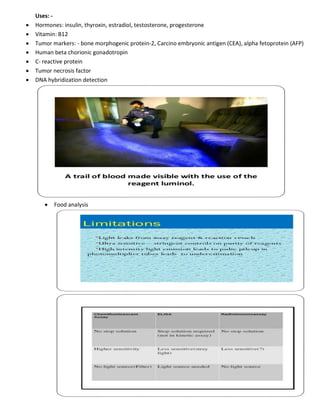
Uses: -
 Hormones: insulin, thyroxin, estradiol, testosterone, progesterone
 Vitamin: B12
 Tumor markers: - bone morphogenic protein-2, Carcino embryonic antigen (CEA), alpha fetoprotein (AFP)
 Human beta chorionic gonadotropin
 C- reactive protein
 Tumor necrosis factor
 DNA hybridization detection
 Food analysis
______________________________THE END ________________________________

immunological assays

  • 1.
    Masters of pharmacy,Pharmaceutical technology (Pharmaceutics) Subject- Modern pharmaceutical analytical techniques (Mpt-101T) Lesion no- 6 IMMUNOLOGICAL ASSAYS By- Drx JAYESH M RAJPUT Points:- 1) Immunological assays (Immunoassay) An immunoassay is a biochemical test that measures the presence or concentration of a macromolecule or a small molecule or a small molecule in a solution through the use of an antibody (usually) or an antigen (sometimes). The molecule detected by the immunoassay is often referred to as an “analyte” and is in many cases a protein although it may be other kinds of molecules, of different size and types, as long as the proper antibodies that have the adequate properties for the assay are developed. Analytes in biological liquids such as serum or urine are frequently measured using immunoassays for medical and research purposes. Immunoassays come in many different formats and variations. Immunoassays may be run in multiple steps with reagents being added and washed away or separated at different points in the assay. Multiple-step assays are often called separation immunoassays or heterogeneous immunoassays. Some immunoassays can be carried out simply by mixing the reagents and sample and making a physical measurement. Such assays are called homogeneous immunoassays, or less frequently non-separation immunoassays. The use of a calibrator is often employed in immunoassays. Calibrators are solutions that are known to contain the analyte in questions, and the concentration of that analyte is generally known. Comparison of an assay’s response to a real sample against the assay’s response produced by the calibrator makes it possible to interpret the signal in terms of the presence or concentration of analyte in the sample. Immunoassay relies on the ability of an antibody to recognize and bind a specific macromolecule in what might be a complex mixture of macromolecules. In immunology the particular macromolecule bound by an antibody is referred to as an antigen and the area on an antigen to which the antibody binds is called an epitope, in some cases, an immunoassay may use an antigen to detect for the presence of antibodies, which recognize that antigen, in a solution. In other words, in some immunoassays, the analyte may be an antibody rather than an antigen. In addition to the binding of an antibody to its antigen, the other key feature of all immunoassays is a means to produce a measurable signal in response to the binding. Most though not all, immunoassays involve chemically linking antibodies or antigens with some kind of detectable label. A large number of labels exist in modern immunoassays, and they allow for detection through different means many labels are detectable because they emit radiation, produce a color change in a solution, fluorescence under light, or can be induced to emit light.  immunoassay means a method to measure any particular substance in a mixture using its specific- binding antibody  one of the merits of immunoassay is that we can measure a substance that is present in a mixture of various contaminants  immunoassay have become very popular in view of their high sensitivity, safety, economy and simple instrument requirements
  • 2.
    2) RIA (RadioImmuno assays) The technique was introduced in 1960 by berson and Yalow as an assay for the concentration of insulin in plasma, it represented the first time that hormone levels in the blood could be detected by an in vitro assay, and the sensitivity range is 0.0006-0.006 micro gram antibody/ml. RADIOIMMUNOASSAY (RIA) is a very sensitive in vitro assay technique in which antibody or antigen is labeled with a radioactive material (I-125)  it is used to measure concentrations of antigens using specificity of antigen-antibody binding and quantization using radioactivity  it is also called as binder-ligand assay where binder is the component to which radioactive material is labeled and ligand (antigen or antibody) is the component which is to be detected  it is more specific and sensitive method and can detect antigen upto pictogram quantities Principle of RIA It involves three principles:  an immune reaction i.e. antigen, antibody binding  a competitive binding or competitive displacement reaction (it gives specificity)  measurement of radio emission (it gives sensitivity) Procedure:  A known quantity of an antigen is made radioactive, frequently by labeling it with γ-radioisotopes of iodine attached to tyrosine  This radio labeled antigen is then mixed with a known amount of antibody for that antigen  A sample of serum from patient containing an unknown quantity of same antigen is added  This causes the unlabelled (cold) antigen from serum to compete with radio labeled antigen (hot) for antibody binding site
  • 3.
     As theconcentration of cold antigen is increased, more of it binds to antibody, displacing the radio labeled variant and reducing the ratio of antibody bound radio labeled antigen to free radio labeled antigen  The bound antigens are then separated from the unbound ones, and the radioactivity of the free antigen remaining in the supernatant is measured using a γ-counter  The concentration of the test antigen can be calculated from the ratio of the bound and total antigen labels, using a standard dose response curve  From these data, a standard binding curve, like the one shown in red, can be drawn  The samples to be assayed (the unknowns) are run in parallel  After determining the ratio of bound to free antigen in each unknown, the antigen concentrations can be read directly from the standard curve Advantages & disadvantages Advantages  Highly specific: immune reactions are specific  Highly sensitivity: immune reactions are sensitive Disadvantages  Radiation hazards: uses radiolabelled reagents  Requires specially trained persons  Labs require special license to handle radioactive material  Requires special arrangements for requisition, storage of radioactive material, radioactive waste disposal Applications  Detection of narcotic drugs  Blood bank screening for the hepatitis (a highly contagious condition) virus  Measurement of growth hormone levels, immunoglobulin’s tumor markers  Tracking of the leukemia virus  Diagnosis and treatment of peptic ulcers  Endocrinology - Insulin, HCG, vasopressin - Detects endocrine disorders - Physiology of endocrine function  Pharmacology - Morphine - Detect drug abuse or drug poisoning  Study drug kinetics  Clinical immunology - Antibodies for inhalant allergens - Allergy diagnosis  Oncology - Carcino-embryonic antigen, and early cancer detection and diagnosis
  • 4.
    3) ELISA (Enzymelinked Immuno-sorbent assay)  Elisa is a biochemical technique used mainly in immunology to detect the presence of an antibody or an antigen in a sample  In this method the antigen or antibody is conjugated to an enzyme  It is a plate based assays designed for detecting and quantifying substances such as peptides, proteins, antibodies, antigens and hormones  It involves detection of “analyte” in a liquid sample using liquid reagent (wet lab) or dry strips (dry lab)  The test can be done in polystyrene tubes (macro-ELISA) or polyvinyl microtitre plates (micro- ELISA) Basic principles (based on immunology response) Lock and key concept - Antigen (key): substance when introduced into the body produces antibodies - Antibody (lock): protein in the body that is used by immune system to identify and neutralize foreign targets (referred to as antigens) - Key fits into the lock  Enzyme conjugate substrates - Enzyme that converts colorless substrates to a colored product - Bound to the antibody that is part of the antibody-antigen complex OR - Bound to a secondary antibody that binds with the antibody-antigen complex
  • 5.
    Advantages of ELISAtest  Sensitive: nanogram levels or lower  Reproducible  Minimal reagents  Qualitative and quantitative Qualitative- Eg: HIV testing Quantitative assays- Eg: TDM  Greater scope: wells can be coated with antigens OR antibodies  No radiation hazards  Fast-90 samples tested in 2-3 hr  Sensitivity (up to 10 pg/ml)  Specificity (sample with high concentration contaminants) Four common ELISA tests- based on the binding structure between the antibody and antigen 1) Direct- ELISA It uses the directly labeling the antibody itself, microwell plates are coated with a sample containing the target antigen, and the binding of labeled antibody is quantitated by a colourimetric, chemiluminescent, of fluorescent end-point  Apply a sample of known antigen to a surface, often in the well of a microtitre plate. The antigen is fixed to the surface to render it immobile  The plate wells or other surface are then coated with blocking buffer  Detecting antibody (labeled by an enzyme), usually diluted in blocking buffer, is applied to the plate for binding to the antigen coated on the plate  The plate is washed, so that unbound antibody is removed after this wash, only the antibody- antigen complexes remain attached to the well  Apply a substrate which is converted by the enzyme to elicit a chromogenic or fluorescent signal
  • 6.
     View/quantify theresult using a spectrophotometer or other optical device  Positive and negative controls should always be included in the test  At every step, incubation and washing is done to wash off unbound reagents Advantages of direct ELISA:  Quick methodology since only one antibody is used  Cross-reactivity of secondary antibody is eliminated Disadvantages of direct ELISA:  Immuno- reactivity of the primary antibody may be reduced as a result of labeling  Labeling of energy primary antibody label from one experiment to another  Little signal amplification 2) Indirect- ELISA  For antibody detection, the wells of microtitre plates are coated with antigen  Sera to be tested are added in these coated wells  If antibody is present, antigen-antibody reaction takes place  To detect this reaction, a goat antihuman immunoglobulin antibody conjugated with an enzyme is added  A substrate is added and enzyme acts on substrate to produce a colour Advantages of indirect ELISA:  High sensitivity: more than one labeled antibody is bound per antigen molecule  Flexible: different primary detection antibodies can be used with a single labeled secondary antibody  Cost-saving: fewer labeled antibodies are required
  • 7.
     A sandwichELISA o Plate is coated with a capture antibody o Sample is added, and any antigen present binds to capture antibody o Detecting antibody is added, and binds to antigen o Enzyme-linked secondary antibody is added, and binds to detecting antibody o Substrate is added and is converted by enzyme to detectable form o The positive results produces colour which can be read by ELISA reader Advantages o High specificity, since two antibodies are used the antigen/analyte is specifically captured and detected o Suitable for complex samples, since the antigen does not require purification prior to measurement o Flexibility and sensitivity, since both direct and indirect detection methods can be used 3) Competitive- ELISA  Here competition occurs between two antibodies for the same antigen  It has been used for detection of HIV antibodies  The microtitre plate wells are coated with HIV antigen  Sera to be tested is added to these wells and incubated at 37degree Celsius and washed  Antigen-antibody reaction occurs
  • 8.
     To detectthis reaction, enzyme labeled specific HIV antibodies are added  These antibodies remain free because there is no antigen left to react  Substrate is added but there is no enzyme to act. Hence positive results show no colour  If serum to be tested is negative for antibodies, antigen is there to combine with enzyme conjugated antibodies and reacts with substrate to produce colour Advantages o high specificity, since two antibodies are used the antigen/analyte is specifically captured and detected o suitable for complex samples, since the antigen does not require purification prior to measurement o flexibility and sensitivity, since both direct and indirect detection methods can be used Applications o Detection of HIV antibodies In serum o Detection of mycobacterial antibodies in tuberculosis o Detection of rotavirus in faeces o Detection of hepatitis B markers in serum o Detection of enterotoxin of E.coli in faeces o Detection of potential food allergens o Analysis of hormones, vitamins, metabolites, diagnostic markers o Eg. ACTH, FSH, T3, T4, glucagon, insulin, testosterone, vitamin B12, prostaglandins, glucocorticoids o Therapeutic drug monitoring o Eg. Barbiturates, morphine, digoxin 4) Non-competitive- ELISA (sandwich-ELISA) o Antigens like tumor markers, hormones, serum proteins may be determined o Antigens in the sample bind with the capture antibody& become immobilized o The antibody of the enzyme conjugate bind with the immobilized antigen to form a sandwich of AB- AG-AB/ enzyme bound to microwell
  • 9.
    5) Multiple andportable ELISA It is a newer technique uses a solid phase made up of an Immuno-sorbent polystyrene rod with 8-12 protruding ogives. The entire device is immersed in a test-tube containing the collected sample and the following steps (washing, incubation in conjugate and incubation in chromogenous) are carried out by dipping the ogives in microwells of standard microplates pre-filled with reagents 6) Modified ELISA  Enzyme ⇒ interface with AG-AB interaction  Second antibody is often labeled with a very small molecular substance, biotin (MW=244.31), and a specific binding protein for biotin, avidin is conjugated with enzyme such as HRP
  • 10.
    4) Bioluminescence assay Bioluminescenceassay systems have become increasingly used in biology and medical research laboratories in addition to fluorescence and chemiluminescence detection strategies. It is used in areas such as in vivo imaging, cell proliferation assays, protein folding/ secretion analyses, reporter gene assays When a living organism produces and emits light as a result of chemical reaction is bioluminescence.  Bio means “living” in Greek while lumen means “light” in Latin  During the process, chemical energy is converted into light energy  The process is caused by enzyme catalyzed chemo luminescence reaction  All bioluminescent organisms use a reaction between an enzyme and a substrate to make light, but different species use different chemicals in the process Occurrence  Bioluminescence on land in freshwater is rare compared to its occurrence in the ocean  In the deep ocean 90% of the animal are luminescent  Bioluminescence is found throughout the ocean from surface to deep sea floor  Most marine animals that emit light exhibit blue green bioluminescence  Bioluminescent organism on land glow mainly in blue-green colors but they can also glow in colors on yellow spectrum How it happens?  Bioluminescence is product of a chemical reaction in organisms  Three ingredients are needed for luminescence to occur  1. Luciferins: it is protein like light producing substance  2. Luciferase: it is enzyme and it allows the light producing chemical reaction to take place
  • 11.
     3. Oxygen:it is colorless and odorless gas. Oxygen forms 20% of earth’s atmosphere and it is found in water  The Luciferase allows oxygen to combine with luciferin  And this reaction produces light and oxidized luciferin become inactive oxy-luciferin  Some reaction do not involve this enzyme Luciferase, so these reaction involve chemical called photoprotin that combine with oxygen and Luciferase but require another agent. Often an ion of element calcium, to produce light Bioluminescence: - is the production and emission of light by a living organism. It is a form of chemiluminescence. Bioluminescence occurs widely in marine vertebrates and invertebrates, as well as in some fungi microorganisms including some bioluminescent bacteria and terrestrial invertebrae such as fireflies. Bioluminescence assays involve the use of the property of bioluminescence for measuring cell proliferation, apoptosis, drug metabolism, kinase activity, etc Principle: - Bioluminescence is a form of chemiluminescence where light energy is released by a chemical reaction. This reaction involves a light emitting pigment, the luciferin and a Luciferase the enzyme component because of the diversity of luciferin/ Luciferase combinations, there are very few commonalities in the chemical mechanism. For example, the firefly luciferin / Luciferase reaction requires magnesium and ATP and produces carbon-dioxide (co2), adenosine monophosphate (AMP) and pyrophosphate (PP) as waste products. Other cofactors may be required for the reaction, such as calcium (ca2+) for the photoprotin acquorin or magnesium (MG2+) ions and ATP for the firely Luciferase. Generically, this reaction could be described as: - Luciferin + o2 ⇒ oxyluciferin + light energy Among assay methods, chemiluminescence (CL) detection represents a versatile, ultrasensitive tool with a wide range of applications in biotechnology. It also gives a sensitive, rapid alternative to radioactivity as a detection principle in IA for the determination of molecules (eg, proteins, hormones, drugs, nucleic acids and environmental pollutants). CL is now commonly used for IA in the form of CL label or as a CL detection reaction for an enzyme or a nanoparticle (NP) label. In recent years, CLIA has become very popular in clinical chemistry and environmental analysis, due to its high sensitivity, wide dynamic range and complete automation. With development and application of recombinant AB (rAB) technology, markers and related techniques, solid-phase materials and improvements in automation, integration and miniaturization, CLIA has acquired an entirely new appearance. Luminescence  “cold light” that can be emitted at lower temperature  Source kicks an electron of an atom out of its lowest energy “ground” state into a higher energy “excited” state  Finally electron returns the energy in the form of light so it can fall back to its “ground” state Introduction  Chemiluminescence immunoassay (CLIA) using microplate luminometers provides a sensitive, high throughoutput, and economical way to quantitatively measure antigen in cell lysates, plasma, urine, saliva, tissue and culture media samples
  • 12.
     Chemiluminescence immunoassaydoes not require long incubations and the addition of stopping reagents, as is the case in conventional colorimetric cases such as enzyme linked Immuno-sorbent assay (ELISA)  Among various enzyme assays that employ light-emitting reactions, one of the most successful assays is the enhanced chemiluminescent immunoassay involving a horseradish peroxidase (HRP) labeled antibody or antigen and a mixture of chemiluminescent substrate, hydrogen peroxide, and enhancers  CLIA are designed to detect glow based chemiluminescent reactions  This provide a broader dynamic assay range, superior low-end sensitivity, and a faster protocol than the conventional (ELISA)  It covers thyroid function markers, gonadal hormones, tumor markers, diabetic marker, cardiac marker and other markers  They can be used to replace conventional colorimetric ELISAs that have been widely used in many research and diagnostic applications Chemiluminescence immunoassay (CLIA) provides a sensitive, high throughoutput alternative to conventional colorimetric methodologies Procedure: - Monoclonal antibody coated well ⇒ test specimen (serum) ⇒ HRP labelled antibody conjugate ⇒ test antigen: sandwich between solid phase AB and enzyme labelled AB ⇒ incubate for 1hr at 37degree Celsius⇒ remove unbound enzyme labeled AB ⇒ chemiluminescence reagent added ⇒ read relative light unit with luminometers
  • 13.
    Labels: -  Reagentsrequired for reactions that produce CL may be coupled to Abs or antigens (Ags) and used as labels for IA. Since the first report on CL labels in 1976  This category involves labels that are consumed in the CL analytical reaction (e.g., luminal derivatives, acridinium esters and NPs)  Luminal is the best known and one of the most efficient CL reagents. It is coupled to ligands via reactions involving the amino acid  However, the resulting conjugates have lower CL efficiencies than the parent compounds. Labels derived from isoluminol have been more successful Solid-phase materials: -  Commonly used solid-phase is 96-well micro titration plates prepared with polystyrene. For the purposes of IA, the microplates are pre-coated with capturing protein like Ab to allow analyte immobilization
  • 14.
    Uses: -  Hormones:insulin, thyroxin, estradiol, testosterone, progesterone  Vitamin: B12  Tumor markers: - bone morphogenic protein-2, Carcino embryonic antigen (CEA), alpha fetoprotein (AFP)  Human beta chorionic gonadotropin  C- reactive protein  Tumor necrosis factor  DNA hybridization detection  Food analysis
  • 15.