Masters of pharmacy, Pharmaceutical technology (Pharmaceutics)
Subject- Drug delivery system (MPH-102T)
Lesion no- 1, Sustained release (SR) and Controlled release (CR) formulations By- Drx JAYESH M.RAJPUT
Points:-
1. Sustained release drug delivery system.
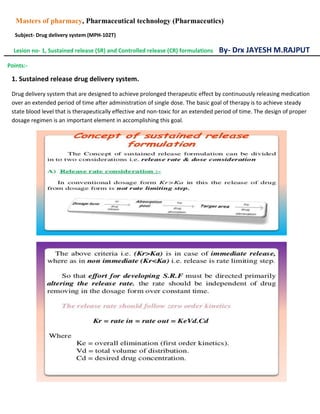
Drug delivery system that are designed to achieve prolonged therapeutic effect by continuously releasing medication
over an extended period of time after administration of single dose. The basic goal of therapy is to achieve steady
state blood level that is therapeutically effective and non-toxic for an extended period of time. The design of proper
dosage regimen is an important element in accomplishing this goal.
Advantages of SR formulations:-
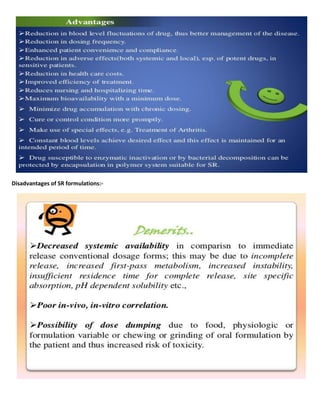
Less frequency of dosing and reduction in personnel time to dispense, administer monitor patients
Better control of drug absorption:- can be obtained, since the high blood level peaks that may be observed after
administration of a dose of high availability drug can be reduced.
Avoid problems of drugs have a narrow therapeutic index (small differences between toxic level and therapeutic
level) required multiple injections, poor patient compliance, increased incidence of infection and hemorrhages
Avoids danger of toxicity with more potent drugs
Improves availability of drugs with short half lives in vivo, some peptides have half-lives of a few minutes or even
seconds.
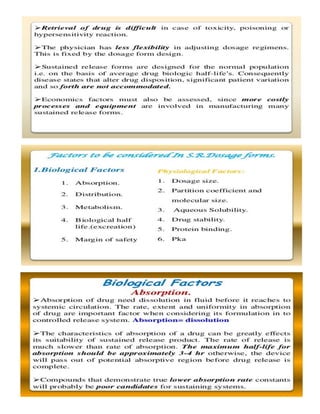
Disadvantages of SR formulations:-
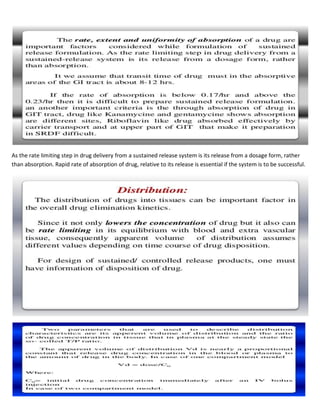
As the rate limiting step in drug delivery from a sustained release system is its release from a dosage form, rather
than absorption. Rapid rate of absorption of drug, relative to its release is essential if the system is to be successful.
Most intestinal wall enzymes systems are saturable. As drug is released at a slower rate to these regions less total
drug is presented to the enzymatic. Process device a specific period, allowing more complete conversion of the drug
to its metabolite.
Thus high molecular weight drugs or polymeric drugs should be expected to display very slow release kinetics in
sustained release device using diffusion through polymer membrane.
Phenothiazine are representative of this type of compound.
2. Controlled release (CR) dosage forms.
To achieve prolong therapeutic effect, implies predictability in drug release kinetics, deliver the drug at pre
determined rate, locally or systematically. Refers to the use of a delivery device with the objective of
releasing drug at a predetermined rate or at specific times or with specific release profiles. They provide a
release profile independent of the external environment and predominantly controlled by the design of
the system. Controlled release systems are multiple dose systems designed to achieve a steady state of
concentration.
Advantages
 Improve patient convenience
 Reduction in fluctuation in steady state level
 Increase the safety margin of high potency drug
 Reduction in total health care cost.
 Controlled delivery of active agent at predetermined rate
 Maintenance of optimal and effective drug level for prolonged periods
 Reduction of untoward effects like git irritation
 Increased patient compliance
 Reduction in dosing frequency
 Drug delivery in the vicinity of site of action
 More efficient utilization of active ingredient
 Avoidance of night time dosing
Disadvantages
 Decrease systemic availability
 Poor in vitro-in vivo correlation
 Increased risk of toxicity
 Retrieval of drug is difficult in case of toxicity, poisoning or hyper sensitivity reaction
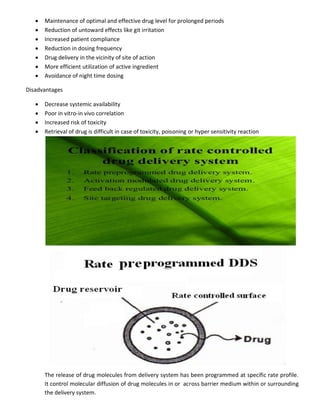
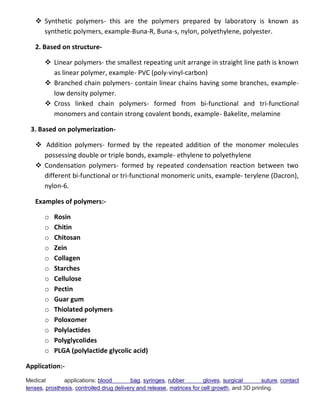
The release of drug molecules from delivery system has been programmed at specific rate profile.
It control molecular diffusion of drug molecules in or across barrier medium within or surrounding
the delivery system.
The system can further be classified as:-
1. Polymer membrane permeation CDDS
2. Polymer matrix diffusion CDDS
3. Micro Reserviour partition CDDS
This is classified as:-
1. Bioerosion regulated DDS
2. Bioresponsive DDS
3. self-regulated DDS
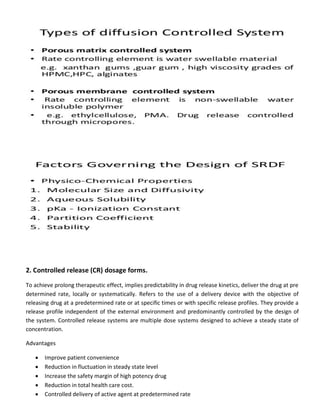
3. Self regulating DDS
This system depends on a reversible and competitive binding mechanism to activate and to
regulate the drug release.
3. Polymers.
A long molecule made up from lots of small molecules is called monomers. A polymer is a substance
composed of molecules with large molecular mass consisting of repeated structural units, or monomers
connected by covalent chemical bonds, and the process is called polymerization.
A polymer (/ˈpɒlɪmər/;[4][5]
Greek poly-, "many" + -mer, "part") is a substance or material consisting
of very large molecules, or macromolecules, composed of many repeating subunits.[6]
Due to their
broad spectrum of properties,[7]
both synthetic and natural polymers play essential and ubiquitous
roles in everyday life.[8]
Polymers range from familiar synthetic plastics such as polystyrene to
natural biopolymers such as DNA and proteins that are fundamental to biological structure and
function. Polymers, both natural and synthetic, are created via polymerization of many small
molecules, known as monomers. Their consequently large molecular mass, relative to small
molecule compounds, produces unique physical properties including toughness,
high elasticity, viscoelasticity, and a tendency to form amorphous and semicrystalline structures
rather than crystals.
The term "polymer" derives from the Greek word πολύς (polus, meaning "many, much") and
μέρος (meros, meaning "part"), and refers to large molecules whose structure is composed of
multiple repeating units, from which originates a characteristic of high relative molecular mass and
attendant properties.[3]
The units composing polymers derive, actually or conceptually, from
molecules of low relative molecular mass.[3]
The term was coined in 1833 by Jöns Jacob Berzelius,
though with a definition distinct from the modern IUPAC definition.[9][10]
The modern concept of
polymers as covalently bonded macromolecular structures was proposed in 1920 by Hermann
Staudinger,[11]
who spent the next decade finding experimental evidence for this hypothesis.
Classification of polymers:-
1. Based on source-
 Natural polymers- the natural polymer is a polymer that results from only raw
materials that are found in nature, example- proteins, cellulose, starch, rubber.
 Semi-synthetic polymers- the polymer can obtain both natural as well as synthetic
origin Is known as semi-synthetic polymer, example- cellulose derivatives, cellulose
acetate
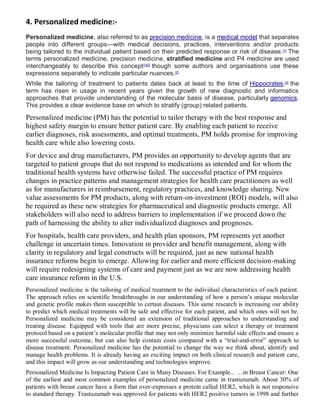
 Synthetic polymers- this are the polymers prepared by laboratory is known as
synthetic polymers, example-Buna-R, Buna-s, nylon, polyethylene, polyester.
2. Based on structure-
 Linear polymers- the smallest repeating unit arrange in straight line path is known
as linear polymer, example- PVC (poly-vinyl-carbon)
 Branched chain polymers- contain linear chains having some branches, example-
low density polymer.
 Cross linked chain polymers- formed from bi-functional and tri-functional
monomers and contain strong covalent bonds, example- Bakelite, melamine
3. Based on polymerization-
 Addition polymers- formed by the repeated addition of the monomer molecules
possessing double or triple bonds, example- ethylene to polyethylene
 Condensation polymers- formed by repeated condensation reaction between two
different bi-functional or tri-functional monomeric units, example- terylene (Dacron),
nylon-6.
Examples of polymers:-
o Rosin
o Chitin
o Chitosan
o Zein
o Collagen
o Starches
o Cellulose
o Pectin
o Guar gum
o Thiolated polymers
o Poloxomer
o Polylactides
o Polyglycolides
o PLGA (polylactide glycolic acid)
Application:-
Medical applications: blood bag, syringes, rubber gloves, surgical suture, contact
lenses, prosthesis, controlled drug delivery and release, matrices for cell growth, and 3D printing.
4. Personalized medicine:-
Personalized medicine, also referred to as precision medicine, is a medical model that separates
people into different groups—with medical decisions, practices, interventions and/or products
being tailored to the individual patient based on their predicted response or risk of disease.[1]
The
terms personalized medicine, precision medicine, stratified medicine and P4 medicine are used
interchangeably to describe this concept[1][2]
though some authors and organisations use these
expressions separately to indicate particular nuances.[2]
While the tailoring of treatment to patients dates back at least to the time of Hippocrates,[3]
the
term has risen in usage in recent years given the growth of new diagnostic and informatics
approaches that provide understanding of the molecular basis of disease, particularly genomics.
This provides a clear evidence base on which to stratify (group) related patients.
Personalized medicine (PM) has the potential to tailor therapy with the best response and
highest safety margin to ensure better patient care. By enabling each patient to receive
earlier diagnoses, risk assessments, and optimal treatments, PM holds promise for improving
health care while also lowering costs.
For device and drug manufacturers, PM provides an opportunity to develop agents that are
targeted to patient groups that do not respond to medications as intended and for whom the
traditional health systems have otherwise failed. The successful practice of PM requires
changes in practice patterns and management strategies for health care practitioners as well
as for manufacturers in reimbursement, regulatory practices, and knowledge sharing. New
value assessments for PM products, along with return-on-investment (ROI) models, will also
be required as these new strategies for pharmaceutical and diagnostic products emerge. All
stakeholders will also need to address barriers to implementation if we proceed down the
path of harnessing the ability to alter individualized diagnoses and prognoses.
For hospitals, health care providers, and health plan sponsors, PM represents yet another
challenge in uncertain times. Innovation in provider and benefit management, along with
clarity in regulatory and legal constructs will be required, just as new national health
insurance reforms begin to emerge. Allowing for earlier and more efficient decision-making
will require redesigning systems of care and payment just as we are now addressing health
care insurance reform in the U.S.
Personalized medicine is the tailoring of medical treatment to the individual characteristics of each patient.
The approach relies on scientific breakthroughs in our understanding of how a person’s unique molecular
and genetic profile makes them susceptible to certain diseases. This same research is increasing our ability
to predict which medical treatments will be safe and effective for each patient, and which ones will not be.
Personalized medicine may be considered an extension of traditional approaches to understanding and
treating disease. Equipped with tools that are more precise, physicians can select a therapy or treatment
protocol based on a patient’s molecular profile that may not only minimize harmful side effects and ensure a
more successful outcome, but can also help contain costs compared with a “trial-and-error” approach to
disease treatment. Personalized medicine has the potential to change the way we think about, identify and
manage health problems. It is already having an exciting impact on both clinical research and patient care,
and this impact will grow as our understanding and technologies improve.
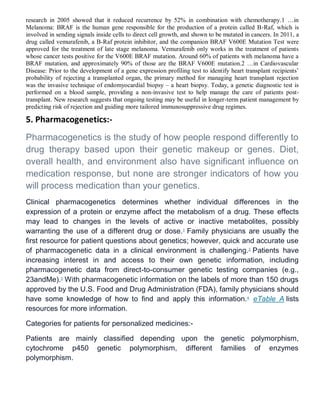
Personalized Medicine Is Impacting Patient Care in Many Diseases. For Example... …in Breast Cancer: One
of the earliest and most common examples of personalized medicine came in trastuzumab. About 30% of
patients with breast cancer have a form that over-expresses a protein called HER2, which is not responsive
to standard therapy. Trastuzumab was approved for patients with HER2 positive tumors in 1998 and further
research in 2005 showed that it reduced recurrence by 52% in combination with chemotherapy.1 …in
Melanoma: BRAF is the human gene responsible for the production of a protein called B-Raf, which is
involved in sending signals inside cells to direct cell growth, and shown to be mutated in cancers. In 2011, a
drug called vemurafenib, a B-Raf protein inhibitor, and the companion BRAF V600E Mutation Test were
approved for the treatment of late stage melanoma. Vemurafenib only works in the treatment of patients
whose cancer tests positive for the V600E BRAF mutation. Around 60% of patients with melanoma have a
BRAF mutation, and approximately 90% of those are the BRAF V600E mutation.2 …in Cardiovascular
Disease: Prior to the development of a gene expression profiling test to identify heart transplant recipients’
probability of rejecting a transplanted organ, the primary method for managing heart transplant rejection
was the invasive technique of endomyocardial biopsy – a heart biopsy. Today, a genetic diagnostic test is
performed on a blood sample, providing a non-invasive test to help manage the care of patients post-
transplant. New research suggests that ongoing testing may be useful in longer-term patient management by
predicting risk of rejection and guiding more tailored immunosuppressive drug regimes.
5. Pharmacogenetics:-
Pharmacogenetics is the study of how people respond differently to
drug therapy based upon their genetic makeup or genes. Diet,
overall health, and environment also have significant influence on
medication response, but none are stronger indicators of how you
will process medication than your genetics.
Clinical pharmacogenetics determines whether individual differences in the
expression of a protein or enzyme affect the metabolism of a drug. These effects
may lead to changes in the levels of active or inactive metabolites, possibly
warranting the use of a different drug or dose.1
Family physicians are usually the
first resource for patient questions about genetics; however, quick and accurate use
of pharmacogenetic data in a clinical environment is challenging.2
Patients have
increasing interest in and access to their own genetic information, including
pharmacogenetic data from direct-to-consumer genetic testing companies (e.g.,
23andMe).3
With pharmacogenetic information on the labels of more than 150 drugs
approved by the U.S. Food and Drug Administration (FDA), family physicians should
have some knowledge of how to find and apply this information.4
eTable A lists
resources for more information.
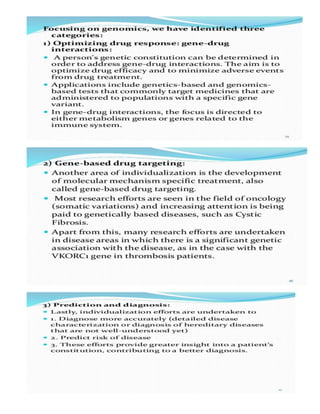
Categories for patients for personalized medicines:-
Patients are mainly classified depending upon the genetic polymorphism,
cytochrome p450 genetic polymorphism, different families of enzymes
polymorphism.
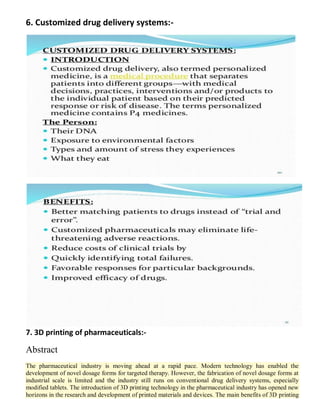
6. Customized drug delivery systems:-
7. 3D printing of pharmaceuticals:-
Abstract
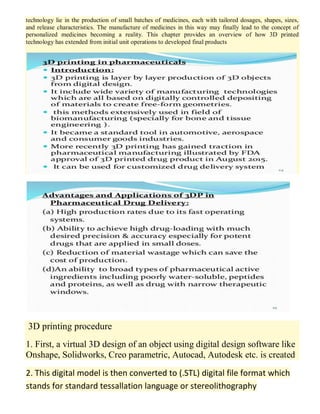
The pharmaceutical industry is moving ahead at a rapid pace. Modern technology has enabled the
development of novel dosage forms for targeted therapy. However, the fabrication of novel dosage forms at
industrial scale is limited and the industry still runs on conventional drug delivery systems, especially
modified tablets. The introduction of 3D printing technology in the pharmaceutical industry has opened new
horizons in the research and development of printed materials and devices. The main benefits of 3D printing
technology lie in the production of small batches of medicines, each with tailored dosages, shapes, sizes,
and release characteristics. The manufacture of medicines in this way may finally lead to the concept of
personalized medicines becoming a reality. This chapter provides an overview of how 3D printed
technology has extended from initial unit operations to developed final products
3D printing procedure
1. First, a virtual 3D design of an object using digital design software like
Onshape, Solidworks, Creo parametric, Autocad, Autodesk etc. is created
2. This digital model is then converted to (.STL) digital file format which
stands for standard tessallation language or stereolithography
3. Triangulated facets give information regarding the surface of the 3D
model that is present in the (.STL) file
4. The (.STL) file is converted into G file by slicing the design into a series
of 2D horizontal cross-sections by the help of specialized slicer software,
which is installed in the 3D printer
5. Now the print head is moved in the x-y axis to create the base of the
3D object.
6. The print head is now allowed to move in the z-axis, thereby
depositing the layers sequentially of the desired material, hence creating
a complete 3D object
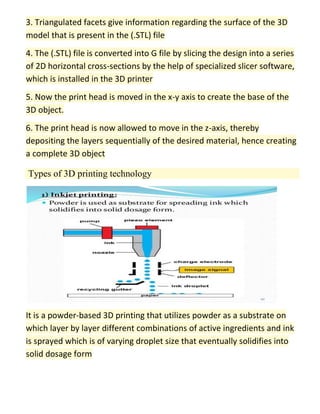
Types of 3D printing technology
It is a powder-based 3D printing that utilizes powder as a substrate on
which layer by layer different combinations of active ingredients and ink
is sprayed which is of varying droplet size that eventually solidifies into
solid dosage form
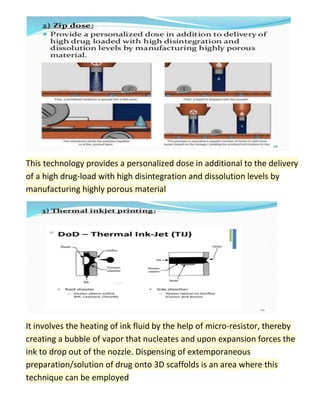
This technology provides a personalized dose in additional to the delivery
of a high drug-load with high disintegration and dissolution levels by
manufacturing highly porous material
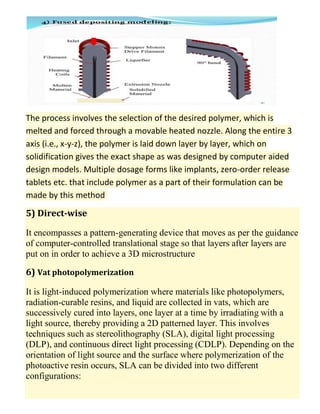
It involves the heating of ink fluid by the help of micro-resistor, thereby
creating a bubble of vapor that nucleates and upon expansion forces the
ink to drop out of the nozzle. Dispensing of extemporaneous
preparation/solution of drug onto 3D scaffolds is an area where this
technique can be employed
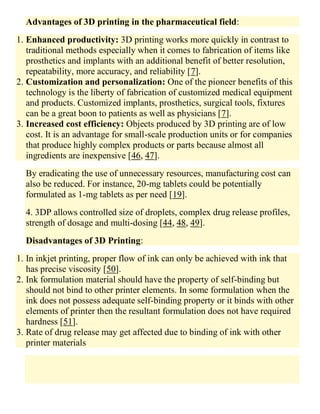
The process involves the selection of the desired polymer, which is
melted and forced through a movable heated nozzle. Along the entire 3
axis (i.e., x-y-z), the polymer is laid down layer by layer, which on
solidification gives the exact shape as was designed by computer aided
design models. Multiple dosage forms like implants, zero-order release
tablets etc. that include polymer as a part of their formulation can be
made by this method
5) Direct-wise
It encompasses a pattern-generating device that moves as per the guidance
of computer-controlled translational stage so that layers after layers are
put on in order to achieve a 3D microstructure
6) Vat photopolymerization
It is light-induced polymerization where materials like photopolymers,
radiation-curable resins, and liquid are collected in vats, which are
successively cured into layers, one layer at a time by irradiating with a
light source, thereby providing a 2D patterned layer. This involves
techniques such as stereolithography (SLA), digital light processing
(DLP), and continuous direct light processing (CDLP). Depending on the
orientation of light source and the surface where polymerization of the
photoactive resin occurs, SLA can be divided into two different
configurations:
Advantages of 3D printing in the pharmaceutical field:
1. Enhanced productivity: 3D printing works more quickly in contrast to
traditional methods especially when it comes to fabrication of items like
prosthetics and implants with an additional benefit of better resolution,
repeatability, more accuracy, and reliability [7].
2. Customization and personalization: One of the pioneer benefits of this
technology is the liberty of fabrication of customized medical equipment
and products. Customized implants, prosthetics, surgical tools, fixtures
can be a great boon to patients as well as physicians [7].
3. Increased cost efficiency: Objects produced by 3D printing are of low
cost. It is an advantage for small-scale production units or for companies
that produce highly complex products or parts because almost all
ingredients are inexpensive [46, 47].
By eradicating the use of unnecessary resources, manufacturing cost can
also be reduced. For instance, 20-mg tablets could be potentially
formulated as 1-mg tablets as per need [19].
4. 3DP allows controlled size of droplets, complex drug release profiles,
strength of dosage and multi-dosing [44, 48, 49].
Disadvantages of 3D Printing:
1. In inkjet printing, proper flow of ink can only be achieved with ink that
has precise viscosity [50].
2. Ink formulation material should have the property of self-binding but
should not bind to other printer elements. In some formulation when the
ink does not possess adequate self-binding property or it binds with other
elements of printer then the resultant formulation does not have required
hardness [51].
3. Rate of drug release may get affected due to binding of ink with other
printer materials
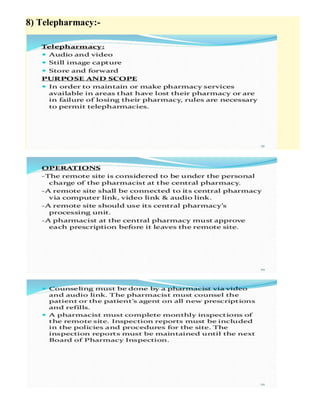
8) Telepharmacy:-
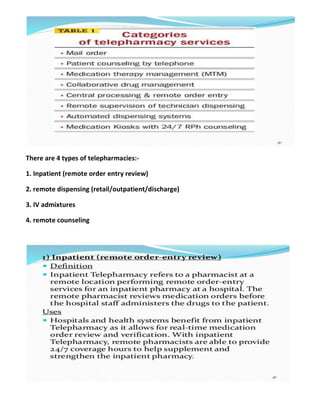
There are 4 types of telepharmacies:-
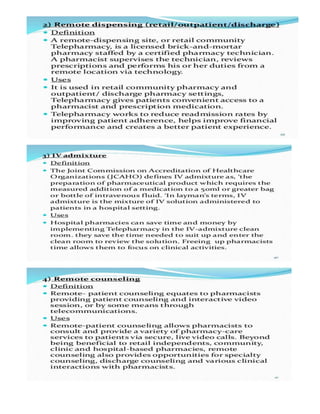
1. Inpatient (remote order entry review)
2. remote dispensing (retail/outpatient/discharge)
3. IV admixtures
4. remote counseling
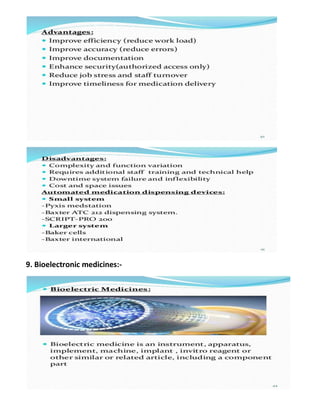
9. Bioelectronic medicines:-
_________________________________The End__________________________________