

SEMINAR ON
ROLLER COMPACTOR
By: Jayesh M. Rajput
E8876
T. Research Associate
Department of Formulation Research and Development
PULSE ADVANCED RESEARCH CENTER.
Dry Granulation
is the process of forming particles i.e., granulates or granules from dry powder or powder blend without adding liquid to aid in the process.
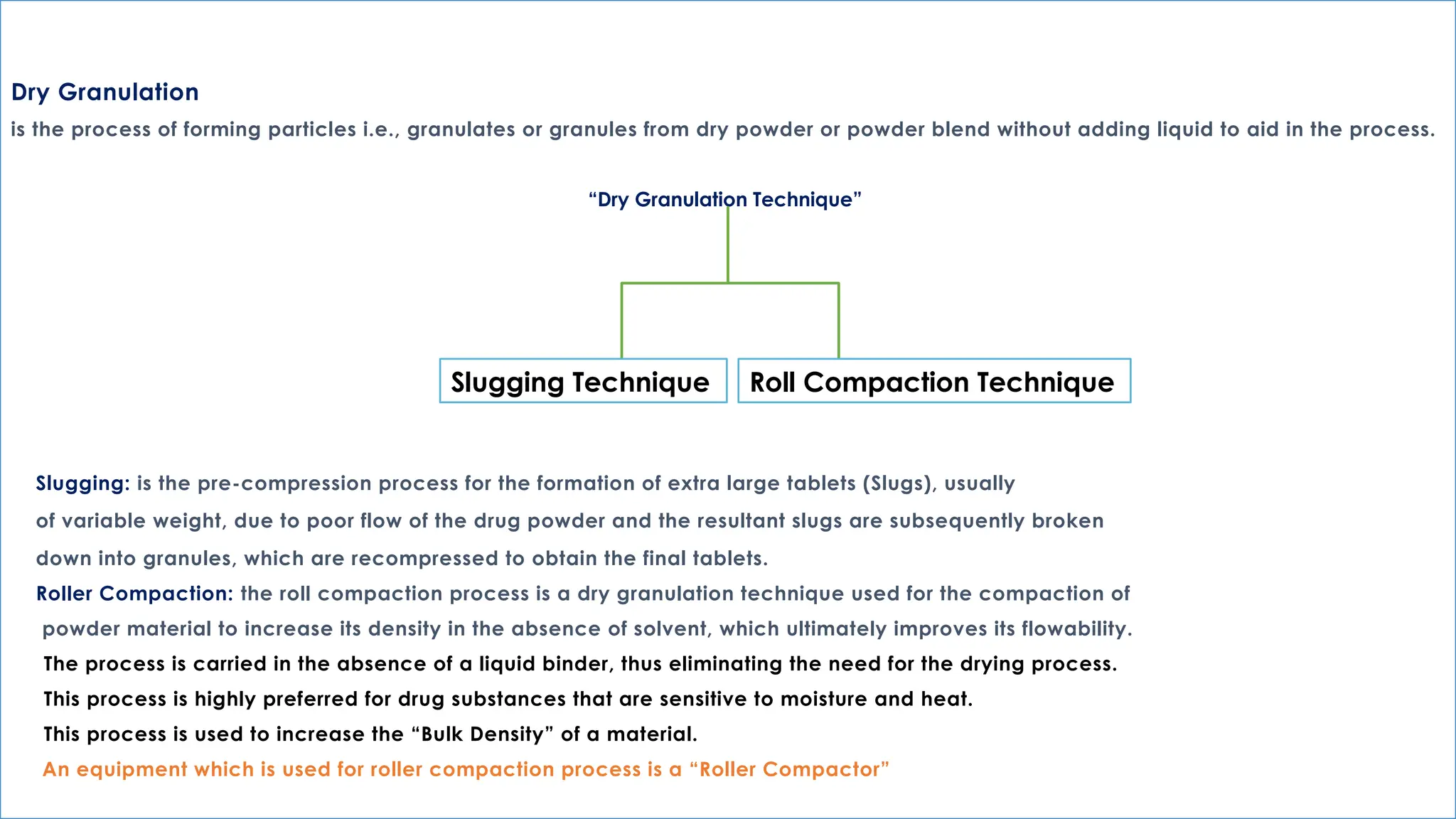
“Dry Granulation Technique”
Slugging: is the pre-compression process for the formation of extra large tablets (Slugs), usually
of variable weight, due to poor flow of the drug powder and the resultant slugs are subsequently broken
down into granules, which are recompressed to obtain the final tablets.
Roller Compaction: the roll compaction process is a dry granulation technique used for the compaction of
powder material to increase its density in the absence of solvent, which ultimately improves its flowability.
 The process is carried in the absence of a liquid binder, thus eliminating the need for the drying process.
 This process is highly preferred for drug substances that are sensitive to moisture and heat.
 This process is used to increase the “Bulk Density” of a material.
An equipment which is used for roller compaction process is a “Roller Compactor”
Slugging Technique Roll Compaction Technique
PARTS IN ROLLER COMPACTOR
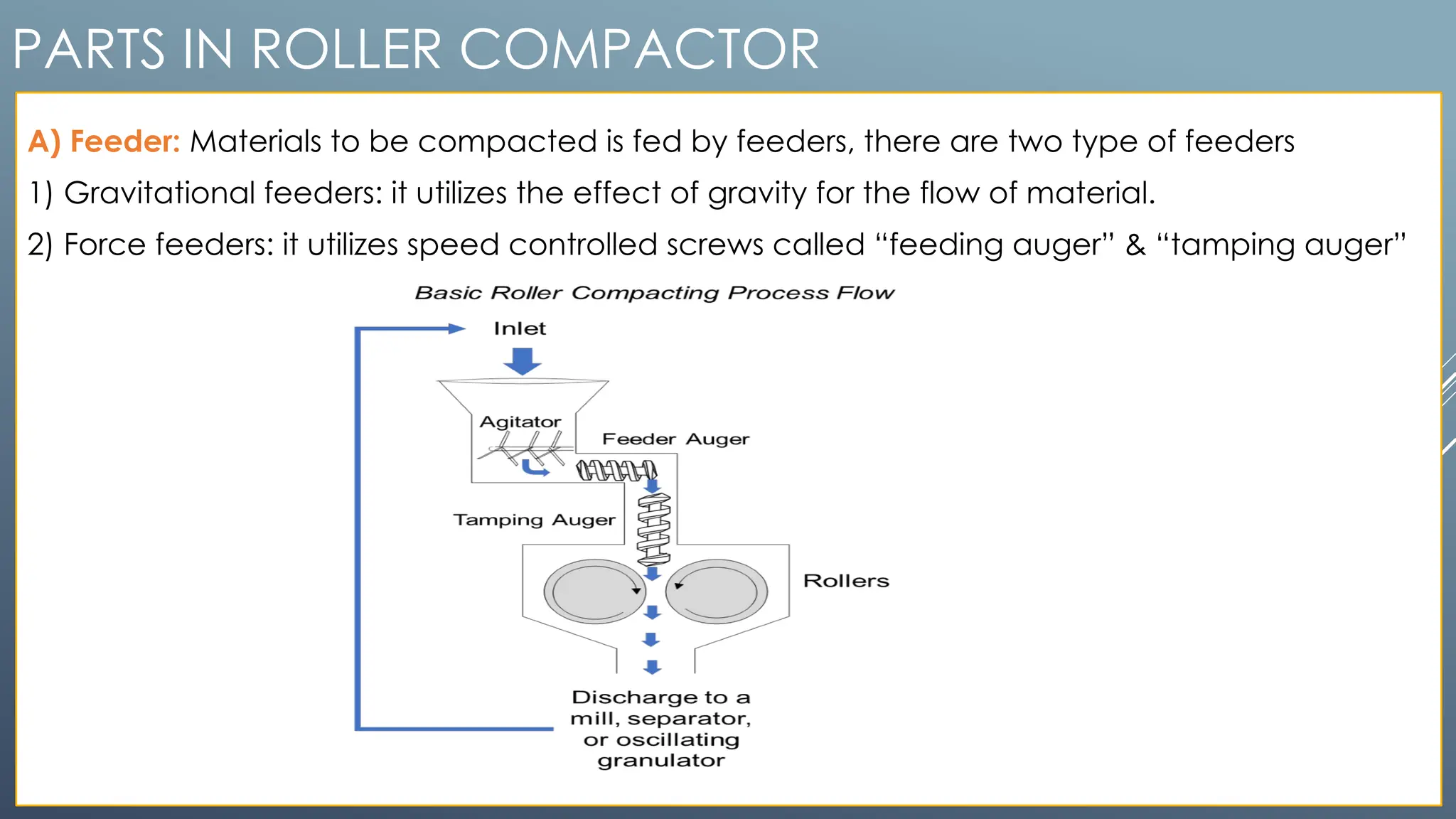
A) Feeder: Materials to be compacted is fed by feeders, there are two type of feeders
1) Gravitational feeders: it utilizes the effect of gravity for the flow of material.
2) Force feeders: it utilizes speed controlled screws called “feeding auger” & “tamping auger”
B) Compaction:
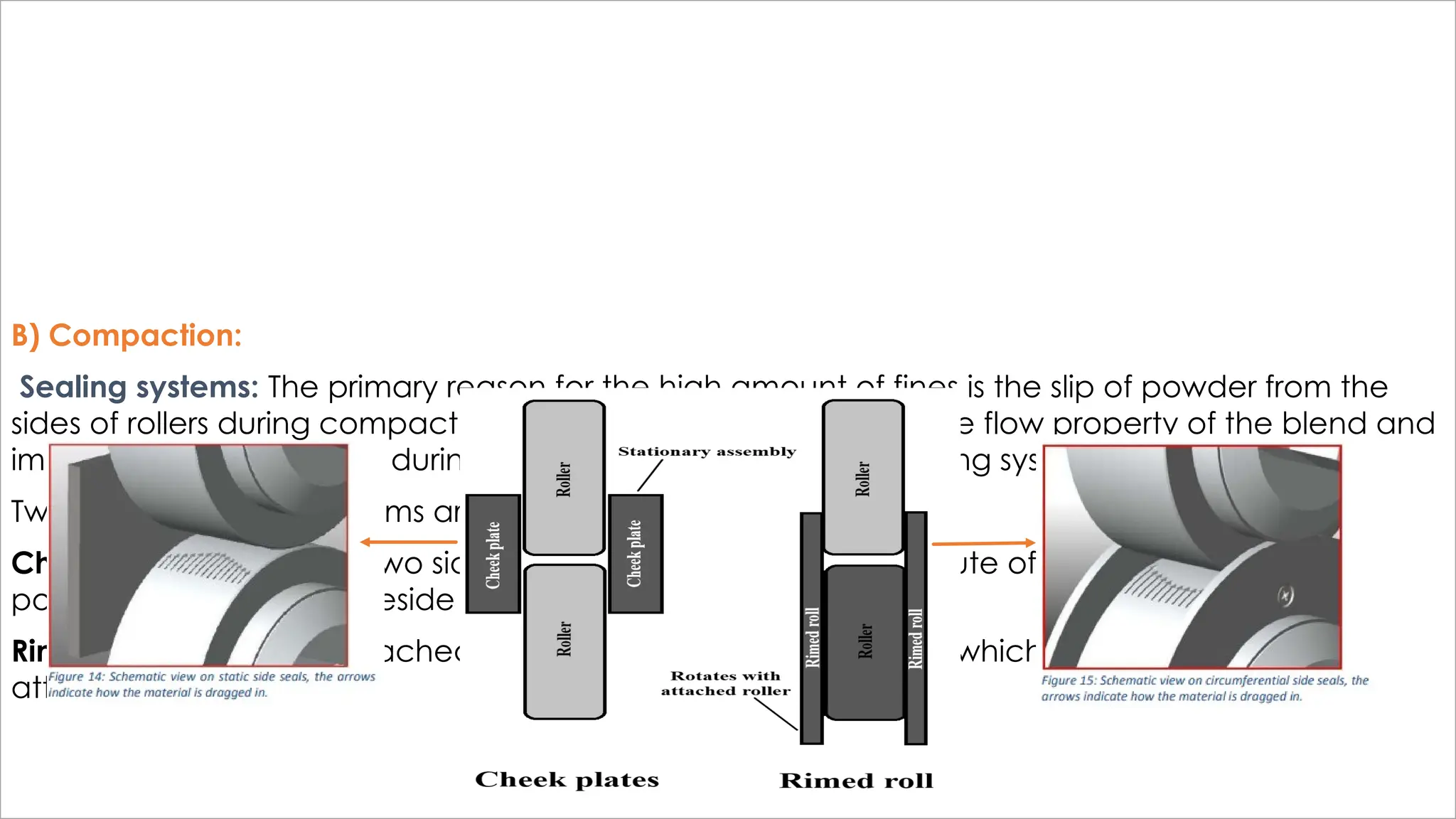
Sealing systems: The primary reason for the high amount of fines is the slip of powder from the
sides of rollers during compaction. Production of fines impacts the flow property of the blend and
impacts die filling volume during tablet compression, thus a sealing system is employed.
Two types of sealing systems are:
Cheek Plates: these are two side plates that seals the escape route of the non-compacted
powder. They are fixed beside the rollers (they are stationary).
Rimmed Roll: flat and attached on both sides to one of the rolls, which rotates along with the
attached roll.
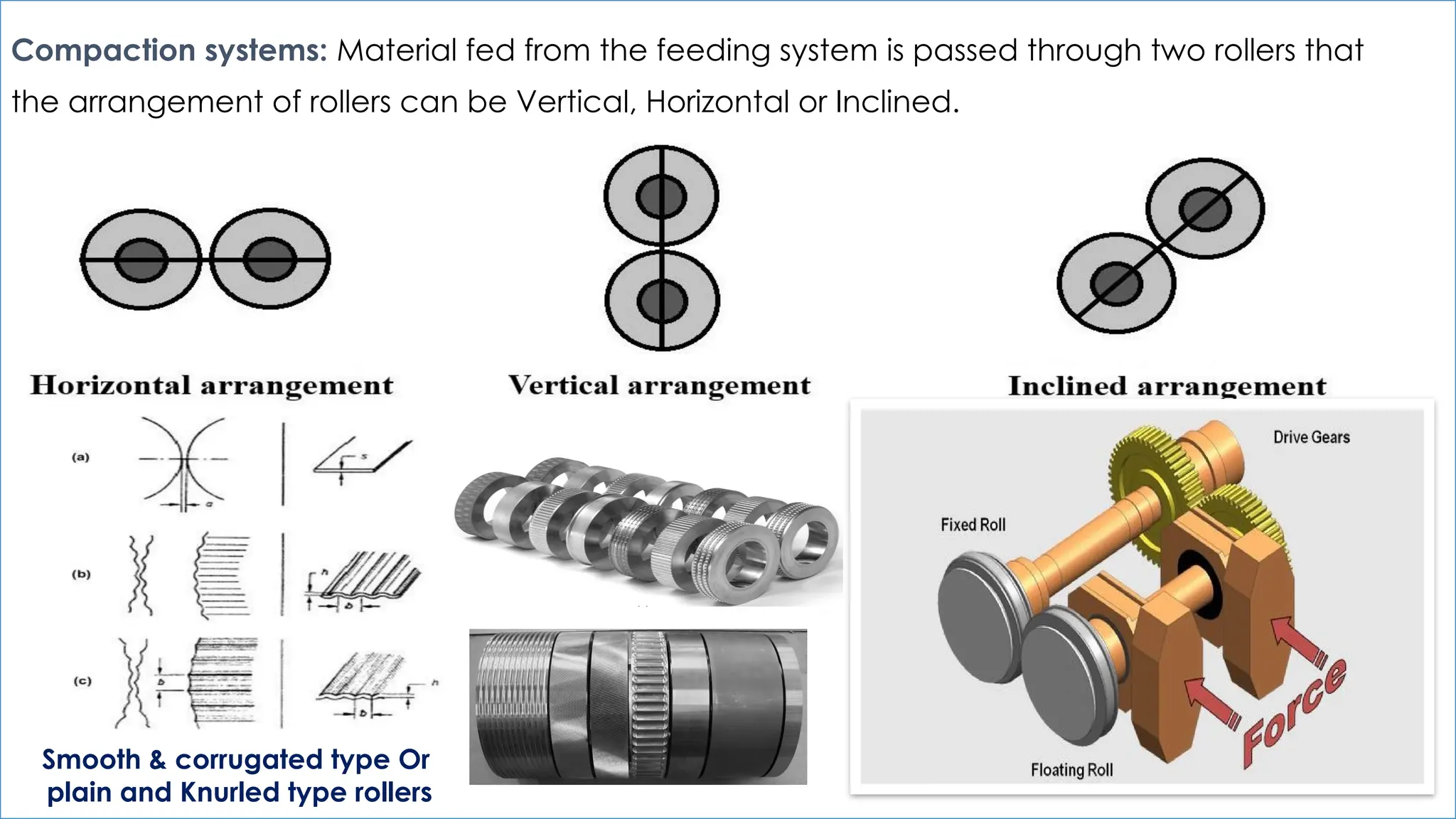
Compaction systems: Material fed from the feeding system is passed through two rollers that
the arrangement of rollers can be Vertical, Horizontal or Inclined.
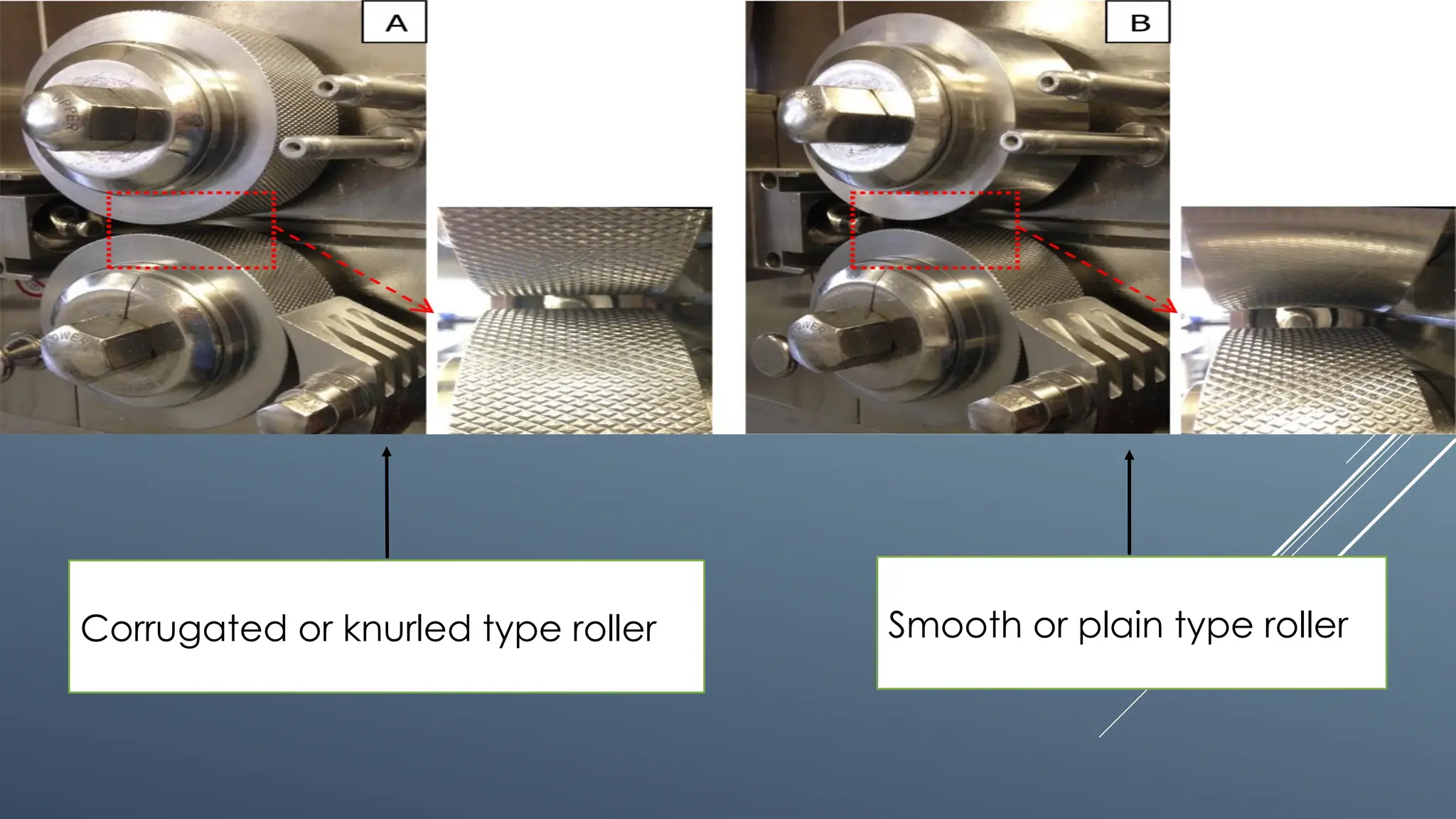
Smooth & corrugated type Or
plain and Knurled type rollers
Corrugated or knurled type roller Smooth or plain type roller
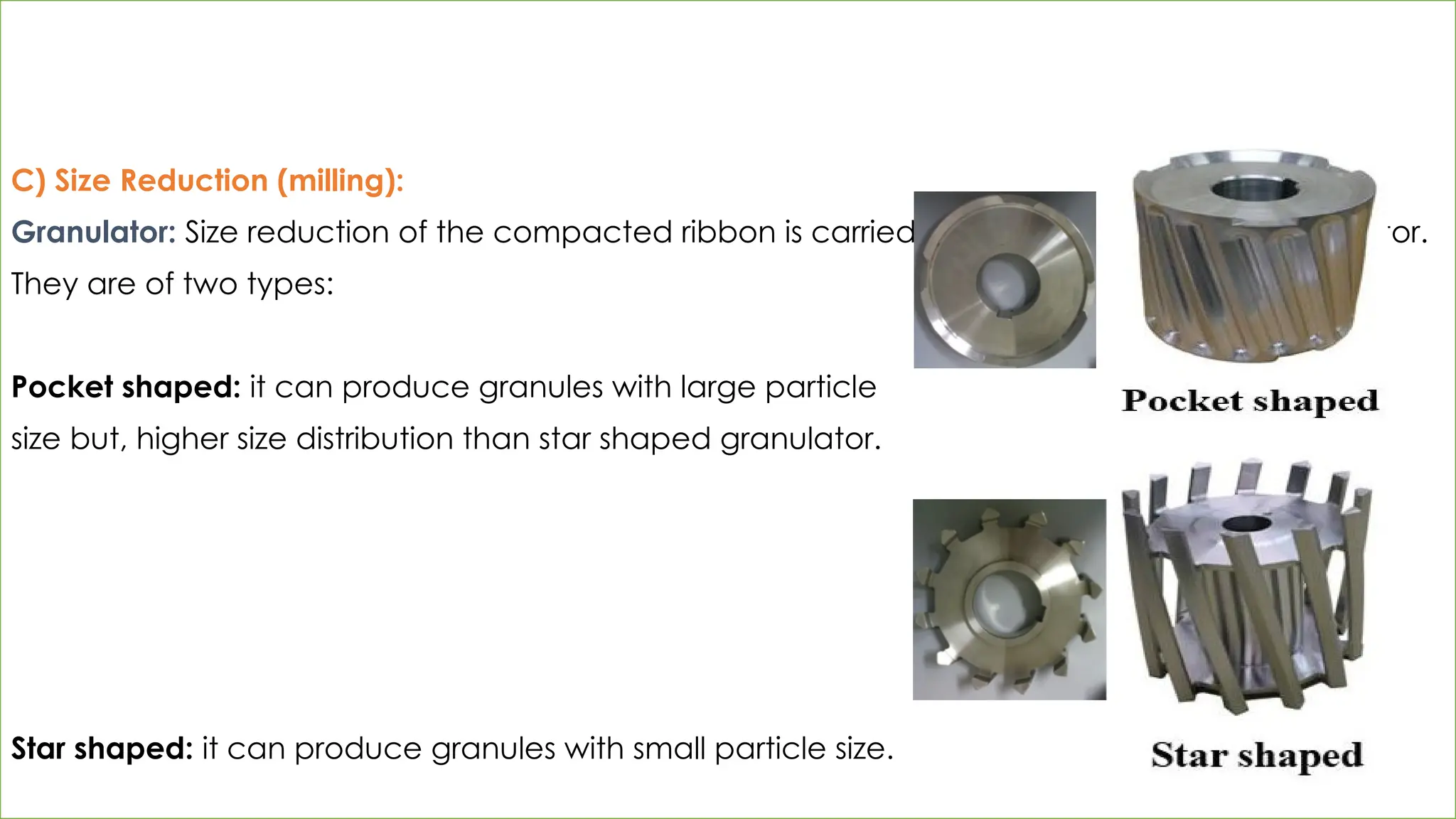
C) Size Reduction (milling):
Granulator: Size reduction of the compacted ribbon is carried out using an oscillating granulator.
They are of two types:
Pocket shaped: it can produce granules with large particle
size but, higher size distribution than star shaped granulator.
Star shaped: it can produce granules with small particle size.
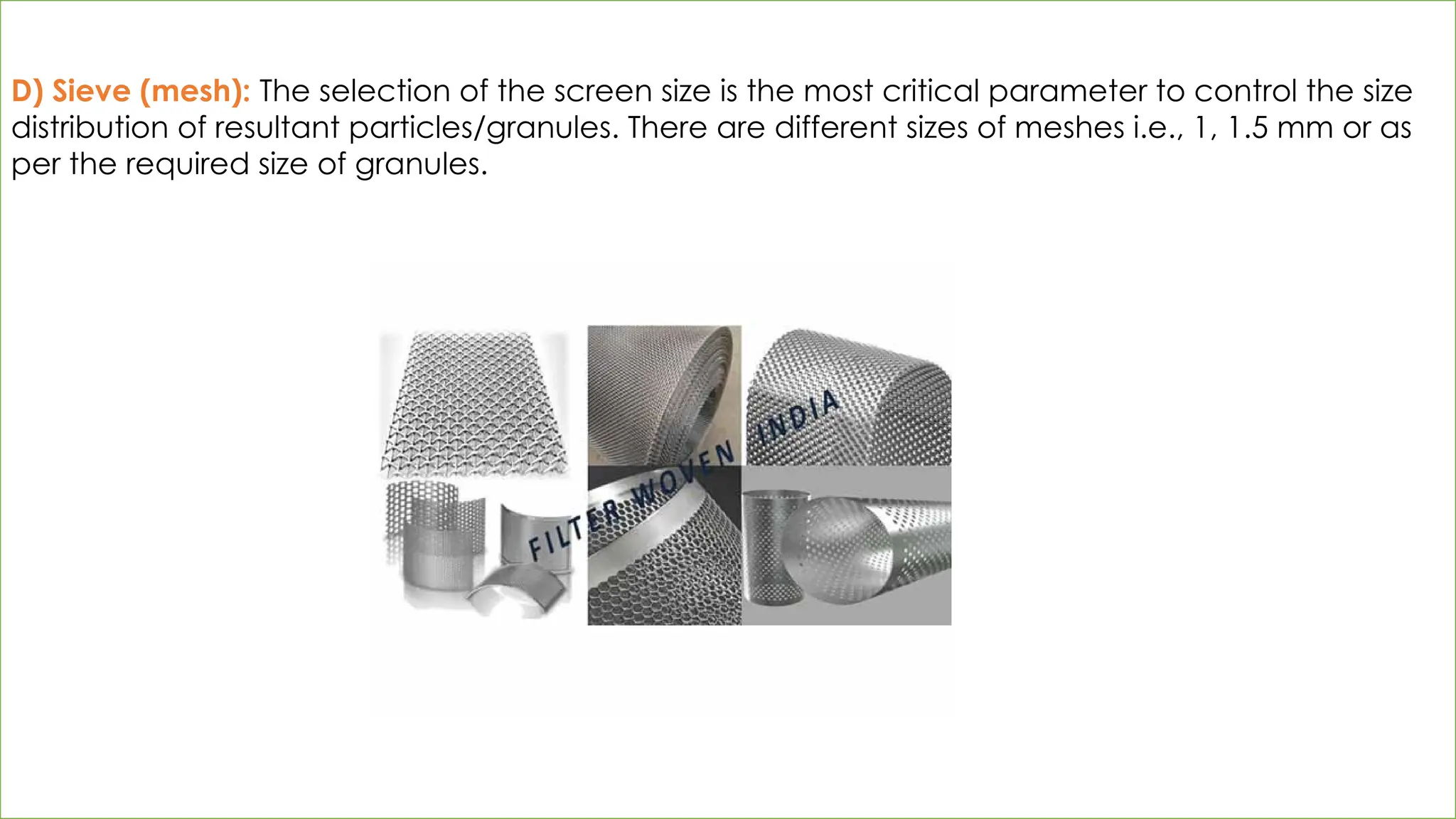
D) Sieve (mesh): The selection of the screen size is the most critical parameter to control the size
distribution of resultant particles/granules. There are different sizes of meshes i.e., 1, 1.5 mm or as
per the required size of granules.
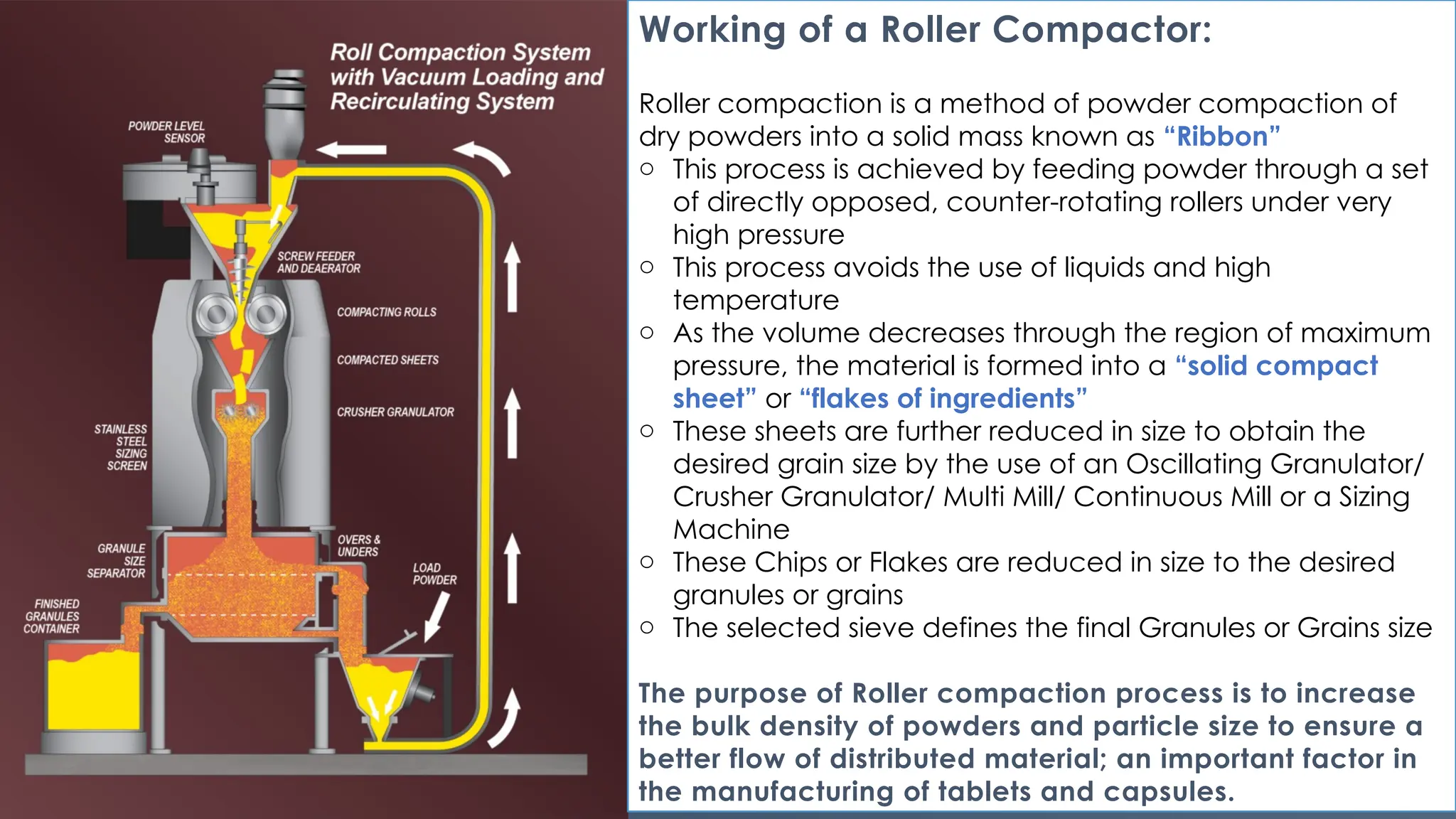
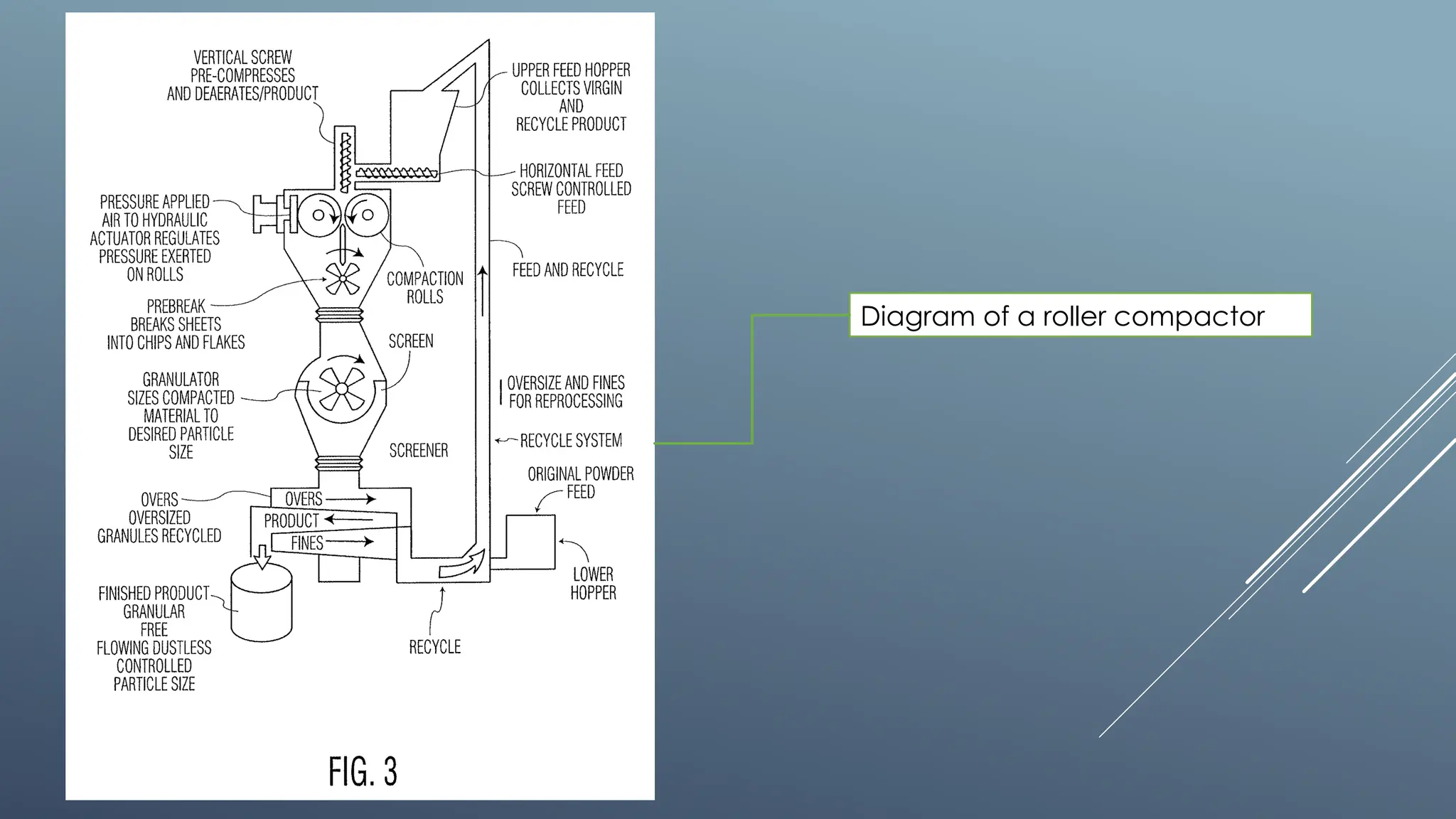
Working of a Roller Compactor:
Roller compaction is a method of powder compaction of
dry powders into a solid mass known as “Ribbon”
o This process is achieved by feeding powder through a set
of directly opposed, counter-rotating rollers under very
high pressure
o This process avoids the use of liquids and high
temperature
o As the volume decreases through the region of maximum
pressure, the material is formed into a “solid compact
sheet” or “flakes of ingredients”
o These sheets are further reduced in size to obtain the
desired grain size by the use of an Oscillating Granulator/
Crusher Granulator/ Multi Mill/ Continuous Mill or a Sizing
Machine
o These Chips or Flakes are reduced in size to the desired
granules or grains
o The selected sieve defines the final Granules or Grains size
The purpose of Roller compaction process is to increase
the bulk density of powders and particle size to ensure a
better flow of distributed material; an important factor in
the manufacturing of tablets and capsules.
Diagram of a roller compactor
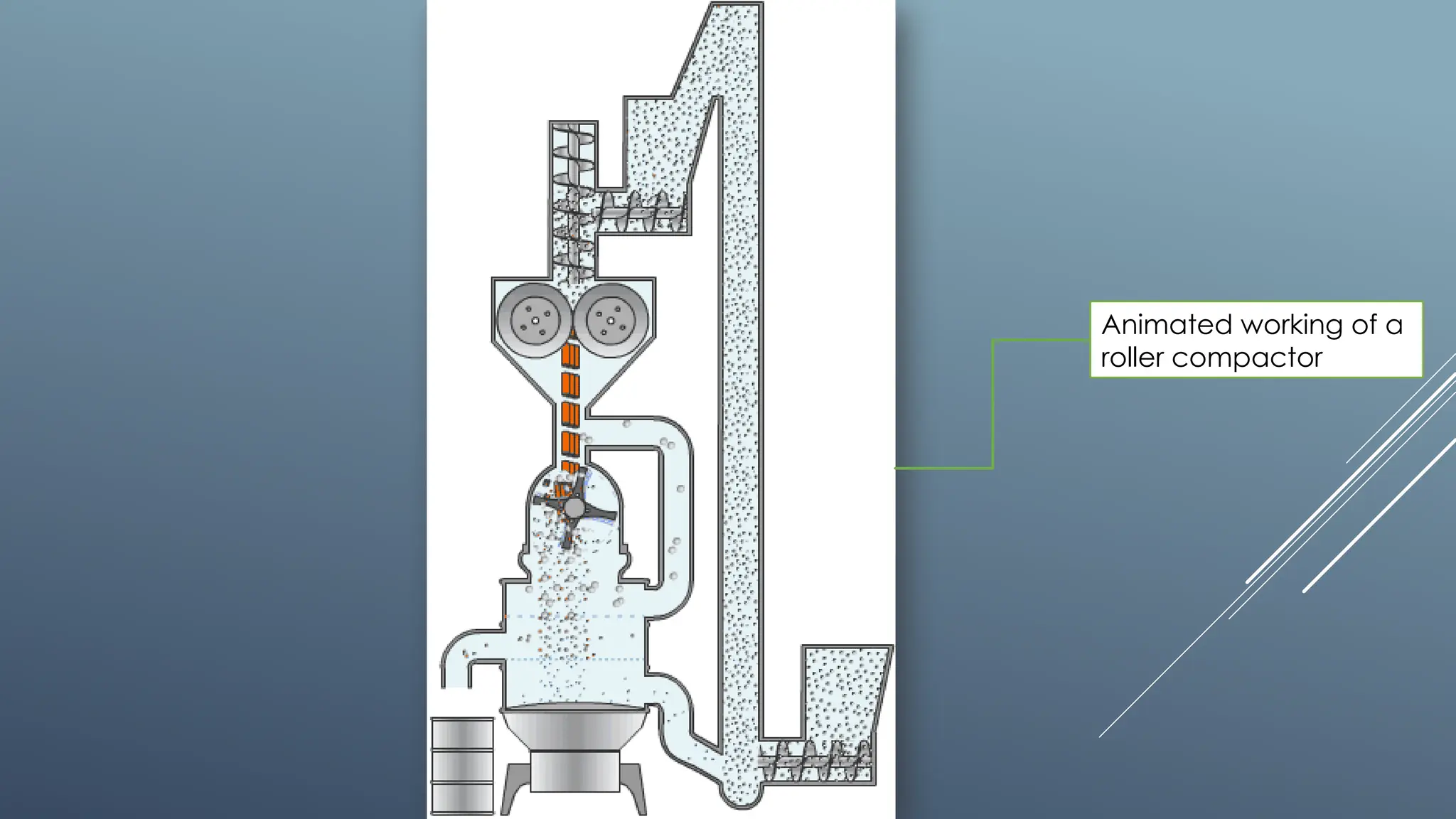
Animated working of a
roller compactor
TYPES OF ROLLER COMPACTORS
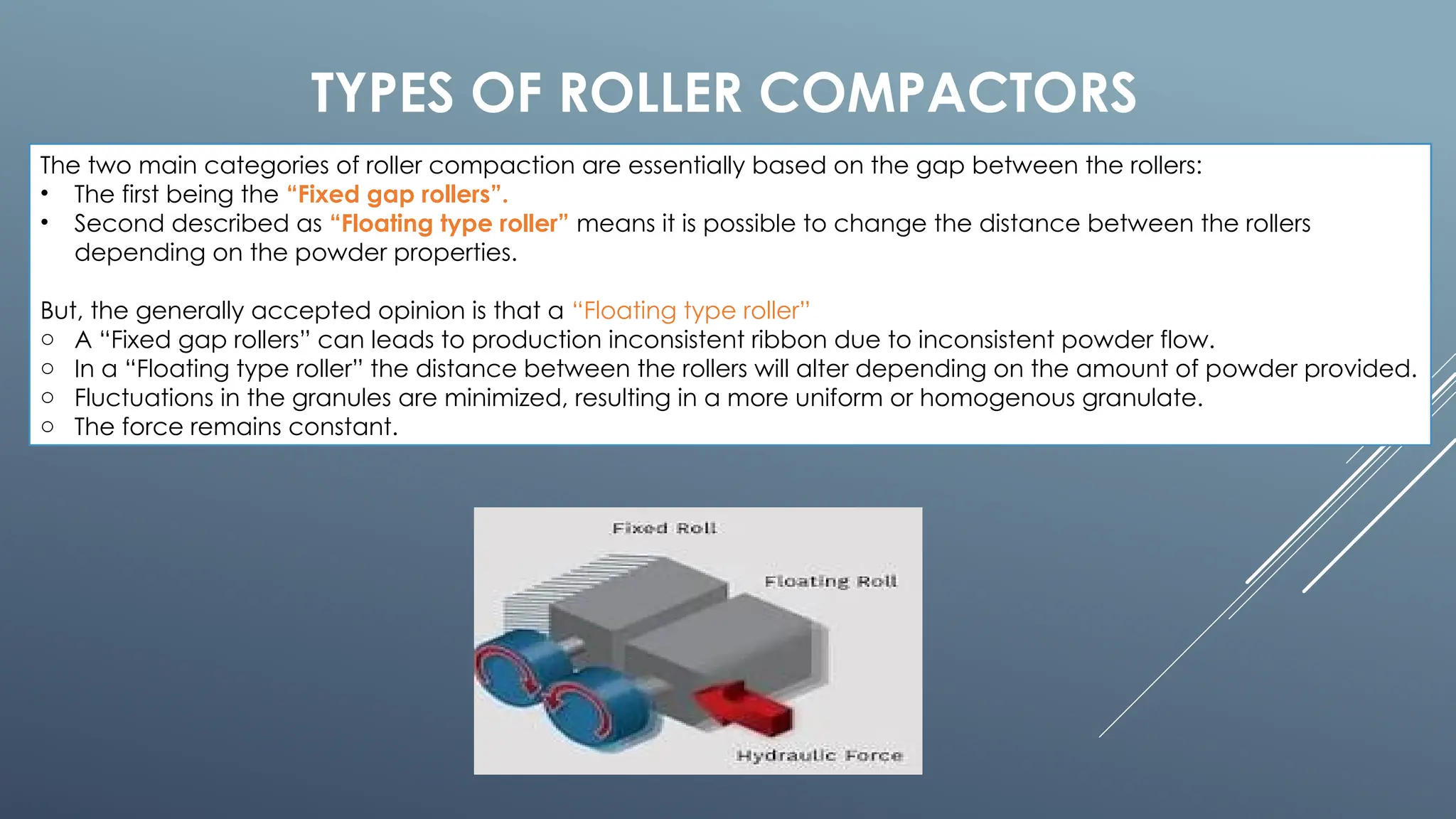
The two main categories of roller compaction are essentially based on the gap between the rollers:
• The first being the “Fixed gap rollers”.
• Second described as “Floating type roller” means it is possible to change the distance between the rollers
depending on the powder properties.
But, the generally accepted opinion is that a “Floating type roller”
o A “Fixed gap rollers” can leads to production inconsistent ribbon due to inconsistent powder flow.
o In a “Floating type roller” the distance between the rollers will alter depending on the amount of powder provided.
o Fluctuations in the granules are minimized, resulting in a more uniform or homogenous granulate.
o The force remains constant.
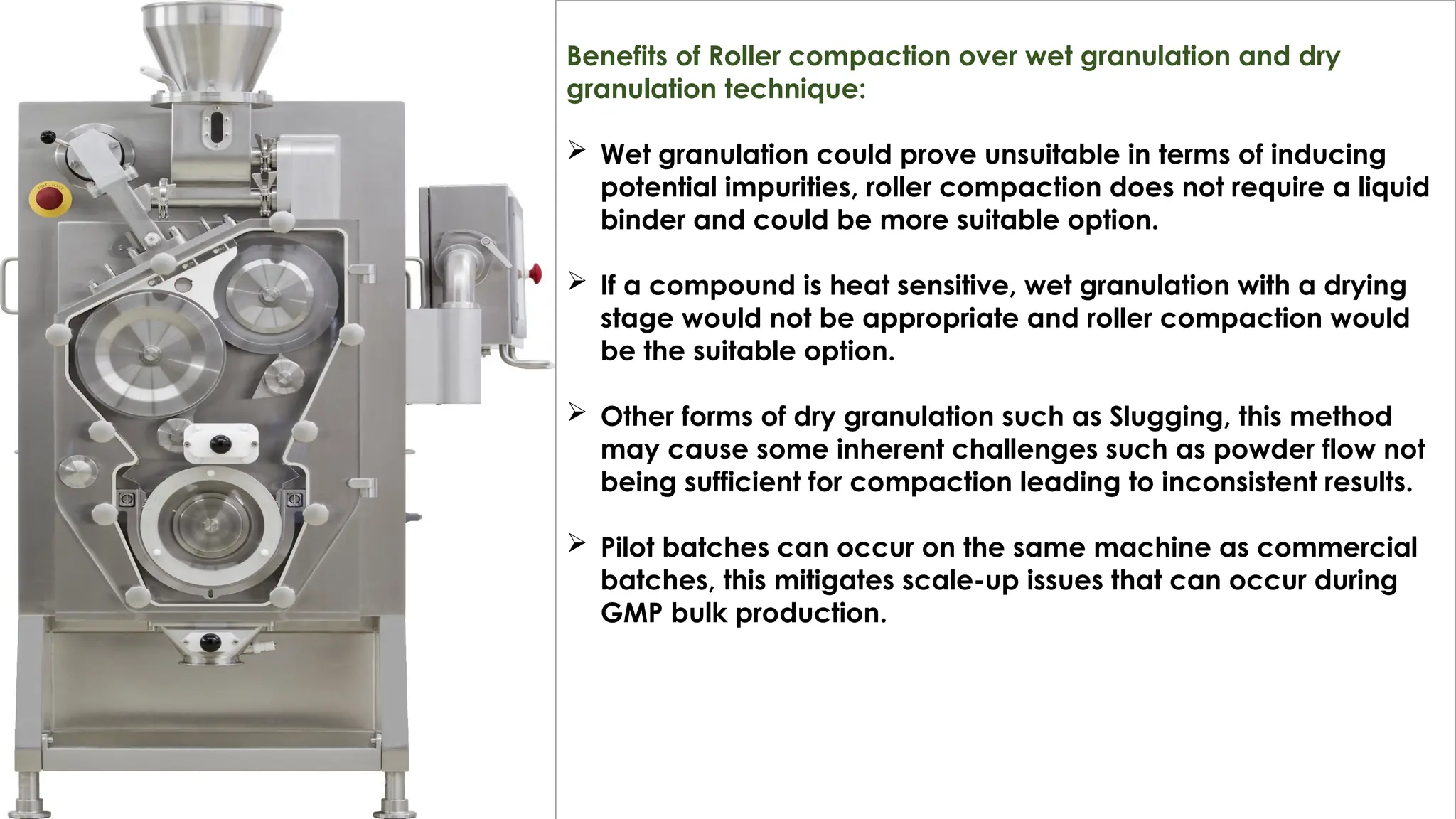
Benefits of Roller compaction over wet granulation and dry
granulation technique:
 Wet granulation could prove unsuitable in terms of inducing
potential impurities, roller compaction does not require a liquid
binder and could be more suitable option.
 If a compound is heat sensitive, wet granulation with a drying
stage would not be appropriate and roller compaction would
be the suitable option.
 Other forms of dry granulation such as Slugging, this method
may cause some inherent challenges such as powder flow not
being sufficient for compaction leading to inconsistent results.
 Pilot batches can occur on the same machine as commercial
batches, this mitigates scale-up issues that can occur during
GMP bulk production.
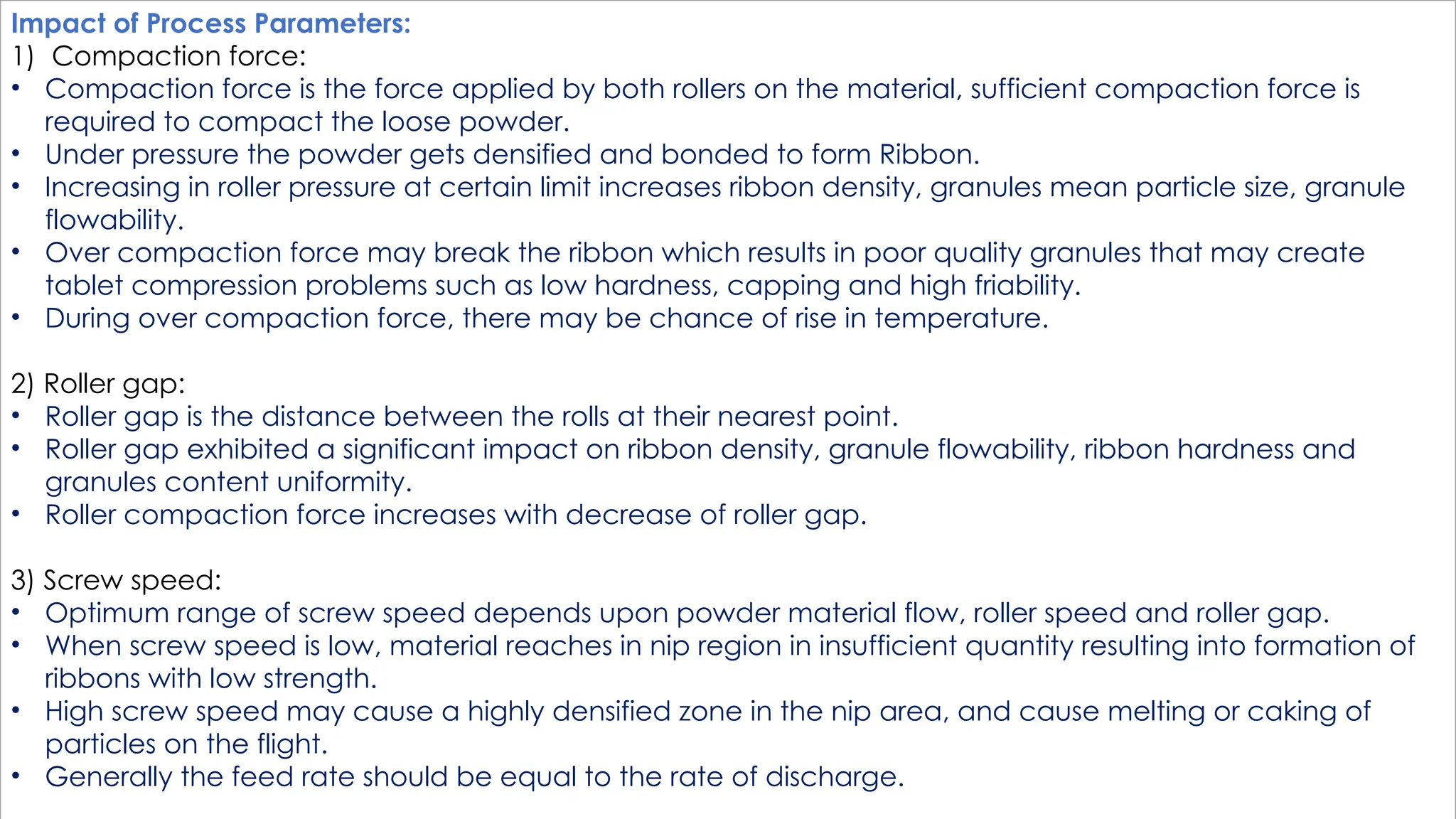
Impact of Process Parameters:
1) Compaction force:
• Compaction force is the force applied by both rollers on the material, sufficient compaction force is
required to compact the loose powder.
• Under pressure the powder gets densified and bonded to form Ribbon.
• Increasing in roller pressure at certain limit increases ribbon density, granules mean particle size, granule
flowability.
• Over compaction force may break the ribbon which results in poor quality granules that may create
tablet compression problems such as low hardness, capping and high friability.
• During over compaction force, there may be chance of rise in temperature.
2) Roller gap:
• Roller gap is the distance between the rolls at their nearest point.
• Roller gap exhibited a significant impact on ribbon density, granule flowability, ribbon hardness and
granules content uniformity.
• Roller compaction force increases with decrease of roller gap.
3) Screw speed:
• Optimum range of screw speed depends upon powder material flow, roller speed and roller gap.
• When screw speed is low, material reaches in nip region in insufficient quantity resulting into formation of
ribbons with low strength.
• High screw speed may cause a highly densified zone in the nip area, and cause melting or caking of
particles on the flight.
• Generally the feed rate should be equal to the rate of discharge.
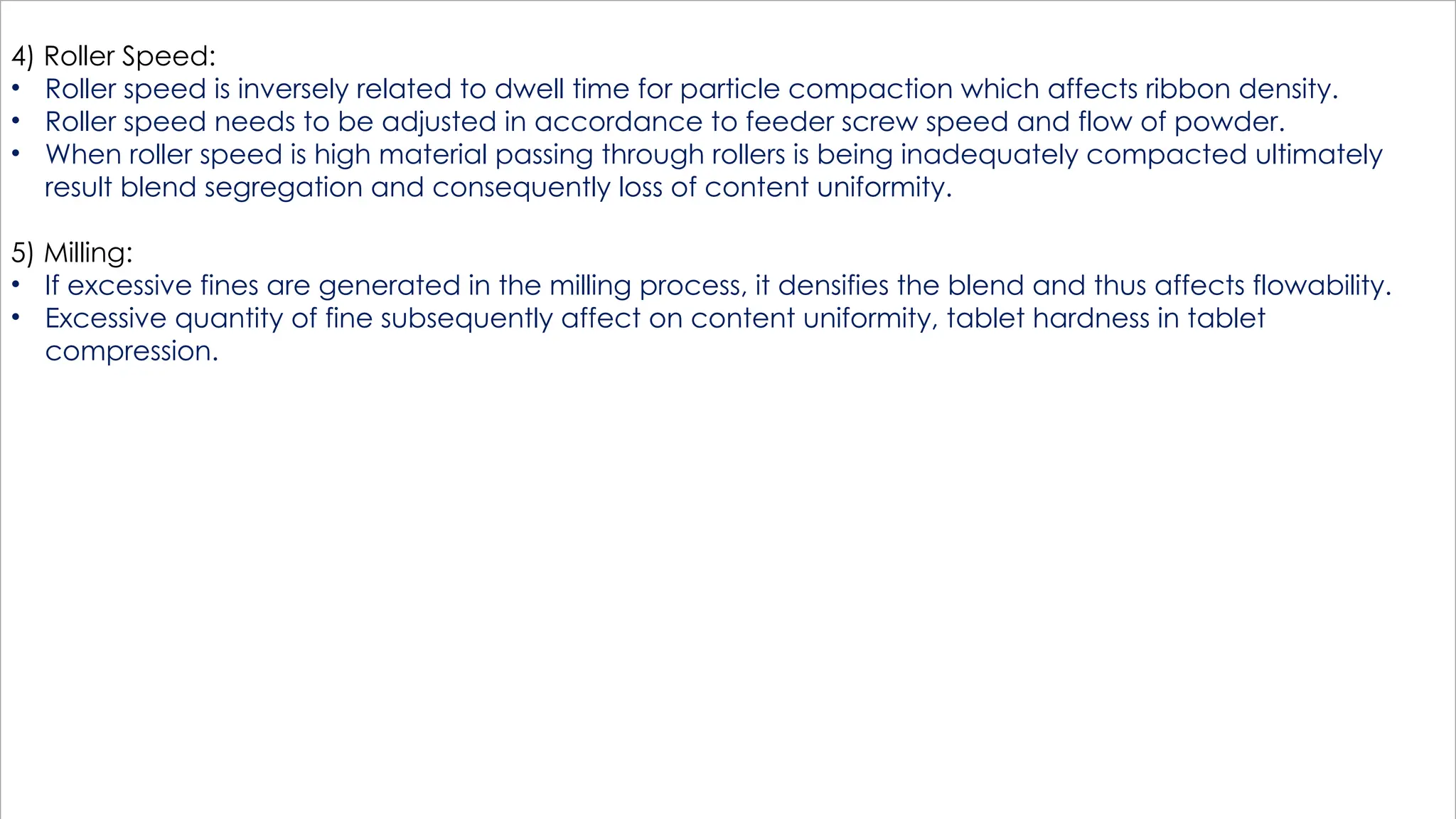
4) Roller Speed:
• Roller speed is inversely related to dwell time for particle compaction which affects ribbon density.
• Roller speed needs to be adjusted in accordance to feeder screw speed and flow of powder.
• When roller speed is high material passing through rollers is being inadequately compacted ultimately
result blend segregation and consequently loss of content uniformity.
5) Milling:
• If excessive fines are generated in the milling process, it densifies the blend and thus affects flowability.
• Excessive quantity of fine subsequently affect on content uniformity, tablet hardness in tablet
compression.
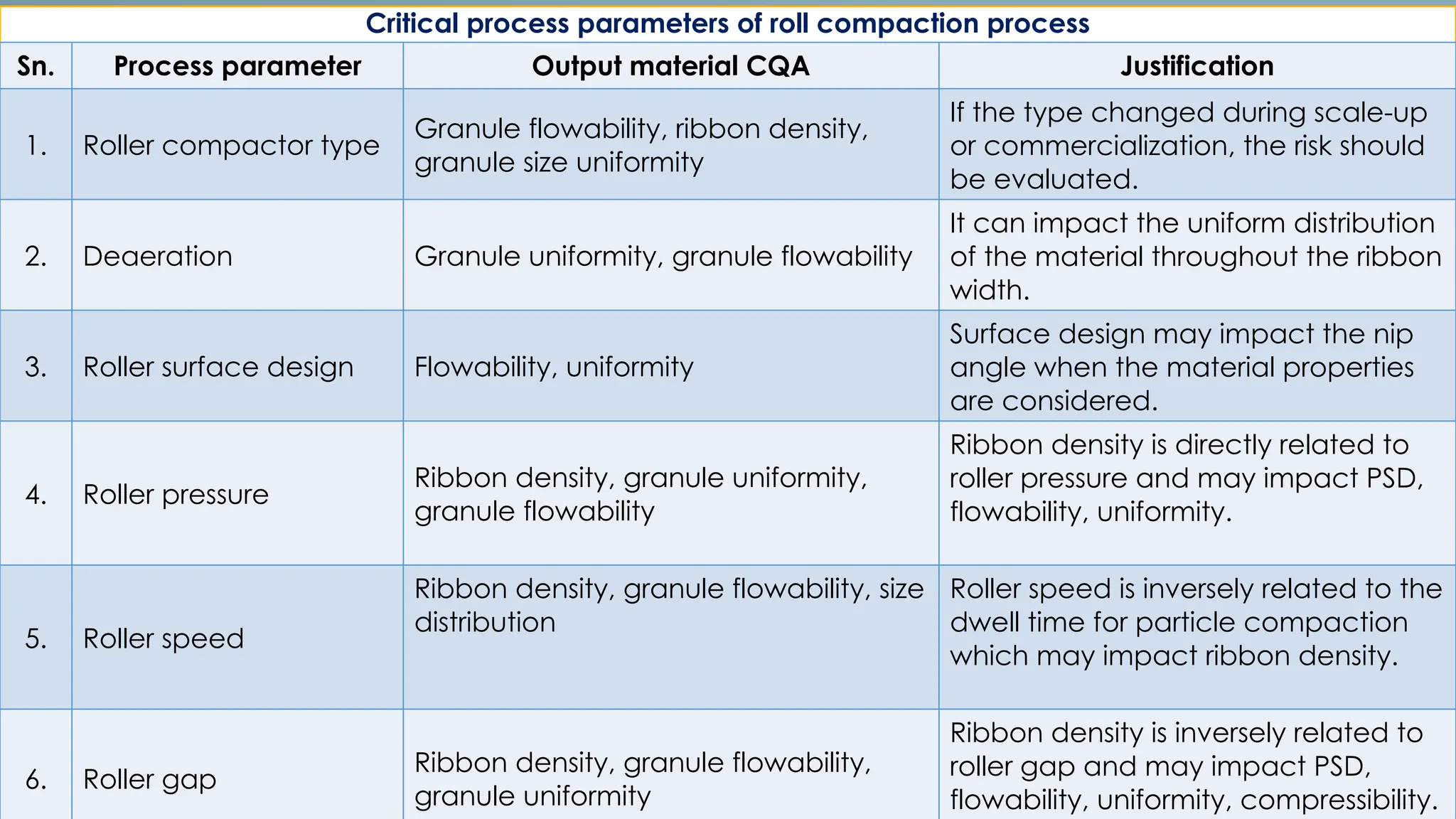
Sn. Process parameter Output material CQA Justification
1. Roller compactor type
Granule flowability, ribbon density,
granule size uniformity
If the type changed during scale-up
or commercialization, the risk should
be evaluated.
2. Deaeration Granule uniformity, granule flowability
It can impact the uniform distribution
of the material throughout the ribbon
width.
3. Roller surface design Flowability, uniformity
Surface design may impact the nip
angle when the material properties
are considered.
4. Roller pressure
Ribbon density, granule uniformity,
granule flowability
Ribbon density is directly related to
roller pressure and may impact PSD,
flowability, uniformity.
5. Roller speed
Ribbon density, granule flowability, size
distribution
Roller speed is inversely related to the
dwell time for particle compaction
which may impact ribbon density.
6. Roller gap
Ribbon density, granule flowability,
granule uniformity
Ribbon density is inversely related to
roller gap and may impact PSD,
flowability, uniformity, compressibility.
Critical process parameters of roll compaction process
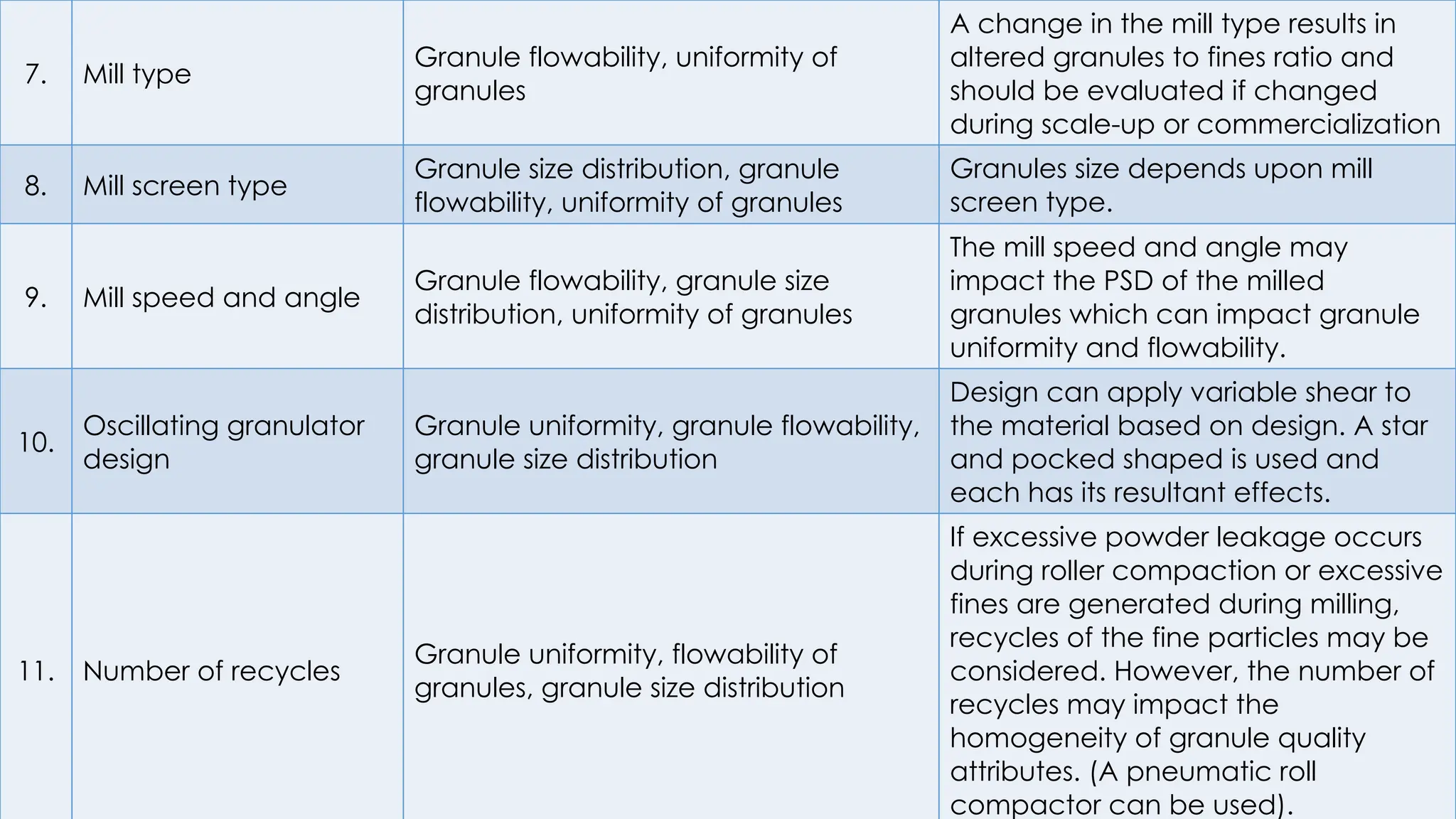
7. Mill type
Granule flowability, uniformity of
granules
A change in the mill type results in
altered granules to fines ratio and
should be evaluated if changed
during scale-up or commercialization
8. Mill screen type
Granule size distribution, granule
flowability, uniformity of granules
Granules size depends upon mill
screen type.
9. Mill speed and angle
Granule flowability, granule size
distribution, uniformity of granules
The mill speed and angle may
impact the PSD of the milled
granules which can impact granule
uniformity and flowability.
10.
Oscillating granulator
design
Granule uniformity, granule flowability,
granule size distribution
Design can apply variable shear to
the material based on design. A star
and pocked shaped is used and
each has its resultant effects.
11. Number of recycles
Granule uniformity, flowability of
granules, granule size distribution
If excessive powder leakage occurs
during roller compaction or excessive
fines are generated during milling,
recycles of the fine particles may be
considered. However, the number of
recycles may impact the
homogeneity of granule quality
attributes. (A pneumatic roll
compactor can be used).
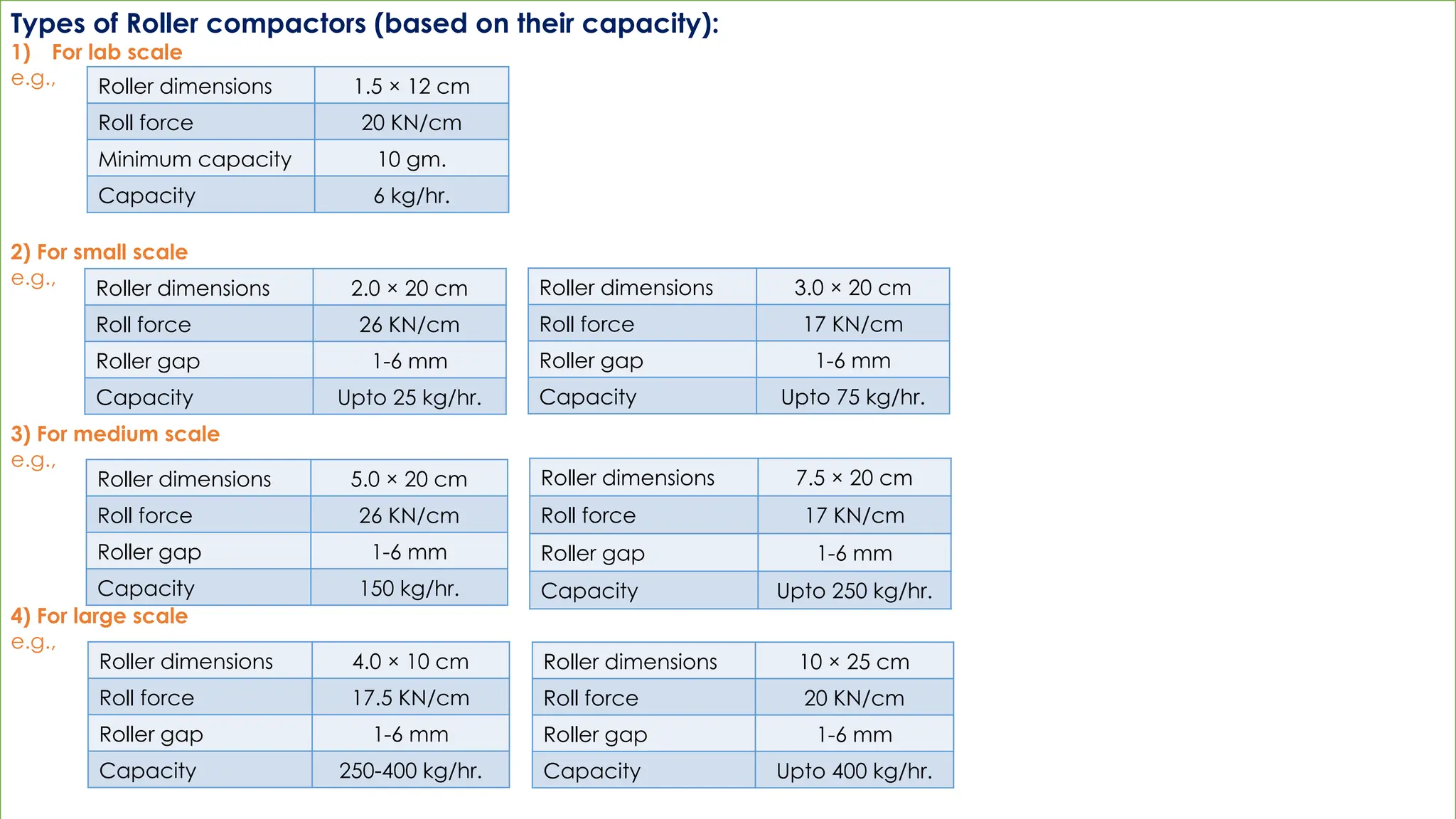
Types of Roller compactors (based on their capacity):
1) For lab scale
e.g.,
2) For small scale
e.g.,
3) For medium scale
e.g.,
4) For large scale
e.g.,
Roller dimensions 1.5 × 12 cm
Roll force 20 KN/cm
Minimum capacity 10 gm.
Capacity 6 kg/hr.
Roller dimensions 2.0 × 20 cm
Roll force 26 KN/cm
Roller gap 1-6 mm
Capacity Upto 25 kg/hr.
Roller dimensions 3.0 × 20 cm
Roll force 17 KN/cm
Roller gap 1-6 mm
Capacity Upto 75 kg/hr.
Roller dimensions 5.0 × 20 cm
Roll force 26 KN/cm
Roller gap 1-6 mm
Capacity 150 kg/hr.
Roller dimensions 7.5 × 20 cm
Roll force 17 KN/cm
Roller gap 1-6 mm
Capacity Upto 250 kg/hr.
Roller dimensions 10 × 25 cm
Roll force 20 KN/cm
Roller gap 1-6 mm
Capacity Upto 400 kg/hr.
Roller dimensions 4.0 × 10 cm
Roll force 17.5 KN/cm
Roller gap 1-6 mm
Capacity 250-400 kg/hr.
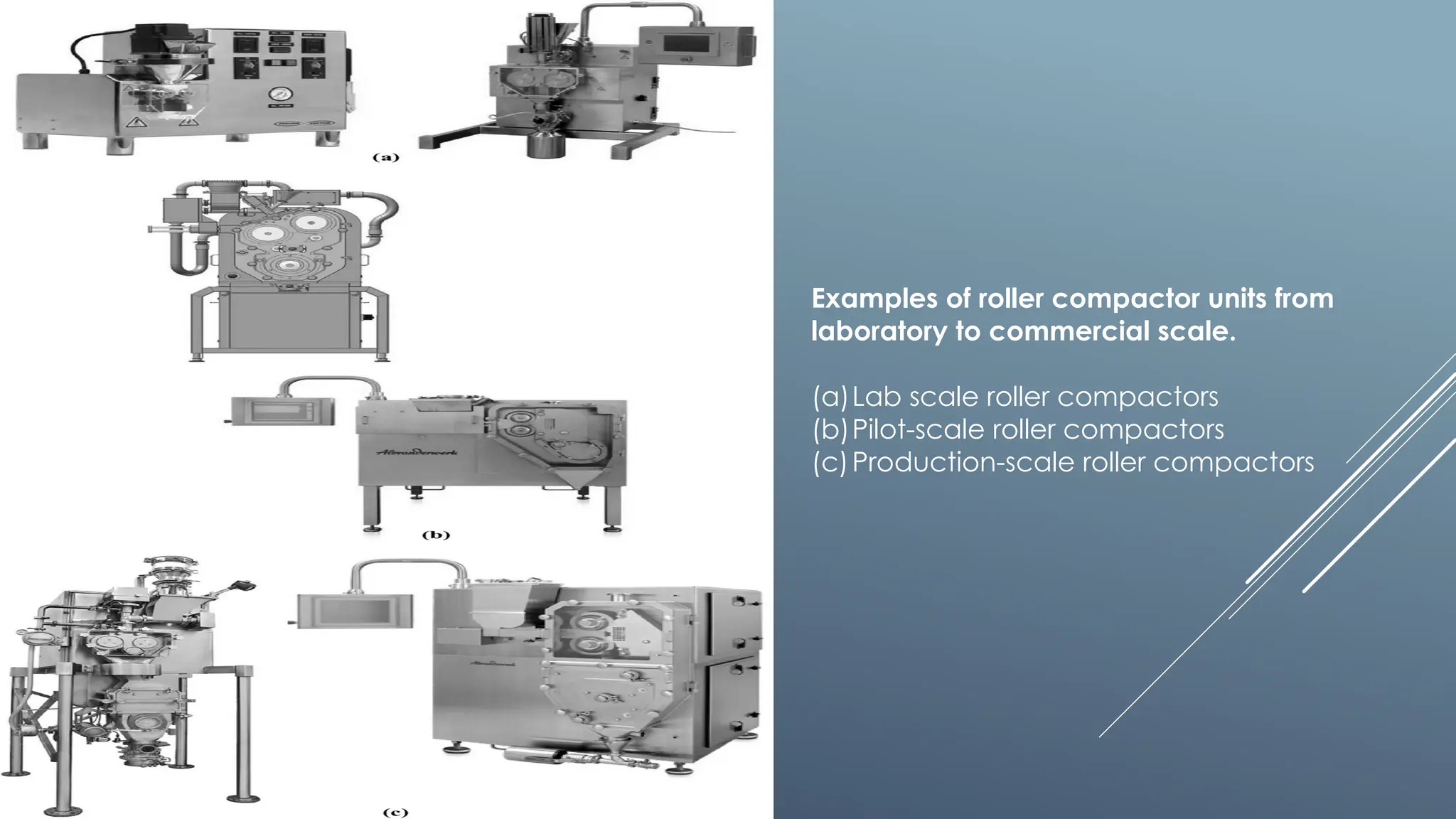
Examples of roller compactor units from
laboratory to commercial scale.
(a)Lab scale roller compactors
(b)Pilot-scale roller compactors
(c)Production-scale roller compactors
CONCLUSION
Roller compaction can be useful for the drugs which have less flow or don’t have flow.
Roller compaction can be useful to the drugs which are sensitive to heat, moisture.
Optimization of process parameters such as Compression force, Roller speed, Roller gap,
Screw speed, Milling speed, and Milling screen orifice size is essential and critical in roller
compaction technique.

Roll Compactor used in dry granulation technique

  • 1.
    SEMINAR ON ROLLER COMPACTOR By:Jayesh M. Rajput E8876 T. Research Associate Department of Formulation Research and Development PULSE ADVANCED RESEARCH CENTER.
  • 2.
    Dry Granulation is theprocess of forming particles i.e., granulates or granules from dry powder or powder blend without adding liquid to aid in the process. “Dry Granulation Technique” Slugging: is the pre-compression process for the formation of extra large tablets (Slugs), usually of variable weight, due to poor flow of the drug powder and the resultant slugs are subsequently broken down into granules, which are recompressed to obtain the final tablets. Roller Compaction: the roll compaction process is a dry granulation technique used for the compaction of powder material to increase its density in the absence of solvent, which ultimately improves its flowability.  The process is carried in the absence of a liquid binder, thus eliminating the need for the drying process.  This process is highly preferred for drug substances that are sensitive to moisture and heat.  This process is used to increase the “Bulk Density” of a material. An equipment which is used for roller compaction process is a “Roller Compactor” Slugging Technique Roll Compaction Technique
  • 3.
    PARTS IN ROLLERCOMPACTOR A) Feeder: Materials to be compacted is fed by feeders, there are two type of feeders 1) Gravitational feeders: it utilizes the effect of gravity for the flow of material. 2) Force feeders: it utilizes speed controlled screws called “feeding auger” & “tamping auger”
  • 4.
    B) Compaction: Sealing systems:The primary reason for the high amount of fines is the slip of powder from the sides of rollers during compaction. Production of fines impacts the flow property of the blend and impacts die filling volume during tablet compression, thus a sealing system is employed. Two types of sealing systems are: Cheek Plates: these are two side plates that seals the escape route of the non-compacted powder. They are fixed beside the rollers (they are stationary). Rimmed Roll: flat and attached on both sides to one of the rolls, which rotates along with the attached roll.
  • 5.
    Compaction systems: Materialfed from the feeding system is passed through two rollers that the arrangement of rollers can be Vertical, Horizontal or Inclined. Smooth & corrugated type Or plain and Knurled type rollers
  • 6.
    Corrugated or knurledtype roller Smooth or plain type roller
  • 7.
    C) Size Reduction(milling): Granulator: Size reduction of the compacted ribbon is carried out using an oscillating granulator. They are of two types: Pocket shaped: it can produce granules with large particle size but, higher size distribution than star shaped granulator. Star shaped: it can produce granules with small particle size.
  • 8.
    D) Sieve (mesh):The selection of the screen size is the most critical parameter to control the size distribution of resultant particles/granules. There are different sizes of meshes i.e., 1, 1.5 mm or as per the required size of granules.
  • 9.
    Working of aRoller Compactor: Roller compaction is a method of powder compaction of dry powders into a solid mass known as “Ribbon” o This process is achieved by feeding powder through a set of directly opposed, counter-rotating rollers under very high pressure o This process avoids the use of liquids and high temperature o As the volume decreases through the region of maximum pressure, the material is formed into a “solid compact sheet” or “flakes of ingredients” o These sheets are further reduced in size to obtain the desired grain size by the use of an Oscillating Granulator/ Crusher Granulator/ Multi Mill/ Continuous Mill or a Sizing Machine o These Chips or Flakes are reduced in size to the desired granules or grains o The selected sieve defines the final Granules or Grains size The purpose of Roller compaction process is to increase the bulk density of powders and particle size to ensure a better flow of distributed material; an important factor in the manufacturing of tablets and capsules.
  • 10.
    Diagram of aroller compactor
  • 11.
    Animated working ofa roller compactor
  • 12.
    TYPES OF ROLLERCOMPACTORS The two main categories of roller compaction are essentially based on the gap between the rollers: • The first being the “Fixed gap rollers”. • Second described as “Floating type roller” means it is possible to change the distance between the rollers depending on the powder properties. But, the generally accepted opinion is that a “Floating type roller” o A “Fixed gap rollers” can leads to production inconsistent ribbon due to inconsistent powder flow. o In a “Floating type roller” the distance between the rollers will alter depending on the amount of powder provided. o Fluctuations in the granules are minimized, resulting in a more uniform or homogenous granulate. o The force remains constant.
  • 13.
    Benefits of Rollercompaction over wet granulation and dry granulation technique:  Wet granulation could prove unsuitable in terms of inducing potential impurities, roller compaction does not require a liquid binder and could be more suitable option.  If a compound is heat sensitive, wet granulation with a drying stage would not be appropriate and roller compaction would be the suitable option.  Other forms of dry granulation such as Slugging, this method may cause some inherent challenges such as powder flow not being sufficient for compaction leading to inconsistent results.  Pilot batches can occur on the same machine as commercial batches, this mitigates scale-up issues that can occur during GMP bulk production.
  • 14.
    Impact of ProcessParameters: 1) Compaction force: • Compaction force is the force applied by both rollers on the material, sufficient compaction force is required to compact the loose powder. • Under pressure the powder gets densified and bonded to form Ribbon. • Increasing in roller pressure at certain limit increases ribbon density, granules mean particle size, granule flowability. • Over compaction force may break the ribbon which results in poor quality granules that may create tablet compression problems such as low hardness, capping and high friability. • During over compaction force, there may be chance of rise in temperature. 2) Roller gap: • Roller gap is the distance between the rolls at their nearest point. • Roller gap exhibited a significant impact on ribbon density, granule flowability, ribbon hardness and granules content uniformity. • Roller compaction force increases with decrease of roller gap. 3) Screw speed: • Optimum range of screw speed depends upon powder material flow, roller speed and roller gap. • When screw speed is low, material reaches in nip region in insufficient quantity resulting into formation of ribbons with low strength. • High screw speed may cause a highly densified zone in the nip area, and cause melting or caking of particles on the flight. • Generally the feed rate should be equal to the rate of discharge.
  • 15.
    4) Roller Speed: •Roller speed is inversely related to dwell time for particle compaction which affects ribbon density. • Roller speed needs to be adjusted in accordance to feeder screw speed and flow of powder. • When roller speed is high material passing through rollers is being inadequately compacted ultimately result blend segregation and consequently loss of content uniformity. 5) Milling: • If excessive fines are generated in the milling process, it densifies the blend and thus affects flowability. • Excessive quantity of fine subsequently affect on content uniformity, tablet hardness in tablet compression.
  • 16.
    Sn. Process parameterOutput material CQA Justification 1. Roller compactor type Granule flowability, ribbon density, granule size uniformity If the type changed during scale-up or commercialization, the risk should be evaluated. 2. Deaeration Granule uniformity, granule flowability It can impact the uniform distribution of the material throughout the ribbon width. 3. Roller surface design Flowability, uniformity Surface design may impact the nip angle when the material properties are considered. 4. Roller pressure Ribbon density, granule uniformity, granule flowability Ribbon density is directly related to roller pressure and may impact PSD, flowability, uniformity. 5. Roller speed Ribbon density, granule flowability, size distribution Roller speed is inversely related to the dwell time for particle compaction which may impact ribbon density. 6. Roller gap Ribbon density, granule flowability, granule uniformity Ribbon density is inversely related to roller gap and may impact PSD, flowability, uniformity, compressibility. Critical process parameters of roll compaction process
  • 17.
    7. Mill type Granuleflowability, uniformity of granules A change in the mill type results in altered granules to fines ratio and should be evaluated if changed during scale-up or commercialization 8. Mill screen type Granule size distribution, granule flowability, uniformity of granules Granules size depends upon mill screen type. 9. Mill speed and angle Granule flowability, granule size distribution, uniformity of granules The mill speed and angle may impact the PSD of the milled granules which can impact granule uniformity and flowability. 10. Oscillating granulator design Granule uniformity, granule flowability, granule size distribution Design can apply variable shear to the material based on design. A star and pocked shaped is used and each has its resultant effects. 11. Number of recycles Granule uniformity, flowability of granules, granule size distribution If excessive powder leakage occurs during roller compaction or excessive fines are generated during milling, recycles of the fine particles may be considered. However, the number of recycles may impact the homogeneity of granule quality attributes. (A pneumatic roll compactor can be used).
  • 18.
    Types of Rollercompactors (based on their capacity): 1) For lab scale e.g., 2) For small scale e.g., 3) For medium scale e.g., 4) For large scale e.g., Roller dimensions 1.5 × 12 cm Roll force 20 KN/cm Minimum capacity 10 gm. Capacity 6 kg/hr. Roller dimensions 2.0 × 20 cm Roll force 26 KN/cm Roller gap 1-6 mm Capacity Upto 25 kg/hr. Roller dimensions 3.0 × 20 cm Roll force 17 KN/cm Roller gap 1-6 mm Capacity Upto 75 kg/hr. Roller dimensions 5.0 × 20 cm Roll force 26 KN/cm Roller gap 1-6 mm Capacity 150 kg/hr. Roller dimensions 7.5 × 20 cm Roll force 17 KN/cm Roller gap 1-6 mm Capacity Upto 250 kg/hr. Roller dimensions 10 × 25 cm Roll force 20 KN/cm Roller gap 1-6 mm Capacity Upto 400 kg/hr. Roller dimensions 4.0 × 10 cm Roll force 17.5 KN/cm Roller gap 1-6 mm Capacity 250-400 kg/hr.
  • 19.
    Examples of rollercompactor units from laboratory to commercial scale. (a)Lab scale roller compactors (b)Pilot-scale roller compactors (c)Production-scale roller compactors
  • 20.
    CONCLUSION Roller compaction canbe useful for the drugs which have less flow or don’t have flow. Roller compaction can be useful to the drugs which are sensitive to heat, moisture. Optimization of process parameters such as Compression force, Roller speed, Roller gap, Screw speed, Milling speed, and Milling screen orifice size is essential and critical in roller compaction technique.