

•By:
Sondos Hassouneh
Areej Abu hanieh
Shireen Rawajbeh
1

IMMUNOASSAYS:
2

 Immuno” refers to an immune response that causes the body to
generate antibodies
 Assay” refers to a test..
• Immunoassays are chemical tests used to detect or quantify a
specific substance, the analyte, in a blood or body fluid sample,
using an immunological reaction. Immunoassays are highly
sensitive and specific. Their high specificity results from the use
of antibodies and purified antigens as reagents.
 Immunoassays measure the formation of antibody-antigen
complexes and detect them via an indicator reaction. High
sensitivity is achieved by using an indicator system (e.g.,
enzyme label) that results in amplification of the measured
product.
 Immunoassays may be qualitative (positive or negative) or
quantitative (amount measured).
Definition :
3
 The purpose of an immunoassay is to measure (or, in a
qualitative assay, to detect) an analyte. Immunoassay is the
method of choice for measuring analytes normally present at
very low concentrations that cannot be determined accurately
by other less expensive tests Common uses include
measurement of drugs, hormones, specific proteins, tumor
markers, and markers of cardiac injury
4
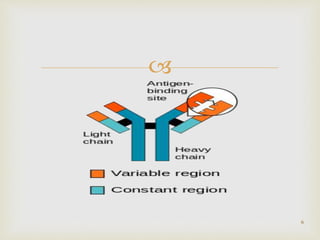
ANTIBODIES and ANTIGENS:
• An antibody is a protein (immunoglobulin) produced
by B-lymphocytes (immune cells) in response to
stimulation by an antigen.
 An antigen is a substance with the ability to induce an
immunological response.
5

6

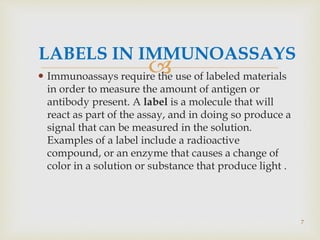
LABELS IN IMMUNOASSAYS
 Immunoassays require the use of labeled materials
in order to measure the amount of antigen or
antibody present. A label is a molecule that will
react as part of the assay, and in doing so produce a
signal that can be measured in the solution.
Examples of a label include a radioactive
compound, or an enzyme that causes a change of
color in a solution or substance that produce light .
7

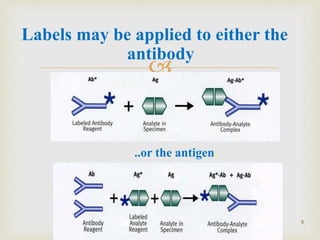
Labels may be applied to either the
antibody
..or the antigen.
8

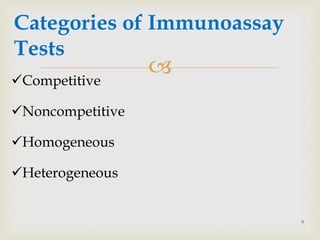
Categories of Immunoassay
Tests
Competitive
Noncompetitive
Homogeneous
Heterogeneous
9

10
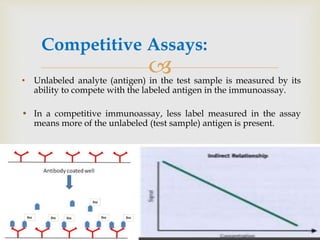
Competitive Assays:
• Unlabeled analyte (antigen) in the test sample is measured by its
ability to compete with the labeled antigen in the immunoassay.
• In a competitive immunoassay, less label measured in the assay
means more of the unlabeled (test sample) antigen is present.

•Noncompetitive (sandwhich) immunoassays generally provide the highest
level of assay sensitivity and specificity. This format is referred to as a
“sandwich” assay because the analyte is bound (sandwiched) between two
highly specific antibody reagents.
•The reaction mixture typically includes an excess of labeled antibody, so that
all drug/metabolite is bound. The amount of antibody-antigen complex is
then measured to determine the amount of drug present in the sample. The
measurement of labeled analyte, usually antibody, is directly proportional to
the amount of antigen present in the sample.
Noncompetitive Assays
11

Heterogeneous and Homogeneous
immunoassays Methods
 HETEROGENEOUS IMMUNOASSAYS :
 Called separation assay
 Require multiple steps
 Unbound analyte is separated or washed away, and
the remaining labelled, bound analyte is measured.
• Those that do not require separation are referred to as
HOMOGENEOUS IMMUNOASSAYS.
• Homogeneous methods have generally been applied to
the measurement of small analytes such as Ab used and
therapeutic drugs
12

There are several different methods used in
immunoassay tests:
 Radioimmunoassay (RIA)
 Enzyme Immunoassay (ELISA)
 Fluorescence Polarization Immunoassay (FPIA)
13

 it begin with the separation of a protein (from a
mixture) using the specificity of antibody - antigen
binding and quantify it using radioactivity .
 The technique begin in 1960 by berson and yalow to
test the blood Insulin
it begin with the separation of a protein (from a
mixture) using the specificity of antibody - antigen
binding and quantify it using radioactivity .
The technique begin in 1960 by berson and yalow to
test the blood Insulin .
Radioimmunoassay (RIAs) utilize a radioactive label
(usually 125I, 3H or 14C), which emits radiation that
can be measured with a beta or gamma counter.
BUT radioactive materials are not administered to
the individual but are used as reagents. 14

 The technique of radioimmunoassay used in many
research and clinical practice in many areas:
Diagnosis of allergy Blood Banking
Endocrinology
15

Principle:
Uses an immune reaction [Antigen – Antibody
reaction] to estimate a ligand
Ag + Ag* + Ab  AgAb + Ag*Ab + Ag + Ab*
◦ Unbound Ag* and Ag washed out
◦ Radioactivity of bound residue measured
◦ Ligand conc. is inversely related to radioactivity
[Ag : ligand to be measured ; Ag* radiolabelled ligand]
Principle of Radioimmunoassay
16

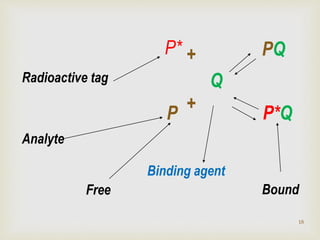
 A mixture is prepared of
 radioactive antigen
 antibodies against that antigen.
 Known amounts of unlabeled ("cold") antigen are
added to samples of the mixture. These compete for
the binding sites of the antibodies.
17
+
+P
P*
P*Q
Radioactive tag
Analyte
Binding agent
Free Bound
Q
PQ
18

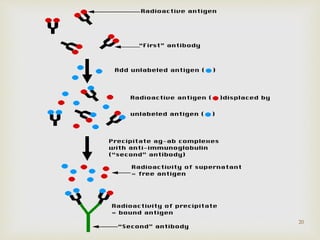
 At increasing concentrations of unlabeled antigen, an
increasing amount of radioactive antigen is displaced
from the antibody molecules.
 The antibody-bound antigen is separated from the
 free antigen in the supernatant fluid, and
 The radioactivity of each is measured.
19
20
21

1. Preparation & characterisation of the Antigen
[Ligand to be analysed]
2. Radiolabelling of the Antigen
3. Preparation of the Specific Antibody
4. Development of Assay System
Requirements of RIA
22

 Antigens prepared by..
 Synthesis of the molecule
 Isolation from natural sources
 Radiolabelling [Tagging procedure]
 3 H , 14 C, 125 I are used as radioactive tags
 Antigens are tagged to 3 H , 14 C, 125 I
 Tagging should NOT affect Antigenic specificity &
Antigenic activity !
Preparation and radiolabeling
of the antigen
23

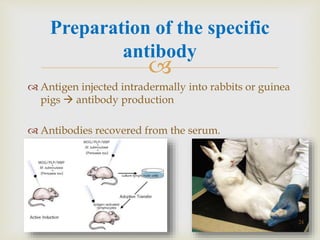
 Antigen injected intradermally into rabbits or guinea
pigs  antibody production
 Antibodies recovered from the serum.
Preparation of the specific
antibody
24

 Crucial step is separation of unbound antigens
 Antibodies bind to microtitre well surface [Solid phase
RIA]
 Antigens bound to the fixed antibodies remain stuck to
the inner surface
 Decanting & washing the well removes unbound antigens
 Other techniques of separation: Centrifugation,
Precipitation and Electrophoresis
Development of the assay
system
25

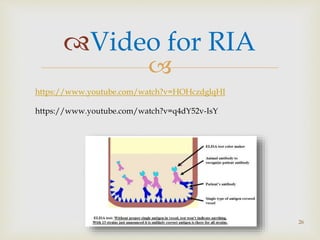
Video for RIA
https://www.youtube.com/watch?v=HOHczdglqHI
https://www.youtube.com/watch?v=q4dY52v-IsY
26

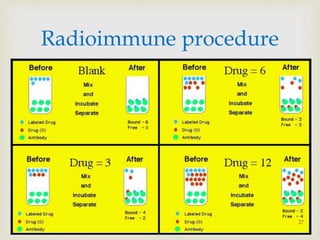
Radioimmune procedure
27

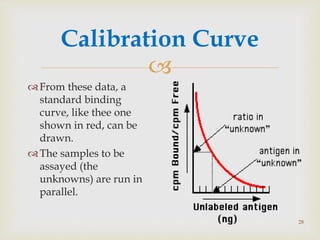
From these data, a
standard binding
curve, like thee one
shown in red, can be
drawn.
The samples to be
assayed (the
unknowns) are run in
parallel.
Calibration Curve
28

General uses
 In Endocrinology
 Insulin, HCG, Vasopressin
 Detects Endocrine Disorders
 Physiology of Endocrine Function
 In Pharmacology
 Morphine
 Detect Drug Abuse or Drug Poisoning
 Study Drug Kinetics
29

Clinical Immunology
Antibodies for Inhalant Allergens
Allergy Diagnosis
 Oncology
Carcinoembryonic Antigen
Early Cancer Detection and Diagnosis
30

 tracking of leukemia virus
 diagnosis and treatment of peptic ulcers
 research with Neurotransmitters
31

 Screening donated blood for evidence of viral
contamination by
 HIV-1 and HIV-2 (presence of anti-HIV antibodies)
 Hepatitis C (presence of antibodies)
 Hepatitis B (testing for both antibodies and a viral
antigen)
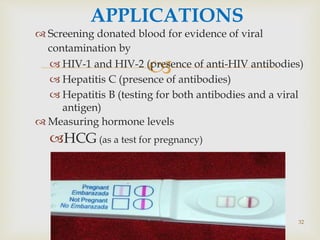
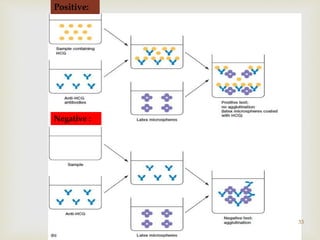
 Measuring hormone levels
HCG (as a test for pregnancy)
APPLICATIONS
32
Negative :
Positive:
33
 LH (Luteinizing hormone , determining the time of
ovulation)
 TSH, T3 and T4 (for thyroid function)
 Hormones (e.g., anabolic steroids, HGH) that may have
been used illicitly by athletes.
 Detecting infections
 sexually-transmitted agents
 like HIV, syphilis, and chlamydia
 hepatitis B and C
 Toxoplasma gondii
34

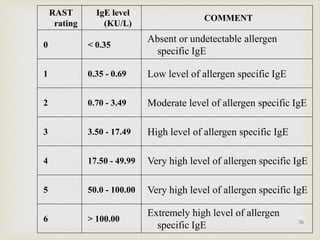
 Detecting allergens in food and house dust .
RAST:
The radioallergosorbent test to detect specific
IgE antibodies to suspected or known allergens . IgE
is the antibody associated with type I allergic
response : Pollen (is a fine to coarse powder
containing the microgamatophytes of seeds)
The amount of radioactivity is proportional to the
serum IgE for the allergen.
35
RAST
rating
IgE level
(KU/L)
COMMENT
0 < 0.35
Absent or undetectable allergen
specific IgE
1 0.35 - 0.69 Low level of allergen specific IgE
2 0.70 - 3.49 Moderate level of allergen specific IgE
3 3.50 - 17.49 High level of allergen specific IgE
4 17.50 - 49.99 Very high level of allergen specific IgE
5 50.0 - 100.00 Very high level of allergen specific IgE
6 > 100.00
Extremely high level of allergen
specific IgE 36
Measuring "rheumatoid factors" and other
auto antibodies in autoimmune diseases
like lupus erythematosus.
Measuring toxins in contaminated food
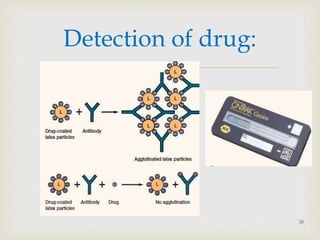
Detecting illicit drugs, e.g.,
 cocaine
 opiates
 Δ-9-tetrahydrocannabinol, the active ingredient in
marijuana
37

Detection of drug:
38

ADVANTAGES
Radioimmunoassay is widely-used because
of its great sensitivity.
Using antibodies of high affinity, it is
possible to detect a few pictograms (10−12 g)
of antigen in the tube.
The greater the specificity of the antiserum,
the greater the specificity of the assay 39

RIA has become a major tool in the clinical
laboratory where it is used to assay .
plasma levels of:
most of our hormones;
digitoxin or digoxin in patients receiving these
drugs;
certain abused drugs.
Presence of hepatitis B surface antigen (HBsAg)
in donated blood.
Anti-DNA antibodies in systemic lupus
erythematosus (SLE). 40

DRAWBACKS
The main drawbacks to radioimmunoassay are
the expense and hazards if preparing and
handling the radioactive antigen.
Both 125I or 131I emit gamma radiation that
requires special counting equipment;
The body concentrates iodine atoms —
radioactive or not — in the thyroid gland where
they are incorporated in thyroxine (T4).
41

Labs require special license to handle
radioactive material
Requires special arrangements for
Requisition
storage of radioactive material
radioactive waste disposal.
42

 http://www.discoveriesinmedicine.com/Ni-
Ra/Radioimmunoassay-RIA.html
 http://www.encyclopedia.com/medicine/divisions
-diagnostics-and-
procedures/medicine/radioimmunoassay
 Textbook of microbiology by Prescott, Harley.
 Practical analytical chemistry by BECKEET.
 http://www.millipore.com/immunodetection/id3/
radioimmunoassay.
References
43

44

Radio Immune Eassay

  • 1.
    •By: Sondos Hassouneh Areej Abuhanieh Shireen Rawajbeh 1
  • 2.
  • 3.
      Immuno” refersto an immune response that causes the body to generate antibodies  Assay” refers to a test.. • Immunoassays are chemical tests used to detect or quantify a specific substance, the analyte, in a blood or body fluid sample, using an immunological reaction. Immunoassays are highly sensitive and specific. Their high specificity results from the use of antibodies and purified antigens as reagents.  Immunoassays measure the formation of antibody-antigen complexes and detect them via an indicator reaction. High sensitivity is achieved by using an indicator system (e.g., enzyme label) that results in amplification of the measured product.  Immunoassays may be qualitative (positive or negative) or quantitative (amount measured). Definition : 3
  • 4.
     The purposeof an immunoassay is to measure (or, in a qualitative assay, to detect) an analyte. Immunoassay is the method of choice for measuring analytes normally present at very low concentrations that cannot be determined accurately by other less expensive tests Common uses include measurement of drugs, hormones, specific proteins, tumor markers, and markers of cardiac injury 4
  • 5.
    ANTIBODIES and ANTIGENS: •An antibody is a protein (immunoglobulin) produced by B-lymphocytes (immune cells) in response to stimulation by an antigen.  An antigen is a substance with the ability to induce an immunological response. 5
  • 6.
  • 7.
     LABELS IN IMMUNOASSAYS Immunoassays require the use of labeled materials in order to measure the amount of antigen or antibody present. A label is a molecule that will react as part of the assay, and in doing so produce a signal that can be measured in the solution. Examples of a label include a radioactive compound, or an enzyme that causes a change of color in a solution or substance that produce light . 7
  • 8.
     Labels may beapplied to either the antibody ..or the antigen. 8
  • 9.
  • 10.
     10 Competitive Assays: • Unlabeledanalyte (antigen) in the test sample is measured by its ability to compete with the labeled antigen in the immunoassay. • In a competitive immunoassay, less label measured in the assay means more of the unlabeled (test sample) antigen is present.
  • 11.
     •Noncompetitive (sandwhich) immunoassaysgenerally provide the highest level of assay sensitivity and specificity. This format is referred to as a “sandwich” assay because the analyte is bound (sandwiched) between two highly specific antibody reagents. •The reaction mixture typically includes an excess of labeled antibody, so that all drug/metabolite is bound. The amount of antibody-antigen complex is then measured to determine the amount of drug present in the sample. The measurement of labeled analyte, usually antibody, is directly proportional to the amount of antigen present in the sample. Noncompetitive Assays 11
  • 12.
     Heterogeneous and Homogeneous immunoassaysMethods  HETEROGENEOUS IMMUNOASSAYS :  Called separation assay  Require multiple steps  Unbound analyte is separated or washed away, and the remaining labelled, bound analyte is measured. • Those that do not require separation are referred to as HOMOGENEOUS IMMUNOASSAYS. • Homogeneous methods have generally been applied to the measurement of small analytes such as Ab used and therapeutic drugs 12
  • 13.
     There are severaldifferent methods used in immunoassay tests:  Radioimmunoassay (RIA)  Enzyme Immunoassay (ELISA)  Fluorescence Polarization Immunoassay (FPIA) 13
  • 14.
      it beginwith the separation of a protein (from a mixture) using the specificity of antibody - antigen binding and quantify it using radioactivity .  The technique begin in 1960 by berson and yalow to test the blood Insulin it begin with the separation of a protein (from a mixture) using the specificity of antibody - antigen binding and quantify it using radioactivity . The technique begin in 1960 by berson and yalow to test the blood Insulin . Radioimmunoassay (RIAs) utilize a radioactive label (usually 125I, 3H or 14C), which emits radiation that can be measured with a beta or gamma counter. BUT radioactive materials are not administered to the individual but are used as reagents. 14
  • 15.
      The techniqueof radioimmunoassay used in many research and clinical practice in many areas: Diagnosis of allergy Blood Banking Endocrinology 15
  • 16.
     Principle: Uses an immunereaction [Antigen – Antibody reaction] to estimate a ligand Ag + Ag* + Ab  AgAb + Ag*Ab + Ag + Ab* ◦ Unbound Ag* and Ag washed out ◦ Radioactivity of bound residue measured ◦ Ligand conc. is inversely related to radioactivity [Ag : ligand to be measured ; Ag* radiolabelled ligand] Principle of Radioimmunoassay 16
  • 17.
      A mixtureis prepared of  radioactive antigen  antibodies against that antigen.  Known amounts of unlabeled ("cold") antigen are added to samples of the mixture. These compete for the binding sites of the antibodies. 17
  • 18.
  • 19.
      At increasingconcentrations of unlabeled antigen, an increasing amount of radioactive antigen is displaced from the antibody molecules.  The antibody-bound antigen is separated from the  free antigen in the supernatant fluid, and  The radioactivity of each is measured. 19
  • 20.
  • 21.
  • 22.
     1. Preparation &characterisation of the Antigen [Ligand to be analysed] 2. Radiolabelling of the Antigen 3. Preparation of the Specific Antibody 4. Development of Assay System Requirements of RIA 22
  • 23.
      Antigens preparedby..  Synthesis of the molecule  Isolation from natural sources  Radiolabelling [Tagging procedure]  3 H , 14 C, 125 I are used as radioactive tags  Antigens are tagged to 3 H , 14 C, 125 I  Tagging should NOT affect Antigenic specificity & Antigenic activity ! Preparation and radiolabeling of the antigen 23
  • 24.
      Antigen injectedintradermally into rabbits or guinea pigs  antibody production  Antibodies recovered from the serum. Preparation of the specific antibody 24
  • 25.
      Crucial stepis separation of unbound antigens  Antibodies bind to microtitre well surface [Solid phase RIA]  Antigens bound to the fixed antibodies remain stuck to the inner surface  Decanting & washing the well removes unbound antigens  Other techniques of separation: Centrifugation, Precipitation and Electrophoresis Development of the assay system 25
  • 26.
  • 27.
  • 28.
     From these data,a standard binding curve, like thee one shown in red, can be drawn. The samples to be assayed (the unknowns) are run in parallel. Calibration Curve 28
  • 29.
     General uses  InEndocrinology  Insulin, HCG, Vasopressin  Detects Endocrine Disorders  Physiology of Endocrine Function  In Pharmacology  Morphine  Detect Drug Abuse or Drug Poisoning  Study Drug Kinetics 29
  • 30.
     Clinical Immunology Antibodies forInhalant Allergens Allergy Diagnosis  Oncology Carcinoembryonic Antigen Early Cancer Detection and Diagnosis 30
  • 31.
      tracking ofleukemia virus  diagnosis and treatment of peptic ulcers  research with Neurotransmitters 31
  • 32.
      Screening donatedblood for evidence of viral contamination by  HIV-1 and HIV-2 (presence of anti-HIV antibodies)  Hepatitis C (presence of antibodies)  Hepatitis B (testing for both antibodies and a viral antigen)  Measuring hormone levels HCG (as a test for pregnancy) APPLICATIONS 32
  • 33.
  • 34.
     LH (Luteinizinghormone , determining the time of ovulation)  TSH, T3 and T4 (for thyroid function)  Hormones (e.g., anabolic steroids, HGH) that may have been used illicitly by athletes.  Detecting infections  sexually-transmitted agents  like HIV, syphilis, and chlamydia  hepatitis B and C  Toxoplasma gondii 34
  • 35.
      Detecting allergensin food and house dust . RAST: The radioallergosorbent test to detect specific IgE antibodies to suspected or known allergens . IgE is the antibody associated with type I allergic response : Pollen (is a fine to coarse powder containing the microgamatophytes of seeds) The amount of radioactivity is proportional to the serum IgE for the allergen. 35
  • 36.
    RAST rating IgE level (KU/L) COMMENT 0 <0.35 Absent or undetectable allergen specific IgE 1 0.35 - 0.69 Low level of allergen specific IgE 2 0.70 - 3.49 Moderate level of allergen specific IgE 3 3.50 - 17.49 High level of allergen specific IgE 4 17.50 - 49.99 Very high level of allergen specific IgE 5 50.0 - 100.00 Very high level of allergen specific IgE 6 > 100.00 Extremely high level of allergen specific IgE 36
  • 37.
    Measuring "rheumatoid factors"and other auto antibodies in autoimmune diseases like lupus erythematosus. Measuring toxins in contaminated food Detecting illicit drugs, e.g.,  cocaine  opiates  Δ-9-tetrahydrocannabinol, the active ingredient in marijuana 37
  • 38.
  • 39.
     ADVANTAGES Radioimmunoassay is widely-usedbecause of its great sensitivity. Using antibodies of high affinity, it is possible to detect a few pictograms (10−12 g) of antigen in the tube. The greater the specificity of the antiserum, the greater the specificity of the assay 39
  • 40.
     RIA has becomea major tool in the clinical laboratory where it is used to assay . plasma levels of: most of our hormones; digitoxin or digoxin in patients receiving these drugs; certain abused drugs. Presence of hepatitis B surface antigen (HBsAg) in donated blood. Anti-DNA antibodies in systemic lupus erythematosus (SLE). 40
  • 41.
     DRAWBACKS The main drawbacksto radioimmunoassay are the expense and hazards if preparing and handling the radioactive antigen. Both 125I or 131I emit gamma radiation that requires special counting equipment; The body concentrates iodine atoms — radioactive or not — in the thyroid gland where they are incorporated in thyroxine (T4). 41
  • 42.
     Labs require speciallicense to handle radioactive material Requires special arrangements for Requisition storage of radioactive material radioactive waste disposal. 42
  • 43.
      http://www.discoveriesinmedicine.com/Ni- Ra/Radioimmunoassay-RIA.html  http://www.encyclopedia.com/medicine/divisions -diagnostics-and- procedures/medicine/radioimmunoassay Textbook of microbiology by Prescott, Harley.  Practical analytical chemistry by BECKEET.  http://www.millipore.com/immunodetection/id3/ radioimmunoassay. References 43
  • 44.