Immunochemistry
Definition:
 Resistance of the body against the
pathogenic agents is known as
immunity
 Immunity is of two types:
 (i) Innate immunity
 (ii) Adaptive immunity
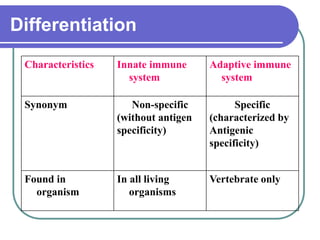
Differentiation
Characteristics Innate immune
system
Adaptive immune
system
Synonym Non-specific
(without antigen
specificity)
Specific
(characterized by
Antigenic
specificity)
Found in
organism
In all living
organisms
Vertebrate only
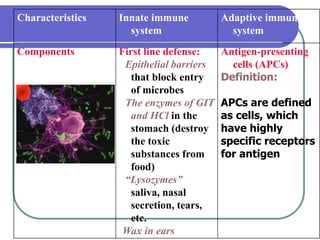
Characteristics Innate immune
system
Adaptive immune
system
Components First line defense:
- Epithelial barriers
that block entry
of microbes
- The enzymes of GIT
and HCl in the
stomach (destroy
the toxic
substances from
food)
- “Lysozymes” in
saliva, nasal
secretion, tears,
etc.
-Wax in ears
Antigen-presenting
cells (APCs)
Definition:
APCs are defined
as cells, which
have highly
specific receptors
for antigen
Characteristics Innate immune
system
Adaptive immune
system
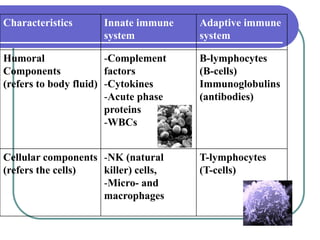
Humoral
Components
(refers to body fluid)
-Complement
factors
-Cytokines
-Acute phase
proteins
-WBCs
B-lymphocytes
(B-cells)
Immunoglobulins
(antibodies)
Cellular components
(refers the cells)
-NK (natural
killer) cells,
-Micro- and
macrophages
T-lymphocytes
(T-cells)
What is Complement
system?
 Definition:
 The complement system is a set of
plasma proteins that help the ability
of antibodies and phagocytic cells to
clear pathogens from an organism.
 4% of all plasma proteins are
complement proteins, that are
numbered as C1, C2….. C9.
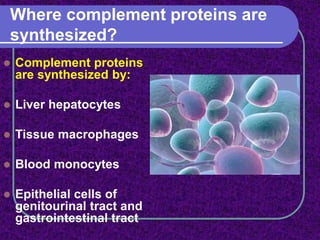
Where complement proteins are
synthesized?
 Complement proteins
are synthesized by:
 Liver hepatocytes
 Tissue macrophages
 Blood monocytes
 Epithelial cells of
genitourinal tract and
gastrointestinal tract
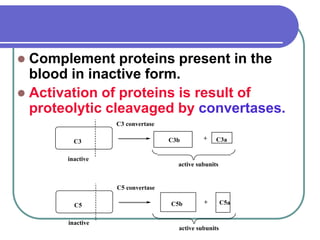
 Complement proteins present in the
blood in inactive form.
 Activation of proteins is result of
proteolytic cleavaged by convertases.
C3 convertase
C3 C3aC3b +
active subunits
inactive
C5 convertase
C5 C5b C5a+
active subunits
inactive
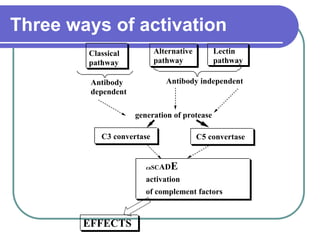
Three ways of activation
Classical
pathway
Alternative
pathway
Lectin
pathway
Antibody independentAntibody
dependent
generation of protease
C3 convertase
caSCADE
activation
of complement factors
EFFECTS
C5 convertase
Classical pathway of
complement activation
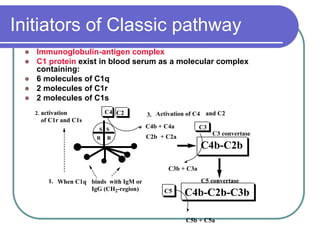
Initiators of Classic pathway
 Immunoglobulin-antigen complex
 C1 protein exist in blood serum as a molecular complex
containing:
 6 molecules of C1q
 2 molecules of C1r
 2 molecules of C1s
S S
R R
binds with IgM or
IgG (CH2-region)
activation
of C1r and C1s
When C1q1.
2. 3.C4
C4b + C4a
Activation of C4 and C2C2
C2b + C2a
C4b-C2b
C3 convertase
C3
C3b + C3a
C4b-C2b-C3b
C5 convertase
C5
C5b + C5a
Alternative pathway of
complement activation
Alternative pathway of
complement activation
 A pathway of complement activation
initiated by
 Bacterial endotoxins,
 Microbial polysaccharides,
lipopolysaccharides,
 Microbial cell walls
 Factors: B, D (adipsin)
 Stabilization of C3-convertase: Factor P
(properdin)
Complement activation cascade
C3
B
C3 Bb
Ba
C3
C3b
C3a B
C3b
1
2 3
Bb
P
D
c3 convertase
4
C3
C3b
Bb
P
C3b
c5-convertase
C5
C5b
C5a
5
6
C3a
exotoxin
of bacteria
wall of bacteria
Mannan-binding lectin
pathway (Lectin pathway)
 It activates complement through the
mannose-binding lectin (MBL) which
is produced by the liver and can
initiate the complement cascade.
 MBL binds to specific carbohydrates
(fucose, mannose) found on the
surface of many pathogens.
MBL binds with
 Yeasts such as Candida albicans
 Viruses such as influenza A, HIV
 Many bacteria such as Streptococci,
Salmonella
 Parasites like Leishmania
Bacteria
mannose
or fucose
MBL
MASP
C2
C2b
C2a
C4
C4b
C3 convertase
C4a
MASP - Mannan-binding lectin-Associated Serine protease
C3
C3b + C3a
Effects of activated complements
Effects of
C3a and C5a
Effects of
C3b and C5b
Produce inflammatory
mediators
Opsonization (C3b)
Formation of MAC
(complement fixation)
(C5b)Chemotaxis
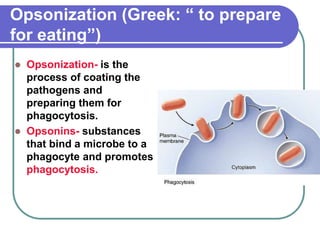
Opsonization (Greek: “ to prepare
for eating”)
 Opsonization- is the
process of coating the
pathogens and
preparing them for
phagocytosis.
 Opsonins- substances
that bind a microbe to a
phagocyte and promotes
phagocytosis.
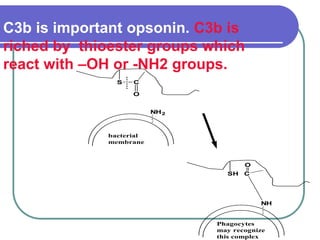
C3b is important opsonin. C3b is
riched by thioester groups which
react with –OH or -NH2 groups.
NH2
bacterial
membrane
S C
O
NH
SH C
O
Phagocytes
may recognize
this complex
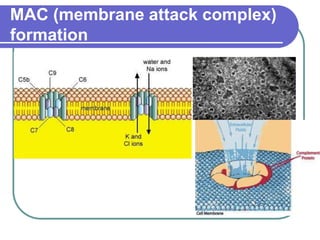
MAC (membrane attack complex)
formation
BIOLOGICAL ROLE
C3a / C5a
 INFLAMMATORY RESPONSE
 C3a and C5a activate releasing of
HISTAMINE by mast cells, basophiles
and platelets.
 C3a and C5a activate leukocytes
Effect of histamine
 Vasodilatation (increase in the
diameter of blood vessels, especially
arteries).
 Increases vascular permeability and
hence increases migration of plasma
proteins (active complement,
cytokines, leukocytes) into the tissue
for pathogen inactivation.
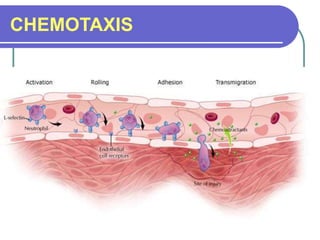
CHEMOTAXIS
COMPLEMENT DEFICIENCIES
 Classic and
alternative pathways
complements
deficiency:
Clinical signs:
(i) Pyogenic (causing the
formation of pus)
infections
(ii) Immune-complex
syndrome**
MAC formation complement
deficiency
 Clinical signs
Immune-complex
syndrome**
Immune-complex
syndrome
 Include:
(i) SYSTEMIC LUPUS ERYTHEMATOSIUS
(SLE) – chronic inflammatory disease of
connective tissue, affecting the skin,
kidney, lungs, heart, brain (eg. formation
of fibrous scar)
(ii) GLOMERULONEPHRITIS- group of
kidney diseases involving the glomeruli
(iii) VASCULITIS – inflammation of the walls
of small blood vessels

Immunochemistry

  • 1.
  • 2.
    Definition:  Resistance ofthe body against the pathogenic agents is known as immunity
  • 3.
     Immunity isof two types:  (i) Innate immunity  (ii) Adaptive immunity
  • 4.
    Differentiation Characteristics Innate immune system Adaptiveimmune system Synonym Non-specific (without antigen specificity) Specific (characterized by Antigenic specificity) Found in organism In all living organisms Vertebrate only
  • 5.
    Characteristics Innate immune system Adaptiveimmune system Components First line defense: - Epithelial barriers that block entry of microbes - The enzymes of GIT and HCl in the stomach (destroy the toxic substances from food) - “Lysozymes” in saliva, nasal secretion, tears, etc. -Wax in ears Antigen-presenting cells (APCs) Definition: APCs are defined as cells, which have highly specific receptors for antigen
  • 6.
    Characteristics Innate immune system Adaptiveimmune system Humoral Components (refers to body fluid) -Complement factors -Cytokines -Acute phase proteins -WBCs B-lymphocytes (B-cells) Immunoglobulins (antibodies) Cellular components (refers the cells) -NK (natural killer) cells, -Micro- and macrophages T-lymphocytes (T-cells)
  • 7.
  • 8.
     Definition:  Thecomplement system is a set of plasma proteins that help the ability of antibodies and phagocytic cells to clear pathogens from an organism.  4% of all plasma proteins are complement proteins, that are numbered as C1, C2….. C9.
  • 9.
    Where complement proteinsare synthesized?  Complement proteins are synthesized by:  Liver hepatocytes  Tissue macrophages  Blood monocytes  Epithelial cells of genitourinal tract and gastrointestinal tract
  • 10.
     Complement proteinspresent in the blood in inactive form.  Activation of proteins is result of proteolytic cleavaged by convertases. C3 convertase C3 C3aC3b + active subunits inactive C5 convertase C5 C5b C5a+ active subunits inactive
  • 11.
    Three ways ofactivation Classical pathway Alternative pathway Lectin pathway Antibody independentAntibody dependent generation of protease C3 convertase caSCADE activation of complement factors EFFECTS C5 convertase
  • 12.
  • 13.
    Initiators of Classicpathway  Immunoglobulin-antigen complex  C1 protein exist in blood serum as a molecular complex containing:  6 molecules of C1q  2 molecules of C1r  2 molecules of C1s S S R R binds with IgM or IgG (CH2-region) activation of C1r and C1s When C1q1. 2. 3.C4 C4b + C4a Activation of C4 and C2C2 C2b + C2a C4b-C2b C3 convertase C3 C3b + C3a C4b-C2b-C3b C5 convertase C5 C5b + C5a
  • 14.
  • 15.
    Alternative pathway of complementactivation  A pathway of complement activation initiated by  Bacterial endotoxins,  Microbial polysaccharides, lipopolysaccharides,  Microbial cell walls  Factors: B, D (adipsin)  Stabilization of C3-convertase: Factor P (properdin)
  • 16.
    Complement activation cascade C3 B C3Bb Ba C3 C3b C3a B C3b 1 2 3 Bb P D c3 convertase 4 C3 C3b Bb P C3b c5-convertase C5 C5b C5a 5 6 C3a exotoxin of bacteria wall of bacteria
  • 17.
  • 18.
     It activatescomplement through the mannose-binding lectin (MBL) which is produced by the liver and can initiate the complement cascade.  MBL binds to specific carbohydrates (fucose, mannose) found on the surface of many pathogens.
  • 19.
    MBL binds with Yeasts such as Candida albicans  Viruses such as influenza A, HIV  Many bacteria such as Streptococci, Salmonella  Parasites like Leishmania
  • 20.
    Bacteria mannose or fucose MBL MASP C2 C2b C2a C4 C4b C3 convertase C4a MASP- Mannan-binding lectin-Associated Serine protease C3 C3b + C3a
  • 21.
    Effects of activatedcomplements Effects of C3a and C5a Effects of C3b and C5b Produce inflammatory mediators Opsonization (C3b) Formation of MAC (complement fixation) (C5b)Chemotaxis
  • 22.
    Opsonization (Greek: “to prepare for eating”)  Opsonization- is the process of coating the pathogens and preparing them for phagocytosis.  Opsonins- substances that bind a microbe to a phagocyte and promotes phagocytosis.
  • 23.
    C3b is importantopsonin. C3b is riched by thioester groups which react with –OH or -NH2 groups. NH2 bacterial membrane S C O NH SH C O Phagocytes may recognize this complex
  • 24.
    MAC (membrane attackcomplex) formation
  • 25.
    BIOLOGICAL ROLE C3a /C5a  INFLAMMATORY RESPONSE  C3a and C5a activate releasing of HISTAMINE by mast cells, basophiles and platelets.  C3a and C5a activate leukocytes
  • 26.
    Effect of histamine Vasodilatation (increase in the diameter of blood vessels, especially arteries).  Increases vascular permeability and hence increases migration of plasma proteins (active complement, cytokines, leukocytes) into the tissue for pathogen inactivation.
  • 27.
  • 28.
    COMPLEMENT DEFICIENCIES  Classicand alternative pathways complements deficiency: Clinical signs: (i) Pyogenic (causing the formation of pus) infections (ii) Immune-complex syndrome**
  • 29.
    MAC formation complement deficiency Clinical signs Immune-complex syndrome**
  • 30.
    Immune-complex syndrome  Include: (i) SYSTEMICLUPUS ERYTHEMATOSIUS (SLE) – chronic inflammatory disease of connective tissue, affecting the skin, kidney, lungs, heart, brain (eg. formation of fibrous scar) (ii) GLOMERULONEPHRITIS- group of kidney diseases involving the glomeruli (iii) VASCULITIS – inflammation of the walls of small blood vessels