Complement System
Prasanna R Kovath
Assistant Professor
Department of Biotechnology
St. Mary's College Thrissur
• Complement, a complex system of more than 30 proteins that act in
concert to help eliminate infectious microorganisms.
• Specifically, the complement system causes the lysis (bursting) of
foreign and infected cells, the phagocytosis (ingestion) of foreign
particles and cell debris, and the inflammation of surrounding tissue.
Classical Pathway
• The interacting proteins of the complement system, which are
produced mainly by the liver, circulate in the blood and extracellular
fluid, primarily in an inactivated state.
• Not until the system receives an appropriate signal are they activated.
The signal sets off a chemical chain reaction in which one activated
complement protein triggers the activation of the next complement
protein in the sequence.
Outcome of complement activation
• Three main effects
1. Lysis of cells such as bacteria, allografts and tumor cells
2. Generation of mediators that participate in inflammation and attract
neutrophils
3. Opsonization ie. Enhancement of phagocytosis
Beneficial effects of complement activation
• 6 beneficial effects
1. Trigger inflammation
2. Chemotactically attract phagocytes to the infection site
3. Promote the attachment of antigens to phagocytes (enhanced
attachment or opsonization)
4. Cause lysis of Gram-negative bacteria and human cells displaying
foreign epitopes
5. Plays a role in the activation of naive B-lymphocytes
6. Remove harmful immune complexes from the body.
Components of the complement system
• There are more than 20 components of which followings are
important.
• – C1,C2,C3,C4,C5,C6,C7,C8,C9
• – Factor B, Factor D, Factor H, Factor I,
• – Properdin, C1 inhibitor, C4 binding protein, S protein
Activation of complements
Why it needs to be activated?
• Several complement components are proenzymes,which must be
cleaved to form active enzymes.
• Activation of the complement can be initiated either by antigen –
antibody complexes or by variety of nonimmunologic molecules eg.
Endotoxin.
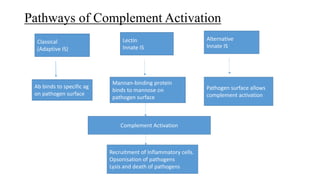
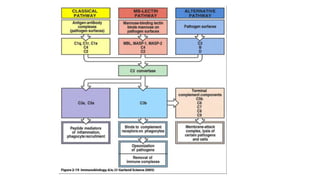
Pathways of Complement Activation
Classical
(Adaptive IS)
Lectin
Innate IS
Alternative
Innate IS
Ab binds to specific ag
on pathogen surface
Mannan-binding protein
binds to mannose on
pathogen surface
Pathogen surface allows
complement activation
Complement Activation
Recruitment of Inflammatory cells.
Opsonisation of pathogens
Lysis and death of pathogens
Classical pathway
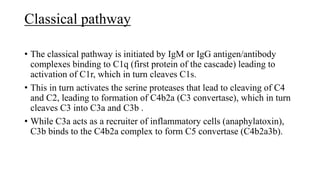
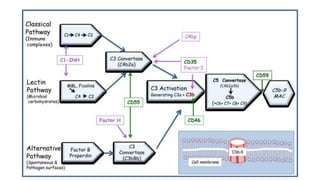
• The classical pathway is initiated by IgM or IgG antigen/antibody
complexes binding to C1q (first protein of the cascade) leading to
activation of C1r, which in turn cleaves C1s.
• This in turn activates the serine proteases that lead to cleaving of C4
and C2, leading to formation of C4b2a (C3 convertase), which in turn
cleaves C3 into C3a and C3b .
• While C3a acts as a recruiter of inflammatory cells (anaphylatoxin),
C3b binds to the C4b2a complex to form C5 convertase (C4b2a3b).
• The C5 convertase initiates the formation of the Membrane Attack
Complex (MAC), that inserts into membrane creating functional pores
in bacterial membranes leading to its lysis.
• The classical pathway can also be activated by other danger signals
like C-reactive protein, viral proteins, polyanions, apoptotic cells and
amyloid, thus providing evidence that classical pathway could be
activated independent of antibodies
• Complement activation alternative pathway was discovered by
Pillemer and colleagues in 1954.
• The alternative pathway of the complement system is an innate
component of the immune system's natural defense against infections.
• The alternative pathway is one of three complement pathways that
opsonize and kill pathogens.
• This pathway is activated by viruses, fungi, bacteria, parasites, cobra
venom, immunoglobulin A, and polysaccharides and forms an
important part of the defense mechanism independent of the immune
response.
The Alternative Pathway
• The alternative pathway is usually activated by bacterial endotoxin, a
lipopolysaccharide present on the outer membrane of gram negative
bacteria.
• This results in spontaneous hydrolysis of C3 into small amounts of
factor C3b, which combines with other factors to produce C3
convertase.
• The complement system, also known as the complement
cascade, forms a part of the innate immune system.
• Complement components are generally made in the liver and circulate
in their inactive form until they are needed.
• Ab independent pathway.
• In the alternative pathway, many unrelated cell surface substances,
e.g., bacterial lipopolysaccharides (endotoxin), fungal cell walls, and
viral envelopes, can initiate the process.
• Usually activated by products of micro-organisms like endotoxin.
Other activators include:
• Complexes containing IgA
• Some virus-infected cells (e.g. EBV)
• Many gram negative and gram positive organisms
• Parasites – Trypanosomes, Leishmania
• Erythrocytes
• Carbohydrates (agarose)
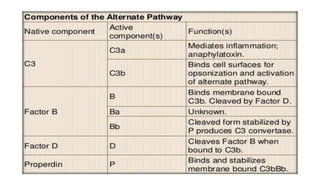
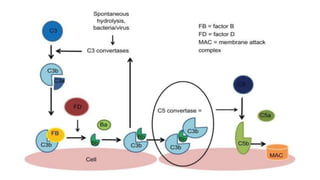
• The alternative pathway is triggered by the hydrolysis of C3 which
forms C3a and C3b.
• C3b becomes bound to the cell surface and is then able to interact with
factor B, which is cleaved by factor D, creating the Bb fragment which
binds to other surface-bound C3b molecules to form C3bBb.
• The C3 convertase of the alternative pathway triggers an
amplification loop, with further hydrolysis of C3.
• Ultimately, there is further production of C3b which joins with C3
convertase to form C5 convertase which cleaves C5 to C5a and C5b,
and this leads to formation of an membrane attack complex.
 The lectin complement pathway is an essential part of the
complement system, which provides an effective defense against
invading pathogens and apoptotic cells in an organism.
 Similar to classical pathway, the lectin pathway is also a proteolytic
cascade that elicits various effector functions including phagocytosis,
cell lysis, inflammation, and guidance of the adaptative immune
response.
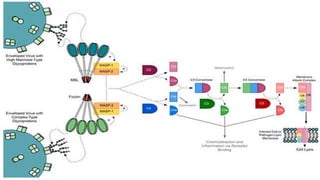
• The lectin pathway is not caused by antibody binding, but by a
carbohydrate -binding-protein called mannan-binding-lectin (MBL).
• It is an acute phase reactant produced in the liver and binds to the
carbohydrates on the surfaces of many pathogens.
• The major events are as follows :
• MBL binds to the carbohydrates on a pathogen.
• Proteases bound on the other side of the MBL cleaves C4 into C4a and
C4b.
• C4b creates C3 convertase, and the rest of the steps happen identically
to the classical pathway from the C3 convertase step.
The Activation Steps of Lectin Complement
Pathway
• The domain structures of MASPs resemble C1r and C1s in the
classical pathway, so their activation steps are very similar.
• Like C1s, MASP-2 contributes to the generation of C3
convertase via subsequent cleavage of C4 (C4a+C4b) and C2
(C2a+C2b).
• The cleaved product C4b and C2a is membrane- associated, and they
can combine to form C4bC2a (C3 convertase) to trigger the
downstream integrated enzyme reaction.
• The activation of MASP-2 is dependent on MASP-1. C3 convertase
can cleave C3 to C3b, which unites C4bC2a to form C5 convertase
(C4bC2aC3b).
• C5 convertase dissociates C5 to C5a and C5b, initiating the assembly
of the membrane-attack complex (MAC).
• C5b recruits C6, C7, C8, C9 to form a fully functional MAC, resulting
in cell lysis and death
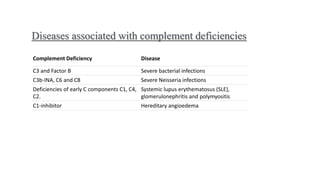
Complement Deficiency Disease
C3 and Factor B Severe bacterial infections
C3b-INA, C6 and C8 Severe Neisseria infections
Deficiencies of early C components C1, C4,
C2.
Systemic lupus erythematosus (SLE),
glomerulonephritis and polymyositis
C1-inhibitor Hereditary angioedema
Diseases associated with complement deficiencies
• https://med.libretexts.org/Bookshelves/Anatomy_and_Physiology/Boo
k%3A_Anatomy_and_Physiology_(Boundless)/20%3A_Immune_Sys
tem/20.6%3A_Humoral_Immune_Response/20.6C%3A_Role_of_the
_Complement_System_in_Immunity
• https://www.immunology.org/public-information/bitesized-
immunology/systems-and-processes/complement-system
• https://www.creative-biolabs.com/complement-therapeutics/lectin-
pathway.htm
• Ananthanarayan and Paniker's Textbook of Microbiology,7th edition,
Orient longman publications.
REFERENCE

Complement system

  • 1.
    Complement System Prasanna RKovath Assistant Professor Department of Biotechnology St. Mary's College Thrissur
  • 2.
    • Complement, acomplex system of more than 30 proteins that act in concert to help eliminate infectious microorganisms. • Specifically, the complement system causes the lysis (bursting) of foreign and infected cells, the phagocytosis (ingestion) of foreign particles and cell debris, and the inflammation of surrounding tissue. Classical Pathway
  • 3.
    • The interactingproteins of the complement system, which are produced mainly by the liver, circulate in the blood and extracellular fluid, primarily in an inactivated state. • Not until the system receives an appropriate signal are they activated. The signal sets off a chemical chain reaction in which one activated complement protein triggers the activation of the next complement protein in the sequence.
  • 4.
    Outcome of complementactivation • Three main effects 1. Lysis of cells such as bacteria, allografts and tumor cells 2. Generation of mediators that participate in inflammation and attract neutrophils 3. Opsonization ie. Enhancement of phagocytosis
  • 5.
    Beneficial effects ofcomplement activation • 6 beneficial effects 1. Trigger inflammation 2. Chemotactically attract phagocytes to the infection site 3. Promote the attachment of antigens to phagocytes (enhanced attachment or opsonization) 4. Cause lysis of Gram-negative bacteria and human cells displaying foreign epitopes 5. Plays a role in the activation of naive B-lymphocytes 6. Remove harmful immune complexes from the body.
  • 6.
    Components of thecomplement system • There are more than 20 components of which followings are important. • – C1,C2,C3,C4,C5,C6,C7,C8,C9 • – Factor B, Factor D, Factor H, Factor I, • – Properdin, C1 inhibitor, C4 binding protein, S protein
  • 7.
    Activation of complements Whyit needs to be activated? • Several complement components are proenzymes,which must be cleaved to form active enzymes. • Activation of the complement can be initiated either by antigen – antibody complexes or by variety of nonimmunologic molecules eg. Endotoxin.
  • 8.
    Pathways of ComplementActivation Classical (Adaptive IS) Lectin Innate IS Alternative Innate IS Ab binds to specific ag on pathogen surface Mannan-binding protein binds to mannose on pathogen surface Pathogen surface allows complement activation Complement Activation Recruitment of Inflammatory cells. Opsonisation of pathogens Lysis and death of pathogens
  • 9.
    Classical pathway • Theclassical pathway is initiated by IgM or IgG antigen/antibody complexes binding to C1q (first protein of the cascade) leading to activation of C1r, which in turn cleaves C1s. • This in turn activates the serine proteases that lead to cleaving of C4 and C2, leading to formation of C4b2a (C3 convertase), which in turn cleaves C3 into C3a and C3b . • While C3a acts as a recruiter of inflammatory cells (anaphylatoxin), C3b binds to the C4b2a complex to form C5 convertase (C4b2a3b).
  • 10.
    • The C5convertase initiates the formation of the Membrane Attack Complex (MAC), that inserts into membrane creating functional pores in bacterial membranes leading to its lysis. • The classical pathway can also be activated by other danger signals like C-reactive protein, viral proteins, polyanions, apoptotic cells and amyloid, thus providing evidence that classical pathway could be activated independent of antibodies
  • 12.
    • Complement activationalternative pathway was discovered by Pillemer and colleagues in 1954. • The alternative pathway of the complement system is an innate component of the immune system's natural defense against infections. • The alternative pathway is one of three complement pathways that opsonize and kill pathogens. • This pathway is activated by viruses, fungi, bacteria, parasites, cobra venom, immunoglobulin A, and polysaccharides and forms an important part of the defense mechanism independent of the immune response.
  • 13.
    The Alternative Pathway •The alternative pathway is usually activated by bacterial endotoxin, a lipopolysaccharide present on the outer membrane of gram negative bacteria. • This results in spontaneous hydrolysis of C3 into small amounts of factor C3b, which combines with other factors to produce C3 convertase. • The complement system, also known as the complement cascade, forms a part of the innate immune system. • Complement components are generally made in the liver and circulate in their inactive form until they are needed.
  • 14.
    • Ab independentpathway. • In the alternative pathway, many unrelated cell surface substances, e.g., bacterial lipopolysaccharides (endotoxin), fungal cell walls, and viral envelopes, can initiate the process. • Usually activated by products of micro-organisms like endotoxin. Other activators include: • Complexes containing IgA • Some virus-infected cells (e.g. EBV) • Many gram negative and gram positive organisms • Parasites – Trypanosomes, Leishmania • Erythrocytes • Carbohydrates (agarose)
  • 17.
    • The alternativepathway is triggered by the hydrolysis of C3 which forms C3a and C3b. • C3b becomes bound to the cell surface and is then able to interact with factor B, which is cleaved by factor D, creating the Bb fragment which binds to other surface-bound C3b molecules to form C3bBb. • The C3 convertase of the alternative pathway triggers an amplification loop, with further hydrolysis of C3. • Ultimately, there is further production of C3b which joins with C3 convertase to form C5 convertase which cleaves C5 to C5a and C5b, and this leads to formation of an membrane attack complex.
  • 18.
     The lectincomplement pathway is an essential part of the complement system, which provides an effective defense against invading pathogens and apoptotic cells in an organism.  Similar to classical pathway, the lectin pathway is also a proteolytic cascade that elicits various effector functions including phagocytosis, cell lysis, inflammation, and guidance of the adaptative immune response.
  • 19.
    • The lectinpathway is not caused by antibody binding, but by a carbohydrate -binding-protein called mannan-binding-lectin (MBL). • It is an acute phase reactant produced in the liver and binds to the carbohydrates on the surfaces of many pathogens. • The major events are as follows : • MBL binds to the carbohydrates on a pathogen. • Proteases bound on the other side of the MBL cleaves C4 into C4a and C4b. • C4b creates C3 convertase, and the rest of the steps happen identically to the classical pathway from the C3 convertase step.
  • 20.
    The Activation Stepsof Lectin Complement Pathway • The domain structures of MASPs resemble C1r and C1s in the classical pathway, so their activation steps are very similar. • Like C1s, MASP-2 contributes to the generation of C3 convertase via subsequent cleavage of C4 (C4a+C4b) and C2 (C2a+C2b). • The cleaved product C4b and C2a is membrane- associated, and they can combine to form C4bC2a (C3 convertase) to trigger the downstream integrated enzyme reaction.
  • 21.
    • The activationof MASP-2 is dependent on MASP-1. C3 convertase can cleave C3 to C3b, which unites C4bC2a to form C5 convertase (C4bC2aC3b). • C5 convertase dissociates C5 to C5a and C5b, initiating the assembly of the membrane-attack complex (MAC). • C5b recruits C6, C7, C8, C9 to form a fully functional MAC, resulting in cell lysis and death
  • 24.
    Complement Deficiency Disease C3and Factor B Severe bacterial infections C3b-INA, C6 and C8 Severe Neisseria infections Deficiencies of early C components C1, C4, C2. Systemic lupus erythematosus (SLE), glomerulonephritis and polymyositis C1-inhibitor Hereditary angioedema Diseases associated with complement deficiencies
  • 25.