IMMUNIZATION
BY
Prof. Dr. S B. Zailani
Consultant Clinical Microbiologist
College of Medical Sciences ATBU,
Bauchi
1
History
 Immunization has been practised in the Chinese &
Indian cultures since the 15th century B.C.
 This practice was based on the observation that
people who recovered from certain illnesses were
protected against recurrence of the same disease.
 Variolation ; the process of inoculation of dried
smallpox exudates to prevent acute attacks of the
illness.
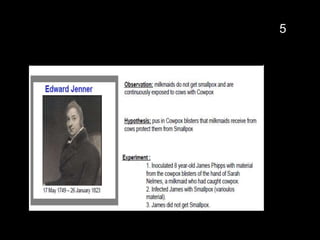
 In 1798,Edward Jenner introduced vaccination with
cowpox virus to protect against smallpox.
2
 Louis Pasteur discovered that innoculating individuals
with attenuated organisms provoked antibodies
against virulent strains of the same organism.
 The WHO estimates that 3million deaths occur
annually due to vaccine preventable illnesses like TB,
measles etc.
3
 High point in hx reached in 1977 with launching of
global campaign to eradicate smallpox & declaration
of eradication 3yrs later.
 Vaccines are the most important cost effective
technology for improving health.
 Early vaccines were developed on a trial & error basis
with no prior knowledge of the immune system.
 Today however, coupling molecular biology &
immunochemistry techniques with knowledge of the
mechanics of the immune system has made possible
the development of new vaccines
4
5
Definitions
 Immunization is defined as the process of
administering an antigen to a live host with the
purpose of inducing immune response for academic
or public health reasons
 Vaccination is the process of administering an antigen
to a living host to induce antibody production for public
health reasons.
 Vaccines are killed or attenuated products of micro
organisms administered through injection, orally or
intranasally to induce antibody production.
6
 Toxoids are non toxic immunogenic preparations
produced from toxins that have been treated with heat
or formalin.
 DNA vaccine: a vaccine produced via insertion of
genes of an infectious microbe into a bacterial plasmid
DNA.
 Live attenuated: a vaccine produced by decreasing the
ability of a microbe to cause dx by serial passage tru
mammalian cells.
 Killed vaccine: vaccine produced by inactivation of the
infectious agent either via heat or chemicals.
7
 Subunit vaccine: a vaccine produced from a non
infectious subunit of a microbe eg surface antigen of
hepatitis B.
8
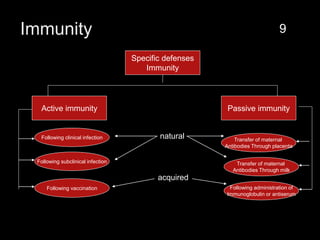
Immunity
Specific defenses
Immunity
Passive immunity
Active immunity
Following clinical infection
Following subclinical infection
Following vaccination Following administration of
Immunoglobulin or antiserum
Transfer of maternal
Antibodies Through milk
Transfer of maternal
Antibodies Through placenta
natural
acquired
9
Active immunity
 Resistance developed in response to stimulus by an
antigen (infecting agent or vaccine) and is
characterized by the production of antibodies by the
host.
10
Passive immunity
 Immunity conferred by an antibody produced in
another host. It may be acquired naturally or artificially
(through an antibody-containing preparation).
11
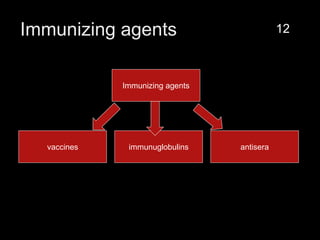
Immunizing agents
Immunizing agents
antisera
immunuglobulins
vaccines
12
Immunoglobulins
 There are 5 major classes: IgM, IgA, IgG, IgE, IgD.
 Two types of immunoglobulin preparations are
available for passive immunization:
 Normal human immunoglobulin
 Specific (hyper-immune) human immunoglobulin
13
 Immune globulin
-used for passive immunization against various dxs or
for maintenance of immunodeficient individuals.
-prepared from pooled, healthy adult serum by cold
fractionation.
-contains a variety of various antibodies mainly IgG to
several micro organisms.
-Human derived gamma globulin may be used in
treatment of hepatitis A & measles.
14
 Specific immune globulin
- is a gamma globulin obtained from people who have recently
recovered from a specific infectious dx.
-Representative preparations include:
-Hepatitis B immune globulin(HBIG) derived from human plasma
demonstrating a high titer to HBsAg.
-Human derived rabies immune globulin(HRIG) is prepared from
serum of individuals hyper immunized against rabies.
-Human derived varicella zoster immune globulin: is prepared from
human derived serum selected for high titers of antibody to
varicella zoster.
-Rho immune globulin RhoGAM is a human derived preparation
used in rh –ve women within 72hrs of delivery, miscarriage or
abortion of an Rh +ve fetus with the aim of avoiding sensitization
of the mother to Rh +ve fetal red cells.
15
Antisera or antitoxins
 These are materials prepared in animals or non human
sources such as horses.
16
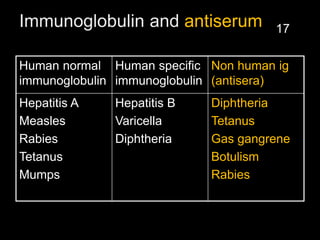
Immunoglobulin and antiserum
Human normal
immunoglobulin
Human specific
immunoglobulin
Non human ig
(antisera)
Hepatitis A
Measles
Rabies
Tetanus
Mumps
Hepatitis B
Varicella
Diphtheria
Diphtheria
Tetanus
Gas gangrene
Botulism
Rabies
17
Vaccination
 Vaccination is a method of giving antigen to stimulate the immune
response through active immunization.
 A vaccine is an immuno-biological substance designed to produce
specific protection against a given disease.
 A vaccine is “antigenic” but not “pathogenic”.
18
Types of vaccines
 Live vaccines
 Attenuated live vaccines
 Inactivated (killed vaccines)
 Toxoids
 Polysaccharide and polypeptide (cellular fraction)
vaccines
 Surface antigen (recombinant) vaccines.
19
Live vaccines
 Live vaccines are made from live infectious agents
without any amendment.
 The only live vaccine is “Variola” small pox vaccine,
made of live vaccinia cow-pox virus (not variola virus)
which is not pathogenic but antigenic, giving cross
immunity for variola.
20
Live attenuated (avirulent)
vaccines
 Virulent pathogenic organisms are treated to become
attenuated and avirulent but antigenic. They have lost
their capacity to induce full-blown disease but retain
their immunogenicity.
 Live attenuated vaccines should not be administered
to persons with suppressed immune response due to:
 Leukemia and lymphoma
 Other malignancies
 Receiving corticosteroids and anti-metabolic
agents
 Radiation
 pregnancy
21
Inactivated (killed) vaccines
 Organisms are killed or inactivated by heat or
chemicals but remain antigenic. They are usually safe
but less effective than live attenuated vaccines. The
only absolute contraindication to their administration is
a severe local or general reaction to a previous dose.
22
Toxoids
 They are prepared by detoxifying the
exotoxins of some bacteria rendering them
antigenic but not pathogenic.
 Adjuvant (e.g. alum precipitation) is used to
increase the potency of vaccine.
 The antibodies produces in the body as a
consequence of toxoid administration
neutralize the toxic moiety produced during
infection rather than act upon the organism
itself. In general toxoids are highly
efficacious and safe immunizing agents.
23
Polysaccharide and polypeptide
(cellular fraction) vaccines
 They are prepared from extracted cellular
fractions e.g. meningococcal vaccine from
the polysaccharide antigen of the cell
wall, the pneumococcal vaccine from the
polysaccharide contained in the capsule
of the organism, and hepatitis B
polypeptide vaccine.
 Their efficacy and safety appear to be
high.
24
Surface antigen (recombinant)
vaccines.
 It is prepared by cloning HBsAg gene in yeast cells
where it is expressed. HBsAg produced is then used
for vaccine preparations.
 Their efficacy and safety also appear to be high.
25
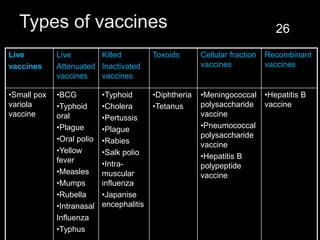
Types of vaccines
Live
vaccines
Live
Attenuated
vaccines
Killed
Inactivated
vaccines
Toxoids Cellular fraction
vaccines
Recombinant
vaccines
•Small pox
variola
vaccine
•BCG
•Typhoid
oral
•Plague
•Oral polio
•Yellow
fever
•Measles
•Mumps
•Rubella
•Intranasal
Influenza
•Typhus
•Typhoid
•Cholera
•Pertussis
•Plague
•Rabies
•Salk polio
•Intra-
muscular
influenza
•Japanise
encephalitis
•Diphtheria
•Tetanus
•Meningococcal
polysaccharide
vaccine
•Pneumococcal
polysaccharide
vaccine
•Hepatitis B
polypeptide
vaccine
•Hepatitis B
vaccine
26
Routes of administration
 Deep subcutaneous or intramuscular route (most
vaccines)
 Oral route (sabine vaccine, oral BCG vaccine)
 Intradermal route (BCG vaccine)
 Scarification (small pox vaccine)
 Intranasal route (live attenuated influenza vaccine)
27
Scheme of immunization
 Primary vaccination
 One dose vaccines (BCG, variola, measles, mumps, rubella, yellow fever)
 Multiple doses vaccines (polio, DPT, hepatitis B)
 Booster vaccination
To maintain immunity level after it declines after some time has elapsed (TT,
MMR).
28
Periods of maintained
immunity due to vaccines
 Short period (months): cholera vaccine
 Two years: TAB vaccine, Meningocaccal vaccine
 Three to five years: DPT vaccine
 Five or more years: BCG vaccine
 Ten years: yellow fever vaccine
 Solid immunity: measles, mumps, and rubella
vaccines.
29
Levels of effectiveness
 Absolutely protective(100%): yellow fever
vaccine
 Almost absolutely protective (99%): Variola,
measles, mumps, rubella vaccines, and
diphtheria and tetanus toxoids.
 Highly protective (80-95%): polio, BCG,
Hepatitis B, and pertussis vaccines.
 Moderately protective (40-60%) TAB, cholera
vaccine, and influenza killed vaccine.
30
The Cold Chain
 The "cold chain" is a system of storage and transport
of vaccines at low temperature from the manufacturer
to the actual vaccination site.
 The cold chain system is necessary because vaccine
failure may occur due to failure to store and transport
under strict temperature controls.
31
The Cold Chain Equipment
Cold chain equipment consists of the following:
(a) Walk in cold rooms: They are located at
regional level, meant to store vaccines up to 3
months and serve districts.
(b) Deep freezers (300 ltr) and Ice lined
Refrigerators: supplied to all districts to store
vaccines. Deep freezers are used for making ice
packs and to store OPV and measles vaccines.
(c) Small deep freezers and (140 ltr) : One set is
provided to PHCs, and Family Planning Centers
32
 (d) Cold boxes: Cold boxes are supplied to all
peripheral centers. These are used mainly for
transportation of the vaccines.
 (e) Vaccine carriers: Vaccine carriers are used to
carry small quantities of vaccines (16-20 vials)
for the out of reach sessions. 4 fully frozen ice
packs are used for lining the sides, and vials of
DPT, DT, TT and diluents should not be placed
in direct contact with frozen ice packs. The
carriers should be closed tightly.
33
 Among the vaccines, polio is the most sensitive to heat, requiring
storage at minus 20 degree C.
 Vaccines which must be stored in the freezer compartment are :
polio and measles.
 Vaccines which must be stored in the COLD PART but never
allowed to freeze are : typhoid, DPT, tetanus toxoid, DT, BCG and
diluents
34
HAZARDS OF IMMUNIZATION
 No immune response is entirely free from the risk of
adverse reactions or remote squeal. The adverse
reactions that may occur may be grouped under the
following heads:
1. Reactions inherent to inoculation
2. Reactions due to faulty techniques
3. Reactions due to hypersensitivity
4. Neurological involvement
5. Provocative reactions
6. Others
35
 1. Reactions inherent to inoculation:
These may be local or general reactions.
The local reactions may be pain, swelling,
redness, tenderness and development of a small
nodule or sterile abscess at the site of injection.
 The general reactions may be fever, malaise,
headache and other constitutional symptoms.
Most killed bacterial vaccines (e.g., typhoid)
cause some local and general reactions.
Diphtheria and tetanus toxoids and live polio
vaccine cause little reaction.
36
 2. Reactions due to faulty techniques:
Faulty techniques may relate to;
 faulty production of vaccine (e.g. inadequate inactivation of the
microbe, inadequate detoxication),
 too much vaccine given in one dose,
 improper immunization site or route,
 vaccine reconstituted with incorrect diluents,
 wrong amount of diluent used,
 vaccine prepared incorrectly for use (e.g., an adsorbed vaccine not
shaken properly before use),
 vaccine or dliluent contaminated,
 vaccine stored incorrectly,
 contraindications ignored (e.g. a child who experienced a severe
reaction after a previous dose of DPT vaccine is immunized with the
same vaccine),
37
 Use of improperly sterilized syringes and needles carry
the hazard of hepatitis B virus, and staphylo - and
streptococcal infection
38
 3. Reactions due to hypersensitivity:
 Administration of antisera (e.g., ATS) may occasionally give rise
to anaphylactic shock and serum sickness. Many viral vaccines
contain traces of various antibiotics used in their preparation
and some individuals may be sensitive to the antibiotic which it
contains. Anaphylactic shock is a rare but dangerous
complication of injection of antiserum. There is bronchospasm,
dyspnoea, pallor, hypotension and collapse.
 The symptoms may appear within a few minutes of injection or
may be delayed up to 2 hours. Some viral vaccines prepared from
embryonated eggs (e.g., influenza) may bring about generalized
anaphylactic reactions. Serum sickness is characterized by
symptoms such as fever, rash, oedema and joint pains occurring 7
-12 days of injection of antiserum.
39
 4. Neurological involvement:
 Neuritic manifestations may be seen after
the administration of serum or vaccine.
The well-known examples are the post-
vaccinial encephalitis and encephalopathy
following administration of anti -rabies and
smallpox vaccines.
 GuillainBarre syndrome in association
with the swine influenza vaccine is
another example.
40
 5. Provocative reactions:
 Occasionally following immunization there may
occur a disease totally unconnected with the
immunizing agent (e.g., provocative polio after
DPT or DT administration against diphtheria).
 The mechanism seems to be that the individual is
harboring the infectious agent and the
administration of the vaccine shortens the
incubation period and produces the disease or
what may have been otherwise only a latent
infection is converted into a clinical attack.
41
 6. Others:
 These may comprise damage to the fetus (e.g., with
rubella vaccination); displacement in the age-
distribution of a disease (e.g., a potential problem in
mass vaccination against measles, rubella and
mumps).
42
PRECAUTIONS TO BE
TAKEN
 Before administration of the antiserum or
antitoxin, it is necessary to test for sensitivity
reaction. This can be done in 2 ways:
(a) instilling a drop of the preparation into the
conjunctival sac. A sensitized person will
develop pricking of the conjunctiva.
(b) a more reliable way of testing is by
intradermal injection of 0.2 ml of antiserum
diluted 1 : 10 with saline. A sensitized patient
will develop a wheal and flare within 10
minutes at the site of injection. It should be
borne in mind that these tests are not
infallible.
43
 Adrenaline (1: 1000 solution) should be kept
ready when giving foreign serum. In the event of
anaphylaxis, for an adult, 0.5 ml of adrenaline
solution should be injected intramuscularly
immediately, followed by 0.5 ml every 20 minutes
if the systolic blood pressure is below 100 mm of
mercury.
 An injection of antihistaminic drug should also be
given, e.g., 10-20 mg of chlorpheniramine
maleate by the intramuscular route, to minimise
the after-effects such as urticaria or oedema. The
patient should be observed for 30 minutes after
any serum injection.
44
 Reconstituted vaccine should be discarded at the end of
each immunization session and NEVER retained for use
in subsequent sessions. In the refrigerator of the
immunization centre, no other drug and substances
should be stored beside vaccines.
 Training of immunization worker and their close
supervision to ensure that proper procedures are being
followed are essential to prevent complications and
deaths following immunization.
45
Active immunization for adult
females
 MMR vaccine is given in adolescence before or after
marriage, but not during pregnancy and has to be
before 3 months of conception
 Tetanus toxoid in pregnancy to prevent tetanus
neonatorum in the newborn. In the first pregnancy on
the third month and after 1 month. The third dose in
the second pregnancy, and the fourth on the third
pregnancy with a maximum of 5 doses. If 10 years
elapse, and then pregnancy occurs, the doses are
given from the start.
 Live attenuated vaccines should not be given during
pregnancy.
46
Vaccination for special
occupations
 Health care workers: hepatitis B, influenza, MMR, polio
 Public safety personnel (police, fire fighters) and staff of
institutions for the developmentally disabled: hepatitis B,
influenza
 Vets and animal handlers: rabies, plague and anthrax
 Sewage workers: DT, hepatitis A, polio, TAB
 Food handlers: TAB
 Military troops and camp dwellers: pneumococcal,
meningococcal, influenza, BCG (for non reactors), tetanus
47
Vaccination for special life styles
and special environmental
situations
 Homosexually active males, Heterosexual with promiscus sexual
partner specially who has STDs, and Injecting drug users
 Inmates of long term correctional institutes, residents of institutions for
the developmentally disabled, and household contacts of HBV carriers
or patients
All should receive hepatitis B vaccine
48
Vaccinations for special health
status persons
 Immuno-compromised persons ( Leukemia, lymphoma, HIV,
malignancy…)
 Hemodialysis and transplantation
Should receive the following vaccines according to their situation:
HBV, Influenza, Pneuomococcal vaccines
49
Vaccinations in travel
 Varies according to the country of arrival and departure.
 Primary vaccine series
 Continuation of booster doses
 Specific vaccine according to the country traveled to:
 TAB, YF, cholera, meningiococcal, pneuomococcal, HIB,
influenza, rabies, plague, Japanese encephalitis.
 Haj for instance necessates meningococcal vaccination
from all over, and YF from places like south Africa, and
cholera from places like India.
50
Vaccines against bioterrorism
 Anthrax
 Small pox
 Plague
 etc.
51
New approaches
 Schistosomiasis
 Cancer
 HIV/AIDS
 Malaria
52
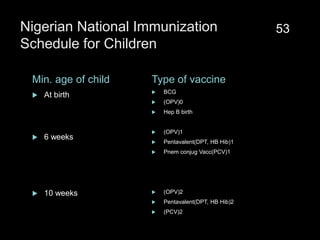
Nigerian National Immunization
Schedule for Children
Min. age of child
 At birth
 6 weeks
 10 weeks
Type of vaccine
 BCG
 (OPV)0
 Hep B birth
 (OPV)1
 Pentavalent(DPT, HB Hib)1
 Pnem conjug Vacc(PCV)1
 (OPV)2
 Pentavalent(DPT, HB Hib)2
 (PCV)2
53
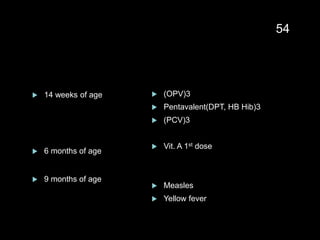
 14 weeks of age
 6 months of age
 9 months of age
 (OPV)3
 Pentavalent(DPT, HB Hib)3
 (PCV)3
 Vit. A 1st dose
 Measles
 Yellow fever
54
 THANK YOU
55

IMMUNIZATION LECTURE.ppt

  • 1.
    IMMUNIZATION BY Prof. Dr. SB. Zailani Consultant Clinical Microbiologist College of Medical Sciences ATBU, Bauchi 1
  • 2.
    History  Immunization hasbeen practised in the Chinese & Indian cultures since the 15th century B.C.  This practice was based on the observation that people who recovered from certain illnesses were protected against recurrence of the same disease.  Variolation ; the process of inoculation of dried smallpox exudates to prevent acute attacks of the illness.  In 1798,Edward Jenner introduced vaccination with cowpox virus to protect against smallpox. 2
  • 3.
     Louis Pasteurdiscovered that innoculating individuals with attenuated organisms provoked antibodies against virulent strains of the same organism.  The WHO estimates that 3million deaths occur annually due to vaccine preventable illnesses like TB, measles etc. 3
  • 4.
     High pointin hx reached in 1977 with launching of global campaign to eradicate smallpox & declaration of eradication 3yrs later.  Vaccines are the most important cost effective technology for improving health.  Early vaccines were developed on a trial & error basis with no prior knowledge of the immune system.  Today however, coupling molecular biology & immunochemistry techniques with knowledge of the mechanics of the immune system has made possible the development of new vaccines 4
  • 5.
  • 6.
    Definitions  Immunization isdefined as the process of administering an antigen to a live host with the purpose of inducing immune response for academic or public health reasons  Vaccination is the process of administering an antigen to a living host to induce antibody production for public health reasons.  Vaccines are killed or attenuated products of micro organisms administered through injection, orally or intranasally to induce antibody production. 6
  • 7.
     Toxoids arenon toxic immunogenic preparations produced from toxins that have been treated with heat or formalin.  DNA vaccine: a vaccine produced via insertion of genes of an infectious microbe into a bacterial plasmid DNA.  Live attenuated: a vaccine produced by decreasing the ability of a microbe to cause dx by serial passage tru mammalian cells.  Killed vaccine: vaccine produced by inactivation of the infectious agent either via heat or chemicals. 7
  • 8.
     Subunit vaccine:a vaccine produced from a non infectious subunit of a microbe eg surface antigen of hepatitis B. 8
  • 9.
    Immunity Specific defenses Immunity Passive immunity Activeimmunity Following clinical infection Following subclinical infection Following vaccination Following administration of Immunoglobulin or antiserum Transfer of maternal Antibodies Through milk Transfer of maternal Antibodies Through placenta natural acquired 9
  • 10.
    Active immunity  Resistancedeveloped in response to stimulus by an antigen (infecting agent or vaccine) and is characterized by the production of antibodies by the host. 10
  • 11.
    Passive immunity  Immunityconferred by an antibody produced in another host. It may be acquired naturally or artificially (through an antibody-containing preparation). 11
  • 12.
  • 13.
    Immunoglobulins  There are5 major classes: IgM, IgA, IgG, IgE, IgD.  Two types of immunoglobulin preparations are available for passive immunization:  Normal human immunoglobulin  Specific (hyper-immune) human immunoglobulin 13
  • 14.
     Immune globulin -usedfor passive immunization against various dxs or for maintenance of immunodeficient individuals. -prepared from pooled, healthy adult serum by cold fractionation. -contains a variety of various antibodies mainly IgG to several micro organisms. -Human derived gamma globulin may be used in treatment of hepatitis A & measles. 14
  • 15.
     Specific immuneglobulin - is a gamma globulin obtained from people who have recently recovered from a specific infectious dx. -Representative preparations include: -Hepatitis B immune globulin(HBIG) derived from human plasma demonstrating a high titer to HBsAg. -Human derived rabies immune globulin(HRIG) is prepared from serum of individuals hyper immunized against rabies. -Human derived varicella zoster immune globulin: is prepared from human derived serum selected for high titers of antibody to varicella zoster. -Rho immune globulin RhoGAM is a human derived preparation used in rh –ve women within 72hrs of delivery, miscarriage or abortion of an Rh +ve fetus with the aim of avoiding sensitization of the mother to Rh +ve fetal red cells. 15
  • 16.
    Antisera or antitoxins These are materials prepared in animals or non human sources such as horses. 16
  • 17.
    Immunoglobulin and antiserum Humannormal immunoglobulin Human specific immunoglobulin Non human ig (antisera) Hepatitis A Measles Rabies Tetanus Mumps Hepatitis B Varicella Diphtheria Diphtheria Tetanus Gas gangrene Botulism Rabies 17
  • 18.
    Vaccination  Vaccination isa method of giving antigen to stimulate the immune response through active immunization.  A vaccine is an immuno-biological substance designed to produce specific protection against a given disease.  A vaccine is “antigenic” but not “pathogenic”. 18
  • 19.
    Types of vaccines Live vaccines  Attenuated live vaccines  Inactivated (killed vaccines)  Toxoids  Polysaccharide and polypeptide (cellular fraction) vaccines  Surface antigen (recombinant) vaccines. 19
  • 20.
    Live vaccines  Livevaccines are made from live infectious agents without any amendment.  The only live vaccine is “Variola” small pox vaccine, made of live vaccinia cow-pox virus (not variola virus) which is not pathogenic but antigenic, giving cross immunity for variola. 20
  • 21.
    Live attenuated (avirulent) vaccines Virulent pathogenic organisms are treated to become attenuated and avirulent but antigenic. They have lost their capacity to induce full-blown disease but retain their immunogenicity.  Live attenuated vaccines should not be administered to persons with suppressed immune response due to:  Leukemia and lymphoma  Other malignancies  Receiving corticosteroids and anti-metabolic agents  Radiation  pregnancy 21
  • 22.
    Inactivated (killed) vaccines Organisms are killed or inactivated by heat or chemicals but remain antigenic. They are usually safe but less effective than live attenuated vaccines. The only absolute contraindication to their administration is a severe local or general reaction to a previous dose. 22
  • 23.
    Toxoids  They areprepared by detoxifying the exotoxins of some bacteria rendering them antigenic but not pathogenic.  Adjuvant (e.g. alum precipitation) is used to increase the potency of vaccine.  The antibodies produces in the body as a consequence of toxoid administration neutralize the toxic moiety produced during infection rather than act upon the organism itself. In general toxoids are highly efficacious and safe immunizing agents. 23
  • 24.
    Polysaccharide and polypeptide (cellularfraction) vaccines  They are prepared from extracted cellular fractions e.g. meningococcal vaccine from the polysaccharide antigen of the cell wall, the pneumococcal vaccine from the polysaccharide contained in the capsule of the organism, and hepatitis B polypeptide vaccine.  Their efficacy and safety appear to be high. 24
  • 25.
    Surface antigen (recombinant) vaccines. It is prepared by cloning HBsAg gene in yeast cells where it is expressed. HBsAg produced is then used for vaccine preparations.  Their efficacy and safety also appear to be high. 25
  • 26.
    Types of vaccines Live vaccines Live Attenuated vaccines Killed Inactivated vaccines ToxoidsCellular fraction vaccines Recombinant vaccines •Small pox variola vaccine •BCG •Typhoid oral •Plague •Oral polio •Yellow fever •Measles •Mumps •Rubella •Intranasal Influenza •Typhus •Typhoid •Cholera •Pertussis •Plague •Rabies •Salk polio •Intra- muscular influenza •Japanise encephalitis •Diphtheria •Tetanus •Meningococcal polysaccharide vaccine •Pneumococcal polysaccharide vaccine •Hepatitis B polypeptide vaccine •Hepatitis B vaccine 26
  • 27.
    Routes of administration Deep subcutaneous or intramuscular route (most vaccines)  Oral route (sabine vaccine, oral BCG vaccine)  Intradermal route (BCG vaccine)  Scarification (small pox vaccine)  Intranasal route (live attenuated influenza vaccine) 27
  • 28.
    Scheme of immunization Primary vaccination  One dose vaccines (BCG, variola, measles, mumps, rubella, yellow fever)  Multiple doses vaccines (polio, DPT, hepatitis B)  Booster vaccination To maintain immunity level after it declines after some time has elapsed (TT, MMR). 28
  • 29.
    Periods of maintained immunitydue to vaccines  Short period (months): cholera vaccine  Two years: TAB vaccine, Meningocaccal vaccine  Three to five years: DPT vaccine  Five or more years: BCG vaccine  Ten years: yellow fever vaccine  Solid immunity: measles, mumps, and rubella vaccines. 29
  • 30.
    Levels of effectiveness Absolutely protective(100%): yellow fever vaccine  Almost absolutely protective (99%): Variola, measles, mumps, rubella vaccines, and diphtheria and tetanus toxoids.  Highly protective (80-95%): polio, BCG, Hepatitis B, and pertussis vaccines.  Moderately protective (40-60%) TAB, cholera vaccine, and influenza killed vaccine. 30
  • 31.
    The Cold Chain The "cold chain" is a system of storage and transport of vaccines at low temperature from the manufacturer to the actual vaccination site.  The cold chain system is necessary because vaccine failure may occur due to failure to store and transport under strict temperature controls. 31
  • 32.
    The Cold ChainEquipment Cold chain equipment consists of the following: (a) Walk in cold rooms: They are located at regional level, meant to store vaccines up to 3 months and serve districts. (b) Deep freezers (300 ltr) and Ice lined Refrigerators: supplied to all districts to store vaccines. Deep freezers are used for making ice packs and to store OPV and measles vaccines. (c) Small deep freezers and (140 ltr) : One set is provided to PHCs, and Family Planning Centers 32
  • 33.
     (d) Coldboxes: Cold boxes are supplied to all peripheral centers. These are used mainly for transportation of the vaccines.  (e) Vaccine carriers: Vaccine carriers are used to carry small quantities of vaccines (16-20 vials) for the out of reach sessions. 4 fully frozen ice packs are used for lining the sides, and vials of DPT, DT, TT and diluents should not be placed in direct contact with frozen ice packs. The carriers should be closed tightly. 33
  • 34.
     Among thevaccines, polio is the most sensitive to heat, requiring storage at minus 20 degree C.  Vaccines which must be stored in the freezer compartment are : polio and measles.  Vaccines which must be stored in the COLD PART but never allowed to freeze are : typhoid, DPT, tetanus toxoid, DT, BCG and diluents 34
  • 35.
    HAZARDS OF IMMUNIZATION No immune response is entirely free from the risk of adverse reactions or remote squeal. The adverse reactions that may occur may be grouped under the following heads: 1. Reactions inherent to inoculation 2. Reactions due to faulty techniques 3. Reactions due to hypersensitivity 4. Neurological involvement 5. Provocative reactions 6. Others 35
  • 36.
     1. Reactionsinherent to inoculation: These may be local or general reactions. The local reactions may be pain, swelling, redness, tenderness and development of a small nodule or sterile abscess at the site of injection.  The general reactions may be fever, malaise, headache and other constitutional symptoms. Most killed bacterial vaccines (e.g., typhoid) cause some local and general reactions. Diphtheria and tetanus toxoids and live polio vaccine cause little reaction. 36
  • 37.
     2. Reactionsdue to faulty techniques: Faulty techniques may relate to;  faulty production of vaccine (e.g. inadequate inactivation of the microbe, inadequate detoxication),  too much vaccine given in one dose,  improper immunization site or route,  vaccine reconstituted with incorrect diluents,  wrong amount of diluent used,  vaccine prepared incorrectly for use (e.g., an adsorbed vaccine not shaken properly before use),  vaccine or dliluent contaminated,  vaccine stored incorrectly,  contraindications ignored (e.g. a child who experienced a severe reaction after a previous dose of DPT vaccine is immunized with the same vaccine), 37
  • 38.
     Use ofimproperly sterilized syringes and needles carry the hazard of hepatitis B virus, and staphylo - and streptococcal infection 38
  • 39.
     3. Reactionsdue to hypersensitivity:  Administration of antisera (e.g., ATS) may occasionally give rise to anaphylactic shock and serum sickness. Many viral vaccines contain traces of various antibiotics used in their preparation and some individuals may be sensitive to the antibiotic which it contains. Anaphylactic shock is a rare but dangerous complication of injection of antiserum. There is bronchospasm, dyspnoea, pallor, hypotension and collapse.  The symptoms may appear within a few minutes of injection or may be delayed up to 2 hours. Some viral vaccines prepared from embryonated eggs (e.g., influenza) may bring about generalized anaphylactic reactions. Serum sickness is characterized by symptoms such as fever, rash, oedema and joint pains occurring 7 -12 days of injection of antiserum. 39
  • 40.
     4. Neurologicalinvolvement:  Neuritic manifestations may be seen after the administration of serum or vaccine. The well-known examples are the post- vaccinial encephalitis and encephalopathy following administration of anti -rabies and smallpox vaccines.  GuillainBarre syndrome in association with the swine influenza vaccine is another example. 40
  • 41.
     5. Provocativereactions:  Occasionally following immunization there may occur a disease totally unconnected with the immunizing agent (e.g., provocative polio after DPT or DT administration against diphtheria).  The mechanism seems to be that the individual is harboring the infectious agent and the administration of the vaccine shortens the incubation period and produces the disease or what may have been otherwise only a latent infection is converted into a clinical attack. 41
  • 42.
     6. Others: These may comprise damage to the fetus (e.g., with rubella vaccination); displacement in the age- distribution of a disease (e.g., a potential problem in mass vaccination against measles, rubella and mumps). 42
  • 43.
    PRECAUTIONS TO BE TAKEN Before administration of the antiserum or antitoxin, it is necessary to test for sensitivity reaction. This can be done in 2 ways: (a) instilling a drop of the preparation into the conjunctival sac. A sensitized person will develop pricking of the conjunctiva. (b) a more reliable way of testing is by intradermal injection of 0.2 ml of antiserum diluted 1 : 10 with saline. A sensitized patient will develop a wheal and flare within 10 minutes at the site of injection. It should be borne in mind that these tests are not infallible. 43
  • 44.
     Adrenaline (1:1000 solution) should be kept ready when giving foreign serum. In the event of anaphylaxis, for an adult, 0.5 ml of adrenaline solution should be injected intramuscularly immediately, followed by 0.5 ml every 20 minutes if the systolic blood pressure is below 100 mm of mercury.  An injection of antihistaminic drug should also be given, e.g., 10-20 mg of chlorpheniramine maleate by the intramuscular route, to minimise the after-effects such as urticaria or oedema. The patient should be observed for 30 minutes after any serum injection. 44
  • 45.
     Reconstituted vaccineshould be discarded at the end of each immunization session and NEVER retained for use in subsequent sessions. In the refrigerator of the immunization centre, no other drug and substances should be stored beside vaccines.  Training of immunization worker and their close supervision to ensure that proper procedures are being followed are essential to prevent complications and deaths following immunization. 45
  • 46.
    Active immunization foradult females  MMR vaccine is given in adolescence before or after marriage, but not during pregnancy and has to be before 3 months of conception  Tetanus toxoid in pregnancy to prevent tetanus neonatorum in the newborn. In the first pregnancy on the third month and after 1 month. The third dose in the second pregnancy, and the fourth on the third pregnancy with a maximum of 5 doses. If 10 years elapse, and then pregnancy occurs, the doses are given from the start.  Live attenuated vaccines should not be given during pregnancy. 46
  • 47.
    Vaccination for special occupations Health care workers: hepatitis B, influenza, MMR, polio  Public safety personnel (police, fire fighters) and staff of institutions for the developmentally disabled: hepatitis B, influenza  Vets and animal handlers: rabies, plague and anthrax  Sewage workers: DT, hepatitis A, polio, TAB  Food handlers: TAB  Military troops and camp dwellers: pneumococcal, meningococcal, influenza, BCG (for non reactors), tetanus 47
  • 48.
    Vaccination for speciallife styles and special environmental situations  Homosexually active males, Heterosexual with promiscus sexual partner specially who has STDs, and Injecting drug users  Inmates of long term correctional institutes, residents of institutions for the developmentally disabled, and household contacts of HBV carriers or patients All should receive hepatitis B vaccine 48
  • 49.
    Vaccinations for specialhealth status persons  Immuno-compromised persons ( Leukemia, lymphoma, HIV, malignancy…)  Hemodialysis and transplantation Should receive the following vaccines according to their situation: HBV, Influenza, Pneuomococcal vaccines 49
  • 50.
    Vaccinations in travel Varies according to the country of arrival and departure.  Primary vaccine series  Continuation of booster doses  Specific vaccine according to the country traveled to:  TAB, YF, cholera, meningiococcal, pneuomococcal, HIB, influenza, rabies, plague, Japanese encephalitis.  Haj for instance necessates meningococcal vaccination from all over, and YF from places like south Africa, and cholera from places like India. 50
  • 51.
    Vaccines against bioterrorism Anthrax  Small pox  Plague  etc. 51
  • 52.
    New approaches  Schistosomiasis Cancer  HIV/AIDS  Malaria 52
  • 53.
    Nigerian National Immunization Schedulefor Children Min. age of child  At birth  6 weeks  10 weeks Type of vaccine  BCG  (OPV)0  Hep B birth  (OPV)1  Pentavalent(DPT, HB Hib)1  Pnem conjug Vacc(PCV)1  (OPV)2  Pentavalent(DPT, HB Hib)2  (PCV)2 53
  • 54.
     14 weeksof age  6 months of age  9 months of age  (OPV)3  Pentavalent(DPT, HB Hib)3  (PCV)3  Vit. A 1st dose  Measles  Yellow fever 54
  • 55.