Granulomatous conditions in
ENT
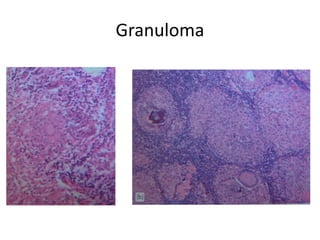
Granuloma formation
• Response of immune system to an indigestible agent
• Usually neutrophils remove agents by phagocytosis &
digestion
• Macrophages phagocytose indigestible agents, loose their
mobility & accumulate at site of injury
• Undergo structural changes: Larger with more cytoplasm 
epitheloid cells
• Epitheloid cells fuse  Multinucleated giant cells
• Nuclei arrange in horse shoe pattern  Langerhans giant
cells
• All these cells are surrounded by a collar of lymphocytes
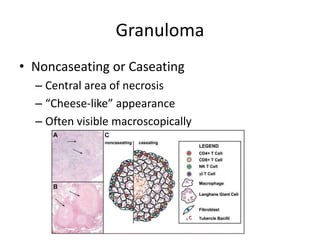
Granuloma
Granuloma
• Noncaseating or Caseating
– Central area of necrosis
– “Cheese-like” appearance
– Often visible macroscopically
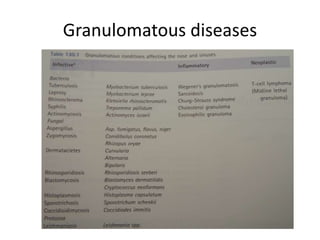
Granulomatous diseases
• Infective
• Inflammatory
• Neoplastic
• Forms part of a spectrum of conditions in which
vasculitides play a role
• Many are systemic conditions
– Preferentially target or present in the upper
respiratory tract
Granulomatous diseases
INFLAMMATORY CONDITIONS
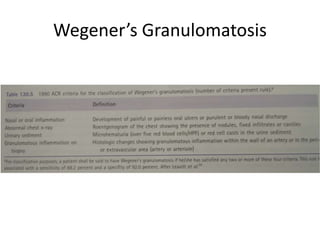
Wegener’s Granulomatosis
• Relatively common disease of upper airway
• Friedrick Wegerner
– 1939: Necrotizing granulomas and vasculitis of upper
& lower airway, occurring either together or as
separate components
• Coexistence of vasculitis & granulomas
• Classically involves triad:
– Airway
– Lung
– Renal disease
Wegener’s Granulomatosis
• Aetiology = unknown
• Hypersensitivity reaction to an unknown
stimulus
• Affects all ages and both males & females
• 3 main forms of WG
– Type 1
• Limited form
• Symptoms of URTI persisting for weeks & not responding to
A/b
• Pain over the dorsum of the nose
• Epistaxis & variable degree of nasal obstruction
• Very large crusting of the nasal cavities & nasopharynx
bilaterally
• When crusts are removed – mucosa is very friable
• Septal perforations & eventual nasal collapse in advanced
disease
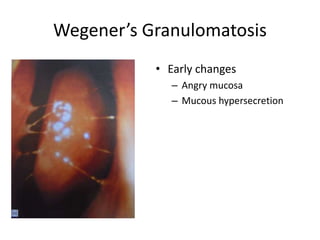
Wegener’s Granulomatosis
• Early changes
– Angry mucosa
– Mucous hypersecretion
Wegener’s Granulomatosis
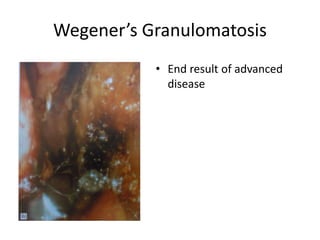
• End result of advanced
disease
Wegener’s Granulomatosis
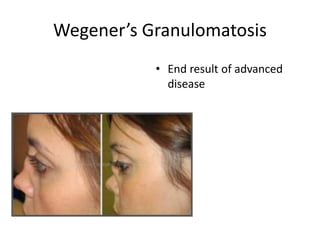
• End result of advanced
disease
Wegener’s Granulomatosis
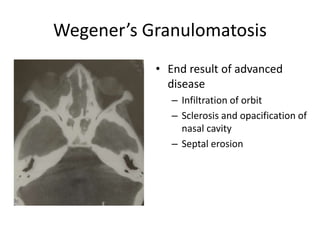
• End result of advanced
disease
– Infiltration of orbit
– Sclerosis and opacification of
nasal cavity
– Septal erosion
Wegener’s Granulomatosis
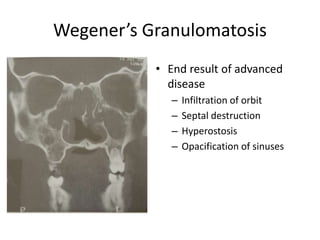
• End result of advanced
disease
– Infiltration of orbit
– Septal destruction
– Hyperostosis
– Opacification of sinuses
• 3 main forms of WG
– Type 2
• Sicker patient with more systemic symptoms
• Pulmonary involvement
– Cough & pleuritic pain
– Haemoptysis & cavitating lesions on CXR
– Encapsulated lung abscess
Wegener’s Granulomatosis
• 3 main forms of WG
– Type 3
• Widely disseminated with involvement of multiple organs
– Airway
» Short segment of subglottic/upper tracheal stenosis
– Pulmonary
– Renal
» Hematuria & abn urinary sediment & segmental/diffuse
glomerulonephritis
– Cutaneous
» Tick-bite like lesions on the distal limbs
– Oral
» Hyperplastic granular lesion of gingiva; ulcerative stomatitis
– Otological
» OME ± mastoiditits & profound SNHL
– Eye
» Conjunctivitis; Dacrocystitis; Episcleritis; Orbital pseudotumour
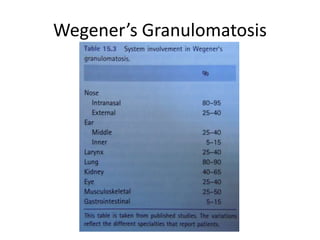
Wegener’s Granulomatosis
• Diagnosis
– cANCA
• 95% sensitive in generalized disease
• 60% sensitive in localized disease
– FBC, ESR, CRP, CXR, Urine analysis for casts
– Histology: Tissue from septum & all turbinates
– CT nose & paranasal sinuses
• Non-specific mucosal thickening; bony destruction; new
bone formation
Wegener’s Granulomatosis
• Main histological features:
– Vasculitis involving medium & small vessels
– Granulomatous necrosis (can be non-necrotic);
Large epitheloid cells; lined with histiocytes
– Scattered multinucleated giant cells
Wegener’s Granulomatosis
• Treatment:
– Prednisone 1mg/kg/day + Cyclophosphamide 2mg/kg/day x
1/12
• Prednisone tapered to alternate days x 2/12 & then discontinued once
complete response achieved
• Cyclophosphamide continued x 6/12 to 1 year & then tapered over a
few months
– Other
• Azathioprine
• Methotrexate
• Plasma exchange Ig infusion
– Nose
• Topical steroids, nasal douching & irrigation
– Surgical reconstruction
• Wait until disease has been in remission for some time
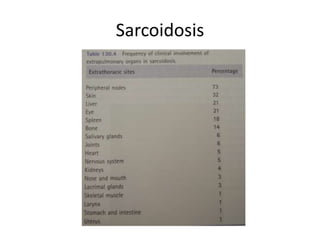
Sarcoidosis
• Systemic condition of unknown aetiology
• Can involve any organ including many H&N structures
• Incidence = 64/100,000 in Scandinavia
• Condition of young adults between 3rd & 5th decade
• Female preponderance = 2:1
• Ratio of black to Caucasian = 12:1
• Nasal manifestation almost always part of multisystem
sarcoid which have been present for some years
Sarcoidosis
Sarcoidosis
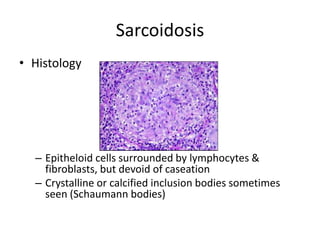
• Histology
– Epitheloid cells surrounded by lymphocytes &
fibroblasts, but devoid of caseation
– Crystalline or calcified inclusion bodies sometimes
seen (Schaumann bodies)
Sarcoidosis
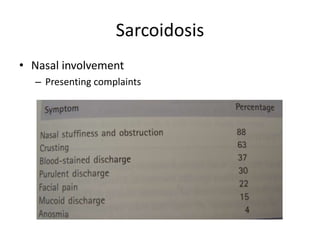
• Nasal involvement
– Presenting complaints
Sarcoidosis
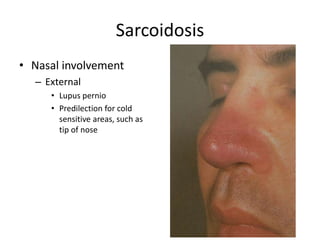
• Nasal involvement
– External
• Lupus pernio
• Predilection for cold
sensitive areas, such as
tip of nose
Sarcoidosis
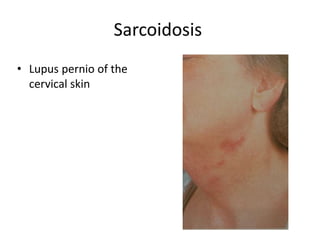
• Lupus pernio of the
cervical skin
Sarcoidosis
• Nasal involvement
– Mucosa
• Granular appearance (“Strawberry skin”)
– Tiny pale granulomas against a erythematous mucosa
• Very friable mucosa
• Crusting, nasal congestion, mucopurulent discharge
• Anterior septal perforation & later nasal bridge collapse
• Paranasal sinus involvement & infection
Sarcoidosis
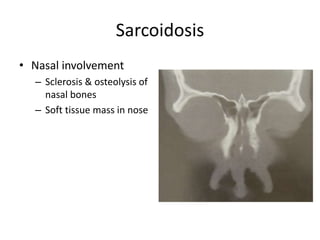
• Nasal involvement
– Sclerosis & osteolysis of
nasal bones
– Soft tissue mass in nose
Sarcoidosis
• Salivary glands
– Bilateral non-tender, firm, smooth parotid swelling
• Lymphoid hyperplasia
– Adenoids – OSA; OME
• Supraglottic larynx
– Dyspnoea; dysphonia
– Sub sites
• Epiglottis  arytenoid  aryepiglottic folds  false
cords
Sarcoidosis
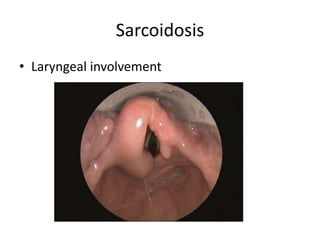
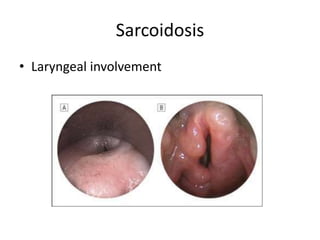
• Laryngeal involvement
Sarcoidosis
• Laryngeal involvement
Sarcoidosis
• Diagnosis
– Combination of histology, imaging & haematology
– Exclude other causes for non-caseating
granulomatous changes
– ↑ serum ACE (83% of patients with active sarcoid)
• Also in TB, Leprosy, 1ᴼ biliary cirrhosis
–  ESR, CRP & urinary calcium
– Mild anaemia, leucopenia, thrombocytopenia,
eosinophilia
Sarcoidosis
• Treatment
– Oral steroids, Methotrexate ± Hydroxychloroquine
– Topical intranasal steroids (spray/drops)
– Nasal douching/irrigation
– Surgery contraindicated for both cosmetic &
functional indications
Churg-Strauss Syndrome
• 1st described 1951 by Churg & Strauss
– Syndrome of systemic vasculitis & asthma
• Eosinophil-rich & granulomatous infl involving
the resp tract & necrotizing vasculitis affecting
small to medium sized vessels & associated
with asthma & eosinophilia
Churg-Strauss Syndrome
• 3 phases
– Prodromal phase
• May persist for years
• Allergic disease (allergic rhinitis, nasal polyposis,
asthma)
– Peripheral blood & tissue eosinophilia
• Chronic eosinophilic pneumonia & eosinophilic
gastroenteritis
– Life threatening systemic vasculitis
Churg-Strauss Syndrome
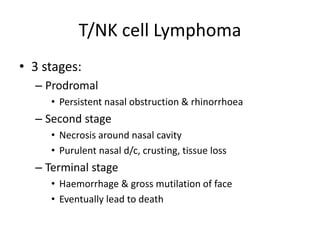
• Histo
– Necrotizing giant cell vasculitis, interstitial
granulomas & eosinophilic pulmonary infiltrates
Churg-Strauss Syndrome
• Nasal involvement
– Usual polyposis
– May also have crusting & septal perforation
– Doesn’t display diffuse mucosal destruction like
with WG
Churg-Strauss Syndrome
• Treatment
– Oral steroids
– Polyposis
• Topical steroids ± surgery
Giant cell Granuloma
• “giant cell reparative granuloma” or “giant cell
reaction of bone”
• Benign condition of jaws & other craniofacial
sites
• Commonly occur in children & young adults
Giant cell Granuloma
• Clinical features
– Maxilla & mandible most commonly affected
–  sphenoid bone  temporal bone
– Pain & swelling over affected bone
– Diplopia; frontal headache; hearing loss; vertigo;
tinnitus
Giant cell Granuloma
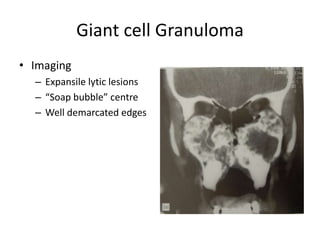
• Imaging
– Expansile lytic lesions
– “Soap bubble” centre
– Well demarcated edges
Giant cell Granuloma
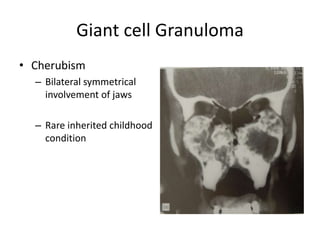
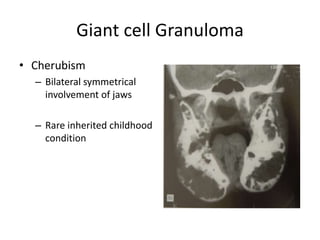
• Cherubism
– Bilateral symmetrical
involvement of jaws
– Rare inherited childhood
condition
Giant cell Granuloma
• Cherubism
– Bilateral symmetrical
involvement of jaws
– Rare inherited childhood
condition
Cholesterol granuloma
• Granulomatous reaction to cholesterol crystals
precipitated in tissues
• Presumed 2ᴼ to haemorrhage and/or trauma
• Lesions may affect maxilla, frontal sinus,
temporal bone
• Produce expansion of bone, cosmetic
deformity & displacement of adjacent
structures
Cholesterol granuloma
• Imaging
– Cyst-like expansion of bone/sinus
– Opaque on CT & not contrast enhancing
• Histo
– Granulation tissue of giant cells surrounding clefts
created by cholesterol granulation
• Treatment
– Surgical excision & complete removal of granulation
INFECTIOUS SYSTEMIC DISEASES
BACTERIAL
Rhinoscleroma
• Chronic granulomatous disease of the resp tract
– Nose; larynx; trachea & bronchi
• Klebsiella rhinoscleromatis
• Occur @ any age in either sex
– > common in middle aged females
• Central & South-eastern Europe; North Africa;
Indian subcontinent; Indonesia; South America
Rhinoscleroma
• 3 stages
– Catarrhal stage
• Foul-smelling purulent rhinorrhoea (weeks – months)
– Atrophic stage
• Large, foul-smelling nasal plaques or crusts
• Same as lesions in atrophic rhinitis
– Granulomatous or proliferative stage
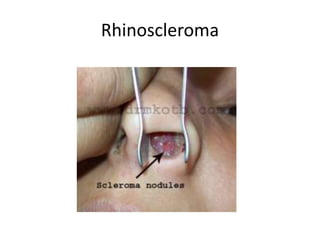
• Multiple granulomatous, non-ulcerative nodules throughout
nose, pharynx, larynx, trachea & bronchi
• Bluish red & rubbery and later paler & harder
– Cicatrizing stage
• Scaring, adhesions, stenosis & distortion of normal anatomy
Rhinoscleroma
Rhinoscleroma
• Histo
– Scattered large foam cells (Mikulicz cells)
• Vacuolated cells with a central nucleus
• Contain the indigestible bacilli & Russel bodies
• Diagnosis
– Clinical features
– Microbiology
– Histological features
Rhinoscleroma
• Treatment
– Treatment must be intense & prolonged
– Streptomycin 1g/day + Tetracycline 2g/day x 4/52
– Continued till 2 x consecutive negative cultures
– Rifampicin, Bactrim & Ciprofloxacin
– Surgical debridement prior to A/b in granulomatous
stage
– Surgery to “core out” scar tissue in Cicatrizing phase
Tuberculosis
• Mycobacterium tuberculosis
• Uncommon in nose
• More common in cervical LN, pharynx, larynx
& ear
Tuberculosis
• Nasal involvement
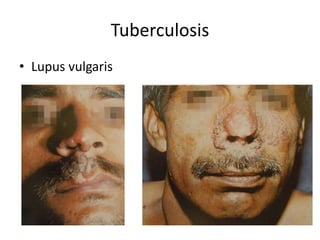
– Lupus Vulgaris
• Begins in vestibule, then extends to adjoining skin &
mucosa
• Apple jelly nodules (Does not blanch)
• May form ulcers with undermined edges
Tuberculosis
• Lupus vulgaris
Tuberculosis
• Nasal involvement
– Lupus Vulgaris
• Begins in vestibule, then extends to adjoining skin & mucosa
• Apple jelly nodules (Does not blanch)
• May form ulcers with undermined edges
– Ulcerative form
• Involves cartilaginous nasal septum or inferior turbinate
• Nasal floor is spared
• Nasal obstruction, pain, discharge, crusting, epistaxis
• Septal perforation, but not dorsal saddling
– Sinus granuloma
• Soft tissue mass with/without bone destruction
Tuberculosis
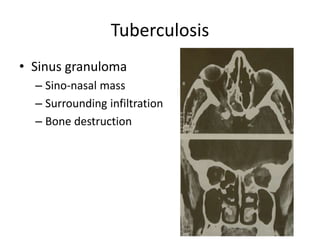
• Sinus granuloma
– Sino-nasal mass
– Surrounding infiltration
– Bone destruction
Tuberculosis
• Laryngeal involvement
– Occurs in association with pulm TB
– Dysphonia, Dysphagia, Otalgia
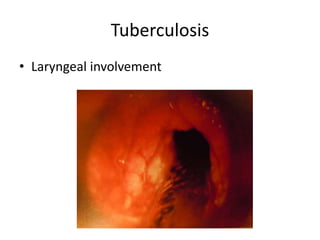
– Diffusely oedematous & reddened larynx
• Predominantly affects post ⅓ of larynx
• May have ulceration (confused with Sq cell CA)
Tuberculosis
• Laryngeal involvement
Tuberculosis
• Diagnosis
– Histology (AFB)
– CXR
– PCR & BACTEC
• Treatment
– As other TB
Nontuberculous Mycobacteria
• Mycobacterium fortuitum
• Mycobacterium scrofulaceum
• Mycobacterium szulgai
• Mycobacterium xenopi
• Mycobacterium bovis
Syphilis
• Spirochaete: Treponema pallidum
• Can affect all ages and both sexes equally
• Primary
– Infectious!!
– Chancre / hard non-painful ulcerated nodule
– Self limiting (6 – 10 weeks)
– Diff: furunculosis / malignant neoplasm
Syphilis
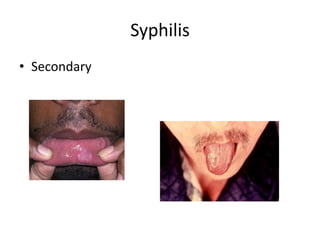
• Secondary
– Most infectious!!
– Persistent catarrhal rhinitis
– Persistent crusting or fissuring of vestibule
– Mucous patches on tongue, gingiva, pharynx
– Rarely larynx
• Diffuse erythematous papules on larynx
– Epiglottis & aryepiglottic folds
Syphilis
• Secondary
Syphilis
• Tertiary
– Luckily much less infective….
– Nose
• Pain (always worse @ night), swelling & obstruction
• Tenderness over nasal bridge (characteristic sign)
• Gumma
– Begins as a subcut nodule  punched out destructive ulcer
• Bony portion of septum most comonly involved
Syphilis
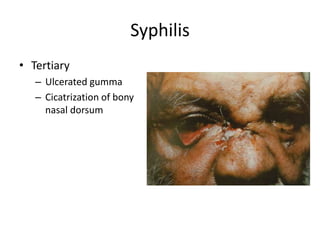
• Tertiary
– Ulcerated gumma
– Cicatrization of bony
nasal dorsum
Syphilis
• Tertiary
– Luckily much less infective….
– Larynx
• Nodular infiltrates coalescing to painless ulcers
– Epiglottis & aryepiglottic folds
• Appearance = similar to TB & CA
– Ear
• SNHL, OM, Meniere’s symptoms
Syphilis
• Diagnosis
– TPHA/VDRL / RPR
– Biopsy in doubtful cases
• Treatment
– Parenteral Penicillin
Leprosy
• Hansen’s disease
• AFB: Myrobacterium leprae
• Epidemiology
– 12 – 15 million people affected world wide
– Brazil, India, Indonesia, Myanmar, Nigeria: 82% of
cases
– Commonly manifests ages 10-20 years
– Nasal d/c = principal route of transmission
Leprosy
• 7th WHO Expert Committee on Leprosy
– Hypopigmented or reddish skin lesion w definite
loss of sensation
– Involvement of peripheral nerves (thickening or
loss of sensation
– Skin smear + for AFB,s
Leprosy
• 2 distinct polar forms of disease w spectrum in
between
– Tuberculoid Leprosy:
• Strong host resistance
• Non-infective
• Localized
– Lepromatous Leprosy
• Poor host resistance
• Infective
• Systemic with widespread involvement of tissues
Leprosy
• Nasal involvement
– Tuberculoid Leprosy
• Solitary skin lesion w cutaneous anaesthetic patches
• Vestibule skin involvement, but no mucosal
involvement
– Lepromatous Leprosy
• Skin, nerve & mucosal involvement
• Nasal obstruction, crust formation & blood-stained d/c
– Nasal d/c contain AFB’s
• Advanced: Atrophic Rhinitis, septal perforation & dorsal
saddling
Leprosy
• Laryngeal involvement
– Only with concurrent systemic illness
– Principal area = supraglottis
• Epiglottis – nodular oedema & ulceration
– Present w dysphonia (muffled voice)
Leprosy
• Diagnosis
– Clinical
– Bacteriological examination: Nasal d/c or
scrapings of nasal mucosa
– Histology
• Treatment
– Dapsone (Single drug treatment  resistance)
– Rifampicin & clefozamine – acts rapidly
– Triple therapy = best results
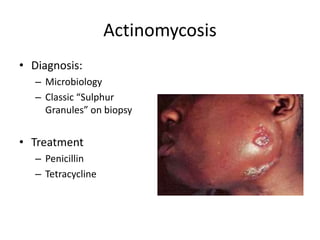
Actinomycosis
• Anaerobes: Actinomycoses bovis / israeli
• Chronic suppurative disease
• Poor dental hygiene
• Soft tissue involvement of submandibular or
cervical regions
– Abscess & sinus tract formation
• Secondary laryngeal involvement
– Erythematous, swollen wooden larynx
Actinomycosis
• Diagnosis:
– Microbiology
– Classic “Sulphur
Granules” on biopsy
• Treatment
– Penicillin
– Tetracycline
INFECTIOUS SYSTEMIC DISEASES
FUNGAL
Histoplasmosis
• Histoplasmosis capsulatum
• Granulomatous fungal disease
• Soil from chicken houses / bat & bird faeces
• Extremes of ages
• Mostly Larynx & tongue, but also nose &
paranasal sinuses
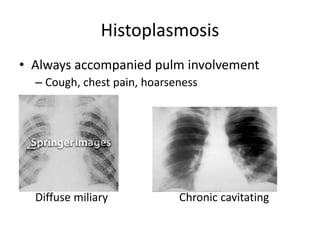
Histoplasmosis
• Always accompanied pulm involvement
– Cough, chest pain, hoarseness
Diffuse miliary Chronic cavitating
Histoplasmosis
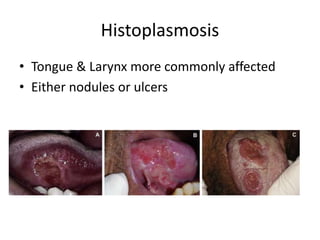
• Tongue & Larynx more commonly affected
• Either nodules or ulcers
Histoplasmosis
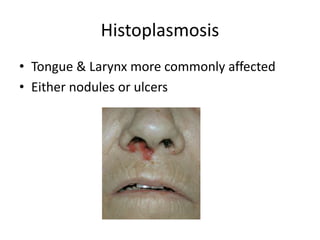
• Tongue & Larynx more commonly affected
• Either nodules or ulcers
Histoplasmosis
• Diagnosis
– Biopsy
• Epitheloid / histiocytic granuloma
• Organism seen with methenamine silver nitrate stain
• Treatment
– Amphotericin B
Rhinosporidiosis
• Rhinosporidium seeberi
• Asia & Africa
• Immersion in contaminated waters
• Nasal mucosal lesions
– Initial: flat & sessile lesion
– Later: Painless polypoid growth filling the nasal
cavity
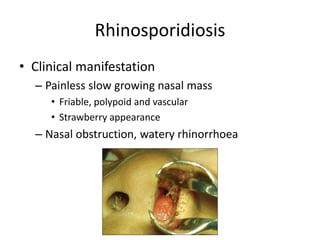
Rhinosporidiosis
• Clinical manifestation
– Painless slow growing nasal mass
• Friable, polypoid and vascular
• Strawberry appearance
– Nasal obstruction, watery rhinorrhoea
Rhinosporidiosis
• Diagnosis
– Histology
• Pseudoepitheliomatous squamous metaplasia overlying
multiple globular cysts (sporangia)
• Prominent accompanied granulomatous reaction of
fibrosis tissue
• Treatment
– No medical management
– Complete surgical excision
Aspergillus/Mucor
• Fungal Rhinosinusitis
• Usually in immune-compromised individuals
• Non-invasive fungal sinusitis / rhinosinusitis
• Invasive fungal rhinosinusitis
Aspergillus/Mucor
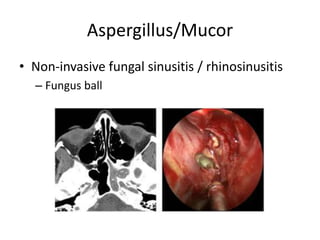
• Non-invasive fungal sinusitis / rhinosinusitis
– Fungus ball
• Only described in adults in the literature
• Immunocompetent patients
• Aspergillus most common
• Tangled mats of hyphae in one or more sinuses
• Extramucosal disease
• Maxillary sinus  sphenoid sinus  other sinuses
• Symptom = Post-nasal d/c , asymptomatic
• CT: heterogeneous opacification
• Surgical removal by endonasal under endoscopic guidance
Aspergillus/Mucor
• Non-invasive fungal sinusitis / rhinosinusitis
– Fungus ball
Aspergillus/Mucor
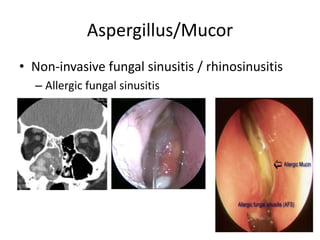
• Non-invasive fungal sinusitis / rhinosinusitis
– Allergic fungal sinusitis
• Immunocompetent patients
• Younger patient group < 30years
• Hypersensitivity to fungus residing in mucous
• Dematiaceous species
• “allergic mucin” – eosinophilic mucin with or without fungus
• Unilateral/Bilateral polyps with complete opacification of sinus
cavity on CT
– Frequently bony expansion
• Diagnosis
– Presence of hyphae in mucin
• Treatment
– Prednisone, nasal steroids & removal of all mucin
Aspergillus/Mucor
• Non-invasive fungal sinusitis / rhinosinusitis
– Allergic fungal sinusitis
Aspergillus/Mucor
• Invasive fungal rhinosinusitis
– Chronic or indolent invasive fungal rhinosinusitis
• Rare
• Mostly in immuno-competent patients
• Aspergillus most frequent
• Pain = Main symptom
• Chronic headache, proptosis, cranial nerve deficits
• Maxillary sinus most commonly affected
• Bony erosion extending to orbit or skull base
Aspergillus/Mucor
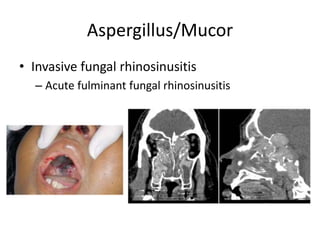
• Invasive fungal rhinosinusitis
– Acute fulminant fungal rhinosinusitis
• Immuno-compromised patients
• Fatal outcome without prompt treatment
• Mycotic infiltration of mucosa & sinuses
• Initially: Fever of unknown origin or rhinorrhoea
• Later: Proptosis, opthalmoplegia, CN palsies
• Most common site: near middle turbinate, septum
• Thrombosis & necrosis
Aspergillus/Mucor
• Invasive fungal rhinosinusitis
– Acute fulminant fungal rhinosinusitis
NEOPLASTIC
T/NK cell Lymphoma
• “midline destructive granuloma”
• Classical destruction of the midface
• Similar appearance of aggressive midfacial
destruction by cocaine abuse
• All decades of life (mean = 50years)
• Both sexes
• Association with EBV
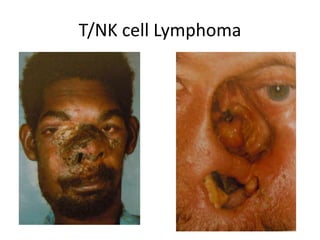
T/NK cell Lymphoma
• 3 stages:
– Prodromal
• Persistent nasal obstruction & rhinorrhoea
– Second stage
• Necrosis around nasal cavity
• Purulent nasal d/c, crusting, tissue loss
– Terminal stage
• Haemorrhage & gross mutilation of face
• Eventually lead to death
T/NK cell Lymphoma
T/NK cell Lymphoma
• Diagnosis
– Good quality representative biopsy beneath the
slough & crusts
• Imaging
– Dramatic destruction of midline soft tissue & bone
without a gross tumour mass
– Treatment
• Radical full course radiotherapy 55 Gy
• Wide field coverage incl nose, sinuses & palate

Granulomatous diseases in ENT

  • 1.
  • 2.
    Granuloma formation • Responseof immune system to an indigestible agent • Usually neutrophils remove agents by phagocytosis & digestion • Macrophages phagocytose indigestible agents, loose their mobility & accumulate at site of injury • Undergo structural changes: Larger with more cytoplasm  epitheloid cells • Epitheloid cells fuse  Multinucleated giant cells • Nuclei arrange in horse shoe pattern  Langerhans giant cells • All these cells are surrounded by a collar of lymphocytes
  • 3.
  • 4.
    Granuloma • Noncaseating orCaseating – Central area of necrosis – “Cheese-like” appearance – Often visible macroscopically
  • 5.
    Granulomatous diseases • Infective •Inflammatory • Neoplastic • Forms part of a spectrum of conditions in which vasculitides play a role • Many are systemic conditions – Preferentially target or present in the upper respiratory tract
  • 6.
  • 7.
  • 8.
    Wegener’s Granulomatosis • Relativelycommon disease of upper airway • Friedrick Wegerner – 1939: Necrotizing granulomas and vasculitis of upper & lower airway, occurring either together or as separate components • Coexistence of vasculitis & granulomas • Classically involves triad: – Airway – Lung – Renal disease
  • 9.
    Wegener’s Granulomatosis • Aetiology= unknown • Hypersensitivity reaction to an unknown stimulus • Affects all ages and both males & females
  • 10.
    • 3 mainforms of WG – Type 1 • Limited form • Symptoms of URTI persisting for weeks & not responding to A/b • Pain over the dorsum of the nose • Epistaxis & variable degree of nasal obstruction • Very large crusting of the nasal cavities & nasopharynx bilaterally • When crusts are removed – mucosa is very friable • Septal perforations & eventual nasal collapse in advanced disease Wegener’s Granulomatosis
  • 11.
    Wegener’s Granulomatosis • Earlychanges – Angry mucosa – Mucous hypersecretion
  • 12.
    Wegener’s Granulomatosis • Endresult of advanced disease
  • 13.
    Wegener’s Granulomatosis • Endresult of advanced disease
  • 14.
    Wegener’s Granulomatosis • Endresult of advanced disease – Infiltration of orbit – Sclerosis and opacification of nasal cavity – Septal erosion
  • 15.
    Wegener’s Granulomatosis • Endresult of advanced disease – Infiltration of orbit – Septal destruction – Hyperostosis – Opacification of sinuses
  • 16.
    • 3 mainforms of WG – Type 2 • Sicker patient with more systemic symptoms • Pulmonary involvement – Cough & pleuritic pain – Haemoptysis & cavitating lesions on CXR – Encapsulated lung abscess Wegener’s Granulomatosis
  • 17.
    • 3 mainforms of WG – Type 3 • Widely disseminated with involvement of multiple organs – Airway » Short segment of subglottic/upper tracheal stenosis – Pulmonary – Renal » Hematuria & abn urinary sediment & segmental/diffuse glomerulonephritis – Cutaneous » Tick-bite like lesions on the distal limbs – Oral » Hyperplastic granular lesion of gingiva; ulcerative stomatitis – Otological » OME ± mastoiditits & profound SNHL – Eye » Conjunctivitis; Dacrocystitis; Episcleritis; Orbital pseudotumour Wegener’s Granulomatosis
  • 18.
  • 19.
    Wegener’s Granulomatosis • Diagnosis –cANCA • 95% sensitive in generalized disease • 60% sensitive in localized disease – FBC, ESR, CRP, CXR, Urine analysis for casts – Histology: Tissue from septum & all turbinates – CT nose & paranasal sinuses • Non-specific mucosal thickening; bony destruction; new bone formation
  • 20.
  • 21.
    Wegener’s Granulomatosis • Mainhistological features: – Vasculitis involving medium & small vessels – Granulomatous necrosis (can be non-necrotic); Large epitheloid cells; lined with histiocytes – Scattered multinucleated giant cells
  • 22.
    Wegener’s Granulomatosis • Treatment: –Prednisone 1mg/kg/day + Cyclophosphamide 2mg/kg/day x 1/12 • Prednisone tapered to alternate days x 2/12 & then discontinued once complete response achieved • Cyclophosphamide continued x 6/12 to 1 year & then tapered over a few months – Other • Azathioprine • Methotrexate • Plasma exchange Ig infusion – Nose • Topical steroids, nasal douching & irrigation – Surgical reconstruction • Wait until disease has been in remission for some time
  • 23.
    Sarcoidosis • Systemic conditionof unknown aetiology • Can involve any organ including many H&N structures • Incidence = 64/100,000 in Scandinavia • Condition of young adults between 3rd & 5th decade • Female preponderance = 2:1 • Ratio of black to Caucasian = 12:1 • Nasal manifestation almost always part of multisystem sarcoid which have been present for some years
  • 24.
  • 25.
    Sarcoidosis • Histology – Epitheloidcells surrounded by lymphocytes & fibroblasts, but devoid of caseation – Crystalline or calcified inclusion bodies sometimes seen (Schaumann bodies)
  • 26.
  • 27.
    Sarcoidosis • Nasal involvement –External • Lupus pernio • Predilection for cold sensitive areas, such as tip of nose
  • 28.
    Sarcoidosis • Lupus pernioof the cervical skin
  • 29.
    Sarcoidosis • Nasal involvement –Mucosa • Granular appearance (“Strawberry skin”) – Tiny pale granulomas against a erythematous mucosa • Very friable mucosa • Crusting, nasal congestion, mucopurulent discharge • Anterior septal perforation & later nasal bridge collapse • Paranasal sinus involvement & infection
  • 30.
    Sarcoidosis • Nasal involvement –Sclerosis & osteolysis of nasal bones – Soft tissue mass in nose
  • 31.
    Sarcoidosis • Salivary glands –Bilateral non-tender, firm, smooth parotid swelling • Lymphoid hyperplasia – Adenoids – OSA; OME • Supraglottic larynx – Dyspnoea; dysphonia – Sub sites • Epiglottis  arytenoid  aryepiglottic folds  false cords
  • 32.
  • 33.
  • 34.
    Sarcoidosis • Diagnosis – Combinationof histology, imaging & haematology – Exclude other causes for non-caseating granulomatous changes – ↑ serum ACE (83% of patients with active sarcoid) • Also in TB, Leprosy, 1ᴼ biliary cirrhosis –  ESR, CRP & urinary calcium – Mild anaemia, leucopenia, thrombocytopenia, eosinophilia
  • 35.
    Sarcoidosis • Treatment – Oralsteroids, Methotrexate ± Hydroxychloroquine – Topical intranasal steroids (spray/drops) – Nasal douching/irrigation – Surgery contraindicated for both cosmetic & functional indications
  • 36.
    Churg-Strauss Syndrome • 1stdescribed 1951 by Churg & Strauss – Syndrome of systemic vasculitis & asthma • Eosinophil-rich & granulomatous infl involving the resp tract & necrotizing vasculitis affecting small to medium sized vessels & associated with asthma & eosinophilia
  • 37.
    Churg-Strauss Syndrome • 3phases – Prodromal phase • May persist for years • Allergic disease (allergic rhinitis, nasal polyposis, asthma) – Peripheral blood & tissue eosinophilia • Chronic eosinophilic pneumonia & eosinophilic gastroenteritis – Life threatening systemic vasculitis
  • 38.
    Churg-Strauss Syndrome • Histo –Necrotizing giant cell vasculitis, interstitial granulomas & eosinophilic pulmonary infiltrates
  • 39.
    Churg-Strauss Syndrome • Nasalinvolvement – Usual polyposis – May also have crusting & septal perforation – Doesn’t display diffuse mucosal destruction like with WG
  • 40.
    Churg-Strauss Syndrome • Treatment –Oral steroids – Polyposis • Topical steroids ± surgery
  • 41.
    Giant cell Granuloma •“giant cell reparative granuloma” or “giant cell reaction of bone” • Benign condition of jaws & other craniofacial sites • Commonly occur in children & young adults
  • 42.
    Giant cell Granuloma •Clinical features – Maxilla & mandible most commonly affected –  sphenoid bone  temporal bone – Pain & swelling over affected bone – Diplopia; frontal headache; hearing loss; vertigo; tinnitus
  • 43.
    Giant cell Granuloma •Imaging – Expansile lytic lesions – “Soap bubble” centre – Well demarcated edges
  • 44.
    Giant cell Granuloma •Cherubism – Bilateral symmetrical involvement of jaws – Rare inherited childhood condition
  • 45.
    Giant cell Granuloma •Cherubism – Bilateral symmetrical involvement of jaws – Rare inherited childhood condition
  • 46.
    Cholesterol granuloma • Granulomatousreaction to cholesterol crystals precipitated in tissues • Presumed 2ᴼ to haemorrhage and/or trauma • Lesions may affect maxilla, frontal sinus, temporal bone • Produce expansion of bone, cosmetic deformity & displacement of adjacent structures
  • 47.
    Cholesterol granuloma • Imaging –Cyst-like expansion of bone/sinus – Opaque on CT & not contrast enhancing • Histo – Granulation tissue of giant cells surrounding clefts created by cholesterol granulation • Treatment – Surgical excision & complete removal of granulation
  • 48.
  • 49.
    Rhinoscleroma • Chronic granulomatousdisease of the resp tract – Nose; larynx; trachea & bronchi • Klebsiella rhinoscleromatis • Occur @ any age in either sex – > common in middle aged females • Central & South-eastern Europe; North Africa; Indian subcontinent; Indonesia; South America
  • 50.
    Rhinoscleroma • 3 stages –Catarrhal stage • Foul-smelling purulent rhinorrhoea (weeks – months) – Atrophic stage • Large, foul-smelling nasal plaques or crusts • Same as lesions in atrophic rhinitis – Granulomatous or proliferative stage • Multiple granulomatous, non-ulcerative nodules throughout nose, pharynx, larynx, trachea & bronchi • Bluish red & rubbery and later paler & harder – Cicatrizing stage • Scaring, adhesions, stenosis & distortion of normal anatomy
  • 51.
  • 52.
    Rhinoscleroma • Histo – Scatteredlarge foam cells (Mikulicz cells) • Vacuolated cells with a central nucleus • Contain the indigestible bacilli & Russel bodies • Diagnosis – Clinical features – Microbiology – Histological features
  • 53.
    Rhinoscleroma • Treatment – Treatmentmust be intense & prolonged – Streptomycin 1g/day + Tetracycline 2g/day x 4/52 – Continued till 2 x consecutive negative cultures – Rifampicin, Bactrim & Ciprofloxacin – Surgical debridement prior to A/b in granulomatous stage – Surgery to “core out” scar tissue in Cicatrizing phase
  • 54.
    Tuberculosis • Mycobacterium tuberculosis •Uncommon in nose • More common in cervical LN, pharynx, larynx & ear
  • 55.
    Tuberculosis • Nasal involvement –Lupus Vulgaris • Begins in vestibule, then extends to adjoining skin & mucosa • Apple jelly nodules (Does not blanch) • May form ulcers with undermined edges
  • 56.
  • 57.
    Tuberculosis • Nasal involvement –Lupus Vulgaris • Begins in vestibule, then extends to adjoining skin & mucosa • Apple jelly nodules (Does not blanch) • May form ulcers with undermined edges – Ulcerative form • Involves cartilaginous nasal septum or inferior turbinate • Nasal floor is spared • Nasal obstruction, pain, discharge, crusting, epistaxis • Septal perforation, but not dorsal saddling – Sinus granuloma • Soft tissue mass with/without bone destruction
  • 58.
    Tuberculosis • Sinus granuloma –Sino-nasal mass – Surrounding infiltration – Bone destruction
  • 59.
    Tuberculosis • Laryngeal involvement –Occurs in association with pulm TB – Dysphonia, Dysphagia, Otalgia – Diffusely oedematous & reddened larynx • Predominantly affects post ⅓ of larynx • May have ulceration (confused with Sq cell CA)
  • 60.
  • 61.
    Tuberculosis • Diagnosis – Histology(AFB) – CXR – PCR & BACTEC • Treatment – As other TB
  • 62.
    Nontuberculous Mycobacteria • Mycobacteriumfortuitum • Mycobacterium scrofulaceum • Mycobacterium szulgai • Mycobacterium xenopi • Mycobacterium bovis
  • 63.
    Syphilis • Spirochaete: Treponemapallidum • Can affect all ages and both sexes equally • Primary – Infectious!! – Chancre / hard non-painful ulcerated nodule – Self limiting (6 – 10 weeks) – Diff: furunculosis / malignant neoplasm
  • 64.
    Syphilis • Secondary – Mostinfectious!! – Persistent catarrhal rhinitis – Persistent crusting or fissuring of vestibule – Mucous patches on tongue, gingiva, pharynx – Rarely larynx • Diffuse erythematous papules on larynx – Epiglottis & aryepiglottic folds
  • 65.
  • 66.
    Syphilis • Tertiary – Luckilymuch less infective…. – Nose • Pain (always worse @ night), swelling & obstruction • Tenderness over nasal bridge (characteristic sign) • Gumma – Begins as a subcut nodule  punched out destructive ulcer • Bony portion of septum most comonly involved
  • 67.
    Syphilis • Tertiary – Ulceratedgumma – Cicatrization of bony nasal dorsum
  • 68.
    Syphilis • Tertiary – Luckilymuch less infective…. – Larynx • Nodular infiltrates coalescing to painless ulcers – Epiglottis & aryepiglottic folds • Appearance = similar to TB & CA – Ear • SNHL, OM, Meniere’s symptoms
  • 69.
    Syphilis • Diagnosis – TPHA/VDRL/ RPR – Biopsy in doubtful cases • Treatment – Parenteral Penicillin
  • 70.
    Leprosy • Hansen’s disease •AFB: Myrobacterium leprae • Epidemiology – 12 – 15 million people affected world wide – Brazil, India, Indonesia, Myanmar, Nigeria: 82% of cases – Commonly manifests ages 10-20 years – Nasal d/c = principal route of transmission
  • 71.
    Leprosy • 7th WHOExpert Committee on Leprosy – Hypopigmented or reddish skin lesion w definite loss of sensation – Involvement of peripheral nerves (thickening or loss of sensation – Skin smear + for AFB,s
  • 72.
    Leprosy • 2 distinctpolar forms of disease w spectrum in between – Tuberculoid Leprosy: • Strong host resistance • Non-infective • Localized – Lepromatous Leprosy • Poor host resistance • Infective • Systemic with widespread involvement of tissues
  • 73.
    Leprosy • Nasal involvement –Tuberculoid Leprosy • Solitary skin lesion w cutaneous anaesthetic patches • Vestibule skin involvement, but no mucosal involvement – Lepromatous Leprosy • Skin, nerve & mucosal involvement • Nasal obstruction, crust formation & blood-stained d/c – Nasal d/c contain AFB’s • Advanced: Atrophic Rhinitis, septal perforation & dorsal saddling
  • 74.
    Leprosy • Laryngeal involvement –Only with concurrent systemic illness – Principal area = supraglottis • Epiglottis – nodular oedema & ulceration – Present w dysphonia (muffled voice)
  • 75.
    Leprosy • Diagnosis – Clinical –Bacteriological examination: Nasal d/c or scrapings of nasal mucosa – Histology • Treatment – Dapsone (Single drug treatment  resistance) – Rifampicin & clefozamine – acts rapidly – Triple therapy = best results
  • 76.
    Actinomycosis • Anaerobes: Actinomycosesbovis / israeli • Chronic suppurative disease • Poor dental hygiene • Soft tissue involvement of submandibular or cervical regions – Abscess & sinus tract formation • Secondary laryngeal involvement – Erythematous, swollen wooden larynx
  • 77.
    Actinomycosis • Diagnosis: – Microbiology –Classic “Sulphur Granules” on biopsy • Treatment – Penicillin – Tetracycline
  • 78.
  • 79.
    Histoplasmosis • Histoplasmosis capsulatum •Granulomatous fungal disease • Soil from chicken houses / bat & bird faeces • Extremes of ages • Mostly Larynx & tongue, but also nose & paranasal sinuses
  • 80.
    Histoplasmosis • Always accompaniedpulm involvement – Cough, chest pain, hoarseness Diffuse miliary Chronic cavitating
  • 81.
    Histoplasmosis • Tongue &Larynx more commonly affected • Either nodules or ulcers
  • 82.
    Histoplasmosis • Tongue &Larynx more commonly affected • Either nodules or ulcers
  • 83.
    Histoplasmosis • Diagnosis – Biopsy •Epitheloid / histiocytic granuloma • Organism seen with methenamine silver nitrate stain • Treatment – Amphotericin B
  • 84.
    Rhinosporidiosis • Rhinosporidium seeberi •Asia & Africa • Immersion in contaminated waters • Nasal mucosal lesions – Initial: flat & sessile lesion – Later: Painless polypoid growth filling the nasal cavity
  • 85.
    Rhinosporidiosis • Clinical manifestation –Painless slow growing nasal mass • Friable, polypoid and vascular • Strawberry appearance – Nasal obstruction, watery rhinorrhoea
  • 86.
    Rhinosporidiosis • Diagnosis – Histology •Pseudoepitheliomatous squamous metaplasia overlying multiple globular cysts (sporangia) • Prominent accompanied granulomatous reaction of fibrosis tissue • Treatment – No medical management – Complete surgical excision
  • 87.
    Aspergillus/Mucor • Fungal Rhinosinusitis •Usually in immune-compromised individuals • Non-invasive fungal sinusitis / rhinosinusitis • Invasive fungal rhinosinusitis
  • 88.
    Aspergillus/Mucor • Non-invasive fungalsinusitis / rhinosinusitis – Fungus ball • Only described in adults in the literature • Immunocompetent patients • Aspergillus most common • Tangled mats of hyphae in one or more sinuses • Extramucosal disease • Maxillary sinus  sphenoid sinus  other sinuses • Symptom = Post-nasal d/c , asymptomatic • CT: heterogeneous opacification • Surgical removal by endonasal under endoscopic guidance
  • 89.
    Aspergillus/Mucor • Non-invasive fungalsinusitis / rhinosinusitis – Fungus ball
  • 90.
    Aspergillus/Mucor • Non-invasive fungalsinusitis / rhinosinusitis – Allergic fungal sinusitis • Immunocompetent patients • Younger patient group < 30years • Hypersensitivity to fungus residing in mucous • Dematiaceous species • “allergic mucin” – eosinophilic mucin with or without fungus • Unilateral/Bilateral polyps with complete opacification of sinus cavity on CT – Frequently bony expansion • Diagnosis – Presence of hyphae in mucin • Treatment – Prednisone, nasal steroids & removal of all mucin
  • 91.
    Aspergillus/Mucor • Non-invasive fungalsinusitis / rhinosinusitis – Allergic fungal sinusitis
  • 92.
    Aspergillus/Mucor • Invasive fungalrhinosinusitis – Chronic or indolent invasive fungal rhinosinusitis • Rare • Mostly in immuno-competent patients • Aspergillus most frequent • Pain = Main symptom • Chronic headache, proptosis, cranial nerve deficits • Maxillary sinus most commonly affected • Bony erosion extending to orbit or skull base
  • 93.
    Aspergillus/Mucor • Invasive fungalrhinosinusitis – Acute fulminant fungal rhinosinusitis • Immuno-compromised patients • Fatal outcome without prompt treatment • Mycotic infiltration of mucosa & sinuses • Initially: Fever of unknown origin or rhinorrhoea • Later: Proptosis, opthalmoplegia, CN palsies • Most common site: near middle turbinate, septum • Thrombosis & necrosis
  • 94.
    Aspergillus/Mucor • Invasive fungalrhinosinusitis – Acute fulminant fungal rhinosinusitis
  • 95.
  • 96.
    T/NK cell Lymphoma •“midline destructive granuloma” • Classical destruction of the midface • Similar appearance of aggressive midfacial destruction by cocaine abuse • All decades of life (mean = 50years) • Both sexes • Association with EBV
  • 97.
    T/NK cell Lymphoma •3 stages: – Prodromal • Persistent nasal obstruction & rhinorrhoea – Second stage • Necrosis around nasal cavity • Purulent nasal d/c, crusting, tissue loss – Terminal stage • Haemorrhage & gross mutilation of face • Eventually lead to death
  • 98.
  • 99.
    T/NK cell Lymphoma •Diagnosis – Good quality representative biopsy beneath the slough & crusts • Imaging – Dramatic destruction of midline soft tissue & bone without a gross tumour mass – Treatment • Radical full course radiotherapy 55 Gy • Wide field coverage incl nose, sinuses & palate