Ozarks Technical Community College
HIS 110: Acoustics & Psychoacoustics
 We have talked about the frequencies and intensities
that the human ear can receive
 We’ve also discussed audiometric concepts of
determining threshold (softest audible sound intensity
at different frequencies) and masking
 Now, let’s discuss the just noticeable difference
(JND) or Difference Limen for frequency and
intensity
 Difference Limen (DL) = smallest difference between
two sounds that can be perceived by a listener
 The minimum difference in decibel level that can be
perceived as sounding “different” by a listener
 In very simple terms, our ears can generally hear the
difference between two sounds when they are separated by
1-2 dB SPL.
 Very low intensity sounds require a greater difference in
intensity to be perceived as different (i.e. a sound that is 10-20
dB must be increased by ~2 dB to be perceived as different
than the original sound)
 High intensity sounds require a smaller difference in intensity
to be perceived as different (i.e. a sound that is 40 dB or
louder only needs to by 1 dB louder to be perceived as
different than the original sound)
 This does vary with frequency
 At 125 Hz, we require a DL of 5dB when we are near
threshold to detect a difference
 This is a very good reason for why we test hearing using
5 dB steps (plus it saves time) 
 The minimum difference in frequency that can be
perceived as sounding “different” by a listener
 The DL for frequency is generally about 0.5 percent of
the frequency of the original tone
 So, at 1000 Hz a change of ~5 Hz would be noticed by
the listener
 Difference Limen for Duration
 Temporal refers to timing (tempo)
 Definition=The shortest gap/interruption of a signal
that can be detected by a listener
 Generally, a gap of 2 to 3 msec can be detected by a
listener (heard as two separate tones)
 When a gap is less than 2 msec, most listeners will hear
one steady tone
 A pure tone has almost all its energy located at one
frequency
 We use pure tones during audiometric testing
 A complex sound is composed of multiple frequencies
 Most of the sounds in our day-to-day lives are complex
in nature
 Wavelength=the distance a
soundwave travels during one
cycle of vibration
 Low frequency sounds have a
longer wavelength
 High frequency sounds have a
shorter wavelength
 If the waves at left occurred
over 1 second, what would the
frequency of each be?
 3 Hz
 10 Hz
Image from: blog.leeburrows.com
 The distance between the ears is approximately 7
inches
 For frequencies of 2000 Hz and higher, the wavelength
is less than 7 inches, and therefore the shadow of the
head results in a reduction of sound intensity at the
ear furthest from the sound source
 This makes it easier to locate high frequency sounds due
to intensity cues
 Note: Our ability to locate low frequency sounds is
primarily due to arrival time differences at the ears
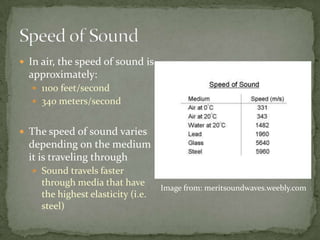
 In air, the speed of sound is
approximately:
 1100 feet/second
 340 meters/second
 The speed of sound varies
depending on the medium
it is traveling through
 Sound travels faster
through media that have
the highest elasticity (i.e.
steel)
Image from: meritsoundwaves.weebly.com
 Reflection of sound that occurs when it bounces off of
a physical object (i.e. wall) and results in a
prolongation of the sound
 Reverberation is reduced by increasing the absorption
of the environment
 Use of acoustic tiles in a classroom or gymnasium
 Carpeting instead of hard-surface flooring
 Draperies
o An understanding of reverberation will be important
when we discuss the hearing-impaired ear
 A periodic sound is a sound in which the wave shape
repeats itself and is predictable
 A pure tone is periodic
 An aperiodic sound is a sound in which the wave
shape does not repeat and is random
 Noise is aperiodic
 Note: this will be important when you learn about
modern hearing aids. HAs are constantly analyzing
the frequency spectrum of incoming sound to
determine if it is speech (periodic) or noise
(aperiodic).
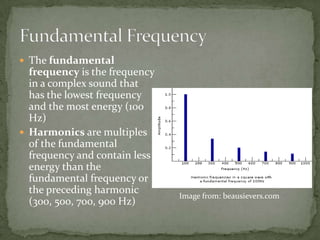
 The fundamental
frequency is the frequency
in a complex sound that
has the lowest frequency
and the most energy (100
Hz)
 Harmonics are multiples
of the fundamental
frequency and contain less
energy than the
fundamental frequency or
the preceding harmonic
(300, 500, 700, 900 Hz)
Image from: beausievers.com
 The resonant frequency is the frequency at which a
system will be most easily set into vibration
 It is the point where mass and stiffness are equal and there is
no opposition to the flow of energy
 In a tube, with one open end and one closed end:
 The longer the tube, the lower the resonant frequency
 The shorter the tube, the higher the resonant frequency
 The average resonant frequency of the earcanal is
approximately 3000 Hz, but will vary depending on the
patient’s earcanal size and shape!
 Note: this will be very important in the fitting of hearing
aids and is the reason why individual REAL-EAR
VERIFICATION is so important

Difference limens & wrap up of acoustics

  • 1.
    Ozarks Technical CommunityCollege HIS 110: Acoustics & Psychoacoustics
  • 2.
     We havetalked about the frequencies and intensities that the human ear can receive  We’ve also discussed audiometric concepts of determining threshold (softest audible sound intensity at different frequencies) and masking  Now, let’s discuss the just noticeable difference (JND) or Difference Limen for frequency and intensity  Difference Limen (DL) = smallest difference between two sounds that can be perceived by a listener
  • 3.
     The minimumdifference in decibel level that can be perceived as sounding “different” by a listener  In very simple terms, our ears can generally hear the difference between two sounds when they are separated by 1-2 dB SPL.  Very low intensity sounds require a greater difference in intensity to be perceived as different (i.e. a sound that is 10-20 dB must be increased by ~2 dB to be perceived as different than the original sound)  High intensity sounds require a smaller difference in intensity to be perceived as different (i.e. a sound that is 40 dB or louder only needs to by 1 dB louder to be perceived as different than the original sound)
  • 4.
     This doesvary with frequency  At 125 Hz, we require a DL of 5dB when we are near threshold to detect a difference  This is a very good reason for why we test hearing using 5 dB steps (plus it saves time) 
  • 5.
     The minimumdifference in frequency that can be perceived as sounding “different” by a listener  The DL for frequency is generally about 0.5 percent of the frequency of the original tone  So, at 1000 Hz a change of ~5 Hz would be noticed by the listener
  • 6.
     Difference Limenfor Duration  Temporal refers to timing (tempo)  Definition=The shortest gap/interruption of a signal that can be detected by a listener  Generally, a gap of 2 to 3 msec can be detected by a listener (heard as two separate tones)  When a gap is less than 2 msec, most listeners will hear one steady tone
  • 8.
     A puretone has almost all its energy located at one frequency  We use pure tones during audiometric testing  A complex sound is composed of multiple frequencies  Most of the sounds in our day-to-day lives are complex in nature
  • 9.
     Wavelength=the distancea soundwave travels during one cycle of vibration  Low frequency sounds have a longer wavelength  High frequency sounds have a shorter wavelength  If the waves at left occurred over 1 second, what would the frequency of each be?  3 Hz  10 Hz Image from: blog.leeburrows.com
  • 10.
     The distancebetween the ears is approximately 7 inches  For frequencies of 2000 Hz and higher, the wavelength is less than 7 inches, and therefore the shadow of the head results in a reduction of sound intensity at the ear furthest from the sound source  This makes it easier to locate high frequency sounds due to intensity cues  Note: Our ability to locate low frequency sounds is primarily due to arrival time differences at the ears
  • 11.
     In air,the speed of sound is approximately:  1100 feet/second  340 meters/second  The speed of sound varies depending on the medium it is traveling through  Sound travels faster through media that have the highest elasticity (i.e. steel) Image from: meritsoundwaves.weebly.com
  • 12.
     Reflection ofsound that occurs when it bounces off of a physical object (i.e. wall) and results in a prolongation of the sound  Reverberation is reduced by increasing the absorption of the environment  Use of acoustic tiles in a classroom or gymnasium  Carpeting instead of hard-surface flooring  Draperies o An understanding of reverberation will be important when we discuss the hearing-impaired ear
  • 13.
     A periodicsound is a sound in which the wave shape repeats itself and is predictable  A pure tone is periodic  An aperiodic sound is a sound in which the wave shape does not repeat and is random  Noise is aperiodic  Note: this will be important when you learn about modern hearing aids. HAs are constantly analyzing the frequency spectrum of incoming sound to determine if it is speech (periodic) or noise (aperiodic).
  • 14.
     The fundamental frequencyis the frequency in a complex sound that has the lowest frequency and the most energy (100 Hz)  Harmonics are multiples of the fundamental frequency and contain less energy than the fundamental frequency or the preceding harmonic (300, 500, 700, 900 Hz) Image from: beausievers.com
  • 15.
     The resonantfrequency is the frequency at which a system will be most easily set into vibration  It is the point where mass and stiffness are equal and there is no opposition to the flow of energy  In a tube, with one open end and one closed end:  The longer the tube, the lower the resonant frequency  The shorter the tube, the higher the resonant frequency  The average resonant frequency of the earcanal is approximately 3000 Hz, but will vary depending on the patient’s earcanal size and shape!  Note: this will be very important in the fitting of hearing aids and is the reason why individual REAL-EAR VERIFICATION is so important