IMPEDANCE AUDIOMETRY
Impedance
 Opposition to the flow of sound energy is called as
IMPEDANCE
 Opposition of Admittance (Ease with which energy flow)
( mho)
 Impedance of the medium : Complex mixture of 3
parameters- stiffness, mass, friction
 Middle ear (ME) act as the impedance matching device
 All ME pathologies alter this impedance , result in lesser
sound energy being transmitted to the cochlea
Impedance
matching by
ME system
 Area of tympanic membrane relative to oval window
(Areal Ratio)
 The lever action of ossicles
 Mobility of TM
Areal Ratio
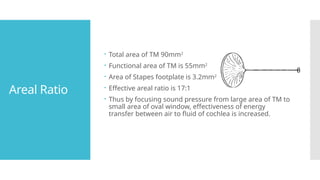
 Total area of TM 90mm2
 Functional area of TM is 55mm2
 Area of Stapes footplate is 3.2mm2
 Effective areal ratio is 17:1
 Thus by focusing sound pressure from large area of TM to
small area of oval window, effectiveness of energy
transfer between air to fluid of cochlea is increased.
Ossicular
Lever
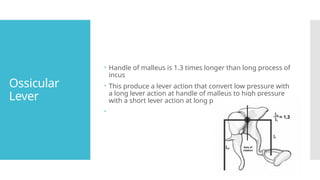
 Handle of malleus is 1.3 times longer than long process of
incus
 This produce a lever action that convert low pressure with
a long lever action at handle of malleus to high pressure
with a short lever action at long process of incus

Mobility of
TM
 Central part of TM has limited mobility compared to
periphery.
 Result in transfer of most of energy to ossicles.
 Act as Curved membrane effect.
• Objective Test
• Uses of Impedance Audiometry
 Objective differentiation between CHL and SNHL
 Measurement of middle ear pressure and evaluation of Eustachian tube function
• Impedance Audiometry include:
1. Tympanometry
2. Stapedial reflex
3. Eustachian Tube Function Test
Principle of
Tympanometr
y
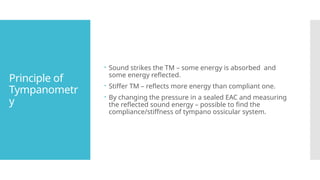
 Sound strikes the TM – some energy is absorbed and
some energy reflected.
 Stiffer TM – reflects more energy than compliant one.
 By changing the pressure in a sealed EAC and measuring
the reflected sound energy – possible to find the
compliance/stiffness of tympano ossicular system.
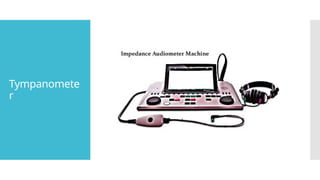
Tympanomete
r
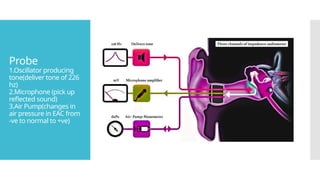
Probe
1.Oscillator producing
tone(deliver tone of 226
hz)
2.Microphone (pick up
reflected sound)
3.Air Pump(changes in
air pressure in EAC from
-ve to normal to +ve)
Procedure
• Otoscopic Examination of EAC and Condition of TM
• Wax or Epithelial Debris or Discharge Completely blocking the TM
• Explained to the patient
Painless and Objective test
Test will take less than 2-3 min, should not swallow or breath very
hard
Ear tip- Air tight fashion-- slight discomfort
• Probe Inserted into EAC in air tight fashion deeply to obtain
correct tympanogram (pumping or seal not obtained)
• Air pressure increased to +200mm of water in EAC and compliance
measured at this pressure after that pressure changes from
+200mm of water to 0 to -200 mm of water and -600mm of water
and compliance measured at different pressure changes.
• Static Compliance: subtracting the compliance at +200 mm of
water from maximum compliance
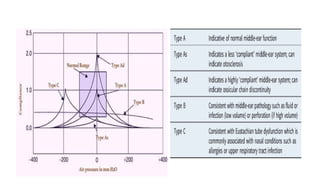
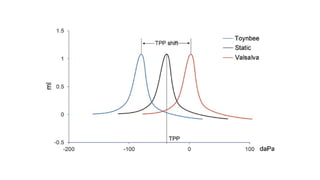
• Result of Tympanometry Test displayed graphically with compliance on Y-Axis and Air
Pressure on X-Axis known as Tympanogram.
• Air pressure measured millimeter of water pressure unit
• Compliance measured in cubic centimeter or milliliter
• Compliance of TM – Normal range of static compliance –is -0.35 to 1.40 ml
• ME pressure- Normal pressure is -50 to +50 mm of water
Compliance
 With Increased
Compliance
1. Ossi.chain
Discontinuity
2. Scarred TM
3. Large TM
4. Post.Stapedecto
my ear
• Decreased
Compliance
1. Otosclerosis
2. Adhesive Secretory
OM
3. Glomus jugulare
4. Fixed Malleus
syndrome
• Normal Compliance
1. ET obstruction
without secretory
changes in ME
ME Pressure
• Negative ME
Pressure
1. Blocked ET
2. OM with
Effusion
• Normal ME
Pressure
1. Otosclerosis
2. Ossi.Chain
discontinuity
3. Scarred TM
4. Fixed Mlleus
syndrome
• Positive ME
Pressure
1. Early AOM
• Absence of
any pressure
peak
1. Adhesive
OM
2. Perforated
TM
3. Artifact(Bloc
ked probe
tip)
4. Patent
grommet in
TM
5. Wax
Feldman
description
of
Tympanogra
m
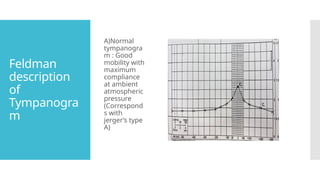
A)Normal
tympanogra
m : Good
mobility with
maximum
compliance
at ambient
atmospheric
pressure
(Correspond
s with
jerger’s type
A)
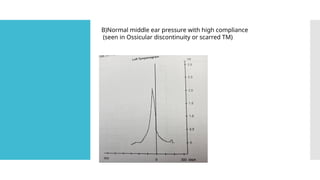
B)Normal middle ear pressure with high compliance
(seen in Ossicular discontinuity or scarred TM)
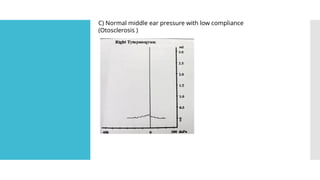
C) Normal middle ear pressure with low compliance
(Otosclerosis )
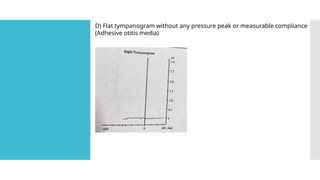
D) Flat tympanogram without any pressure peak or measurable compliance
(Adhesive otitis media)
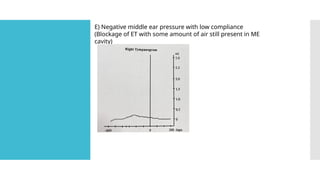
E) Negative middle ear pressure with low compliance
(Blockage of ET with some amount of air still present in ME
cavity)
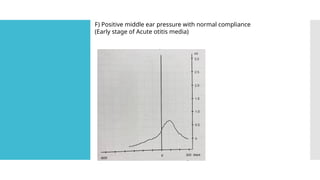
F) Positive middle ear pressure with normal compliance
(Early stage of Acute otitis media)
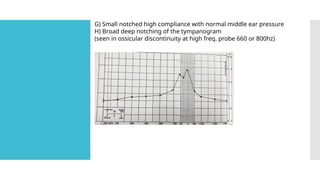
G) Small notched high compliance with normal middle ear pressure
H) Broad deep notching of the tympanogram
(seen in ossicular discontinuity at high freq. probe 660 or 800hz)
Feldman
description
of
Tympanogra
m
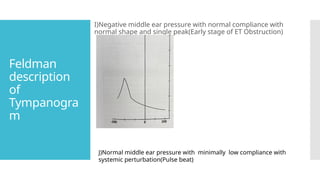
I)Negative middle ear pressure with normal compliance with
normal shape and single peak(Early stage of ET Obstruction)
J)Normal middle ear pressure with minimally low compliance with
systemic perturbation(Pulse beat)
Fallacies of
Tympanometr
y
• It is Objective test , it is not without errors
• Some conditions where tympanogram does not give true picture of
ME pathology
• Mainly when there is two or more ME pathology are
present ,compliance is representative of the more lateral ME
pathology
• Examples
1. A patient with otosclerosis and Eustachian tube dysfunction (from a
cold) may show negative middle ear pressure and low compliance
on tympanometry, mimicking otitis media with effusion. This can
lead to a misdiagnosis.
2. A patient with a scarred tympanic membrane but developing
otosclerosis may present a Type Ad tympanogram with high
compliance. This pattern usually suggests ossicular chain
discontinuity.
Fallacies of
Tympanometr
y
3. A patient with tympanic membrane thickening but otherwise normal
hearing, this patient will present with As type of graph which is particular
for Otosclerosis. If this patient may develop tubal dysfunction from a cold,
causing a negative pressure, low compliance tympanogram. This can
falsely suggest OME, even when no middle ear fluid is present.
EUSTACHIAN
TUBE
FUNCTION
TEST
 Physiological function of ET:
1) Maintenance of equality of air pressure between the
middle ear and the ambient atmosphere(ventilatory
function)
2) Drainage of the mucus from the ear to the nasopharynx
(mucociliary clearance function)
William’s Test
 Test of Tubal Function with intact TM
 Measure the middle ear pressure in three condition 1)
resting phase 2) while patient swallows 3) finally after
performing Valsalva.
 Normally at resting phase middle ear pressure is at or
near environmental atmospheric pressure, become
negative while swallows and become positive after
Valsalva
 Any deviation as abnormal
 Partially impaired ET function : middle ear pressure
become negative at swallows but remain negative after
Valsalva
 Grossly impaired ET function : Middle ear pressure does
not change at all during swallows or valsalva
Toynbee’s
Test
 Done in patient with Perforated TM
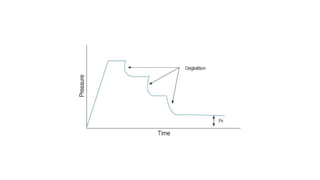
 Artificially increased or decreased pressure in the middle ear and
then record the change of middle ear pressure each time patient
swallows
 Carried out for fixed duration of time (min.40 sec to max. 160 sec)
 Air pressure at middle ear end of ET is changed either +250 or -250
mm of water.
 Ask patient to swallow repeatedly- pressure will be partially
neutralized with each swallow
 Normally pressure should be totally neutralize after 3 to 4 swallow
 If some residual pressure persist even after 5 swallow – partially
 Can not be neutralize at all by repeated swallowing –grossly.
Acoustic /
Stapedial
Reflex Test
 Non invasive
 Objective
 Can be carried out in new born
Principle
 Loud sound reach the ear
 Stapedius and tensor tympani muscle contract reflexly
 Pull the stapes outward and upward, tympanic
membrane inward
 Change the impedance of middle ear system
 Changes are monitored and analyzed by electroacoustic
bridge and result displayed accordingly
Acoustic
Reflex
Threshold
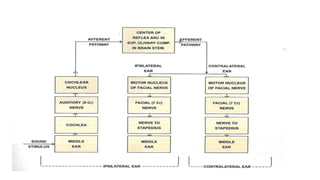
The signal enters the right ear, travels through the outer, middle (ME),
and inner ear (IE), along the VIII nerve to the brainstem. When the
signal reaches the brainstem, the signal arrives first at the cochlear
nucleus (CN). From here, the signal travels to both right and left
superior olivary complexes and both right and left facial nerve (VII)
nuclei. The signal is sent from both facial nerve nuclei to both facial (VII)
nerves, which results in a contraction of both stapedius muscles. Thus,
both stapes bones are pulled outward and downward, in a direction
away from the inner ear. This action makes it harder for energy to travel
through the middle ear (increase in impedance/decrease in
admittance). The lowest intensity level at which this contraction is
measurable is the ART.
Clinical
significance
of Stapedial
Reflex
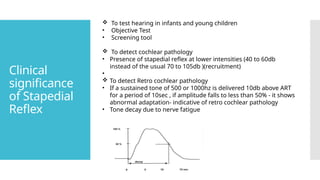
 To test hearing in infants and young children
• Objective Test
• Screening tool
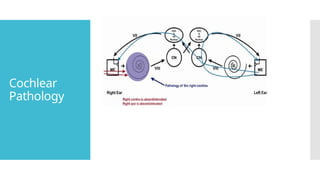
 To detect cochlear pathology
• Presence of stapedial reflex at lower intensities (40 to 60db
instead of the usual 70 to 105db )(recruitment)
•
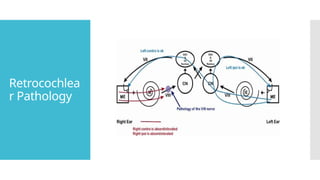
 To detect Retro cochlear pathology
• If a sustained tone of 500 or 1000hz is delivered 10db above ART
for a period of 10sec , if amplitude falls to less than 50% - it shows
abnormal adaptation- indicative of retro cochlear pathology
• Tone decay due to nerve fatigue
Clinical
significance
of Stapedial
Reflex
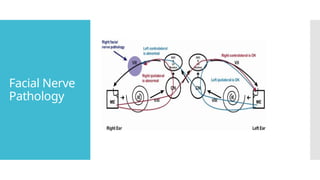
 Lesion of facial nerve
• Stapedial reflex absent( if injury is before the origin of the nerve of
stapedius)
• Stapedial Reflex present ( if injury is beyond the origin of the nerve
of stapedius)
 To find malingerers
• Doesn’t give response on PTA, shows positive stapedial reflex
Afferent
pathway
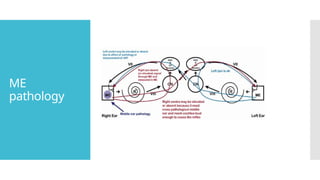
 IL middle ear disease causing moderate to severe CHL
 Lesion in IL cochlea or 8th
cranial nerve (causing severe SNHL)
 Lesion in IL cochlear nucleus or superior olivary complex
Efferent
pathway
 Lesion in facial nerve nucleus at brain stem level
 Facial nerve paralysis before proximal to origin of nerve
of stapedius
 Disease of Stapedius muscle like myasthenia gravis
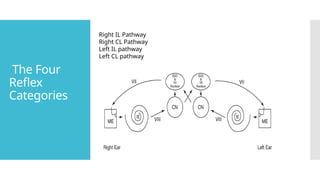
The Four
Reflex
Categories
Right IL Pathway
Right CL Pathway
Left IL pathway
Left CL pathway
Cochlear
Pathology
Retrocochlea
r Pathology
Facial Nerve
Pathology
ME
pathology
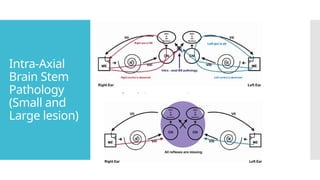
Intra-Axial
Brain Stem
Pathology
(Small and
Large lesion)
Thank You

impedance Audiometry impedance Audiometry

  • 1.
  • 2.
    Impedance  Opposition tothe flow of sound energy is called as IMPEDANCE  Opposition of Admittance (Ease with which energy flow) ( mho)  Impedance of the medium : Complex mixture of 3 parameters- stiffness, mass, friction  Middle ear (ME) act as the impedance matching device  All ME pathologies alter this impedance , result in lesser sound energy being transmitted to the cochlea
  • 3.
    Impedance matching by ME system Area of tympanic membrane relative to oval window (Areal Ratio)  The lever action of ossicles  Mobility of TM
  • 4.
    Areal Ratio  Totalarea of TM 90mm2  Functional area of TM is 55mm2  Area of Stapes footplate is 3.2mm2  Effective areal ratio is 17:1  Thus by focusing sound pressure from large area of TM to small area of oval window, effectiveness of energy transfer between air to fluid of cochlea is increased.
  • 5.
    Ossicular Lever  Handle ofmalleus is 1.3 times longer than long process of incus  This produce a lever action that convert low pressure with a long lever action at handle of malleus to high pressure with a short lever action at long process of incus 
  • 6.
    Mobility of TM  Centralpart of TM has limited mobility compared to periphery.  Result in transfer of most of energy to ossicles.  Act as Curved membrane effect.
  • 7.
    • Objective Test •Uses of Impedance Audiometry  Objective differentiation between CHL and SNHL  Measurement of middle ear pressure and evaluation of Eustachian tube function • Impedance Audiometry include: 1. Tympanometry 2. Stapedial reflex 3. Eustachian Tube Function Test
  • 8.
    Principle of Tympanometr y  Soundstrikes the TM – some energy is absorbed and some energy reflected.  Stiffer TM – reflects more energy than compliant one.  By changing the pressure in a sealed EAC and measuring the reflected sound energy – possible to find the compliance/stiffness of tympano ossicular system.
  • 9.
  • 10.
    Probe 1.Oscillator producing tone(deliver toneof 226 hz) 2.Microphone (pick up reflected sound) 3.Air Pump(changes in air pressure in EAC from -ve to normal to +ve)
  • 11.
    Procedure • Otoscopic Examinationof EAC and Condition of TM • Wax or Epithelial Debris or Discharge Completely blocking the TM • Explained to the patient Painless and Objective test Test will take less than 2-3 min, should not swallow or breath very hard Ear tip- Air tight fashion-- slight discomfort • Probe Inserted into EAC in air tight fashion deeply to obtain correct tympanogram (pumping or seal not obtained) • Air pressure increased to +200mm of water in EAC and compliance measured at this pressure after that pressure changes from +200mm of water to 0 to -200 mm of water and -600mm of water and compliance measured at different pressure changes. • Static Compliance: subtracting the compliance at +200 mm of water from maximum compliance
  • 12.
    • Result ofTympanometry Test displayed graphically with compliance on Y-Axis and Air Pressure on X-Axis known as Tympanogram. • Air pressure measured millimeter of water pressure unit • Compliance measured in cubic centimeter or milliliter • Compliance of TM – Normal range of static compliance –is -0.35 to 1.40 ml • ME pressure- Normal pressure is -50 to +50 mm of water
  • 14.
    Compliance  With Increased Compliance 1.Ossi.chain Discontinuity 2. Scarred TM 3. Large TM 4. Post.Stapedecto my ear • Decreased Compliance 1. Otosclerosis 2. Adhesive Secretory OM 3. Glomus jugulare 4. Fixed Malleus syndrome • Normal Compliance 1. ET obstruction without secretory changes in ME
  • 15.
    ME Pressure • NegativeME Pressure 1. Blocked ET 2. OM with Effusion • Normal ME Pressure 1. Otosclerosis 2. Ossi.Chain discontinuity 3. Scarred TM 4. Fixed Mlleus syndrome • Positive ME Pressure 1. Early AOM • Absence of any pressure peak 1. Adhesive OM 2. Perforated TM 3. Artifact(Bloc ked probe tip) 4. Patent grommet in TM 5. Wax
  • 16.
    Feldman description of Tympanogra m A)Normal tympanogra m : Good mobilitywith maximum compliance at ambient atmospheric pressure (Correspond s with jerger’s type A)
  • 17.
    B)Normal middle earpressure with high compliance (seen in Ossicular discontinuity or scarred TM)
  • 18.
    C) Normal middleear pressure with low compliance (Otosclerosis )
  • 19.
    D) Flat tympanogramwithout any pressure peak or measurable compliance (Adhesive otitis media)
  • 20.
    E) Negative middleear pressure with low compliance (Blockage of ET with some amount of air still present in ME cavity)
  • 21.
    F) Positive middleear pressure with normal compliance (Early stage of Acute otitis media)
  • 22.
    G) Small notchedhigh compliance with normal middle ear pressure H) Broad deep notching of the tympanogram (seen in ossicular discontinuity at high freq. probe 660 or 800hz)
  • 23.
    Feldman description of Tympanogra m I)Negative middle earpressure with normal compliance with normal shape and single peak(Early stage of ET Obstruction) J)Normal middle ear pressure with minimally low compliance with systemic perturbation(Pulse beat)
  • 24.
    Fallacies of Tympanometr y • Itis Objective test , it is not without errors • Some conditions where tympanogram does not give true picture of ME pathology • Mainly when there is two or more ME pathology are present ,compliance is representative of the more lateral ME pathology • Examples 1. A patient with otosclerosis and Eustachian tube dysfunction (from a cold) may show negative middle ear pressure and low compliance on tympanometry, mimicking otitis media with effusion. This can lead to a misdiagnosis. 2. A patient with a scarred tympanic membrane but developing otosclerosis may present a Type Ad tympanogram with high compliance. This pattern usually suggests ossicular chain discontinuity.
  • 25.
    Fallacies of Tympanometr y 3. Apatient with tympanic membrane thickening but otherwise normal hearing, this patient will present with As type of graph which is particular for Otosclerosis. If this patient may develop tubal dysfunction from a cold, causing a negative pressure, low compliance tympanogram. This can falsely suggest OME, even when no middle ear fluid is present.
  • 26.
    EUSTACHIAN TUBE FUNCTION TEST  Physiological functionof ET: 1) Maintenance of equality of air pressure between the middle ear and the ambient atmosphere(ventilatory function) 2) Drainage of the mucus from the ear to the nasopharynx (mucociliary clearance function)
  • 27.
    William’s Test  Testof Tubal Function with intact TM  Measure the middle ear pressure in three condition 1) resting phase 2) while patient swallows 3) finally after performing Valsalva.  Normally at resting phase middle ear pressure is at or near environmental atmospheric pressure, become negative while swallows and become positive after Valsalva  Any deviation as abnormal  Partially impaired ET function : middle ear pressure become negative at swallows but remain negative after Valsalva  Grossly impaired ET function : Middle ear pressure does not change at all during swallows or valsalva
  • 29.
    Toynbee’s Test  Done inpatient with Perforated TM  Artificially increased or decreased pressure in the middle ear and then record the change of middle ear pressure each time patient swallows  Carried out for fixed duration of time (min.40 sec to max. 160 sec)  Air pressure at middle ear end of ET is changed either +250 or -250 mm of water.  Ask patient to swallow repeatedly- pressure will be partially neutralized with each swallow  Normally pressure should be totally neutralize after 3 to 4 swallow  If some residual pressure persist even after 5 swallow – partially  Can not be neutralize at all by repeated swallowing –grossly.
  • 31.
    Acoustic / Stapedial Reflex Test Non invasive  Objective  Can be carried out in new born
  • 32.
    Principle  Loud soundreach the ear  Stapedius and tensor tympani muscle contract reflexly  Pull the stapes outward and upward, tympanic membrane inward  Change the impedance of middle ear system  Changes are monitored and analyzed by electroacoustic bridge and result displayed accordingly
  • 34.
    Acoustic Reflex Threshold The signal entersthe right ear, travels through the outer, middle (ME), and inner ear (IE), along the VIII nerve to the brainstem. When the signal reaches the brainstem, the signal arrives first at the cochlear nucleus (CN). From here, the signal travels to both right and left superior olivary complexes and both right and left facial nerve (VII) nuclei. The signal is sent from both facial nerve nuclei to both facial (VII) nerves, which results in a contraction of both stapedius muscles. Thus, both stapes bones are pulled outward and downward, in a direction away from the inner ear. This action makes it harder for energy to travel through the middle ear (increase in impedance/decrease in admittance). The lowest intensity level at which this contraction is measurable is the ART.
  • 35.
    Clinical significance of Stapedial Reflex  Totest hearing in infants and young children • Objective Test • Screening tool  To detect cochlear pathology • Presence of stapedial reflex at lower intensities (40 to 60db instead of the usual 70 to 105db )(recruitment) •  To detect Retro cochlear pathology • If a sustained tone of 500 or 1000hz is delivered 10db above ART for a period of 10sec , if amplitude falls to less than 50% - it shows abnormal adaptation- indicative of retro cochlear pathology • Tone decay due to nerve fatigue
  • 36.
    Clinical significance of Stapedial Reflex  Lesionof facial nerve • Stapedial reflex absent( if injury is before the origin of the nerve of stapedius) • Stapedial Reflex present ( if injury is beyond the origin of the nerve of stapedius)  To find malingerers • Doesn’t give response on PTA, shows positive stapedial reflex
  • 37.
    Afferent pathway  IL middleear disease causing moderate to severe CHL  Lesion in IL cochlea or 8th cranial nerve (causing severe SNHL)  Lesion in IL cochlear nucleus or superior olivary complex
  • 38.
    Efferent pathway  Lesion infacial nerve nucleus at brain stem level  Facial nerve paralysis before proximal to origin of nerve of stapedius  Disease of Stapedius muscle like myasthenia gravis
  • 39.
    The Four Reflex Categories Right ILPathway Right CL Pathway Left IL pathway Left CL pathway
  • 40.
  • 41.
  • 42.
  • 43.
  • 44.
  • 45.