 Fungi are omnipresent
 Immune system keeps organisms suppressed
 Most infections are benign, non-invasive
 Immunocompromised – higher risk of invasive
disease
 20,000 – 1.5 million fungal species
Few dozen species cause human infection
 Forms: yeast or mold
Yeast
○ Unicellular
○ Reproduce asexually by budding
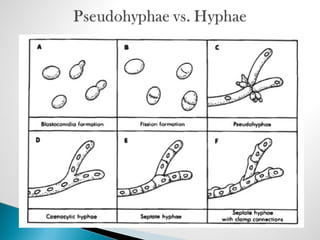
Pseudohyphae – when bud doesn’t detach from yeast
Mold
○ Multicellular
○ Grow by branching – hyphae
 Spore
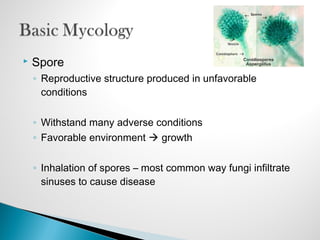
◦ Reproductive structure produced in unfavorable
conditions
◦ Withstand many adverse conditions
◦ Favorable environment  growth
◦ Inhalation of spores – most common way fungi infiltrate
sinuses to cause disease
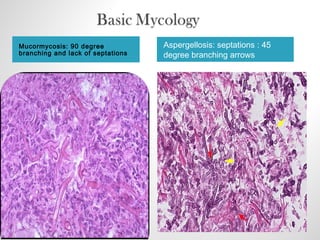
Mucormycosis: 90 degree
branching and lack of septations
Aspergellosis: septations : 45
degree branching arrows
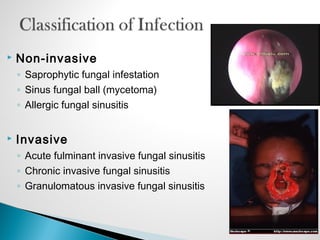
 Non-invasive
◦ Saprophytic fungal infestation
◦ Sinus fungal ball (mycetoma)
◦ Allergic fungal sinusitis
 Invasive
◦ Acute fulminant invasive fungal sinusitis
◦ Chronic invasive fungal sinusitis
◦ Granulomatous invasive fungal sinusitis
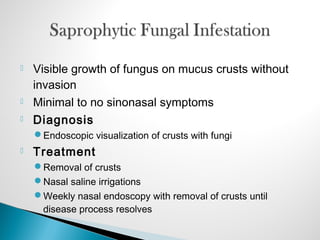
 Visible growth of fungus on mucus crusts without
invasion
 Minimal to no sinonasal symptoms
 Diagnosis
Endoscopic visualization of crusts with fungi
 Treatment
Removal of crusts
Nasal saline irrigations
Weekly nasal endoscopy with removal of crusts until
disease process resolves
 Sequestration of fungal elements within a sinus
without invasion or granulomatous changes
 Inhaled spores  grow while evading host
immune system (no invasion)
 Aspergillus most common species
 Maxillary sinus most often involved (70-80% of
cases)
 Clinically
◦ Symptoms due to mass effect and sinus obstruction
◦ Presents similar to rhinosinusitis
 Congestion, facial pain, headache, rhinorrhea
 Physical examination
◦ Mild to minimal mucosal inflammation
◦ Polyps in 10% of cases
 Diagnosis
◦ CT Scan
 Single sinus in 59-94% of cases (maxillary)
 Complete or subtotal opacification of sinus
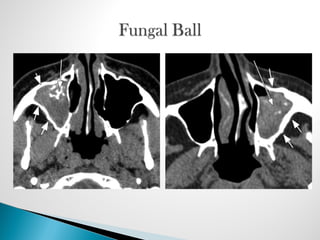
 Radiodensities within the opacifications
 Bony sclerosis; destruction is rare (3.6-17% of cases)
◦ Biopsy = fungal elements
 Treatment
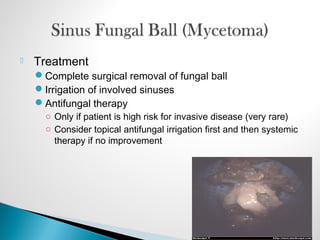
Complete surgical removal of fungal ball
Irrigation of involved sinuses
Antifungal therapy
○ Only if patient is high risk for invasive disease (very rare)
○ Consider topical antifungal irrigation first and then systemic
therapy if no improvement
 Fungal colonization resulting in allergic
inflammation without invasion
 IgE mediated response to fungal protein
 Symptoms:
◦ Nasal obstruction (gradual)
◦ Rhinorrhea
◦ Facial pressure/pain
◦ Sneezing, watery/itchy eyes
◦ Periorbital edema
Diagnostic Criteria
1. Eosinophlic mucin
2. Nasal polyposis
3. Radiographic findings
4. Immunocompetance
5. Allergy to fungi
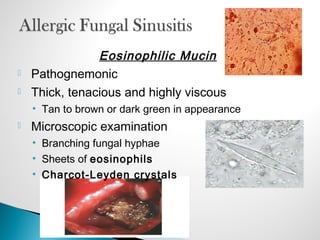
Eosinophilic Mucin
 Pathognemonic
 Thick, tenacious and highly viscous
• Tan to brown or dark green in appearance
 Microscopic examination
• Branching fungal hyphae
• Sheets of eosinophils
• Charcot-Leyden crystals
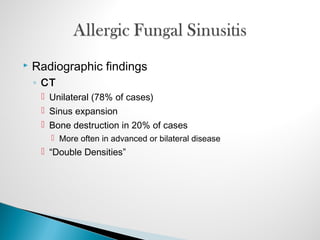
 Radiographic findings
◦ CT
 Unilateral (78% of cases)
 Sinus expansion
 Bone destruction in 20% of cases
 More often in advanced or bilateral disease
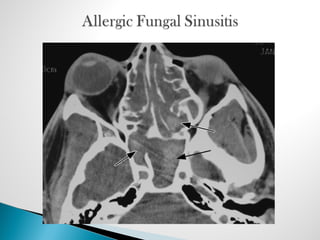
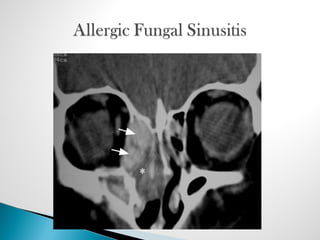
 “Double Densities”
 Radiographic findings
◦ MRI
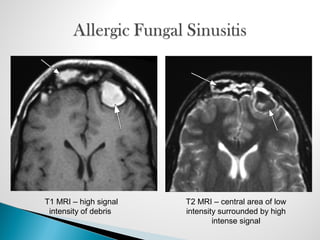
 Variable signal intensity on T1 (usually hyperintense)
 T2 – hypointense central portion (low water content of
mucin) with peripheral enhancement due to edema
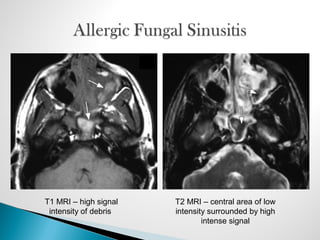
T1 MRI – high signal
intensity of debris
T2 MRI – central area of low
intensity surrounded by high
intense signal
T1 MRI – high signal
intensity of debris
T2 MRI – central area of low
intensity surrounded by high
intense signal
 Allergy to Fungi
Most patient with AFS will have allergy to fungus
causing disease
Manning et al
○ Prospective study
○ Compared
8 patients with AFS and (+)culture with Bipolaris
10 controls with chronic rhinosinusitis
○ All 8 patients showed (+) skin testing, RAST, and ELISA to
Bipolaris
○ 8 of 10 controls (-) for all tests
IgE levels > 1000 IU/mL
 Treatment
Surgical
○ Remove all mucin
○ Provide permanent drainage and ventilation of affected
sinuses
Systemic +/- topical steroids
○ Systemic steroids decrease rate of recurrence
Course can range from 2-12 months
- Schubert showed that longer courses had better results, but
more side effects
0.5mg/kg Prednisone starting dose and taper over 2-3 months
 Immunotherapy
Decrease recurrence
Alleviate need for steroids
Prospective review
○ All patients had surgery and systemic steroids
○ One group got immunotherapy, the other did not
Consisted of fungal and non-fungal antigens to which patients
were sensitive
○ After 1 year:
No requirement for systemic or topical steroids by patients in
immunotherapy group
Recurrence of disease significantly less in immunotherapy group
 Immunotherapy
◦ Folker et al
 Retrospective study
 Compared 11 patients who received immunotherapy post-
operatively vs. 11 who did not
 Recurrence rates did NOT decrease
 However:
 Quality of life scores and mucosal edema were much better in
those who received immunotherapy
 Patient population
Most often compromised immune system
○ DM, AIDS, hematologic malignancies, organ transplant,
iatrogenic (chemotherapy and steroids)
 Most common fungi
Aspergillus
Mucormycosis
○ Mucor, Rhizopus, Absidia
 Less common fungi
Candida
Bipolaris
Fusarium
 Pathogenesis
Spores inhaled  fungus grows in warm, humid sinonasal
cavity
Fungi invade neural and vascular structures with thrombosis
of feeding vessels
Necrosis and loss of sensation  acidic environment 
further fungal growth
Extrasinus extension occurs via bony destruction,
perineural and perivascular invasion
○ Nasal and palate mucosa destroyed
○ Facial anesthesia
○ Proptosis
○ Cranial nerve deficits
○ Mental status changes
 Other signs/symptoms
Fever (most common – 90% of cases)
Loss of sensation over face or oral cavity
Ulceration of face and sinonasal/palatal
mucosa
Rhinorrhea, facial pain/anesthesia, headaches
Seizures, CN deficits
Fast progressing symptoms
○ In some cases, hours to days till death!
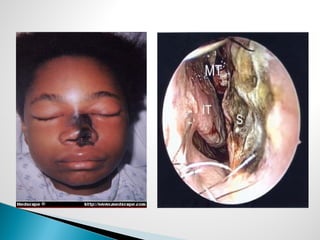
 Endoscopic findings
◦ Loss of sensation and change in appearance of
mucosa (pale or black)
 Most consistent finding
◦ Ulcerations and black mucosa are late findings
◦ Serial examinations are required
Biopsy + Culture
○ Should always be performed when:
Suspect fungal disease
Change in sensation or color of mucosa
Any immunocompromised patient with signs of sinusitis who fails to
improve after 72 hours of IV antibiotics
○ Where?
Diseased mucosa (pale, insensate, ulcerative, black)
Normal appearance/sensation
- Middle turbinate – most common spot for AFIFS (67%)
- Septum – 24% of cases
○ Must request silver staining
○ Culture
Very difficult to get (+) result, especially with Mucormycosis
 Radiographic studies
◦ CT sinus
◦ MRI to assess tissue invasion, and orbital, intracranial, or
neural involvement
◦ Findings
 CT
 Bone erosion and extrasinus extension – classic finding
 Severe, unilateral mucosal thickening
 Thickening of periantral fat planes
 MRI
Obliteration of the periantral fat
Leptomeningeal enhancement (intracranial extension)
Granuloma formation
○ Hypointense on T1 and T2
Extrasinus extension
Cavernous sinus involvement
○ Absent flow void of carotid
○ Soft tissue thickening of the involved sinus
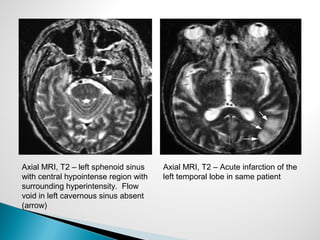
Axial MRI, T2 – left sphenoid sinus
with central hypointense region with
surrounding hyperintensity. Flow
void in left cavernous sinus absent
(arrow)
Axial MRI, T2 – Acute infarction of the
left temporal lobe in same patient
 Combination of medical and surgical treatment
◦ Medical
 Correct the underlying compromised state
 Reverse DKA and improve hydration
 80% survival if done promptly
 Absolute neutrophil count
 < 1000 = poor prognosis
 WBC transfusion and granulocyte colony stimulating factor to
increase ANC
 Medical treatment
Systemic antifungals
○ Amphotericin B infusion
1mg/kg/day
Serious side effects
- ototoxicity, nephrotoxicity (occurs in 80% of cases)
○ Lipid-based form of Amphotericin B
More expensive
Less toxic
Can achieve higher concentrations of drug
○ Voriconazole or itraconazole
Used most often when Aspergillus involved
Much less toxic than Amphotericin B
Mucormycosis are resistant to these
 Topical Amphotericin B rinses
Have shown some success, but mixed results
 Surgical treatment
Goals
○ Decrease pathogen load
○ Remove devitalized tissue
○ Establish pathways for sinus drainage
Debride until clear, bleeding margins
 Endoscopic vs. Open procedures
Recommend endoscopic in early course of disease
○ Decreased morbidity
○ Similar survival rates as open procedures
Advanced disease (orbit, palatal, skin)
○ Open approach required
○ Once disease has gone intracranial, prognosis is very poor
Must be considered prior to partaking in extensive surgical
resection
 Retrospective review out of Turkey
Examined treatment of AFIFS
26 patient
○ 19 – endoscopic resection
○ 7 – open resection
5 orbital exenteration (2 survived)
All patients with skull base/intracranial extension died
Overall mortality rate – 50%
Survival rates
○ Endoscopic – 90% (less severe disease)
○ Open – 57%
In those who died, Mucormycosis were involved in 62% of cases
○ More aggressive with early orbital and intracranial invasion
 Prognosis
Mortality rate: 18-80%
○ Early detection and treatment = much better chance of
survival
○ Intracranial involvement
Most predictive indicator for mortality
70%+ mortality rate
○ Absolute Neutrophil Count (ANC) < 1000
Worse prognosis
Recovery from neutropenia = most predictive indicator for
survival
○ Mucormycosis = more fatal
○ Diabetics tend to do worse
Greater incidence of Mucormycosis in these patients
 Slower disease process than acute
 Rare
 Biggest difference:
Most patients are immunocompetent
 Common fungi
Aspergillus (most common - >80% of cases)
Bipolaris
Candida
Mucormycosis
 Signs/Symptoms
◦ Similar to symptoms of chronic rhinosinusitis
 Nasal congestion, rhinorrhea, facial pressure, headaches,
polyposis
◦ Proptosis, visual changes, anesthesia of skin, epistaxis
 More concerning
◦ Does not respond to antibiotics
◦ Worsens with steroids
 Diagnosis
◦ Full H&N examination with nasal endoscopy
 Nasal polyps, thick mucus
 Rarely find ulcerations
 Biopsy if suspect fungal disease or note any changes
◦ CT & MRI
 Similar findings to AFIFS – bony destruction, extrasinus
extension, unilateral
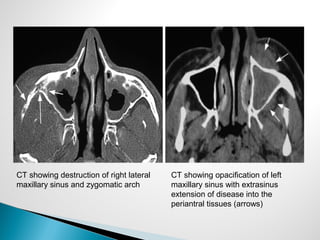
CT showing destruction of right lateral
maxillary sinus and zygomatic arch
CT showing opacification of left
maxillary sinus with extrasinus
extension of disease into the
periantral tissues (arrows)
 Diagnosis
◦ Pathology
 Invasion of blood vessels, neural structures, and
surrounding mucosa
 Few if any inflammatory cells
 Major difference between acute and chronic invasive disease
 No Granuloma formation
 Main difference between chronic invasive fungal disease and
granulomatous invasive fungal disease
 Treatment
Similar to AFIFS – surgical + medical
Surgery
○ resect all involved tissue to expose bleeding margins
Systemic antifungals
○ Start with Amphotericin B until can rule out Mucormycosis
○ Best length of treatment not well studied
Most recommend 3-6 months of therapy
Topical Amphotericin B sinus rinses
Close F/U and debridement required
○ Biopsy anything that is suspicious as asymptomatic recurrence is not
uncommon
 Appears exactly like CIFS
 Very rare
 Presence of multinucleated giant cell
granulomas
◦ Most important difference between Chronic and
Granulomatous disease
 Aspergillus flavus
 Most often seen in North Africa and Southeast
Asia
 Presentation and work-up are exactly the same
as CIFS
 Treatment
Surgical resection to bleeding margins
Topical antifungal rinses
Systemic antifungals
○ Oral voriconazole or itraconazole
○ Minority of authors believe systemic antifungals not required
Close F/U and debridement required
○ Biopsy anything that is suspicious as asymptomatic
recurrence is not uncommon
 Fungi are present everywhere
 Disease in immunocompetent is nearly always
benign, but must consider invasive disease
 Invasive fungal disease must be considered in all
immunocompromised patients
Low threshold for biopsy
 Surgical debridement
Mainstay of treatment of fungal sinus disease
Invasive disease – debride until clear, bleeding margins
Weigh extent of surgery with prognosis
○ Skull base/intracranial involvement very poor prognosis even with
aggressive therapy
 Systemic antifungals required for invasive disease
Monitor for severe side effects
 Close follow-up with debridement and biopsy of any
suspicious lesions

Fungalsinusitis

  • 2.
     Fungi areomnipresent  Immune system keeps organisms suppressed  Most infections are benign, non-invasive  Immunocompromised – higher risk of invasive disease
  • 3.
     20,000 –1.5 million fungal species Few dozen species cause human infection  Forms: yeast or mold Yeast ○ Unicellular ○ Reproduce asexually by budding Pseudohyphae – when bud doesn’t detach from yeast Mold ○ Multicellular ○ Grow by branching – hyphae
  • 5.
     Spore ◦ Reproductivestructure produced in unfavorable conditions ◦ Withstand many adverse conditions ◦ Favorable environment  growth ◦ Inhalation of spores – most common way fungi infiltrate sinuses to cause disease
  • 6.
    Mucormycosis: 90 degree branchingand lack of septations Aspergellosis: septations : 45 degree branching arrows
  • 7.
     Non-invasive ◦ Saprophyticfungal infestation ◦ Sinus fungal ball (mycetoma) ◦ Allergic fungal sinusitis  Invasive ◦ Acute fulminant invasive fungal sinusitis ◦ Chronic invasive fungal sinusitis ◦ Granulomatous invasive fungal sinusitis
  • 8.
     Visible growthof fungus on mucus crusts without invasion  Minimal to no sinonasal symptoms  Diagnosis Endoscopic visualization of crusts with fungi  Treatment Removal of crusts Nasal saline irrigations Weekly nasal endoscopy with removal of crusts until disease process resolves
  • 9.
     Sequestration offungal elements within a sinus without invasion or granulomatous changes  Inhaled spores  grow while evading host immune system (no invasion)  Aspergillus most common species  Maxillary sinus most often involved (70-80% of cases)
  • 10.
     Clinically ◦ Symptomsdue to mass effect and sinus obstruction ◦ Presents similar to rhinosinusitis  Congestion, facial pain, headache, rhinorrhea  Physical examination ◦ Mild to minimal mucosal inflammation ◦ Polyps in 10% of cases
  • 11.
     Diagnosis ◦ CTScan  Single sinus in 59-94% of cases (maxillary)  Complete or subtotal opacification of sinus  Radiodensities within the opacifications  Bony sclerosis; destruction is rare (3.6-17% of cases) ◦ Biopsy = fungal elements
  • 13.
     Treatment Complete surgicalremoval of fungal ball Irrigation of involved sinuses Antifungal therapy ○ Only if patient is high risk for invasive disease (very rare) ○ Consider topical antifungal irrigation first and then systemic therapy if no improvement
  • 14.
     Fungal colonizationresulting in allergic inflammation without invasion  IgE mediated response to fungal protein  Symptoms: ◦ Nasal obstruction (gradual) ◦ Rhinorrhea ◦ Facial pressure/pain ◦ Sneezing, watery/itchy eyes ◦ Periorbital edema
  • 15.
    Diagnostic Criteria 1. Eosinophlicmucin 2. Nasal polyposis 3. Radiographic findings 4. Immunocompetance 5. Allergy to fungi
  • 16.
    Eosinophilic Mucin  Pathognemonic Thick, tenacious and highly viscous • Tan to brown or dark green in appearance  Microscopic examination • Branching fungal hyphae • Sheets of eosinophils • Charcot-Leyden crystals
  • 17.
     Radiographic findings ◦CT  Unilateral (78% of cases)  Sinus expansion  Bone destruction in 20% of cases  More often in advanced or bilateral disease  “Double Densities”
  • 20.
     Radiographic findings ◦MRI  Variable signal intensity on T1 (usually hyperintense)  T2 – hypointense central portion (low water content of mucin) with peripheral enhancement due to edema
  • 21.
    T1 MRI –high signal intensity of debris T2 MRI – central area of low intensity surrounded by high intense signal
  • 22.
    T1 MRI –high signal intensity of debris T2 MRI – central area of low intensity surrounded by high intense signal
  • 23.
     Allergy toFungi Most patient with AFS will have allergy to fungus causing disease Manning et al ○ Prospective study ○ Compared 8 patients with AFS and (+)culture with Bipolaris 10 controls with chronic rhinosinusitis ○ All 8 patients showed (+) skin testing, RAST, and ELISA to Bipolaris ○ 8 of 10 controls (-) for all tests IgE levels > 1000 IU/mL
  • 24.
     Treatment Surgical ○ Removeall mucin ○ Provide permanent drainage and ventilation of affected sinuses Systemic +/- topical steroids ○ Systemic steroids decrease rate of recurrence Course can range from 2-12 months - Schubert showed that longer courses had better results, but more side effects 0.5mg/kg Prednisone starting dose and taper over 2-3 months
  • 25.
     Immunotherapy Decrease recurrence Alleviateneed for steroids Prospective review ○ All patients had surgery and systemic steroids ○ One group got immunotherapy, the other did not Consisted of fungal and non-fungal antigens to which patients were sensitive ○ After 1 year: No requirement for systemic or topical steroids by patients in immunotherapy group Recurrence of disease significantly less in immunotherapy group
  • 26.
     Immunotherapy ◦ Folkeret al  Retrospective study  Compared 11 patients who received immunotherapy post- operatively vs. 11 who did not  Recurrence rates did NOT decrease  However:  Quality of life scores and mucosal edema were much better in those who received immunotherapy
  • 27.
     Patient population Mostoften compromised immune system ○ DM, AIDS, hematologic malignancies, organ transplant, iatrogenic (chemotherapy and steroids)  Most common fungi Aspergillus Mucormycosis ○ Mucor, Rhizopus, Absidia  Less common fungi Candida Bipolaris Fusarium
  • 28.
     Pathogenesis Spores inhaled fungus grows in warm, humid sinonasal cavity Fungi invade neural and vascular structures with thrombosis of feeding vessels Necrosis and loss of sensation  acidic environment  further fungal growth Extrasinus extension occurs via bony destruction, perineural and perivascular invasion ○ Nasal and palate mucosa destroyed ○ Facial anesthesia ○ Proptosis ○ Cranial nerve deficits ○ Mental status changes
  • 29.
     Other signs/symptoms Fever(most common – 90% of cases) Loss of sensation over face or oral cavity Ulceration of face and sinonasal/palatal mucosa Rhinorrhea, facial pain/anesthesia, headaches Seizures, CN deficits Fast progressing symptoms ○ In some cases, hours to days till death!
  • 30.
     Endoscopic findings ◦Loss of sensation and change in appearance of mucosa (pale or black)  Most consistent finding ◦ Ulcerations and black mucosa are late findings ◦ Serial examinations are required
  • 32.
    Biopsy + Culture ○Should always be performed when: Suspect fungal disease Change in sensation or color of mucosa Any immunocompromised patient with signs of sinusitis who fails to improve after 72 hours of IV antibiotics ○ Where? Diseased mucosa (pale, insensate, ulcerative, black) Normal appearance/sensation - Middle turbinate – most common spot for AFIFS (67%) - Septum – 24% of cases ○ Must request silver staining ○ Culture Very difficult to get (+) result, especially with Mucormycosis
  • 33.
     Radiographic studies ◦CT sinus ◦ MRI to assess tissue invasion, and orbital, intracranial, or neural involvement ◦ Findings  CT  Bone erosion and extrasinus extension – classic finding  Severe, unilateral mucosal thickening  Thickening of periantral fat planes
  • 36.
     MRI Obliteration ofthe periantral fat Leptomeningeal enhancement (intracranial extension) Granuloma formation ○ Hypointense on T1 and T2 Extrasinus extension Cavernous sinus involvement ○ Absent flow void of carotid ○ Soft tissue thickening of the involved sinus
  • 37.
    Axial MRI, T2– left sphenoid sinus with central hypointense region with surrounding hyperintensity. Flow void in left cavernous sinus absent (arrow) Axial MRI, T2 – Acute infarction of the left temporal lobe in same patient
  • 38.
     Combination ofmedical and surgical treatment ◦ Medical  Correct the underlying compromised state  Reverse DKA and improve hydration  80% survival if done promptly  Absolute neutrophil count  < 1000 = poor prognosis  WBC transfusion and granulocyte colony stimulating factor to increase ANC
  • 39.
     Medical treatment Systemicantifungals ○ Amphotericin B infusion 1mg/kg/day Serious side effects - ototoxicity, nephrotoxicity (occurs in 80% of cases) ○ Lipid-based form of Amphotericin B More expensive Less toxic Can achieve higher concentrations of drug ○ Voriconazole or itraconazole Used most often when Aspergillus involved Much less toxic than Amphotericin B Mucormycosis are resistant to these
  • 40.
     Topical AmphotericinB rinses Have shown some success, but mixed results  Surgical treatment Goals ○ Decrease pathogen load ○ Remove devitalized tissue ○ Establish pathways for sinus drainage Debride until clear, bleeding margins
  • 41.
     Endoscopic vs.Open procedures Recommend endoscopic in early course of disease ○ Decreased morbidity ○ Similar survival rates as open procedures Advanced disease (orbit, palatal, skin) ○ Open approach required ○ Once disease has gone intracranial, prognosis is very poor Must be considered prior to partaking in extensive surgical resection
  • 42.
     Retrospective reviewout of Turkey Examined treatment of AFIFS 26 patient ○ 19 – endoscopic resection ○ 7 – open resection 5 orbital exenteration (2 survived) All patients with skull base/intracranial extension died Overall mortality rate – 50% Survival rates ○ Endoscopic – 90% (less severe disease) ○ Open – 57% In those who died, Mucormycosis were involved in 62% of cases ○ More aggressive with early orbital and intracranial invasion
  • 43.
     Prognosis Mortality rate:18-80% ○ Early detection and treatment = much better chance of survival ○ Intracranial involvement Most predictive indicator for mortality 70%+ mortality rate ○ Absolute Neutrophil Count (ANC) < 1000 Worse prognosis Recovery from neutropenia = most predictive indicator for survival ○ Mucormycosis = more fatal ○ Diabetics tend to do worse Greater incidence of Mucormycosis in these patients
  • 44.
     Slower diseaseprocess than acute  Rare  Biggest difference: Most patients are immunocompetent  Common fungi Aspergillus (most common - >80% of cases) Bipolaris Candida Mucormycosis
  • 45.
     Signs/Symptoms ◦ Similarto symptoms of chronic rhinosinusitis  Nasal congestion, rhinorrhea, facial pressure, headaches, polyposis ◦ Proptosis, visual changes, anesthesia of skin, epistaxis  More concerning ◦ Does not respond to antibiotics ◦ Worsens with steroids
  • 46.
     Diagnosis ◦ FullH&N examination with nasal endoscopy  Nasal polyps, thick mucus  Rarely find ulcerations  Biopsy if suspect fungal disease or note any changes ◦ CT & MRI  Similar findings to AFIFS – bony destruction, extrasinus extension, unilateral
  • 47.
    CT showing destructionof right lateral maxillary sinus and zygomatic arch CT showing opacification of left maxillary sinus with extrasinus extension of disease into the periantral tissues (arrows)
  • 48.
     Diagnosis ◦ Pathology Invasion of blood vessels, neural structures, and surrounding mucosa  Few if any inflammatory cells  Major difference between acute and chronic invasive disease  No Granuloma formation  Main difference between chronic invasive fungal disease and granulomatous invasive fungal disease
  • 49.
     Treatment Similar toAFIFS – surgical + medical Surgery ○ resect all involved tissue to expose bleeding margins Systemic antifungals ○ Start with Amphotericin B until can rule out Mucormycosis ○ Best length of treatment not well studied Most recommend 3-6 months of therapy Topical Amphotericin B sinus rinses Close F/U and debridement required ○ Biopsy anything that is suspicious as asymptomatic recurrence is not uncommon
  • 50.
     Appears exactlylike CIFS  Very rare  Presence of multinucleated giant cell granulomas ◦ Most important difference between Chronic and Granulomatous disease  Aspergillus flavus  Most often seen in North Africa and Southeast Asia
  • 51.
     Presentation andwork-up are exactly the same as CIFS  Treatment Surgical resection to bleeding margins Topical antifungal rinses Systemic antifungals ○ Oral voriconazole or itraconazole ○ Minority of authors believe systemic antifungals not required Close F/U and debridement required ○ Biopsy anything that is suspicious as asymptomatic recurrence is not uncommon
  • 52.
     Fungi arepresent everywhere  Disease in immunocompetent is nearly always benign, but must consider invasive disease  Invasive fungal disease must be considered in all immunocompromised patients Low threshold for biopsy
  • 53.
     Surgical debridement Mainstayof treatment of fungal sinus disease Invasive disease – debride until clear, bleeding margins Weigh extent of surgery with prognosis ○ Skull base/intracranial involvement very poor prognosis even with aggressive therapy  Systemic antifungals required for invasive disease Monitor for severe side effects  Close follow-up with debridement and biopsy of any suspicious lesions

Editor's Notes

  • #7 Nonseptated hyphae with branching at 90
  • #12 Due to increased heavy metal content
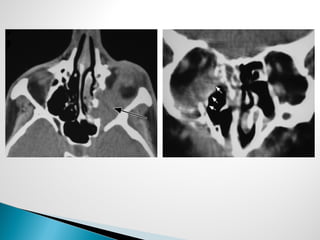
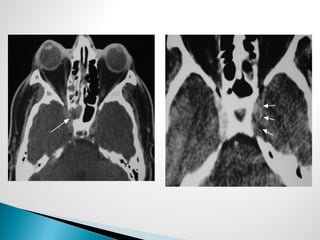
  • #13 Images show thickening of bony walls (short arrows) and heterodense material within the sinus with calcifications (long arrows
  • #14 Severely immunocompromised Continued recurrence of disease despite proper medical/surgical management
  • #17 Breakdown of cells by enzymes produced by eosinophils Slender and pointed at each end Pair of hexagonal pyramids joined at bases
  • #18 Heterogeneity of signal  increased heavy metal content (iron and manganese) and calcium salts
  • #19 Arrows show double densities. Note sinus expansion
  • #20 Double densities (arrows). Expansion of sinus with extension of disease into the nasal cavity (star
  • #35 CT scans; Left image: Destruction of medial wall of orbit with extension of disease into the orbit. Right image: Destruction of medial and inferior walls of the orbit with extension of disease into the orbit
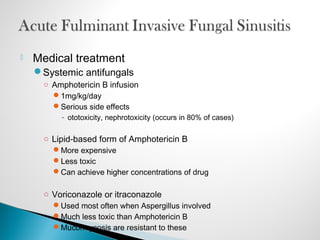
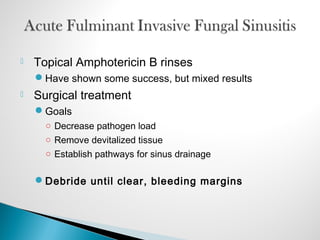
  • #36 Axial CT scans. Left image: invasion through lateral wall of the sphenoid sinus and into the cavernous sinus. Right image: lack of enhancement of the cavernous sinus due to fungal thrombosis
  • #51 This form of fungal sinusitis is rare in the United States. It is usually seen in patients from Sudan, India, Pakistan and Saudi Arabia. Patients have normal immune status.  The disease has a relatively slow time course over 3 months, and patients present with an enlarging mass in the cheek, orbit, nose, and sinuses. Microscopically, it is characterized by formation of granulomas, and this differentiates it from chronic invasive fungal sinusitis. Aspergillus flavus is usually the causative organism. Treatment may involve surgery in combination with antifungal agents.