Presented By:
POOJA R
3GU13CS013
Guide name
Prof. VEERESH
Contents
1. Introduction
2. Image Segmentation
3. Segmentation Methods
4. Face Detection Techniques
5. Human Skin Color Based Face Detection
6. Advantages And Disadvantages
7. Conclusions
8. References
Introduction
 Face detection is the process of locating human faces in still photographs and videos.
 Face detection is a one kind of special application of image segmentation.
 Here, we have to segment the image or video frame and then have to identify the segment or
region which contains a human face.
 Face detection is a necessary preprocessing step for any automatic face recognition or face
expression analyzer system.
 Face detection techniques can be classifieds into two main families:
1. Implicit or Pattern Based
2. Explicit or Knowledge Based.
Image Segmentation
• An image may be defined as a two dimensional function, f (x, y), where x and y are
spatial (plane) coordinates, and the amplitude of f at any pair of coordinates (x, y) is
called the intensity or gray level of the image at that point.
• The process of partitioning an image into meaningful groups of connected pixels is
called segmentation.
• Image segmentation is one of the most important steps leading to the analysis of
processed image data.
• Types : There are 2 types of Image Segmentation.
• 1. Complete Segmentation 2. Partial Segmentation
• 1.Complete Segmentation:-Set of disjoint regions uniquely corresponding with objects
in the input image.
• 2. Partial Segmentation:-Regions do not correspond directly with image objects.
Figure 2: Image Segmentation
 The above figure clarifies the process of image segmentation.Here,afootball match
scene image is segmented. Two level of segmentation are displayed. The segmentation process
extracts the regions of an image which contains the real word objects and makes the image.
Segmentation Methods
There are 3 types of Segmentations Methods as follows.
1.Thresholding (Global Approach)
2.Edge based Segmentation
3.Region based Segmentation
1. Thresholding (Global Approaches):
• Thresholding is the transformation of an input image f to an output (segmented) binary image
g as follows:
g (i, j) = 1 for f (i, j) > T
g(i, j) = 0 for f (i, j) < T
Where T is the threshold, g(i, j) =1 for image elements of objects, and g (i, j) = 0 for image
elements of the background.
• Threshold can be brightness, or some other parameter, such as redness, depending upon the
type of the image.
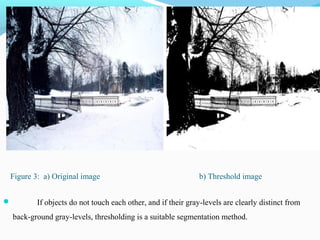
Figure 3: a) Original image b) Threshold image
 If objects do not touch each other, and if their gray-levels are clearly distinct from
back-ground gray-levels, thresholding is a suitable segmentation method.
Conti…
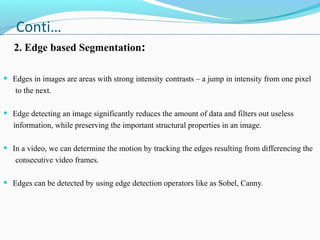
2. Edge based Segmentation:
• Edges in images are areas with strong intensity contrasts – a jump in intensity from one pixel
to the next.
• Edge detecting an image significantly reduces the amount of data and filters out useless
information, while preserving the important structural properties in an image.
• In a video, we can determine the motion by tracking the edges resulting from differencing the
consecutive video frames.
• Edges can be detected by using edge detection operators like as Sobel, Canny.
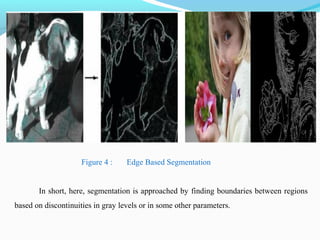
Figure 4 : Edge Based Segmentation
In short, here, segmentation is approached by finding boundaries between regions
based on discontinuities in gray levels or in some other parameters.
Conti…
3. Region based Segmentation:
• The objective of segmentation is to partition an image into regions.
• Here, segmentation is achieved by finding the regions directly.
• Regions are constructed directly here without first finding borders between them.
• Homogeneity is an important property of regions and is used as the main segmentation criterion in
region growing, whose basic idea is to divide an image into zones of maximum homogeneity.
• The main idea here is to classify a particular image into a number of regions or classes.
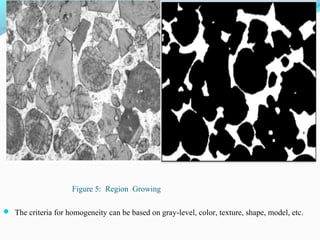
Figure 5: Region Growing
 The criteria for homogeneity can be based on gray-level, color, texture, shape, model, etc.
Face Detection Techniques
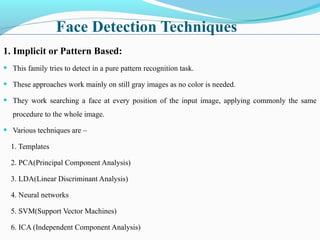
1. Implicit or Pattern Based:
• This family tries to detect in a pure pattern recognition task.
• These approaches work mainly on still gray images as no color is needed.
• They work searching a face at every position of the input image, applying commonly the same
procedure to the whole image.
• Various techniques are –
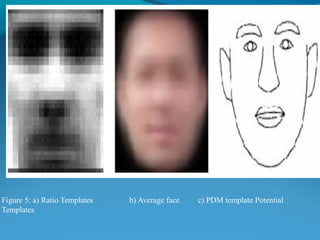
1. Templates
2. PCA(Principal Component Analysis)
3. LDA(Linear Discriminant Analysis)
4. Neural networks
5. SVM(Support Vector Machines)
6. ICA (Independent Component Analysis)
Figure 5: a) Ratio Templates b) Average face c) PDM template Potential
Templates
Cont…
2. Explicit or Knowledge Based:
 This family takes into account face knowledge explicitly, exploiting and combining cues or
invariants such as color, motion, face geometry, facial features information, and facial
appearance.
 Various techniques are –
1. Face Contours
2. Facial Features (geometry)
3. Motion Detection
4. Color.
Figure 6: a) Face contour b) Facial Features
Human Skin Color Based FaceDetection
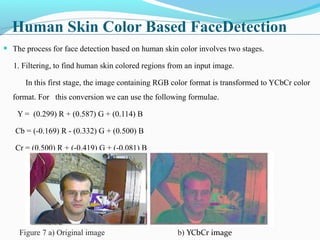
• The process for face detection based on human skin color involves two stages.
1. Filtering, to find human skin colored regions from an input image.
In this first stage, the image containing RGB color format is transformed to YCbCr color
format. For this conversion we can use the following formulae.
Y = (0.299) R + (0.587) G + (0.114) B
Cb = (-0.169) R - (0.332) G + (0.500) B
Cr = (0.500) R + (-0.419) G + (-0.081) B
Figure 7 a) Original image b) YCbCr image
Conti…
2. Finding out region containing facial part.
Figure 8: a) Original image b)Face Detected image(shown using Rectangle)
Advantages And Disadvantages
Advantages:
 This method does not need time-consuming process to train any neural network or classifier.
 Also there is no need of computing distance measures between every possible region in the image.
 This method is orientation independent.
 The public are already aware of its capture and use for identity verification purposes.
Disadvantages:
 Face Detection is affected by changes in lighting, the person’s hair, the age, and if the person wear
glasses.
 Requires camera equipment for user identification; thus, it is not likely to become popular until most
PCs include cameras as standard equipment.
Conclusion
 Image segmentation is a lucrative field in image processing.
 Applications of image segmentation ranges from military ones, like target recognition, to civilian
ones, like security.
 We studied here basic techniques for segmenting an image.
 A special application of image segmentation, face detection, is also a good choice for people who
are interested in research in image processing field.
 Face detection using human skin color is described here. Face can be detected based on a human
skin color. Results are quite good for this technique.
 After having worked on this , two things really impressed me lot. One is the field of image
processing, and the other is MATLAB tool. It’s quite useful tool, without which to work with
images is very cumbersome.
References
 [B1]: Digital Image Processing, by Rafael Gonzalez, Richard Woods
 [B2]: Image Processing, Analysis, and Machine Vision, by Milan Sonka, Vaclav Hlavac,
Roger Boyle
 [B3]: A Guide to MATLAB, by Brian R. Hunt, Ronald L. Lips man, Jonathan M. Rosenberg
 Web-sites:
 [W1]: www.civs.stat.ucla.edu
 [W2]: www.cs.cf.ac.uk
 [W3]: www.icaen.uiowa.edu
 [A] Wiskott, et al. (1997) “Face recognization by elastic bunch graph matching. IEEE Trans.
Patt. Anal. Mach. Intel. 19, 775-779.
Face detection ppt
Face detection ppt

Face detection ppt

  • 2.
  • 3.
    Contents 1. Introduction 2. ImageSegmentation 3. Segmentation Methods 4. Face Detection Techniques 5. Human Skin Color Based Face Detection 6. Advantages And Disadvantages 7. Conclusions 8. References
  • 4.
    Introduction  Face detectionis the process of locating human faces in still photographs and videos.  Face detection is a one kind of special application of image segmentation.  Here, we have to segment the image or video frame and then have to identify the segment or region which contains a human face.  Face detection is a necessary preprocessing step for any automatic face recognition or face expression analyzer system.  Face detection techniques can be classifieds into two main families: 1. Implicit or Pattern Based 2. Explicit or Knowledge Based.
  • 5.
    Image Segmentation • Animage may be defined as a two dimensional function, f (x, y), where x and y are spatial (plane) coordinates, and the amplitude of f at any pair of coordinates (x, y) is called the intensity or gray level of the image at that point. • The process of partitioning an image into meaningful groups of connected pixels is called segmentation. • Image segmentation is one of the most important steps leading to the analysis of processed image data. • Types : There are 2 types of Image Segmentation. • 1. Complete Segmentation 2. Partial Segmentation • 1.Complete Segmentation:-Set of disjoint regions uniquely corresponding with objects in the input image. • 2. Partial Segmentation:-Regions do not correspond directly with image objects.
  • 6.
    Figure 2: ImageSegmentation  The above figure clarifies the process of image segmentation.Here,afootball match scene image is segmented. Two level of segmentation are displayed. The segmentation process extracts the regions of an image which contains the real word objects and makes the image.
  • 7.
    Segmentation Methods There are3 types of Segmentations Methods as follows. 1.Thresholding (Global Approach) 2.Edge based Segmentation 3.Region based Segmentation 1. Thresholding (Global Approaches): • Thresholding is the transformation of an input image f to an output (segmented) binary image g as follows: g (i, j) = 1 for f (i, j) > T g(i, j) = 0 for f (i, j) < T Where T is the threshold, g(i, j) =1 for image elements of objects, and g (i, j) = 0 for image elements of the background. • Threshold can be brightness, or some other parameter, such as redness, depending upon the type of the image.
  • 8.
    Figure 3: a)Original image b) Threshold image  If objects do not touch each other, and if their gray-levels are clearly distinct from back-ground gray-levels, thresholding is a suitable segmentation method.
  • 9.
    Conti… 2. Edge basedSegmentation: • Edges in images are areas with strong intensity contrasts – a jump in intensity from one pixel to the next. • Edge detecting an image significantly reduces the amount of data and filters out useless information, while preserving the important structural properties in an image. • In a video, we can determine the motion by tracking the edges resulting from differencing the consecutive video frames. • Edges can be detected by using edge detection operators like as Sobel, Canny.
  • 10.
    Figure 4 :Edge Based Segmentation In short, here, segmentation is approached by finding boundaries between regions based on discontinuities in gray levels or in some other parameters.
  • 11.
    Conti… 3. Region basedSegmentation: • The objective of segmentation is to partition an image into regions. • Here, segmentation is achieved by finding the regions directly. • Regions are constructed directly here without first finding borders between them. • Homogeneity is an important property of regions and is used as the main segmentation criterion in region growing, whose basic idea is to divide an image into zones of maximum homogeneity. • The main idea here is to classify a particular image into a number of regions or classes.
  • 12.
    Figure 5: RegionGrowing  The criteria for homogeneity can be based on gray-level, color, texture, shape, model, etc.
  • 13.
    Face Detection Techniques 1.Implicit or Pattern Based: • This family tries to detect in a pure pattern recognition task. • These approaches work mainly on still gray images as no color is needed. • They work searching a face at every position of the input image, applying commonly the same procedure to the whole image. • Various techniques are – 1. Templates 2. PCA(Principal Component Analysis) 3. LDA(Linear Discriminant Analysis) 4. Neural networks 5. SVM(Support Vector Machines) 6. ICA (Independent Component Analysis)
  • 14.
    Figure 5: a)Ratio Templates b) Average face c) PDM template Potential Templates
  • 15.
    Cont… 2. Explicit orKnowledge Based:  This family takes into account face knowledge explicitly, exploiting and combining cues or invariants such as color, motion, face geometry, facial features information, and facial appearance.  Various techniques are – 1. Face Contours 2. Facial Features (geometry) 3. Motion Detection 4. Color.
  • 16.
    Figure 6: a)Face contour b) Facial Features
  • 17.
    Human Skin ColorBased FaceDetection • The process for face detection based on human skin color involves two stages. 1. Filtering, to find human skin colored regions from an input image. In this first stage, the image containing RGB color format is transformed to YCbCr color format. For this conversion we can use the following formulae. Y = (0.299) R + (0.587) G + (0.114) B Cb = (-0.169) R - (0.332) G + (0.500) B Cr = (0.500) R + (-0.419) G + (-0.081) B Figure 7 a) Original image b) YCbCr image
  • 18.
    Conti… 2. Finding outregion containing facial part. Figure 8: a) Original image b)Face Detected image(shown using Rectangle)
  • 19.
    Advantages And Disadvantages Advantages: This method does not need time-consuming process to train any neural network or classifier.  Also there is no need of computing distance measures between every possible region in the image.  This method is orientation independent.  The public are already aware of its capture and use for identity verification purposes. Disadvantages:  Face Detection is affected by changes in lighting, the person’s hair, the age, and if the person wear glasses.  Requires camera equipment for user identification; thus, it is not likely to become popular until most PCs include cameras as standard equipment.
  • 20.
    Conclusion  Image segmentationis a lucrative field in image processing.  Applications of image segmentation ranges from military ones, like target recognition, to civilian ones, like security.  We studied here basic techniques for segmenting an image.  A special application of image segmentation, face detection, is also a good choice for people who are interested in research in image processing field.  Face detection using human skin color is described here. Face can be detected based on a human skin color. Results are quite good for this technique.  After having worked on this , two things really impressed me lot. One is the field of image processing, and the other is MATLAB tool. It’s quite useful tool, without which to work with images is very cumbersome.
  • 21.
    References  [B1]: DigitalImage Processing, by Rafael Gonzalez, Richard Woods  [B2]: Image Processing, Analysis, and Machine Vision, by Milan Sonka, Vaclav Hlavac, Roger Boyle  [B3]: A Guide to MATLAB, by Brian R. Hunt, Ronald L. Lips man, Jonathan M. Rosenberg  Web-sites:  [W1]: www.civs.stat.ucla.edu  [W2]: www.cs.cf.ac.uk  [W3]: www.icaen.uiowa.edu  [A] Wiskott, et al. (1997) “Face recognization by elastic bunch graph matching. IEEE Trans. Patt. Anal. Mach. Intel. 19, 775-779.