IMAGE PROCESSING
&
INTERPRETATION
By,
Prof. Shivaji R. Suryavanshi
Asst. Professor of Agronomy,
Dr. D.Y. Patil College of Agriculture, Talsande.
IMAGE INTERPRETATION
Aerial photographs as well as imagery, obtained by
remote sensing using aircraft or spacecraft as platforms,
have applicability in various fields.
Image interpretation is defined as the act of
examining images to identify objects and judge their
significance by considering their location.
An interpreter studies remotely sensed data and
attempts through logical process to detect, identify,
measure and evaluate the significance of environmental
and cultural objects, patterns and spatial relationships.
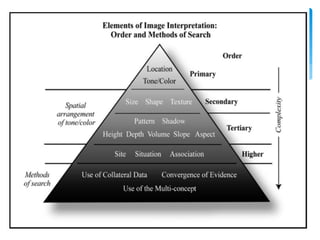
Elements of Visual Interpretation
1. Tone or colour:
 Tone is the relative brightness of grey level on black and
white image.
 Tone is the measure of the intensity of the reflected or
emitted radiation of the objects of the terrain.
 Lower reflected objects appear relatively dark and higher
reflected objects appear bright.
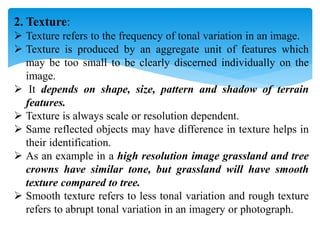
 Figure 1.1(a) represents a band imaged in NIR region of
the electromagnetic spectrum.
 Rivers does not reflect in NIR region thus appear black
and the vegetation reflects much thus appears bright.
Our eyes can discriminate only 16-20 grey levels in
the black and white photograph, while more than
hundreds of color can be distinguished in a color
photograph.
 In multispectral imaging, optimal three bands are
used to generate color composite image.
 False Color Composite (FCC) using NIR, red and
green are most preferred combination for visual
interpretation.
 In a standard FCC, NIR band passes through red
channel, red band passes through green channel and
green band passes through blue channel.
(a) (b)
Fig. 1.1. Satellite image of area in (a) grey scale and in (b) standard FCC
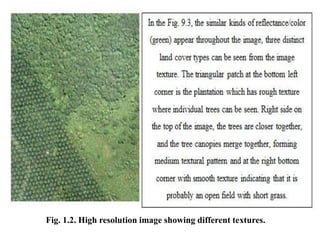
2. Texture:
 Texture refers to the frequency of tonal variation in an image.
 Texture is produced by an aggregate unit of features which
may be too small to be clearly discerned individually on the
image.
 It depends on shape, size, pattern and shadow of terrain
features.
 Texture is always scale or resolution dependent.
 Same reflected objects may have difference in texture helps in
their identification.
 As an example in a high resolution image grassland and tree
crowns have similar tone, but grassland will have smooth
texture compared to tree.
 Smooth texture refers to less tonal variation and rough texture
refers to abrupt tonal variation in an imagery or photograph.
Fig. 1.2. High resolution image showing different textures.
3. Pattern:
 Pattern refers to the spatial arrangement of the objects. Objects
both natural and manmade have a pattern which aids in their
recognition.
 The repetition of certain general form or relationship in tones and
texture creates a pattern, which is characteristic of this element in
image interpretation.
 In the Fig. 1.3 it could be easily understood that at the left bottom
corner of the image, it is plantation, where the tress are nearly
equally spaced.
 Whereas at the upper right and bottom right corners show natural
vegetation
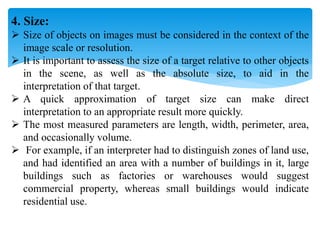
4. Size:
 Size of objects on images must be considered in the context of the
image scale or resolution.
 It is important to assess the size of a target relative to other objects
in the scene, as well as the absolute size, to aid in the
interpretation of that target.
 A quick approximation of target size can make direct
interpretation to an appropriate result more quickly.
 The most measured parameters are length, width, perimeter, area,
and occasionally volume.
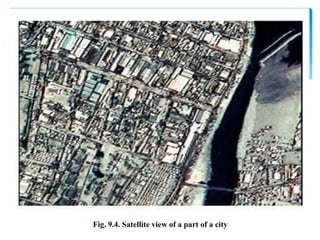
 For example, if an interpreter had to distinguish zones of land use,
and had identified an area with a number of buildings in it, large
buildings such as factories or warehouses would suggest
commercial property, whereas small buildings would indicate
residential use.
Fig. 9.4. Satellite view of a part of a city
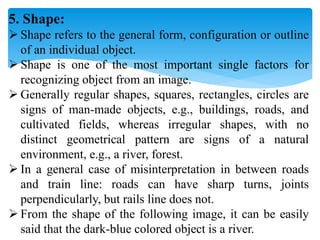
5. Shape:
 Shape refers to the general form, configuration or outline
of an individual object.
 Shape is one of the most important single factors for
recognizing object from an image.
 Generally regular shapes, squares, rectangles, circles are
signs of man-made objects, e.g., buildings, roads, and
cultivated fields, whereas irregular shapes, with no
distinct geometrical pattern are signs of a natural
environment, e.g., a river, forest.
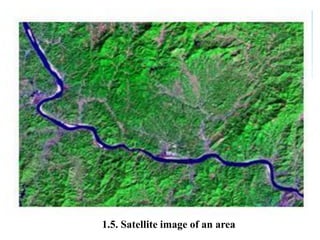
 In a general case of misinterpretation in between roads
and train line: roads can have sharp turns, joints
perpendicularly, but rails line does not.
 From the shape of the following image, it can be easily
said that the dark-blue colored object is a river.
1.5. Satellite image of an area
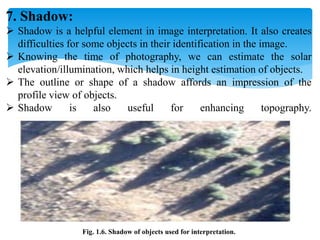
7. Shadow:
 Shadow is a helpful element in image interpretation. It also creates
difficulties for some objects in their identification in the image.
 Knowing the time of photography, we can estimate the solar
elevation/illumination, which helps in height estimation of objects.
 The outline or shape of a shadow affords an impression of the
profile view of objects.
 Shadow is also useful for enhancing topography.
Fig. 1.6. Shadow of objects used for interpretation.
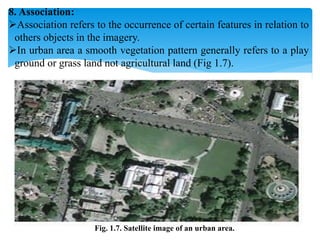
8. Association:
Association refers to the occurrence of certain features in relation to
others objects in the imagery.
In urban area a smooth vegetation pattern generally refers to a play
ground or grass land not agricultural land (Fig 1.7).
Fig. 1.7. Satellite image of an urban area.
8. Site:
 Site refers to topographic or geographic location.
 It is also an important element in image interpretation
when objects are not clearly identified using the
previous the elements.
 A very high reflectance feature in the Himalayan
valley may be snow or cloud, but in Kerala one cannot
say it as snow.
Generation of Thematic Maps:
An image interpretation map is usually
produced by transferring the interpreted information
to a base map which has been prepared in advance.
The requirements of the base map should be as
follows:
Proper map scale to enable appropriate
presentation of interpreted information.
Geographic coordinate system to establish the
geographic reference.
 Basic map information to be printed in light tones
as background which results in enhancement of
interpreted information
Normally, a topographic map (Toposheet), plan
map, or ortho photomap is used as a base map.
Factors Governing the Quality of an image
In addition to the inherent characteristics of an object
itself, the following factors influence image quality:
 Sensor characteristics (film types, digital systems)
 Season of the year and time of day
 Atmospheric effects
 Resolution of the imaging system and scale
 Image motion
63

Image processing & interpretation

  • 1.
    IMAGE PROCESSING & INTERPRETATION By, Prof. ShivajiR. Suryavanshi Asst. Professor of Agronomy, Dr. D.Y. Patil College of Agriculture, Talsande.
  • 2.
    IMAGE INTERPRETATION Aerial photographsas well as imagery, obtained by remote sensing using aircraft or spacecraft as platforms, have applicability in various fields. Image interpretation is defined as the act of examining images to identify objects and judge their significance by considering their location. An interpreter studies remotely sensed data and attempts through logical process to detect, identify, measure and evaluate the significance of environmental and cultural objects, patterns and spatial relationships.
  • 5.
    Elements of VisualInterpretation 1. Tone or colour:  Tone is the relative brightness of grey level on black and white image.  Tone is the measure of the intensity of the reflected or emitted radiation of the objects of the terrain.  Lower reflected objects appear relatively dark and higher reflected objects appear bright.  Figure 1.1(a) represents a band imaged in NIR region of the electromagnetic spectrum.  Rivers does not reflect in NIR region thus appear black and the vegetation reflects much thus appears bright.
  • 6.
    Our eyes candiscriminate only 16-20 grey levels in the black and white photograph, while more than hundreds of color can be distinguished in a color photograph.  In multispectral imaging, optimal three bands are used to generate color composite image.  False Color Composite (FCC) using NIR, red and green are most preferred combination for visual interpretation.  In a standard FCC, NIR band passes through red channel, red band passes through green channel and green band passes through blue channel.
  • 7.
    (a) (b) Fig. 1.1.Satellite image of area in (a) grey scale and in (b) standard FCC
  • 8.
    2. Texture:  Texturerefers to the frequency of tonal variation in an image.  Texture is produced by an aggregate unit of features which may be too small to be clearly discerned individually on the image.  It depends on shape, size, pattern and shadow of terrain features.  Texture is always scale or resolution dependent.  Same reflected objects may have difference in texture helps in their identification.  As an example in a high resolution image grassland and tree crowns have similar tone, but grassland will have smooth texture compared to tree.  Smooth texture refers to less tonal variation and rough texture refers to abrupt tonal variation in an imagery or photograph.
  • 9.
    Fig. 1.2. Highresolution image showing different textures.
  • 10.
    3. Pattern:  Patternrefers to the spatial arrangement of the objects. Objects both natural and manmade have a pattern which aids in their recognition.  The repetition of certain general form or relationship in tones and texture creates a pattern, which is characteristic of this element in image interpretation.  In the Fig. 1.3 it could be easily understood that at the left bottom corner of the image, it is plantation, where the tress are nearly equally spaced.  Whereas at the upper right and bottom right corners show natural vegetation
  • 11.
    4. Size:  Sizeof objects on images must be considered in the context of the image scale or resolution.  It is important to assess the size of a target relative to other objects in the scene, as well as the absolute size, to aid in the interpretation of that target.  A quick approximation of target size can make direct interpretation to an appropriate result more quickly.  The most measured parameters are length, width, perimeter, area, and occasionally volume.  For example, if an interpreter had to distinguish zones of land use, and had identified an area with a number of buildings in it, large buildings such as factories or warehouses would suggest commercial property, whereas small buildings would indicate residential use.
  • 12.
    Fig. 9.4. Satelliteview of a part of a city
  • 13.
    5. Shape:  Shaperefers to the general form, configuration or outline of an individual object.  Shape is one of the most important single factors for recognizing object from an image.  Generally regular shapes, squares, rectangles, circles are signs of man-made objects, e.g., buildings, roads, and cultivated fields, whereas irregular shapes, with no distinct geometrical pattern are signs of a natural environment, e.g., a river, forest.  In a general case of misinterpretation in between roads and train line: roads can have sharp turns, joints perpendicularly, but rails line does not.  From the shape of the following image, it can be easily said that the dark-blue colored object is a river.
  • 14.
  • 15.
    7. Shadow:  Shadowis a helpful element in image interpretation. It also creates difficulties for some objects in their identification in the image.  Knowing the time of photography, we can estimate the solar elevation/illumination, which helps in height estimation of objects.  The outline or shape of a shadow affords an impression of the profile view of objects.  Shadow is also useful for enhancing topography. Fig. 1.6. Shadow of objects used for interpretation.
  • 16.
    8. Association: Association refersto the occurrence of certain features in relation to others objects in the imagery. In urban area a smooth vegetation pattern generally refers to a play ground or grass land not agricultural land (Fig 1.7). Fig. 1.7. Satellite image of an urban area.
  • 17.
    8. Site:  Siterefers to topographic or geographic location.  It is also an important element in image interpretation when objects are not clearly identified using the previous the elements.  A very high reflectance feature in the Himalayan valley may be snow or cloud, but in Kerala one cannot say it as snow.
  • 18.
    Generation of ThematicMaps: An image interpretation map is usually produced by transferring the interpreted information to a base map which has been prepared in advance. The requirements of the base map should be as follows: Proper map scale to enable appropriate presentation of interpreted information. Geographic coordinate system to establish the geographic reference.  Basic map information to be printed in light tones as background which results in enhancement of interpreted information Normally, a topographic map (Toposheet), plan map, or ortho photomap is used as a base map.
  • 19.
    Factors Governing theQuality of an image In addition to the inherent characteristics of an object itself, the following factors influence image quality:  Sensor characteristics (film types, digital systems)  Season of the year and time of day  Atmospheric effects  Resolution of the imaging system and scale  Image motion
  • 20.