CHAPTER- 8 
THE PATH OF LIGHT 
IMAGE FORMATION 
By 
ANOOP. M.R 
MOUNT TABOR TRAINING COLLEGE 
PATHANAPURAM
IMAGE FORMATION OF 
CONCAVE MIRROR
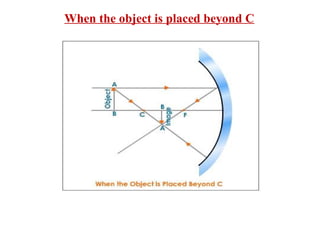
When the object is placed beyond C
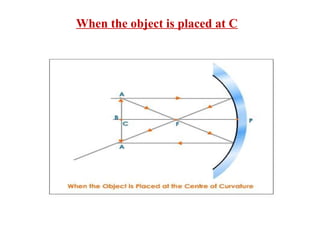
When the object is placed at C
Case 1: Object beyond C 
Location 
: image will always be located somewhere in between the center 
of curvature and the focal point 
Orientation 
: image will be an inverted image 
Size 
: reduced in size (M is less than 1) 
Type 
: image is a real image
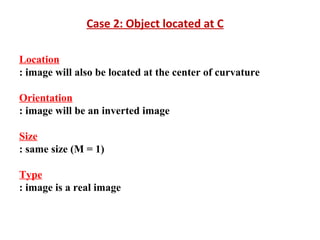
Case 2: Object located at C 
Location 
: image will also be located at the center of curvature 
Orientation 
: image will be an inverted image 
Size 
: same size (M = 1) 
Type 
: image is a real image
When the object is placed between C and F
When the object is placed at F
When the object is placed between F and P
Case 3: Object between C &f 
Location 
: object is located in front of the center of curvature, the image 
will be located beyond the center of curvature 
Orientation 
: image will be an inverted image 
Size 
: image is enlarged (M is greater than 1) 
Type 
: image is a real image
Case 4: The object is located at f 
No image is formed 
Light rays from the same point on the object will reflect off the 
mirror and neither converge nor diverge. After reflecting, the 
light rays are traveling parallel to each other and do not result 
in the formation of an image.
Case 5: Object located in front of f 
Location 
: object is located at a location beyond the focal point, the image will 
always be located somewhere on the opposite side of the mirror (behind 
mirror) 
Orientation 
: image will be an upright image 
Size 
: image is enlarged (M is greater than 1) 
Type 
: image is a virtual image. Light rays from the same point on the object 
reflect off the mirror and diverge upon reflection. For this reason, the 
image location can only be found by extending the reflected rays 
backwards beyond the mirror. The point of their intersection is the virtual 
image location.
IMAGE FORMATION OF CONVEX MIRROR 
In general, the image formed by a convex mirror is 
upright, virtual, and smaller than the object
Image formation

Image formation

  • 1.
    CHAPTER- 8 THEPATH OF LIGHT IMAGE FORMATION By ANOOP. M.R MOUNT TABOR TRAINING COLLEGE PATHANAPURAM
  • 2.
    IMAGE FORMATION OF CONCAVE MIRROR
  • 3.
    When the objectis placed beyond C
  • 4.
    When the objectis placed at C
  • 5.
    Case 1: Objectbeyond C Location : image will always be located somewhere in between the center of curvature and the focal point Orientation : image will be an inverted image Size : reduced in size (M is less than 1) Type : image is a real image
  • 6.
    Case 2: Objectlocated at C Location : image will also be located at the center of curvature Orientation : image will be an inverted image Size : same size (M = 1) Type : image is a real image
  • 8.
    When the objectis placed between C and F
  • 9.
    When the objectis placed at F
  • 10.
    When the objectis placed between F and P
  • 11.
    Case 3: Objectbetween C &f Location : object is located in front of the center of curvature, the image will be located beyond the center of curvature Orientation : image will be an inverted image Size : image is enlarged (M is greater than 1) Type : image is a real image
  • 12.
    Case 4: Theobject is located at f No image is formed Light rays from the same point on the object will reflect off the mirror and neither converge nor diverge. After reflecting, the light rays are traveling parallel to each other and do not result in the formation of an image.
  • 13.
    Case 5: Objectlocated in front of f Location : object is located at a location beyond the focal point, the image will always be located somewhere on the opposite side of the mirror (behind mirror) Orientation : image will be an upright image Size : image is enlarged (M is greater than 1) Type : image is a virtual image. Light rays from the same point on the object reflect off the mirror and diverge upon reflection. For this reason, the image location can only be found by extending the reflected rays backwards beyond the mirror. The point of their intersection is the virtual image location.
  • 14.
    IMAGE FORMATION OFCONVEX MIRROR In general, the image formed by a convex mirror is upright, virtual, and smaller than the object