INTRODUCTION
 In optics, a ray is an idealized narrow beam
of light. Rays are used to model the
propagation of light through an optical
system, by dividing the real light field up into
discrete rays that can be computationally
propagated through the system by the
techniques of ray tracing.
REFLECTION OFREFLECTION OF
LIGHTLIGHT
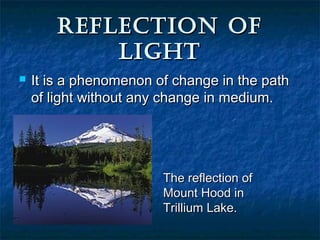
 It is a phenomenon of change in the pathIt is a phenomenon of change in the path
of light without any change in medium.of light without any change in medium.
The reflection ofThe reflection of
Mount Hood inMount Hood in
Trillium Lake.Trillium Lake.
LAWS OF REFLECTION
The laws of reflection are as follows:
The incident ray, the reflected ray and the
normal to the reflection surface at the
point of the incidence lie in the same
plane.
The angle which the incident ray makes
with the normal is equal to the angle which
the reflected ray makes to the same
normal.
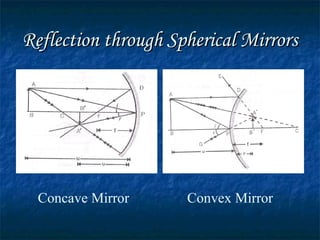
Reflection through Spherical MirrorsReflection through Spherical Mirrors
Concave Mirror Convex Mirror
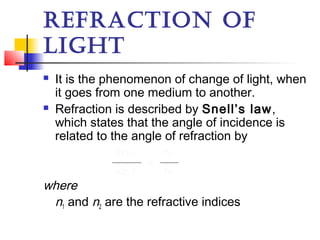
REFRACTION OF
LIGHT
 It is the phenomenon of change of light, when
it goes from one medium to another.
 Refraction is described by Snell’s law,
which states that the angle of incidence is
related to the angle of refraction by
where
n1 and n2 are the refractive indices
sin i
sin r
=
n2
n1
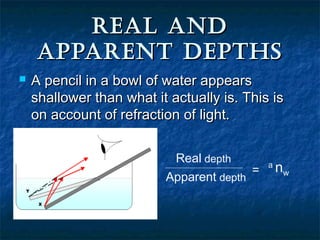
REAL ANDREAL AND
APPARENT DEPTHSAPPARENT DEPTHS
 A pencil in a bowl of water appearsA pencil in a bowl of water appears
shallower than what it actually is. This isshallower than what it actually is. This is
on account of refraction of light.on account of refraction of light.
Real depth
Apparent depth
=
a
nw
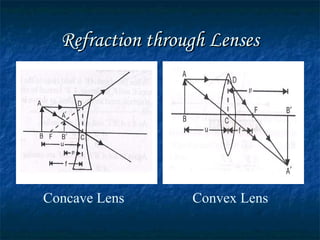
Refraction through LensesRefraction through Lenses
Concave Lens Convex Lens
LensesLenses
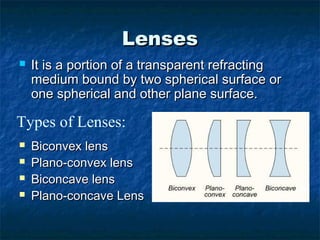
 It is a portion of a transparent refractingIt is a portion of a transparent refracting
medium bound by two spherical surface ormedium bound by two spherical surface or
one spherical and other plane surface.one spherical and other plane surface.
 Biconvex lensBiconvex lens
 Plano-convex lensPlano-convex lens
 Biconcave lensBiconcave lens
 Plano-concave LensPlano-concave Lens
Types of Lenses:
PRISMPRISM
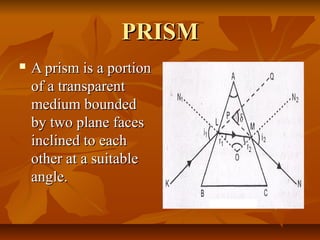
 A prism is a portionA prism is a portion
of a transparentof a transparent
medium boundedmedium bounded
by two plane facesby two plane faces
inclined to eachinclined to each
other at a suitableother at a suitable
angle.angle.
DISPERSION OFDISPERSION OF
LIGHTLIGHT
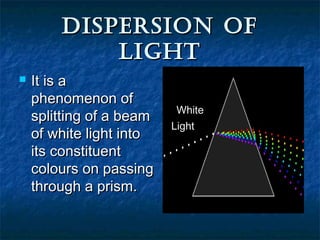
 It is aIt is a
phenomenon ofphenomenon of
splitting of a beamsplitting of a beam
of white light intoof white light into
its constituentits constituent
colours on passingcolours on passing
through a prism.through a prism.
White
Light
OPTICAL INSTUMENTSOPTICAL INSTUMENTS
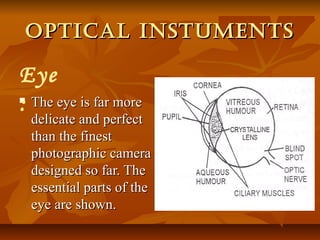
 The eye is far moreThe eye is far more
delicate and perfectdelicate and perfect
than the finestthan the finest
photographic cameraphotographic camera
designed so far. Thedesigned so far. The
essential parts of theessential parts of the
eye are shown.eye are shown.
Eye
:
DEFECTS OF VISION
 Myopia (Short Sightedness)
 Hypermetropia (Long Sightedness)
 Presbyopia (Old Sight)
 Astigmatism
 Phorias
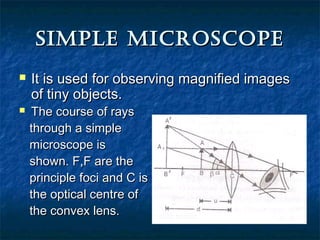
SIMPLE MICROSCOPESIMPLE MICROSCOPE
 It is used for observing magnified imagesIt is used for observing magnified images
of tiny objects.of tiny objects.
 The course of raysThe course of rays
through a simplethrough a simple
microscope ismicroscope is
shown. F,F are theshown. F,F are the
principle foci and C isprinciple foci and C is
the optical centre ofthe optical centre of
the convex lens.the convex lens.
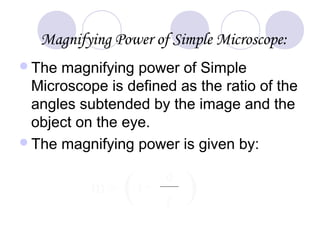
Magnifying Power of Simple Microscope:
The magnifying power of Simple
Microscope is defined as the ratio of the
angles subtended by the image and the
object on the eye.
The magnifying power is given by:
m = ( )1+
d
f
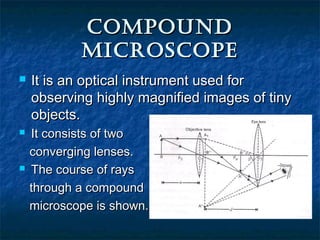
CompoundCompound
miCrosCopemiCrosCope
 It is an optical instrument used forIt is an optical instrument used for
observing highly magnified images of tinyobserving highly magnified images of tiny
objects.objects.
 It consists of twoIt consists of two
converging lenses.converging lenses.
 The course of raysThe course of rays
through a compoundthrough a compound
microscope is shown.microscope is shown.
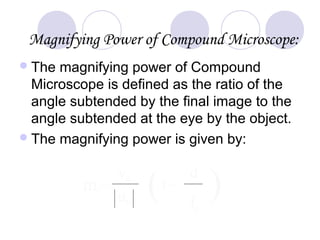
Magnifying Power of Compound Microscope:
The magnifying power of Compound
Microscope is defined as the ratio of the
angle subtended by the final image to the
angle subtended at the eye by the object.
The magnifying power is given by:
m = ( )1+
d
fe
v0
u0
AstronomiCAlAstronomiCAl
telesCopetelesCope
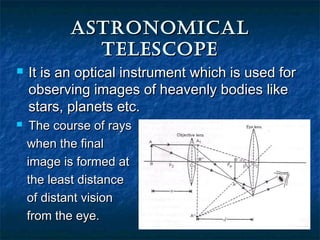
 It is an optical instrument which is used forIt is an optical instrument which is used for
observing images of heavenly bodies likeobserving images of heavenly bodies like
stars, planets etc.stars, planets etc.
 The course of raysThe course of rays
when the finalwhen the final
image is formed atimage is formed at
the least distancethe least distance
of distant visionof distant vision
from the eye.from the eye.
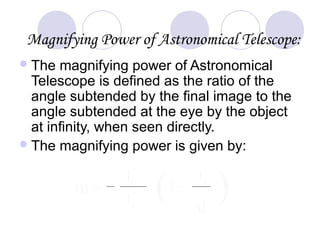
Magnifying Power of Astronomical Telescope:
The magnifying power of Astronomical
Telescope is defined as the ratio of the
angle subtended by the final image to the
angle subtended at the eye by the object
at infinity, when seen directly.
The magnifying power is given by:
m = ( )1+
fe
d
f0
fe
Thank You
Presented by :-
ABHISHEK &
PAWAN
Xii – Sci
FAITH
ACADEMY

Ray Optics

  • 2.
    INTRODUCTION  In optics,a ray is an idealized narrow beam of light. Rays are used to model the propagation of light through an optical system, by dividing the real light field up into discrete rays that can be computationally propagated through the system by the techniques of ray tracing.
  • 3.
    REFLECTION OFREFLECTION OF LIGHTLIGHT It is a phenomenon of change in the pathIt is a phenomenon of change in the path of light without any change in medium.of light without any change in medium. The reflection ofThe reflection of Mount Hood inMount Hood in Trillium Lake.Trillium Lake.
  • 4.
    LAWS OF REFLECTION Thelaws of reflection are as follows: The incident ray, the reflected ray and the normal to the reflection surface at the point of the incidence lie in the same plane. The angle which the incident ray makes with the normal is equal to the angle which the reflected ray makes to the same normal.
  • 5.
    Reflection through SphericalMirrorsReflection through Spherical Mirrors Concave Mirror Convex Mirror
  • 6.
    REFRACTION OF LIGHT  Itis the phenomenon of change of light, when it goes from one medium to another.  Refraction is described by Snell’s law, which states that the angle of incidence is related to the angle of refraction by where n1 and n2 are the refractive indices sin i sin r = n2 n1
  • 7.
    REAL ANDREAL AND APPARENTDEPTHSAPPARENT DEPTHS  A pencil in a bowl of water appearsA pencil in a bowl of water appears shallower than what it actually is. This isshallower than what it actually is. This is on account of refraction of light.on account of refraction of light. Real depth Apparent depth = a nw
  • 8.
    Refraction through LensesRefractionthrough Lenses Concave Lens Convex Lens
  • 9.
    LensesLenses  It isa portion of a transparent refractingIt is a portion of a transparent refracting medium bound by two spherical surface ormedium bound by two spherical surface or one spherical and other plane surface.one spherical and other plane surface.  Biconvex lensBiconvex lens  Plano-convex lensPlano-convex lens  Biconcave lensBiconcave lens  Plano-concave LensPlano-concave Lens Types of Lenses:
  • 10.
    PRISMPRISM  A prismis a portionA prism is a portion of a transparentof a transparent medium boundedmedium bounded by two plane facesby two plane faces inclined to eachinclined to each other at a suitableother at a suitable angle.angle.
  • 11.
    DISPERSION OFDISPERSION OF LIGHTLIGHT It is aIt is a phenomenon ofphenomenon of splitting of a beamsplitting of a beam of white light intoof white light into its constituentits constituent colours on passingcolours on passing through a prism.through a prism. White Light
  • 12.
    OPTICAL INSTUMENTSOPTICAL INSTUMENTS The eye is far moreThe eye is far more delicate and perfectdelicate and perfect than the finestthan the finest photographic cameraphotographic camera designed so far. Thedesigned so far. The essential parts of theessential parts of the eye are shown.eye are shown. Eye :
  • 13.
    DEFECTS OF VISION Myopia (Short Sightedness)  Hypermetropia (Long Sightedness)  Presbyopia (Old Sight)  Astigmatism  Phorias
  • 14.
    SIMPLE MICROSCOPESIMPLE MICROSCOPE It is used for observing magnified imagesIt is used for observing magnified images of tiny objects.of tiny objects.  The course of raysThe course of rays through a simplethrough a simple microscope ismicroscope is shown. F,F are theshown. F,F are the principle foci and C isprinciple foci and C is the optical centre ofthe optical centre of the convex lens.the convex lens.
  • 15.
    Magnifying Power ofSimple Microscope: The magnifying power of Simple Microscope is defined as the ratio of the angles subtended by the image and the object on the eye. The magnifying power is given by: m = ( )1+ d f
  • 16.
    CompoundCompound miCrosCopemiCrosCope  It isan optical instrument used forIt is an optical instrument used for observing highly magnified images of tinyobserving highly magnified images of tiny objects.objects.  It consists of twoIt consists of two converging lenses.converging lenses.  The course of raysThe course of rays through a compoundthrough a compound microscope is shown.microscope is shown.
  • 17.
    Magnifying Power ofCompound Microscope: The magnifying power of Compound Microscope is defined as the ratio of the angle subtended by the final image to the angle subtended at the eye by the object. The magnifying power is given by: m = ( )1+ d fe v0 u0
  • 18.
    AstronomiCAlAstronomiCAl telesCopetelesCope  It isan optical instrument which is used forIt is an optical instrument which is used for observing images of heavenly bodies likeobserving images of heavenly bodies like stars, planets etc.stars, planets etc.  The course of raysThe course of rays when the finalwhen the final image is formed atimage is formed at the least distancethe least distance of distant visionof distant vision from the eye.from the eye.
  • 19.
    Magnifying Power ofAstronomical Telescope: The magnifying power of Astronomical Telescope is defined as the ratio of the angle subtended by the final image to the angle subtended at the eye by the object at infinity, when seen directly. The magnifying power is given by: m = ( )1+ fe d f0 fe
  • 20.
    Thank You Presented by:- ABHISHEK & PAWAN Xii – Sci FAITH ACADEMY