1
Module # 39
Mirrors
Image Formed by a Plane Mirror
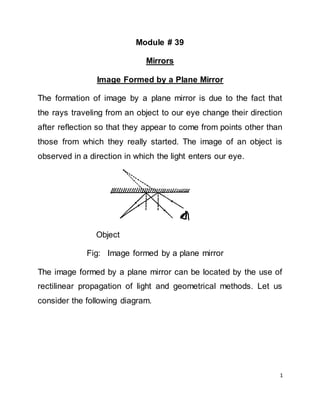
The formation of image by a plane mirror is due to the fact that
the rays traveling from an object to our eye change their direction
after reflection so that they appear to come from points other than
those from which they really started. The image of an object is
observed in a direction in which the light enters our eye.
Object
Fig: Image formed by a plane mirror
The image formed by a plane mirror can be located by the use of
rectilinear propagation of light and geometrical methods. Let us
consider the following diagram.
2
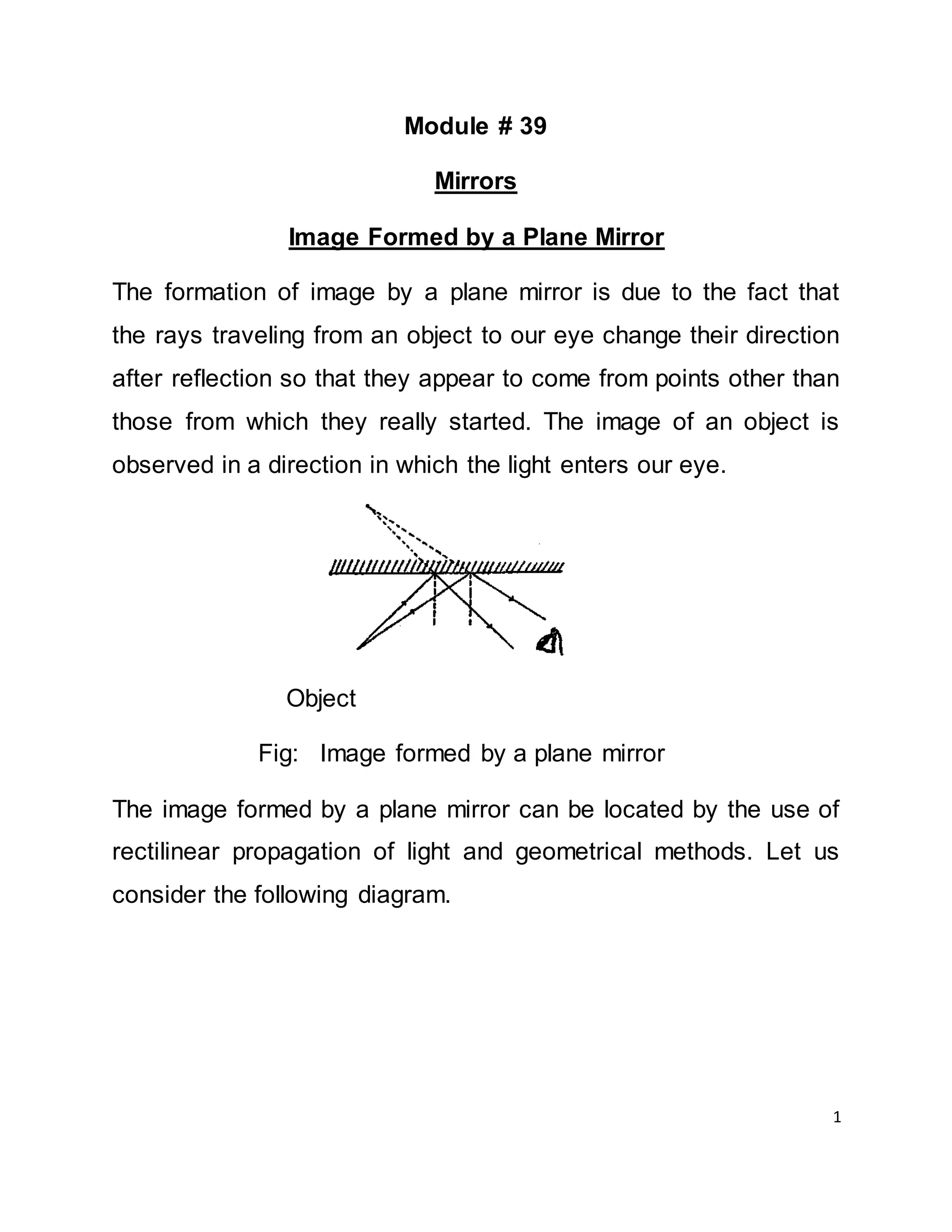
Plane mirror
Fig: Image of point object
Light rays coming from a luminous object O are reflected by the
plane mirror M and enter our eye. The line which joins the image I
and the object O makes an angle of 90° with the surface of the
mirror M. From the geometrical construction, the distance
between the object and the mirror OM and the distance between
the image and the mirror IM are equal. Therefore, we feel that the
light rays come from the image I, but in fact they come from the
object O and are reflected by the mirror. At the mirror surface, we
find that the angle of incidence is equal to the angle of reflection.
Characteristics of Image in case of Plane Mirror
(1) Image is formed as far behind the mirror as the object is in
front of it.
(2) The image formed in a plane mirror is always virtual, i.e. it
cannot be obtained on the screen.
3
(3) The size of image is same as that of object, but, is laterally
inverted, i.e., right side of the object appears as left and left side
of the object appears as the right side of the image.
Spherical Mirrors
Mirrors whose surfaces are not plane but curved are called
spherical mirrors as distinguished from plane mirrors. A spherical
mirror is a silvered part or section of a hollow sphere.
There are two types of spherical mirrors:
1 Concave mirror
2 Convex mirror
Principal Focus of a Spherical Mirror
The principal focus of a spherical mirror is that point on the
principal axis to which all rays originally parallel and close to the
principal axis converge, or from which they appear to diverge,
after reflection from the mirror.
Principal Axis of a Spherical Mirror
The principal axis of a spherical mirror is the line joining the pole
P or centre of the mirror to the centre of curvature C which is the
centre of the sphere of which the mirror forms a part.
OR
4
It is the straight line passing through the centre of curvature and
the pole.
Focal Length of a Spherical Mirror
The distance of principal focus from the pole of the spherical
mirror is called focal length.
Note: The focal length of concave mirror is taken as positive
whereas the focal length of convex mirror is taken as negative.
Sign Convention
In the case of spherical mirrors, virtual as well as real images are
formed which under certain conditions are diminished and under
the other conditions are magnified. Therefore, it is necessary to
define a sign convention so that we may be able to distinguish
between real and virtual images as well magnified and diminished
images. The sign convention is given as follows:
(1) All distances are measured from the pole of the mirror.
(2) Distances of real objects and images are taken as positive.
(3) Distances of virtual objects and images and taken as
negative.
5
Aperture (of a Spherical Mirror)
The diameter of the circular edge of a spherical mirror is known
as aperture.
Linear Magnification by a Spherical Mirror
The magnification (m) by a spherical mirror is the ratio of the
height of the image to the height of the object.
Height of image Image distance from mirror
Magnification (m) = ---------------------- = ----------------------------------------
Height of object Object distance from mirror
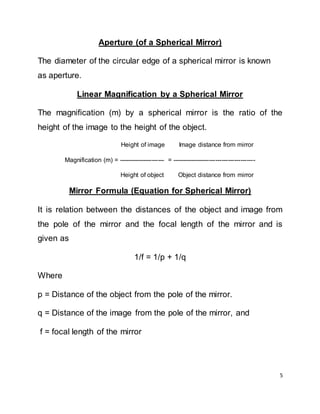
Mirror Formula (Equation for Spherical Mirror)
It is relation between the distances of the object and image from
the pole of the mirror and the focal length of the mirror and is
given as
1/f = 1/p + 1/q
Where
p = Distance of the object from the pole of the mirror.
q = Distance of the image from the pole of the mirror, and
f = focal length of the mirror
6
Centre of Curvature
The centre of the sphere, of which a concave or convex mirror is
a part, is known as the centre of curvature of the spherical mirror.
In other words, the centre of curvature (c) is the centre of the
sphere from which a curved reflecting surface is obtained.
Radius of Curvature
The radius of curvature r is the distance between the pole P and
the centre of curvature C of the spherical mirror.
OR
The distance between the pole of the spherical mirror and its
centre of curvature is called radius of curvature.
OR
Radius of curvature is a straight line drawn from the centre of
curvature to the reflecting curved surface.
Note: In spherical mirrors, the radius of curvature is twice as large
as its focal length.
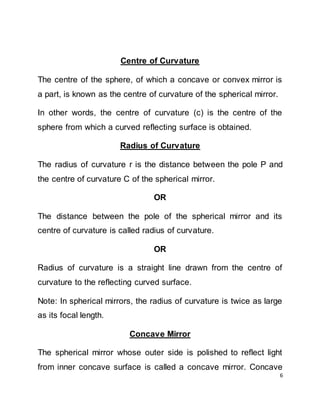
Concave Mirror
The spherical mirror whose outer side is polished to reflect light
from inner concave surface is called a concave mirror. Concave
7
mirrors possess the ability to converge a parallel beam of light
and are, therefore, called converging mirrors.
Fig: Concave Mirror
Uses of Concave Mirror
(1) The image formed in the concave mirror is erect, magnified
and virtual. Therefore, these mirrors are used as shaving mirrors
because face is magnified and appears erect in them.
(2) Doctors use ophthalmoscope which consist of concave
mirrors for examination of ear, nose, throat and eye.
(3) These are used as magnifiers.
(4) Concave mirrors are used to throw light on the slides of the
microscopes so that the slides can be viewed more clearly.
(5) These are also used to focus light in case of search lights
and head lights of automobiles.
(6) Concave mirrors are used as objectives in the telescopes to
concentrate a parallel beam of light from distant stars.
8
Formation of Images in case of Concave Mirrors
For image formation, we use two rays of light. It is observed that
different images are formed when the object is placed at different
positions.
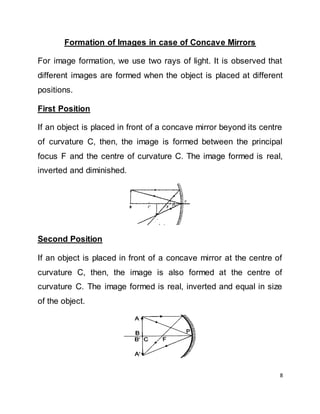
First Position
If an object is placed in front of a concave mirror beyond its centre
of curvature C, then, the image is formed between the principal
focus F and the centre of curvature C. The image formed is real,
inverted and diminished.
Second Position
If an object is placed in front of a concave mirror at the centre of
curvature C, then, the image is also formed at the centre of
curvature C. The image formed is real, inverted and equal in size
of the object.
9
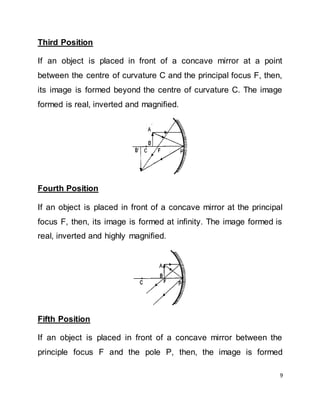
Third Position
If an object is placed in front of a concave mirror at a point
between the centre of curvature C and the principal focus F, then,
its image is formed beyond the centre of curvature C. The image
formed is real, inverted and magnified.
Fourth Position
If an object is placed in front of a concave mirror at the principal
focus F, then, its image is formed at infinity. The image formed is
real, inverted and highly magnified.
Fifth Position
If an object is placed in front of a concave mirror between the
principle focus F and the pole P, then, the image is formed
10
somewhere behind the mirror. The image formed is virtual, erect
end magnified.
Formation of Virtual Image in a Concave Mirror
Fig: Formation of image in a concave mirror
If the object is placed in front of a concave mirror between
principal focus F and pole P, the image is formed somewhere
behind the mirror. This image is erect, virtual and magnified.
Principal Focus (of a Concave Mirror)
Rays of light parallel to the principal axis after reflection from a
concave mirror converge to a point F on the principal axis. This
point is known as principal focus of the concave mirror.
Principal Focus (of a Convex Mirror)
Rays of light parallel to the principal axis after reflection from a
11
convex mirror appear to diverge from a point on the other side of
the mirror. This point is known as principal focus of the convex
mirror.
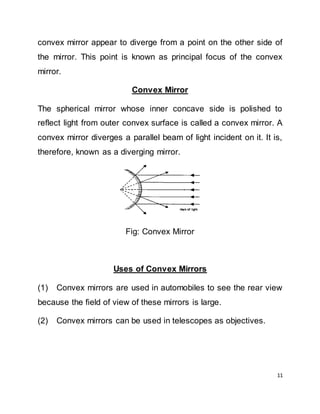
Convex Mirror
The spherical mirror whose inner concave side is polished to
reflect light from outer convex surface is called a convex mirror. A
convex mirror diverges a parallel beam of light incident on it. It is,
therefore, known as a diverging mirror.
Fig: Convex Mirror
Uses of Convex Mirrors
(1) Convex mirrors are used in automobiles to see the rear view
because the field of view of these mirrors is large.
(2) Convex mirrors can be used in telescopes as objectives.
12
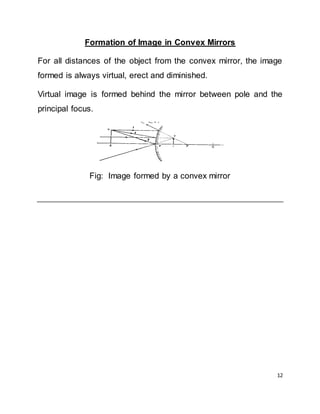
Formation of Image in Convex Mirrors
For all distances of the object from the convex mirror, the image
formed is always virtual, erect and diminished.
Virtual image is formed behind the mirror between pole and the
principal focus.
Fig: Image formed by a convex mirror

Module No. 39

  • 1.
    1 Module # 39 Mirrors ImageFormed by a Plane Mirror The formation of image by a plane mirror is due to the fact that the rays traveling from an object to our eye change their direction after reflection so that they appear to come from points other than those from which they really started. The image of an object is observed in a direction in which the light enters our eye. Object Fig: Image formed by a plane mirror The image formed by a plane mirror can be located by the use of rectilinear propagation of light and geometrical methods. Let us consider the following diagram.
  • 2.
    2 Plane mirror Fig: Imageof point object Light rays coming from a luminous object O are reflected by the plane mirror M and enter our eye. The line which joins the image I and the object O makes an angle of 90° with the surface of the mirror M. From the geometrical construction, the distance between the object and the mirror OM and the distance between the image and the mirror IM are equal. Therefore, we feel that the light rays come from the image I, but in fact they come from the object O and are reflected by the mirror. At the mirror surface, we find that the angle of incidence is equal to the angle of reflection. Characteristics of Image in case of Plane Mirror (1) Image is formed as far behind the mirror as the object is in front of it. (2) The image formed in a plane mirror is always virtual, i.e. it cannot be obtained on the screen.
  • 3.
    3 (3) The sizeof image is same as that of object, but, is laterally inverted, i.e., right side of the object appears as left and left side of the object appears as the right side of the image. Spherical Mirrors Mirrors whose surfaces are not plane but curved are called spherical mirrors as distinguished from plane mirrors. A spherical mirror is a silvered part or section of a hollow sphere. There are two types of spherical mirrors: 1 Concave mirror 2 Convex mirror Principal Focus of a Spherical Mirror The principal focus of a spherical mirror is that point on the principal axis to which all rays originally parallel and close to the principal axis converge, or from which they appear to diverge, after reflection from the mirror. Principal Axis of a Spherical Mirror The principal axis of a spherical mirror is the line joining the pole P or centre of the mirror to the centre of curvature C which is the centre of the sphere of which the mirror forms a part. OR
  • 4.
    4 It is thestraight line passing through the centre of curvature and the pole. Focal Length of a Spherical Mirror The distance of principal focus from the pole of the spherical mirror is called focal length. Note: The focal length of concave mirror is taken as positive whereas the focal length of convex mirror is taken as negative. Sign Convention In the case of spherical mirrors, virtual as well as real images are formed which under certain conditions are diminished and under the other conditions are magnified. Therefore, it is necessary to define a sign convention so that we may be able to distinguish between real and virtual images as well magnified and diminished images. The sign convention is given as follows: (1) All distances are measured from the pole of the mirror. (2) Distances of real objects and images are taken as positive. (3) Distances of virtual objects and images and taken as negative.
  • 5.
    5 Aperture (of aSpherical Mirror) The diameter of the circular edge of a spherical mirror is known as aperture. Linear Magnification by a Spherical Mirror The magnification (m) by a spherical mirror is the ratio of the height of the image to the height of the object. Height of image Image distance from mirror Magnification (m) = ---------------------- = ---------------------------------------- Height of object Object distance from mirror Mirror Formula (Equation for Spherical Mirror) It is relation between the distances of the object and image from the pole of the mirror and the focal length of the mirror and is given as 1/f = 1/p + 1/q Where p = Distance of the object from the pole of the mirror. q = Distance of the image from the pole of the mirror, and f = focal length of the mirror
  • 6.
    6 Centre of Curvature Thecentre of the sphere, of which a concave or convex mirror is a part, is known as the centre of curvature of the spherical mirror. In other words, the centre of curvature (c) is the centre of the sphere from which a curved reflecting surface is obtained. Radius of Curvature The radius of curvature r is the distance between the pole P and the centre of curvature C of the spherical mirror. OR The distance between the pole of the spherical mirror and its centre of curvature is called radius of curvature. OR Radius of curvature is a straight line drawn from the centre of curvature to the reflecting curved surface. Note: In spherical mirrors, the radius of curvature is twice as large as its focal length. Concave Mirror The spherical mirror whose outer side is polished to reflect light from inner concave surface is called a concave mirror. Concave
  • 7.
    7 mirrors possess theability to converge a parallel beam of light and are, therefore, called converging mirrors. Fig: Concave Mirror Uses of Concave Mirror (1) The image formed in the concave mirror is erect, magnified and virtual. Therefore, these mirrors are used as shaving mirrors because face is magnified and appears erect in them. (2) Doctors use ophthalmoscope which consist of concave mirrors for examination of ear, nose, throat and eye. (3) These are used as magnifiers. (4) Concave mirrors are used to throw light on the slides of the microscopes so that the slides can be viewed more clearly. (5) These are also used to focus light in case of search lights and head lights of automobiles. (6) Concave mirrors are used as objectives in the telescopes to concentrate a parallel beam of light from distant stars.
  • 8.
    8 Formation of Imagesin case of Concave Mirrors For image formation, we use two rays of light. It is observed that different images are formed when the object is placed at different positions. First Position If an object is placed in front of a concave mirror beyond its centre of curvature C, then, the image is formed between the principal focus F and the centre of curvature C. The image formed is real, inverted and diminished. Second Position If an object is placed in front of a concave mirror at the centre of curvature C, then, the image is also formed at the centre of curvature C. The image formed is real, inverted and equal in size of the object.
  • 9.
    9 Third Position If anobject is placed in front of a concave mirror at a point between the centre of curvature C and the principal focus F, then, its image is formed beyond the centre of curvature C. The image formed is real, inverted and magnified. Fourth Position If an object is placed in front of a concave mirror at the principal focus F, then, its image is formed at infinity. The image formed is real, inverted and highly magnified. Fifth Position If an object is placed in front of a concave mirror between the principle focus F and the pole P, then, the image is formed
  • 10.
    10 somewhere behind themirror. The image formed is virtual, erect end magnified. Formation of Virtual Image in a Concave Mirror Fig: Formation of image in a concave mirror If the object is placed in front of a concave mirror between principal focus F and pole P, the image is formed somewhere behind the mirror. This image is erect, virtual and magnified. Principal Focus (of a Concave Mirror) Rays of light parallel to the principal axis after reflection from a concave mirror converge to a point F on the principal axis. This point is known as principal focus of the concave mirror. Principal Focus (of a Convex Mirror) Rays of light parallel to the principal axis after reflection from a
  • 11.
    11 convex mirror appearto diverge from a point on the other side of the mirror. This point is known as principal focus of the convex mirror. Convex Mirror The spherical mirror whose inner concave side is polished to reflect light from outer convex surface is called a convex mirror. A convex mirror diverges a parallel beam of light incident on it. It is, therefore, known as a diverging mirror. Fig: Convex Mirror Uses of Convex Mirrors (1) Convex mirrors are used in automobiles to see the rear view because the field of view of these mirrors is large. (2) Convex mirrors can be used in telescopes as objectives.
  • 12.
    12 Formation of Imagein Convex Mirrors For all distances of the object from the convex mirror, the image formed is always virtual, erect and diminished. Virtual image is formed behind the mirror between pole and the principal focus. Fig: Image formed by a convex mirror