LIGHT
BY: MD. OBAIDULLAH ANSARI
BY: MD OBAIDULLAH ANSARI 1
Light
Light is a form of energy that causes sensation of vision in our eyes.
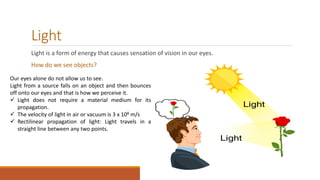
How do we see objects?
Our eyes alone do not allow us to see.
Light from a source falls on an object and then bounces
off onto our eyes and that is how we perceive it.
 Light does not require a material medium for its
propagation.
 The velocity of light in air or vacuum is 3 x 10⁸ m/s
 Rectilinear propagation of light: Light travels in a
straight line between any two points.
Propagation of light
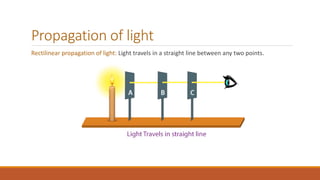
Rectilinear propagation of light: Light travels in a straight line between any two points.
Propagation of light with a simple experiment
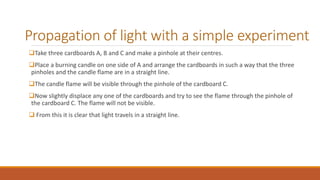
Take three cardboards A, B and C and make a pinhole at their centres.
Place a burning candle on one side of A and arrange the cardboards in such a way that the three
pinholes and the candle flame are in a straight line.
The candle flame will be visible through the pinhole of the cardboard C.
Now slightly displace any one of the cardboards and try to see the flame through the pinhole of
the cardboard C. The flame will not be visible.
 From this it is clear that light travels in a straight line.
Ray and Beam of Light
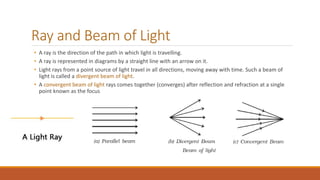
• A ray is the direction of the path in which light is travelling.
• A ray is represented in diagrams by a straight line with an arrow on it.
• Light rays from a point source of light travel in all directions, moving away with time. Such a beam of
light is called a divergent beam of light.
• A convergent beam of light rays comes together (converges) after reflection and refraction at a single
point known as the focus
Reflection of Light
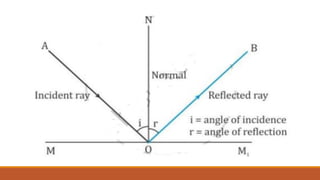
Reflection of light is the phenomenon of bouncing back of light in the same medium on striking
the surface of any object.
Incident ray - The ray of light falling on the surface AB is called the incident ray (AO).
Reflected ray - The Incident ray bouncing back In the same medium after striking the reflecting
surface is called reflected ray(OB).
Point of incidence- The point at which the light hits the surface is called the point of incidence.
Normal - It is the line drawn perpendicular to the reflecting surface at the point of incidence(NO)
Angle of Incidence - The angle formed between the incident ray and the normal Is the Angle of
Incidence
Angle of reflection - The angle formed between the normal and the reflected ray Is called angle
of reflection
Laws of Reflection
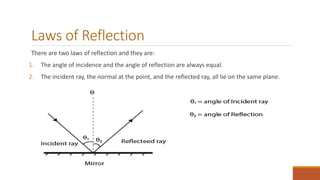
There are two laws of reflection and they are:
1. The angle of incidence and the angle of reflection are always equal.
2. The incident ray, the normal at the point, and the reflected ray, all lie on the same plane.
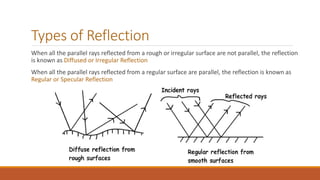
Types of Reflection
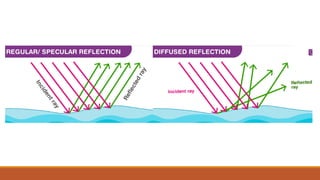
When all the parallel rays reflected from a rough or irregular surface are not parallel, the reflection
is known as Diffused or Irregular Reflection
When all the parallel rays reflected from a regular surface are parallel, the reflection is known as
Regular or Specular Reflection
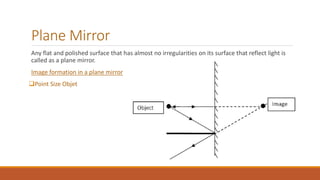
Plane Mirror
Any flat and polished surface that has almost no irregularities on its surface that reflect light is
called as a plane mirror.
Image formation in a plane mirror
Point Size Objet
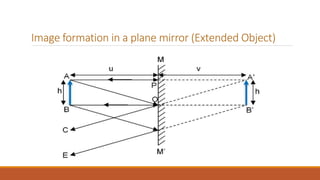
Image formation in a plane mirror (Extended Object)
Characteristics of an image formed by plane mirror
The image obtained is virtual.
The image is laterally inverted.
The image is erect.
The size of the image is the same as the size of the object.
The distance between the image obtained is the same as the distance between the object from
the mirror.
Spherical mirrors
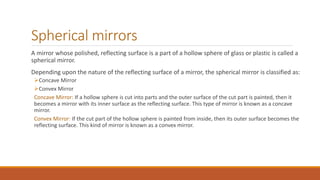
A mirror whose polished, reflecting surface is a part of a hollow sphere of glass or plastic is called a
spherical mirror.
Depending upon the nature of the reflecting surface of a mirror, the spherical mirror is classified as:
Concave Mirror
Convex Mirror
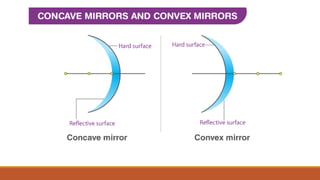
Concave Mirror: If a hollow sphere is cut into parts and the outer surface of the cut part is painted, then it
becomes a mirror with its inner surface as the reflecting surface. This type of mirror is known as a concave
mirror.
Convex Mirror: If the cut part of the hollow sphere is painted from inside, then its outer surface becomes the
reflecting surface. This kind of mirror is known as a convex mirror.
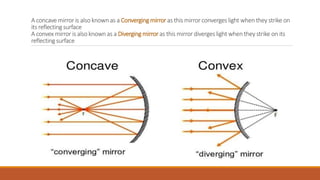
A concave mirror is also known as a Convergingmirror as this mirror converges light when they strike on
its reflecting surface
A convex mirror is also known as a Divergingmirroras this mirror diverges light when they strike on its
reflecting surface
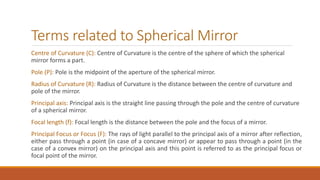
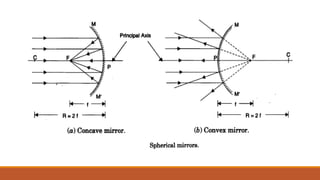
Terms related to Spherical Mirror
Centre of Curvature (C): Centre of Curvature is the centre of the sphere of which the spherical
mirror forms a part.
Pole (P): Pole is the midpoint of the aperture of the spherical mirror.
Radius of Curvature (R): Radius of Curvature is the distance between the centre of curvature and
pole of the mirror.
Principal axis: Principal axis is the straight line passing through the pole and the centre of curvature
of a spherical mirror.
Focal length (f): Focal length is the distance between the pole and the focus of a mirror.
Principal Focus or Focus (F): The rays of light parallel to the principal axis of a mirror after reflection,
either pass through a point (in case of a concave mirror) or appear to pass through a point (in the
case of a convex mirror) on the principal axis and this point is referred to as the principal focus or
focal point of the mirror.
Image Formation by Spherical Mirrors
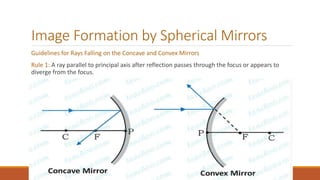
Guidelines for Rays Falling on the Concave and Convex Mirrors
Rule 1: A ray parallel to principal axis after reflection passes through the focus or appears to
diverge from the focus.
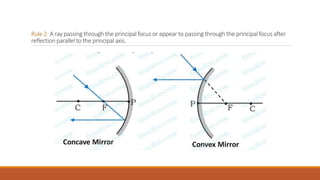
Rule 2: A ray passing through the principal focus or appear to passing through the principal focus after
reflection parallel to the principal axis.
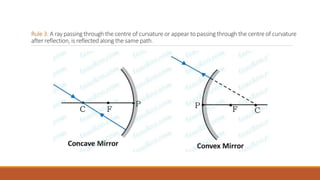
Rule 3: A ray passing through the centre of curvature or appear to passing through the centre of curvature
after reflection, is reflected along the same path.
Image Formation By Concave Mirror
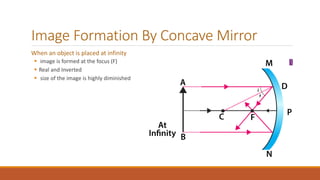
When an object is placed at infinity
 image is formed at the focus (F)
 Real and Inverted
 size of the image is highly diminished
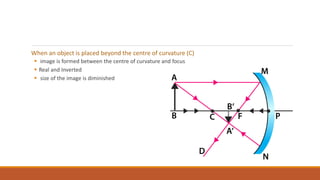
When an object is placed beyond the centre of curvature (C)
 image is formed between the centre of curvature and focus
 Real and Inverted
 size of the image is diminished
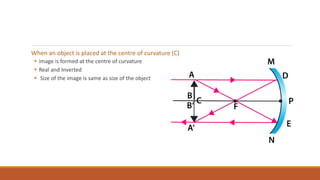
When an object is placed at the centre of curvature (C)
 image is formed at the centre of curvature
 Real and Inverted
 Size of the image is same as size of the object
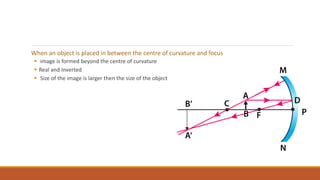
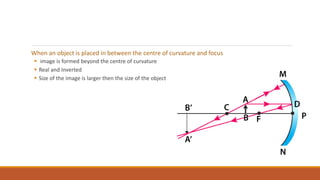
When an object is placed in between the centre of curvature and focus
 image is formed beyond the centre of curvature
 Real and Inverted
 Size of the image is larger then the size of the object
When an object is placed in between the centre of curvature and focus
 image is formed beyond the centre of curvature
 Real and Inverted
 Size of the image is larger then the size of the object
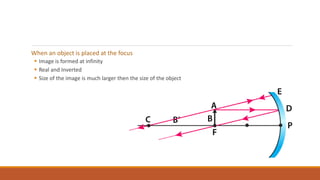
When an object is placed at the focus
 Image is formed at infinity
 Real and Inverted
 Size of the image is much larger then the size of the object
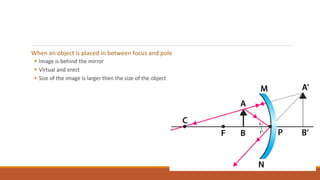
When an object is placed in between focus and pole
 Image is behind the mirror
 Virtual and erect
 Size of the image is larger then the size of the object
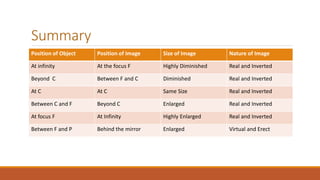
Summary
Position of Object Position of Image Size of Image Nature of Image
At infinity At the focus F Highly Diminished Real and Inverted
Beyond C Between F and C Diminished Real and Inverted
At C At C Same Size Real and Inverted
Between C and F Beyond C Enlarged Real and Inverted
At focus F At Infinity Highly Enlarged Real and Inverted
Between F and P Behind the mirror Enlarged Virtual and Erect
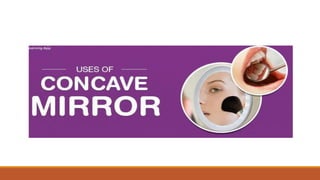
Uses of Concave Mirror
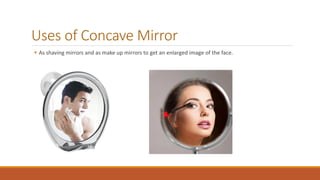
 As shaving mirrors and as make up mirrors to get an enlarged image of the face.
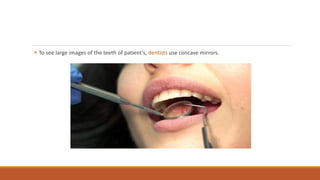
 To see large images of the teeth of patient’s, dentists use concave mirrors.
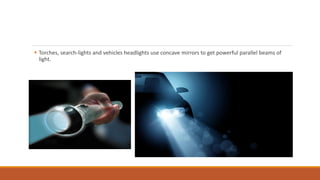
 Torches, search-lights and vehicles headlights use concave mirrors to get powerful parallel beams of
light.
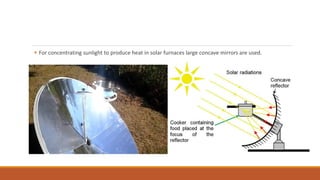
 For concentrating sunlight to produce heat in solar furnaces large concave mirrors are used.
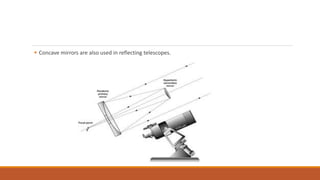
 Concave mirrors are also used in reflecting telescopes.
Image Formation By Convex Mirror
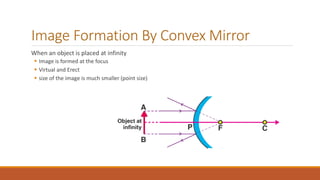
When an object is placed at infinity
 Image is formed at the focus
 Virtual and Erect
 size of the image is much smaller (point size)
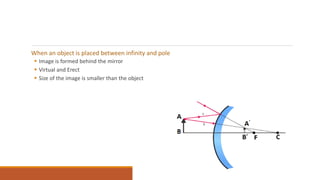
When an object is placed between infinity and pole
 Image is formed behind the mirror
 Virtual and Erect
 Size of the image is smaller than the object
Summary
Position Of Object Position of Image Size of Image Nature of Image
At Infinity At the focus F Highly diminished Virtual and Erect
Between Infinity and the Pole Between P and F Diminished Virtual and Erect
Uses of Convex Mirror
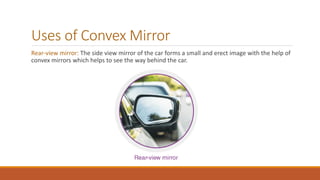
Rear-view mirror: The side view mirror of the car forms a small and erect image with the help of
convex mirrors which helps to see the way behind the car.
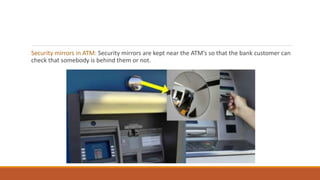
Security mirrors in ATM: Security mirrors are kept near the ATM’s so that the bank customer can
check that somebody is behind them or not.
They are used in passenger side mirror on a car and somewhere it is labelled as “objects in
mirror are closer than they appear” to warn the driver
They are used in driveways, roads, and alleys to provide safety to all the bikers and motorists at
curves and turns and other places where there is a lack of visibility.
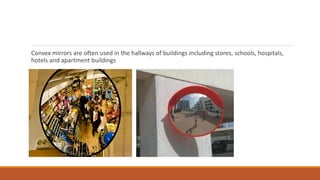
Convex mirrors are often used in the hallways of buildings including stores, schools, hospitals,
hotels and apartment buildings
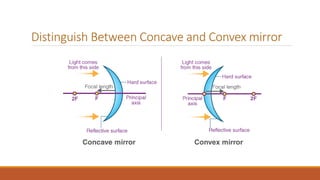
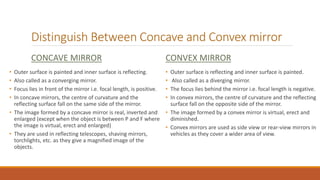
Distinguish Between Concave and Convex mirror
CONCAVE MIRROR
• Outer surface is painted and inner surface is reflecting.
• Also called as a converging mirror.
• Focus lies in front of the mirror i.e. focal length, is positive.
• In concave mirrors, the centre of curvature and the
reflecting surface fall on the same side of the mirror.
• The image formed by a concave mirror is real, inverted and
enlarged (except when the object is between P and F where
the image is virtual, erect and enlarged)
• They are used in reflecting telescopes, shaving mirrors,
torchlights, etc. as they give a magnified image of the
objects.
CONVEX MIRROR
• Outer surface is reflecting and inner surface is painted.
• Also called as a diverging mirror.
• The focus lies behind the mirror i.e. focal length is negative.
• In convex mirrors, the centre of curvature and the reflecting
surface fall on the opposite side of the mirror.
• The image formed by a convex mirror is virtual, erect and
diminished.
• Convex mirrors are used as side view or rear-view mirrors in
vehicles as they cover a wider area of view.
If an object is placed at a distance of 0.5 m in front of a plane
mirror, the distance between the object and the image formed
by the mirror will be
David is observing his image in a plane mirror. The distance between the
mirror and his image is 4 m. If he moves 1 m towards the mirror, then the
distance between David and his image will be

light

  • 1.
    LIGHT BY: MD. OBAIDULLAHANSARI BY: MD OBAIDULLAH ANSARI 1
  • 2.
    Light Light is aform of energy that causes sensation of vision in our eyes. How do we see objects? Our eyes alone do not allow us to see. Light from a source falls on an object and then bounces off onto our eyes and that is how we perceive it.  Light does not require a material medium for its propagation.  The velocity of light in air or vacuum is 3 x 10⁸ m/s  Rectilinear propagation of light: Light travels in a straight line between any two points.
  • 3.
    Propagation of light Rectilinearpropagation of light: Light travels in a straight line between any two points.
  • 4.
    Propagation of lightwith a simple experiment Take three cardboards A, B and C and make a pinhole at their centres. Place a burning candle on one side of A and arrange the cardboards in such a way that the three pinholes and the candle flame are in a straight line. The candle flame will be visible through the pinhole of the cardboard C. Now slightly displace any one of the cardboards and try to see the flame through the pinhole of the cardboard C. The flame will not be visible.  From this it is clear that light travels in a straight line.
  • 5.
    Ray and Beamof Light • A ray is the direction of the path in which light is travelling. • A ray is represented in diagrams by a straight line with an arrow on it. • Light rays from a point source of light travel in all directions, moving away with time. Such a beam of light is called a divergent beam of light. • A convergent beam of light rays comes together (converges) after reflection and refraction at a single point known as the focus
  • 6.
    Reflection of Light Reflectionof light is the phenomenon of bouncing back of light in the same medium on striking the surface of any object. Incident ray - The ray of light falling on the surface AB is called the incident ray (AO). Reflected ray - The Incident ray bouncing back In the same medium after striking the reflecting surface is called reflected ray(OB). Point of incidence- The point at which the light hits the surface is called the point of incidence. Normal - It is the line drawn perpendicular to the reflecting surface at the point of incidence(NO) Angle of Incidence - The angle formed between the incident ray and the normal Is the Angle of Incidence Angle of reflection - The angle formed between the normal and the reflected ray Is called angle of reflection
  • 8.
    Laws of Reflection Thereare two laws of reflection and they are: 1. The angle of incidence and the angle of reflection are always equal. 2. The incident ray, the normal at the point, and the reflected ray, all lie on the same plane.
  • 9.
    Types of Reflection Whenall the parallel rays reflected from a rough or irregular surface are not parallel, the reflection is known as Diffused or Irregular Reflection When all the parallel rays reflected from a regular surface are parallel, the reflection is known as Regular or Specular Reflection
  • 11.
    Plane Mirror Any flatand polished surface that has almost no irregularities on its surface that reflect light is called as a plane mirror. Image formation in a plane mirror Point Size Objet
  • 12.
    Image formation ina plane mirror (Extended Object)
  • 13.
    Characteristics of animage formed by plane mirror The image obtained is virtual. The image is laterally inverted. The image is erect. The size of the image is the same as the size of the object. The distance between the image obtained is the same as the distance between the object from the mirror.
  • 14.
    Spherical mirrors A mirrorwhose polished, reflecting surface is a part of a hollow sphere of glass or plastic is called a spherical mirror. Depending upon the nature of the reflecting surface of a mirror, the spherical mirror is classified as: Concave Mirror Convex Mirror Concave Mirror: If a hollow sphere is cut into parts and the outer surface of the cut part is painted, then it becomes a mirror with its inner surface as the reflecting surface. This type of mirror is known as a concave mirror. Convex Mirror: If the cut part of the hollow sphere is painted from inside, then its outer surface becomes the reflecting surface. This kind of mirror is known as a convex mirror.
  • 16.
    A concave mirroris also known as a Convergingmirror as this mirror converges light when they strike on its reflecting surface A convex mirror is also known as a Divergingmirroras this mirror diverges light when they strike on its reflecting surface
  • 17.
    Terms related toSpherical Mirror Centre of Curvature (C): Centre of Curvature is the centre of the sphere of which the spherical mirror forms a part. Pole (P): Pole is the midpoint of the aperture of the spherical mirror. Radius of Curvature (R): Radius of Curvature is the distance between the centre of curvature and pole of the mirror. Principal axis: Principal axis is the straight line passing through the pole and the centre of curvature of a spherical mirror. Focal length (f): Focal length is the distance between the pole and the focus of a mirror. Principal Focus or Focus (F): The rays of light parallel to the principal axis of a mirror after reflection, either pass through a point (in case of a concave mirror) or appear to pass through a point (in the case of a convex mirror) on the principal axis and this point is referred to as the principal focus or focal point of the mirror.
  • 19.
    Image Formation bySpherical Mirrors Guidelines for Rays Falling on the Concave and Convex Mirrors Rule 1: A ray parallel to principal axis after reflection passes through the focus or appears to diverge from the focus.
  • 20.
    Rule 2: Aray passing through the principal focus or appear to passing through the principal focus after reflection parallel to the principal axis.
  • 21.
    Rule 3: Aray passing through the centre of curvature or appear to passing through the centre of curvature after reflection, is reflected along the same path.
  • 22.
    Image Formation ByConcave Mirror When an object is placed at infinity  image is formed at the focus (F)  Real and Inverted  size of the image is highly diminished
  • 23.
    When an objectis placed beyond the centre of curvature (C)  image is formed between the centre of curvature and focus  Real and Inverted  size of the image is diminished
  • 24.
    When an objectis placed at the centre of curvature (C)  image is formed at the centre of curvature  Real and Inverted  Size of the image is same as size of the object
  • 25.
    When an objectis placed in between the centre of curvature and focus  image is formed beyond the centre of curvature  Real and Inverted  Size of the image is larger then the size of the object
  • 26.
    When an objectis placed in between the centre of curvature and focus  image is formed beyond the centre of curvature  Real and Inverted  Size of the image is larger then the size of the object
  • 27.
    When an objectis placed at the focus  Image is formed at infinity  Real and Inverted  Size of the image is much larger then the size of the object
  • 28.
    When an objectis placed in between focus and pole  Image is behind the mirror  Virtual and erect  Size of the image is larger then the size of the object
  • 29.
    Summary Position of ObjectPosition of Image Size of Image Nature of Image At infinity At the focus F Highly Diminished Real and Inverted Beyond C Between F and C Diminished Real and Inverted At C At C Same Size Real and Inverted Between C and F Beyond C Enlarged Real and Inverted At focus F At Infinity Highly Enlarged Real and Inverted Between F and P Behind the mirror Enlarged Virtual and Erect
  • 31.
    Uses of ConcaveMirror  As shaving mirrors and as make up mirrors to get an enlarged image of the face.
  • 32.
     To seelarge images of the teeth of patient’s, dentists use concave mirrors.
  • 33.
     Torches, search-lightsand vehicles headlights use concave mirrors to get powerful parallel beams of light.
  • 34.
     For concentratingsunlight to produce heat in solar furnaces large concave mirrors are used.
  • 35.
     Concave mirrorsare also used in reflecting telescopes.
  • 36.
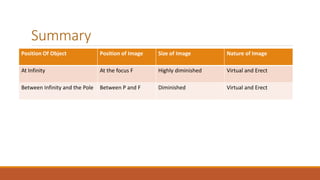
    Image Formation ByConvex Mirror When an object is placed at infinity  Image is formed at the focus  Virtual and Erect  size of the image is much smaller (point size)
  • 37.
    When an objectis placed between infinity and pole  Image is formed behind the mirror  Virtual and Erect  Size of the image is smaller than the object
  • 38.
    Summary Position Of ObjectPosition of Image Size of Image Nature of Image At Infinity At the focus F Highly diminished Virtual and Erect Between Infinity and the Pole Between P and F Diminished Virtual and Erect
  • 39.
    Uses of ConvexMirror Rear-view mirror: The side view mirror of the car forms a small and erect image with the help of convex mirrors which helps to see the way behind the car.
  • 40.
    Security mirrors inATM: Security mirrors are kept near the ATM’s so that the bank customer can check that somebody is behind them or not.
  • 41.
    They are usedin passenger side mirror on a car and somewhere it is labelled as “objects in mirror are closer than they appear” to warn the driver
  • 42.
    They are usedin driveways, roads, and alleys to provide safety to all the bikers and motorists at curves and turns and other places where there is a lack of visibility.
  • 43.
    Convex mirrors areoften used in the hallways of buildings including stores, schools, hospitals, hotels and apartment buildings
  • 44.
    Distinguish Between Concaveand Convex mirror
  • 45.
    Distinguish Between Concaveand Convex mirror CONCAVE MIRROR • Outer surface is painted and inner surface is reflecting. • Also called as a converging mirror. • Focus lies in front of the mirror i.e. focal length, is positive. • In concave mirrors, the centre of curvature and the reflecting surface fall on the same side of the mirror. • The image formed by a concave mirror is real, inverted and enlarged (except when the object is between P and F where the image is virtual, erect and enlarged) • They are used in reflecting telescopes, shaving mirrors, torchlights, etc. as they give a magnified image of the objects. CONVEX MIRROR • Outer surface is reflecting and inner surface is painted. • Also called as a diverging mirror. • The focus lies behind the mirror i.e. focal length is negative. • In convex mirrors, the centre of curvature and the reflecting surface fall on the opposite side of the mirror. • The image formed by a convex mirror is virtual, erect and diminished. • Convex mirrors are used as side view or rear-view mirrors in vehicles as they cover a wider area of view.
  • 46.
    If an objectis placed at a distance of 0.5 m in front of a plane mirror, the distance between the object and the image formed by the mirror will be
  • 47.
    David is observinghis image in a plane mirror. The distance between the mirror and his image is 4 m. If he moves 1 m towards the mirror, then the distance between David and his image will be