LEARNING OBJECTIVES—VIDEO 3
•RULES FOR TRACING IMAGES FORMED BY
CONCAVE MIRROR.
•IMAGE FORMATION BY A CONCAVE MIRROR
IN DIFFERENT POSITIONS OF THE OBJECT.
•SUMMARY OF THE CHARACTERISTICS OF
IMAGES FORMED BY A CONCAVE MIRROR.
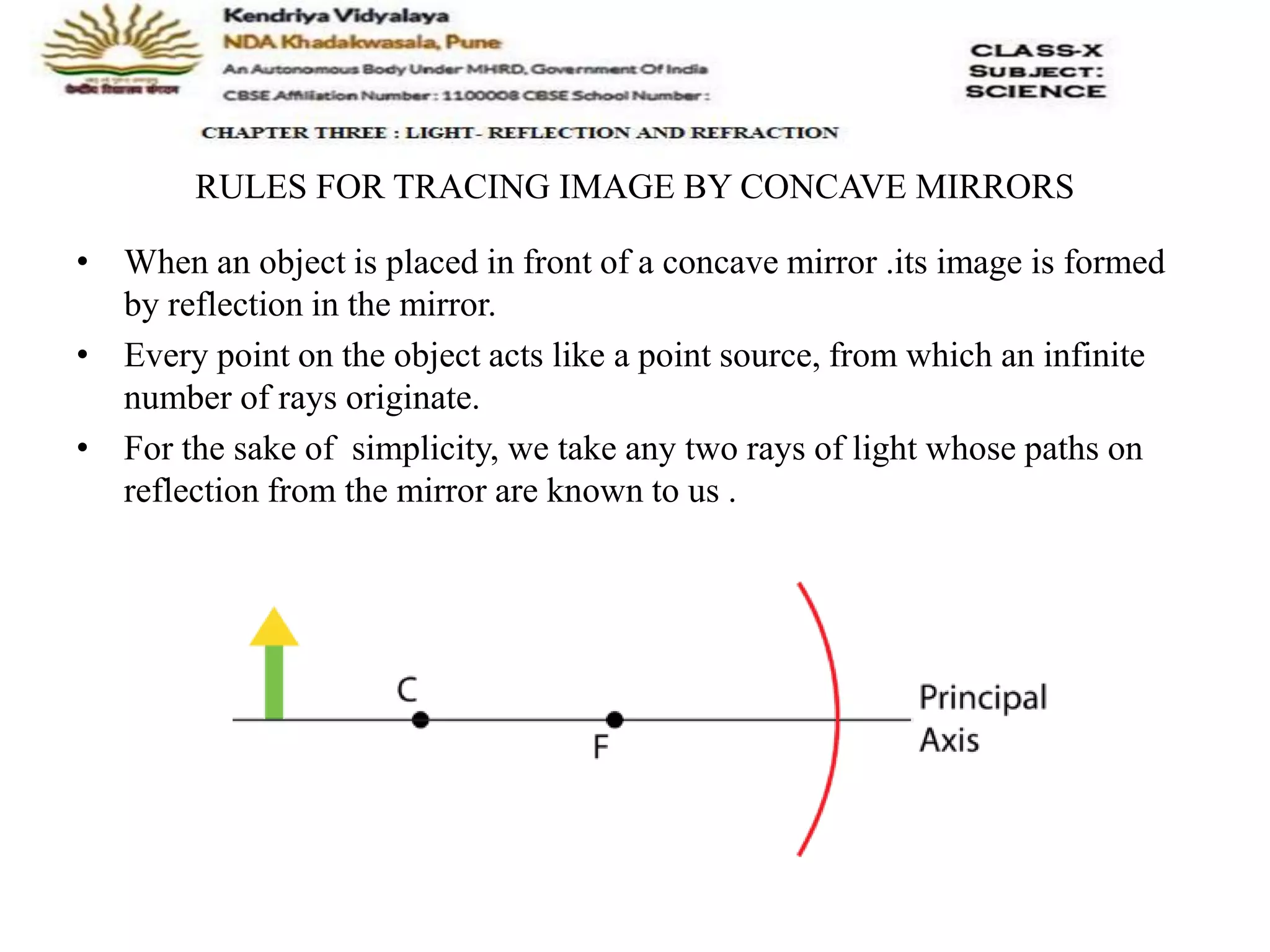
RULES FOR TRACING IMAGE BY CONCAVE MIRRORS
• When an object is placed in front of a concave mirror .its image is formed
by reflection in the mirror.
• Every point on the object acts like a point source, from which an infinite
number of rays originate.
• For the sake of simplicity, we take any two rays of light whose paths on
reflection from the mirror are known to us .
RULES FOR CONCAVE MIRROR
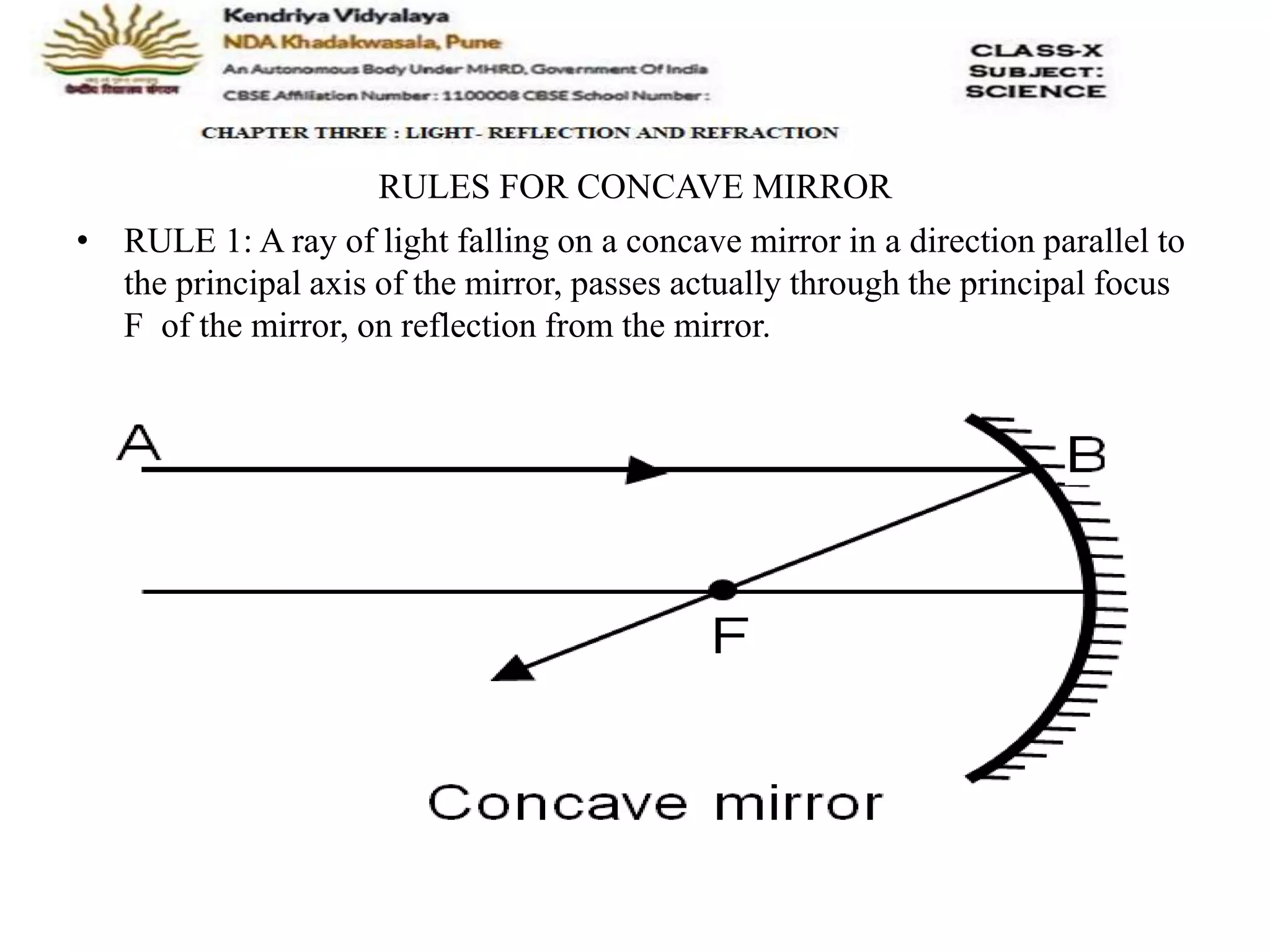
• RULE 1: A ray of light falling on a concave mirror in a direction parallel to
the principal axis of the mirror, passes actually through the principal focus
F of the mirror, on reflection from the mirror.
RULES FOR CONCAVE MIRROR
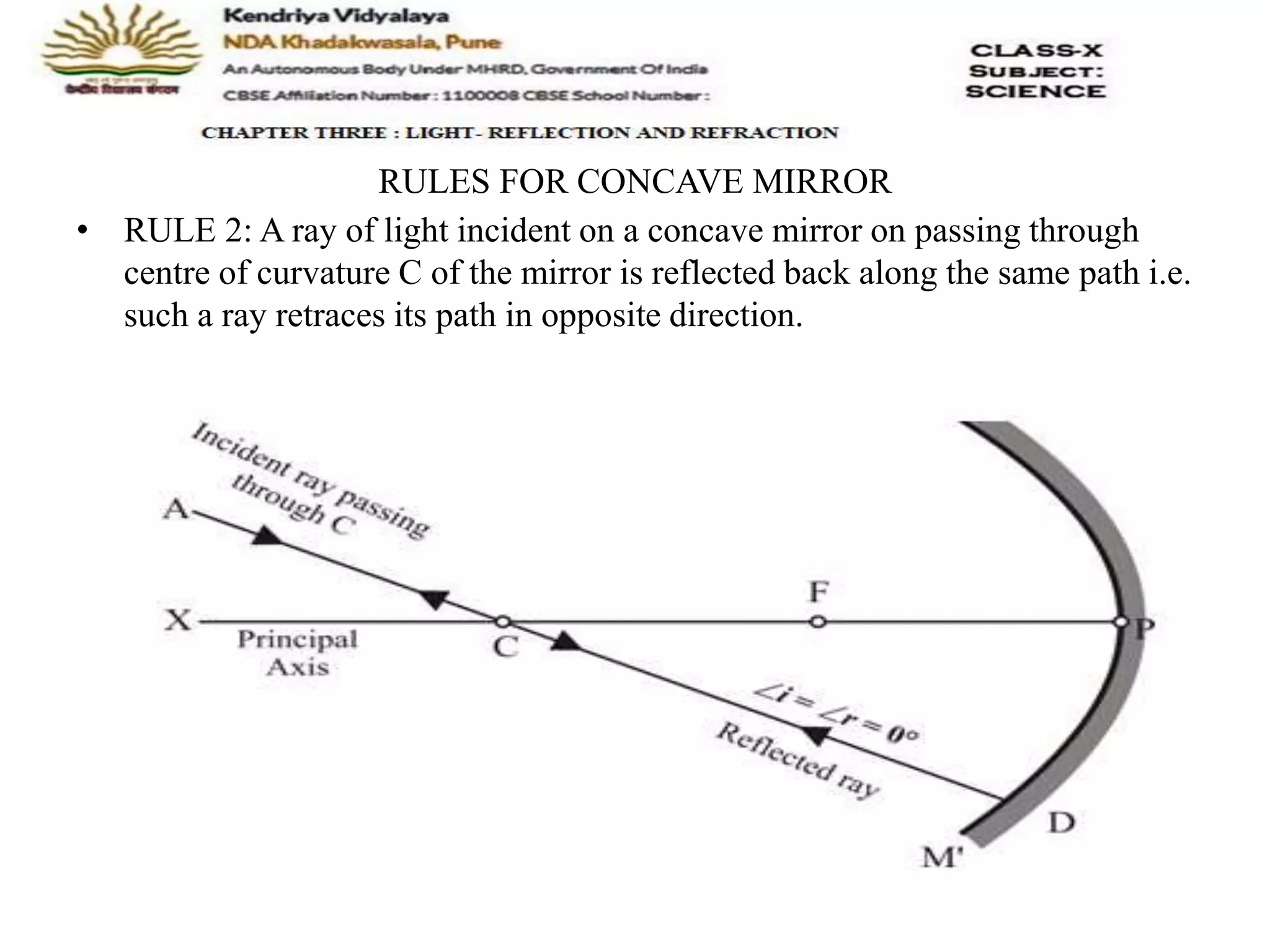
• RULE 2: A ray of light incident on a concave mirror on passing through
centre of curvature C of the mirror is reflected back along the same path i.e.
such a ray retraces its path in opposite direction.
RULES FOR CONCAVE MIRROR
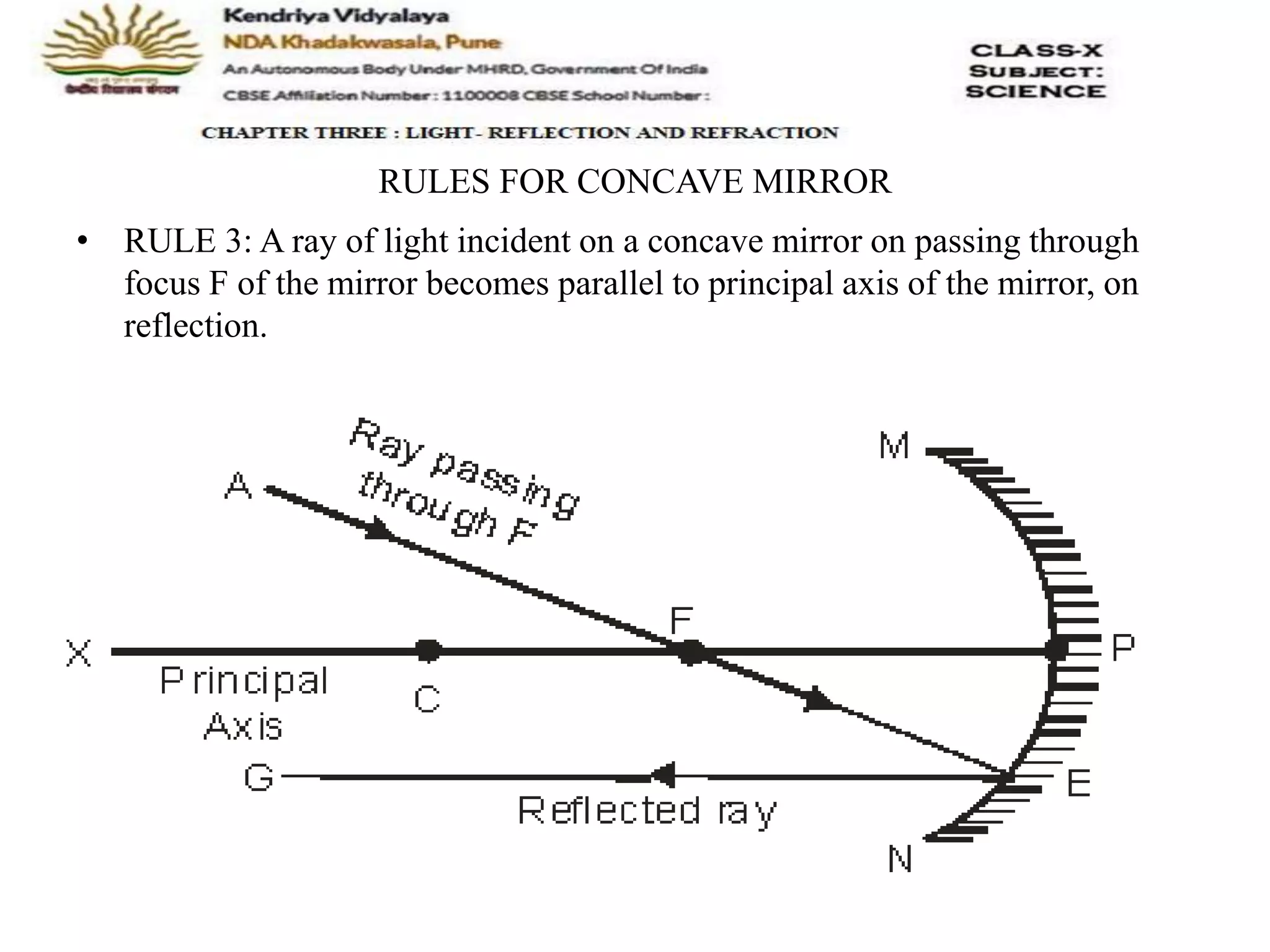
• RULE 3: A ray of light incident on a concave mirror on passing through
focus F of the mirror becomes parallel to principal axis of the mirror, on
reflection.
RULES FOR CONCAVE MIRROR
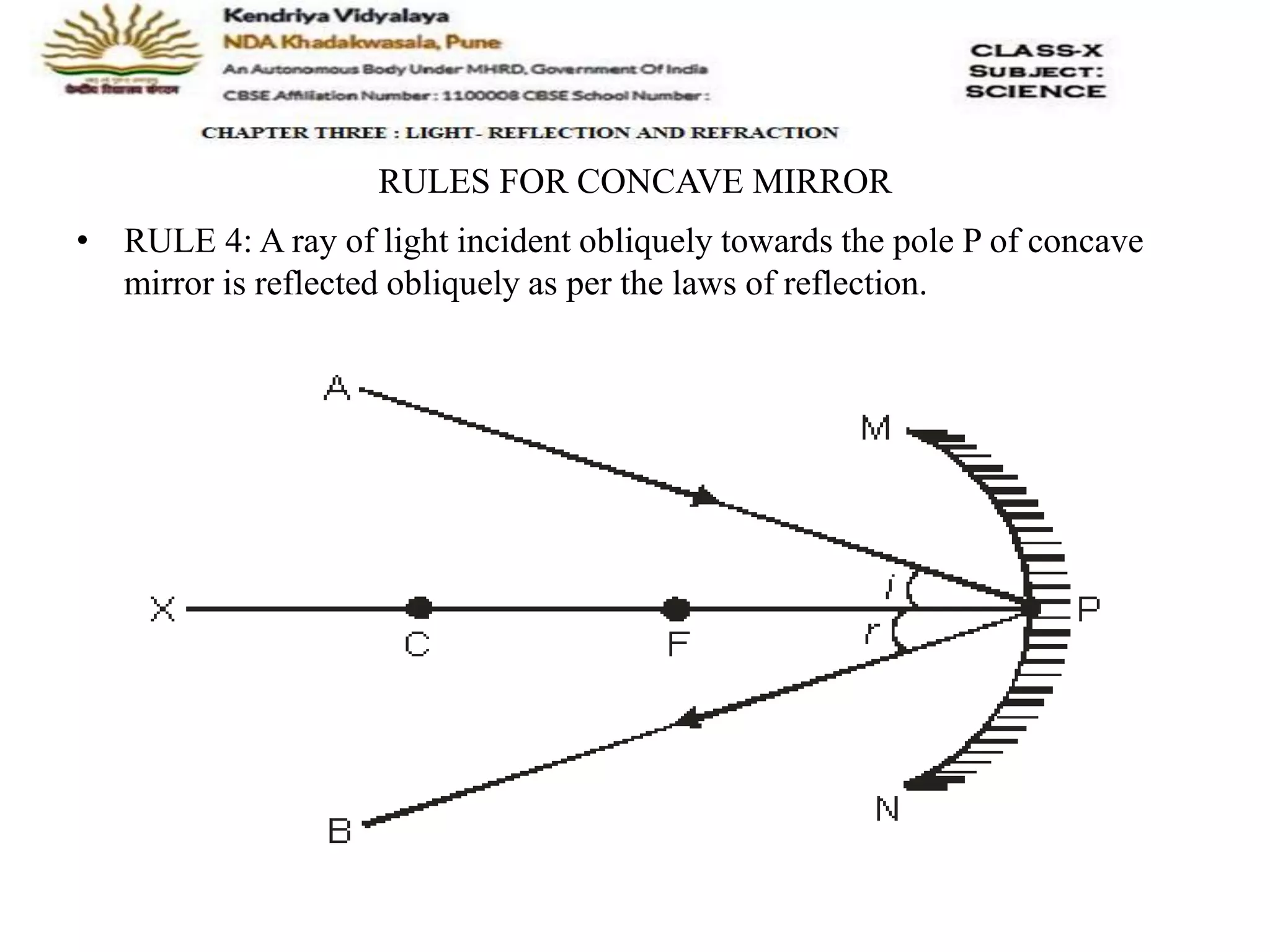
• RULE 4: A ray of light incident obliquely towards the pole P of concave
mirror is reflected obliquely as per the laws of reflection.
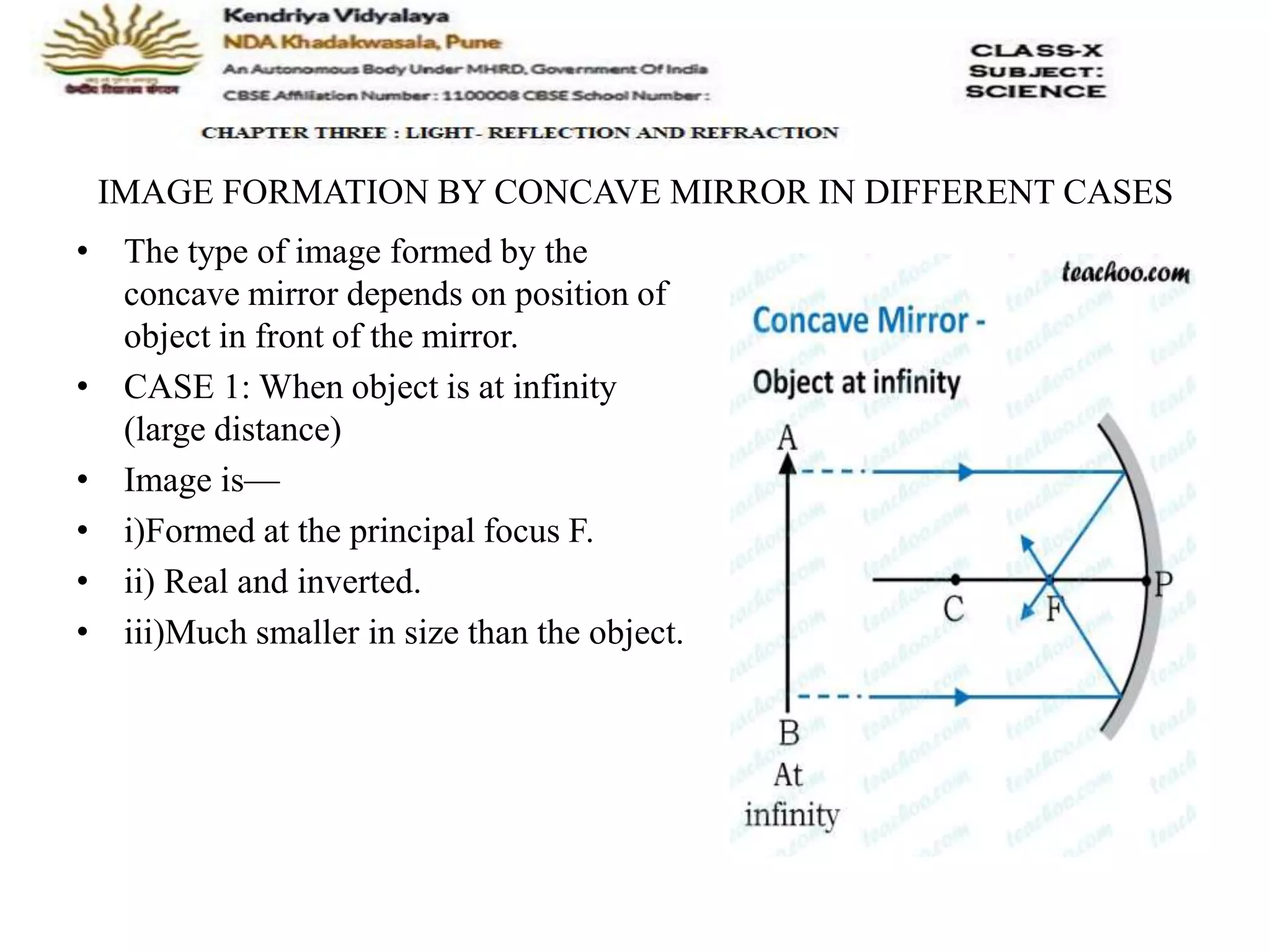
IMAGE FORMATION BY CONCAVE MIRROR IN DIFFERENT CASES
• The type of image formed by the
concave mirror depends on position of
object in front of the mirror.
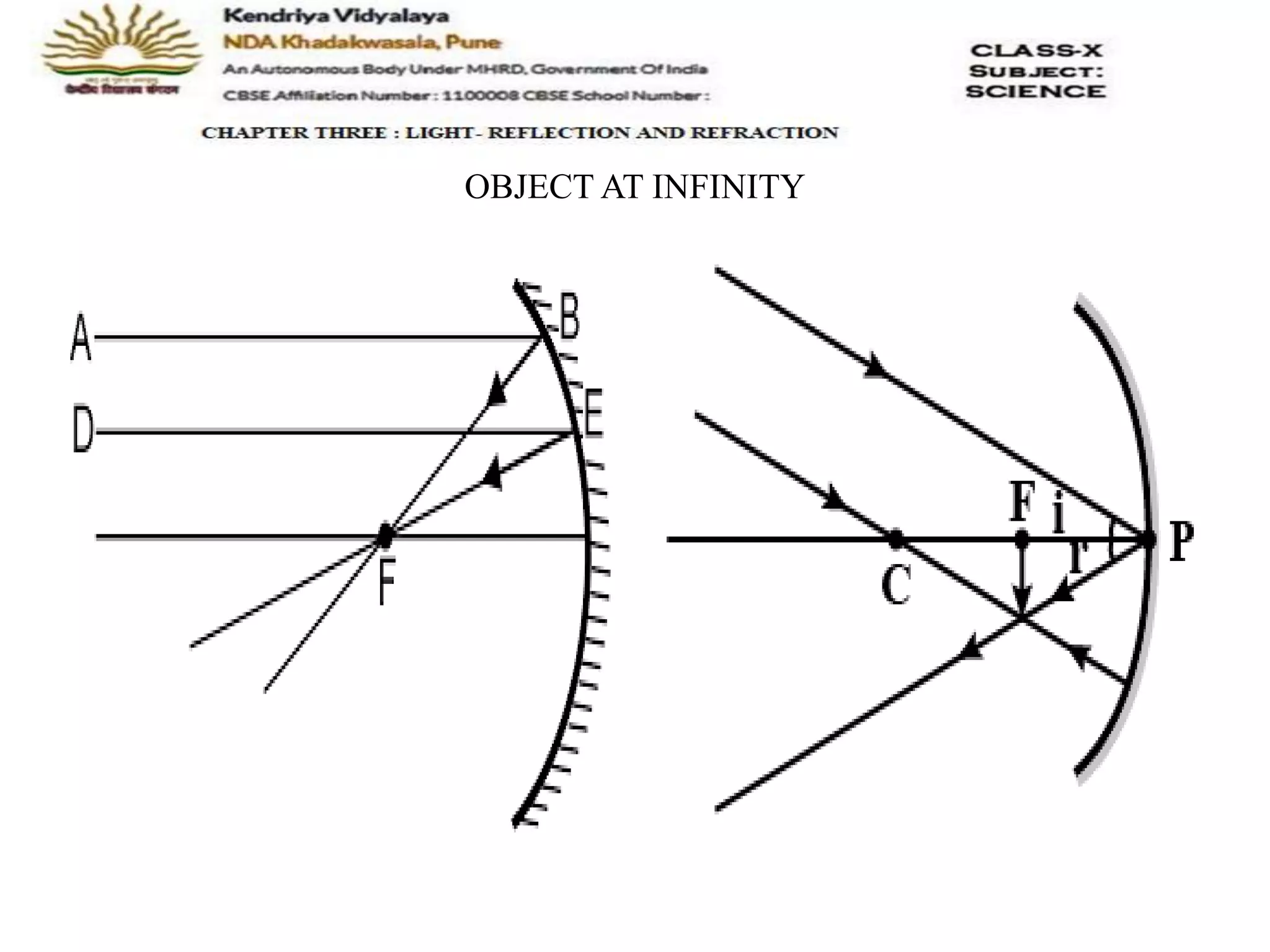
• CASE 1: When object is at infinity
(large distance)
• Image is—
• i)Formed at the principal focus F.
• ii) Real and inverted.
• iii)Much smaller in size than the object.
OBJECT AT INFINITY
IMAGE FORMATION BY CONCAVE MIRROR
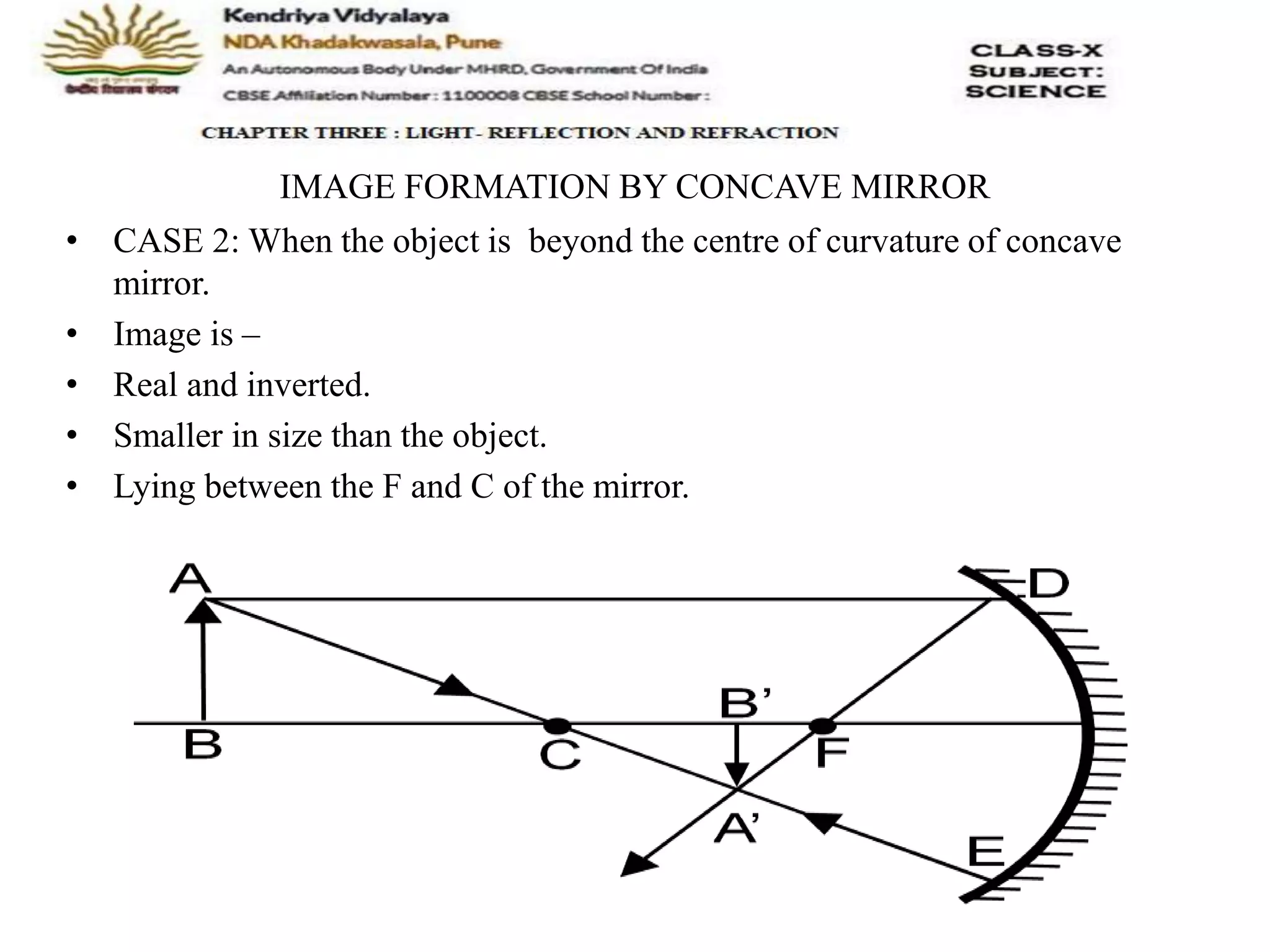
• CASE 2: When the object is beyond the centre of curvature of concave
mirror.
• Image is –
• Real and inverted.
• Smaller in size than the object.
• Lying between the F and C of the mirror.
IMAGE FORMATION BY CONCAVE MIRROR
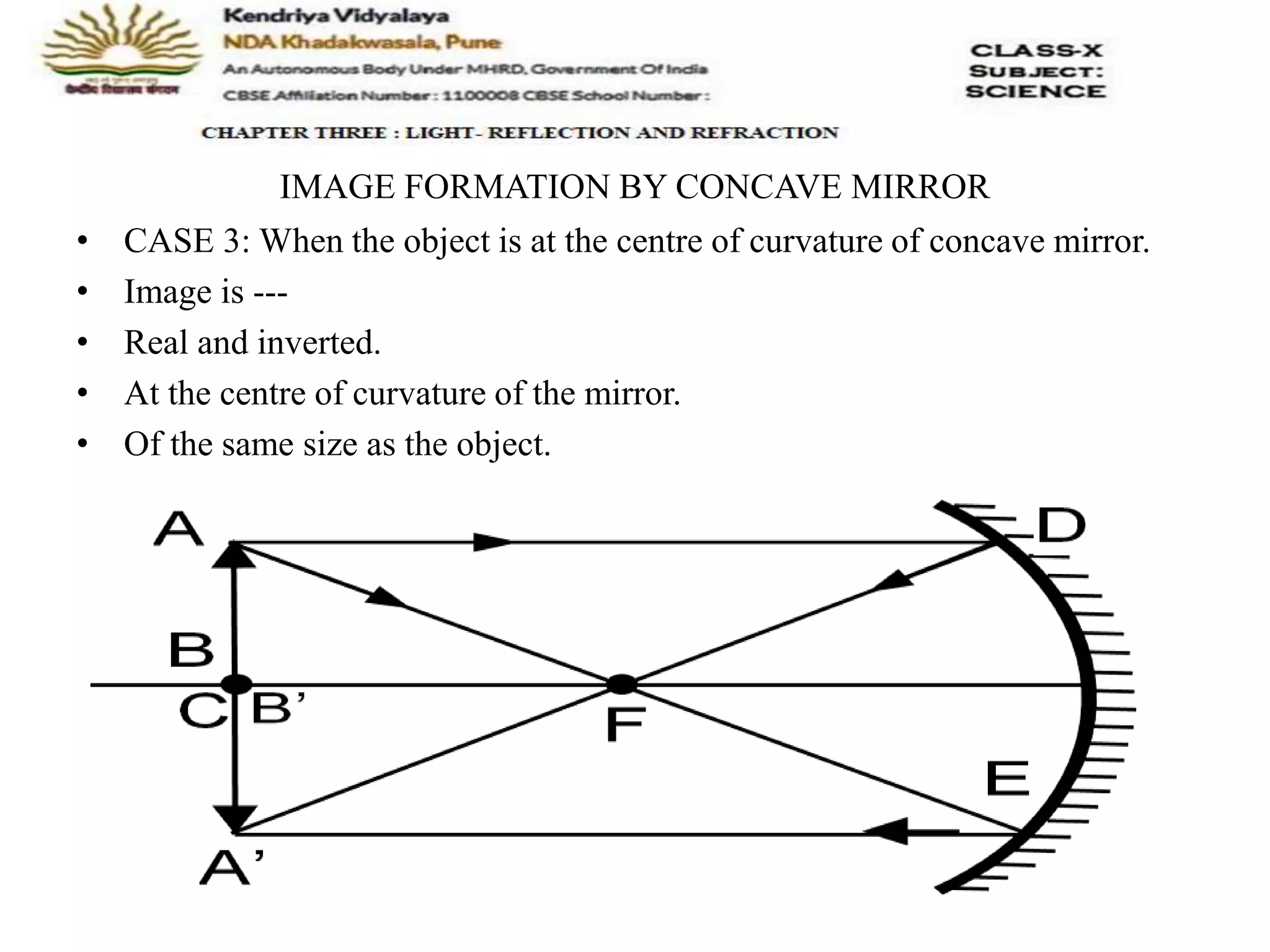
• CASE 3: When the object is at the centre of curvature of concave mirror.
• Image is ---
• Real and inverted.
• At the centre of curvature of the mirror.
• Of the same size as the object.
IMAGE FORMATION BY CONCAVE MIRROR
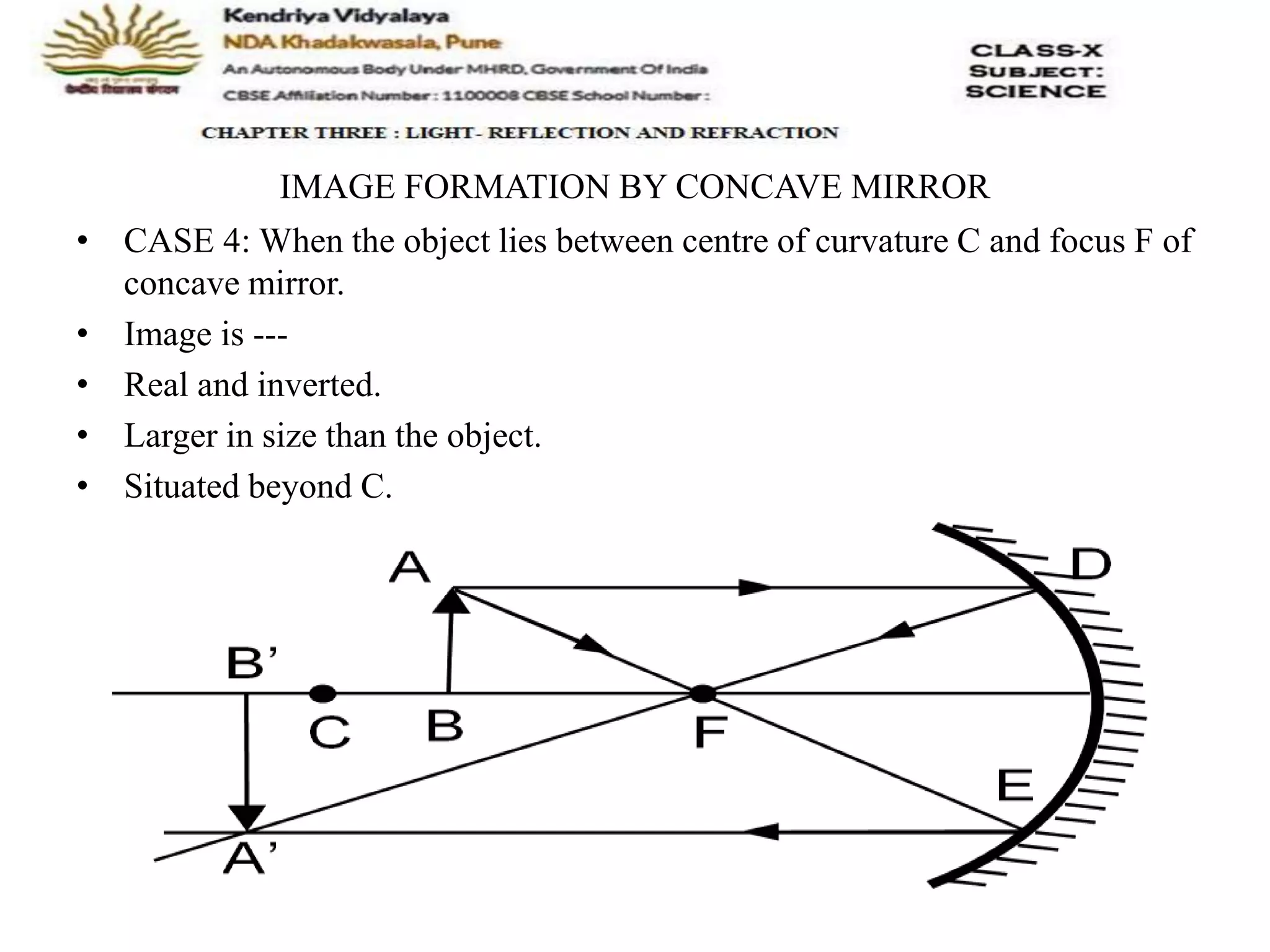
• CASE 4: When the object lies between centre of curvature C and focus F of
concave mirror.
• Image is ---
• Real and inverted.
• Larger in size than the object.
• Situated beyond C.
IMAGE FORMATION BY CONCAVE MIRROR
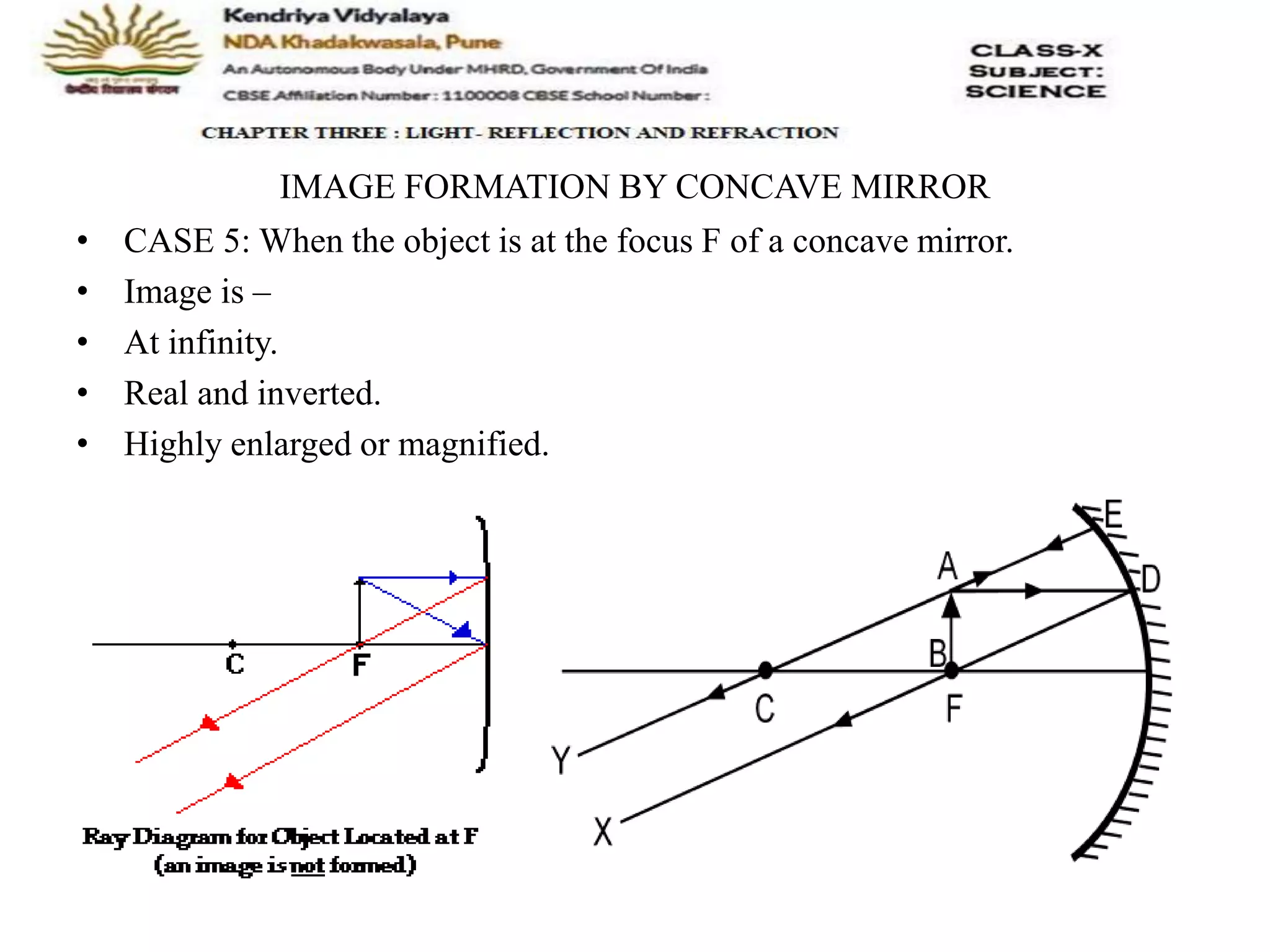
• CASE 5: When the object is at the focus F of a concave mirror.
• Image is –
• At infinity.
• Real and inverted.
• Highly enlarged or magnified.
IMAGE FORMATION BY CONCAVE MIRROR
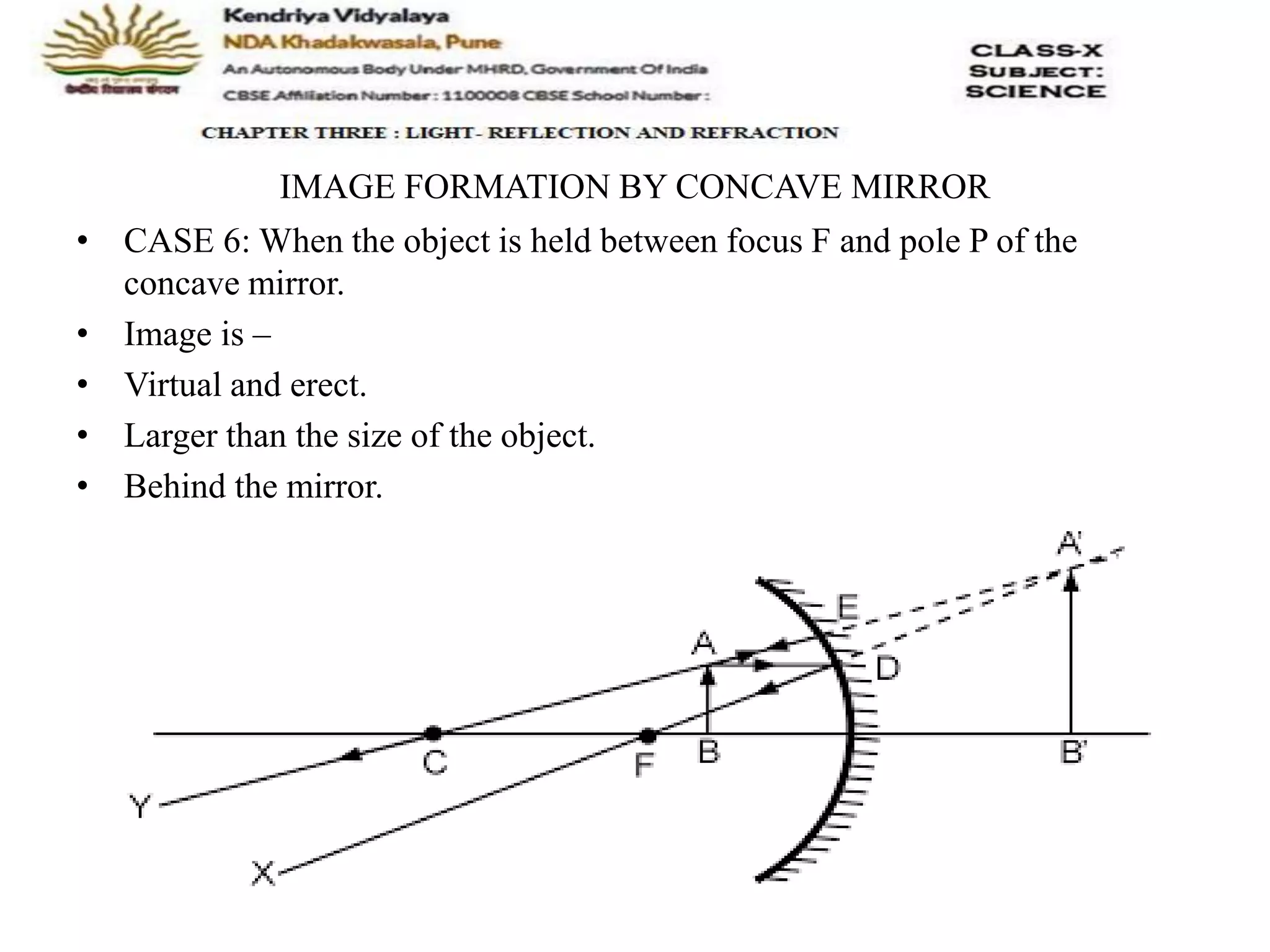
• CASE 6: When the object is held between focus F and pole P of the
concave mirror.
• Image is –
• Virtual and erect.
• Larger than the size of the object.
• Behind the mirror.
SUMMARY
• RULES FOR TRACING IMAGES FORMED BY CONCAVE MIRROR.
• IMAGE FORMATION BY A CONCAVE MIRROR IN DIFFERENT
POSITIONS OF THE OBJECT.
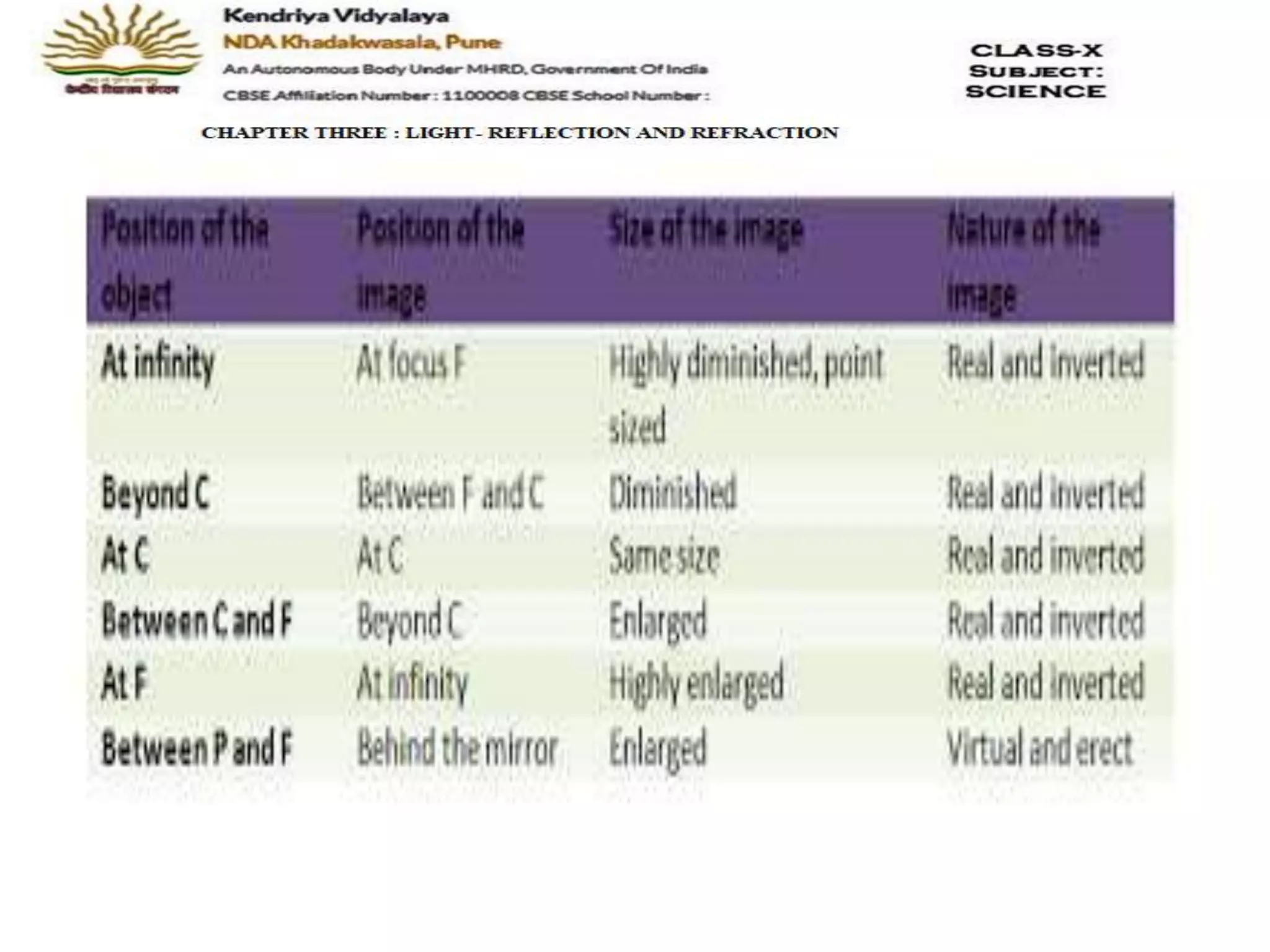
• SUMMARY OF THE CHARACTERISTICS OF IMAGES FORMED BY
A CONCAVE MIRROR.

CLASS-X SUBJECT-SCIENCE CHAPTER-LIGHT PPT 3

  • 1.
    LEARNING OBJECTIVES—VIDEO 3 •RULESFOR TRACING IMAGES FORMED BY CONCAVE MIRROR. •IMAGE FORMATION BY A CONCAVE MIRROR IN DIFFERENT POSITIONS OF THE OBJECT. •SUMMARY OF THE CHARACTERISTICS OF IMAGES FORMED BY A CONCAVE MIRROR.
  • 2.
    RULES FOR TRACINGIMAGE BY CONCAVE MIRRORS • When an object is placed in front of a concave mirror .its image is formed by reflection in the mirror. • Every point on the object acts like a point source, from which an infinite number of rays originate. • For the sake of simplicity, we take any two rays of light whose paths on reflection from the mirror are known to us .
  • 3.
    RULES FOR CONCAVEMIRROR • RULE 1: A ray of light falling on a concave mirror in a direction parallel to the principal axis of the mirror, passes actually through the principal focus F of the mirror, on reflection from the mirror.
  • 4.
    RULES FOR CONCAVEMIRROR • RULE 2: A ray of light incident on a concave mirror on passing through centre of curvature C of the mirror is reflected back along the same path i.e. such a ray retraces its path in opposite direction.
  • 5.
    RULES FOR CONCAVEMIRROR • RULE 3: A ray of light incident on a concave mirror on passing through focus F of the mirror becomes parallel to principal axis of the mirror, on reflection.
  • 6.
    RULES FOR CONCAVEMIRROR • RULE 4: A ray of light incident obliquely towards the pole P of concave mirror is reflected obliquely as per the laws of reflection.
  • 7.
    IMAGE FORMATION BYCONCAVE MIRROR IN DIFFERENT CASES • The type of image formed by the concave mirror depends on position of object in front of the mirror. • CASE 1: When object is at infinity (large distance) • Image is— • i)Formed at the principal focus F. • ii) Real and inverted. • iii)Much smaller in size than the object.
  • 8.
  • 9.
    IMAGE FORMATION BYCONCAVE MIRROR • CASE 2: When the object is beyond the centre of curvature of concave mirror. • Image is – • Real and inverted. • Smaller in size than the object. • Lying between the F and C of the mirror.
  • 10.
    IMAGE FORMATION BYCONCAVE MIRROR • CASE 3: When the object is at the centre of curvature of concave mirror. • Image is --- • Real and inverted. • At the centre of curvature of the mirror. • Of the same size as the object.
  • 11.
    IMAGE FORMATION BYCONCAVE MIRROR • CASE 4: When the object lies between centre of curvature C and focus F of concave mirror. • Image is --- • Real and inverted. • Larger in size than the object. • Situated beyond C.
  • 12.
    IMAGE FORMATION BYCONCAVE MIRROR • CASE 5: When the object is at the focus F of a concave mirror. • Image is – • At infinity. • Real and inverted. • Highly enlarged or magnified.
  • 13.
    IMAGE FORMATION BYCONCAVE MIRROR • CASE 6: When the object is held between focus F and pole P of the concave mirror. • Image is – • Virtual and erect. • Larger than the size of the object. • Behind the mirror.
  • 15.
    SUMMARY • RULES FORTRACING IMAGES FORMED BY CONCAVE MIRROR. • IMAGE FORMATION BY A CONCAVE MIRROR IN DIFFERENT POSITIONS OF THE OBJECT. • SUMMARY OF THE CHARACTERISTICS OF IMAGES FORMED BY A CONCAVE MIRROR.