Sequencing
             technologies
  past, current and next generation

•Introduction to Helicos, Illumina and
     Solid sequencing technology
             •Applications
               Robert Pinard
          Some slides were adapted from
            Karen Staehling-Hampton
           The Stowers Genome Center
Introduction
• Genomics research has entered a new age, in
  which deciphering the genome’s effect on
  biology and medicine requires not only the
  detection of mutations and sequence
  variation, but also understanding the dynamic
  nature of genome biology.
• The “Next Generation Sequencing” should be
  called the Current Generation Sequencing
Overview of three major next
    Generation Sequencing Technologies
•   Illumina / GAII
•   Helicos / Heliscope
•   Life Tech / Solid
•   (briefly Ion Torrent, PacBio
    & Complete Genomics)
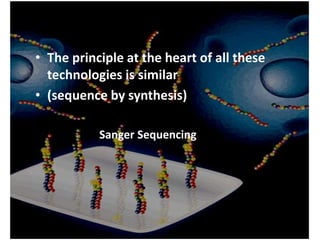
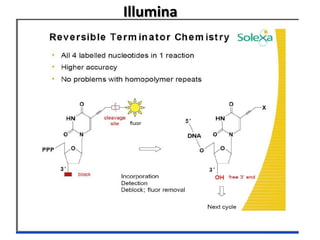
• The principle at the heart of all these
  technologies is similar
• (sequence by synthesis)

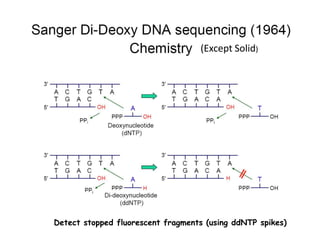
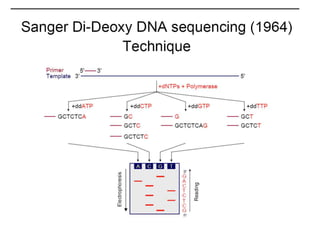
           Sanger Sequencing
(Except Solid)


Detect stopped fluorescent fragments (using ddNTP spikes)
• It is similar with the next generation
  sequencers where the different platforms
  either detect the incorporation of a
  fluorescent nucleotide or a bi-product of the
  reaction like the PPi or the release of a
  proton by the DNA polymerase
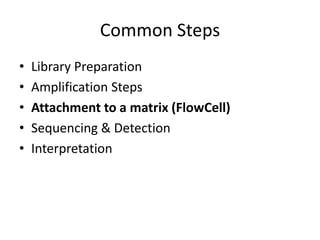
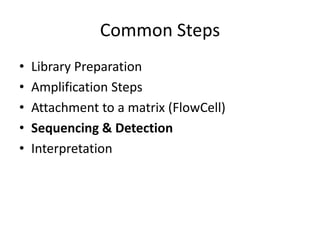
Common Steps (to all platforms)
•   Library Preparation
•   Amplification Steps
•   Attachment to a matrix (FlowCell)
•   Sequencing & Detection
•   Interpretation
Common Steps
•   Library Preparation
•   Amplification Steps
•   Attachment to a matrix (FlowCell)
•   Sequencing & Detection
•   Interpretation
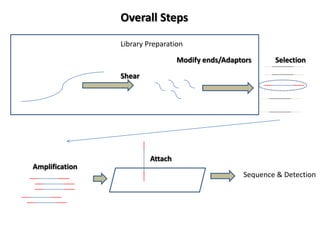
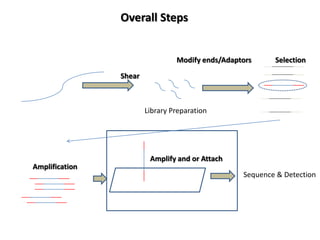
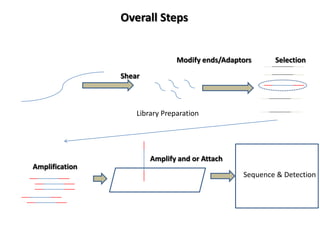
Overall Steps

                Library Preparation

                                  Modify ends/Adaptors     Selection

                Shear


                         Attach
Amplification
                                                   Sequence & Detection
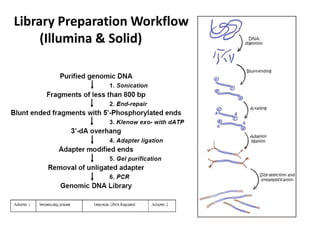
Library Preparation Workflow
     (Illumina & Solid)
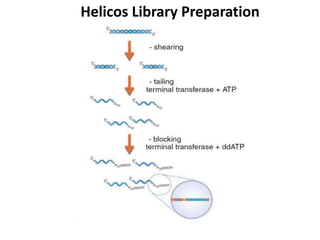
Helicos Library Preparation
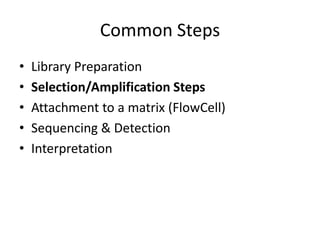
Common Steps
•   Library Preparation
•   Selection/Amplification Steps
•   Attachment to a matrix (FlowCell)
•   Sequencing & Detection
•   Interpretation
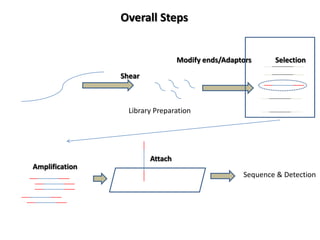
Overall Steps


                                 Modify ends/Adaptors     Selection

                Shear


                  Library Preparation


                        Attach
Amplification
                                                  Sequence & Detection
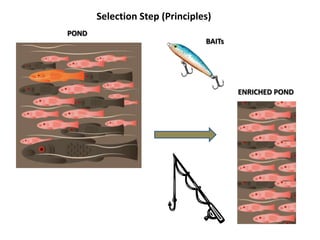
Selection Step (Principles)
POND
                                BAITs


                                        ENRICHED POND
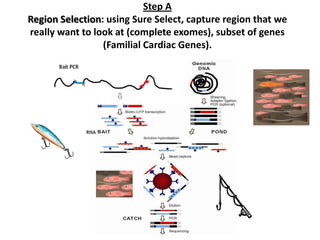
Step A
Region Selection: using Sure Select, capture region that we
really want to look at (complete exomes), subset of genes
                 (Familial Cardiac Genes).
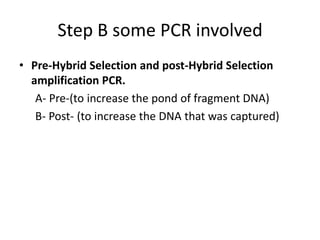
Step B some PCR involved
• Pre-Hybrid Selection and post-Hybrid Selection
  amplification PCR.
   A- Pre-(to increase the pond of fragment DNA)
   B- Post- (to increase the DNA that was captured)
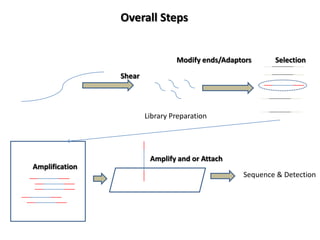
Overall Steps


                                 Modify ends/Adaptors     Selection

                Shear


                        Library Preparation


                         Amplify and or Attach
Amplification
                                                  Sequence & Detection
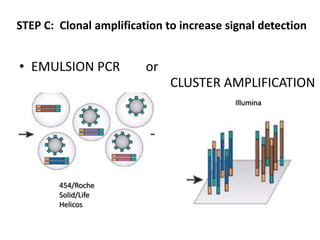
STEP C: Clonal amplification to increase signal detection


• EMULSION PCR           or
                              CLUSTER AMPLIFICATION
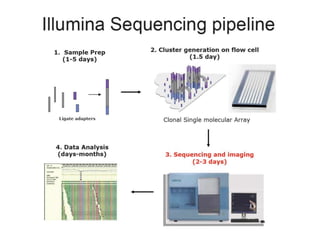
                                          Illumina


        454/Roche
        Solid/Life
        Helicos
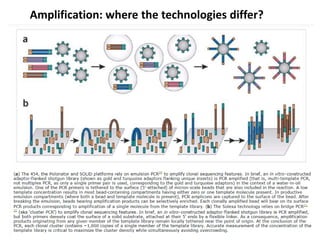
Amplification: where the technologies differ?
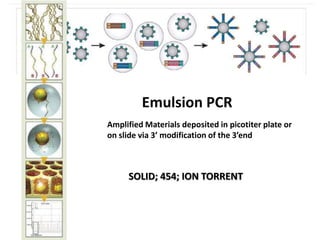
Emulsion PCR
Amplified Materials deposited in picotiter plate or
on slide via 3’ modification of the 3’end


     SOLID; 454; ION TORRENT
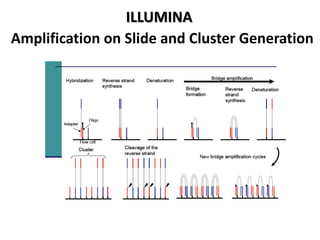
ILLUMINA
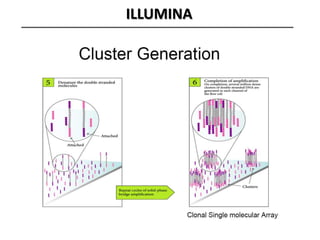
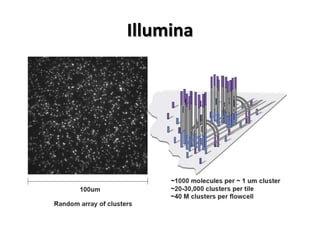
Amplification on Slide and Cluster Generation
ILLUMINA
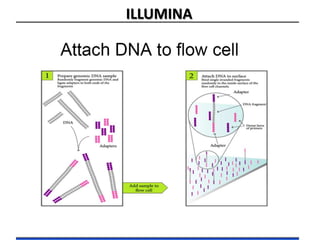
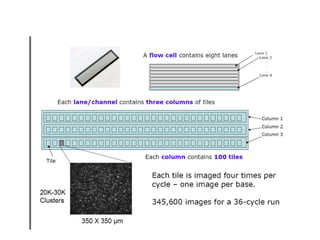
Illumina
Common Steps
•   Library Preparation
•   Amplification Steps
•   Attachment to a matrix (FlowCell)
•   Sequencing & Detection
•   Interpretation
Overall Steps


                                 Modify ends/Adaptors     Selection

                Shear


                        Library Preparation


                         Amplify and or Attach
Amplification
                                                  Sequence & Detection
ILLUMINA
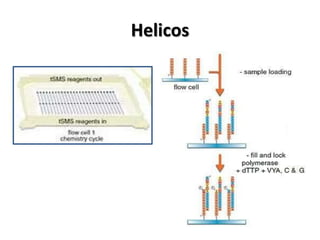
Helicos
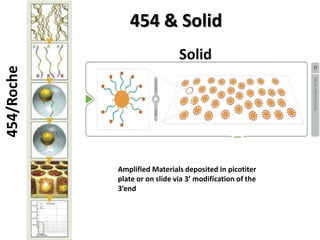
454 & Solid
                               Solid
454/Roche


            Amplified Materials deposited in picotiter
            plate or on slide via 3’ modification of the
            3’end
Common Steps
•   Library Preparation
•   Amplification Steps
•   Attachment to a matrix (FlowCell)
•   Sequencing & Detection
•   Interpretation
Overall Steps


                                Modify ends/Adaptors     Selection

                Shear


                    Library Preparation


                        Amplify and or Attach
Amplification
                                                 Sequence & Detection
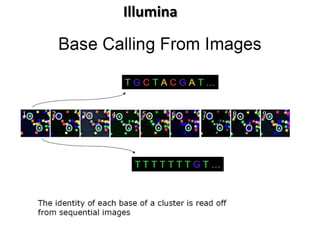
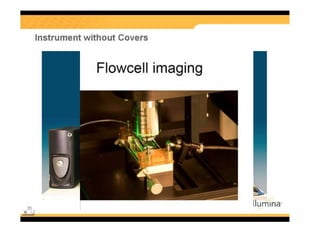
Illumina
Illumina
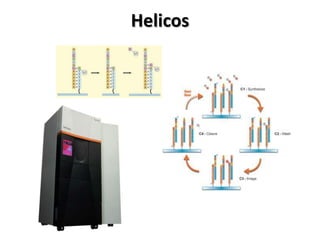
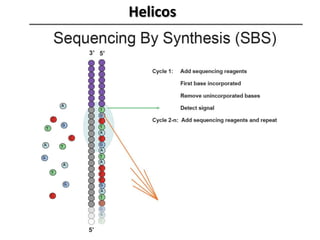
Helicos
Helicos
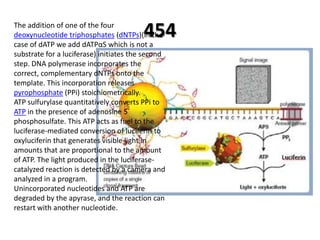
The addition of one of the four
                                         454
deoxynucleotide triphosphates (dNTPs)(in the
case of dATP we add dATPαS which is not a
substrate for a luciferase) initiates the second
step. DNA polymerase incorporates the
correct, complementary dNTPs onto the
template. This incorporation releases
pyrophosphate (PPi) stoichiometrically.
ATP sulfurylase quantitatively converts PPi to
ATP in the presence of adenosine 5´
phosphosulfate. This ATP acts as fuel to the
luciferase-mediated conversion of luciferin to
oxyluciferin that generates visible light in
amounts that are proportional to the amount
of ATP. The light produced in the luciferase-
catalyzed reaction is detected by a camera and
analyzed in a program.
Unincorporated nucleotides and ATP are
degraded by the apyrase, and the reaction can
restart with another nucleotide.
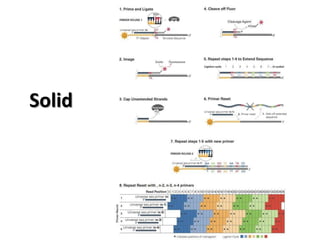
Solid
Common Steps
•   Library Preparation
•   Amplification Steps
•   Attachment to a matrix (FlowCell)
•   Sequencing & Detection
•   Interpretation
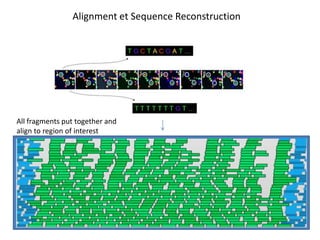
Alignment et Sequence Reconstruction


All fragments put together and
align to region of interest
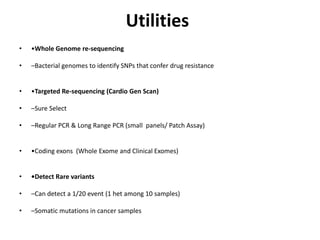
Utilities
•   •Whole Genome re-sequencing

•   –Bacterial genomes to identify SNPs that confer drug resistance


•   •Targeted Re-sequencing (Cardio Gen Scan)

•   –Sure Select

•   –Regular PCR & Long Range PCR (small panels/ Patch Assay)


•   •Coding exons (Whole Exome and Clinical Exomes)


•   •Detect Rare variants

•   –Can detect a 1/20 event (1 het among 10 samples)

•   –Somatic mutations in cancer samples
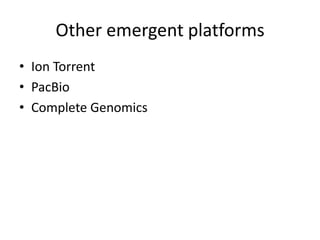
Other emergent platforms
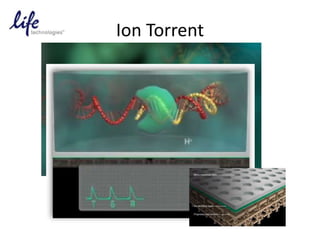
• Ion Torrent
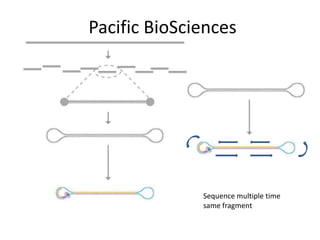
• PacBio
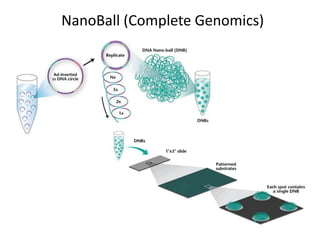
• Complete Genomics
Ion Torrent
Pacific BioSciences


              Sequence multiple time
              same fragment
NanoBall (Complete Genomics)
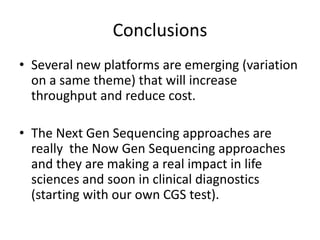
Conclusions
• Several new platforms are emerging (variation
  on a same theme) that will increase
  throughput and reduce cost.

• The Next Gen Sequencing approaches are
  really the Now Gen Sequencing approaches
  and they are making a real impact in life
  sciences and soon in clinical diagnostics
  (starting with our own CGS test).

Correlagen next gen presentation 042711

  • 1.
    Sequencing technologies past, current and next generation •Introduction to Helicos, Illumina and Solid sequencing technology •Applications Robert Pinard Some slides were adapted from Karen Staehling-Hampton The Stowers Genome Center
  • 2.
    Introduction • Genomics researchhas entered a new age, in which deciphering the genome’s effect on biology and medicine requires not only the detection of mutations and sequence variation, but also understanding the dynamic nature of genome biology. • The “Next Generation Sequencing” should be called the Current Generation Sequencing
  • 3.
    Overview of threemajor next Generation Sequencing Technologies • Illumina / GAII • Helicos / Heliscope • Life Tech / Solid • (briefly Ion Torrent, PacBio & Complete Genomics)
  • 6.
    • The principleat the heart of all these technologies is similar • (sequence by synthesis) Sanger Sequencing
  • 7.
    (Except Solid) Detect stoppedfluorescent fragments (using ddNTP spikes)
  • 9.
    • It issimilar with the next generation sequencers where the different platforms either detect the incorporation of a fluorescent nucleotide or a bi-product of the reaction like the PPi or the release of a proton by the DNA polymerase
  • 10.
    Common Steps (toall platforms) • Library Preparation • Amplification Steps • Attachment to a matrix (FlowCell) • Sequencing & Detection • Interpretation
  • 11.
    Common Steps • Library Preparation • Amplification Steps • Attachment to a matrix (FlowCell) • Sequencing & Detection • Interpretation
  • 12.
    Overall Steps Library Preparation Modify ends/Adaptors Selection Shear Attach Amplification Sequence & Detection
  • 13.
  • 14.
  • 15.
    Common Steps • Library Preparation • Selection/Amplification Steps • Attachment to a matrix (FlowCell) • Sequencing & Detection • Interpretation
  • 16.
    Overall Steps Modify ends/Adaptors Selection Shear Library Preparation Attach Amplification Sequence & Detection
  • 17.
  • 18.
    Step A Region Selection:using Sure Select, capture region that we really want to look at (complete exomes), subset of genes (Familial Cardiac Genes).
  • 19.
    Step B somePCR involved • Pre-Hybrid Selection and post-Hybrid Selection amplification PCR. A- Pre-(to increase the pond of fragment DNA) B- Post- (to increase the DNA that was captured)
  • 20.
    Overall Steps Modify ends/Adaptors Selection Shear Library Preparation Amplify and or Attach Amplification Sequence & Detection
  • 21.
    STEP C: Clonalamplification to increase signal detection • EMULSION PCR or CLUSTER AMPLIFICATION Illumina 454/Roche Solid/Life Helicos
  • 22.
    Amplification: where thetechnologies differ?
  • 23.
    Emulsion PCR Amplified Materialsdeposited in picotiter plate or on slide via 3’ modification of the 3’end SOLID; 454; ION TORRENT
  • 24.
    ILLUMINA Amplification on Slideand Cluster Generation
  • 25.
  • 26.
  • 27.
    Common Steps • Library Preparation • Amplification Steps • Attachment to a matrix (FlowCell) • Sequencing & Detection • Interpretation
  • 28.
    Overall Steps Modify ends/Adaptors Selection Shear Library Preparation Amplify and or Attach Amplification Sequence & Detection
  • 29.
  • 31.
  • 32.
    454 & Solid Solid 454/Roche Amplified Materials deposited in picotiter plate or on slide via 3’ modification of the 3’end
  • 33.
    Common Steps • Library Preparation • Amplification Steps • Attachment to a matrix (FlowCell) • Sequencing & Detection • Interpretation
  • 34.
    Overall Steps Modify ends/Adaptors Selection Shear Library Preparation Amplify and or Attach Amplification Sequence & Detection
  • 35.
  • 36.
  • 38.
  • 39.
  • 40.
    The addition ofone of the four 454 deoxynucleotide triphosphates (dNTPs)(in the case of dATP we add dATPαS which is not a substrate for a luciferase) initiates the second step. DNA polymerase incorporates the correct, complementary dNTPs onto the template. This incorporation releases pyrophosphate (PPi) stoichiometrically. ATP sulfurylase quantitatively converts PPi to ATP in the presence of adenosine 5´ phosphosulfate. This ATP acts as fuel to the luciferase-mediated conversion of luciferin to oxyluciferin that generates visible light in amounts that are proportional to the amount of ATP. The light produced in the luciferase- catalyzed reaction is detected by a camera and analyzed in a program. Unincorporated nucleotides and ATP are degraded by the apyrase, and the reaction can restart with another nucleotide.
  • 41.
  • 42.
    Common Steps • Library Preparation • Amplification Steps • Attachment to a matrix (FlowCell) • Sequencing & Detection • Interpretation
  • 43.
    Alignment et SequenceReconstruction All fragments put together and align to region of interest
  • 47.
    Utilities • •Whole Genome re-sequencing • –Bacterial genomes to identify SNPs that confer drug resistance • •Targeted Re-sequencing (Cardio Gen Scan) • –Sure Select • –Regular PCR & Long Range PCR (small panels/ Patch Assay) • •Coding exons (Whole Exome and Clinical Exomes) • •Detect Rare variants • –Can detect a 1/20 event (1 het among 10 samples) • –Somatic mutations in cancer samples
  • 49.
    Other emergent platforms •Ion Torrent • PacBio • Complete Genomics
  • 50.
  • 51.
    Pacific BioSciences Sequence multiple time same fragment
  • 52.
  • 53.
    Conclusions • Several newplatforms are emerging (variation on a same theme) that will increase throughput and reduce cost. • The Next Gen Sequencing approaches are really the Now Gen Sequencing approaches and they are making a real impact in life sciences and soon in clinical diagnostics (starting with our own CGS test).