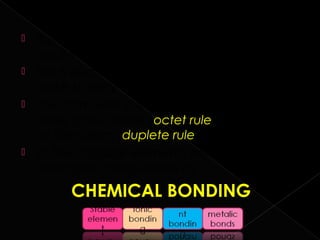
The stable elementsThe stable elements
Ionic bondingIonic bonding
Metalic bondsMetalic bonds
Covalent bondingCovalent bonding
 Many nature elements are unstable and
tend to form compounds, except
the noble gas
 The are no nature noble gas compounds found
 The noble gases are stable elements
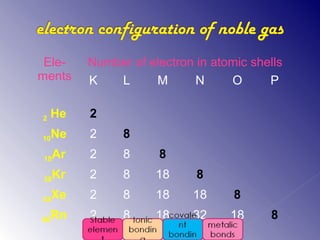
Ele-
ments
Number of electron in atomic shells
K L M N O P
2 He 2
10Ne 2 8
18Ar 2 8 8
36Kr 2 8 18 8
54Xe 2 8 18 18 8
86Rn 2 8 18 32 18 8
 The outer (valence) shell of noble gas atom
has 8 electrons (except He : 2 electrons)
 The 8 electrons form 4 electron pairs and
make stability
 The atom with 8 valence electrons like
noble gas is stable (octet rule) > 2 electron
for little atom (duplete rule)
 So the unstable elements trends to reach
noble gas configuration by :
CHEMICAL BONDING
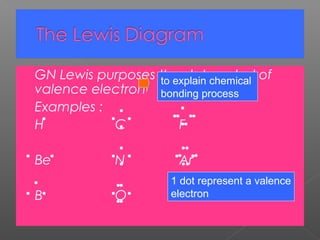
 GN Lewis purposes the dot symbol of
valence electron
 Examples :
H C F
Be N Ar
B O
1 dot represent a valence
electron
to explain chemical
bonding process
conceptconcept
examplesexamples
exercisesexercises summarysummary Home
assigment
Home
assigment
Covalent
coordinate
Covalent
coordinate
Single
Double
Tripple
bond
Single
Double
Tripple
bond
Polar
Covalent
bond
Polar
Covalent
bond
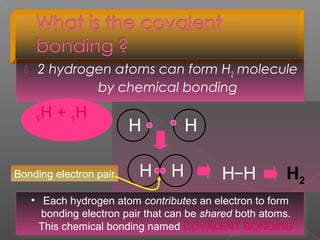
 2 hydrogen atoms can form H2 molecule
by chemical bonding
 2 hydrogen atoms can form H2 molecule
by chemical bonding
1H + 1H
H H
H H H H H2
Bonding electron pair
• Each hydrogen atom contributes an electron to form
bonding electron pair that can be shared both atoms.
This chemical bonding named COVALENT BONDING
• Each hydrogen atom contributes an electron to form
bonding electron pair that can be shared both atoms.
This chemical bonding named COVALENT BONDING
H
H
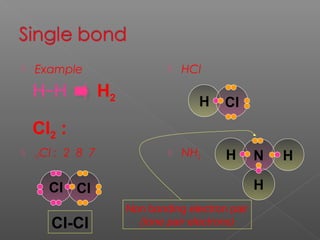
 Example
 17Cl : 2 8 7
 HCl
 NH3
H H H2
Cl2 :
Cl Cl
Cl-Cl
H Cl
H N
Non bonding electron pair
(lone pair electrons)
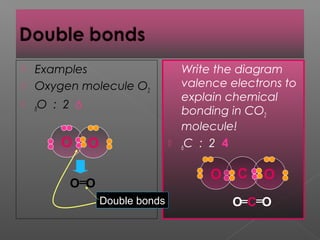
 Examples
 Oxygen molecule O2
 8O : 2 6
 Write the diagram
valence electrons to
explain chemical
bonding in CO2
molecule!
 6C : 2 4O O
O O
Double bonds
C OO
O OC
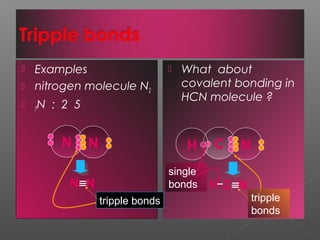
 Examples
 nitrogen molecule N2
 7N : 2 5
 Examples
 nitrogen molecule N2
 7N : 2 5
 What about
covalent bonding in
HCN molecule ?
 What about
covalent bonding in
HCN molecule ?
N N
N N
tripple bonds
C N
C N
H
H
single
bonds
tripple
bonds
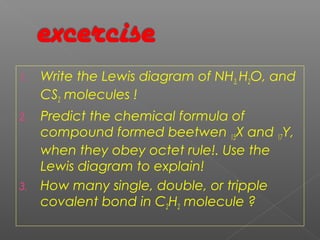
1. Write the Lewis diagram of NH3, H2O, and
CS2 molecules !
2. Predict the chemical formula of
compound formed beetwen 15X and 17Y,
when they obey octet rule!. Use the
Lewis diagram to explain!
3. How many single, double, or tripple
covalent bond in C2H2 molecule ?
 The covalent bonding is chemical
bonding resulted by sharing electron
pairs that is formed by electrons
contributing from atoms.
 The covalent bonding should be single,
double, or tripple bond, form molecular
compound.
Covalent bond
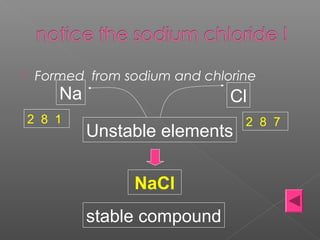
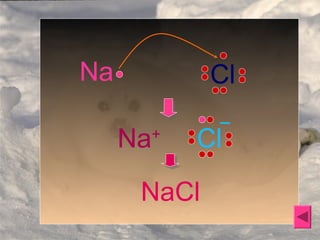
 Formed from sodium and chlorine
Na Cl
Unstable elements
2 8 1 2 8 7
NaCl
stable compound
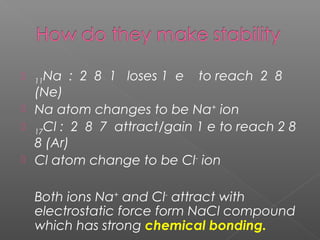
 11Na : 2 8 1 loses 1 e to reach 2 8
(Ne)
 Na atom changes to be Na+
ion
 17Cl : 2 8 7 attract/gain 1 e to reach 2 8
8 (Ar)
 Cl atom change to be Cl-
ion
Both ions Na+
and Cl-
attract with
electrostatic force form NaCl compound
which has strong chemical bonding.
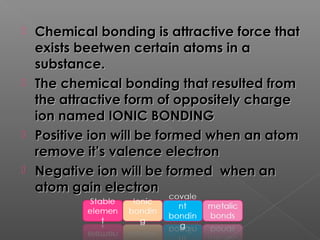
 Chemical bonding is attractive force thatChemical bonding is attractive force that
exists beetwen certain atoms in aexists beetwen certain atoms in a
substance.substance.
 The chemical bonding that resulted fromThe chemical bonding that resulted from
the attractive form of oppositely chargethe attractive form of oppositely charge
ion named IONIC BONDINGion named IONIC BONDING
 Positive ion will be formed when an atomPositive ion will be formed when an atom
remove it’s valence electronremove it’s valence electron
 Negative ion will be formed when anNegative ion will be formed when an
atom gain electronatom gain electron
Na Cl
Na+
Cl
_
NaCl
 Explain the chemical bonding
beetwen magnesium and
fluorine !
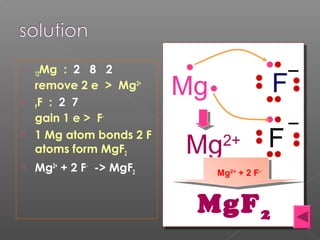
 12Mg : 2 8 2
remove 2 e > Mg2+
 9F : 2 7
gain 1 e > F-
 1 Mg atom bonds 2 F
atoms form MgF2
 Mg2+
+ 2 F-
-> MgF2
Mg F
Mg2+ F
_
MgF2
_
Mg2+
+ 2 F-
 Explain the chemical bonding in
formation of kalsium oxide (CaO)
 What is the compound formed beetwen
potassum and oxigen ? What about it’s
chemical bond formation ?
 IONIC BONDING is the chemical
bonding that resulted from the attractive
force of oppositely charge ion.
 The ions is formed by removing or
gaining electrons of an atom
 Aluminium metal and sulphure can formAluminium metal and sulphure can form
the aluminium sulphide.the aluminium sulphide.
Write the electron configuration Al and SWrite the electron configuration Al and S
How do the Al and S atom reach theHow do the Al and S atom reach the
“octet” configuration ?“octet” configuration ?
Explain the chemical bond formedExplain the chemical bond formed
beetwen Al and Sbeetwen Al and S
What is the chemical formula ofWhat is the chemical formula of
aluminium sulphide ?aluminium sulphide ?

Ikatan kimIa Arum

  • 2.
    The stable elementsThestable elements Ionic bondingIonic bonding Metalic bondsMetalic bonds Covalent bondingCovalent bonding
  • 3.
     Many natureelements are unstable and tend to form compounds, except the noble gas  The are no nature noble gas compounds found  The noble gases are stable elements
  • 4.
    Ele- ments Number of electronin atomic shells K L M N O P 2 He 2 10Ne 2 8 18Ar 2 8 8 36Kr 2 8 18 8 54Xe 2 8 18 18 8 86Rn 2 8 18 32 18 8
  • 5.
     The outer(valence) shell of noble gas atom has 8 electrons (except He : 2 electrons)  The 8 electrons form 4 electron pairs and make stability  The atom with 8 valence electrons like noble gas is stable (octet rule) > 2 electron for little atom (duplete rule)  So the unstable elements trends to reach noble gas configuration by : CHEMICAL BONDING
  • 6.
     GN Lewispurposes the dot symbol of valence electron  Examples : H C F Be N Ar B O 1 dot represent a valence electron to explain chemical bonding process
  • 7.
  • 8.
  • 9.
     2 hydrogenatoms can form H2 molecule by chemical bonding  2 hydrogen atoms can form H2 molecule by chemical bonding 1H + 1H H H H H H H H2 Bonding electron pair • Each hydrogen atom contributes an electron to form bonding electron pair that can be shared both atoms. This chemical bonding named COVALENT BONDING • Each hydrogen atom contributes an electron to form bonding electron pair that can be shared both atoms. This chemical bonding named COVALENT BONDING
  • 10.
    H H  Example  17Cl: 2 8 7  HCl  NH3 H H H2 Cl2 : Cl Cl Cl-Cl H Cl H N Non bonding electron pair (lone pair electrons)
  • 11.
     Examples  Oxygenmolecule O2  8O : 2 6  Write the diagram valence electrons to explain chemical bonding in CO2 molecule!  6C : 2 4O O O O Double bonds C OO O OC
  • 12.
     Examples  nitrogenmolecule N2  7N : 2 5  Examples  nitrogen molecule N2  7N : 2 5  What about covalent bonding in HCN molecule ?  What about covalent bonding in HCN molecule ? N N N N tripple bonds C N C N H H single bonds tripple bonds
  • 13.
    1. Write theLewis diagram of NH3, H2O, and CS2 molecules ! 2. Predict the chemical formula of compound formed beetwen 15X and 17Y, when they obey octet rule!. Use the Lewis diagram to explain! 3. How many single, double, or tripple covalent bond in C2H2 molecule ?
  • 14.
     The covalentbonding is chemical bonding resulted by sharing electron pairs that is formed by electrons contributing from atoms.  The covalent bonding should be single, double, or tripple bond, form molecular compound. Covalent bond
  • 15.
     Formed fromsodium and chlorine Na Cl Unstable elements 2 8 1 2 8 7 NaCl stable compound
  • 16.
     11Na :2 8 1 loses 1 e to reach 2 8 (Ne)  Na atom changes to be Na+ ion  17Cl : 2 8 7 attract/gain 1 e to reach 2 8 8 (Ar)  Cl atom change to be Cl- ion Both ions Na+ and Cl- attract with electrostatic force form NaCl compound which has strong chemical bonding.
  • 17.
     Chemical bondingis attractive force thatChemical bonding is attractive force that exists beetwen certain atoms in aexists beetwen certain atoms in a substance.substance.  The chemical bonding that resulted fromThe chemical bonding that resulted from the attractive form of oppositely chargethe attractive form of oppositely charge ion named IONIC BONDINGion named IONIC BONDING  Positive ion will be formed when an atomPositive ion will be formed when an atom remove it’s valence electronremove it’s valence electron  Negative ion will be formed when anNegative ion will be formed when an atom gain electronatom gain electron
  • 18.
  • 19.
     Explain thechemical bonding beetwen magnesium and fluorine !
  • 20.
     12Mg :2 8 2 remove 2 e > Mg2+  9F : 2 7 gain 1 e > F-  1 Mg atom bonds 2 F atoms form MgF2  Mg2+ + 2 F- -> MgF2 Mg F Mg2+ F _ MgF2 _ Mg2+ + 2 F-
  • 21.
     Explain thechemical bonding in formation of kalsium oxide (CaO)  What is the compound formed beetwen potassum and oxigen ? What about it’s chemical bond formation ?
  • 22.
     IONIC BONDINGis the chemical bonding that resulted from the attractive force of oppositely charge ion.  The ions is formed by removing or gaining electrons of an atom
  • 23.
     Aluminium metaland sulphure can formAluminium metal and sulphure can form the aluminium sulphide.the aluminium sulphide. Write the electron configuration Al and SWrite the electron configuration Al and S How do the Al and S atom reach theHow do the Al and S atom reach the “octet” configuration ?“octet” configuration ? Explain the chemical bond formedExplain the chemical bond formed beetwen Al and Sbeetwen Al and S What is the chemical formula ofWhat is the chemical formula of aluminium sulphide ?aluminium sulphide ?