BOND
FORMATION
RAYMART ENRIQUEZ ISIDRO, LPT
CHEMICAL BOND
SLIDE 2
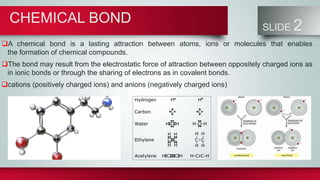
A chemical bond is a lasting attraction between atoms, ions or molecules that enables
the formation of chemical compounds.
The bond may result from the electrostatic force of attraction between oppositely charged ions as
in ionic bonds or through the sharing of electrons as in covalent bonds.
cations (positively charged ions) and anions (negatively charged ions)
WHY DO ATOMS CREATE CHEMICAL
BOND? SLIDE 3
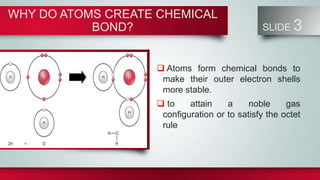
 Atoms form chemical bonds to
make their outer electron shells
more stable.
 to attain a noble gas
configuration or to satisfy the octet
rule
HOW DO ATOMS FORM BONDS? SLIDE 4
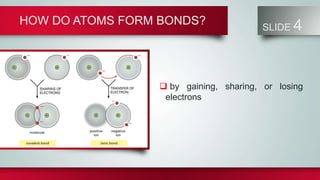
 by gaining, sharing, or losing
electrons
TYPES OF CHEMICAL BONDS
SLIDE 5
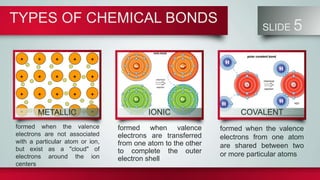
formed when the valence
electrons from one atom
are shared between two
or more particular atoms
METALLIC IONIC COVALENT
formed when valence
electrons are transferred
from one atom to the other
to complete the outer
electron shell
formed when the valence
electrons are not associated
with a particular atom or ion,
but exist as a "cloud" of
electrons around the ion
centers
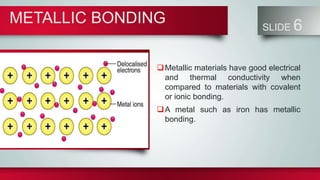
METALLIC BONDING SLIDE 6
Metallic materials have good electrical
and thermal conductivity when
compared to materials with covalent
or ionic bonding.
A metal such as iron has metallic
bonding.
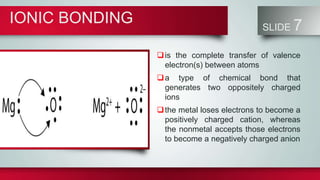
IONIC BONDING SLIDE 7
is the complete transfer of valence
electron(s) between atoms
a type of chemical bond that
generates two oppositely charged
ions
the metal loses electrons to become a
positively charged cation, whereas
the nonmetal accepts those electrons
to become a negatively charged anion
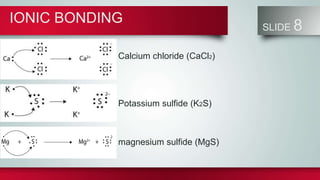
IONIC BONDING
SLIDE 8
Calcium chloride (CaCl2)
Potassium sulfide (K2S)
magnesium sulfide (MgS)
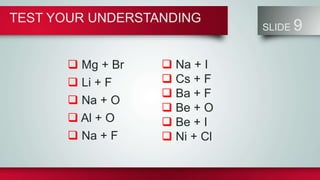
TEST YOUR UNDERSTANDING
SLIDE 9
 Mg + Br
 Li + F
 Na + O
 Al + O
 Na + F
 Na + I
 Cs + F
 Ba + F
 Be + O
 Be + I
 Ni + Cl
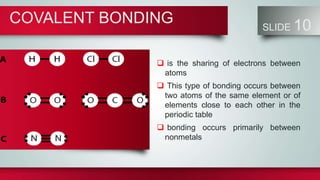
COVALENT BONDING SLIDE 10
 is the sharing of electrons between
atoms
 This type of bonding occurs between
two atoms of the same element or of
elements close to each other in the
periodic table
 bonding occurs primarily between
nonmetals
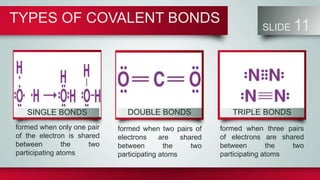
TYPES OF COVALENT BONDS
SLIDE 11
formed when three pairs
of electrons are shared
between the two
participating atoms
SINGLE BONDS DOUBLE BONDS TRIPLE BONDS
formed when two pairs of
electrons are shared
between the two
participating atoms
formed when only one pair
of the electron is shared
between the two
participating atoms
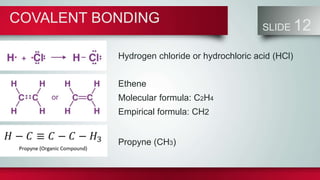
COVALENT BONDING
SLIDE 12
Hydrogen chloride or hydrochloric acid (HCl)
Ethene
Molecular formula: C2H4
Empirical formula: CH2
Propyne (CH3)
TEST YOUR UNDERSTANDING
SLIDE 13
 P + Cl
 H + O
 O + F
 Br + H
 C + O
 S + O
 N + H
 C + Cl
 P + H
 C + C
 O + O
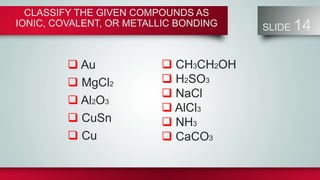
CLASSIFY THE GIVEN COMPOUNDS AS
IONIC, COVALENT, OR METALLIC BONDING SLIDE 14
 Au
 MgCl2
 Al2O3
 CuSn
 Cu
 CH3CH2OH
 H2SO3
 NaCl
 AlCl3
 NH3
 CaCO3
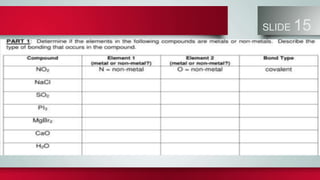
SLIDE 15
That’s all. Thank you very much! 
Any Questions?

Bond Formation (Ionic, Covalent, and Metallic Bonding)

  • 1.
  • 2.
    CHEMICAL BOND SLIDE 2 Achemical bond is a lasting attraction between atoms, ions or molecules that enables the formation of chemical compounds. The bond may result from the electrostatic force of attraction between oppositely charged ions as in ionic bonds or through the sharing of electrons as in covalent bonds. cations (positively charged ions) and anions (negatively charged ions)
  • 3.
    WHY DO ATOMSCREATE CHEMICAL BOND? SLIDE 3  Atoms form chemical bonds to make their outer electron shells more stable.  to attain a noble gas configuration or to satisfy the octet rule
  • 4.
    HOW DO ATOMSFORM BONDS? SLIDE 4  by gaining, sharing, or losing electrons
  • 5.
    TYPES OF CHEMICALBONDS SLIDE 5 formed when the valence electrons from one atom are shared between two or more particular atoms METALLIC IONIC COVALENT formed when valence electrons are transferred from one atom to the other to complete the outer electron shell formed when the valence electrons are not associated with a particular atom or ion, but exist as a "cloud" of electrons around the ion centers
  • 6.
    METALLIC BONDING SLIDE6 Metallic materials have good electrical and thermal conductivity when compared to materials with covalent or ionic bonding. A metal such as iron has metallic bonding.
  • 7.
    IONIC BONDING SLIDE7 is the complete transfer of valence electron(s) between atoms a type of chemical bond that generates two oppositely charged ions the metal loses electrons to become a positively charged cation, whereas the nonmetal accepts those electrons to become a negatively charged anion
  • 8.
    IONIC BONDING SLIDE 8 Calciumchloride (CaCl2) Potassium sulfide (K2S) magnesium sulfide (MgS)
  • 9.
    TEST YOUR UNDERSTANDING SLIDE9  Mg + Br  Li + F  Na + O  Al + O  Na + F  Na + I  Cs + F  Ba + F  Be + O  Be + I  Ni + Cl
  • 10.
    COVALENT BONDING SLIDE10  is the sharing of electrons between atoms  This type of bonding occurs between two atoms of the same element or of elements close to each other in the periodic table  bonding occurs primarily between nonmetals
  • 11.
    TYPES OF COVALENTBONDS SLIDE 11 formed when three pairs of electrons are shared between the two participating atoms SINGLE BONDS DOUBLE BONDS TRIPLE BONDS formed when two pairs of electrons are shared between the two participating atoms formed when only one pair of the electron is shared between the two participating atoms
  • 12.
    COVALENT BONDING SLIDE 12 Hydrogenchloride or hydrochloric acid (HCl) Ethene Molecular formula: C2H4 Empirical formula: CH2 Propyne (CH3)
  • 13.
    TEST YOUR UNDERSTANDING SLIDE13  P + Cl  H + O  O + F  Br + H  C + O  S + O  N + H  C + Cl  P + H  C + C  O + O
  • 14.
    CLASSIFY THE GIVENCOMPOUNDS AS IONIC, COVALENT, OR METALLIC BONDING SLIDE 14  Au  MgCl2  Al2O3  CuSn  Cu  CH3CH2OH  H2SO3  NaCl  AlCl3  NH3  CaCO3
  • 15.
  • 16.
    That’s all. Thankyou very much!  Any Questions?